153 Startup Launch Sites to Get Your First Users
153 startup launch sites organized by category. Directories, Reddit subreddits, communities, newsletters, and platforms to launch your startup in 2026.
Siddharth Gangal • 2026-04-03 • Content Strategy
In This Article
By Stacc Editorial · We publish 3,500+ SEO articles across 70+ industries. · Last updated: April 3, 2026
If you are building a startup and need real users finding it, you will love this list. We researched and compiled 153 startup launch sites that founders are using right now to get their first 1,000 users. Every platform, subreddit, community, and newsletter on this list is active, accepts submissions, and can send you traffic.
According to DemandSage’s startup research, 137,000 new startups launch every single day. Only 10% survive past year one. The difference between the ones that make it and the ones that do not? Early visibility. Getting your product in front of the right people before your runway runs out.
This list covers everything: launch platforms, startup directories, Reddit subreddits for startups, Slack communities, Discord groups, newsletters, developer marketplaces, media outlets, and more.
You can jump to any category using the table of contents. Here is what we cover:
- Launch Platforms — 15 sites
- Startup Directories — 16 sites
- AI and SaaS Directories — 14 sites
- Reddit Subreddits for Startups — 22 subreddits
- Slack Communities for Founders — 12 communities
- Discord and Telegram Groups — 10 groups
- Newsletters That Feature Startups — 15 newsletters
- Developer and API Marketplaces — 10 marketplaces
- Lifetime Deal Platforms — 8 platforms
- Media and PR Outlets — 12 outlets
- Social Platforms and Forums — 11 platforms
- Submission Tools and Aggregators — 8 tools
Launch Platforms
These are the flagship startup launch sites. They exist specifically to help founders announce new products. A strong launch on any of these can deliver thousands of visitors in a single day.
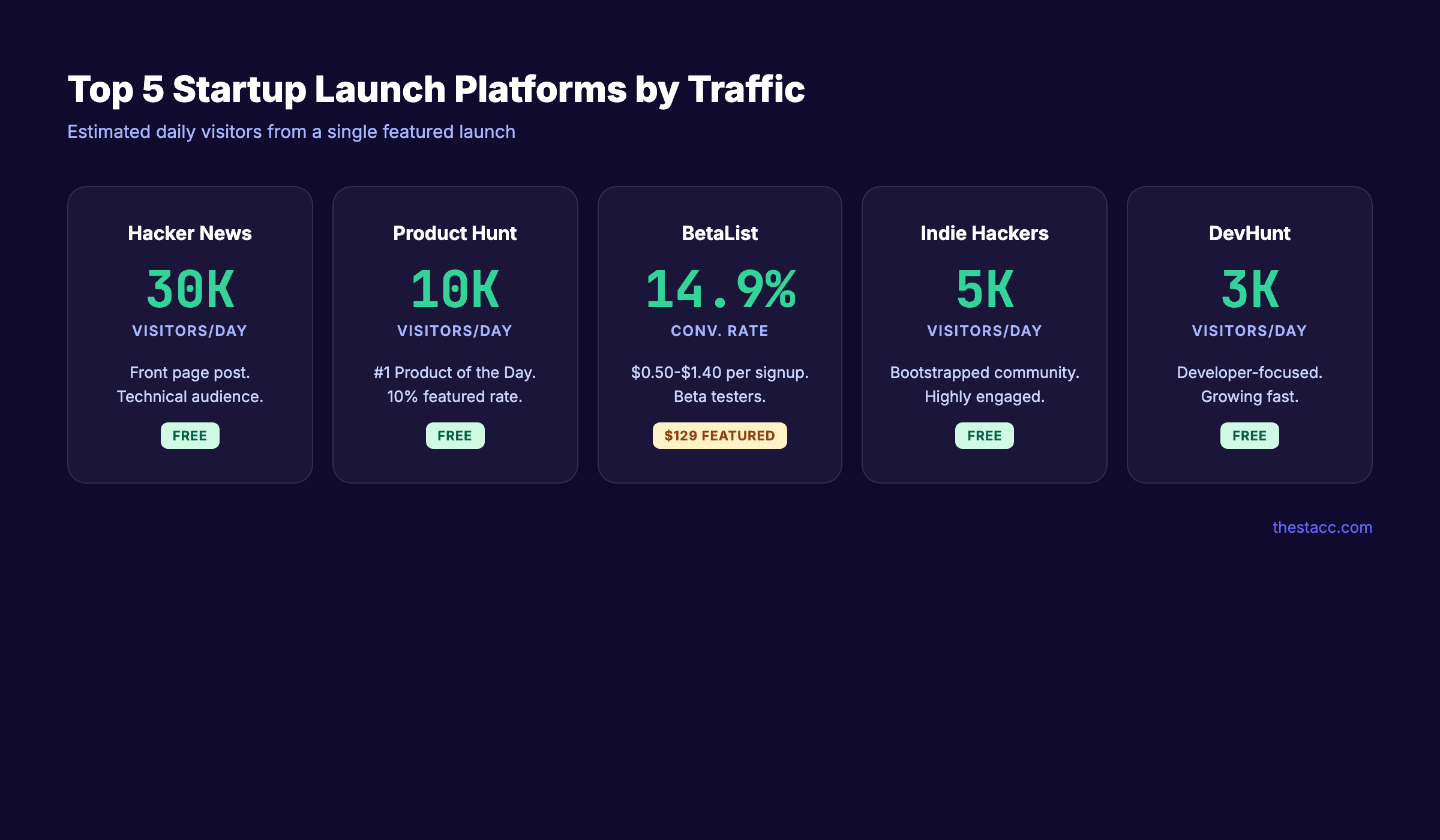
1. Product Hunt — The most recognized startup launch site on the internet. A #1 Product of the Day badge can send 5,000 to 10,000 visitors. Only about 10% of submissions get featured now, so preparation matters. Free to submit.
2. Hacker News (Show HN) — Post a “Show HN” thread to reach one of the most technical audiences online. A front-page post brings 20,000 to 30,000 visitors per day. Free. Best for developer tools and technical products.
3. BetaList — Focused on early-stage startups seeking beta testers. BetaList reports a 14.9% conversion rate at $0.50 to $1.40 per signup. Free listing available. Paid ($129) gets you featured faster.
4. Indie Hackers — A community of bootstrapped founders sharing revenue numbers and growth stories. Post your product launch in the products section. Free. The audience is small but highly engaged and likely to try new tools.
5. DevHunt — A developer-focused launch platform built for open-source and dev tools. Growing fast as a Product Hunt alternative for technical products. Free to submit.
6. MicroLaunch — Newer launch platform designed for indie makers and micro-SaaS founders. Smaller audience than Product Hunt, but less competition for visibility. Free tier available.
7. Launching Next — Submit your startup for review and get listed in their directory of new launches. Curated by editors. Free basic listing. Paid options for faster review.
8. Uneed — A curated directory of useful tools and startups. Clean interface. Good for SaaS and productivity tools. Free to submit. Growing steadily since 2024.
9. SideProjectors — A marketplace for side projects. List your project for sale, collaboration, or just visibility. Free. Great for early-stage SaaS products looking for co-founders or first users.
10. BetaPage — Similar to BetaList but with a different audience. Submit your beta product for free. Get feedback from early adopters. Paid options for priority placement.
11. StartupBase — A community-driven directory of startups organized by category. Free to list. Each listing includes a description, screenshots, and user votes.
12. 1000 Tools — A curated list of tools organized by use case. Free submission. Gets steady organic traffic from people searching for specific tool categories.
13. Launched — A simple launch platform where founders share what they built. Minimal friction. Free. Good for getting your first few dozen signups from other makers.
14. AlternativeTo — List your product as an alternative to established tools. When someone searches for “alternatives to [competitor],” your product shows up. Free. High intent traffic.
15. There Is A Bot For That — Specifically for AI bots, chatbots, and automation tools. Growing directory. Free to submit. Good for AI startup launches.
Stop writing. Start ranking. Stacc publishes 30 SEO articles per month for your startup. That is more content than most Series A companies produce in a year. Start for $1 →
Startup Directories
Directories provide a permanent listing that generates ongoing traffic and backlinks. Unlike launch platforms, these keep sending visitors months after you submit. For a deeper dive into 209 directories specifically, see our startup directories submission guide.
16. Crunchbase — The largest startup database. Over 700,000 companies listed. Investors, journalists, and competitors all check Crunchbase. Free basic profile. Essential for credibility.
17. Wellfound — The go-to platform for startup hiring and fundraising. A profile here signals legitimacy to investors and job seekers. Free.
18. F6S — Over 1 million startups registered. Offers free founder deals, accelerator applications, and a public profile. Free. Good for early-stage companies.
19. KillerStartups — A curated directory that has featured startups since 2005. Editorial review required. Free and paid options. Sends referral traffic for months after listing.
20. StartupRanking — Ranks startups globally based on web presence and social media activity. Free to register. Your rank updates automatically as your metrics improve.
21. EU-Startups — A directory and media outlet focused on European startups. Free listing. If you are based in Europe or targeting European markets, this is a must.
22. StartUs Insights — A data-driven startup discovery platform. Over 3 million startups indexed. Used by corporations scouting for partnerships and acquisitions. Free basic listing.
23. Startup Stash — A curated directory of resources and tools for startups. Clean design. Free to submit your tool. Organized by category for easy discovery.
24. Land-book — A gallery of landing page designs. If your startup has a beautiful website, submit it here. Drives design-conscious users to your site. Free.
25. StartupLift — Submit your startup for user feedback and visibility. Free. The community votes and reviews submissions. Good for validation alongside launch.
26. GetApp — A Gartner company. Business software directory with detailed comparisons and user reviews. Free to list. High domain authority backlink.
27. SaaSHub — A software alternatives directory. List your product as an alternative to competitors. Free. Gets strong organic traffic from comparison searches.
28. G2 — One of the most trusted B2B software review sites. A listing here is critical for any SaaS startup. Free profile. User reviews build credibility with buyers.
29. Capterra — Another Gartner property. Millions of business buyers use it monthly. Free basic listing. Paid for priority placement. Essential for B2B software.
30. TechPluto — A startup directory and news site covering technology companies. Free to submit. Good for reaching a tech-savvy Indian and global audience.
31. StartupBuffer — A curated startup discovery platform. Submit your startup and get votes from the community. Free. Active since 2015 with steady traffic.
For a comprehensive list of 217 SaaS-specific directories, check our SaaS directories guide.
AI and SaaS Directories
If you are building an AI product or SaaS tool, these specialized directories attract buyers actively searching for your category. AI directories in particular have exploded since 2023. There’s An AI For That alone gets over 500,000 monthly visitors.
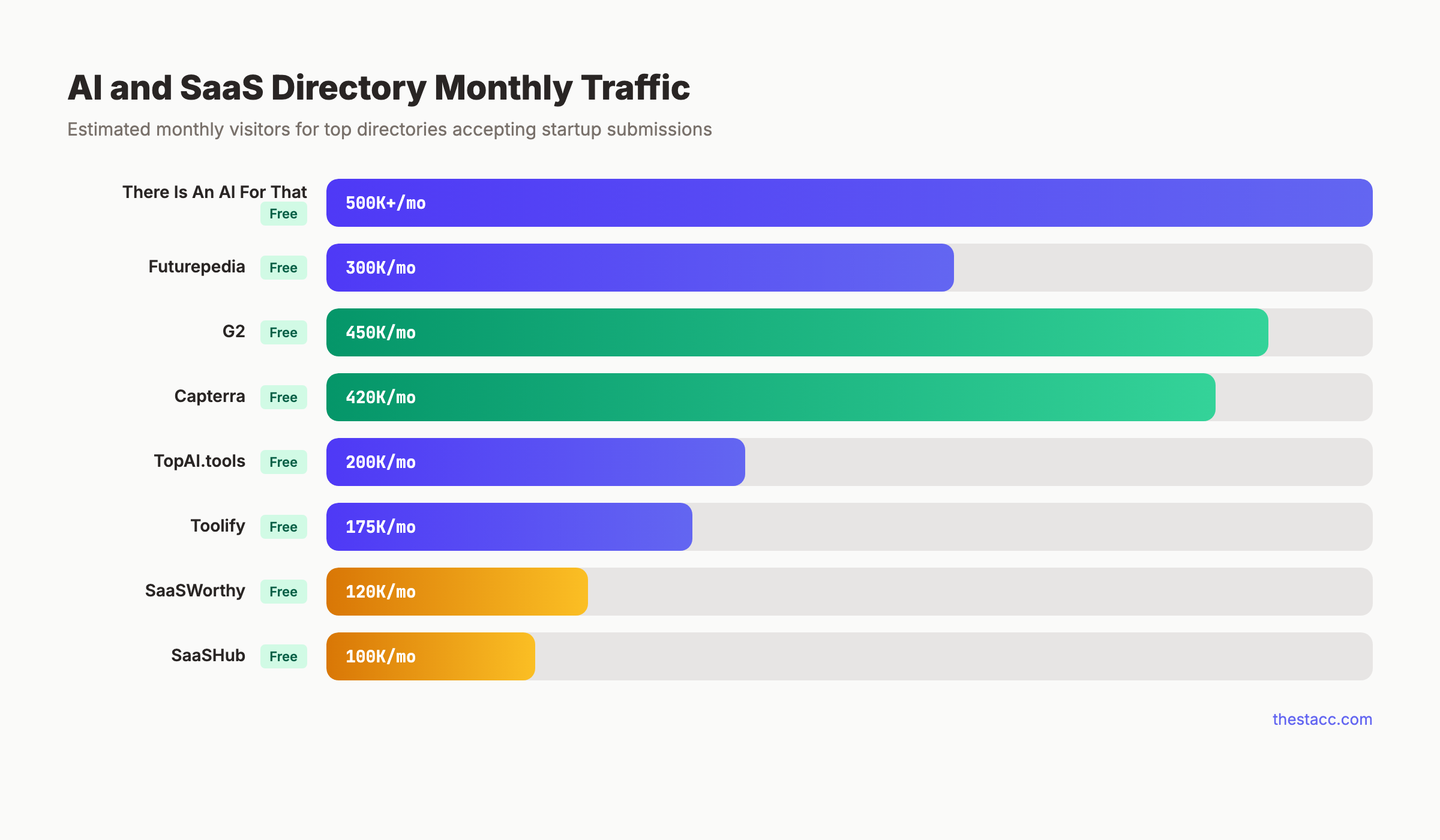
32. There Is An AI For That — The largest AI tool directory. Over 500,000 monthly visitors searching for AI tools by use case. Free to submit. Paid for featured placement.
33. Futurepedia — A popular AI tool directory organized by category and use case. Free submission. Strong organic traffic from people searching for AI solutions.
34. TopAI.tools — A growing AI directory with category filters and user ratings. Free to list. Good traffic from long-tail AI tool searches.
35. Toolify — An AI tools directory that ranks products by popularity and user ratings. Free submission. Updated frequently with new categories.
36. AI Scout — Curated AI tool recommendations organized by industry and use case. Free to submit. Smaller but highly targeted audience.
37. Easy With AI — A clean AI directory focused on practical use cases. Free listing. Good for tools that solve specific business problems.
38. SuperTools — Curated directory of AI and productivity tools. Free submission. Organized by workflow category. Growing steadily.
39. SaaSWorthy — A SaaS discovery platform with detailed product profiles and comparisons. Free to list. Includes user reviews and feature breakdowns.
40. AppSumo Marketplace — Beyond lifetime deals, AppSumo has a permanent marketplace. Your product stays listed after the deal ends. Free to apply as a partner.
41. FindMyAITool — An AI tool finder that helps users discover products by describing their problem. Free to submit. Uses AI to match searchers with tools.
42. Ben’s Bites Directory — Spun out from the popular AI newsletter. Lists AI tools with editorial descriptions. Free submission. Gets traffic from newsletter readers.
43. SaaS AI Tools — A specialized directory for SaaS products that use AI. Free listing. Good for products at the intersection of SaaS and AI.
44. ToolPilot — An AI tool testing and review platform. Products get hands-on reviews. Free to submit for consideration. Reviews build credibility.
45. AItoolslist — A comprehensive AI tools list updated weekly. Free submission. Organized by category with user ratings. Solid organic search traffic.
Your SEO team. $99 per month. 30 optimized articles, published automatically. While you focus on building your product, Stacc handles the content that ranks. Start for $1 →
Reddit Subreddits for Startups
Reddit is one of the most underrated startup launch sites. The right subreddit can send hundreds of targeted users to your product in a single day. The key is providing value first. Do not just drop a link. Share your story, your numbers, or your technical approach.
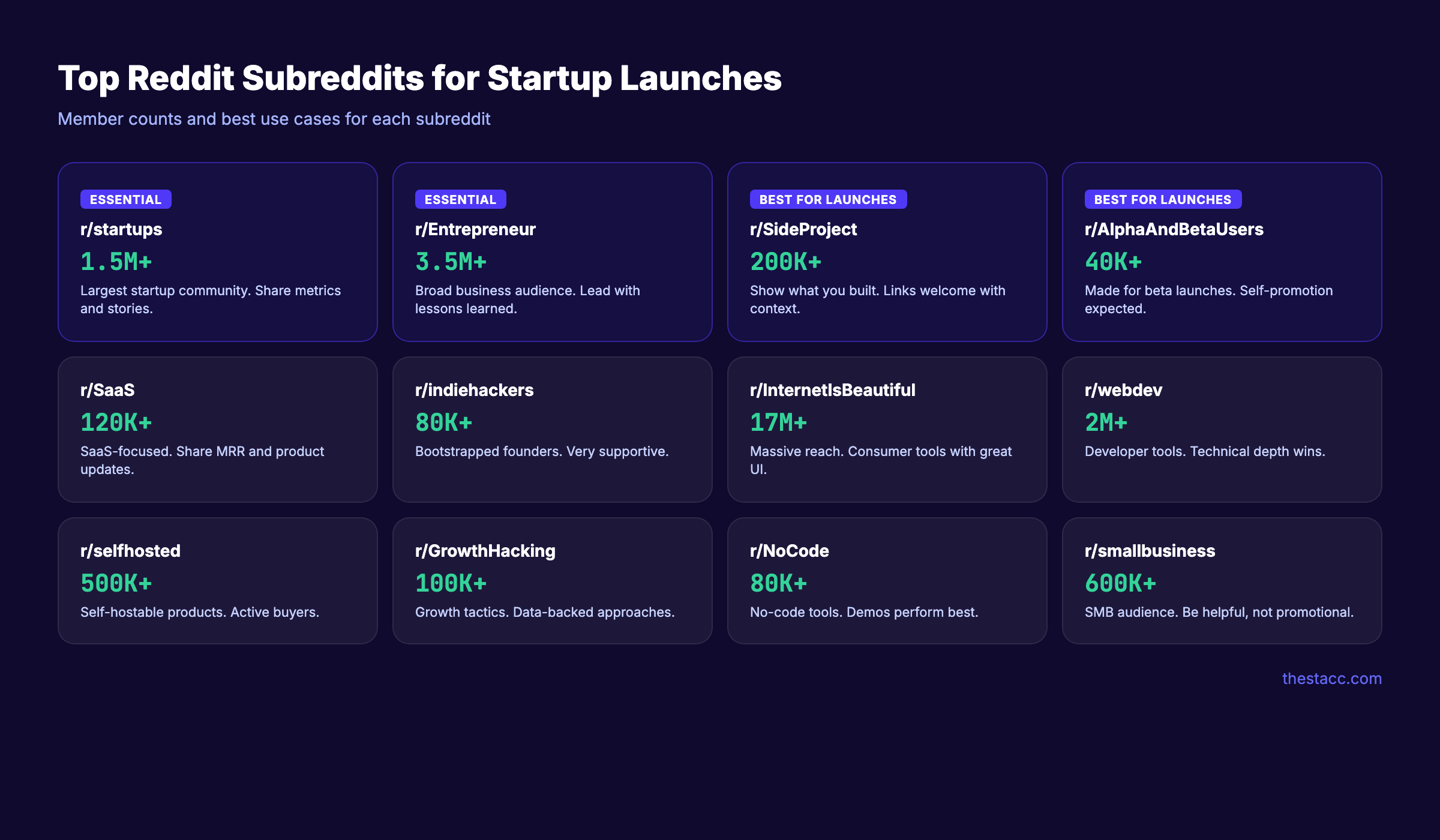
46. r/startups (1.5M+ members) — The largest startup subreddit. Share your launch story with real metrics. Self-promotion rules are strict. Lead with your story, not your URL.
47. r/Entrepreneur (3.5M+ members) — Massive community of business builders. Good for sharing lessons learned, revenue milestones, and growth tactics. Avoid blatant promotion.
48. r/SideProject (200K+ members) — One of the best subreddits for launching indie products. The community expects you to share what you built. Links welcome if you add context.
49. r/SaaS (120K+ members) — Focused on SaaS businesses. Share your MRR journey, product updates, and lessons. Technical and business-minded audience.
50. r/indiehackers (80K+ members) — The Reddit extension of the Indie Hackers community. Bootstrapped founders sharing revenue, tactics, and launches. Very supportive.
51. r/smallbusiness (600K+ members) — If your startup serves small businesses, this is where your buyers hang out. Answer questions. Be helpful. Mention your product only when relevant.
52. r/AlphaAndBetaUsers (40K+ members) — Specifically designed for sharing beta products and getting early users. This is one of the few subreddits where self-promotion is the point.
53. r/RoastMyStartup (15K+ members) — Post your startup for brutally honest feedback. The roast format gets engagement. You get visibility plus genuine product feedback.
54. r/growmybusiness (30K+ members) — Focused on growth tactics and business development. Share how you grew your startup. Practical advice performs best here.
55. r/EntrepreneurRideAlong (150K+ members) — Follows entrepreneurs building businesses in real time. Share your journey from idea to launch. The community loves transparency.
56. r/IMadeThis (60K+ members) — A showcase subreddit. Post what you built with screenshots and a description. Links welcome. Low friction way to get eyeballs on your product.
57. r/InternetIsBeautiful (17M+ members) — Massive audience. If your product has a consumer-facing web tool or a beautiful interface, post it here. One viral post can send 50,000+ visitors.
58. r/webdev (2M+ members) — For developer tools and web-based products. Share the technical story behind your product. The audience respects engineering depth.
59. r/selfhosted (500K+ members) — If your product can be self-hosted, this audience is gold. They actively seek new tools to run on their own servers.
60. r/marketing (1M+ members) — For marketing tools and services. Share data, case studies, or unique marketing approaches. The audience is marketing professionals looking for an edge.
61. r/SEO (350K+ members) — For SEO tools and services specifically. Share data or unique SEO insights. If your startup touches search engine optimization, start here.
62. r/ProductManagement (200K+ members) — For product tools and frameworks. Share your product development process. PMs love hearing about unique approaches to building.
63. r/venturecapital (100K+ members) — For startups seeking funding. Share your fundraising journey. VCs and angels actively browse this subreddit.
64. r/advancedentrepreneur (50K+ members) — A more experienced entrepreneurship community. Less noise than r/Entrepreneur. Higher quality discussions and feedback.
65. r/GrowthHacking (100K+ members) — For growth-focused founders. Share unconventional tactics that worked. The audience values creative, data-backed approaches.
66. r/NoCode (80K+ members) — For no-code and low-code products. If your startup enables non-technical builders, this is your audience. Demos and tutorials perform best.
67. r/digitalnomad (2M+ members) — For products targeting remote workers and location-independent professionals. Tools for productivity, finance, and remote work do well here.
3,500+ blogs published. 92% average SEO score. See what Stacc can do for your startup. Most founders spend 40 hours per month on content. Stacc does it in zero. Start for $1 →
Slack Communities for Founders
Slack communities offer something Reddit and directories do not: ongoing relationships. You do not just post once and leave. You become part of the conversation. These communities often have dedicated channels for product launches and feedback.
68. OnDeck — A highly curated community of ambitious founders, operators, and investors. Application-based. The network effects here are powerful for early customers and advisors.
69. Startup Study Group — A community of founders studying and building together. Active channels for launches, feedback, and growth. Free to join.
70. SaaS Community — A Slack group focused on SaaS builders. Channels for product launches, marketing, and technical discussions. Free.
71. Product-Led Growth Community — For founders building PLG products. Share your onboarding flow, pricing model, or conversion data. Active and specific.
72. GrowthHackers — Founded by Sean Ellis. A community of growth professionals. Share experiments and results. Good for getting tactical feedback on your launch strategy.
73. Women in Tech — A supportive community of women in technology. Channels for product launches, job opportunities, and mentorship. Application-based.
74. Elpha — Built for women in tech. Active community with product launch channels, career advice, and industry discussions. Free to join.
75. RevGenius — A community of revenue professionals (sales, marketing, CS). If your startup sells to revenue teams, this is where your buyers network. Free.
76. Demand Curve — Founded by the growth marketing team behind Bell Curve. Focused on marketing tactics and startup growth. Active Slack with launch feedback channels.
77. Rands Leadership Slack — A community of engineering leaders. If your product targets engineering managers or development teams, this is a high-value network. Free.
78. Lenny’s Community — Connected to Lenny Rachitsky’s popular product newsletter. Product managers, founders, and operators. Application-based. High quality.
79. Startup Grind — A Google-backed startup community with chapters in 125+ countries. Their Slack connects founders globally. Free to join the digital community.
Discord and Telegram Groups
Discord and Telegram host some of the most active real-time startup communities. The conversations move fast. These work best when you participate consistently, not just when you need something.
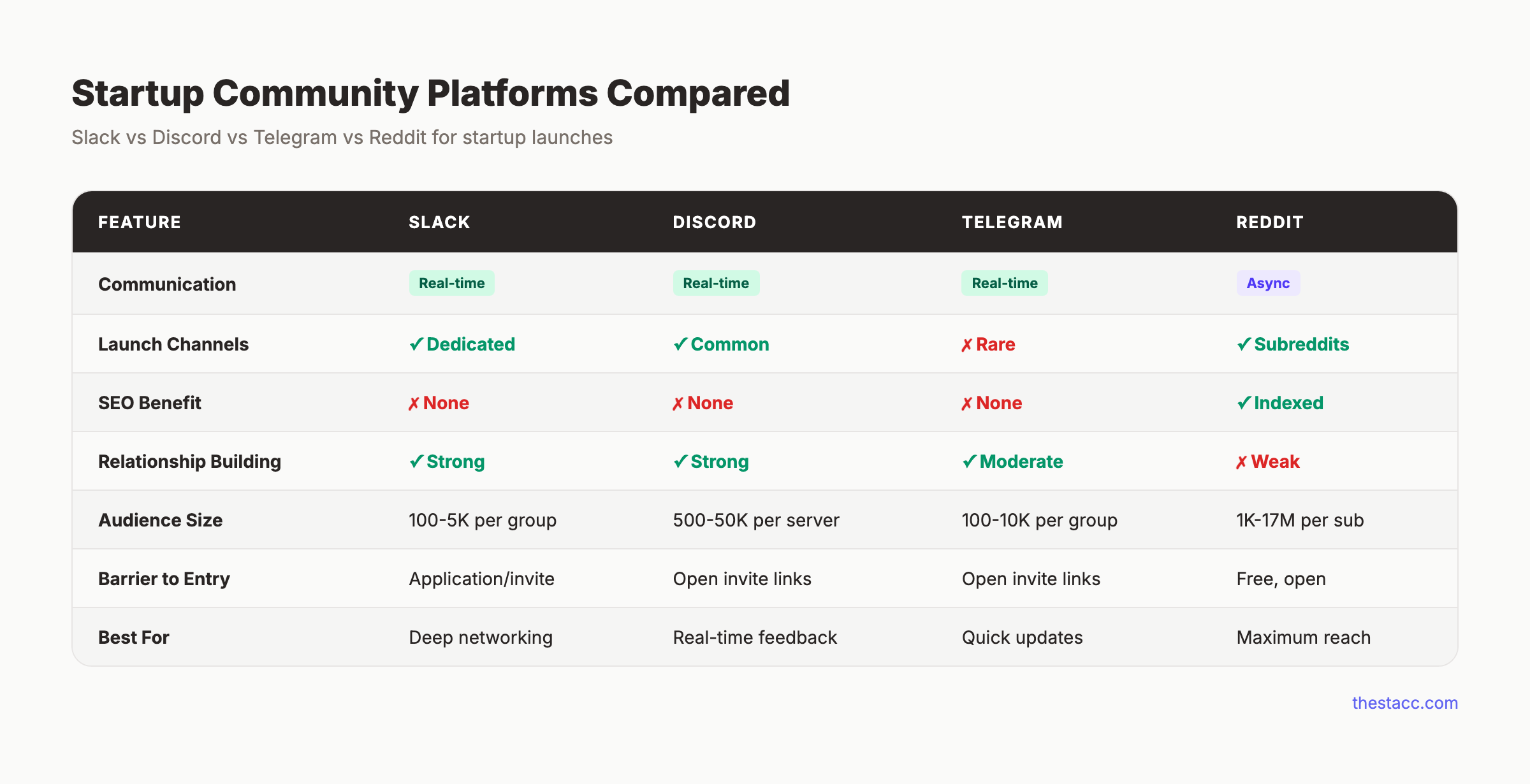
80. YC Startup School Discord — Connected to Y Combinator’s free Startup School program. Founders building in public. Active channels for product feedback and launches.
81. Indie Worldwide Discord — A community of indie makers and bootstrapped founders. Regular show-and-tell events. Free. One of the most supportive Discord communities for launches.
82. SaaS Community Discord — Focused on SaaS metrics, growth, and product development. Active channels for sharing MRR milestones and getting feedback.
83. Failory Discord — Connected to the Failory newsletter and website. Founders sharing both successes and failures. Honest feedback environment.
84. GenZ VCs Discord — A community of young investors and founders. If your startup targets Gen Z or you are a young founder, this is your network.
85. Buildspace Discord — One of the largest builder communities. Started as a web3 community, now broader. Regular build challenges and demo days.
86. Product Hunt Discord — The official Discord for Product Hunt. Connect with other launchers, get tips for your launch day, and find upvote buddies.
87. Ramen Club (Telegram) — A Telegram group for bootstrapped founders. Named after the “ramen profitable” milestone. Active daily discussions on growth and product.
88. Startup Chat (Telegram) — A broad startup community on Telegram. Discussions cover fundraising, product development, marketing, and hiring. Free.
89. Founders Cafe Discord — A community for early-stage founders. Regular pitch practice sessions, product demos, and feedback rounds. Application-based.
Rank everywhere. Do nothing. Blog SEO, Local SEO, and Social on autopilot. That is 3 channels generating inbound leads while you build your product. Start for $1 →
Newsletters That Feature Startups
Getting featured in the right newsletter puts your startup in front of thousands of targeted readers. Unlike social media posts that disappear in hours, newsletter features drive traffic for days as subscribers open at their own pace.
90. Product Hunt Daily — Sent to over 1 million subscribers. Features the top-launched products daily. Getting Product of the Day guarantees a spot. Free (earned through launch).
91. BetaList Weekly — Features new beta products to an audience of early adopters and tech enthusiasts. Listing on BetaList automatically qualifies you for the newsletter.
92. Indie Hackers Newsletter — Curated stories of bootstrapped founders. Features new products, revenue milestones, and growth stories. Pitch your story to get featured.
93. Starter Story — Features the stories behind profitable businesses. If you have revenue, pitch your founder story. Great for content marketing and backlinks.
94. Failory — Features startup post-mortems and success stories equally. Pitching your honest journey (including mistakes) resonates with this audience.
95. The Hustle — Over 2 million subscribers. Covers business and tech news. A mention here drives massive traffic. Pitch a unique angle or data point about your market.
96. TLDR — A daily tech newsletter with 1.2 million+ subscribers. Features developer tools, AI products, and tech startups. Sponsored placements available.
97. Hacker Newsletter — A weekly curated newsletter of the best Hacker News posts. If your Show HN post does well, it often gets featured here automatically.
98. Morning Brew — Over 4 million subscribers. Business-focused audience. A mention here is rare but high-impact. Best for products with broad business appeal.
99. Ben’s Bites — The leading AI newsletter. Over 100,000 subscribers. If you are building an AI product, a feature here reaches your exact target audience.
100. SaaS Weekly — A curated weekly roundup of SaaS news, tools, and resources. Accepts submissions. Good for reaching SaaS operators and founders.
101. First 1000 — Tells the story of how startups got their first 1,000 customers. Pitch your acquisition story. The audience is founders at the same stage.
102. Startup Digest — A Techstars property. Curated by local curators in cities worldwide. Submit your startup for consideration. Regional targeting available.
103. Dense Discovery — A weekly newsletter covering tools, design, and productivity. Curated and thoughtful. Free to pitch. Good for design-forward products.
104. Console — A weekly newsletter for developers featuring the best tools and open-source projects. If you are building for developers, pitch here. Free.
Skip the agency. Keep the results. Stacc starts at $99 per month with a $1 launch trial. That is 30 articles per month. No writers to manage. No deadlines to chase. Start for $1 →
Developer and API Marketplaces
If your startup is a developer tool, plugin, or API, these marketplaces put you in front of millions of developers and businesses already looking for solutions in your category.
105. GitHub Marketplace — List your GitHub App or Action. Millions of developers browse the marketplace. Free to list. Paid apps keep 100% of revenue in the first $1M.
106. VS Code Marketplace — Over 30 million VS Code users. If your product has a VS Code extension, this is a massive distribution channel. Free to publish.
107. Atlassian Marketplace — Reach teams using Jira, Confluence, and Trello. Over 35,000 apps listed. Strong distribution to enterprise buyers. Free to list.
108. Zapier App Directory — Over 6,000 apps integrated. Listing your product here connects you to 2.2 million+ Zapier users. Free to build an integration.
109. Shopify App Store — Over 1.8 million active Shopify stores. If your product serves ecommerce businesses, this is one of the highest-value marketplaces. Free to list.
110. Chrome Web Store — Hundreds of millions of Chrome users. A browser extension is one of the fastest ways to get distribution for a developer tool. Free to publish.
111. Slack App Directory — Over 18 million daily active Slack users. If your product integrates with team workflows, list it here. Free to submit.
112. RapidAPI Hub — The largest API marketplace. List your API and reach over 4 million developers. Free to list. Revenue share model for paid APIs.
113. Heroku Elements — Marketplace for Heroku add-ons, buttons, and buildpacks. Smaller audience but highly technical and willing to pay for good tools.
114. Pipedream Marketplace — A growing integration platform. List your app as a Pipedream integration. Free. Reaches automation-focused developers.
Lifetime Deal Platforms
Lifetime deal (LTD) platforms generate a burst of revenue and users in exchange for a one-time price. The tradeoff is lower per-user revenue. The benefit is hundreds of paying users fast, plus reviews and feedback.
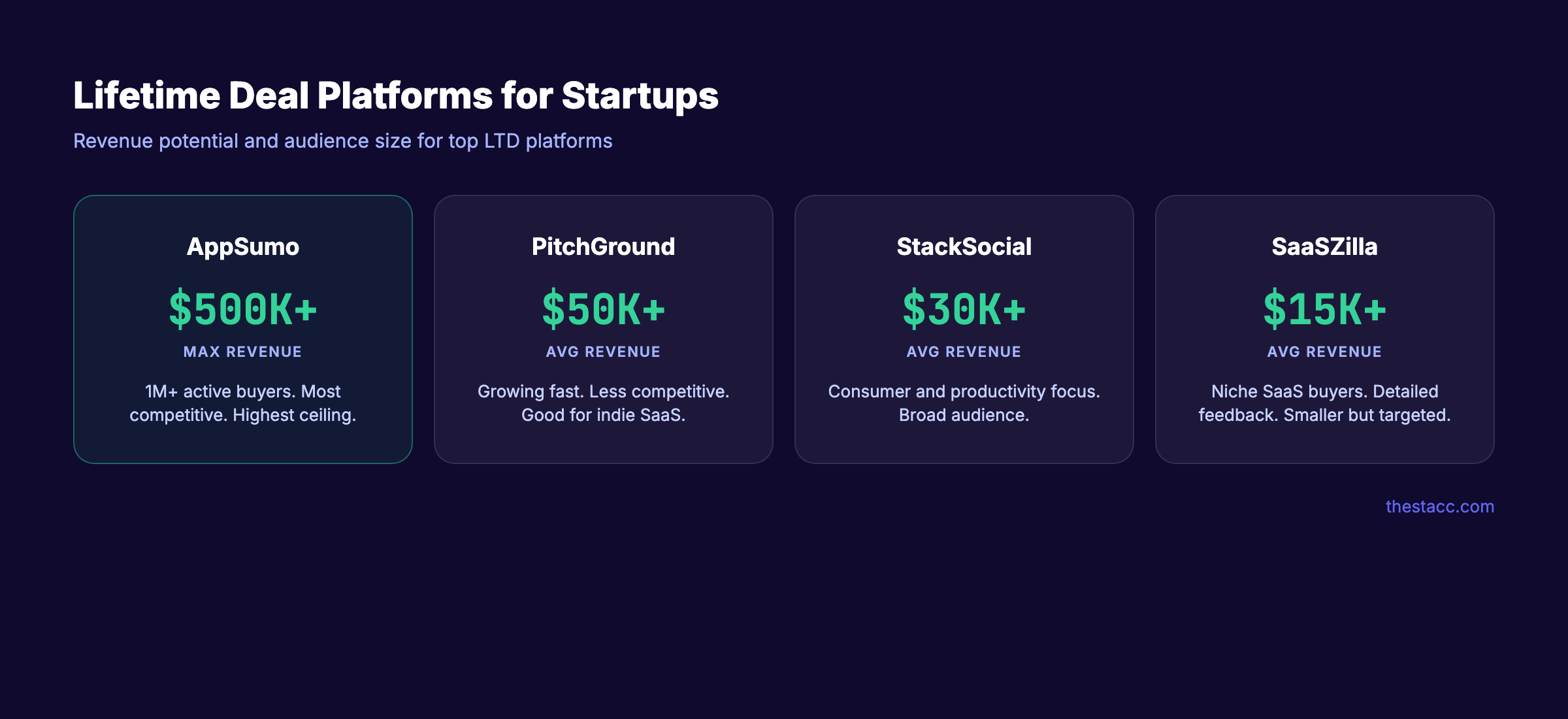
115. AppSumo — The largest lifetime deal platform. Over 1 million active buyers. A successful AppSumo launch can generate $50,000 to $500,000+ in revenue. Competitive to get accepted.
116. StackSocial — Sells tech products and software deals to a broad consumer audience. Good for productivity tools and creative software. Revenue share model.
117. PitchGround — A growing LTD platform focused on SaaS products. Smaller than AppSumo but less competitive. Good for indie SaaS and micro-SaaS products.
118. SaaSZilla — A marketplace for SaaS lifetime deals. Smaller audience but very targeted. The buyers here are SaaS-savvy and provide detailed feedback.
119. DealMirror — An Indian LTD platform with a global audience. Good for reaching price-conscious buyers in emerging markets. Accepts most SaaS categories.
120. Dealify — A curated platform for software deals. Smaller but growing. Less noise than AppSumo. Free to apply as a vendor.
121. RocketHub — A newer LTD platform targeting SaaS and digital tools. Growing community. Less saturated than established platforms.
122. SaaS Mantra — An LTD platform focused on tools for digital marketers and agencies. Good fit if your product serves the marketing stack.
Media and PR Outlets
Media coverage builds credibility that directories and communities cannot match. A single TechCrunch mention changes how investors, customers, and partners perceive your startup. For a deeper guide on earning media coverage, see our digital PR guide.
123. TechCrunch — The gold standard for startup coverage. A TechCrunch feature signals legitimacy to the entire tech ecosystem. Pitch via their tips email or through a warm intro.
124. VentureBeat — Covers AI, enterprise tech, and emerging platforms. Strong with B2B startups. Accepts contributed articles from founders with unique data or perspectives.
125. Fast Company — Covers innovation across industries. Good for startups with a design angle or social impact mission. Accepts pitches and contributed pieces.
126. Wired — Deep-dive tech journalism. A Wired feature carries enormous credibility. Best for startups with a genuinely novel technology or approach.
127. The Verge — Consumer tech coverage with a massive audience. If your product is consumer-facing, a mention here drives significant traffic and downloads.
128. Mashable — Covers tech, culture, and digital trends. Good for consumer products, apps, and lifestyle-adjacent startups. Accepts pitches via their newsroom.
129. Inc.com — Covers entrepreneurship and business growth. Good for founder stories, fundraising announcements, and growth milestones. Accepts contributed articles.
130. Entrepreneur.com — Similar to Inc but with a broader business audience. Good for how-to content and founder stories. Accepts contributor applications.
Your SEO team. $99 per month. Focus on your product. Let Stacc handle the SEO for your startup. 30 articles published monthly. Zero effort from you. Start for $1 →
131. HARO (Help a Reporter Out) — Journalists post queries. You respond as a source. Free. A single HARO placement in Forbes or Business Insider builds massive authority. Check our link building guide for HARO strategies.
132. SourceBottle — Similar to HARO but with more international media outlets. Free. Smaller competition per query means higher response rates.
133. Business Insider — Covers business, finance, and tech. Strong credibility signal. Pitching a data-driven story about your market performs best.
134. Forbes Next — Forbes’ initiative covering the next generation of entrepreneurs. If you are a young founder or have a unique founder story, pitch here directly.
Social Platforms and Forums
Social platforms are not directories. You do not submit and wait. You participate, build an audience, and organically drive users to your product. The social media strategy matters more than the platform.
135. X (Twitter) — Build in public. Share your daily progress, metrics, and lessons. The startup community on X is massive. A viral thread can drive thousands of signups.
136. LinkedIn — Post about your startup journey. LinkedIn’s algorithm rewards personal stories and professional insights. Best for B2B startups targeting business buyers.
137. Quora — Answer questions related to your product’s category. Include your product as a recommendation when genuinely relevant. Answers rank in Google for years.
138. Dev.to — A community of 1 million+ developers. Write technical articles about how you built your product. Include a natural mention of your tool. Free.
139. Hashnode — A developer blogging platform. Write about your tech stack, architecture decisions, or engineering challenges. Good for developer tool startups.
140. Medium — Publish thought leadership and product stories. Medium articles rank well in Google. Use publications like “The Startup” or “Better Programming” for reach.
141. Stack Overflow — Answer technical questions related to your product category. Include your tool as a solution when appropriate. High-intent traffic from developers.
142. Facebook Groups — Hundreds of niche startup groups exist. Find the ones where your target users spend time. Be helpful first. Promote second.
143. Hacker News Threads — Beyond Show HN posts, participate in relevant discussions. Thoughtful comments with your product context build reputation over time.
144. YouTube — Create a demo video or product walkthrough. YouTube videos rank in Google searches. A well-optimized video can drive signups for years.
145. TikTok — Yes, B2B startups are finding users on TikTok. Short product demos and founder stories resonate. The algorithm does not care about follower count.
Submission Tools and Aggregators
These tools automate the submission process or aggregate multiple directories into one workflow. They save hours of manual submissions across the sites listed above.
146. SubmitJuice — Submits your startup to 100+ directories in one click. Paid service. Saves hours of manual submissions. Good for founders short on time.
147. Promote Hour — An aggregator of startup directories and communities. Organizes submission sites by category and tracks your progress across platforms.
148. LaunchLister — A tool that tracks upcoming product launches across multiple platforms. Submit your launch date and get visibility across their network.
149. MakerLog — A productivity tool for makers. Log your daily tasks publicly. The community follows along and checks out what you are building. Free.
150. Ship by Product Hunt — Product Hunt’s pre-launch tool. Build a subscriber list before your official launch. Free. Subscribers get notified on launch day.
151. ListingBot — Automates directory submissions for startups. Submits to multiple directories from a single form. Paid service. Saves significant manual effort.
152. FoundEvo — Maintains a curated list of free startup launch platforms and directories. Their list is one of the most comprehensive free resources available.
153. Awesome Launch Platforms (GitHub) — An open-source list of launch platforms maintained on GitHub. Community-contributed and regularly updated. Free.
How to Use This List
Do not submit to all 153 sites in one day. That is a waste of time and energy. Here is the approach that works:
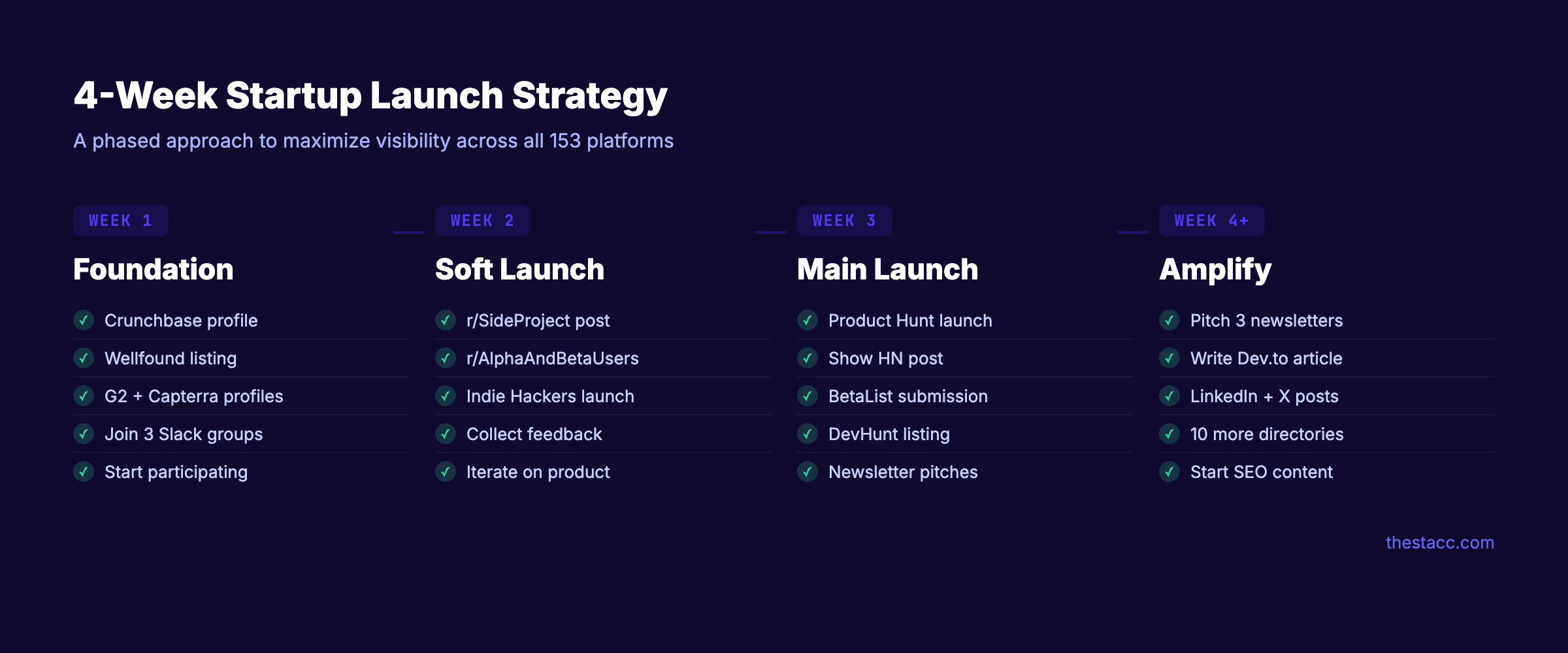
Week 1: Foundation. Set up profiles on Crunchbase, Wellfound, G2, and Capterra. These are your credibility anchors. Join 2 to 3 Slack communities and start participating.
Week 2: Soft Launch. Post on r/SideProject, r/AlphaAndBetaUsers, and Indie Hackers. Share your story, not just your link. Collect feedback and iterate.
Week 3: Main Launch. Launch on Product Hunt (Tuesday or Wednesday, 12:01 AM PST). Simultaneously post a Show HN on Hacker News. Submit to BetaList and DevHunt.
Week 4: Amplify. Pitch 3 newsletters. Write a Dev.to article about how you built it. Post your launch story on LinkedIn and X. Submit to 10 relevant directories.
Ongoing: Stack the Channels. Every week, submit to 5 more directories. Post in 2 Reddit subreddits. Share one update in your Slack communities. Build content that ranks with SEO for startups strategies.
The founders who get results do not rely on a single launch day. They build a machine that compounds. Every directory listing, every Reddit post, every newsletter mention stacks on the last.
That is the same principle behind SEO content compounding. One article does not move the needle. Thirty per month does.
FAQ
What are the best startup launch sites for free?
Product Hunt, Hacker News (Show HN), Reddit subreddits like r/SideProject and r/AlphaAndBetaUsers, and Indie Hackers are all free. Most startup directories also offer free basic listings. You do not need to pay anything to get your first 1,000 users.
Which Reddit subreddits are best for launching a startup?
r/SideProject, r/AlphaAndBetaUsers, and r/startups are the top three. r/SideProject welcomes self-promotion if you share context. r/AlphaAndBetaUsers exists specifically for beta launches. r/startups has the largest audience but stricter rules.
How many directories should I submit my startup to?
Submit to 30 to 50 directories in your first month. Focus on the most relevant ones first. Each listing takes 5 to 15 minutes. Batch them in groups of 10. For a detailed list of 209 submission directories, see our startup directories guide.
When is the best day to launch on Product Hunt?
Tuesday, Wednesday, and Thursday between 12:01 AM and 3:00 AM PST get the most traffic. Avoid weekends and holidays. The Product Hunt audience is most active mid-week.
How do I get featured in startup newsletters?
Pitch a story, not a product. Newsletters want unique angles: your revenue numbers, a surprising growth tactic, or a contrarian take on your market. Keep the pitch under 200 words.
Does directory submission help with SEO?
Yes. Most directories provide a dofollow or nofollow backlink to your site. While individual directory links carry modest weight, 50 to 100 directory listings collectively build your domain authority and drive referral traffic. See our full link building strategies guide for more.
Did we miss a startup launch site? If your favorite platform, subreddit, or community is not on this list, let us know and we will add it. We update this list regularly. Bookmark it and check back.
Your startup deserves traffic that compounds. Stacc publishes 30 SEO articles per month. Every article builds on the last. Start with a $1 trial and see the difference in 90 days. Start for $1 →
Written and published by Stacc. We publish 3,500+ articles per month across 70+ industries. All data verified against public sources as of March 2026.