
Digital PR for SEO (2026): Strategies, Tactics & Examples
Practical digital pr seo strategies for 2026: step-by-step tactics, real examples, and tools to improve rankings and drive organic traffic.
Digital PR for SEO: The Complete Guide (2026)
94% of online content earns zero external backlinks. That single stat explains why most businesses struggle with organic rankings despite publishing regularly.
The cost of invisible content is real. Without backlinks from trusted publications, your pages sit on page 3. Your competitors with press coverage outrank you. Your domain authority stagnates.
Digital PR for SEO solves this problem. It earns high-authority backlinks by creating content that journalists want to cover and link to.
We publish 3,500+ blog posts across 70+ industries. We have seen firsthand how digital PR transforms domain authority and keyword rankings when paired with consistent content.
Here is what you will learn in this 8-chapter guide:
- What digital PR is and how it differs from traditional PR
- Why digital PR directly impacts SEO rankings and E-E-A-T
- The 6 campaign types that earn the most links
- How to create content journalists actually want to cover
- Pitch strategies and email templates that get responses
- How to measure digital PR ROI with specific metrics
- The best tools for running campaigns at any budget
- Common mistakes that kill campaigns before they start
Table of Contents
- Chapter 1: What Is Digital PR?
- Chapter 2: Why Digital PR Matters for SEO
- Chapter 3: 6 Types of Digital PR Campaigns
- Chapter 4: How to Create Newsworthy Content
- Chapter 5: Building Media Lists and Relationships
- Chapter 6: Pitching Strategies That Get Coverage
- Chapter 7: Measuring Digital PR Success
- Chapter 8: Digital PR Tools and Software
- Chapter 9: Common Digital PR Mistakes
- FAQ
Chapter 1: What Is Digital PR? {#ch1}
Digital PR is the practice of earning online media coverage, backlinks, and brand mentions from authoritative websites. It combines traditional public relations tactics with SEO strategy. The goal is not just brand awareness. The goal is measurable search engine performance.
Digital PR Defined
A digital PR campaign creates newsworthy assets and pitches them to online journalists, bloggers, and editors. These assets include data studies, expert commentary, original research, and interactive content.
When a journalist covers your story, they link back to your website. That link carries domain authority from their publication to your domain. Over time, these high-authority links compound into stronger rankings across your entire site.
How Digital PR Differs from Traditional PR
Traditional PR focuses on brand awareness through TV, print, and radio. Digital PR focuses on earning online placements that deliver backlinks and referral traffic.
The measurement model is completely different. Traditional PR tracks media impressions and advertising value equivalency (AVE). Digital PR tracks backlinks, domain rating of linking sites, referral traffic, and keyword ranking improvements.
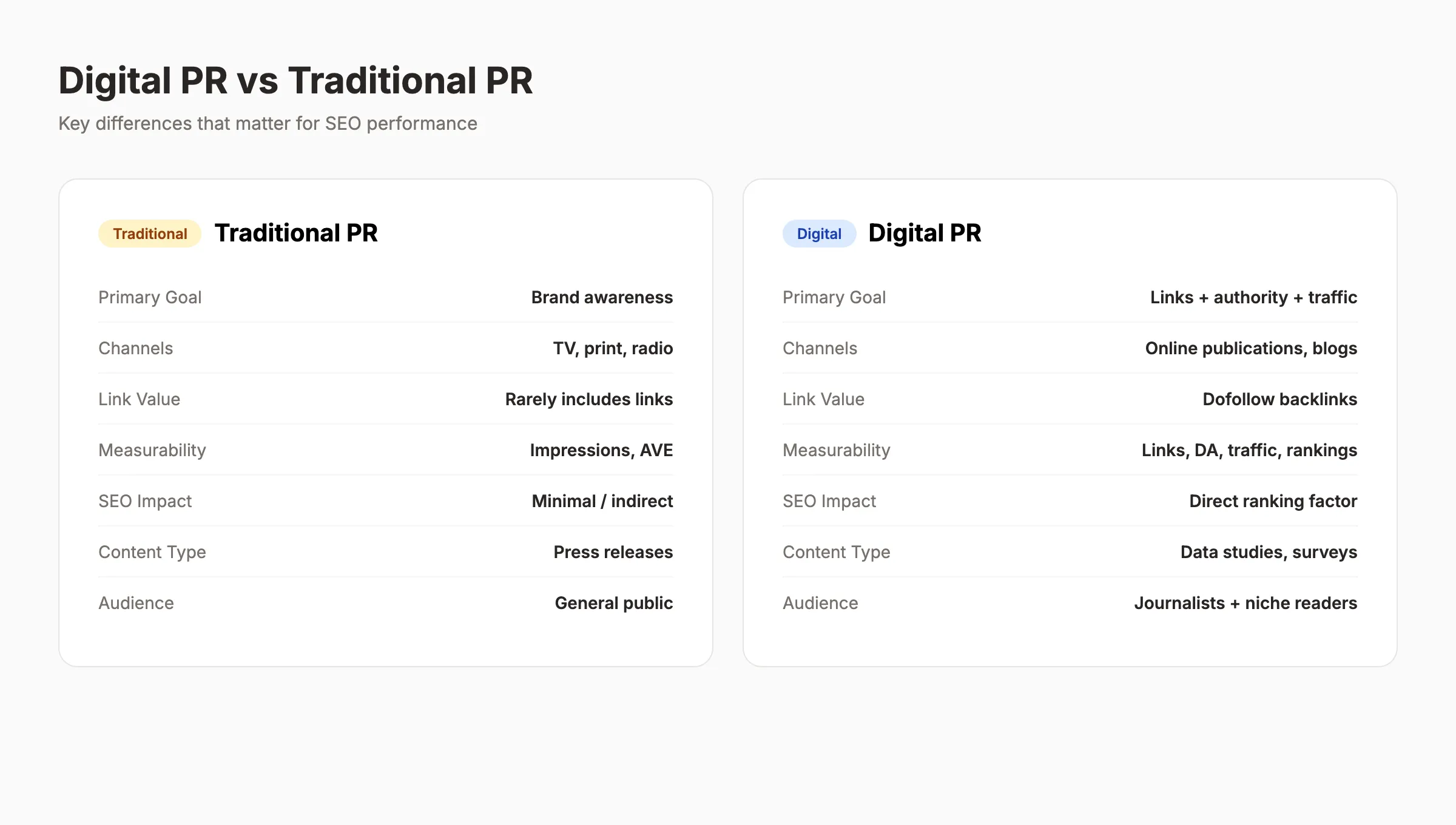
| Factor | Traditional PR | Digital PR |
|---|---|---|
| Primary goal | Brand awareness | Links + authority + traffic |
| Channels | TV, print, radio | Online publications, blogs |
| Link value | Rarely includes links | Dofollow backlinks |
| SEO impact | Minimal | Direct ranking factor |
| Measurement | Impressions, AVE | Links, DA, traffic, rankings |
| Content type | Press releases | Data studies, expert quotes |
How Digital PR Differs from Link Building
Standard link building relies on outreach to existing content. You ask someone to add a link to a page they already published. Digital PR creates news that journalists want to cover. The links come to you.
Guest posting is another form of link building where you write content for another site. Our guest posting guide covers that tactic in detail. Digital PR earns links through earned media, not contributed content.
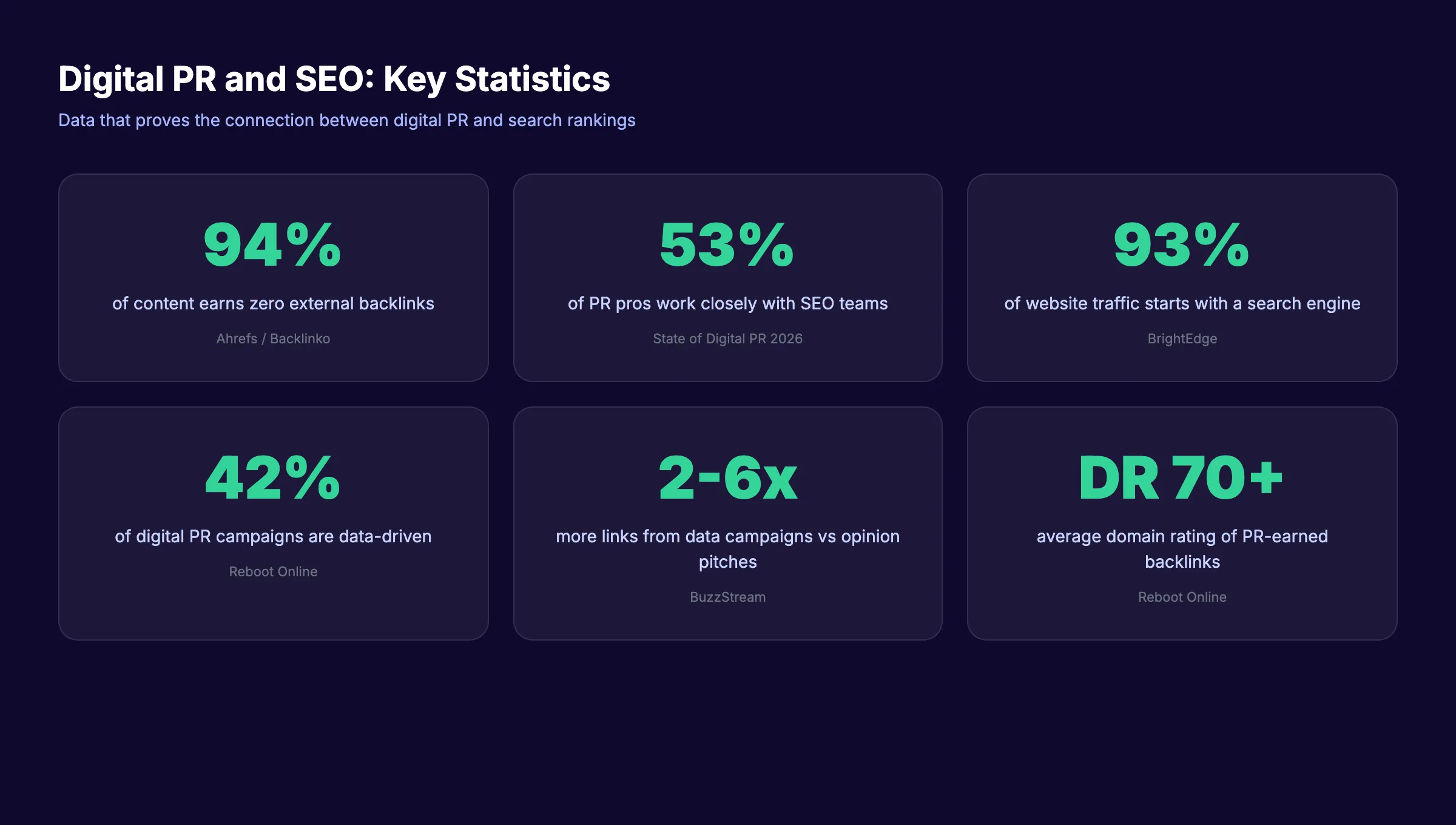
The authority of links from digital PR is typically higher. Over 20% of backlinks earned through digital PR come from domains with a rating of 70 or above, according to Reboot Online.
Chapter 2: Why Digital PR Matters for SEO {#ch2}
Search engines use backlinks as a ranking signal. A link from a high-authority news publication carries significantly more weight than a link from a low-traffic directory. Digital PR targets exactly those high-authority placements.
Backlinks Remain a Top Ranking Factor
Google has confirmed that links remain one of the top 3 ranking factors. The challenge is earning them at scale.
94% of online content earns zero external backlinks. Only 2.2% earns links from multiple domains. Digital PR is the most reliable method for earning links from publications with domain ratings above 60.
A single data study campaign can generate 5 to 30 referring domains when the angle is newsworthy and data-backed, per BuzzStream research. That is more links from one campaign than most businesses earn in a year of manual outreach.
E-E-A-T and Brand Authority Signals
Google evaluates content through E-E-A-T signals: Experience, Expertise, Authoritativeness, and Trustworthiness. Media coverage directly strengthens the Authoritativeness and Trustworthiness signals.
When Forbes, TechCrunch, or an industry trade publication mentions your brand and links to your site, Google recognizes that third-party validation. Your domain gains entity recognition. This is what the SEO industry calls “entity lifting.”
Entity lifting means that media mentions strengthen your brand authority across unrelated queries. A link from a marketing publication about your data study can help your product pages rank better too.
Impact on AI Search and Answer Engines
53% of digital PR professionals now work closely with SEO teams, according to the 2026 State of Digital PR Report. One reason is AI search.
Platforms like ChatGPT, Perplexity, and Google AI Overviews pull information from high-authority sources. Brands that earn consistent media coverage appear more frequently in AI-generated answers. Digital PR builds the exact signals these platforms prioritize: trusted mentions, authoritative links, and brand recognition.
Domain Authority Compounding
Every high-authority link raises your domain authority. Higher domain authority makes every new page you publish more likely to rank. One strong digital PR campaign raises the floor for all future content.
This is the Content Compound Effect in action. Consistent publishing builds topical authority. Digital PR accelerates that process by delivering the external validation Google needs to trust your domain.
Your content deserves backlinks. We handle the publishing. Stacc publishes 30 SEO blog posts per month while you focus on strategy. Start for $1 →
Chapter 3: 6 Types of Digital PR Campaigns {#ch3}
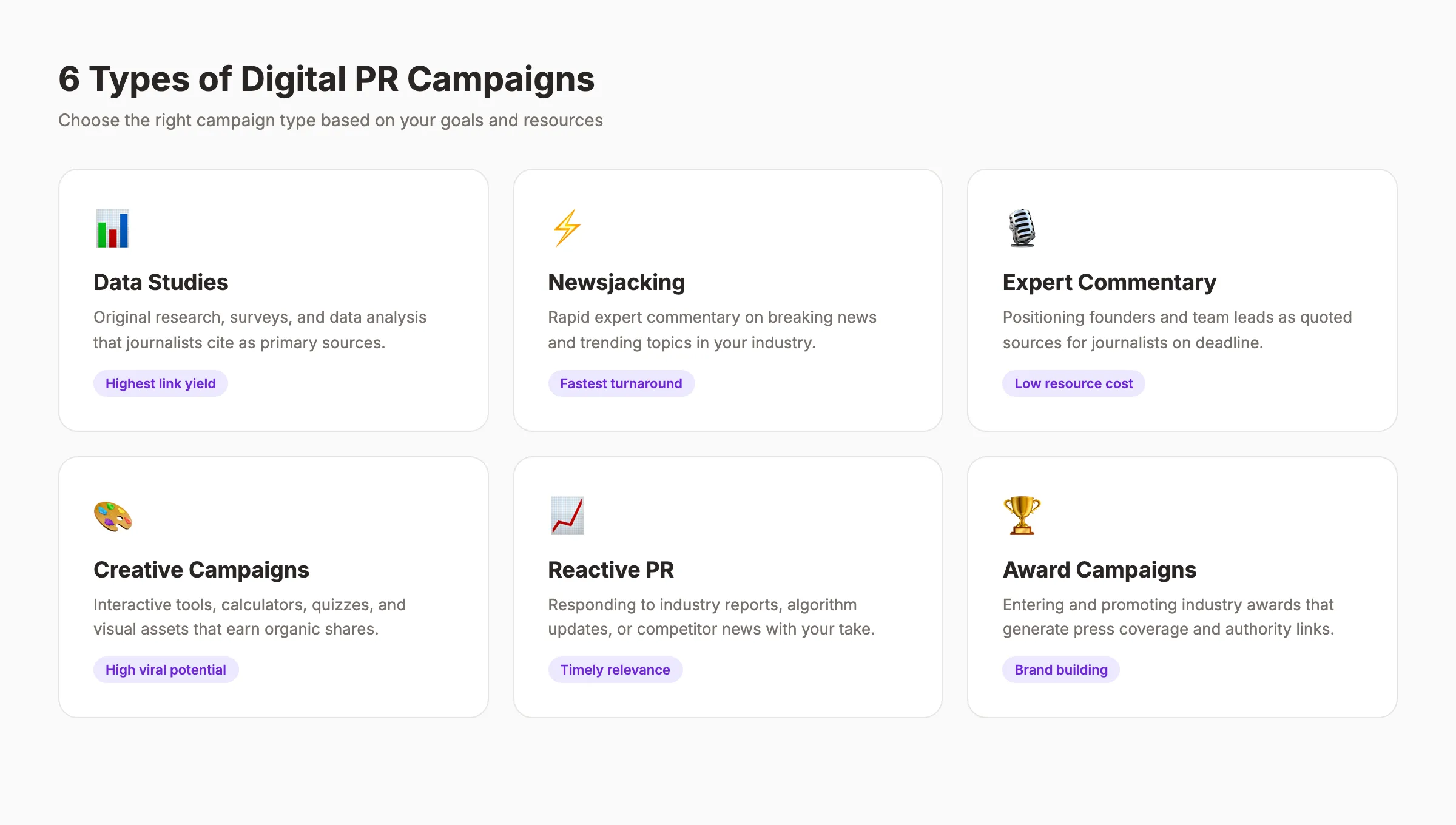
Not every digital PR campaign looks the same. The best approach depends on your budget, timeline, and industry. Here are 6 proven campaign types ranked by link-earning potential.
Data Studies and Original Research
Data-driven campaigns earn the most backlinks. 42% of all digital PR campaigns are data-driven, and 95% of PR professionals consider them the most effective tactic, per Reboot Online.
Data studies earn 2 to 6 times more links than opinion-based pitches. Journalists need data to support their stories. When you provide original research, you become a primary source that everyone cites.
Examples of data-driven campaigns:
- Survey 500+ professionals in your industry and publish the results
- Analyze publicly available data (Census, BLS, SEC filings) through a new lens
- Scrape and aggregate pricing, trend, or usage data across your market
- Run a year-over-year comparison study on industry benchmarks
One agency reported a single data campaign earning 727 backlinks from outlets like Yahoo, USA Today, and CNBC. The key was a clear, surprising finding that challenged conventional wisdom.
Newsjacking
Newsjacking means inserting your expert perspective into a breaking news story. When a major event, algorithm update, or industry shift happens, journalists scramble for expert quotes.
Speed matters here. You need to respond within hours, not days. The payoff is earned coverage in real time with minimal content creation cost.
To newsjack effectively:
- Set up Google Alerts for your top 10 industry keywords
- Monitor trending topics on X and Google Trends daily
- Prepare 2 to 3 standing expert bios with headshots
- Draft template responses you can customize in minutes
- Have a direct email or phone number for 5 to 10 journalists
Expert Commentary and Thought Leadership
Platforms like Connectively (formerly HARO), Qwoted, and Featured match journalists with expert sources. You respond to journalist queries. They quote you and link to your website.
This approach requires the least resources. A 15-minute response to a journalist query can earn a backlink from a DR 80+ publication.
The compound effect is significant. Respond to 10 queries per week. Even a 20% success rate gives you 2 placements per week, or roughly 100 per year.
Creative Campaigns
Interactive tools, calculators, quizzes, and visual assets earn links because they provide ongoing utility. A mortgage calculator, salary comparison tool, or industry benchmark quiz gives journalists a resource to reference.
One interactive campaign earned over 1,300 backlinks, according to Siege Media. Creative campaigns require more upfront investment but generate links passively for months or years.
Reactive PR
Reactive PR differs from newsjacking in scope. Instead of jumping on breaking news, reactive PR responds to industry reports, competitor announcements, or seasonal trends with prepared content.
When a major industry report drops, publish your analysis within 24 hours. When a competitor makes news, offer a contrasting perspective. Journalists look for alternative viewpoints.
Award Entries and Nominations
Industry awards generate press coverage, brand mentions, and authority links. Winning is ideal, but even being shortlisted earns a backlink from the award organizer plus media coverage.
Target awards from high-DA organizations. A single “Best of” feature from a trade publication can deliver 5 to 15 links as other outlets report the results.
Chapter 4: How to Create Newsworthy Content {#ch4}
Journalists do not cover products. They cover stories. The gap between “content marketing” and “digital PR content” is newsworthiness. Here is how to create content that earns coverage.
The Newsworthiness Framework
Every newsworthy story hits at least one of these triggers:
| Trigger | Definition | Example |
|---|---|---|
| Surprise | Data that contradicts expectations | ”70% of marketers do not track ROI” |
| Timeliness | Connected to current events or trends | Annual benchmark reports |
| Relevance | Matters to a specific audience | Regional salary data |
| Magnitude | Large scale or high impact | ”$4.2 billion wasted on unused SaaS” |
| Conflict | Opposing viewpoints or tension | ”SEO vs PPC: 2026 spend analysis” |
| Human interest | Emotional or relatable angle | Small business success stories |
Your content needs at least one strong trigger. The best campaigns combine 2 or 3.
Turning Internal Data into PR Assets
Most businesses sit on unreported data. Customer surveys, usage patterns, pricing trends, and performance benchmarks all contain stories journalists want to tell.
Steps to mine your internal data:
- Audit what data you already collect (CRM, analytics, surveys)
- Look for surprising patterns or year-over-year changes
- Frame findings as industry insights, not company metrics
- Create a clean data visualization or summary report
- Write a methodology section for credibility
Our guide on writing case studies covers how to package business data into compelling narratives. The same principles apply to digital PR assets.
Writing Headlines That Get Clicks
The headline determines whether a journalist opens your pitch or deletes it. Use the same principles from our blog headlines guide, but optimize for journalist interest instead of search traffic.
Strong digital PR headlines follow these patterns:
- Number + finding: “67% of Small Businesses Have Never Claimed Their Google Profile”
- Ranking + geography: “The 10 Most Expensive Cities for Home Renovation in 2026”
- Trend + reversal: “Email Marketing ROI Drops for First Time in 8 Years”
- Comparison + surprise: “TikTok Now Drives More Local Business Calls Than Google Ads”
Avoid vague headlines like “New Study Reveals Interesting Marketing Trends.” Be specific. Be surprising.
30 SEO articles per month. Zero writing required. Stacc publishes optimized blog content that builds your domain authority over time. Start for $1 →
Chapter 5: Building Media Lists and Relationships {#ch5}
The best campaign in the world fails without the right distribution. Building a targeted media list is the foundation of every successful digital PR effort.
How to Build a Media List from Scratch
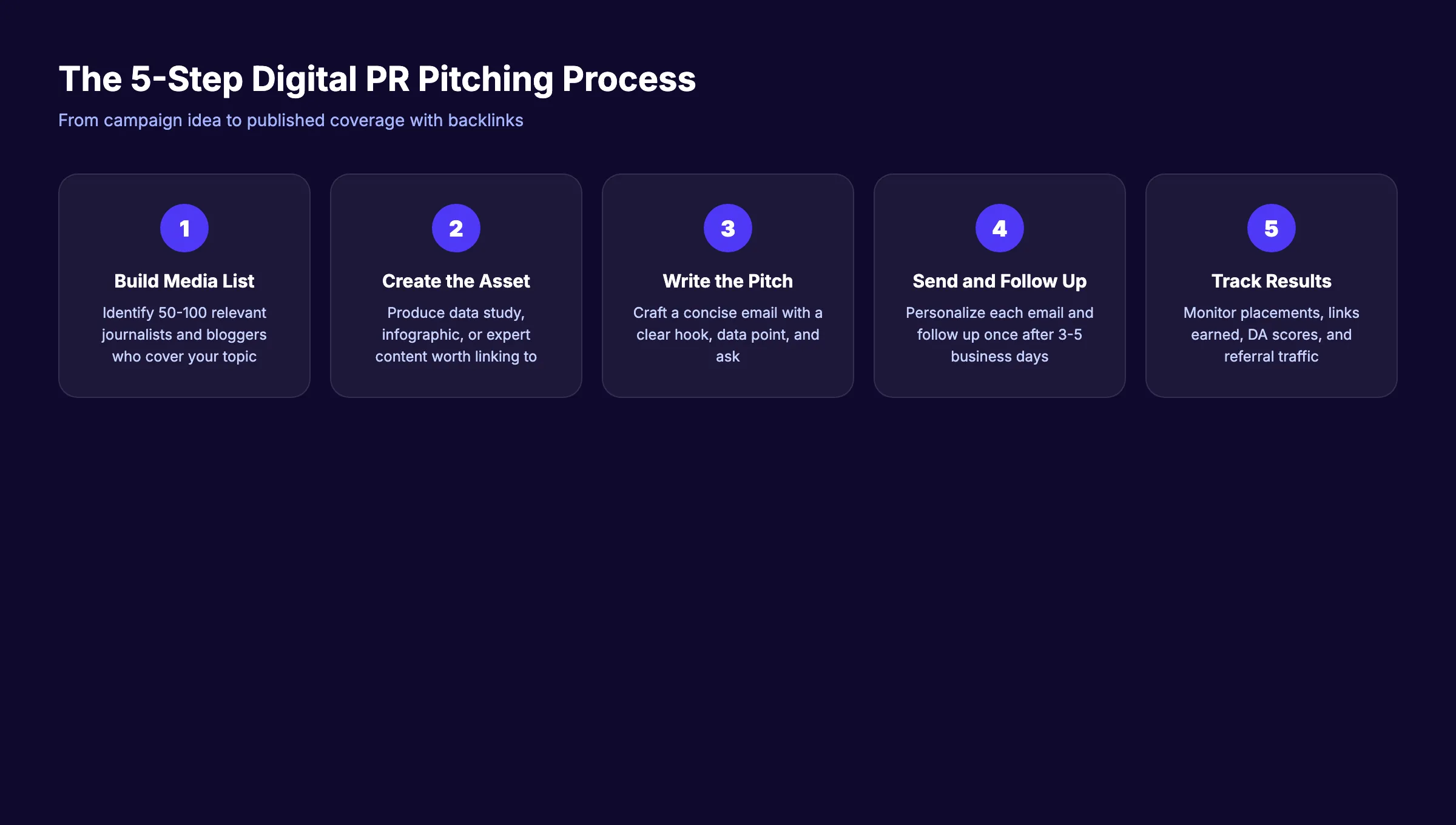
Start by identifying 50 to 100 journalists who cover your topic. Quality matters more than quantity.
Steps to build your first media list:
- Search Google News for your target keywords
- Note which journalists wrote the top 20 results
- Check their recent articles to confirm they still cover the beat
- Find their email addresses (Twitter/X bio, publication staff page, or Hunter.io)
- Record their name, outlet, beat, email, and social profiles in a spreadsheet
- Segment by tier: Tier 1 (national), Tier 2 (industry), Tier 3 (niche/regional)
A 100-person media list segmented by tier and beat outperforms a 1,000-person generic list every time.
Journalist Relationship Building
Cold pitching works. Warm relationships work better. Invest time in building genuine connections with your target journalists before you need coverage.
Practical ways to build relationships:
- Share and comment on their articles on social media
- Respond to their requests for sources (even when you do not need the link)
- Send useful data or insights without asking for anything in return
- Meet them at industry events and conferences
- Reference their previous work in your pitches
The key principle: journalists are the customer. Treat them like one. Understand their deadlines, their audience, and the types of stories they need to produce.
Using HARO and Journalist Query Platforms
Connectively (the platform formerly known as HARO) sends daily emails with journalist requests. Each request includes the publication, topic, deadline, and requirements.
Best practices for responding:
- Answer within 2 hours of the request going live
- Lead with your strongest credential in 1 sentence
- Give a direct, quotable answer in 3 to 5 sentences
- Attach a headshot and 1-paragraph bio
- Do not pitch your product
Qwoted and Featured offer similar services. Using all 3 platforms multiplies your opportunities. Budget 30 minutes per day for monitoring and responding.
Organizing Your Outreach with a CRM
Spreadsheets work for small campaigns. Dedicated outreach tools work better at scale. BuzzStream, Pitchbox, and Respona let you manage media lists, track pitches, schedule follow-ups, and measure response rates.
Track these fields for every contact:
| Field | Purpose |
|---|---|
| Name | Personalization |
| Primary contact | |
| Outlet | Publication name |
| Beat | Topic they cover |
| DA/DR | Authority of their site |
| Last contacted | Avoid over-pitching |
| Response status | Open, replied, covered, declined |
Chapter 6: Pitching Strategies That Get Coverage {#ch6}
The pitch email is where most digital PR campaigns succeed or fail. Journalists receive hundreds of pitches per week. Yours needs to stand out in 3 seconds.
Anatomy of a Winning Pitch Email
Every effective pitch has 5 elements:
- Subject line: 6 to 10 words with a specific hook or data point
- Opening line: Reference the journalist’s recent work or beat
- The hook: 1 to 2 sentences explaining why this story matters now
- The proof: Key data point, finding, or expert quote
- The ask: Clear CTA (interview, data access, exclusive angle)
Keep the total email under 150 words. Journalists scan. They do not read essays.
Subject Line Formulas That Work
The subject line determines your open rate. Here are 5 proven formulas:
- Data hook: “New Data: 67% of [Industry] Businesses [Surprising Finding]”
- Exclusive offer: “Exclusive: [Study Name] Results for [Publication]”
- Timely tie-in: “Expert Comment on [Breaking News Topic]”
- Question: “Are [Audience] Really [Common Assumption]? Our Data Says No.”
- Resource offer: “Free Data for Your [Topic] Story”
Avoid subject lines that read like marketing emails. No exclamation points. No ALL CAPS. No “revolutionary” or “groundbreaking.”
The Follow-Up Strategy
Most coverage comes from the follow-up, not the initial pitch. Journalists are busy. Your first email may get buried.
Follow up once after 3 to 5 business days. Keep it short:
“Hi [Name], following up on the [topic] data I sent last week. Happy to share the full dataset or arrange a quick call with our [expert title]. Let me know if this fits anything you are working on.”
Do not follow up more than once. Two emails is the maximum. After that, move on to the next journalist.
Personalization at Scale
Personalization does not mean writing 100 unique emails from scratch. It means customizing 3 elements per pitch:
- The journalist’s name and recent article (30 seconds per email)
- The angle (adjust the hook to match their beat)
- The data point (lead with the stat most relevant to their audience)
Tools like BuzzStream and Respona help automate the repetitive parts while preserving personalization fields.
SEO that runs itself. Stacc publishes 30 optimized blog posts per month so your team can focus on PR and strategy. Start for $1 →
Chapter 7: Measuring Digital PR Success {#ch7}
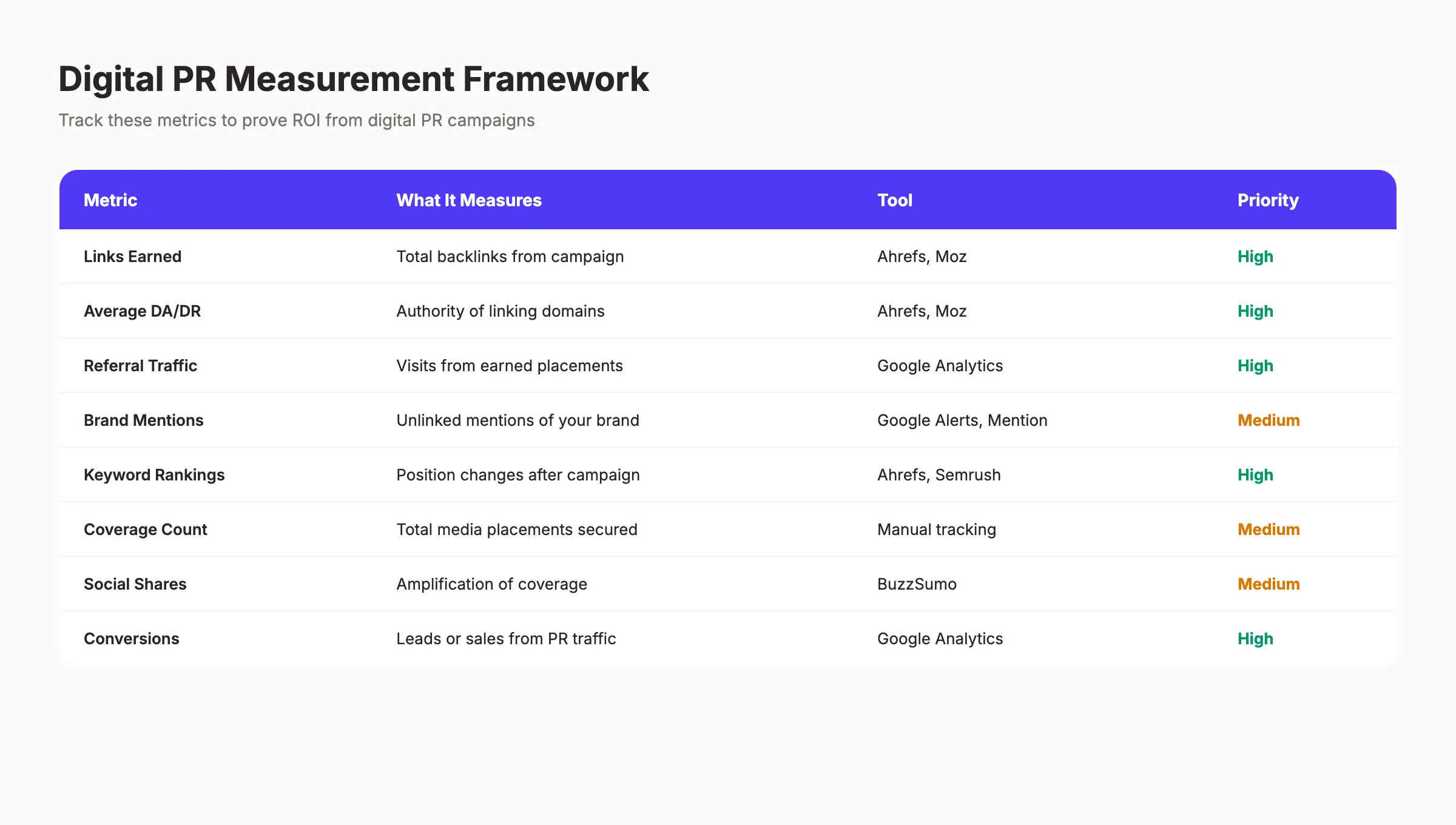
Digital PR produces measurable SEO results. Track these metrics to prove ROI and refine future campaigns.
Primary Metrics: Links and Authority
The 2 most important metrics for digital PR are total links earned and the average domain authority of linking sites.
A campaign that earns 5 links from DR 80+ publications delivers more SEO value than 50 links from DR 20 blogs. Quality always outranks quantity.
Track links using Ahrefs, Moz, or Semrush. Set up new backlink alerts so you catch placements within 24 hours of publication.
Use our backlink audit guide to evaluate the quality of earned links and identify any low-quality placements that need attention.
Secondary Metrics: Traffic and Rankings
Links are the input. Traffic and rankings are the output. Track these secondary metrics to connect digital PR to business results:
- Referral traffic: Direct visits from published articles (Google Analytics)
- Keyword rankings: Position changes for target keywords after campaigns
- Organic traffic growth: Month-over-month change in search traffic
- Brand search volume: Increase in branded keyword searches
The Google Search Console guide explains how to track keyword position changes and identify which queries improved after a PR campaign.
Building a Measurement Dashboard
Consolidate all digital PR metrics into a single dashboard. Here is a recommended structure:
| Metric | Frequency | Target |
|---|---|---|
| Links earned | Per campaign | 5-30 per campaign |
| Average DA of placements | Per campaign | DA 50+ |
| Referral traffic | Monthly | 10%+ growth |
| Keyword rankings | Monthly | Top 20 for targets |
| Brand mentions | Monthly | Increasing trend |
| Campaign ROI | Quarterly | Positive within 6 months |
Connecting PR Metrics to SEO Outcomes
The timeline between a digital PR campaign and ranking improvement is typically 4 to 12 weeks. Google needs time to crawl, index, and reassess your domain authority.
Run campaigns consistently. A single campaign moves the needle. Monthly campaigns create lasting momentum.
Track the full funnel: campaign launch to coverage to links to ranking change to traffic increase to conversions. That chain proves ROI to stakeholders who want business outcomes, not vanity metrics.
Learn more about tracking SEO performance in our SEO audit guide.
Chapter 8: Digital PR Tools and Software {#ch8}
You do not need an agency budget to run digital PR campaigns. The right tools make it possible for in-house teams and solo marketers to compete.
Journalist Discovery and Query Platforms
These platforms connect you with journalists actively seeking sources:
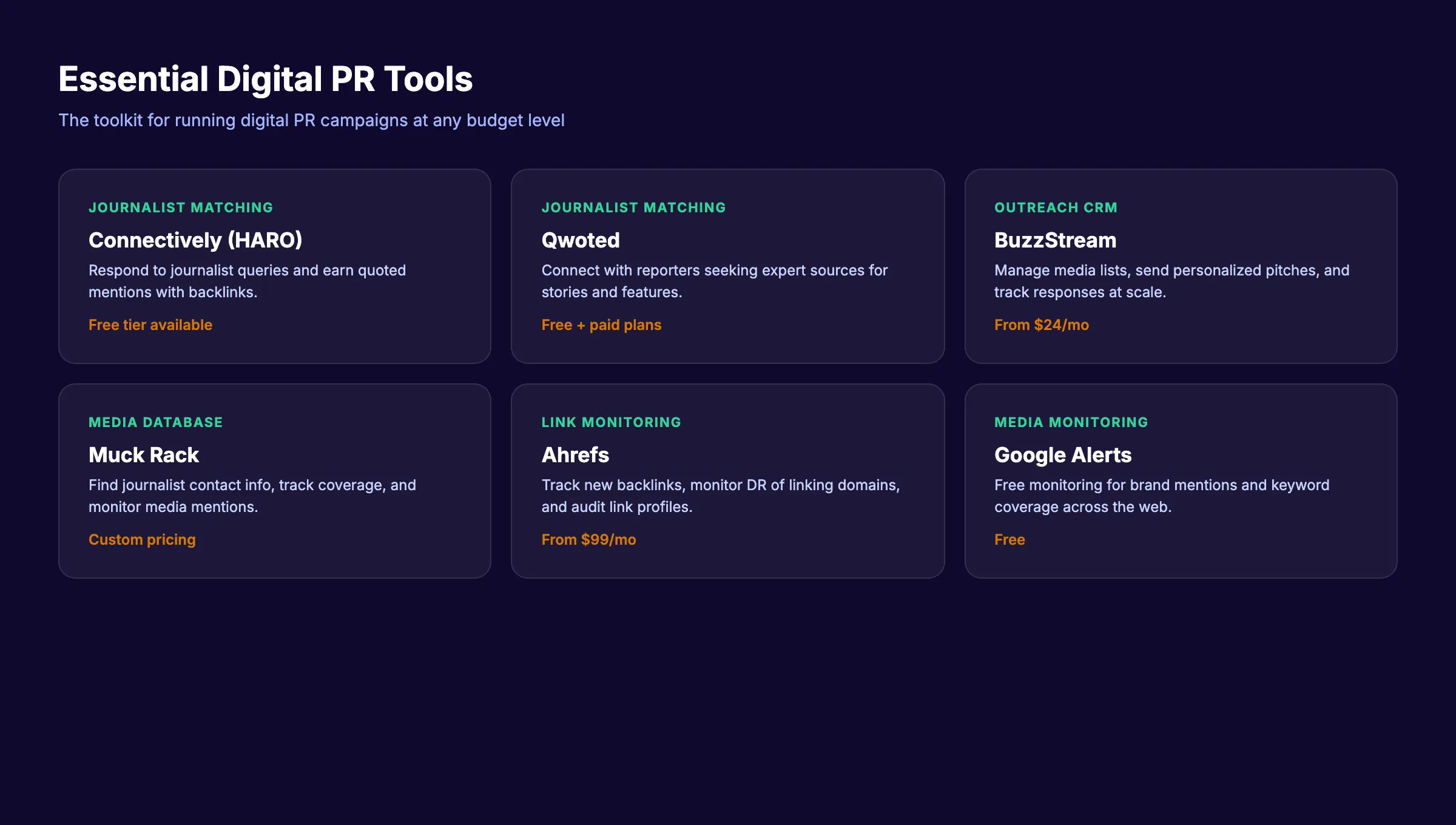
Connectively (formerly HARO): The largest journalist query platform. Free tier lets you respond to 3 queries per day. Paid plans unlock more queries, keyword filters, and faster notifications.
Qwoted: A newer platform with a growing journalist network. Offers both reactive (respond to queries) and proactive (pitch your expertise) options.
Featured: Focuses on expert commentary placements. Submit your expertise and get matched with relevant journalist requests.
Outreach and CRM Tools
BuzzStream: The industry standard for managing digital PR outreach. Build media lists, send personalized emails, track opens and replies, and manage follow-ups. Starts at $24 per month.
Pitchbox: Combines prospecting with outreach automation. Useful for teams running multiple campaigns simultaneously.
Respona: Built specifically for PR and link building outreach. Integrates with Ahrefs for contact discovery.
Media Monitoring Tools
Google Alerts: Free. Set up alerts for your brand name, competitor names, and target keywords. Receive daily or weekly email digests.
Mention: Paid monitoring across web, social, and news sources. Tracks brand mentions in real time.
Muck Rack: Combines journalist database with media monitoring. Find contacts, track coverage, and measure campaign reach in one platform.
Link Analysis Tools
Use Ahrefs, Semrush, or Moz to track backlinks earned from PR campaigns. These tools show you:
- New and lost backlinks over time
- Domain rating of every linking site
- Anchor text distribution
- Referring domain growth trends
Pair link analysis with our on-page SEO guide to ensure the pages receiving PR links are fully optimized for their target keywords.
Budget-Friendly Tool Stack
You can run effective digital PR with under $200 per month in tools:
| Tool | Cost | Purpose |
|---|---|---|
| Connectively | Free | Journalist queries |
| Qwoted | Free | Expert matching |
| Google Alerts | Free | Brand monitoring |
| BuzzStream | $24/mo | Outreach CRM |
| Ahrefs Lite | $99/mo | Link tracking |
| Hunter.io | Free tier | Email finding |
| Total | $123/mo | Full PR toolkit |
Focus on PR. Let us handle the content. Stacc publishes 30 SEO articles per month so you can spend your time earning links and media coverage. Start for $1 →
Chapter 9: Common Digital PR Mistakes {#ch9}
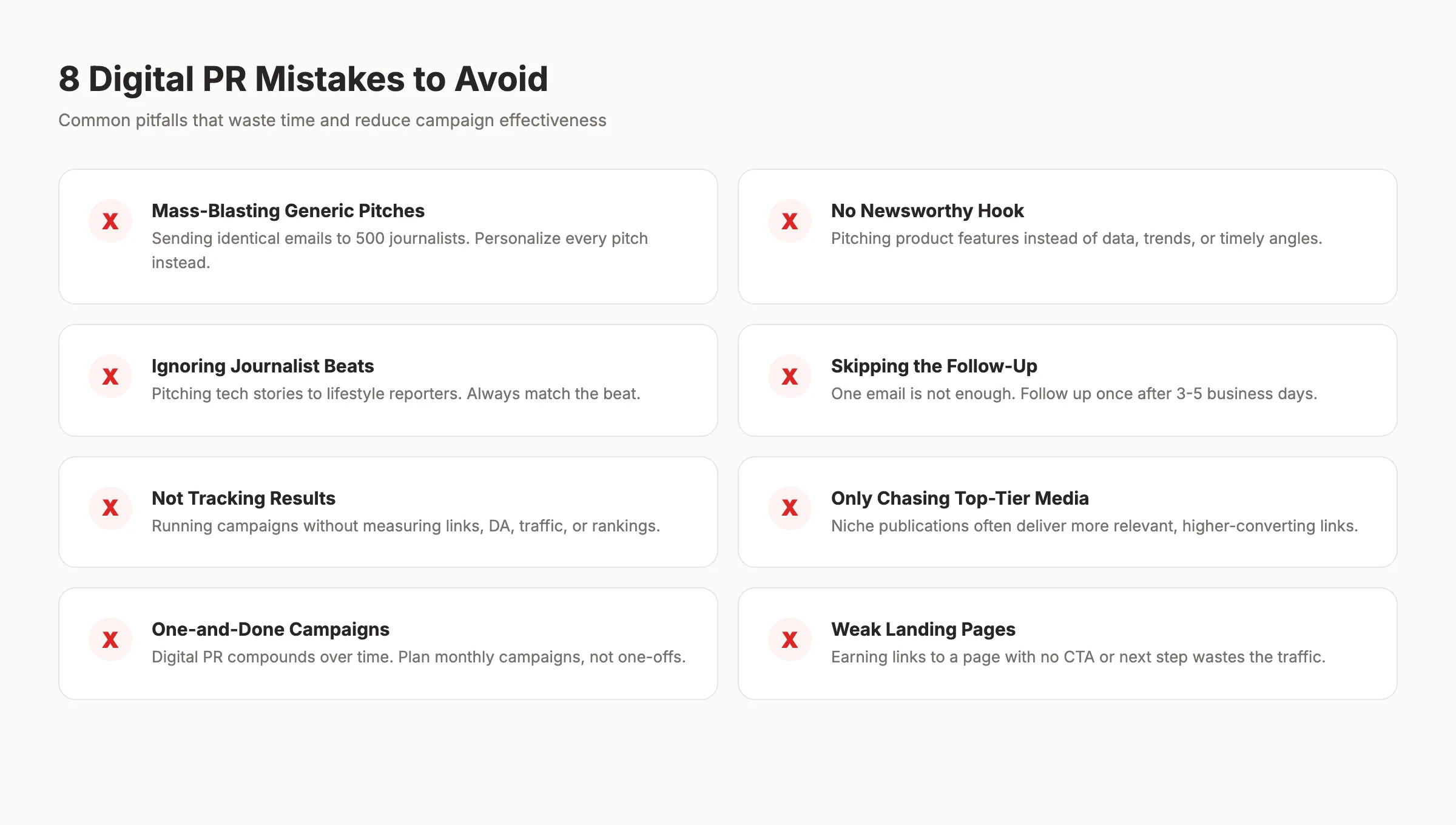
Most digital PR campaigns fail because of avoidable errors, not because the strategy is wrong. Here are the 8 mistakes that kill campaigns before they gain traction.
Mass-Blasting Generic Pitches
Sending the same email to 500 journalists is the fastest way to get blacklisted. Journalists talk to each other. They share bad pitches on social media.
Personalize every pitch. Reference the journalist’s recent work. Explain why your story fits their specific beat. Quality pitches to 50 targeted contacts outperform generic blasts to 500.
Pitching Without a Newsworthy Hook
Product launches are not news. Feature updates are not news. Data, trends, expert analysis, and timely commentary are news.
Ask yourself: “Would a journalist cover this if it came from a company they had never heard of?” If the answer is no, your hook is too weak.
Ignoring Journalist Beats and Deadlines
A tech story pitched to a lifestyle reporter wastes everyone’s time. A pitch sent after deadline earns a delete.
Research every journalist before pitching. Read their last 5 articles. Confirm they still cover the relevant beat. Note their preferred contact method and any stated pitch guidelines.
Only Targeting Top-Tier Publications
The Wall Street Journal and TechCrunch are not the only sources of high-quality backlinks. Niche industry publications, regional business journals, and specialized blogs often have domain ratings above 60.
Niche publications also deliver more relevant traffic. A link from a dental industry trade publication sends more qualified visitors to a dental practice than a mention in a national newspaper.
Running One Campaign and Quitting
Digital PR compounds over time. One campaign teaches you what works. Monthly campaigns build relationships, refine your angles, and create a growing link profile.
The businesses that succeed with digital PR treat it as an ongoing channel, not a one-time experiment. Plan at least 6 months of consistent effort before evaluating whether it works for your business.
Not Building on Your Content Marketing Strategy
Digital PR works best when integrated with your existing content plan. The links you earn should point to pages that are already optimized for target keywords.
Build a content foundation first. Publish consistent, SEO-optimized blog content that targets your primary keywords. Then use digital PR to accelerate the ranking process with authority links.
Skipping the Follow-Up
Most journalists do not respond to the first email. They are busy, dealing with hundreds of pitches per week. A single, polite follow-up 3 to 5 days later doubles your response rate.
Do not follow up more than once. And never send a guilt-trip follow-up. Keep it brief and professional.
Weak Landing Pages
Earning a link to a page with no clear next step wastes the referral traffic. Every page receiving PR links should have:
- A clear value proposition above the fold
- An internal link to a relevant blog post or resource
- A conversion action (email signup, free trial, consultation)
- Schema markup for rich search results
Scaling Digital PR Without an Agency
Many businesses assume digital PR requires a $5,000 per month agency retainer. It does not. In-house teams and solo marketers can run effective campaigns with the right systems.
The Weekly Digital PR Routine
Dedicate 5 hours per week to digital PR:
| Day | Activity | Time |
|---|---|---|
| Monday | Respond to HARO/Connectively queries | 45 min |
| Tuesday | Monitor media mentions and new opportunities | 30 min |
| Wednesday | Create or update a data asset | 90 min |
| Thursday | Send 10 to 15 personalized pitches | 60 min |
| Friday | Follow up on outstanding pitches and track results | 45 min |
This schedule produces 40 to 60 pitches per month. At a 10% to 20% success rate, that delivers 4 to 12 placements per month.
Combining Digital PR with Blog SEO
Digital PR and content marketing reinforce each other. Blog content gives you pages worth linking to. PR links give those pages the authority to rank.
The Stacc Stack Method combines consistent blog publishing with link-earning strategies. Publish 20 to 30 SEO blog posts per month. Run 1 to 2 digital PR campaigns per month. The compounding effect accelerates rankings faster than either tactic alone.
Read our guide on building backlinks for your blog for more link-earning strategies that pair with digital PR.
When to Hire an Agency
Consider an agency when:
- You need more than 20 placements per month
- You lack in-house writing or data analysis resources
- You operate in a competitive niche where relationships matter
- Your campaigns require custom data collection or creative production
The exception is early-stage businesses. Build your own PR muscles first. Understand what works before outsourcing it.
Consistent content builds the foundation. PR builds the authority. Stacc handles the content side with 30 SEO articles per month starting at $99. Start for $1 →
Frequently Asked Questions {#faq}
How long does digital PR take to impact SEO rankings?
Most businesses see ranking movement 4 to 12 weeks after earning high-authority links. Google needs time to crawl the linking pages and reassess your domain authority. Consistent monthly campaigns produce faster results than one-off efforts. Plan for at least 3 to 6 months of consistent digital PR before evaluating full impact on organic traffic.
Is digital PR the same as link building?
No. Link building includes all tactics for earning backlinks, such as guest posting, directory submissions, and resource page outreach. Digital PR is a specific subset that earns links through media coverage, data studies, and journalist relationships. Digital PR typically earns higher-authority links because placements come from news sites and trusted publications rather than blogs or directories.
How many backlinks should a digital PR campaign earn?
A well-executed campaign earns 5 to 30 referring domains per story. Data-driven campaigns targeting national media can earn 50 to 100+ links. The quality of links matters more than the count. 5 links from DR 80+ publications deliver more SEO value than 50 links from DR 20 sites. Track both volume and average domain rating.
Can small businesses do digital PR without a budget?
Yes. Connectively (HARO), Qwoted, and Google Alerts are free. Expert commentary responses require zero budget beyond your time. Even 30 minutes per day responding to journalist queries can generate 4 to 8 high-authority placements per month. Add BuzzStream at $24 per month when you are ready to scale outreach.
What is the difference between digital PR and content marketing?
Content marketing creates and distributes content to attract your target audience. Digital PR creates newsworthy content specifically to earn media coverage and backlinks. The best strategies combine both. Publish consistent blog content through a content strategy. Then use digital PR to earn authority links that help that content rank for competitive keywords.
Does digital PR help with E-E-A-T?
Absolutely. Google evaluates Authoritativeness and Trustworthiness by examining who mentions and links to your site. Media coverage from recognized publications is one of the strongest E-E-A-T signals. Journalist quotes, expert mentions, and editorial backlinks all contribute to how Google perceives your site’s authority and credibility.
Digital PR is the fastest path to high-authority backlinks that move rankings. Start with expert commentary platforms, build your media relationships, and run data-driven campaigns consistently. The links compound. The authority builds. And the rankings follow.
Related Tools & Resources
Free SEO Tools:
Best Lists:

Written by
Siddharth GangalSiddharth is the founder of theStacc and Arka360, and a graduate of IIT Mandi. He spent years watching great businesses lose organic traffic to competitors who simply published more. So he built a system to fix that. He writes about SEO, content at scale, and the tactics that actually move rankings.
30 SEO blog articles published every month
Keyword-optimized, scheduled, and live on your site. Automatically.
30-day trial · Cancel anytime
theStacc
Stop writing SEO content manually
30 blog articles, 30 GBP posts, and social media content. Published every month. Automatically.
Start Your $1 Trial$1 for 3 days · Cancel anytime