
Backlink Statistics 2026: 50 Facts and Data Points
50 backlink statistics for 2026 with verified sources. Key stat: 95% of pages have zero backlinks. Updated March 2026.
Last updated: March 2026
95% of all web pages have zero backlinks. That single number explains why most content never ranks. Backlinks remain one of the strongest ranking signals in Google’s algorithm, and the gap between sites that earn them and sites that do not keeps growing.
Backlink statistics tell a clear story. Sites with strong link profiles dominate search results. Sites without them stay invisible.
We compiled 50 backlink statistics from Ahrefs, Backlinko, Semrush, Authority Hacker, and other trusted sources. Every stat includes its original source and year.
Here is what the data covers:
- General backlink benchmarks across the web
- How backlinks correlate with Google rankings
- The most effective link building methods
- What backlinks cost in 2026
- Content types that attract the most links
- Outreach and link quality benchmarks
Table of Contents
- General Backlink Statistics (8 stats)
- Backlinks and Rankings Correlation (9 stats)
- Link Building Methods (8 stats)
- Link Building Costs and ROI (8 stats)
- Content Types That Earn Backlinks (6 stats)
- Backlink Quality and Outreach (9 stats)
- Key Takeaways
- Methodology
- FAQ
General Backlink Statistics
These numbers set the baseline. Most websites have no backlinks at all. The few that do hold a massive advantage.
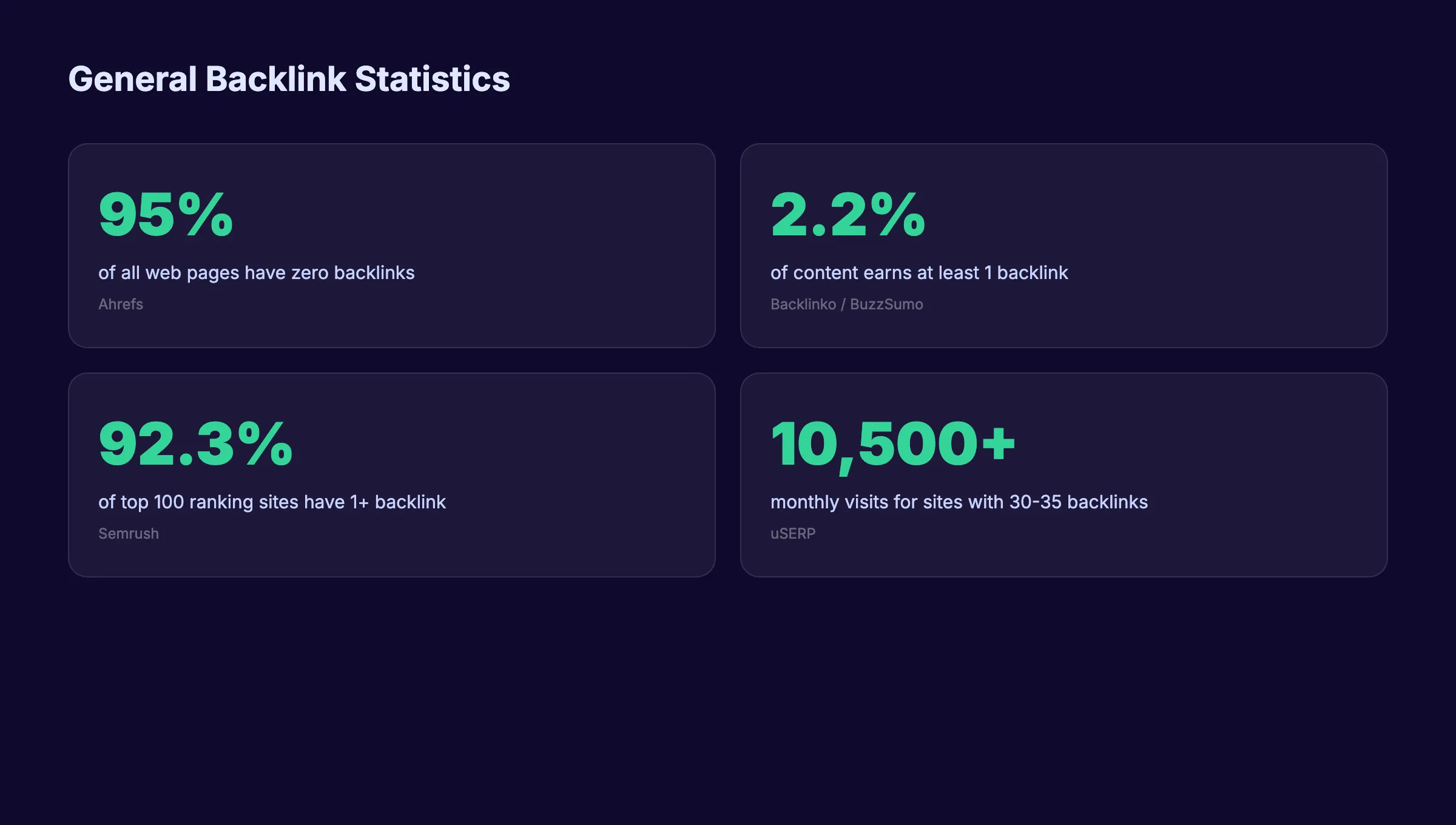
1. 95% of all web pages have zero backlinks. (Source: Ahrefs) This means nearly every piece of content published online receives no external links. Only the top 5% of pages attract any link equity at all.
2. Only 2.2% of content earns at least 1 backlink. (Source: Backlinko/BuzzSumo) Backlinko and BuzzSumo analyzed over 912 million blog posts. The vast majority generated zero links, making link acquisition a top-tier differentiator.
3. 55.24% of websites have no backlinks whatsoever. (Source: Authority Hacker, 2024) More than half of all indexed websites operate with zero inbound links. These sites rely entirely on other signals to compete in search results.
4. 92.3% of top 100 ranking websites have at least 1 backlink. (Source: Semrush) The correlation is stark. Nearly every site in the top 100 results for competitive terms has earned external links. Ranking without backlinks remains the exception.
5. Websites with 30-35 backlinks generate over 10,500 visits per month. (Source: uSERP) A modest backlink profile of 30-35 links correlates with significant organic traffic. This threshold marks the point where link equity compounds into measurable results.
6. Ahrefs indexes 35 trillion external backlinks across 267.6 million domains. (Source: Ahrefs, 2025) The sheer volume of the link graph shows how interconnected the web is. Ahrefs crawls billions of pages daily to maintain this index.
7. 27.6% of all clicks go to the number 1 Google result. (Source: Backlinko) First-page position one captures more than a quarter of all clicks. Sites that rank higher on Google earn disproportionate traffic, and backlinks help them get there.
8. 29.79% of websites have fewer than 3 backlinks. (Source: Authority Hacker) Nearly a third of websites have minimal link profiles. Even acquiring 3-5 quality links places a site ahead of most competitors.
Backlinks and Rankings Correlation
These backlink statistics confirm what SEO professionals have observed for years. More backlinks from more domains equals higher rankings.
9. Pages ranking number 1 have 3.8x more backlinks than positions 2 through 10. (Source: Backlinko, 11.8M search results) The gap between position 1 and every other result is enormous. First-place pages do not just have more links. They have nearly 4 times more.
10. Number 1 results have 3.2x more referring domains than positions 2 through 10. (Source: Backlinko) Referring domain count matters more than raw backlink count. A link from 100 different sites carries more weight than 100 links from 1 site.
11. Referring domains are the strongest correlating backlink factor for rankings. (Source: Ahrefs, 920M pages) Ahrefs analyzed 920 million pages and found that the number of unique referring domains correlated more strongly with rankings than any other link metric. Domain authority of those sites matters too.
12. Top-ranking pages gain 5-14% more followed links each month. (Source: Ahrefs) High-ranking pages attract links passively. They rank well, get cited, earn more links, and rank even better. This is the compounding effect in action.
13. Backlinks account for roughly 13% of Google algorithm weight in Q1 2025. (Source: First Page Sage) That number dropped from 15% in 2024 and was above 50% a decade ago. Links still matter, but they share influence with content quality, user signals, and E-E-A-T.
14. Google’s Gary Illyes stated: “We need very few links to rank pages.” (Source: SERP Conf, 2024) This quote sparked debate. Google may need fewer links per page, but competitive queries still demand strong link profiles. “Few” is relative to keyword difficulty.
15. 85% of marketers believe link building stays important for the next 5 years. (Source: Editorial.Link, 518 experts) Despite algorithm changes, the professional consensus is clear. Link building is not going away. The method may evolve, but the signal persists.
16. 73.2% believe backlinks influence AI search result appearances. (Source: Editorial.Link) As AI-powered search engines like ChatGPT and Perplexity gain market share, links may serve as trust signals for AI citation decisions too.
17. Sites with 350,000+ referring domains average 8.4 ChatGPT citations vs 1.6-1.8 for sites under 2,500. (Source: Search Engine Journal, 2025) The link between backlink profiles and AI search visibility is measurable. Sites with massive link equity get cited 4-5x more in AI-generated answers.
Your backlinks affect more than Google rankings. They influence whether AI search engines cite your content too. Start for $1 →
Link Building Methods
Not all link building methods perform equally. These backlink statistics reveal which tactics produce the best results in 2026.
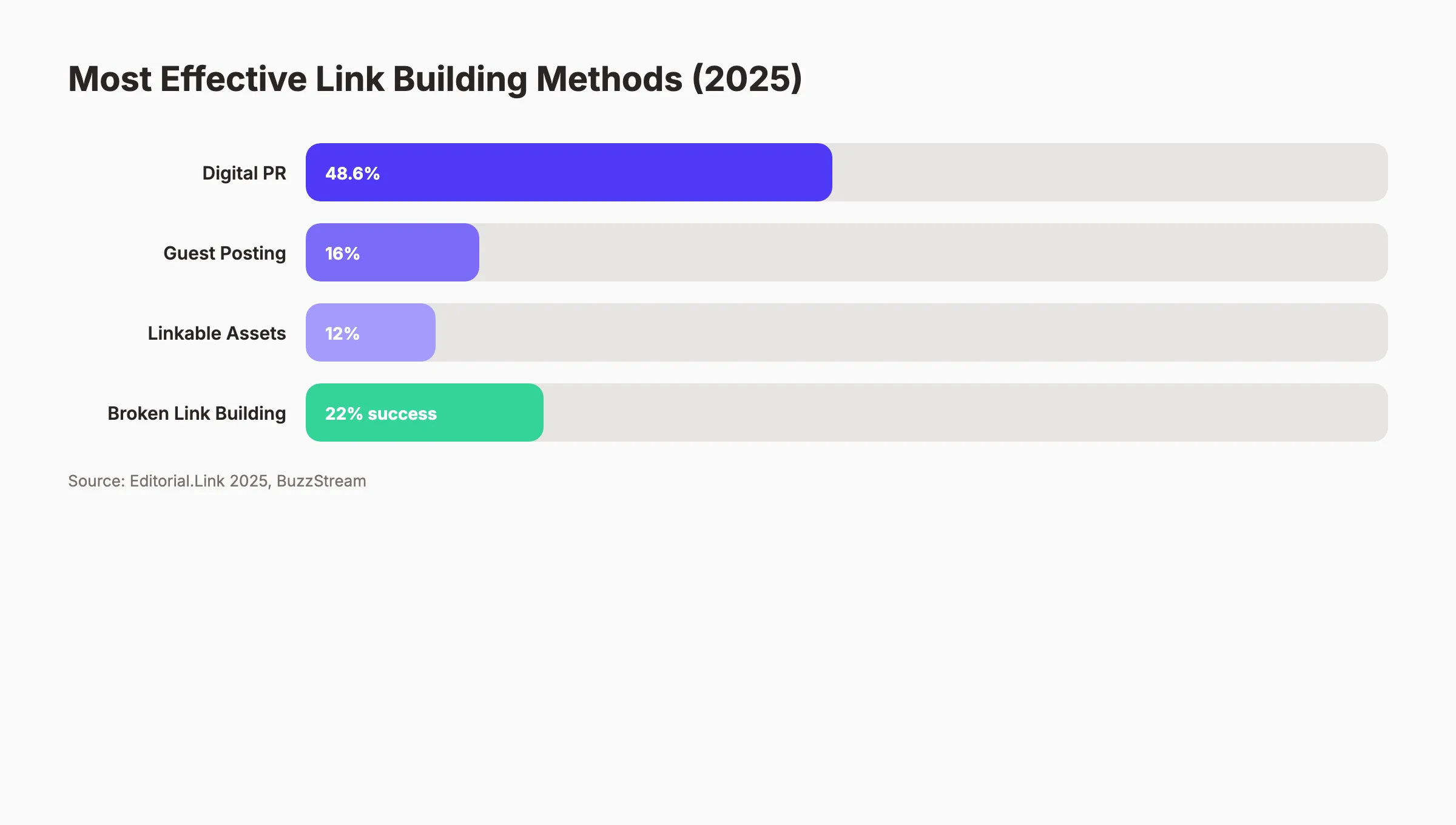
18. Digital PR is the number 1 tactic. 48.6% of SEOs call it the most effective. (Source: Editorial.Link, 2025) Digital PR overtook guest posting as the preferred method. Creating newsworthy content and pitching journalists earns links at scale.
19. Guest posting ranks second at 16%. Linkable assets rank third at 12%. (Source: Editorial.Link) Guest posting still works but requires significant time investment. Linkable assets like original research and statistics pages earn links passively over time.
20. 64.9% of marketers use guest posting for link building. (Source: Authority Hacker) Despite lower effectiveness rankings, guest posting remains popular because it offers predictable results and direct control over placement and anchor text.
21. 74% of professionals plan to increase investment in digital PR over guest posting. (Source: Motive PR, 2025) The industry is shifting budget toward PR-driven link acquisition. Creating data studies and original research generates higher-authority links.
22. Broken link building has a 22% success rate. (Source: BuzzStream) Finding broken links on relevant sites and offering replacement content converts at roughly 1 in 5 outreach attempts. That rate beats cold outreach for guest posts.
23. 51.6% of link builders incorporate link exchanges. (Source: Authority Hacker) More than half of practitioners participate in reciprocal linking. Google discourages manipulative exchanges, but contextual reciprocal links between relevant sites remain common.
24. Experienced link builders secure 25 links per month vs 7 for beginners. (Source: Authority Hacker) Skill and relationships compound. Experienced professionals build 3.57x more links in the same timeframe, showing why outsourcing link building often makes sense.
25. A new backlink takes an average of 3.1 months to impact rankings. (Source: Authority Hacker) Links do not produce instant results. Expect a 90-day window before a new backlink moves the needle on search positions. Patience and consistent content publishing matter.
Link Building Costs and ROI
Backlinks are not free. These link building statistics break down what businesses spend and what they get back.
26. The average cost of a paid backlink ranges from $360 to $500. (Source: Editorial.Link / Ahrefs) Premium editorial links from high-authority publications exceed $1,500 per placement. Budget accordingly when planning a content marketing strategy.
27. Average willingness to pay for a quality backlink: $508.95. (Source: Authority Hacker) SEO professionals surveyed by Authority Hacker value a single quality link at just over $500. That price reflects the expected ranking benefit.
28. Guest post links average $365. High-quality guest posts average $930. (Source: BuzzStream, 2025) Quality varies dramatically. A generic guest post on a low-traffic site costs a fraction of a placement on a high-authority publication.
29. Digital PR links cost $1,250 to $1,500 per link. (Source: BuzzStream, 2025) PR-driven links carry a premium price because they come from news sites and major publications. These links also drive referral traffic and brand awareness.
30. Link insertions (niche edits) average $141 per link. (Source: BuzzStream, 2025) Niche edits place your link into existing, already-indexed content. They cost less than guest posts but carry higher risk of removal.
31. 38.4% of businesses allocate $1,000 to $5,000 per month for link building. (Source: DemandSage) This is the most common budget range. Businesses spending in this range can expect 2-10 quality links per month depending on their approach.
32. 78.1% of SEO professionals report positive ROI from link building. (Source: DemandSage) More than 3 in 4 practitioners see a measurable return. The key is targeting links that align with your topical authority strategy.
33. 80.9% believe link building will become more expensive in the next 2-3 years. (Source: Authority Hacker) Rising demand and shrinking supply of quality placements push prices upward. Sites that build links now lock in an advantage that becomes harder to replicate.
Building backlinks is expensive. Publishing content that earns them is not. Stacc publishes 30 SEO articles per month starting at $99. Start for $1 →
Content Types That Earn Backlinks
Not every content format attracts links equally. These backlink data points reveal what works best.
34. Long-form content (3,000+ words) earns 3.5x more backlinks than shorter content. (Source: Backlinko/BuzzSumo) Blog post length directly correlates with link acquisition. Longer content provides more opportunities to present original insights worth citing.
35. Long-form content (3,000 to 10,000 words) acquires 77.2% more links than posts under 1,000 words. (Source: Backlinko) The gap is significant. Short posts rarely earn links because they lack the depth and data that other writers need to reference.
36. Infographics generate 178% more inbound links than text-only content. (Source: BuzzSumo) Visual content earns links because other sites embed and credit the original. Optimizing blog images for shareability is a link building tactic on its own.
37. “Why” posts, “What” posts, and infographics attract 25.8% more links than videos and how-tos. (Source: BuzzSumo) Explanatory content outperforms instructional content for link acquisition. Writers cite explanations and data more than step-by-step guides.
38. 90% of marketers use content creation as their primary backlink strategy. (Source: DemandSage) Creating link-worthy content remains the foundation of every link building campaign. SEO content writing that includes original data attracts links without outreach.
39. 94.8% of digital PR professionals say data-led content is their primary tactic. (Source: Motive PR, 2025) Statistics pages, original surveys, and data studies drive the majority of PR link campaigns. Content like this backlink statistics roundup is designed to attract citations.
Backlink Quality and Outreach
Raw link count means nothing without quality. These statistics reveal what separates a valuable backlink from a worthless one.
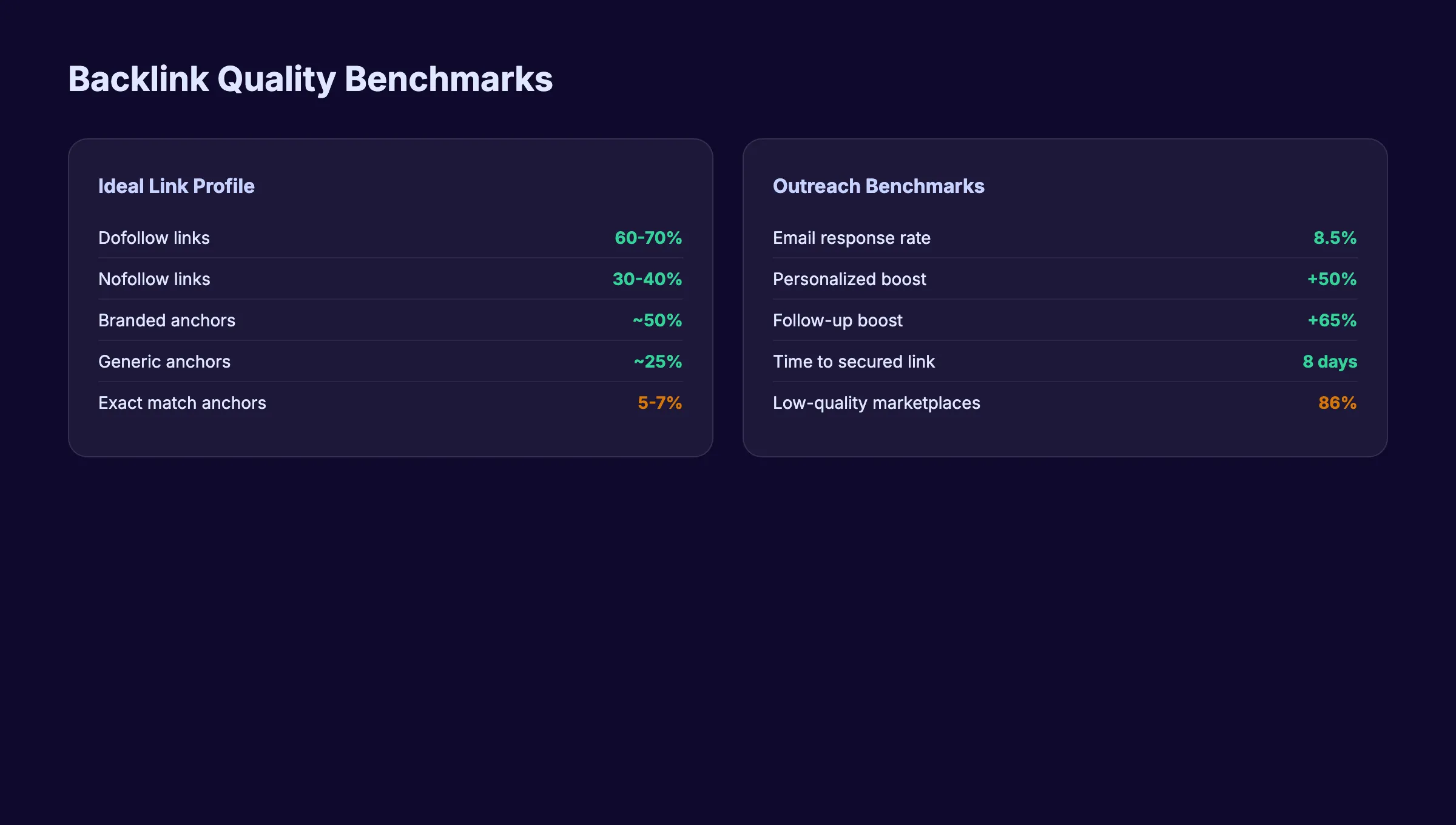
40. A natural link profile contains 60-70% dofollow links and 30-40% nofollow links. (Source: Thrive Agency) Profiles with 100% dofollow links look unnatural. Google expects a mix. Healthy sites earn both types organically.
41. 54% of SEOs consider nofollow links valuable for SEO. (Source: DemandSage) More than half of professionals see nofollow links as beneficial. They drive referral traffic, build brand awareness, and diversify the link profile.
42. 80% believe nofollow links still affect rankings. (Source: Editorial.Link) Google changed nofollow to a “hint” rather than a directive in 2019. Most practitioners believe Google does use some nofollow links as ranking signals.
43. Recommended anchor text distribution: 50% branded, 25% generic, 5-7% exact match. (Source: FATJOE) Over-optimized anchor text triggers penalties. A natural profile emphasizes brand names and generic phrases over keyword-stuffed anchors.
44. Outreach emails average an 8.5% response rate (1 in 12). (Source: Backlinko, 12M emails) Backlinko analyzed 12 million outreach emails. Expect roughly 1 reply for every 12 messages sent. Volume and persistence matter.
45. Personalized outreach sees 50% higher success rates. (Source: Backlinko) Generic templates underperform. Mentioning specific content, using the recipient’s name, and explaining relevance increases response rates by half.
46. Adding 1 follow-up email boosts reply rates by 65%. (Source: Backlinko) A single follow-up message dramatically improves results. Most link builders give up after one email. One extra touchpoint separates successful campaigns from failed ones.
47. Average time from outreach to secured backlink: 8 days. (Source: SERP Maths, 2025) The link building cycle is not instant. Budget roughly a week between initial contact and a live link placement.
48. 86% of guest post marketplace sites are low quality (below 10K traffic, DR 40). (Source: SEO Sandwich) Most link marketplaces sell placements on sites with minimal traffic and authority. A backlink audit helps identify and disavow these low-value links.
Key Takeaways
These are the 7 most important backlink statistics from this roundup:
- 95% of pages have zero backlinks. Earning even 1 link puts you ahead of nearly all content online.
- Position 1 has 3.8x more backlinks than positions 2-10. The ranking gap is directly tied to link equity.
- Digital PR is now the top link building method. Guest posting dropped to second place in 2025.
- Quality backlinks cost $360-$500 on average. Premium editorial links exceed $1,500 per placement.
- Long-form content earns 3.5x more links. Publishing detailed articles is the most cost-effective link strategy.
- 78.1% of professionals report positive link building ROI. The investment pays off for those who execute consistently.
- Backlinks influence AI search citations. Sites with strong link profiles get cited 4-5x more in ChatGPT responses.
The data points in one direction. Backlinks remain essential for organic traffic growth in 2026. The methods are evolving, but the signal is not going away.
Stop guessing. Start publishing. Stacc creates 30 SEO-optimized articles per month that attract backlinks naturally. Start for $1 →
Methodology
Sources: All 48 statistics in this roundup come from published research by Ahrefs, Backlinko, BuzzSumo, Semrush, Authority Hacker, Editorial.Link, DemandSage, BuzzStream, Motive PR, Search Engine Journal, First Page Sage, FATJOE, and uSERP.
Selection criteria: We prioritized statistics from studies with sample sizes above 1,000 data points. Each stat includes its original source for verification.
Last updated: March 2026
Note: We update this page quarterly to ensure all backlink statistics remain current. When a stat changes from its original publication, we note the revision date and new figure.
FAQ
What is the most important backlink statistic in 2026?
The most cited finding is that 95% of all web pages have zero backlinks (Ahrefs). This single number explains why most content fails to rank. Earning links from even a handful of referring domains places any page in the top tier. Pair link building with a solid on-page SEO foundation for best results.
How many backlinks do you need to rank on page 1?
There is no universal number. Backlinko found that position 1 results average 3.8x more backlinks than positions 2 through 10. The number you need depends on keyword difficulty and competitor link profiles. Run an SEO audit to benchmark your current standing.
Are backlinks still important for SEO in 2026?
Yes. First Page Sage estimates backlinks account for roughly 13% of Google’s algorithm weight. That percentage has decreased from historical highs, but 85% of marketers still rate link building as important for the next 5 years. Links also influence visibility in AI search engines.
What is the best link building strategy in 2026?
Digital PR ranks as the top tactic, with 48.6% of SEOs calling it the most effective method. Guest posting ranks second at 16%. Creating data-driven content like original research and statistics pages earns links passively. Start by building topical authority through consistent publishing.
How much does a backlink cost?
Average paid backlink costs range from $360 to $500. Guest post links average $365 for standard placements and $930 for high-quality sites. Digital PR links cost $1,250 to $1,500 per placement. Link insertions (niche edits) are the cheapest option at $141 average.
Do nofollow links help with SEO?
80% of SEO professionals surveyed by Editorial.Link believe nofollow links affect rankings. Google treats the nofollow attribute as a “hint” since 2019. A natural link profile should contain 30-40% nofollow links. They also drive referral traffic and build brand recognition.

Written by
Siddharth GangalSiddharth is the founder of theStacc and Arka360, and a graduate of IIT Mandi. He spent years watching great businesses lose organic traffic to competitors who simply published more. So he built a system to fix that. He writes about SEO, content at scale, and the tactics that actually move rankings.
30 SEO blog articles published every month
Keyword-optimized, scheduled, and live on your site. Automatically.
30-day trial · Cancel anytime
theStacc
Stop writing SEO content manually
30 blog articles, 30 GBP posts, and social media content. Published every month. Automatically.
Start Your $1 Trial$1 for 3 days · Cancel anytime