
Guest Posting to Earning Links (2026): Guide
Step-by-step guest posting guide guide for 2026: proven tactics, real examples, common mistakes to avoid, and implementation tips.
You want backlinks. You do not want to wait 12 months for them to appear on their own.
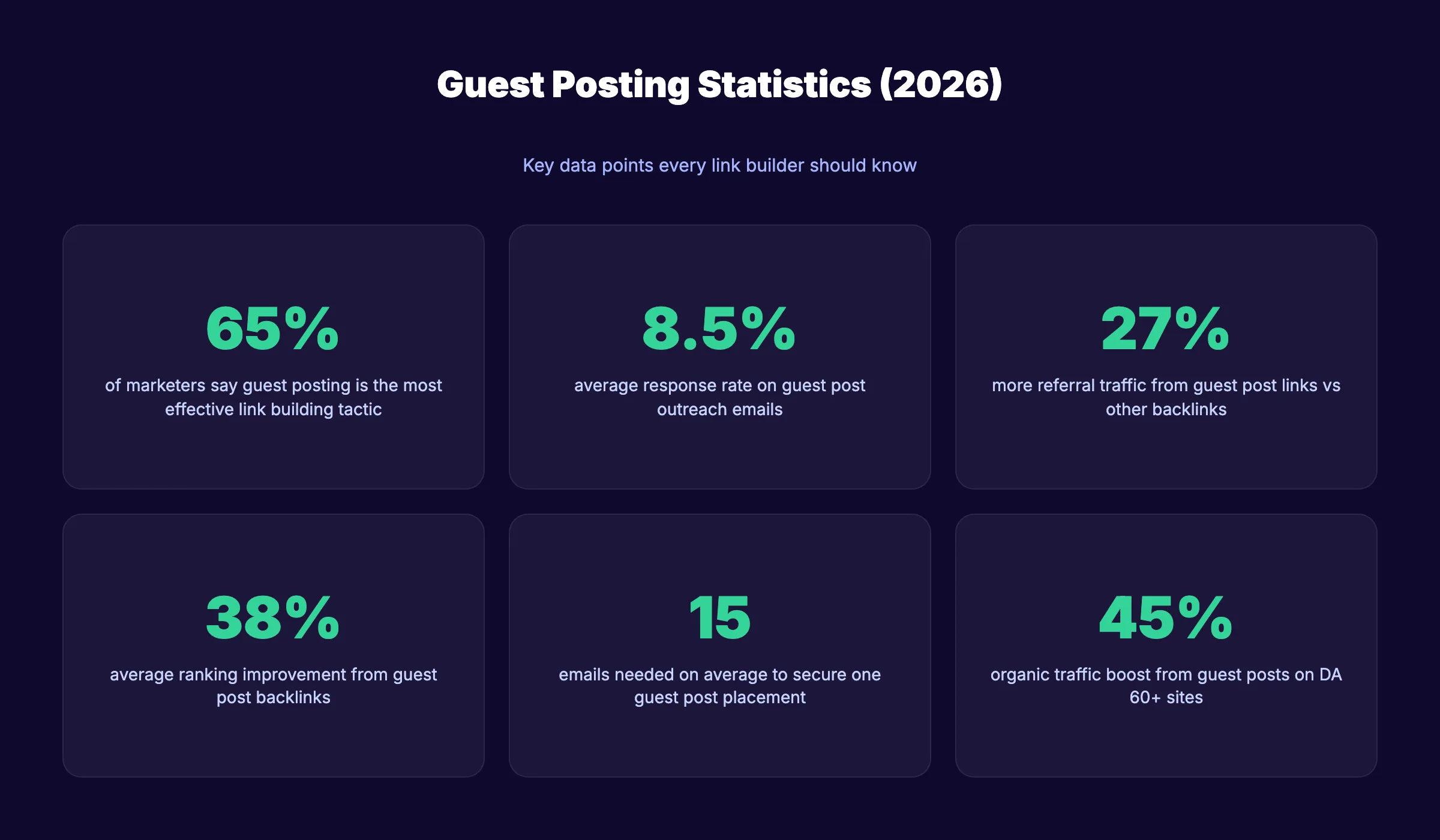
Guest posting remains the most reliable way to earn high-quality backlinks on a predictable timeline. 65% of marketers rank it as the most effective link building strategy. Sites with 50 or more guest post backlinks rank in the top 10 results 75% of the time.
Yet most guest posting campaigns fail. The average outreach response rate sits at 8.5%. That means 91 out of every 100 pitches go ignored. Bad targeting, generic emails, and thin content kill results before they start.
We have published 3,500+ blog posts across 70+ industries. The sites that grow fastest use guest posting as a core part of their off-page SEO strategy. Not randomly. Systematically.
Here is what you will learn in this guide:
- How to find guest post opportunities using search operators and competitor analysis
- The exact criteria for vetting sites before you pitch
- A 5-part pitch email framework that gets responses
- How to write guest posts that earn contextual links and drive traffic
- Where to place links for maximum SEO value
- How to scale guest posting without triggering Google penalties
- The 4 metrics that prove guest posting ROI
Table of Contents
- Chapter 1: What Guest Posting Is and Why It Still Works
- Chapter 2: How to Find Guest Post Opportunities
- Chapter 3: How to Vet and Qualify Target Sites
- Chapter 4: How to Write Pitch Emails That Get Accepted
- Chapter 5: How to Write Guest Posts That Earn Links
- Chapter 6: Link Placement Strategy for Maximum SEO Value
- Chapter 7: How to Scale Guest Posting Without Losing Quality
- Chapter 8: Common Mistakes and Google Penalties to Avoid
- Chapter 9: How to Measure Guest Posting ROI
- Chapter 10: Guest Posting vs Other Link Building Methods
Chapter 1: What Guest Posting Is and Why It Still Works {#ch1}
Guest posting means writing an article and publishing it on someone else’s website. You provide free content. They provide a backlink and access to their audience. Both sides benefit when the execution is right.
Some marketers declared guest posting dead after Google cracked down on spammy link schemes in 2014. A decade later, the data tells a different story.
The Definition in Plain Terms
A guest post is content you create for another website’s blog. You pitch the idea, write the article, and include 1-2 links back to your own site within the body or author bio.
The host site gets free, quality content. You get a backlink, referral traffic, and brand exposure to a new audience. The arrangement works because it is mutually beneficial.
Guest posting is not the same as sponsored content. Sponsored posts involve payment. Guest posts earn placement through content quality alone.
Why Guest Posting Works for SEO in 2026
Google’s algorithm still treats backlinks as one of the top 3 ranking factors. A study by Ahrefs found that the number 1 ranking page has 3.8 times more backlinks than positions 2 through 10.
Guest posts on sites with a Domain Authority of 60 or higher increase organic traffic by up to 45% within 6 months. That is not theory. That is measured data from thousands of campaigns.
Google does not penalize guest posting done right. Google penalizes manipulative link schemes. There is a clear difference. A well-written article on a relevant site with a natural link is exactly the kind of signal Google wants to see.
The Numbers That Prove It
Guest posting generates 27% more referral traffic than other backlink types. Organizations using guest posting experience 35% faster organic growth. And 48% of bloggers write between 1 and 5 guest posts every month.
The strategy works. The question is whether you execute it well enough to see results.
Chapter 2: How to Find Guest Post Opportunities {#ch2}
The quality of your guest posting campaign depends on where you publish. Finding the right sites is the first and most important step. Bad targets waste time. Good targets compound your topical authority and rankings.
There are 4 reliable methods for finding guest post opportunities. Use all of them.
Google Search Operators
Google search operators let you find sites that actively accept guest contributions. These queries surface submission pages, contributor guidelines, and existing guest posts.
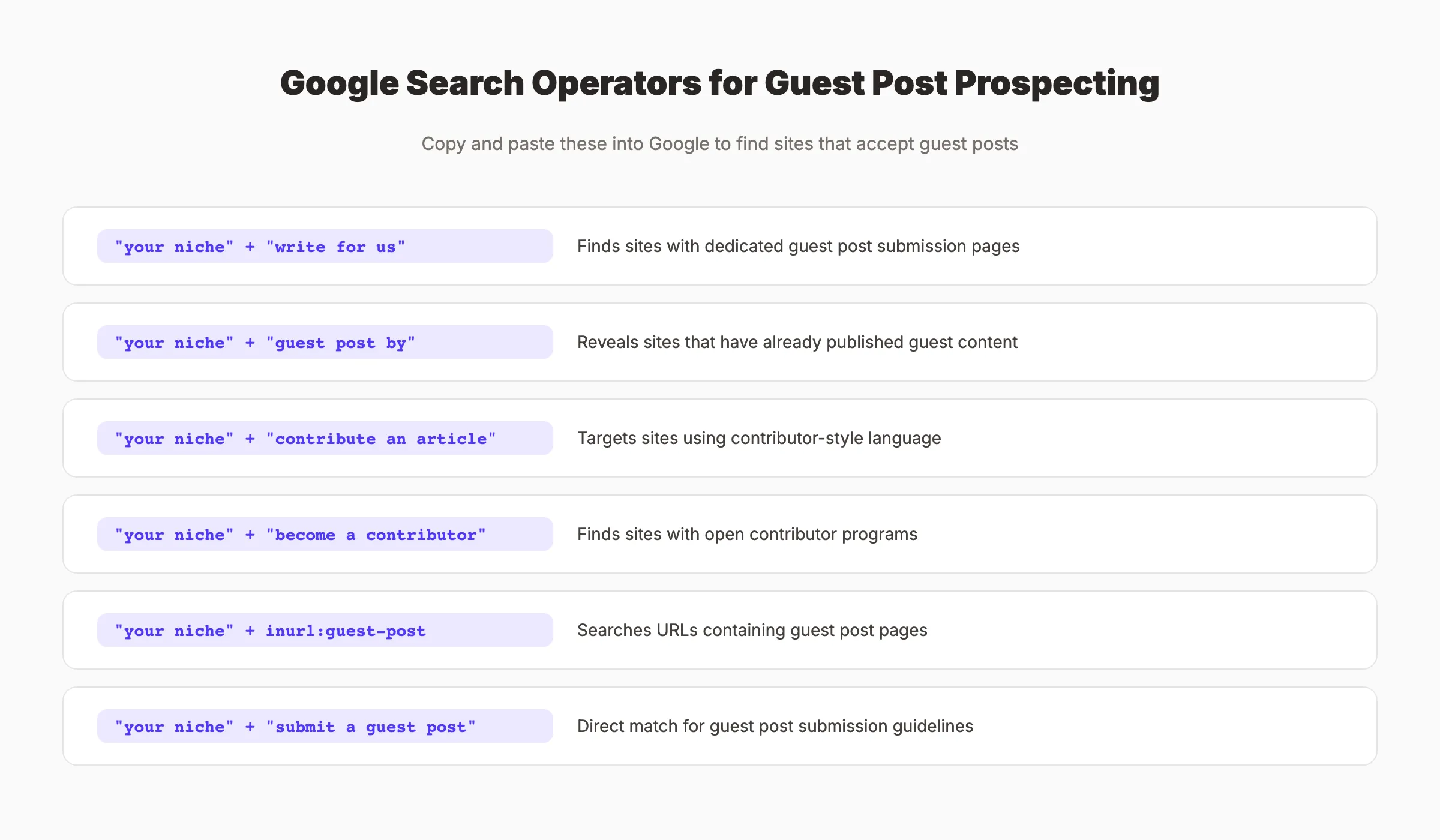
Here are the 6 operators that work best:
| Search Operator | What It Finds |
|---|---|
| ”your niche” + “write for us” | Dedicated guest post submission pages |
| ”your niche” + “guest post by” | Sites that have published guest content |
| ”your niche” + “contribute an article” | Sites using contributor-style language |
| ”your niche” + “become a contributor” | Open contributor programs |
| ”your niche” + inurl:guest-post | URLs containing guest post pages |
| ”your niche” + “submit a guest post” | Direct submission guideline pages |
Replace “your niche” with your actual topic. A marketing SaaS company might search “content marketing” + “write for us” to find relevant blogs.
Run 10-15 variations per niche. Export the results to a spreadsheet. You should find 30-50 potential targets per session.
Competitor Backlink Analysis
Your competitors already did the prospecting work for you. Use Ahrefs, Semrush, or Moz to pull their backlink profiles. Filter for links from guest posts.
Look at the referring domains for your top 3-5 competitors. Identify sites that linked to them through guest content. Those same sites will likely accept your pitch too.
This method is faster than search operators because you already know the sites accept guest content. You also know they are relevant to your niche.
Social Media and Community Prospecting
Twitter, LinkedIn, and niche communities surface guest posting opportunities that never appear in Google searches. Follow editors and content managers in your space. They often post calls for contributors.
Join Slack communities, Facebook groups, and subreddits related to your industry. Members regularly share guest posting opportunities and connect writers with editors.
Existing Relationship Outreach
The highest-converting guest post pitches go to people who already know you. Comment on their blog posts. Share their content on social media. Reply to their emails or newsletters.
Build a list of 20-30 site owners you genuinely follow. After 2-3 weeks of engagement, your pitch lands in a warm inbox instead of a cold one. Personalized pitches to warm contacts get 40% higher acceptance rates than cold outreach.
Building backlinks takes consistent effort. Stacc publishes 30 SEO-optimized articles monthly that attract links naturally. Start for $1 →
Chapter 3: How to Vet and Qualify Target Sites {#ch3}
Not every site that accepts guest posts is worth your time. Publishing on the wrong site wastes hours of effort and can even hurt your rankings. You need a clear vetting process before you pitch.
64% of marketers prioritize domain authority when choosing guest post targets. But DA alone is not enough.
The 5-Point Site Quality Checklist
Run every potential target through these 5 checks:
- Domain Authority of 30 or higher (check with Moz or Ahrefs)
- Real organic traffic of at least 1,000 monthly visits (verify with Semrush or SimilarWeb)
- Topical relevance to your niche or adjacent topics
- Active editorial process (they review and edit submissions)
- Clean outbound link profile (no links to gambling, pharma, or payday loan sites)
A site can have a DA of 50 and still be worthless if it publishes 20 guest posts per day with zero editorial oversight. That pattern signals a link farm.
Green Flags and Red Flags
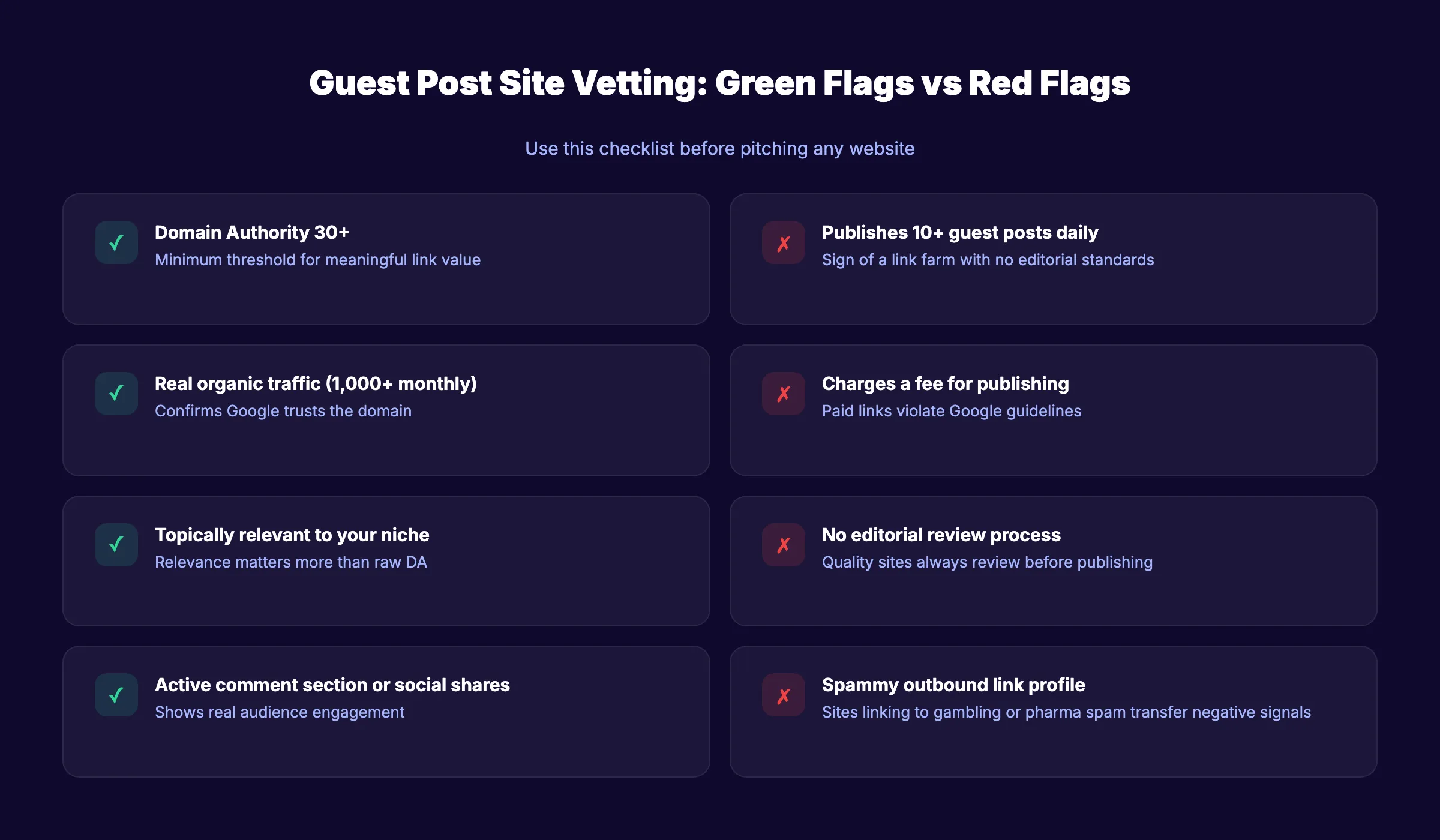
Green flags indicate a quality site worth pitching. Red flags tell you to move on.
Green flags: Real comments on posts. Social media shares. Named authors with bios. Consistent publishing schedule. Content indexed in Google.
Red flags: No editorial review. Charges a fee to publish your post. Publishes guest posts from unrelated niches. Has a “sponsored” or “paid” tag on most content. Outbound links go to suspicious sites.
How to Check Domain Authority and Traffic
Use free tools to verify site metrics quickly. Moz’s free toolbar shows DA. Ahrefs Webmaster Tools shows Domain Rating. Semrush’s free plan shows estimated traffic.
Cross-reference at least 2 tools. DA scores vary between platforms. A site showing DA 40 on Moz might show DR 35 on Ahrefs. Look for consistency.
Check the traffic trend too. A site with declining traffic signals problems. A site with stable or growing traffic is a better target. Google Search Console data is the most accurate source, but you will only have access to your own site’s data. Use third-party estimates for targets.
Relevance Matters More Than Raw Authority
A DA 35 site in your exact niche delivers more SEO value than a DA 70 site in an unrelated industry. Google weighs topical relevance heavily when evaluating backlinks.
A dental practice guest posting on a healthcare blog earns a relevant, valuable link. That same practice guest posting on a technology news site earns a link that looks unnatural. E-E-A-T signals reward topical consistency.
Match your guest posting targets to your content strategy. Every placement should reinforce what your site is about.
Chapter 4: How to Write Pitch Emails That Get Accepted {#ch4}
The average guest post outreach response rate is 8.5%. That means you need to send roughly 15 emails to land one placement. A better pitch raises that rate dramatically.
70% of bloggers say their biggest challenge is getting responses to guest post pitches. The problem is almost always the email itself.
The 5-Part Pitch Framework
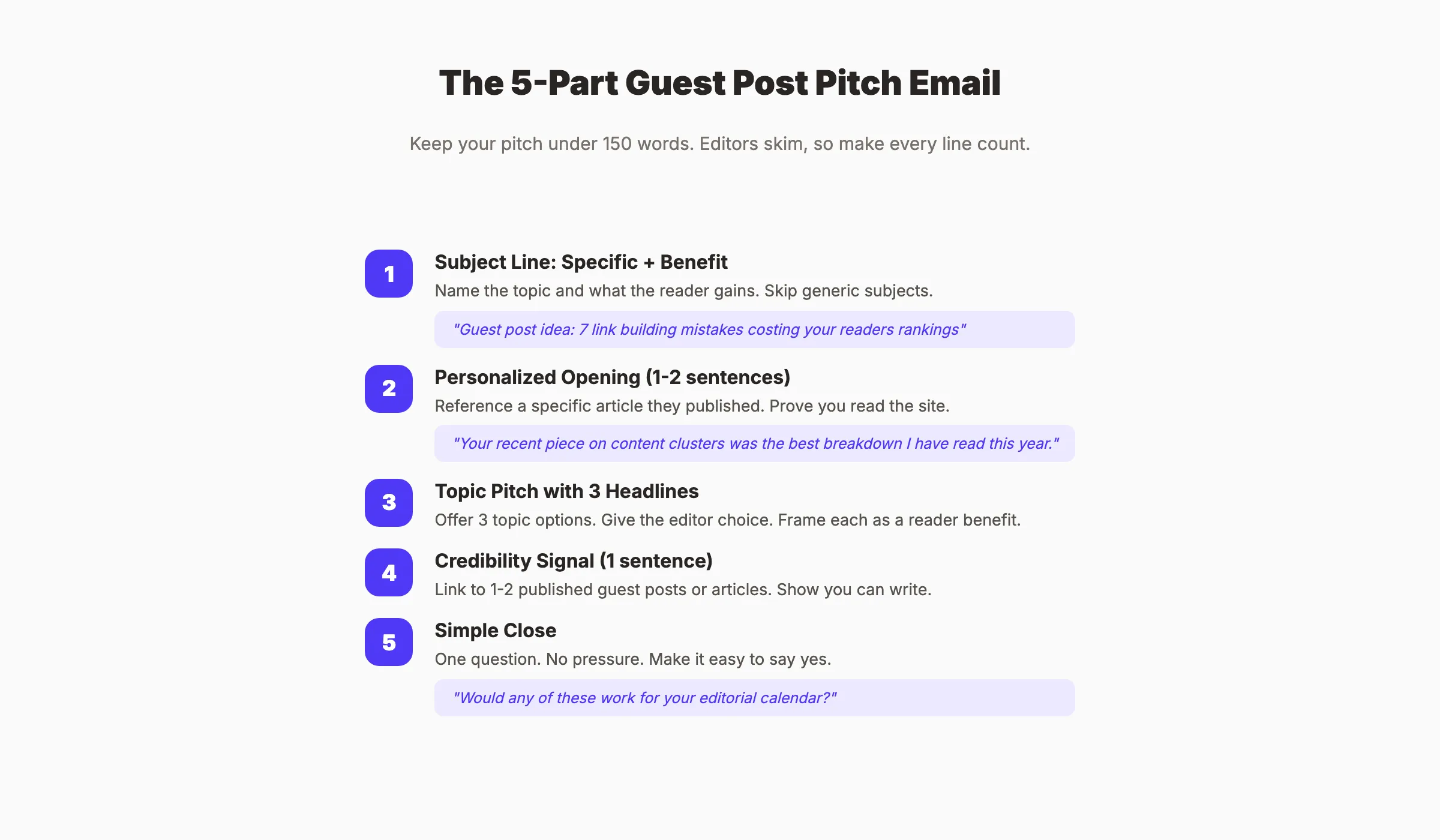
Every successful pitch email contains 5 elements. Keep the total length under 150 words. Editors skim. Make every sentence earn its place.
Part 1: Subject line. Be specific. Include the topic and a benefit. “Guest post idea: 7 keyword research mistakes costing your readers rankings” beats “Guest post inquiry” every time.
Part 2: Personalized opening. Reference a specific article they published. Prove you actually read their site. One sentence is enough.
Part 3: Topic pitch with 3 headline options. Offer 3 different topics. Give the editor a choice. Frame each headline around what their audience gains.
Part 4: Credibility signal. Link to 1-2 published articles or guest posts. Show you can write at their level.
Part 5: Simple close. Ask one question. “Would any of these work for your editorial calendar?” No pressure. Easy to say yes.
Subject Lines That Get Opened
The subject line determines whether your email gets read. Avoid generic lines like “Guest post submission” or “Collaboration opportunity.”
Subject lines that work:
- “Guest post idea: [specific topic] for [site name] readers”
- “[Number] [topic] tips I would love to write for [site name]”
- “Quick idea for [site name] , [topic] angle you have not covered”
Specificity signals effort. Generic signals spam. Editors can tell the difference in 2 seconds.
The Follow-Up Sequence
Do not give up after one email. Follow-ups improve acceptance rates by 25%. Send your first follow-up 5-7 days after the initial pitch. Keep it short. Reference your original email and add one new topic idea.
Send a maximum of 2 follow-ups. Three total emails per target. After that, move on. Persistence helps. Harassment does not.
What to Include in Your Pitch (and What to Skip)
Include: Your strongest topic ideas. Links to published work. A clear ask. Your name and site URL.
Skip: Your life story. A list of 10 topics. Excessive compliments. Requests for specific anchor text or link placement. Any mention of payment.
Editors reject 80% of pitches for poor quality or irrelevance. A clean, concise, personalized pitch puts you in the top 20% immediately.
Need a steady stream of content without the outreach grind? Stacc writes and publishes 30 SEO articles every month on autopilot. Start for $1 →
Chapter 5: How to Write Guest Posts That Earn Links {#ch5}
Getting accepted is step one. Writing a post that actually delivers SEO value and referral traffic is step two. The quality of your guest post determines whether the link helps or gets ignored.
Guest posts with original data and unique insights get 50% more engagement than average posts. Long-form guest posts of 1,500 words or more generate 77.2% more links than short-form content.
Match the Host Site’s Style and Audience
Read 5-10 recent articles on the host site before you write a single word. Study their tone, formatting, and content depth. Note the average word count, heading structure, and use of visuals.
Write for their audience, not yours. A guest post on a beginner-focused blog should not assume advanced knowledge. A post on an industry publication should not over-explain basic concepts.
Match their formatting conventions. If they use short paragraphs, write short paragraphs. If they include images every 300 words, include images every 300 words.
Write Original Content With Unique Angles
Editors reject rehashed content. They want perspectives their existing writers have not covered. Bring original data, case studies, or frameworks that add something new.
Your guest post should not read like every other article on the topic. Find an angle that is specific, opinionated, and backed by evidence. “7 link building tactics” is generic. “The link building tactic that earned us 43 backlinks in 30 days” is specific.
Original research performs best. If you have proprietary data, survey results, or case studies, lead with those. Content with first-hand experience ranks higher under Google’s E-E-A-T framework.
Structure for Readability and SEO
Use the same blog post structure principles you apply to your own content. Clear headings. Short paragraphs. Bullet points and numbered lists.
Aim for 1,500 to 2,500 words per guest post. This range gives you enough depth to be useful and enough space for natural link placement. Posts under 700 words rarely rank or earn additional shares.
Include 1-2 images per post. Posts with visuals get 94% more engagement. Screenshots, charts, and custom graphics all work. Do not use generic stock photos.
Optimize for the Host Site’s Keywords
Research keywords the host site does not currently rank for. Use Semrush’s keyword gap tool or Ahrefs’ Content Gap feature. Pitch topics that fill holes in their content coverage.
This approach benefits both sides. The host site gets content targeting new keywords. You get a guest post more likely to rank and drive long-term referral traffic to your site.
Write a strong meta description for your guest post. Many sites let guest authors suggest SEO metadata. Take advantage of that option.
Chapter 6: Link Placement Strategy for Maximum SEO Value {#ch6}
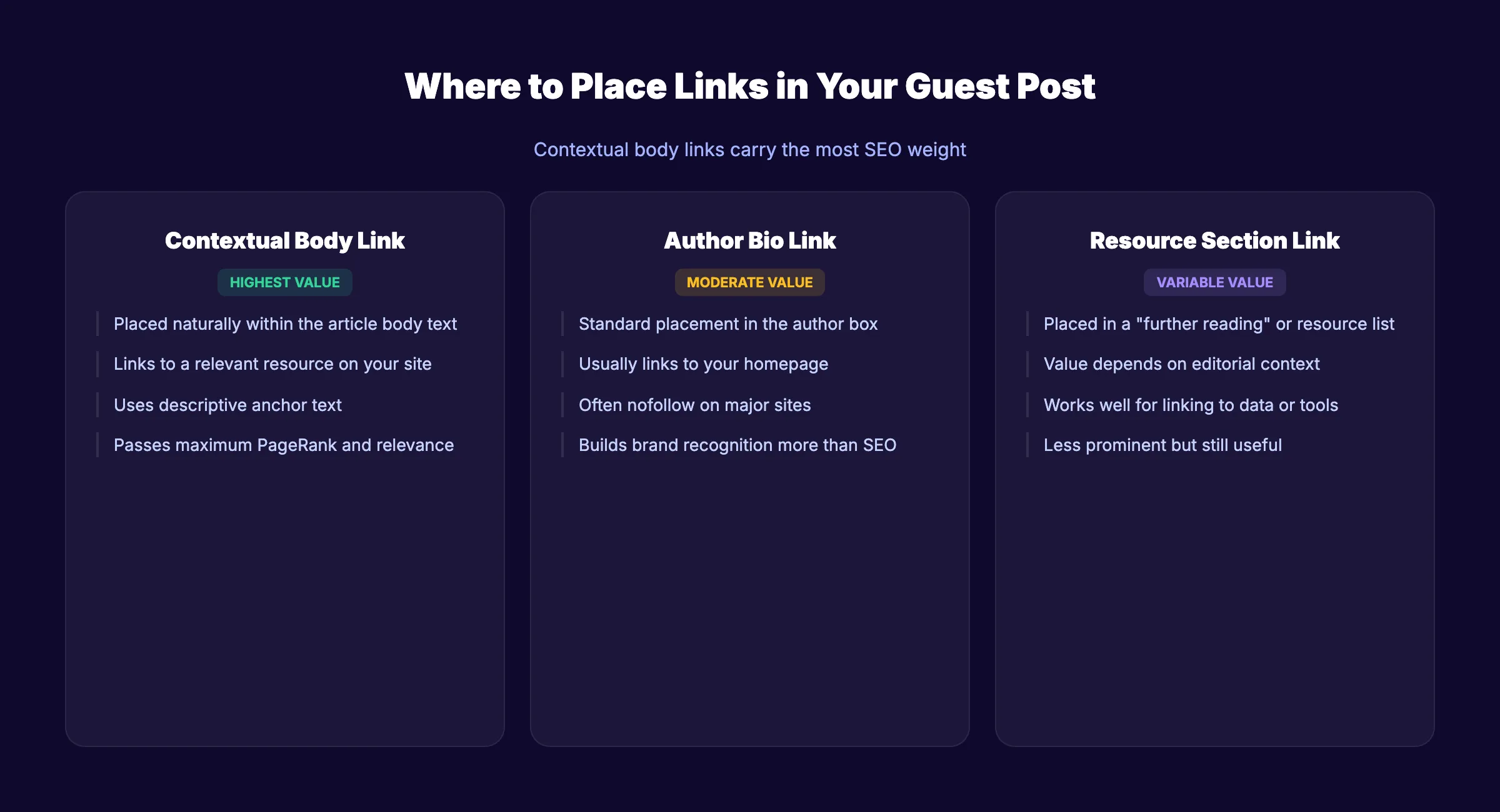
Where you place your link within a guest post matters as much as which site you publish on. Contextual links within the article body carry the most weight. Author bio links carry less.
Anchor text optimization increases SEO impact by 27%. But over-optimization triggers penalties. You need a balanced strategy.
Contextual Body Links vs Author Bio Links
A contextual body link sits naturally within the article text. It links to a relevant resource on your site because the content calls for it. Google treats these links as editorial endorsements.
An author bio link sits in the author box at the bottom of the post. It usually points to your homepage. Most high-authority sites make bio links nofollow. They still have brand value but limited SEO impact.
Always aim for at least 1 contextual body link. If the site allows 2, use the second one to link to a specific resource page, blog post, or tool on your site.
Anchor Text Best Practices
Vary your anchor text across guest posts. Never use the same exact-match keyword anchor on every placement. That pattern is the fastest way to trigger a manual penalty.
Anchor text distribution to aim for:
| Anchor Type | Example | Target Ratio |
|---|---|---|
| Branded | ”Stacc” or “thestacc.com” | 30-40% |
| Descriptive | ”this backlink building guide” | 25-35% |
| Naked URL | ”thestacc.com/blog/example” | 10-15% |
| Exact match keyword | ”guest posting” | 5-10% |
| Generic | ”read more here” | 10-15% |
Keep exact match anchors under 10% of your total profile. A natural link profile has variety. An unnatural one repeats the same phrase.
Link to Your Best Assets
Do not waste guest post links on your homepage. Link to your highest-value pages instead.
Good link targets include pillar content, data-driven blog posts, free tools, and in-depth guides. These pages convert visitors and attract additional links on their own.
Each guest post link should point to a different page on your site. Spreading links across multiple URLs builds authority across your entire domain, not just one page.
Your blog content is your best link magnet. Stacc creates the SEO-optimized posts that guest post links should point to. Start for $1 →
Chapter 7: How to Scale Guest Posting Without Losing Quality {#ch7}
Publishing 1 guest post per month moves the needle slowly. Publishing 4-8 per month builds serious momentum. The challenge is scaling without sacrificing the quality that makes guest posting work.
Agencies that maintain 4-8 high-quality guest posts per month per client see the best results. Going above that pace without a process leads to shortcuts that trigger penalties.
Build a Repeatable Weekly Workflow
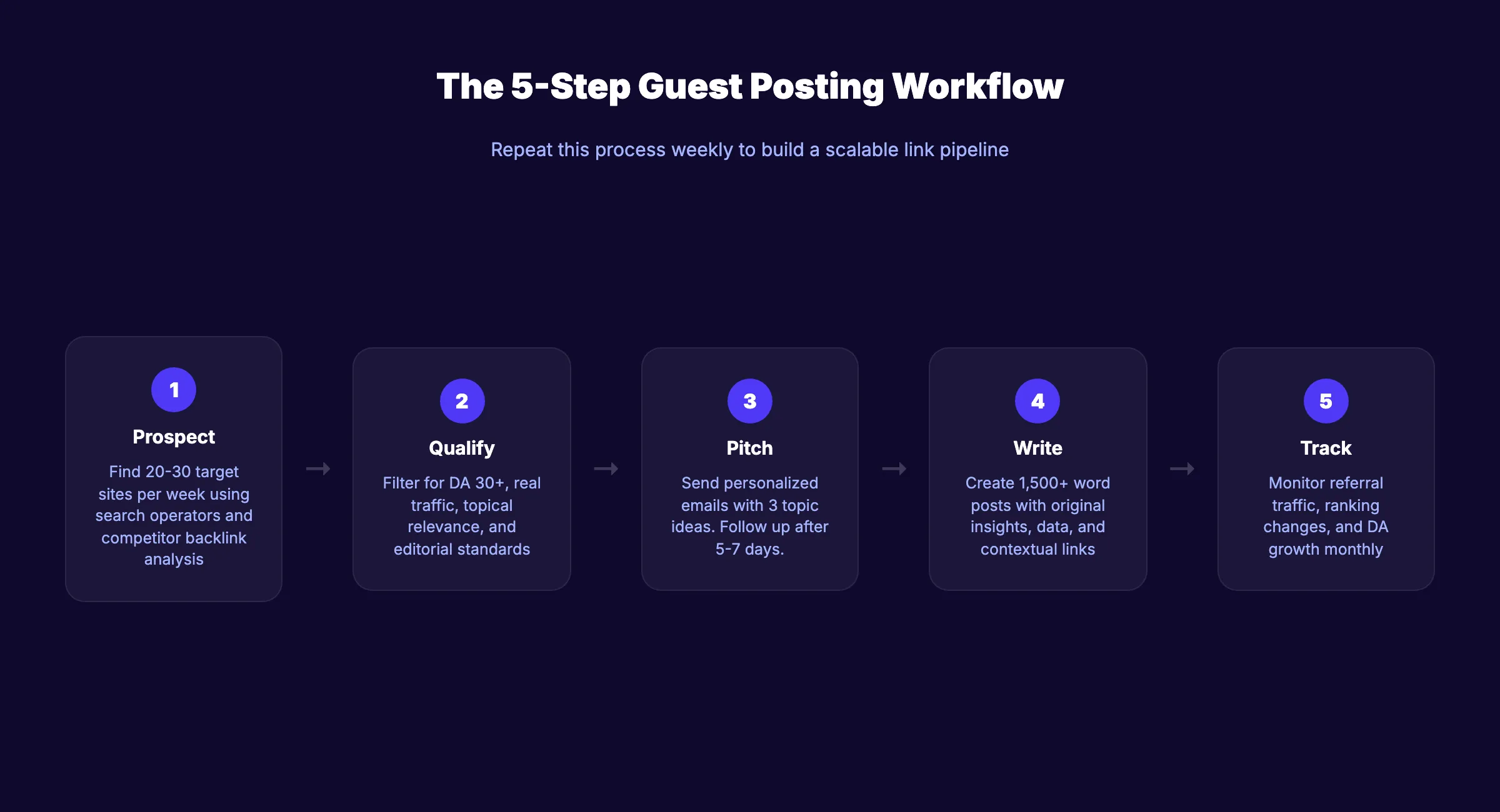
Break guest posting into 5 discrete steps. Assign each step to a specific day or time block. This prevents bottlenecks and keeps the pipeline full.
Monday: Prospect 20-30 new sites using search operators and competitor backlink data. Add to your master spreadsheet.
Tuesday: Qualify and vet the new prospects. Run DA checks, traffic verification, and relevance scoring. Remove sites that do not pass.
Wednesday-Thursday: Send personalized pitches to 10-15 qualified targets. Follow up on pitches from the previous week.
Friday: Write and submit accepted guest posts. Track all placements in your spreadsheet.
Use Templates Without Sounding Templated
Create base templates for your pitch emails. But customize at least 3 elements per email: the site name, a specific article reference, and the topic ideas.
A template saves time on structure. Personalization saves your pitch from the trash folder. 40% higher acceptance comes from personalized pitches. That number justifies the extra 5 minutes per email.
Save your best-performing subject lines and pitch angles. Track open rates and response rates if your email tool supports it. Double down on what works.
Track Everything in a Central Spreadsheet
Your guest posting spreadsheet should track 8 columns minimum:
- Site name and URL
- Domain Authority and monthly traffic
- Contact name and email
- Pitch date and status (sent, accepted, rejected, no response)
- Follow-up dates
- Published URL
- Link target (which page on your site)
- Anchor text used
This spreadsheet becomes your most valuable asset. It prevents duplicate pitches, reveals your acceptance rate, and shows which site types convert best.
When to Outsource (and When Not To)
Outsource prospecting and initial qualification first. These tasks are process-driven and easy to delegate. A virtual assistant can run search operators and fill your spreadsheet.
Do not outsource writing until you have a proven writer who matches your quality standard. Bad guest post content burns bridges with editors. Only 25% of guest contributions meet quality standards at major outlets.
Outsource pitching last. Your personal relationships and credibility drive acceptance rates. A generic VA pitch performs worse than your own personalized email.
Chapter 8: Common Mistakes and Google Penalties to Avoid {#ch8}
Google does not penalize guest posting. Google penalizes manipulative link schemes that use guest posts as the vehicle. Understanding the line keeps your site safe.
In 2024, Google’s spam team updated their link spam guidelines to specifically call out “large-scale guest posting campaigns” as a potential violation. The keyword is “large-scale.” Quality at scale is fine. Spam at scale is not.
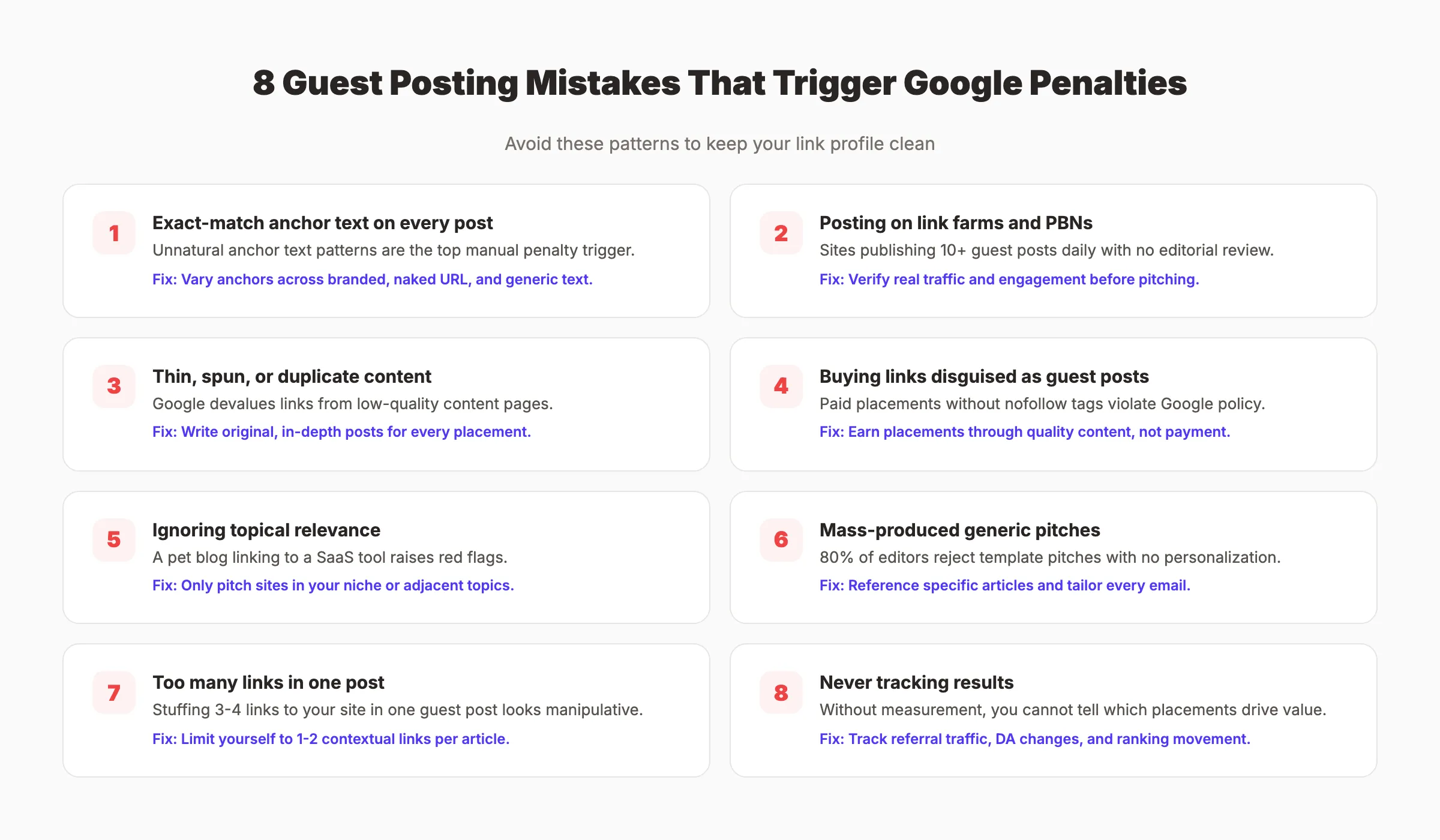
The 8 Mistakes That Trigger Penalties
These are the patterns that get sites penalized. Avoid every one.
1. Exact-match anchor text on every post. If every guest post links to your page with the phrase “best SEO tools,” Google sees it. Vary your anchors.
2. Publishing on link farms and PBNs. Sites that publish 10 or more guest posts daily with no editorial review are link farms. Google knows which sites these are.
3. Thin, spun, or duplicate content. Guest posts under 500 words with no original insight signal a link scheme. Write substantial, unique content for every placement.
4. Buying links disguised as guest posts. Paying a site to publish your post with a dofollow link violates Google’s guidelines. If you pay, the link must be nofollow or sponsored.
5. Ignoring topical relevance. A dental site guest posting on a cryptocurrency blog raises red flags. Stick to your niche and adjacent topics.
6. Mass-produced generic pitches. Sending the same email to 500 sites is not guest posting. It is spam. Personalize every pitch.
7. Too many links in one post. One to 2 contextual links per post is standard. Three or more links to your own site in a single article looks manipulative.
8. Never tracking results. Without measurement, you repeat mistakes. Track every placement and its impact.
How to Recover From a Link Penalty
If you receive a manual action for unnatural links, take these steps. First, audit your entire backlink profile. Identify every guest post link that looks manipulative.
Request link removal from the site owners. Use Google’s Disavow Tool for links you cannot get removed. Then submit a reconsideration request through Google Search Console.
Recovery takes 2-6 months. Prevention is always cheaper than recovery. Build your guest posting process on quality from the start.
The Safe Guest Posting Framework
Follow these rules and you will never face a penalty:
- Publish on relevant, editorially managed sites only
- Write original, in-depth content for every placement
- Vary anchor text across branded, descriptive, and generic phrases
- Limit links to 1-2 per guest post
- Never pay for dofollow link placements
- Space guest posts naturally (do not publish 20 in one week)
- Track and audit your link profile quarterly
Focus on your business while your content works for you. Stacc publishes SEO-optimized blog posts that build authority the right way. Start for $1 →
Chapter 9: How to Measure Guest Posting ROI {#ch9}
Guest posting takes time. Each post requires 10-15 hours of research, pitching, and writing. You need to measure whether that investment pays off. Without data, you are guessing.
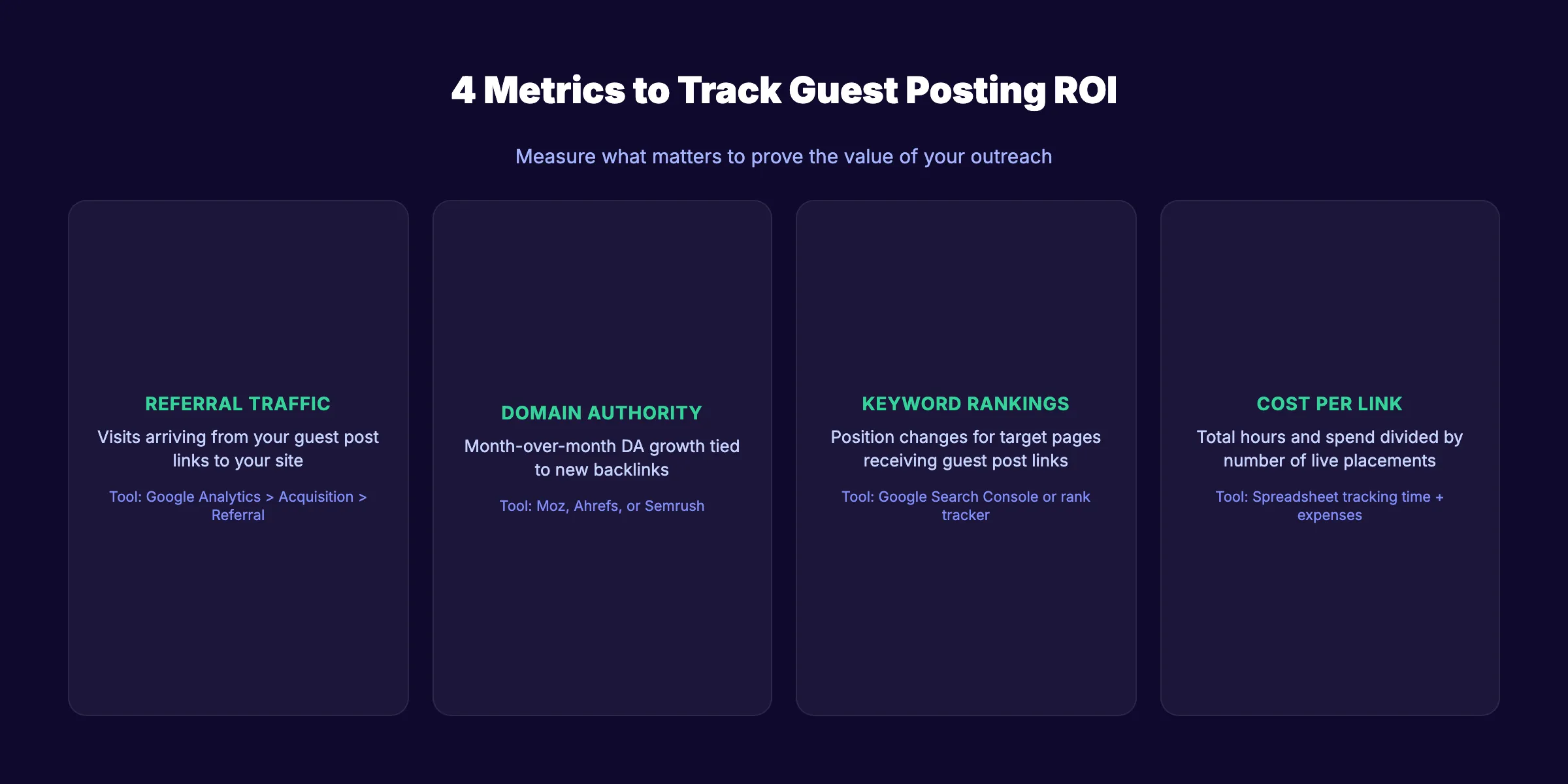
Track 4 metrics to evaluate your guest posting program. Each tells you something different about the value of your placements.
Metric 1: Referral Traffic
Open Google Analytics. Move through to Acquisition, then Referral traffic. Filter for the domains where you published guest posts. This shows exactly how many visitors each placement sent to your site.
Good guest posts on high-traffic sites send 50-200 referral visits per month. Posts on smaller niche sites send 10-50. Both have value. The high-traffic posts drive awareness. The niche posts drive qualified leads.
Track referral traffic monthly for each placement. Some guest posts generate traffic for years. Others peak in the first week and drop off. This data shapes your future targeting decisions.
Metric 2: Domain Authority Growth
Check your domain authority monthly using Moz, Ahrefs, or Semrush. Compare your DA trend to the number of guest post backlinks you earn each month.
Sites using guest posting consistently see a 22% DA increase within 6 months. That growth compounds. Higher DA makes every future piece of content on your site rank faster.
Track DA alongside your backlink count. When both rise together, your guest posting program is working.
Metric 3: Keyword Ranking Changes
Guest post backlinks point to specific pages on your site. Monitor the keyword rankings for those pages using Google Search Console or a rank tracking tool.
After earning a guest post link, watch the target page for 30-60 days. You should see ranking improvements within that window if the link carries real value. Pages receiving guest post backlinks improve rankings by an average of 38%.
If a placement does not move rankings after 60 days, the link may be devalued. Check whether the page still exists and whether the link is dofollow.
Metric 4: Cost Per Link
Calculate the true cost of each guest post link. Include your time (or your team’s time), any tool subscriptions used for prospecting, and any costs for content creation.
Divide total monthly spend by the number of live guest post placements. A healthy cost per link ranges from $100 to $500 depending on site quality. If your cost per link exceeds $500, look for efficiency gains in your prospecting or pitching process.
Chapter 10: Guest Posting vs Other Link Building Methods {#ch10}
Guest posting is one of many link building strategies. It works best as part of a balanced approach. Here is how it compares to the other major methods.
Understanding the strengths and weaknesses of each method helps you allocate time and budget where it produces the most backlinks.
Guest Posting vs Digital PR
Digital PR earns links through news coverage, data studies, and media mentions. The links are typically higher authority (DA 70+) but harder to control and slower to acquire.
Guest posting gives you more control. You choose the topic, write the content, and place the links. Digital PR depends on journalist interest and news cycles. Use both if your budget allows.
Guest Posting vs Broken Link Building
Broken link building finds dead links on other sites and offers your content as a replacement. It is cheaper per link but harder to scale. You need a large content library to match broken link contexts.
Guest posting scales more predictably. You control the pipeline volume by adjusting how many pitches you send each week. Broken link building depends on finding enough dead links.
Guest Posting vs HARO and Connectively
HARO (now Connectively) connects journalists with expert sources. Responses can earn links from major publications. The cost is zero beyond your time. But response rates are low and you have no control over link placement or anchor text.
Guest posting offers higher control and more consistent results. HARO earns occasional high-authority wins. Use HARO as a supplement to guest posting, not a replacement.
The Comparison at a Glance
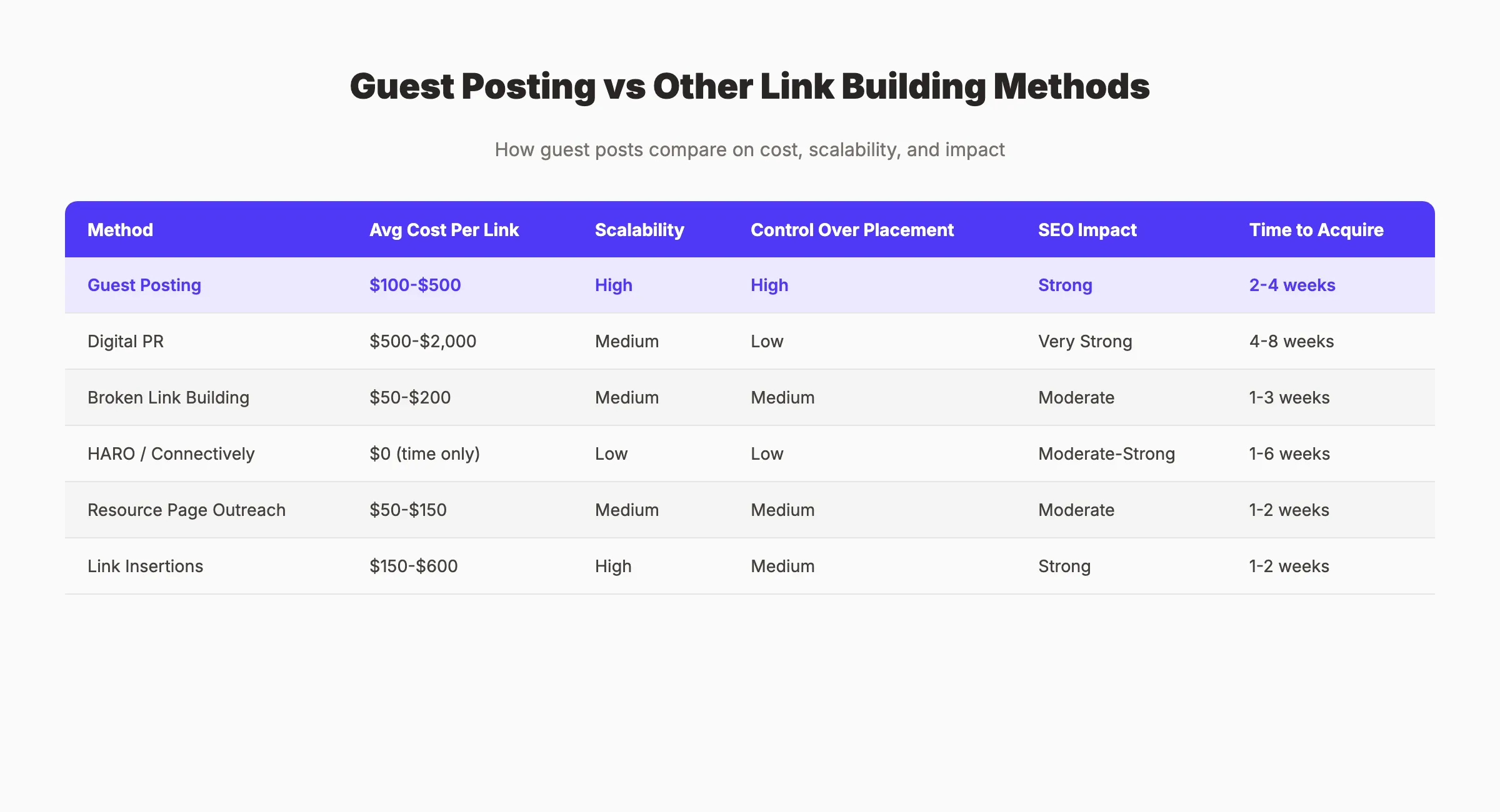
The Best Approach: A Balanced Mix
The strongest link profiles combine multiple methods. Guest posting builds the predictable base. Digital PR adds occasional high-authority spikes. Broken link building and HARO fill gaps.
Allocate 50-60% of your link building budget to guest posting. Use the remaining 40-50% across other methods. This balance gives you consistency and upside.
Pair your off-page link building with strong on-page SEO. Links to poorly optimized pages waste their value. Make sure every page receiving a guest post link is optimized for its target keyword.
Let Stacc handle the content. You handle the links. 30 SEO-optimized blog posts every month give guest post links something to point to. Start for $1 →
Frequently Asked Questions
Is guest posting still effective for SEO in 2026?
Yes. Guest posting remains one of the most effective link building strategies. 65% of marketers rank it as their top method for earning backlinks. Sites with 50 or more guest post backlinks rank in the top 10 search results 75% of the time. The key is quality over quantity. Publish on relevant, authoritative sites with real editorial standards.
How many guest posts should I publish per month?
Aim for 4-8 high-quality guest posts per month. This pace builds meaningful backlink momentum without sacrificing content quality. Going above 8 per month requires a dedicated team and strong processes. One excellent guest post on a DA 60 site delivers more value than 10 mediocre posts on DA 20 sites.
Does Google penalize guest posting?
Google does not penalize legitimate guest posting. Google penalizes manipulative link schemes that use guest posts as the vehicle. Paid link placements, exact-match anchor text spam, and publishing on link farms trigger penalties. Quality guest posts on relevant sites with natural anchor text are safe and effective.
How long does it take to see results from guest posting?
Expect to see ranking improvements within 30-60 days of a guest post going live. Referral traffic appears immediately. Domain Authority growth takes 3-6 months of consistent effort. The compound effect means results accelerate over time. Month 6 delivers more impact than month 1.
What is a good response rate for guest post outreach?
The industry average is 8.5%. A well-targeted, personalized campaign can achieve 15-25%. If your response rate is below 5%, your targeting or pitch quality needs improvement. Track response rates by site type to identify which segments convert best.
Should I pay for guest post placements?
No. Paying for dofollow guest post links violates Google’s guidelines. If you pay, the link must include a nofollow or sponsored attribute. Earned placements through quality content carry more SEO value and zero penalty risk. The backlink statistics are clear: earned links outperform purchased ones.
Guest posting is a skill. Like any skill, it improves with practice and repetition. Start with 5 pitches this week. Refine your process based on what works. Build from there.
The sites that rank highest on Google did not get there by accident. They built backlinks deliberately. Guest posting is the most controllable way to do exactly that.
Ready to build the content foundation that earns links? Stacc publishes 30 SEO blog posts every month. Your job is to point backlinks at them. Start for $1 →

Written by
Siddharth GangalSiddharth is the founder of theStacc and Arka360, and a graduate of IIT Mandi. He spent years watching great businesses lose organic traffic to competitors who simply published more. So he built a system to fix that. He writes about SEO, content at scale, and the tactics that actually move rankings.
30 SEO blog articles published every month
Keyword-optimized, scheduled, and live on your site. Automatically.
30-day trial · Cancel anytime
theStacc
Stop writing SEO content manually
30 blog articles, 30 GBP posts, and social media content. Published every month. Automatically.
Start Your $1 Trial$1 for 3 days · Cancel anytime