
Social Media for B2B Companies (2026): Guide
social media for b2b companies guide for 2026: strategies, tactics, real examples, and implementation steps to get results faster.
Most B2B companies treat social media like an afterthought. They post a company update once a week, get 12 likes from employees, and call it a strategy.
That approach wastes time and budget. 75% of B2B buyers now use social media to evaluate vendors before talking to sales. 84% of C-suite executives say social platforms influence their purchasing decisions. The companies that ignore social media for B2B companies lose deals to competitors who show up in feeds, comments, and search results.
This guide covers everything you need to run social media for B2B companies. Not generic advice. Specific platforms, content types, and metrics that map to pipeline revenue.
We publish 3,500+ blogs across 70+ industries and manage content marketing strategies for B2B companies every month. This guide reflects what we see working right now.
Here is what you will learn:
- Why B2B social media requires a different playbook than B2C
- Which platforms generate the most B2B leads in 2026
- The 6 content types that build trust and drive pipeline
- How to structure an organic and paid social strategy
- The exact metrics to measure B2B social media ROI
- The 7 mistakes that kill B2B social media programs
Why Social Media for B2B Companies Works Differently
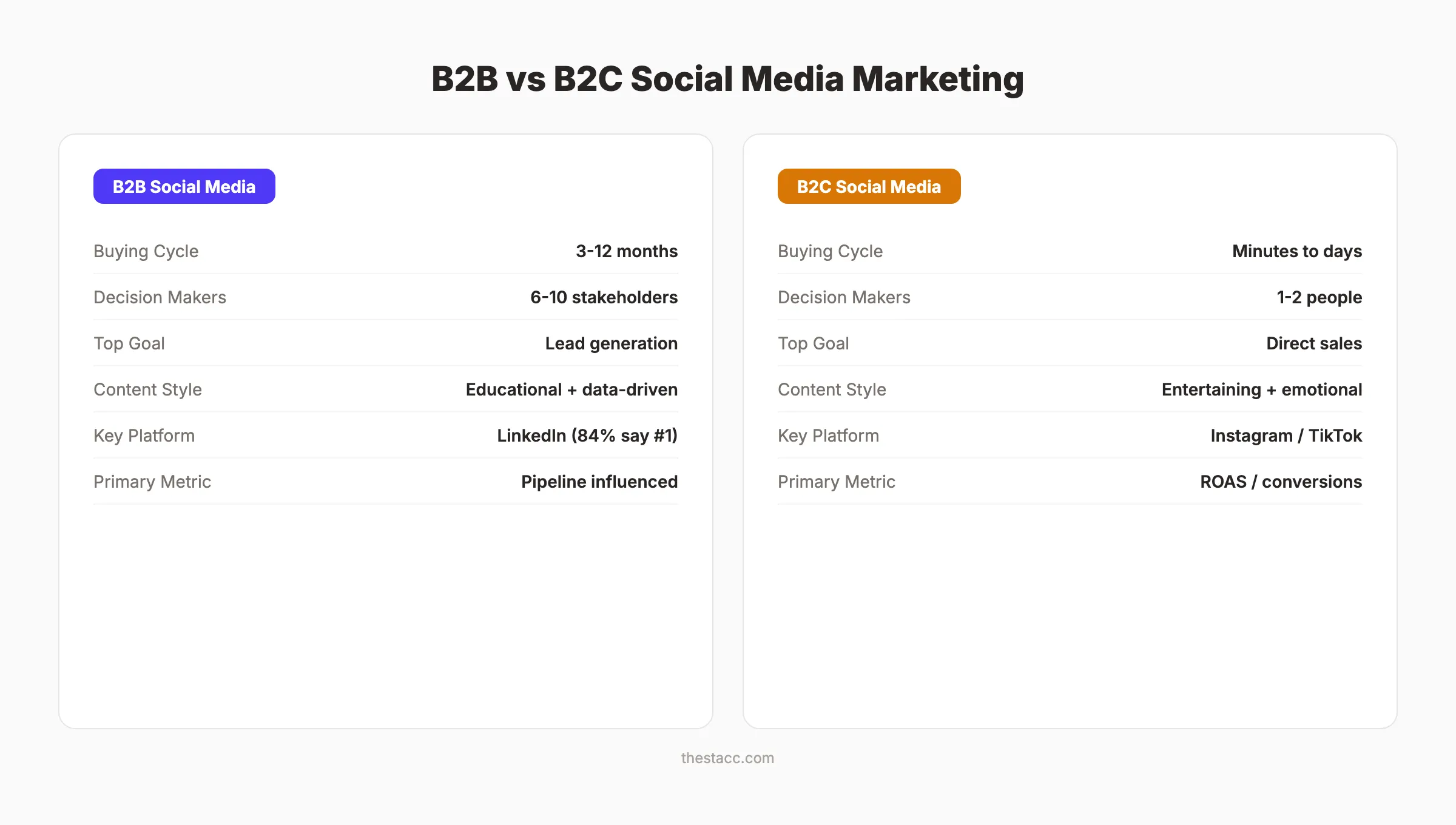
B2C brands sell to individuals making fast, emotional decisions. A B2B buyer makes slow, rational decisions with 6 to 10 stakeholders involved. That difference changes everything about your social media approach.
The B2B Buying Cycle Is Longer
The average B2B purchase takes 3 to 12 months from first touch to signed contract. Social media content must nurture relationships over that entire period. One viral post does not close a deal. Consistent presence across multiple touchpoints does.
B2C brands optimize for immediate conversions. B2B brands optimize for trust. That means your content calendar needs to map posts to different stages of the buying journey, not just publish whatever performs on vanity metrics.
Multiple Decision Makers See Your Content
A single B2B deal involves an average of 6.8 decision makers according to Gartner research. Your social content reaches the marketing director, the CFO, the IT lead, and the end user. Each one evaluates your credibility independently.
This is why thought leadership matters more in B2B than product promotion. When a CFO sees your CEO sharing original data on LinkedIn, it builds confidence. When they see only product screenshots and promotional posts, it signals desperation.
Social Signals Support SEO Performance
Social media does not directly influence search rankings. But it creates the conditions that do. Shares drive referral traffic. Brand mentions trigger branded search volume. Content distribution generates backlinks from people who discover your work through social feeds.
We covered this connection in depth in our guide on whether social media helps SEO. The short version: B2B companies that combine social distribution with consistent blog publishing see 2 to 3 times faster topical authority growth.
The Trust Gap Is Larger
B2B purchases carry higher stakes. A bad SaaS vendor costs a company months of implementation time and hundreds of thousands of dollars. Buyers use social media to reduce that risk by evaluating the people behind the company.
E-E-A-T signals matter here. Google evaluates expertise, experience, authoritativeness, and trustworthiness. Social media profiles that demonstrate genuine industry knowledge contribute to those signals, both for search engines and for human buyers.
Your content compounds. Every article stacks on the last. Stacc publishes 30 SEO-optimized articles per month for B2B companies, starting at $99. Start for $1 →
Best Social Media Platforms for B2B Companies
Not every platform deserves your time. B2B buyers cluster on specific networks. Focus your resources where your audience already spends attention.
LinkedIn: The Dominant B2B Platform
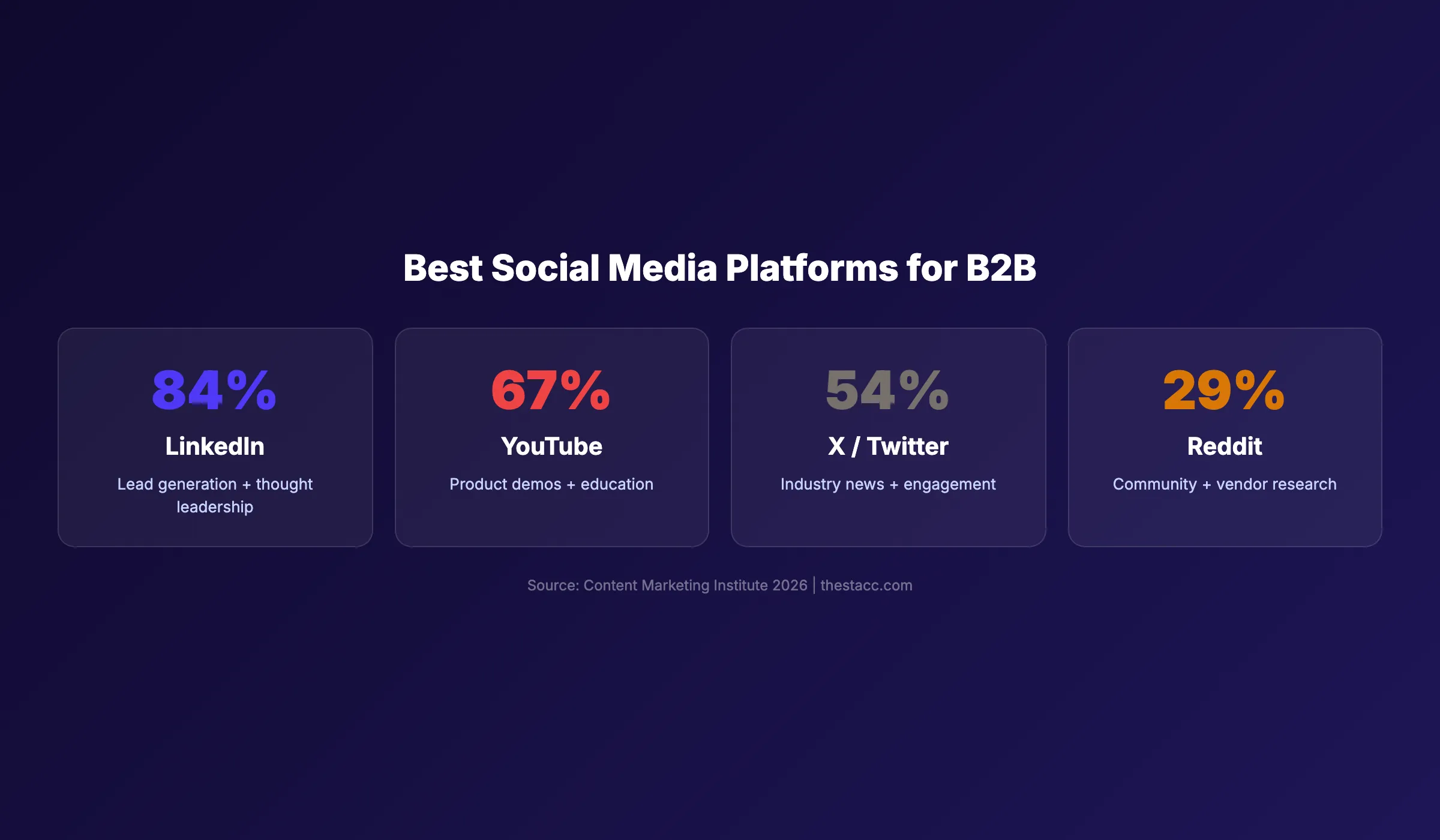
84% of B2B marketers say LinkedIn delivers the most value among organic social channels, according to the Content Marketing Institute. No other platform comes close.
LinkedIn works for B2B because the audience is already in a professional mindset. They open the app to learn, network, and evaluate vendors. The algorithm rewards long-form text posts, document carousels, and native video.
| LinkedIn B2B Metric | Value |
|---|---|
| B2B marketers who use it | 89% |
| Marketers who say it generates leads | 62% |
| Average ROI on paid social | 192% |
| Lead-gen ad conversion rate | 6.1% |
| Organic post reach (company page) | 2-5% of followers |
The platform also offers the most precise B2B targeting available. You can filter by job title, company size, industry, seniority level, and even specific companies. That precision makes both organic and paid strategies more efficient.
YouTube: The B2B Search Engine
67% of B2B marketers now use YouTube as part of their social strategy. 29% of enterprise buyers search YouTube for product demos and reviews before contacting a sales team.
YouTube functions as a search engine, not just a social platform. B2B buyers type questions like “best CRM for manufacturing companies” or “how to implement zero trust security” directly into YouTube search. If your company publishes helpful video content, you capture those searches.
The best B2B YouTube strategies focus on education. Product demos, how-to tutorials, customer testimonials, and industry analysis all perform well. Short-form content under 3 minutes works for awareness. Long-form content between 8 and 15 minutes works for consideration-stage buyers.
You can repurpose blog content into social media posts and video scripts. A single 3,000-word blog post can become 5 to 8 YouTube Shorts, 3 LinkedIn carousels, and 1 long-form video.
X (Twitter): Industry Conversations in Real Time
54% of B2B marketers maintain a presence on X. The platform works best for real-time industry commentary, product announcements, and engaging with analysts and journalists.
X rewards frequency and personality. B2B brands that post 3 to 5 times per day with a mix of original takes, data points, and replies to industry conversations outperform brands that post once a day with generic updates.
The exception: X is less effective for lead generation than LinkedIn. Use it for brand awareness and relationship building, not for driving form fills.
Reddit: The Hidden B2B Research Hub
87% of B2B executives use platforms like Reddit to vet vendors before talking to sales. Reddit threads appear in Google search results and AI-generated answers. If your brand has no presence in relevant subreddits, you are invisible to a growing share of buyer research.
Reddit requires a fundamentally different approach. Direct promotion gets downvoted immediately. The winning strategy is genuine participation: answering questions, sharing expertise, and contributing to conversations without linking back to your product.
The platform also offers surprisingly affordable advertising. Reddit CPCs range from $0.50 to $4.00, compared to $5 to $15 on LinkedIn. For B2B companies with limited budgets, Reddit ads can extend reach at a fraction of the cost.
If your company operates in SaaS, cybersecurity, developer tools, or IT services, Reddit is especially valuable. Technical buyers spend significant time on subreddits related to their field.
Platform Selection Framework
Do not try to be everywhere. Pick 2 to 3 platforms based on where your specific buyers spend time.
| Company Type | Primary Platform | Secondary Platform |
|---|---|---|
| B2B SaaS | YouTube | |
| Professional Services | X (Twitter) | |
| IT / Developer Tools | ||
| Manufacturing / Industrial | YouTube | |
| Marketing / Agencies | X (Twitter) |
B2B Social Media Content That Generates Leads
Posting company news and press releases does not generate leads. B2B buyers want content that helps them do their jobs, understand trends, and make better decisions.
Thought Leadership Posts
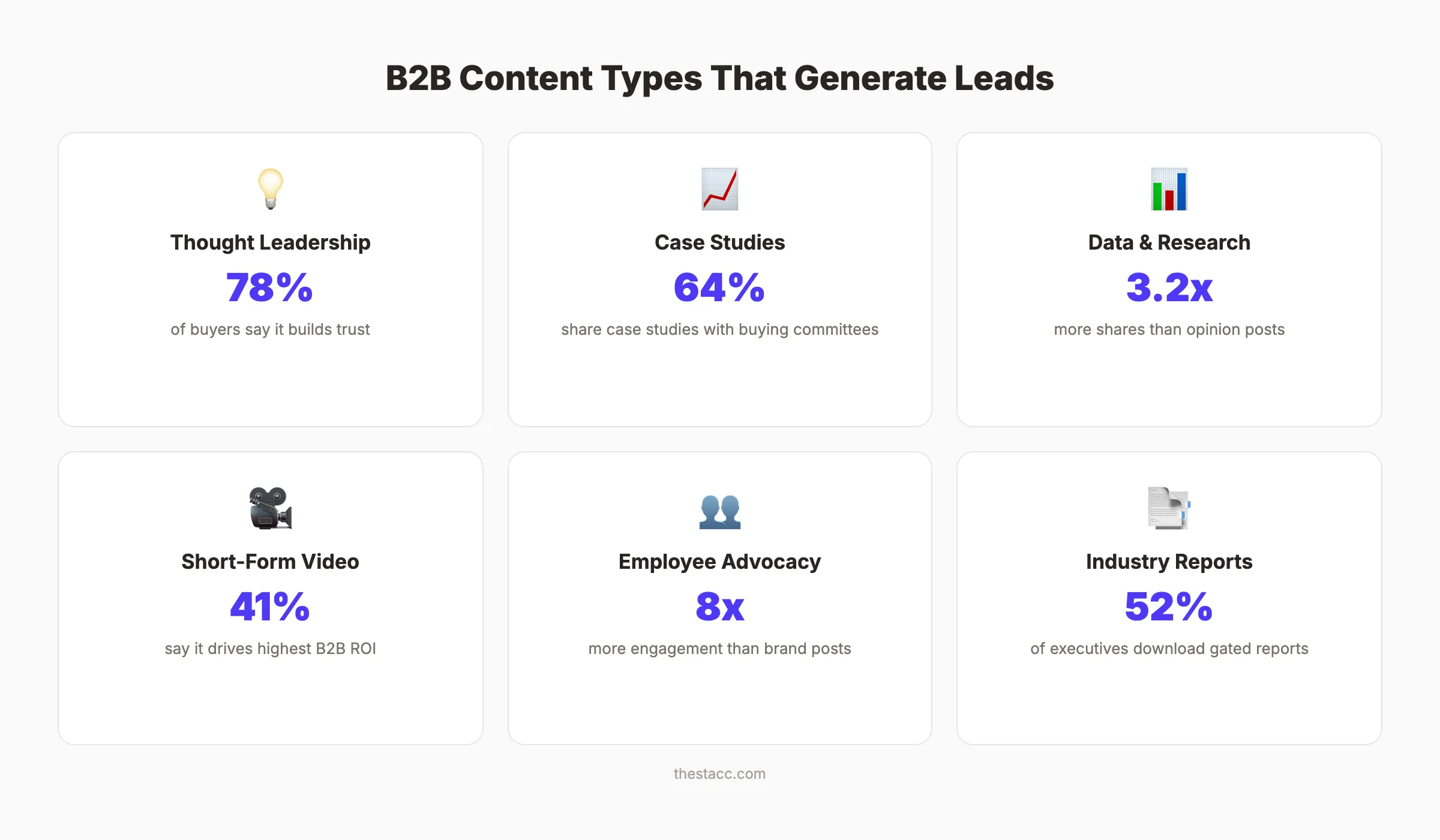
78% of B2B buyers say thought leadership content directly influences their trust in a vendor. But most companies confuse thought leadership with self-promotion.
Real thought leadership shares a genuine point of view. It challenges conventional thinking. It presents original data or a unique framework. It names a problem that the industry ignores.
Examples that work on LinkedIn:
- A CEO sharing lessons from a failed product launch
- A VP of Engineering explaining why they chose one architecture over another
- A CFO breaking down the real cost of a business decision with actual numbers
The key is specificity. “We believe in innovation” is not thought leadership. “We cut our customer acquisition cost by 34% by doing X instead of Y” is.
Case Studies and Customer Stories
64% of B2B buyers share case studies with their internal buying committees. A well-structured case study gives every stakeholder a reason to say yes.
The social media version of a case study is not a link to a PDF. It is a short, compelling story posted natively on the platform. Format it as: Problem the customer faced, approach you took together, measurable result achieved.
Use specific numbers. “We helped a client grow revenue” means nothing. “We helped a 50-person logistics company increase organic traffic by 312% in 8 months” means everything.
Original Data and Research
Data posts get 3.2 times more shares than opinion posts on LinkedIn. Original research is the single most effective content type for earning backlinks and building topical authority.
You do not need a massive research budget. Survey your customers. Analyze your own data. Pull insights from your product usage metrics. Any proprietary data point is more valuable than resharing someone else’s study.
Our content marketing statistics guide covers the data that matters. When you share original numbers, you become a source that others cite. That drives inbound links, brand mentions, and referral traffic.
Short-Form Video
41% of B2B marketers say short-form video drives the highest ROI among all video formats. HubSpot’s 2026 Social Media Trends Report confirms that video now outperforms static content across every B2B platform.
Effective B2B short-form video includes:
- 60-second product walkthroughs
- Quick data breakdowns with on-screen text
- Customer testimonial clips
- “Day in the life” content from team members
- Industry trend reactions
Keep production simple. A smartphone, good lighting, and clear audio work better than overproduced corporate videos. Authenticity outperforms polish in B2B social content.
Employee Advocacy Content
Employee posts receive 8 times more engagement than company page posts. This is the single biggest untapped channel for most B2B companies.
When your sales team, engineers, and executives post about their work, it reaches their personal networks. Those networks include potential buyers, partners, and recruits. The content feels personal rather than corporate, which builds trust faster.
Start with a small program. Identify 5 to 10 employees who are already active on LinkedIn. Provide them with content ideas, key messages, and permission to share their genuine experiences. Do not script their posts. Give them themes and let them write in their own voice.
Industry Reports and Gated Content
52% of B2B executives download gated reports that address their specific challenges. Social media is the distribution channel that drives those downloads.
Post a compelling data point from the report as a native social post. Include 2 to 3 key findings that create curiosity. Then link to the landing page where readers can download the full report in exchange for their email.
This approach bridges social media and lead generation directly. Every download becomes a qualified lead in your CRM.
Done-for-you content that ranks. Stacc handles blog publishing, social posts, and local SEO for B2B companies on autopilot. Start for $1 →
How to Build a B2B Social Media Strategy
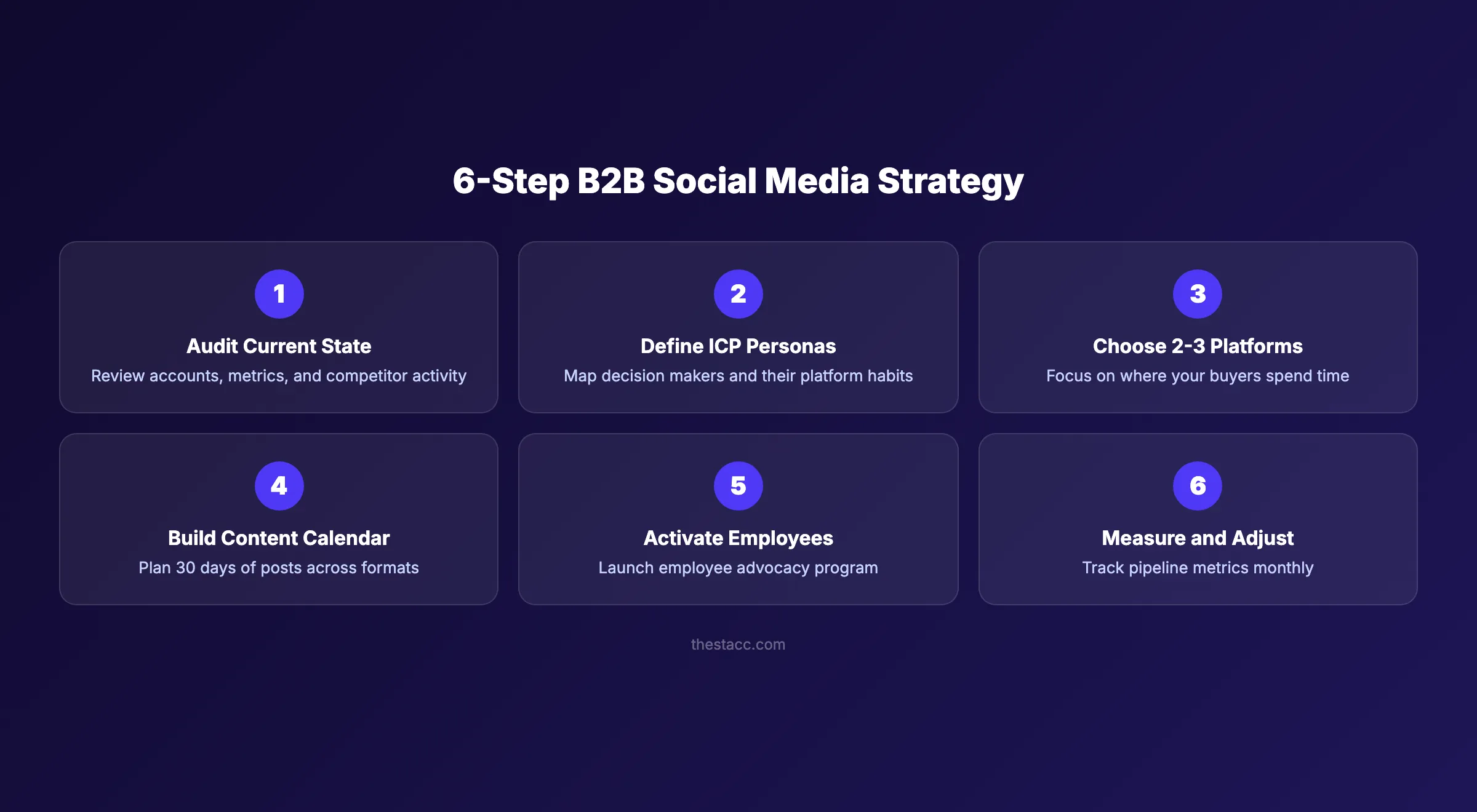
A strategy is not a posting schedule. It is a system that connects social activity to business outcomes. Here is the 6-step framework.
Step 1: Audit Your Current State
Before building anything new, document where you stand. Review every social account your company owns. Record follower counts, engagement rates, posting frequency, and top-performing content from the past 90 days.
Audit your competitors too. Identify 3 to 5 competitors and analyze what they post, how often, and what gets engagement. Look for gaps they miss. Those gaps become your opportunity.
Step 2: Define Your ICP Personas
Map your ideal customer profile to specific social behaviors. A VP of Marketing at a mid-market SaaS company uses LinkedIn differently than a CTO at a manufacturing firm.
Document for each persona:
- Which platforms they use daily
- What content formats they engage with
- Which industry influencers they follow
- What questions they ask online
- What stage of the buying journey they are in
This persona mapping determines your platform selection, content mix, and posting cadence. If you have not already defined your ICP, our guide on content marketing strategy covers the process.
Step 3: Choose 2 to 3 Platforms
Spreading across 5 platforms with mediocre content loses to dominating 2 platforms with excellent content. Use the platform selection framework from the previous section.
Commit to your chosen platforms for at least 6 months before evaluating. Social media compounds over time. Switching platforms every quarter prevents the audience growth that drives results.
Step 4: Build a Content Calendar
Plan 30 days of content at a time. Map each post to a content pillar, a buying journey stage, and a content format.
A strong B2B content calendar includes:
- 40% educational content (how-to posts, data, industry analysis)
- 25% thought leadership (opinions, frameworks, predictions)
- 20% social proof (case studies, testimonials, results)
- 15% promotional (product updates, events, CTAs)
Use scheduling tools to batch content creation. You can plan and write an entire month of social posts in 2 to 3 focused sessions.
Our guide on building a content calendar for SEO covers the planning process in detail.
Step 5: Activate Employee Advocacy
Launch your employee advocacy program in the first month. Do not wait until your company page is “ready.” Employee content outperforms brand content from day one.
- Identify 5 to 10 willing participants
- Create a shared content theme calendar
- Provide 3 to 5 content prompts per week
- Set a minimum goal of 2 posts per person per week
- Track engagement and share top-performing examples
Step 6: Measure and Adjust Monthly
Review performance against business metrics, not vanity metrics. Likes and impressions feel good but do not predict revenue. Track the metrics that connect social activity to pipeline.
We cover the specific metrics in the ROI section below.
Organic vs Paid Social Media for B2B
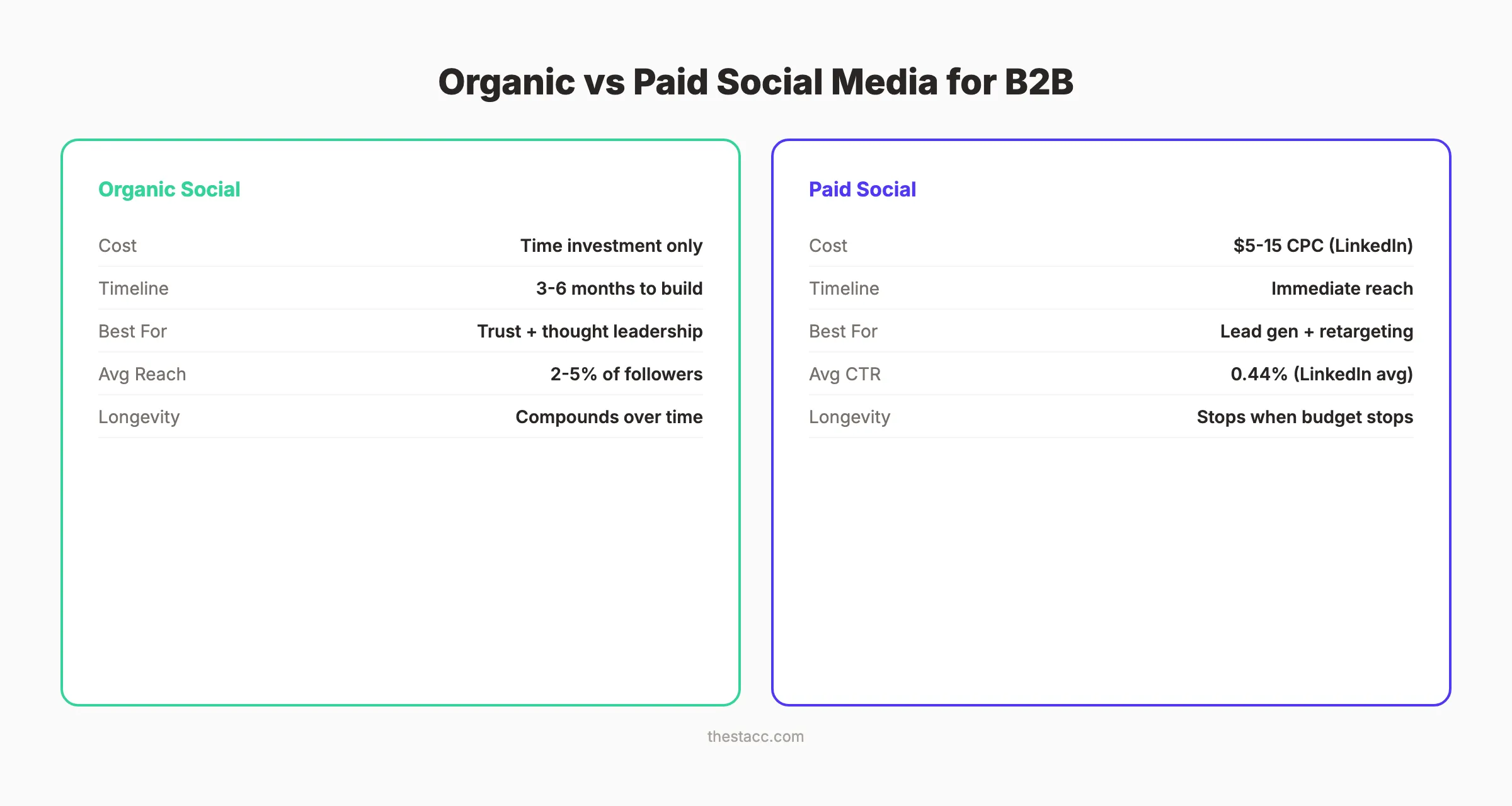
Most B2B companies need both organic and paid social strategies. They serve different purposes and work on different timelines.
When Organic Social Works Best
Organic social builds long-term brand equity. It establishes your company and your people as trusted voices in the industry. The results compound over months and years.
Organic social is most effective for:
- Thought leadership and brand positioning
- Employee advocacy programs
- Community building and engagement
- SEO support through social signals and brand searches
- Relationship building with prospects already in your pipeline
The downside: organic reach on company pages averages 2 to 5% of followers. Personal profiles reach more people. That is another reason employee advocacy matters.
When Paid Social Works Best
Paid social delivers immediate reach to a targeted audience. LinkedIn paid social delivers 192% ROI for B2B brands, making it the highest-performing paid social channel for lead generation.
Paid social is most effective for:
- Promoting gated content and lead magnets
- Retargeting website visitors who did not convert
- Reaching new audiences outside your follower base
- Account-based marketing to specific companies
- Event promotion and webinar registration
The Combined Approach
The strongest B2B social programs use organic content to build trust and paid promotion to amplify the content that performs best. Here is the framework:
| Stage | Organic Role | Paid Role |
|---|---|---|
| Awareness | Thought leadership posts | Sponsored content to new audiences |
| Consideration | Case studies, data posts | Retargeting to website visitors |
| Decision | Employee advocacy, demos | Lead-gen ads to warm audiences |
Start with organic. Once you identify which content resonates, allocate paid budget to amplify those top performers. This approach prevents wasting ad spend on content your audience does not care about.
B2B paid social budgets grew by approximately 15% year-over-year entering 2026. Companies that test and iterate on paid campaigns outperform those that set and forget.
If you are deciding between building content in-house or outsourcing, consider that social media management often benefits from a hybrid model. Strategy stays internal. Content production can be outsourced.
Automate your content engine. Stacc writes and publishes blog posts and social content on autopilot for B2B companies. Start for $1 →
How to Measure B2B Social Media ROI
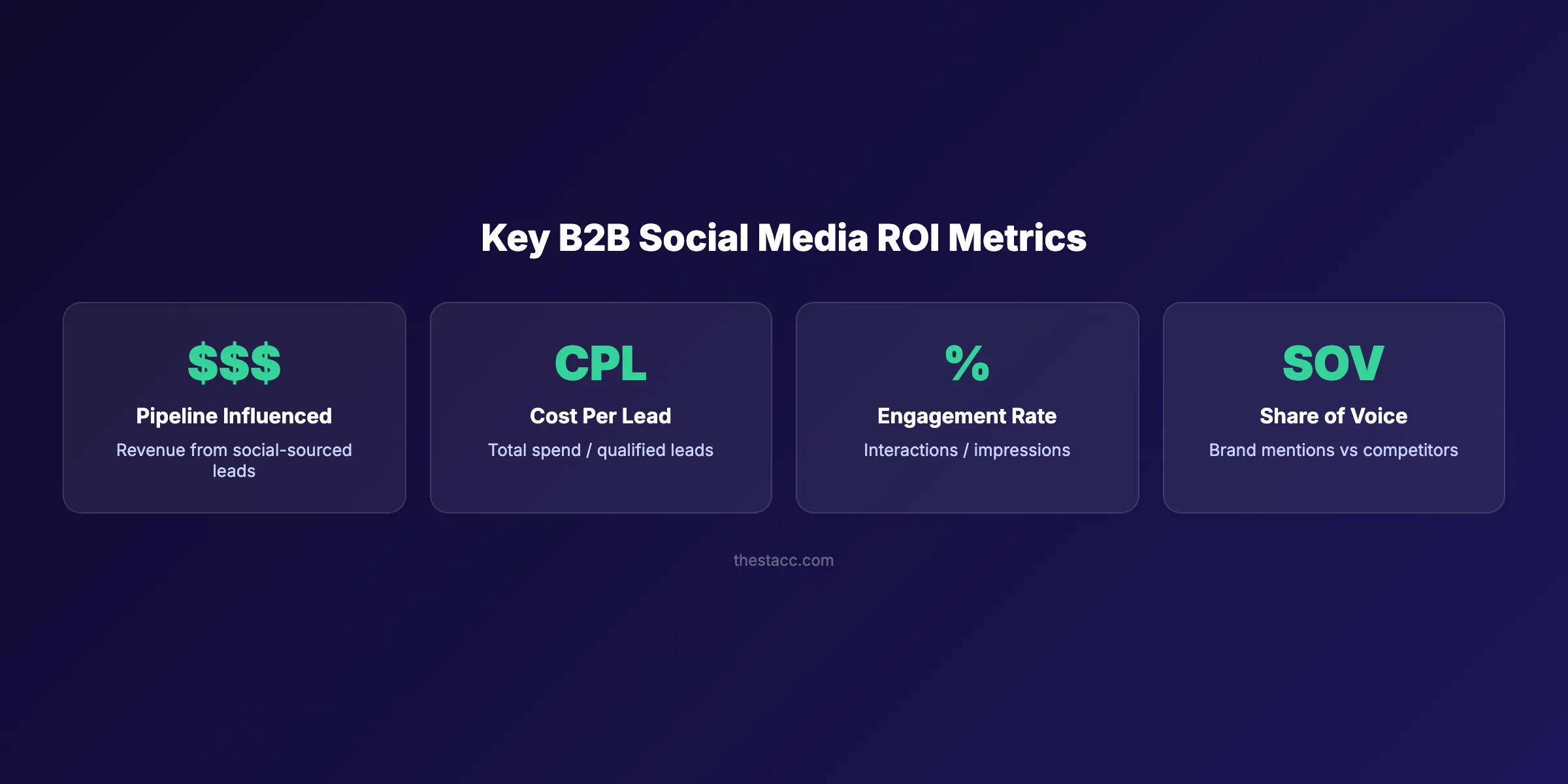
The biggest complaint from B2B executives about social media: they cannot measure the return. That is a measurement problem, not a social media problem.
Pipeline Metrics (Most Important)
These metrics connect social media directly to revenue:
- Social-sourced leads: Leads that first touched your brand through social media
- Social-influenced pipeline: Deals where social media was one of the touchpoints
- Cost per lead (CPL): Total social spend divided by qualified leads generated
- Lead-to-opportunity rate: Percentage of social leads that become sales opportunities
Set up UTM parameters on every social link. Connect your CRM to track the full journey from social click to closed deal. Without this tracking, you are guessing.
Engagement Metrics (Leading Indicators)
Engagement metrics predict future pipeline. They are not the goal, but they signal whether your content resonates:
- Engagement rate: Total interactions divided by impressions
- Share rate: The most important engagement metric for B2B. Shares put your content in front of new audiences
- Comment quality: 10 thoughtful comments from target buyers matter more than 100 generic reactions
- Profile visits: People who visit your company or personal profile after seeing content are evaluating you as a vendor
Brand Metrics (Long-Term Value)
These metrics are harder to track but represent the compounding value of social media:
- Share of voice: Your brand mentions compared to competitors
- Branded search volume: How often people Google your company name
- Inbound link growth: Links from people who discovered your content through social distribution
- Referral traffic: Website visits from social media platforms
Our guide on measuring content marketing ROI covers the full measurement framework. The principles apply directly to social media.
Reporting Cadence
Review engagement metrics weekly. Review pipeline metrics monthly. Review brand metrics quarterly. Do not make strategic changes based on a single week of data. Social media rewards consistency over months, not days.
7 Common B2B Social Media Mistakes
These mistakes kill social media programs before they produce results. Avoid all 7.
Mistake 1: Treating Social Like a Broadcast Channel
Posting company updates without engaging in conversations signals that you do not care about your audience. Social media is a two-way channel. Reply to comments. Join relevant conversations. Ask questions. The companies that treat social as a dialogue outperform those that treat it as a megaphone.
Mistake 2: Ignoring Employee Advocacy
Your company page reaches 2 to 5% of followers. Your employees’ combined networks reach 10 to 50 times more people. Ignoring employee advocacy is the single biggest missed opportunity in B2B social media.
Mistake 3: Posting the Same Content Everywhere
Each platform has its own format, audience, and algorithm. A LinkedIn text post does not work as an Instagram story. A YouTube video description does not work as a tweet. Adapt your content to each platform’s native format.
Mistake 4: Measuring the Wrong Metrics
Tracking followers and likes as primary KPIs leads to content that optimizes for vanity, not pipeline. Measure what drives revenue. Track leads, pipeline influence, and cost per acquisition.
Mistake 5: Quitting After 90 Days
Social media compounds. The first 90 days rarely show significant ROI. Companies that abandon their social strategy at the 3-month mark miss the inflection point that typically arrives between months 4 and 8. Just like SEO and blogging, consistency separates winners from everyone else.
Mistake 6: No Connection Between Social and SEO
Social media and SEO are not separate channels. They amplify each other. Social media supports SEO through brand search signals, referral traffic, and backlink generation. Your social content should drive readers to your blog. Your blog should provide shareable content for social.
Companies that combine blog publishing with social distribution see results faster than those that run each channel in isolation. Our content marketing statistics show that integrated strategies outperform siloed ones by a wide margin.
Mistake 7: Over-Automating Without Strategy
Automation tools save time. But scheduling 30 generic posts per month without a strategy produces noise, not results. Use social media management tools to schedule and distribute. Use human judgment to craft the strategy, voice, and engagement.
Frequently Asked Questions
How often should B2B companies post on social media?
LinkedIn: 3 to 5 times per week. X (Twitter): 3 to 5 times per day. YouTube: 1 to 2 times per week. Consistency matters more than volume. A company that posts 3 times per week for 12 months will outperform one that posts daily for 3 months and then stops.
What is the best social media platform for B2B lead generation?
LinkedIn. 84% of B2B marketers rate it as the most valuable organic social channel. It also delivers the highest paid social ROI for B2B at 192%. If you only have resources for one platform, choose LinkedIn.
Does social media for B2B companies actually generate leads?
Yes. 60% of US B2B marketers report that social media is their most effective revenue channel. The key is connecting social activity to pipeline through proper tracking. Without UTM parameters and CRM integration, leads appear to come from “direct” rather than social.
How much should a B2B company spend on social media?
Most B2B companies allocate 10 to 15% of their total marketing budget to social media. For paid social specifically, start with $2,000 to $5,000 per month on LinkedIn and scale based on cost-per-lead performance. Organic social requires time investment rather than direct spend.
How long does it take for B2B social media to show results?
Expect 3 to 6 months before social media contributes meaningfully to pipeline. Brand awareness and engagement metrics improve within 30 to 60 days. Lead generation and revenue attribution take longer because the B2B buying cycle itself takes 3 to 12 months.
Should B2B companies use TikTok?
TikTok is growing for B2B, but it is not yet essential for most industries. Companies targeting younger buyers (millennials and Gen Z decision makers) in tech, marketing, or creative industries may find value. For most B2B companies, LinkedIn, YouTube, and X deliver better ROI per hour invested.
B2B social media is not about going viral. It is about showing up consistently, sharing genuine expertise, and building trust with the people who make buying decisions. Pick 2 platforms, commit to 6 months, and measure what matters: pipeline, not likes.
If you want to pair social media with SEO content that compounds, see how Stacc can help. We publish 30 articles per month at $99 and handle social content starting at $49 per month.
Related Tools & Resources
Free SEO Tools:
Best Lists:

Written by
Siddharth GangalSiddharth is the founder of theStacc and Arka360, and a graduate of IIT Mandi. He spent years watching great businesses lose organic traffic to competitors who simply published more. So he built a system to fix that. He writes about SEO, content at scale, and the tactics that actually move rankings.
30 SEO blog articles published every month
Keyword-optimized, scheduled, and live on your site. Automatically.
30-day trial · Cancel anytime
theStacc
Stop writing SEO content manually
30 blog articles, 30 GBP posts, and social media content. Published every month. Automatically.
Start Your $1 Trial$1 for 3 days · Cancel anytime