
SEO for Startups (2026): Strategies, Tactics & Examples
Practical seo for startups strategies for 2026: step-by-step tactics, real examples, and tools to improve rankings and drive organic traffic.
96.55% of web pages get zero organic traffic from Google. Most startups fall into that group because they treat SEO as an afterthought. They pour budget into paid ads, watch the cost per lead climb, and wonder why growth stalls the moment they stop spending.
SEO for startups is not optional. It is the only marketing channel that compounds over time. Every article you publish, every page you optimize, and every backlink you earn builds on the last. Paid ads stop working the second you stop paying. SEO keeps delivering.
Organic search drives 53% of all web traffic. SEO generates leads at roughly $31 each. PPC costs $181 per lead. For startups with limited runway, the math is clear.
We have published 3,500+ blog posts across 70+ industries. Many of those clients were startups with zero organic presence. This guide covers the exact process we use to take a startup from invisible to ranking.
Here is what you will learn:
- Why SEO delivers better ROI than paid ads for startups
- How to build a technical foundation that Google trusts
- How to find low-competition keywords your competitors ignore
- How to create content that builds topical authority fast
- How to earn backlinks without a budget
- The 6 most common SEO mistakes startups make
- How to track and measure your SEO progress
Why SEO Matters More for Startups Than Established Companies
Startups face a unique problem. They have no brand recognition, no domain authority, and no content library. Every marketing dollar needs to produce measurable results.
SEO solves all three problems simultaneously. Published content builds brand recognition through search visibility. Consistent publishing builds domain authority over time. Every article becomes a permanent asset that drives traffic for years.
The average ROI on SEO is 748% over a 3-year period. That means every $1 invested returns $7.48. No other marketing channel delivers that kind of compounding return.
Startups that invest in SEO early gain an advantage that becomes harder to overcome each month. The longer you wait, the more content your competitors publish and the harder it becomes to catch up. SEO takes time. Starting now means ranking sooner.
The Compounding Effect
A startup that publishes 20 articles per month builds 240 ranking pages in one year. Each page targets a keyword. Each keyword brings a stream of visitors. The traffic from month 1 does not disappear when month 6 arrives. It stacks.
This is what separates SEO from every other channel. Paid ads deliver flat returns. SEO delivers exponential returns. The earlier a startup starts, the steeper the growth curve.
SEO vs Paid Ads: Where to Invest First
Most startup founders default to paid ads because they produce instant results. That instinct is wrong for 2 reasons. First, paid traffic stops the moment you stop paying. Second, cost per click increases as competition rises.
SEO produces slower initial results but dramatically better long-term economics.
| Factor | SEO | Paid Ads (PPC) |
|---|---|---|
| Cost per lead | ~$31 | ~$181 |
| Time to results | 3-6 months | Immediate |
| Longevity | Years | Stops when budget stops |
| Compounding | Yes | No |
| Trust signal | High (organic result) | Lower (ad label) |
| Scalability | Content library grows | Costs scale linearly |
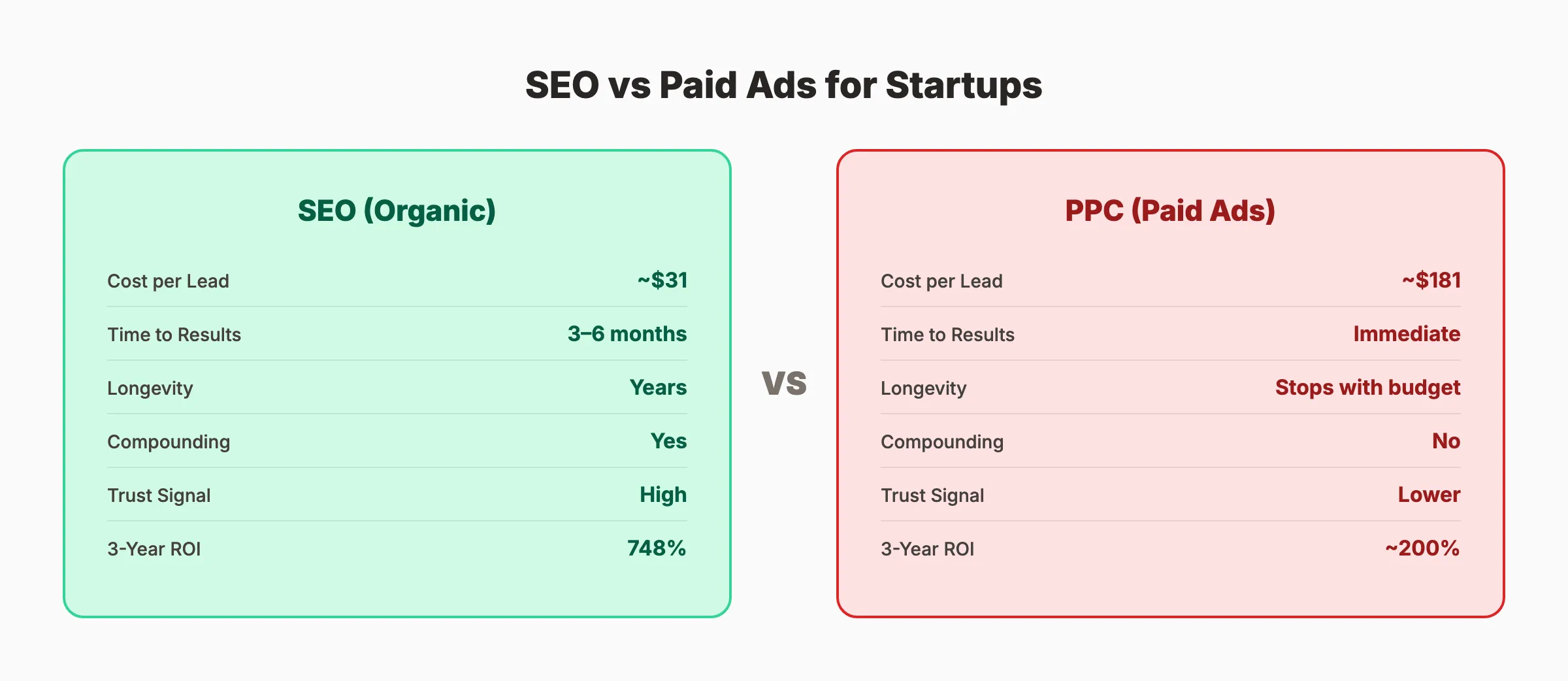
The best approach for most startups: run a small paid ads campaign for immediate validation while investing the majority of your budget into SEO for long-term growth. Once organic traffic reaches a sustainable level, reduce ad spend and reinvest those savings into more content.
Skip the agency. Keep the results. Stacc publishes 30 SEO articles per month for $99. Built for startups that need results without agency fees. Start for $1 →
Build Your Technical SEO Foundation
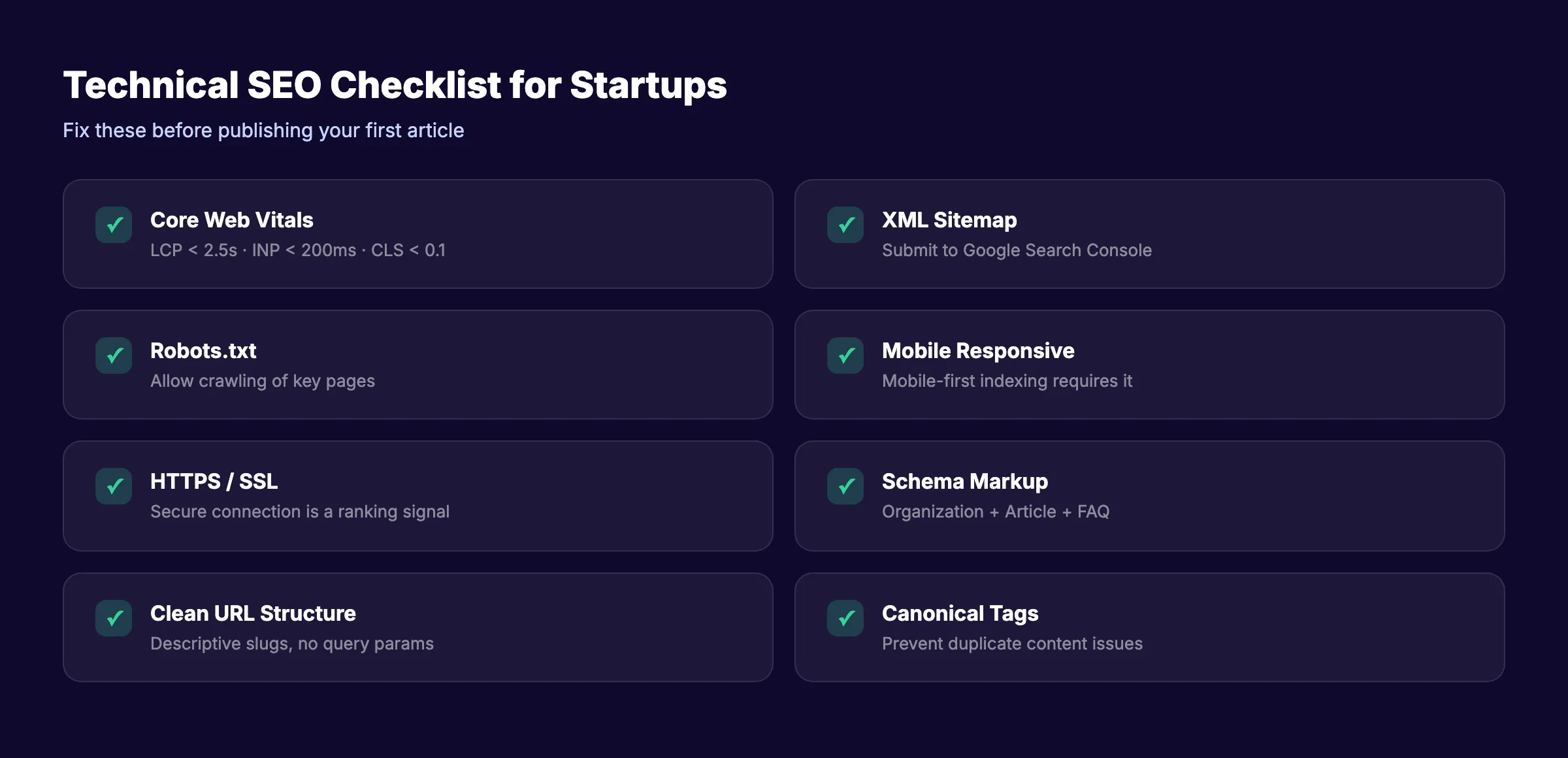
Before publishing a single article, fix your technical foundation. A site with technical problems wastes every piece of content you create.
Site Speed and Core Web Vitals
Google uses Core Web Vitals as a ranking factor. Only 40% of websites pass all three thresholds. Passing gives your startup an immediate advantage over 60% of competitors.
The 3 metrics that matter:
- Largest Contentful Paint (LCP): Under 2.5 seconds. Compress images, use a CDN, minimize render-blocking scripts.
- Interaction to Next Paint (INP): Under 200 milliseconds. Reduce JavaScript execution time.
- Cumulative Layout Shift (CLS): Under 0.1. Set explicit width and height on images and embeds.
Crawlability and Indexing
Google cannot rank pages it cannot find. Verify these basics:
- Submit an XML sitemap to Google Search Console
- Ensure your
robots.txtdoes not block important pages - Use clean URL structures with descriptive slugs
- Fix all broken links and redirect chains
- Set canonical URLs on every page
Mobile Optimization
Google indexes the mobile version of your site first. A startup with a desktop-only experience is invisible to Google. Test every page on mobile. Ensure buttons are tappable, text is readable, and content does not overflow the viewport.
Schema Markup
Structured data tells Google exactly what your content means. Add Organization schema to your homepage. Add Article schema to blog posts. Add FAQ schema to any page with questions and answers. Startups that implement schema earn rich results faster.
Keyword Research for Early-Stage Startups
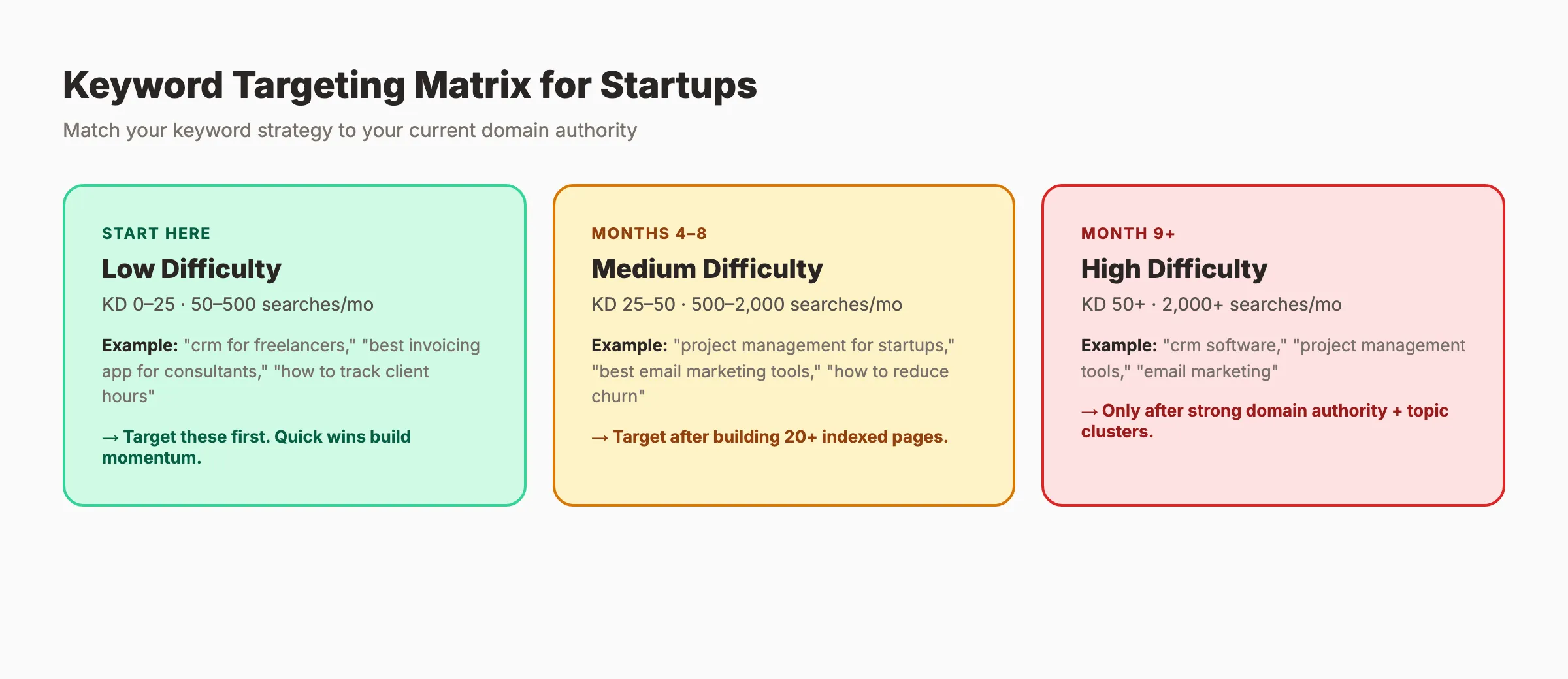
Most startups make the same keyword mistake. They target high-volume, high-competition terms like “project management software” and wonder why they never rank. A site with zero authority cannot compete against Asana and Monday for those keywords.
Target Low-Competition Keywords First
The smartest startup SEO strategy is to rank for 100 low-volume keywords instead of failing to rank for 5 high-volume ones. A keyword with 200 monthly searches and a difficulty score of 15 is worth more than a keyword with 10,000 searches and a difficulty of 85.
Keyword research for startups follows this priority:
- Long-tail keywords with 50-500 monthly searches and low difficulty
- Problem-aware keywords that describe the pain your product solves
- Comparison keywords like “best [category] for small teams”
- Question keywords from People Also Ask and Reddit threads
Match Keywords to Search Intent
Every keyword has an intent. Mismatching intent wastes a publishing slot. Use search intent analysis to match format to keyword:
| Intent | Keyword Example | Content Format |
|---|---|---|
| Informational | ”what is product-led growth” | Guide or explainer |
| Commercial | ”best crm for startups” | Comparison list |
| Transactional | ”[product] pricing” | Pricing page |
| Navigational | ”[brand name] login” | Product page |
Focus 70% of your content on informational keywords. These build traffic and authority. Mix in 20% commercial keywords and 10% transactional keywords to capture buyers.
Your SEO team. $99 per month. 30 optimized articles published automatically. No writers to hire. No briefs to write. Start for $1 →
Content Strategy That Builds Authority Fast
Publishing random articles does not build authority. Publishing a structured content library does. Google evaluates your site by topic coverage, not by individual pages.
Build Topic Clusters
A topic cluster groups 10 to 20 related articles around a central pillar page. The pillar targets a broad keyword. The supporting articles target specific long-tail variations. Internal links connect every supporting article back to the pillar.
Example cluster for a project management startup:
| Content Type | Topic | Target Keyword |
|---|---|---|
| Pillar | Project Management Guide | ”project management” |
| Supporting | How to Run Sprint Planning | ”sprint planning process” |
| Supporting | Best Agile Frameworks | ”agile frameworks comparison” |
| Supporting | Remote Team Management Tips | ”managing remote teams” |
| Supporting | Project Scope Template | ”project scope template” |
This structure tells Google your site is an authority on project management. A single article about the topic does not send that signal.
Publishing Frequency Matters
Sites that publish 16+ articles per month receive 3.5 times more traffic than sites publishing fewer than 4. For startups, even 8 to 12 articles per month builds momentum faster than the industry average of 1 to 4.
Set a content calendar and stick to it. Consistency matters more than occasional bursts of publishing.
Write for Humans First
Google ranks content that satisfies searchers. A 3,000-word guide filled with fluff performs worse than a 1,500-word guide that answers every question directly. Ahrefs found that the top-ranking pages for startup-related queries tend to be practical guides with clear structure and specific examples.
Follow these SEO content writing principles:
- Answer the main query in the first 100 words
- Use clear headers that match what people search
- Include data, examples, and actionable steps
- Break text into short paragraphs (2-3 sentences maximum)
- Add tables, lists, and visuals to improve readability
On-Page SEO Essentials for Every Startup Page
Great content with poor on-page optimization is like a store with no sign. Google needs clear signals to understand what each page covers.
Title Tags and Meta Descriptions
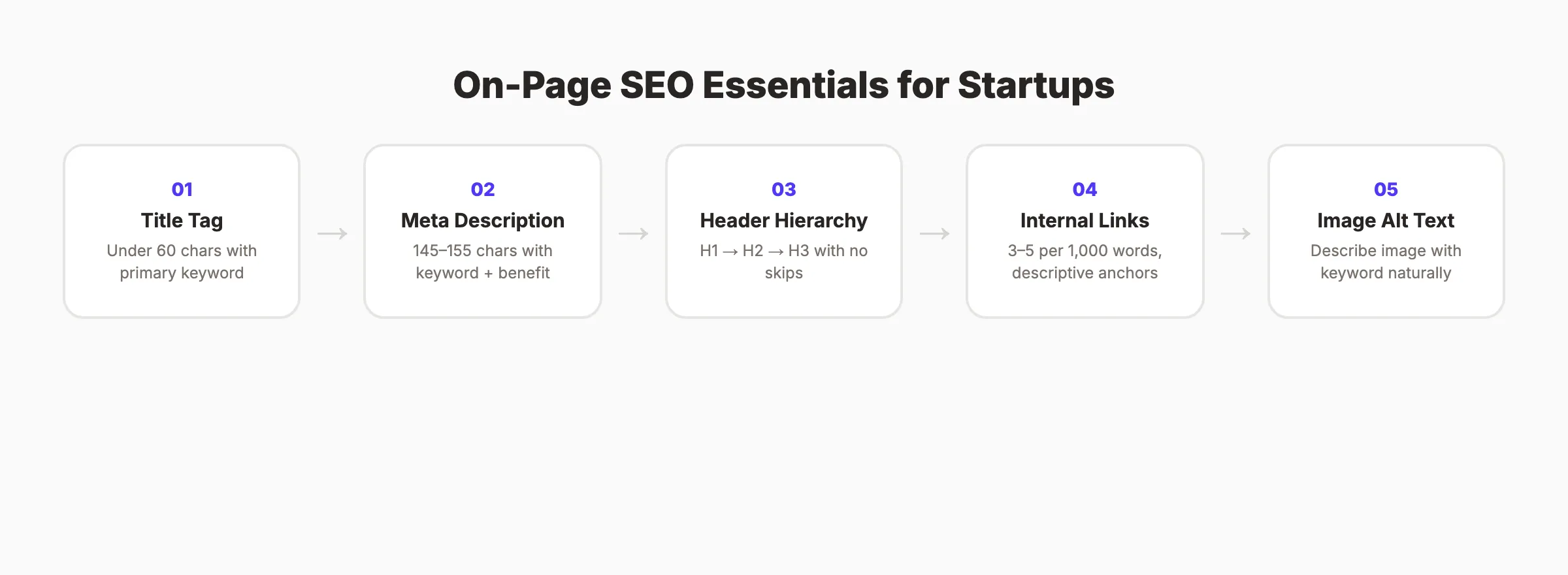
Every page needs a unique title tag under 60 characters that includes the primary keyword. Write a meta description between 145 and 155 characters that includes the keyword and a clear benefit.
Header Hierarchy
Use one H1 per page (the title). Break content into H2 sections for major topics. Use H3s for subtopics. Follow the on-page SEO hierarchy strictly. Never skip from H2 to H4.
Internal Linking
Every new article should link to 3 to 5 existing pages. Every existing page should link back to relevant new content. This internal linking strategy distributes authority across your entire site and helps Google discover new pages faster.
Use descriptive anchor text. “Read our keyword research guide” is better than “click here.” Aim for 3 to 5 internal links per 1,000 words of content. Review and update internal links quarterly as your content library grows.
Link Building on a Startup Budget
Backlinks remain one of Google’s strongest ranking signals. Startups without a link building budget can still earn links through these strategies.
Create Linkable Content
Data studies, original research, and free tools earn links naturally. Publish a study about your industry. Survey 100 customers. Create a free calculator or template. These assets attract links because other writers cite them as sources.
The best linkable content types for startups:
| Content Type | Link Potential | Effort Level | Example |
|---|---|---|---|
| Original data study | Very high | High | ”We analyzed 500 SaaS pricing pages” |
| Free tool or calculator | Very high | High | ROI calculator, audit tool |
| Industry benchmark report | High | Medium | ”2026 Startup Marketing Benchmarks” |
| Expert roundup | Medium | Low | ”15 CTOs share their SEO stack” |
| Template or checklist | Medium | Low | ”Content brief template” |
Guest Posting
Write articles for industry blogs and include a link back to your site. Target sites with real audiences, not link farms. Focus on publications your ideal customers actually read. One link from a relevant, authoritative site outweighs 50 links from low-quality directories.
Look for guest post opportunities by searching “[your industry] + write for us” or “[your niche] + guest post guidelines.” Pitch topics that fill a gap in their existing content. Editors reject generic pitches. Show that you read their blog before reaching out.
Broken Link Building
Find broken links on industry websites using free SEO tools. Contact the site owner. Offer your content as a replacement. The success rate is low (expect 5 to 10% response rates), but the links earned are high quality and worth the effort for startups that cannot afford paid placements.
HARO and Journalist Requests
Respond to journalist queries on platforms like Connectively (formerly HARO), Qwoted, and Help a B2B Writer. Each successful response earns a backlink from a news or industry publication. Set up daily alerts and respond within 2 hours for the best acceptance rates.
For a deeper look at earning authority links, read our guide on building backlinks for your blog.
3,500+ blogs published. 92% average SEO score. See what Stacc can do for your startup. Start for $1 →
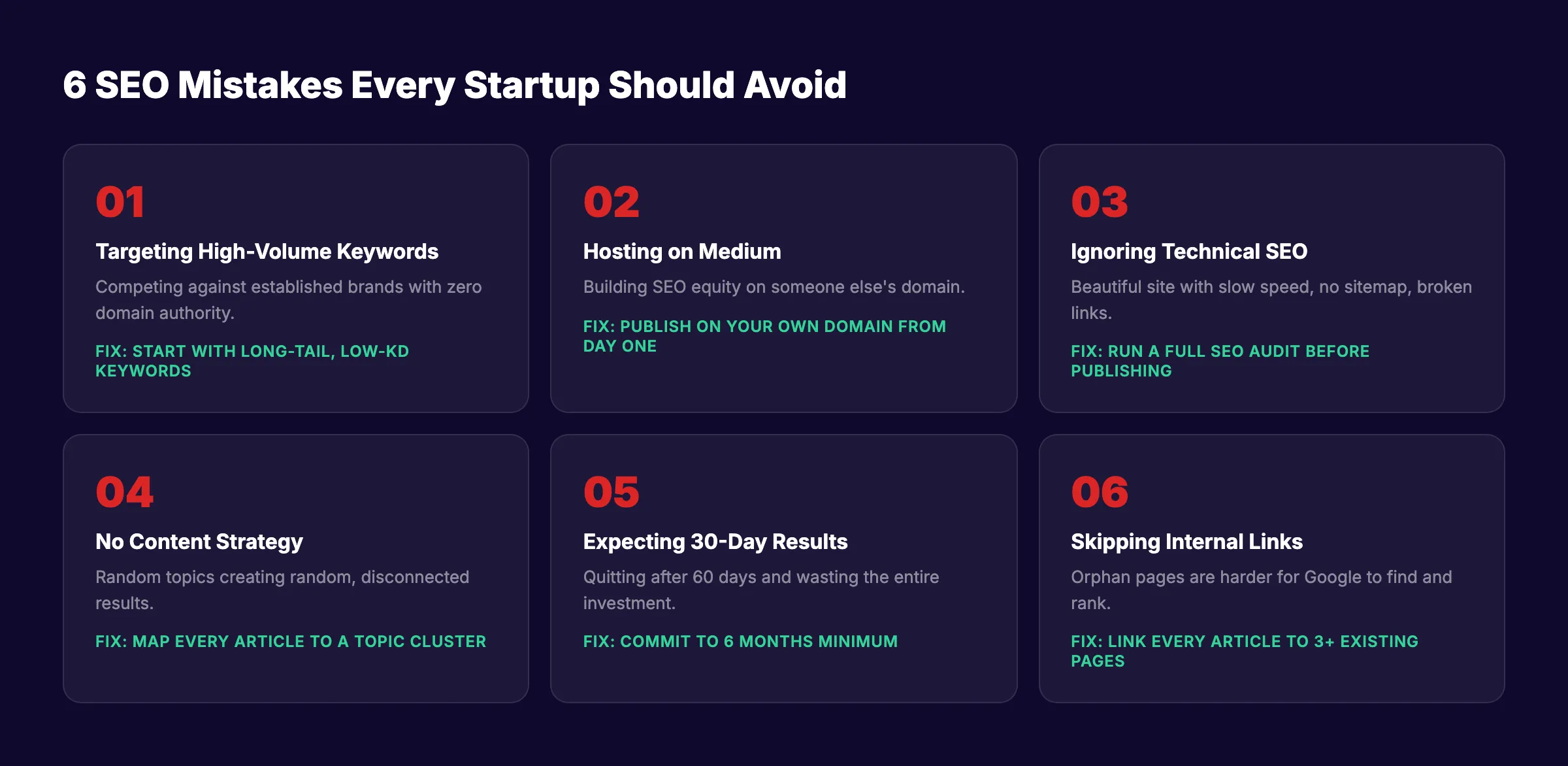
6 SEO Mistakes Every Startup Should Avoid
Avoiding these mistakes saves months of wasted effort. Most of them stem from applying enterprise SEO tactics to a startup context.
Mistake 1: Targeting Only High-Volume Keywords
New sites cannot compete for “CRM software” against HubSpot and Salesforce. Start with long-tail keywords where you can win. Build authority first. Then move upstream to higher-difficulty terms.
Mistake 2: Hosting Content on Medium or Substack
Every backlink and every SEO signal you build on a third-party platform benefits that platform. Not your domain. Host all content on your own domain from day one.
Mistake 3: Ignoring Technical SEO
A beautiful site with 4-second load times, broken links, and no sitemap will not rank. Fix the foundation before investing in content. Run a full SEO audit before publishing your first article.
Mistake 4: Publishing Without a Strategy
Random topics create random results. Every article should target a specific keyword, belong to a topic cluster, and serve a business goal. Use a content calendar to enforce strategic publishing.
Mistake 5: Expecting Results in 30 Days
SEO is a 3 to 6 month investment before meaningful traffic appears. Startups that quit after 60 days waste every dollar they spent. Set realistic expectations and commit to at least 6 months of consistent publishing.
Mistake 6: Skipping Internal Links
Every orphan page (a page with no internal links pointing to it) is harder for Google to discover and rank. Link every new article to at least 3 existing pages. Update old articles to link to new ones.
How to Measure Your Startup SEO Results
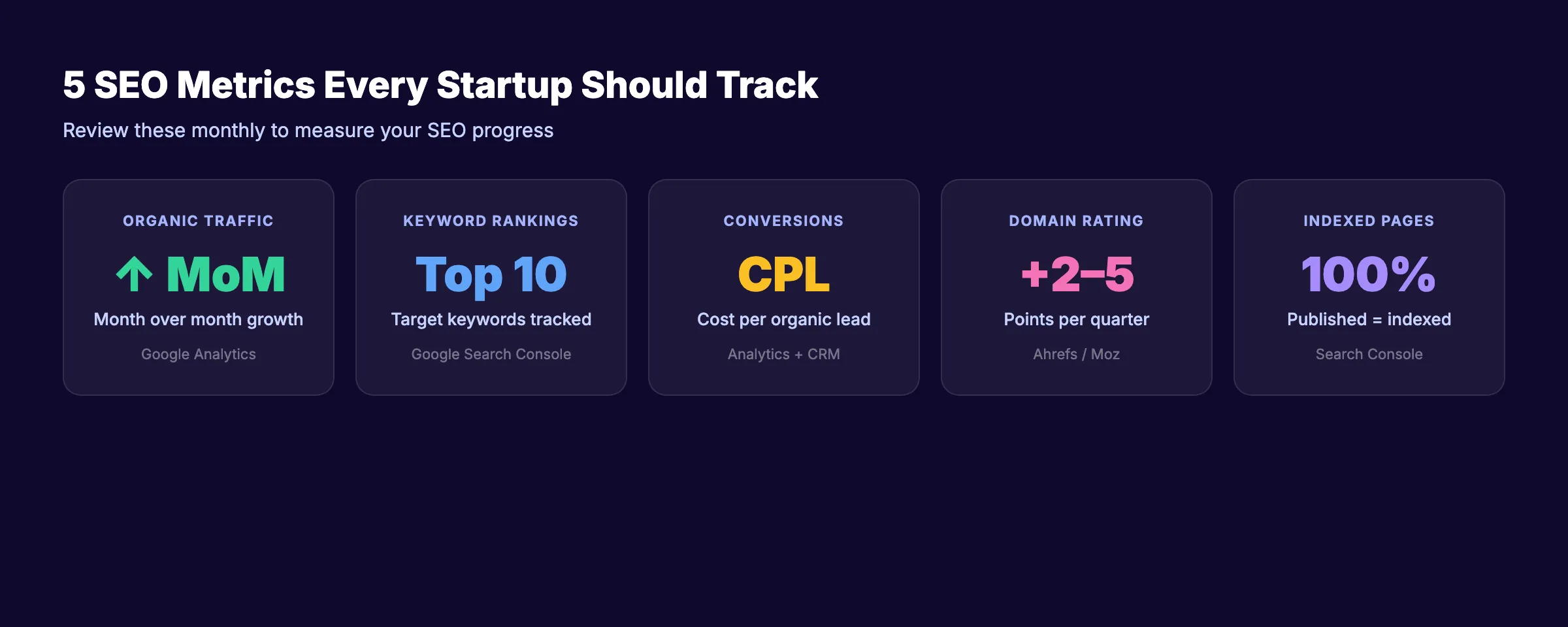
SEO without measurement is guesswork. Track these 5 KPIs monthly to know if your strategy is working.
Set up a monthly reporting cadence. Review these 5 metrics on the same day each month. Compare to the previous period and adjust your content plan based on what the data shows.
Organic Traffic
Monitor total organic sessions in Google Analytics. Look for month-over-month growth. A healthy SEO program shows steady increases after the first 3 months.
Keyword Rankings
Track how many target keywords rank in the top 10, top 20, and top 50. Google Search Console shows average position for every query your site appears for. Focus on moving keywords from page 2 (positions 11-20) to page 1.
Organic Conversions
Traffic without conversions is vanity. Set up conversion tracking for sign-ups, demo requests, or purchases. Calculate your cost per organic lead by dividing total SEO investment by total organic conversions.
Domain Authority Growth
Track your domain authority or domain rating monthly. A new site starts near zero. Consistent content and link building should push this number up by 2 to 5 points per quarter. Use Ahrefs, Moz, or Semrush to check this metric. All three use slightly different scoring, so pick one and stay consistent.
Indexed Pages
Monitor how many pages Google has indexed via Search Console. If you have published 50 articles but only 30 are indexed, investigate crawl errors, thin content, or noindex tags.
FAQ
How much should a startup spend on SEO?
Early-stage startups should allocate $500 to $2,000 per month on SEO. This covers content creation, basic tools, and technical fixes. As organic traffic grows and generates revenue, increase the budget. Stacc offers 30 articles per month for $99, making professional SEO accessible to bootstrapped startups.
How long does SEO take to work for a startup?
Expect 3 to 6 months before seeing meaningful organic traffic. Some low-competition keywords may rank within 4 to 8 weeks. High-competition keywords can take 6 to 12 months. Consistent publishing accelerates results.
Should startups hire an SEO agency or do it in-house?
Most early-stage startups lack the budget for an agency ($1,000 to $5,000 per month). In-house works if a founder or team member understands SEO basics. The third option is a service like Stacc that delivers agency-level output at a fraction of the cost.
What are the best free SEO tools for startups?
Google Search Console, Google Analytics, and Google Keyword Planner are free and essential. Ubersuggest offers limited free access. Our guide to free SEO tools covers 15+ options with no paid subscription required.
Is SEO worth it for a pre-launch startup?
Yes. Publishing content before launch builds domain authority and indexed pages. By launch day, your site already has organic traffic. Waiting until post-launch means starting from zero when you need results most.
Can a startup do SEO without a blog?
A blog is the most efficient way to target keywords and build authority. Without one, your SEO is limited to product pages and landing pages. Read our guide on starting a blog for organic traffic to see why every startup needs one.
SEO is the highest-ROI marketing channel available to startups. The startups that invest early build a traffic asset that compounds every month. Start with technical foundations, target low-competition keywords, publish consistently, and measure everything. The gap between you and your competitors shrinks with every article you publish. The best time to start was 6 months ago. The second best time is today.
Related Tools & Resources
Free SEO Tools:
Best Lists:

Written by
Siddharth GangalSiddharth is the founder of theStacc and Arka360, and a graduate of IIT Mandi. He spent years watching great businesses lose organic traffic to competitors who simply published more. So he built a system to fix that. He writes about SEO, content at scale, and the tactics that actually move rankings.
30 SEO blog articles published every month
Keyword-optimized, scheduled, and live on your site. Automatically.
30-day trial · Cancel anytime
theStacc
Stop writing SEO content manually
30 blog articles, 30 GBP posts, and social media content. Published every month. Automatically.
Try for free$1 for 3 days · Cancel anytime