SaaS Content Strategy: The Complete Guide
Build a SaaS content strategy that drives signups and pipeline. Covers topic clusters, funnel mapping, keyword research, and ROI. Updated March 2026.
Siddharth Gangal • 2026-03-30 • Content Strategy
In This Article
Most SaaS companies publish blog content. Few have a SaaS content strategy. The difference is the gap between random blog posts and a system that generates pipeline.
A blog without strategy is a cost center. It produces traffic that does not convert. A strategy-driven content operation turns organic search into the largest source of qualified leads. B2B SaaS SEO delivers 702% average ROI with a 7-month breakeven.
We have published 3,500+ blog posts across 70+ industries, including B2B SaaS, IT consulting, and marketing technology. This guide covers the exact framework for building a SaaS content strategy that drives signups and revenue.
Here is what you will learn:
- Why most SaaS content strategies fail and how to fix them
- A funnel-first framework for prioritizing content
- Topic cluster architecture for SaaS keyword coverage
- Content types that convert at each funnel stage
- How to measure content ROI beyond traffic metrics
- The publishing cadence that compounds over time
Why Most SaaS Content Strategies Fail
The typical SaaS blog publishes 2-4 articles per month. All top-of-funnel. All targeting broad informational keywords. Traffic grows. Pipeline does not.
The problem is not the content. It is the strategy.
The 3 Most Common Mistakes
1. Over-indexing on awareness content. Most SaaS content plans are 80% top-of-funnel and nearly empty at consideration and decision stages. That is exactly backwards from a pipeline standpoint. Awareness content drives traffic. Decision content drives revenue.
2. Ignoring comparison and alternatives content. People searching “[your product] vs [competitor]” or “best [category] software” are ready to buy. Comparison pages convert at 3.2x the rate of standard feature pages. Yet most SaaS companies never publish them.
3. Publishing without a topic cluster architecture. Random blog posts do not build topical authority. Google evaluates whether your site covers a topic deeply. Disconnected articles about scattered topics signal shallow expertise.
The fix: start at the bottom of the funnel. Work upward. Build in clusters. This approach flips the conventional wisdom that says “build awareness first.” Awareness without conversion infrastructure is a leaky bucket. Fix the conversion layers first, then pour traffic into them.
The Funnel-First Content Framework
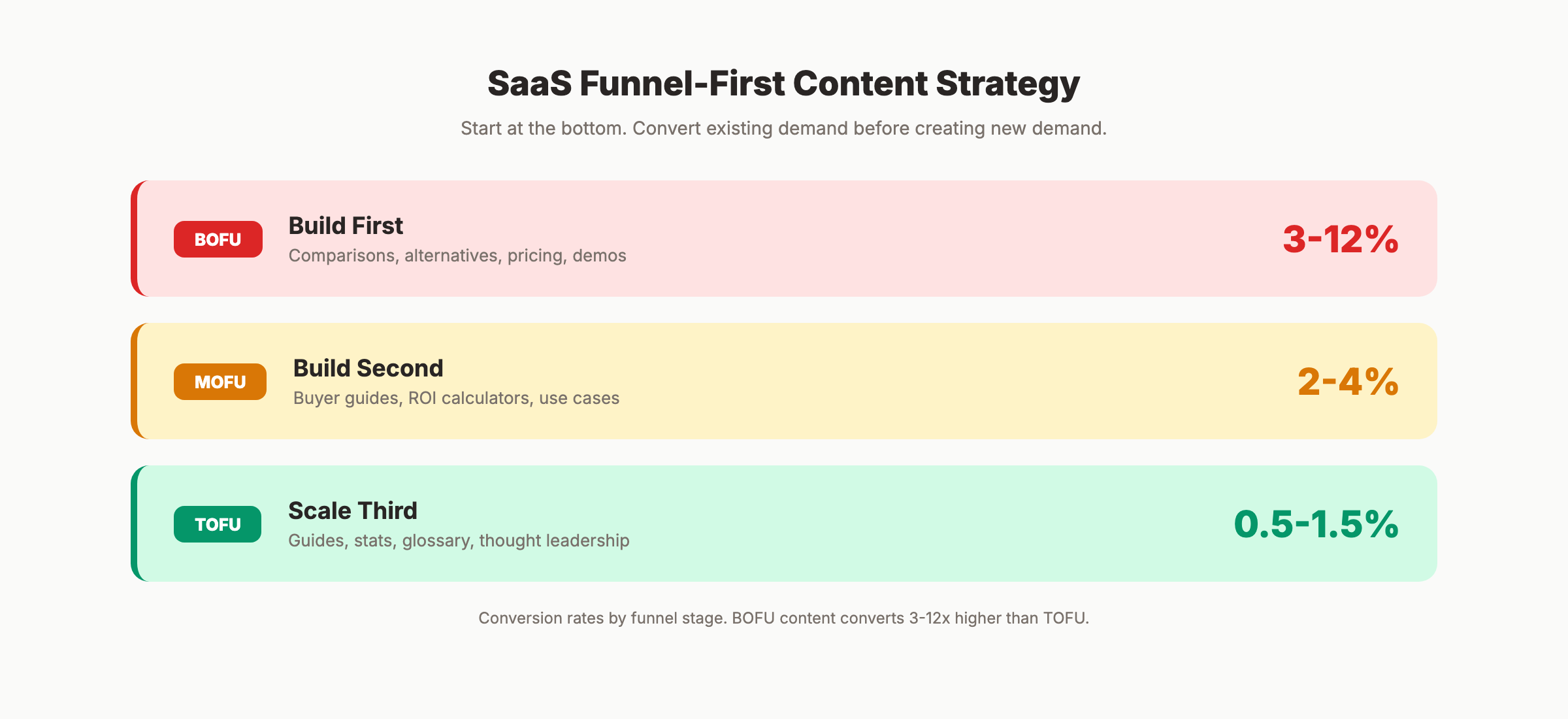
The most effective SaaS content strategy starts with the content closest to revenue and works backward toward awareness.
Bottom of Funnel (BOFU) — Build First
BOFU content targets buyers who are actively evaluating. These pages have the highest conversion rates and the shortest path to revenue.
| Content Type | Target Keywords | Conversion Rate |
|---|---|---|
| Competitor comparison pages | ”[product] vs [competitor]“ | 3-5% |
| Alternatives pages | ”[competitor] alternatives” | 2-4% |
| Pricing pages | ”[product] pricing” | 5-8% |
| Case studies | ”[industry] case study [product]“ | 2-3% |
| Product demo pages | ”[product] demo” | 8-12% |
A SaaS company with 5 competitors should publish 5 comparison pages and 5 alternatives pages before writing a single educational blog post. Each page captures buyers in evaluation mode.
Middle of Funnel (MOFU) — Build Second
MOFU content helps prospects understand their options and imagine using your product.
Content types:
- Buyer guides (“how to choose [category] software”)
- Feature breakdowns (“what to look for in a [category] tool”)
- ROI calculators and assessment tools
- Industry-specific use case pages
- Webinar recordings and product walkthroughs
MOFU content bridges the gap between “I have a problem” and “I am evaluating tools to fix it.” Every MOFU page should link to at least one BOFU page.
Top of Funnel (TOFU) — Scale Third
TOFU content builds authority, earns backlinks, and captures early-stage search demand.
Content types:
- Educational guides and how-to articles
- Industry statistics and data reports
- Glossary pages defining industry terms
- Problem-focused blog posts
- Thought leadership with original perspectives
Companies publishing 16+ blog posts monthly generate 3.5x more traffic than those publishing fewer than 4. But TOFU only works when MOFU and BOFU content exist to capture the leads TOFU generates.
For a deeper B2B perspective, read our B2B SEO guide.
Stop writing. Start ranking. Stacc publishes 30 SEO articles per month for $99. Start for $1 →
Topic Cluster Architecture for SaaS
Topic clusters organize your content around core themes. Each cluster has a pillar page (the hub) surrounded by cluster pages (the spokes). Internal links connect them all.
Why Clusters Matter
Google ranks sites with topical authority higher than sites with scattered content. A SaaS company with 1 article about “project management” ranks worse than a company with a pillar page on project management linked to 12 articles about subtopics (task tracking, team collaboration, Gantt charts, sprint planning).
Topic clusters typically show significant ranking improvements within 3-6 months of full publication.
How to Build a SaaS Topic Cluster
Step 1: Identify 4-6 core topics aligned with your product categories.
For a project management SaaS, core topics might be:
- Project management (pillar)
- Team collaboration
- Task management
- Resource planning
- Project reporting
- Agile methodology
Step 2: Build a pillar page for each core topic.
Each pillar page should be 2,000-5,000 words. It covers the entire topic at a high level. Every subtopic gets 200-400 words on the pillar with a link to a dedicated cluster page.
Step 3: Create 8-15 cluster pages per pillar.
Each cluster page targets a specific long-tail keyword related to the pillar topic. Aim for 1,000-2,000 words per cluster page.
Step 4: Interlink everything.
Every cluster page links back to its pillar page. The pillar page links to every cluster page. Cluster pages also link to each other where relevant. This internal linking structure tells Google that your site owns this topic.
For more on building topic clusters, see our guide on what content clusters are and how they work.
Example Cluster Architecture
| Pillar | Cluster Pages | Total Keywords |
|---|---|---|
| Project Management Guide | 12 articles (task tracking, Gantt charts, team workflows, etc.) | 45 keywords |
| Team Collaboration | 10 articles (remote team tools, async communication, etc.) | 35 keywords |
| Agile Methodology | 8 articles (sprint planning, retrospectives, scrum, etc.) | 30 keywords |
Three clusters with 30 articles cover 110+ keywords. That is a content moat competitors cannot replicate in a quarter.
Common Cluster Mistakes to Avoid
- Clusters that are too broad. “Marketing” is not a cluster. “Email marketing automation for SaaS” is.
- Pillar pages that read like blog posts. Pillar pages should be reference-quality resources, not opinions.
- Missing internal links. Every cluster page must link back to the pillar. Every pillar must link to every cluster page. Missing links break the architecture.
- Publishing clusters partially. A pillar with 3 cluster pages looks incomplete. Wait until you have 8+ cluster pages ready before publishing the pillar.
- Ignoring keyword cannibalization. Two cluster pages targeting the same keyword compete with each other. Each page in the cluster needs a distinct target keyword. Read our guide on fixing keyword cannibalization to prevent this.
SaaS Keyword Research That Drives Pipeline
SaaS keyword research follows different rules than consumer keyword research. Volume matters less. Intent matters more.
The SaaS Keyword Matrix
Organize keywords into 4 categories by intent:
| Intent | Example Keywords | Content Type | Priority |
|---|---|---|---|
| Transactional | ”[product] pricing,” “[product] free trial” | Landing pages | Highest |
| Commercial | ”best [category] software,” “[product] vs [competitor]“ | Comparison/review pages | High |
| Informational | ”how to [solve problem],” “[topic] guide” | Blog posts, guides | Medium |
| Navigational | ”[brand name],” “[product name] login” | Homepage, product pages | Ongoing |
Start keyword research with transactional and commercial intent. These keywords drive pipeline directly. Expand to informational keywords once your BOFU and MOFU content is published.
Where to Find SaaS Keywords
- Sales call transcripts. The exact phrases prospects use when describing their problems.
- Customer support tickets. Questions reveal content gaps.
- Competitor keyword gaps. Use Ahrefs or Semrush to find keywords your competitors rank for that you do not.
- Review sites (G2, Capterra). The language buyers use to describe features and frustrations.
- Reddit and community forums. Unfiltered problem descriptions from your target audience.
For a complete keyword research process, read our keyword research for blog posts guide.
Your SEO team. $99 per month. 30 optimized articles, published automatically. Start for $1 →
Content Types That Convert for SaaS
Different content types serve different purposes. The mix matters.
Comparison Pages (Highest Converting)
“[Your Product] vs [Competitor]” pages convert at 3-5% because the searcher is already evaluating. Structure each page with:
- Feature-by-feature comparison table
- Pricing comparison with actual numbers
- Use case recommendations (“choose X if…” / “choose Y if…”)
- A clear but fair verdict
Publish one comparison page for every major competitor. These pages often rank within 2-3 months for branded competitor keywords.
Case Studies (Strongest Social Proof)
Case studies convert at 2-3%. They work best when structured as: Problem → Approach → Results. Include specific numbers: “reduced churn by 23% in 90 days” outperforms “improved retention.”
Publish at least 1 case study per industry you serve. Target the keyword “[industry] [category] case study” for organic discovery.
Educational Blog Posts (Authority Builders)
Blog posts drive the most traffic but convert at the lowest rate (0.5-1.5%). Their value is in building topical authority and earning backlinks that lift your entire site.
Focus each post on a single keyword. Follow our SEO content writing framework for structure and optimization.
Free Tools and Calculators
Interactive tools earn backlinks and convert visitors who use them. An ROI calculator, a benchmarking tool, or a grading assessment gives visitors a reason to enter their email.
SaaS companies with free tools generate 2-3x more organic backlinks than those with blog content alone.
Thought Leadership (Brand Differentiation)
Thought leadership sets your brand apart from competitors who all publish the same “how to” guides. Original perspectives on industry trends, contrarian takes on accepted practices, and predictions backed by data build the kind of authority that Google and buyers both reward.
97% of B2B buyers say trust in the vendor is a key purchase factor. Thought leadership content builds that trust faster than product marketing.
The best thought leadership comes from internal subject matter experts. Interview your product team, customer success leads, and founders. Their insights are unique to your company. That uniqueness is what earns backlinks and brand recall.
Product-Led Content (Usage as Marketing)
Product-led content shows your product solving real problems. Integration guides, workflow tutorials, and template galleries attract users who are already searching for what your product does.
Target keywords like “how to [do task] with [product]” and “[product] templates.” These pages serve both existing users (reducing churn) and prospects (demonstrating value before signup).
Product-led content often ranks for long-tail keywords with near-zero competition because no other site publishes content about your specific product workflows.
Content Repurposing for Maximum Reach
One pillar article generates 5-10 derivative content pieces:
- 3-5 LinkedIn posts pulling key stats or insights
- 1 email newsletter section summarizing the article
- 2-3 short-form social posts with individual data points
- 1 infographic visualizing the key framework
- 1 video walkthrough of the article’s main process
Repurposing multiplies the ROI of every article by distributing its insights across every channel your audience uses. A content distribution strategy ensures nothing you publish is seen only once.
Publishing Cadence: How Much Content SaaS Companies Need
Content marketing compounds. The more you publish, the more keywords you rank for. The more keywords you rank for, the more traffic you get. The more traffic you get, the more leads enter your pipeline.
The Minimum Effective Dose
| Company Stage | Monthly Articles | Content Types |
|---|---|---|
| Seed/Series A | 8-12 | BOFU comparisons + pillar pages |
| Series B | 12-20 | BOFU + MOFU + topic clusters |
| Series C+ | 20-30+ | Full funnel + thought leadership + data |
Companies publishing 16+ articles per month see 4.5x more leads than those publishing fewer than 4. But 16 mediocre articles produce worse results than 8 excellent ones. Quality and volume must both increase together.
The Compounding Effect
A single blog post generates traffic for 2+ years when maintained. An article published in month 1 still drives leads in month 24. By month 12, a SaaS company with 150+ published articles has a content moat that competitors cannot replicate with paid ads.
SEO customer acquisition cost decreases 60% over 2 years. The more content you publish, the cheaper each new lead becomes.
For help building a content calendar, read our planning guide.
Measuring SaaS Content ROI
Traffic is a vanity metric for SaaS. Pipeline is the only metric that matters.
The SaaS Content Measurement Stack
| Metric | What It Tells You | Target |
|---|---|---|
| Organic signups | Direct conversion from content | Track by landing page |
| Assisted conversions | Content touchpoints in the buyer journey | GA4 attribution |
| Pipeline influenced | Deals that touched content before closing | CRM + content tracking |
| Organic MRR | Monthly recurring revenue from organic leads | CRM |
| Content velocity | Publishing speed and consistency | Editorial calendar |
| Keyword portfolio | Number of ranking keywords and positions | Ahrefs/Semrush |
Calculating Content ROI
Content ROI = (Revenue from Organic Leads - Content Investment) / Content Investment x 100
Example for a Series B SaaS:
- Monthly content spend: $10,000 (writers + tools + strategy)
- Organic leads per month: 200
- Lead-to-customer rate: 3%
- Average annual contract value: $12,000
- Monthly new ARR from content: 200 x 0.03 x $12,000 = $72,000
- Content ROI: ($72,000 - $10,000) / $10,000 = 620%
Content marketing generates $3 for every $1 invested. For SaaS specifically, the ROI is higher because recurring revenue multiplies the lifetime value of each acquired customer.
For more on measuring marketing ROI, see our content ROI guide.
3,500+ blogs published. 92% average SEO score. See what Stacc can do for your SaaS. Start for $1 →
SaaS Content Strategy Checklist
Use this before launching or auditing your content program:
Foundation:
- Define 4-6 core topic clusters aligned with product
- Build pillar pages for each cluster (2,000-5,000 words each)
- Map keywords to funnel stages (TOFU, MOFU, BOFU)
- Prioritize BOFU content first (comparisons, alternatives, pricing)
Keyword Strategy:
- Research keywords from sales calls, support tickets, and reviews
- Target commercial intent keywords before informational ones
- Identify competitor keyword gaps
- Plan 8-15 cluster pages per pillar topic
Content Production:
- Publish 8+ articles per month minimum
- Scale to 16+ articles as resources allow
- Include 1 case study per quarter per industry served
- Build 1 free tool or calculator per quarter
Distribution:
- Interlink all cluster pages to their pillar
- Share every post across LinkedIn, email, and social
- Repurpose blog content into social posts and email sequences
- Submit new URLs via IndexNow for faster indexing
Measurement:
- Track organic signups, not just traffic
- Calculate pipeline influenced by content monthly
- Report content-attributed MRR quarterly
- Adjust topic priorities based on conversion data
FAQ
What is a SaaS content strategy?
A SaaS content strategy is a system for planning, creating, and distributing content that drives software signups and pipeline. It maps content to the buyer journey (TOFU, MOFU, BOFU), organizes topics into clusters for SEO authority, and measures success by leads and revenue rather than traffic alone.
How many blog posts should a SaaS company publish per month?
Seed-stage companies should publish 8-12 articles monthly. Series B companies should target 12-20. Series C and beyond should aim for 20-30+. Companies publishing 16+ posts monthly generate 4.5x more leads. Quality and quantity must increase together.
What content converts best for SaaS?
Competitor comparison pages convert at 3-5%. Product demo pages convert at 8-12%. Case studies convert at 2-3%. Educational blog posts convert at 0.5-1.5%. The highest-converting content targets buyers in the evaluation and decision stages of the funnel.
How long does SaaS content marketing take to show results?
Most SaaS content programs show measurable results in 6-12 months. B2B SaaS SEO breaks even in approximately 7 months. Topic clusters show significant ranking improvements within 3-6 months. The compounding effect means year-2 results are dramatically stronger than year-1.
What is the ROI of SaaS content marketing?
B2B SaaS SEO delivers an average 702% ROI over a 3-year window. Content marketing generates $3 for every $1 invested. SaaS companies see higher returns than average because recurring subscription revenue multiplies the lifetime value of each organically acquired customer.
How do you build topic clusters for SaaS?
Identify 4-6 core topics aligned with your product. Build a 2,000-5,000 word pillar page for each. Create 8-15 cluster pages targeting long-tail keywords. Interlink every cluster page to its pillar and to related cluster pages. The structure builds topical authority that improves rankings across the entire cluster.
SaaS content strategy is a compounding investment. Every article builds authority. Every cluster strengthens rankings. Every month of consistent publishing reduces your cost per lead and increases the gap between you and competitors who start later.
Written and published by Stacc. We publish 3,500+ articles per month across 70+ industries. All data verified against public sources as of March 2026.