
Link Building Opportunities: The Complete Guide (2026)
Find link building opportunities that earn real backlinks. 10 chapters covering broken links, HARO alternatives, guest posts, and gap analysis. Updated 2026.
Most websites have zero backlinks. Not a few. Not a handful. Literally 95% of all pages on the internet have no external links pointing to them.
That is not a content problem. It is a link building problem. Specifically, it is a failure to find and act on the right link building opportunities.
This guide breaks down every major type of link building opportunity available in 2026. From broken link prospecting to HARO alternatives to competitor gap analysis, you will get exact steps for each method.
We publish 3,500+ blog posts across 70+ industries. We have watched what moves rankings and what does not. Backlinks still sit at the center of every ranking algorithm.
Here is what you will learn:
- How to find broken link building opportunities on authority sites
- Where to pitch resource pages that actually link out
- Which HARO alternatives still work after the 2024 shutdown
- How to run a competitor backlink gap analysis
- The exact tools that make prospecting faster
- Why digital PR outperforms cold outreach for earning links
Table of Contents
- What Link Building Opportunities Are
- Broken Link Building Opportunities
- Resource Page Link Building
- Link Insertion and Niche Edit Opportunities
- HARO Alternatives for Editorial Backlinks
- Guest Posting Opportunities That Move Rankings
- Unlinked Brand Mentions and Link Reclamation
- Competitor Backlink Gap Analysis
- Digital PR, Podcasts, and Content Syndication
- Tools for Finding Link Building Opportunities
- FAQ
What Link Building Opportunities Are {#what-link-building-opportunities-are}
A link building opportunity is any scenario where you can earn a backlink from another website. That sounds simple. The execution is not.
Not all opportunities carry equal weight. A link from a DA 80 news site matters more than 50 links from random blog directories. Google’s algorithm evaluates topical relevance, authority, and editorial context when assigning link value.
Why Link Building Opportunities Still Matter in 2026
Pages ranking first on Google have 3.8 times more backlinks than pages in positions 2 through 10. That gap has not narrowed. According to a 2026 survey of 518 SEO professionals, 67.5% of businesses say link building significantly impacts their SERP rankings.
The shift in 2026 is not about whether links matter. It is about where you find them. Old tactics like blog comment spam and directory submissions died years ago. The opportunities that produce real results require research, outreach, and content worth linking to.
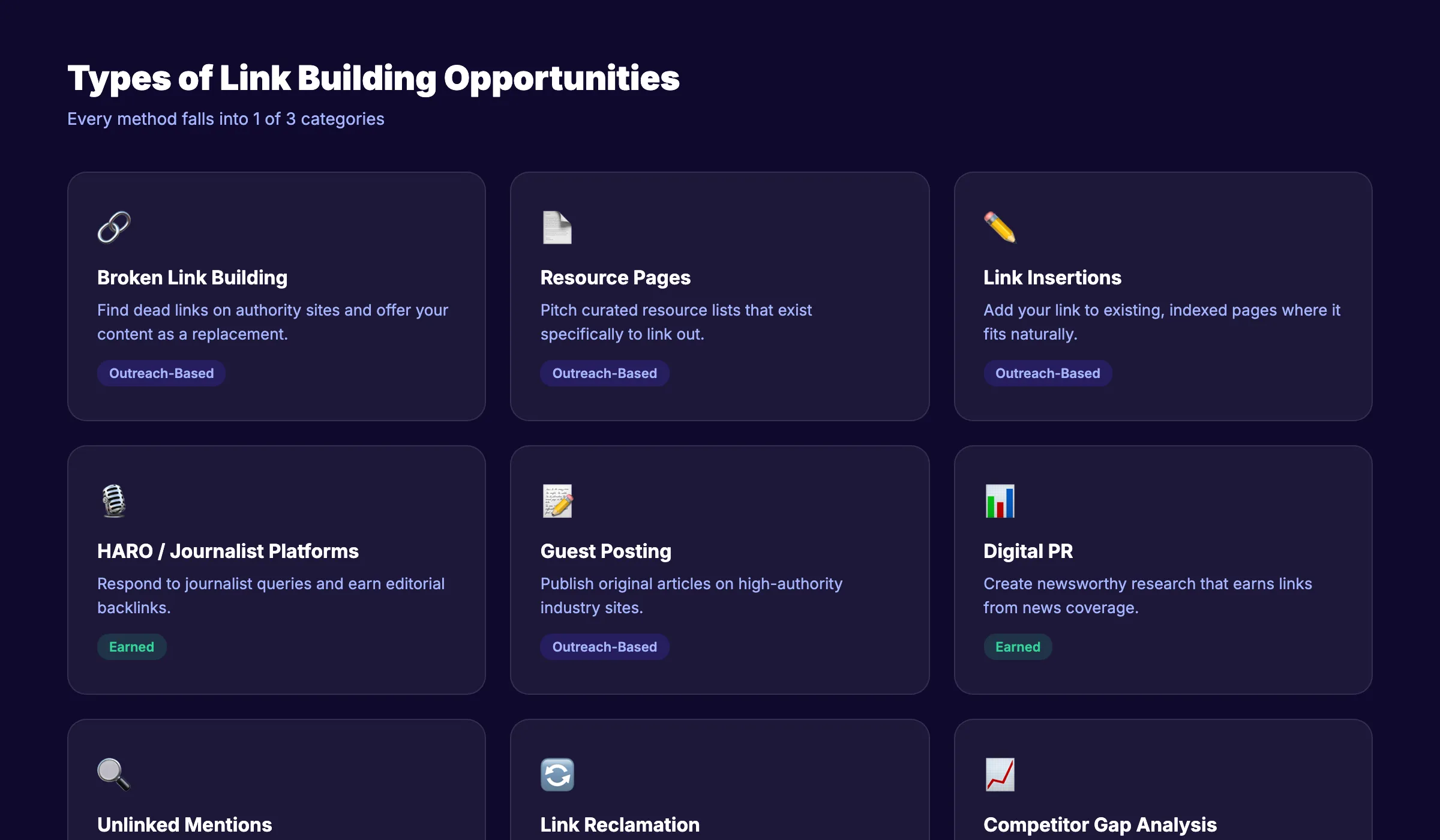
The 3 Categories of Link Building Opportunities
Every method falls into 1 of 3 buckets:
| Category | What It Means | Examples |
|---|---|---|
| Earned | You create something worth linking to | Original research, tools, data studies |
| Outreach-Based | You ask someone to link | Guest posts, broken link building, link inserts |
| Reclaimed | You recover links you should already have | Unlinked mentions, 404 reclamation, redirect fixes |
The strongest link profiles combine all 3. Relying on a single category creates fragile rankings that competitors can overtake.
Broken Link Building Opportunities {#broken-link-building}
Broken link building is one of the highest-conversion outreach methods available. You find dead links on authority sites, create replacement content, and ask the site owner to swap in your URL.
The conversion logic is simple. You are doing the webmaster a favor. Nobody wants 404 errors on their site. When you offer a working replacement, you solve their problem and earn a backlink simultaneously.
How to Find Broken Links on Authority Sites
Start with resource-heavy pages in your niche. Industry guides, university pages, and government resource lists accumulate broken links over time as sources go offline.
Use these search operators in Google:
"your keyword" + inurl:resources"your keyword" + "useful links""your keyword" + intitle:resources
Then run each result through a broken link checker. The Check My Links Chrome extension scans entire pages in seconds and highlights dead links in red.
For larger-scale prospecting, use Ahrefs or Semrush. Filter your competitor’s backlinks by HTTP status code to find every 404 page linking to them. Those are your targets.
Building Replacement Content
Do not pitch a generic homepage as a replacement. That approach gets ignored.
Check the dead page on the Wayback Machine first. See what the original content covered. Then create something better. More current data. Better formatting. Deeper coverage.
Your replacement content should match the intent of the original page. If the broken link pointed to a statistics roundup, create a statistics roundup. If it linked to a how-to guide, publish a how-to guide.
We wrote a full walkthrough on fixing broken links that covers the technical side.
Outreach That Gets Responses
Your outreach email needs 3 elements:
- Name the specific broken link (URL + anchor text)
- Link to your replacement content
- Keep the email under 100 words
Skip the flattery. Skip the long introduction. Webmasters receive dozens of these emails. The ones that convert are short, specific, and helpful.
Average response rates for broken link building outreach range from 5% to 15%. That beats cold guest post pitches, which average under 3%.
Resource Page Link Building {#resource-page-link-building}
Resource pages exist to link out. That makes them the most straightforward link building opportunity in SEO.
A resource page is a curated list of links on a specific topic. Universities, industry associations, government agencies, and niche blogs all maintain them. Because the page’s entire purpose is to provide useful links, site owners are receptive to adding relevant new ones.
How to Find Resource Pages in Your Niche
Use Google search operators to surface resource pages:
| Search Query | What It Finds |
|---|---|
"keyword" + inurl:links | Pages with “links” in the URL |
"keyword" + "useful resources" | Curated recommendation pages |
"keyword" + intitle:resources | Pages titled as resource lists |
"keyword" + "recommended sites" | Editorial recommendation lists |
site:.edu + "keyword" + resources | University resource pages |
The .edu and .gov resource pages carry the most authority. They are also the hardest to earn. Start with niche blog resource pages for faster wins, then work up to institutional targets.
Qualifying Resource Page Prospects
Not every resource page is worth a pitch. Check these 4 factors:
- Domain Authority above 30
- Page was updated within the last 12 months
- Links go to a mix of sites (not just internal links)
- The page topic matches your content closely
If a resource page only links to .edu sites, your commercial blog will not fit. If the page has not been updated since 2019, nobody is reading your pitch. Focus on active, relevant, diversified resource pages.
Crafting the Pitch
Explain what your content adds that the current list does not cover. Be specific. “I have a great article on SEO” will get deleted. “Your resources page covers on-page SEO but does not include a guide to backlink auditing. Here is one we published with 7 steps and free tools” will get read.
Backlinks drive rankings. Content drives backlinks. We publish 30 SEO-optimized articles per month so you always have link-worthy content to pitch. Start for $1 →
Link Insertion and Niche Edit Opportunities {#link-insertion-opportunities}
Link insertion (also called niche edits) is the practice of adding your link to an existing, already-indexed page. Unlike guest posting, you do not create new content. You find a published article where your link adds value and ask the author to insert it.
Why Link Insertions Work
An existing page with age, authority, and backlinks of its own passes more value than a freshly published guest post. Google has already crawled and indexed the page. The link equity transfers faster.
Link insertions also require less effort from the site owner. They do not need to review a full article draft. They just add a contextual link to content they already published.
How to Find Link Insertion Opportunities
Search for articles ranking on page 1 or 2 for your target keywords. Read each one. Look for sentences or paragraphs where your content would provide a natural supporting reference.
For example, if an article says “backlinks remain a top ranking factor” without citing a source, your backlink statistics roundup is a natural fit.
Tools that help:
- Ahrefs Content Explorer. Search by topic, filter by DR and traffic
- BuzzSumo. Find high-engagement articles in your niche
- Hunter.io. Find contact emails for outreach
Avoiding Low-Quality Link Insertion Schemes
Paid niche edit services that sell links in bulk are a Google penalty waiting to happen. Legitimate link insertions involve genuine editorial decisions. The site owner agrees your link improves their content for readers.
If someone offers you “50 niche edits for $500,” walk away. Those links come from PBNs or compromised sites. Focus on manual, one-to-one outreach to real publishers.
HARO Alternatives for Editorial Backlinks {#haro-alternatives}
HARO (Help a Reporter Out) was the gold standard for earning editorial backlinks. Then Cision rebranded it to Connectively in 2024 and shut it down entirely in December 2024. Featured.com acquired the HARO brand in April 2025 and relaunched it as a paid platform.
The good news: several alternatives have filled the gap. Editorial backlinks from journalist platforms correlate 3 times more strongly with AI search visibility than traditional backlinks.
Top HARO Alternatives for 2026
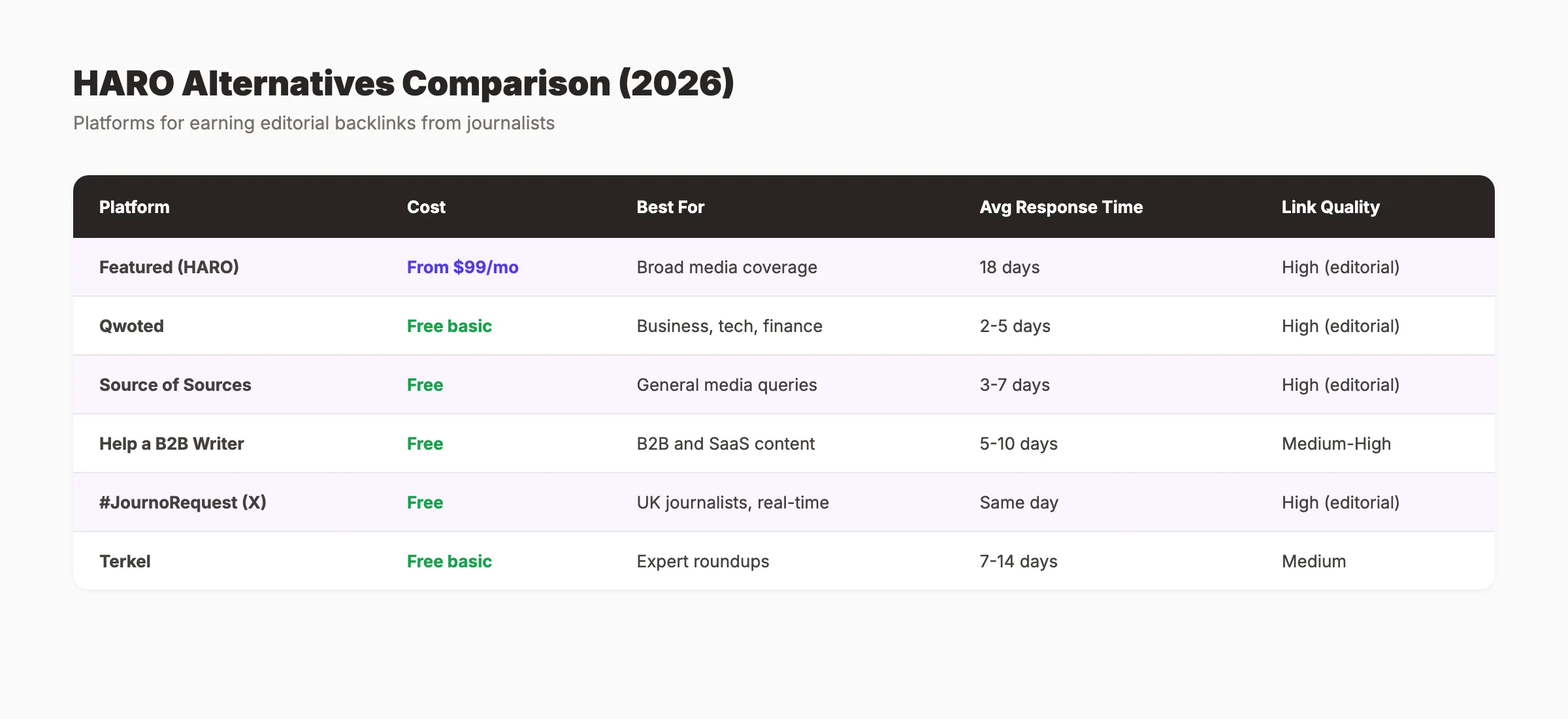
| Platform | Cost | Best For | Response Time |
|---|---|---|---|
| Featured (formerly HARO) | Paid plans from $99/mo | Broad media coverage | 18 days avg |
| Qwoted | Free basic, paid tiers | Business, tech, finance | 2-5 days |
| Source of Sources (SOS) | Free | General media queries | 3-7 days |
| Help a B2B Writer | Free | B2B and SaaS content | 5-10 days |
| #JournoRequest on X | Free | UK journalists, real-time | Same day |
| Terkel | Free basic | Expert roundups | 7-14 days |
How to Maximize Response Rates
Most experts who pitch through these platforms never hear back. The mistake is treating every query the same way.
Follow these rules:
- Only respond to queries where you have genuine expertise
- Lead with your strongest credential in the first sentence
- Answer the specific question in under 200 words
- Include 1 original data point or real example
- Respond within 2 hours of the query posting
Speed matters. Journalists on tight deadlines pick the first strong response. Not the best response submitted 3 days later.
Building a Journalist Source Profile
Consistent pitching builds your reputation on these platforms. Journalists start recognizing your name. They come to you directly for quotes. That shift. From pitching to being sought. Is where the real link building opportunity compounds.
This approach supports E-E-A-T signals that Google evaluates for rankings. Real journalist quotes from real experts demonstrate the experience and expertise that Google wants to see.
Guest Posting Opportunities That Move Rankings {#guest-posting-opportunities}
Guest posting still works. But the gap between effective guest posting and wasted effort is enormous.
The value of a guest post depends entirely on the host site. A guest article on a DA 60 industry publication with real traffic earns genuine link equity. A guest post on a “write for us” farm that exists only to sell links earns nothing. Possibly a penalty.
Finding High-Quality Guest Post Targets
Use these search operators:
"your niche" + "write for us""your niche" + "guest post guidelines""your niche" + "contribute an article""your niche" + "become a contributor"
Then filter ruthlessly. Check each prospect against this checklist:
- Domain Rating above 40
- Site publishes content in your niche regularly
- Articles have real comments and social shares
- The site is not a guest post mill (check “write for us” page quality)
- Organic traffic above 10,000 monthly visits
Writing Guest Posts That Earn Links and Traffic
Your guest post should be better than what you publish on your own blog. That sounds counterintuitive. But high-effort guest content earns more links, drives referral traffic, and builds relationships with editors who invite you back.
Include original insights, not recycled advice. Reference data. Use the same content writing standards you apply to your own site.
The author bio is where your link lives. Write 2 sentences: 1 credential, 1 link to your most relevant page. Do not stuff 5 links into a 3-sentence bio.
Consistent publishing builds link-worthy content. Stacc publishes 30 articles per month so your site always has fresh assets to pitch for guest posts and link placements. Start for $1 →
Unlinked Brand Mentions and Link Reclamation {#unlinked-brand-mentions}
Roughly 60% of brand mentions online are unlinked. Someone wrote about your company, product, or founder and did not include a hyperlink. That is a link building opportunity hiding in plain sight.
Finding Unlinked Mentions
Set up monitoring with these tools:
- Google Alerts. Free, basic, catches most mentions
- Ahrefs Alerts. More thorough, includes backlink monitoring
- Mention. Real-time brand monitoring across web and social
- BrandMentions. Tracks mentions and sentiment
Search for your brand name, product name, founder name, and any branded methodologies. When you find a mention without a link, send a polite email asking for attribution.
Link Reclamation: Recovering Lost Links
Link reclamation is different from unlinked mentions. This is about finding backlinks you already had that broke. Maybe you changed a URL and forgot a redirect. Maybe the linking site updated their page and dropped your link.
Run a backlink audit quarterly. Export your backlink profile from Ahrefs or Semrush. Filter for lost links. For each one:
- Check if the linking page still exists
- Verify whether the link was removed or the page was deleted
- If removed, contact the site owner with a brief “was this intentional?” email
- If your URL changed, set up a 301 redirect immediately
Link reclamation has the highest conversion rate of any outreach method. You are not asking for a new favor. You are asking someone to restore something they already gave you.
Fixing Internal Broken Links
While you are auditing, check your own site for broken outbound and internal links. Dead links on your pages hurt user experience and waste crawl budget. We covered the full process in our broken link repair guide.
Competitor Backlink Gap Analysis {#competitor-backlink-gap}
Your competitors already have backlinks. Some of those same sites would link to you if they knew your content existed. A backlink gap analysis reveals every linking domain pointing to competitors but not to you.
Running a Gap Analysis Step by Step
Open Ahrefs or Semrush. Use the “Link Intersect” or “Backlink Gap” tool. Enter your domain and 3 to 5 competitors.
The tool outputs every domain that links to at least 1 competitor but not to you. Sort by domain authority. The high-DA sites that link to multiple competitors represent your highest-priority targets.
| Priority Level | Signal | Action |
|---|---|---|
| High | Links to 3+ competitors, DA 50+ | Create competing content immediately |
| Medium | Links to 1-2 competitors, DA 30-50 | Add to outreach list |
| Low | Links to 1 competitor, DA under 30 | Monitor only |
Turning Gap Data Into Outreach Campaigns
For each high-priority prospect, answer 1 question: why did they link to your competitor?
Check the linking page. Find the specific anchor text and context. Then determine what you need to offer:
- They linked to a resource → Create a better resource
- They linked to data → Publish more current data
- They linked to a tool → Build a better tool or calculator
- They cited an expert quote → Pitch yourself as an alternative expert
This is where competitor keyword analysis and backlink gap analysis overlap. The same competitors you study for keyword opportunities also reveal link building opportunities.
Automating Gap Monitoring
Set up recurring reports in Ahrefs or Semrush. When a competitor earns a new backlink from a high-authority site, you want to know within days. Not months. Speed matters because the linking site is more likely to add another reference shortly after publishing.
SEO compounds over time. Every article you publish is a new asset for outreach and link building. Stacc publishes 30 per month on autopilot. Start for $1 →
Digital PR, Podcasts, and Content Syndication {#digital-pr-podcasts}
Digital PR is now the most popular link building method. 67.3% of marketers use it, and 48.6% rate it as the most effective tactic.
The reason is scale. A single digital PR campaign can earn 20 to 100+ backlinks from news sites, industry publications, and blogs that pick up the story. No other method matches that ratio of effort to links earned.
Digital PR Campaigns That Earn Links
The formula: create newsworthy data or research that journalists want to reference. The best formats are:
- Original surveys. Poll your customers or industry peers
- Data studies. Analyze a large dataset and publish findings
- Industry benchmarks , “We analyzed 10,000 websites and found…”
- Trend reports. Combine multiple data sources into a narrative
Brands using earned media and digital PR strategies report an average ROI of 312%. That number comes from the compounding effect of links, brand mentions, and referral traffic that a single campaign generates.
Podcast and Interview Link Building
Appearing as a guest on industry podcasts earns backlinks from show notes pages. Most podcast hosts include a link to your site and any resources you mention during the interview.
Find relevant podcasts through:
- Apple Podcasts search by keyword
- ListenNotes.com for niche discovery
- Searching
"your keyword" + podcast + "guest"on Google
Podcast links carry high trust signals because they sit on editorial pages alongside real content. They also support your E-E-A-T profile by demonstrating real-world expertise.
Content Syndication Platforms
Content syndication means republishing your content on third-party platforms. This earns links back to the original and expands your audience.
| Platform | Link Type | Audience |
|---|---|---|
| Medium | Nofollow (canonical available) | General, tech, business |
| LinkedIn Articles | Nofollow | B2B professionals |
| Business2Community | Dofollow | Marketing, business |
| GrowthHackers | Dofollow | Startups, growth |
| Zest.is | Dofollow | Marketing professionals |
Always set the canonical tag to your original URL when syndicating. This tells Google which version is the original. Medium supports this natively through their import tool.
Syndication supports your broader content marketing strategy by putting existing content to work in new channels.
Tools for Finding Link Building Opportunities {#link-building-tools}
Manual prospecting works at small scale. For anything beyond 10 outreach targets per week, you need tools. Here is what works best for each phase of the process.
Prospecting and Research Tools
| Tool | Best For | Starting Price |
|---|---|---|
| Ahrefs | Backlink gap analysis, broken link finding | $99/mo |
| Semrush | Link building tool, outreach lists | $129/mo |
| Moz Link Explorer | Domain authority checking, link research | $99/mo |
| BuzzStream | Outreach management, relationship tracking | $24/mo |
| Hunter.io | Finding contact emails for outreach | Free (25/mo) |
| Pitchbox | Large-scale outreach automation | $550/mo |
| Check My Links | Chrome extension for broken link checking | Free |
How to Build a Prospecting Workflow
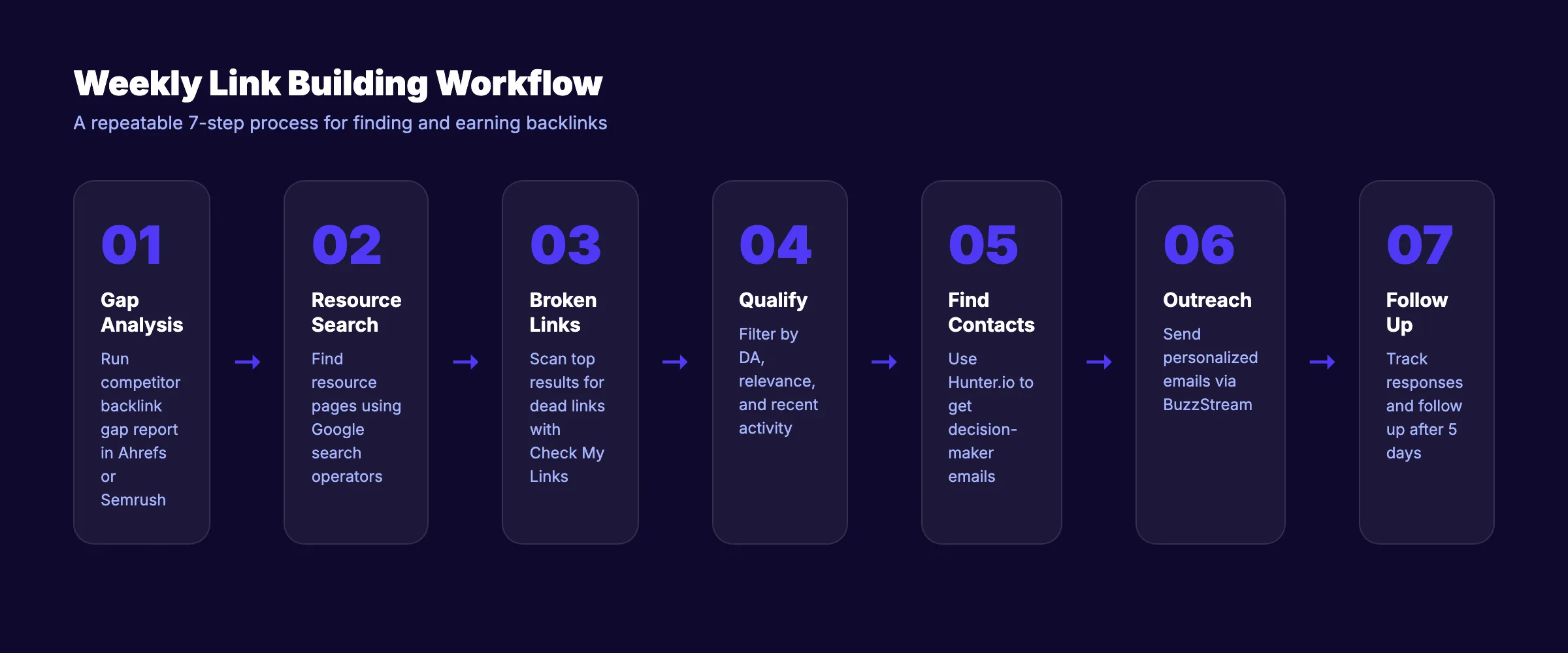
A repeatable workflow prevents wasted effort. Follow this sequence every week:
- Run competitor gap analysis (Ahrefs or Semrush)
- Search for resource pages using Google operators
- Check top results for broken links (Check My Links)
- Qualify prospects by DA and relevance
- Find contact emails (Hunter.io)
- Send personalized outreach (BuzzStream or manual)
- Track responses and follow up after 5 business days
Tracking Your Link Building Results
Measure 3 metrics monthly:
- Links earned. New referring domains pointing to your site
- Response rate. Percentage of outreach emails that get replies
- Conversion rate. Percentage of replies that result in a placed link
Use Google Search Console to track referring domains over time. Cross-reference with Ahrefs to catch links that GSC misses.
The industry average for outreach conversion is 5% to 15%. If your rate falls below 5%, revisit your prospect qualification. You are likely pitching sites that do not match your content.
Set monthly targets based on your current domain authority. Sites under DA 30 should aim for 10 to 15 new referring domains per month. Sites above DA 50 can target 20 to 30.
Building links starts with having content worth linking to. Stacc publishes 30 articles per month that serve as link-worthy assets for every outreach campaign you run. Start for $1 →
FAQ {#faq}
What are link building opportunities?
Link building opportunities are situations where you can earn a backlink from another website. They include broken link replacement, resource page pitching, guest posting, journalist platforms, competitor gap analysis, and unlinked brand mention outreach. Each method requires different tactics and tools.
What is the easiest link building opportunity for beginners?
Unlinked brand mention outreach is the easiest starting point. Set up Google Alerts for your brand name. When someone mentions you without linking, send a short email requesting they add a hyperlink. The conversion rate is high because the site owner already chose to reference you.
Is broken link building still effective in 2026?
Yes. Broken link building remains one of the highest-converting outreach methods. The approach evolved. You now need to create genuinely superior replacement content rather than pitching generic alternatives. Response rates average 5% to 15%, which outperforms cold guest post pitches.
What replaced HARO for link building?
After HARO shut down in December 2024, several platforms filled the gap. Featured.com acquired the HARO brand and relaunched it as a paid service. Free alternatives include Qwoted, Source of Sources (SOS), Help a B2B Writer, and the #JournoRequest hashtag on X. Each platform connects experts with journalists seeking quotes.
How many backlinks do I need to rank on page 1?
There is no fixed number. Pages ranking first on Google have 3.8 times more backlinks than pages in positions 2 through 10. The requirement depends on your niche competitiveness. Focus on earning links from high-authority, topically relevant sites rather than chasing a specific count.
What tools do I need for finding link building opportunities?
At minimum, use Ahrefs or Semrush for backlink research and gap analysis. Add Hunter.io for finding contact emails and BuzzStream or a spreadsheet for tracking outreach. The Check My Links Chrome extension is free and essential for broken link prospecting. 82% of SEO professionals rely on backlink analysis tools for their campaigns.
Link building in 2026 rewards specificity over volume. Every opportunity type covered in this guide produces real results when executed with the right research and genuine outreach. Start with 1 or 2 methods that match your current resources. Build systems around them. Then expand as your backlink profile grows and compounds over time.

Written by
Siddharth GangalSiddharth is the founder of theStacc and Arka360, and a graduate of IIT Mandi. He spent years watching great businesses lose organic traffic to competitors who simply published more. So he built a system to fix that. He writes about SEO, content at scale, and the tactics that actually move rankings.
30 SEO blog articles published every month
Keyword-optimized, scheduled, and live on your site. Automatically.
30-day trial · Cancel anytime
theStacc
Stop writing SEO content manually
30 blog articles, 30 GBP posts, and social media content. Published every month. Automatically.
Start Your $1 Trial$1 for 3 days · Cancel anytime