Tattoo Shop SEO: The Complete Guide (2026)
The complete SEO guide for tattoo shops. GBP optimization, portfolio image SEO, local keywords, and review strategy. With industry data. Updated 2026.
Siddharth Gangal • 2026-03-29 • Local SEO
In This Article
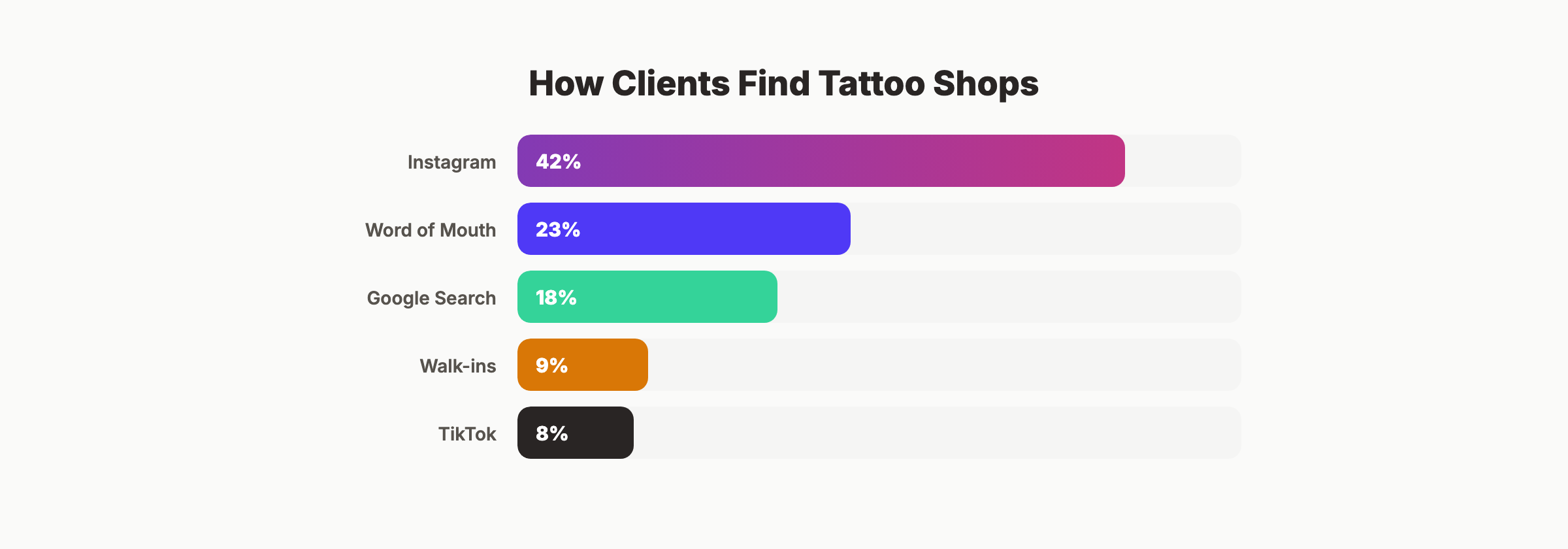
Tattoo shop SEO is how you stop depending on Instagram’s algorithm for bookings. 42% of tattoo clients find their artist through Instagram. But 18% find them through Google Search and Maps. And that 18% converts at a higher rate because they are actively looking for a shop near them, ready to book.
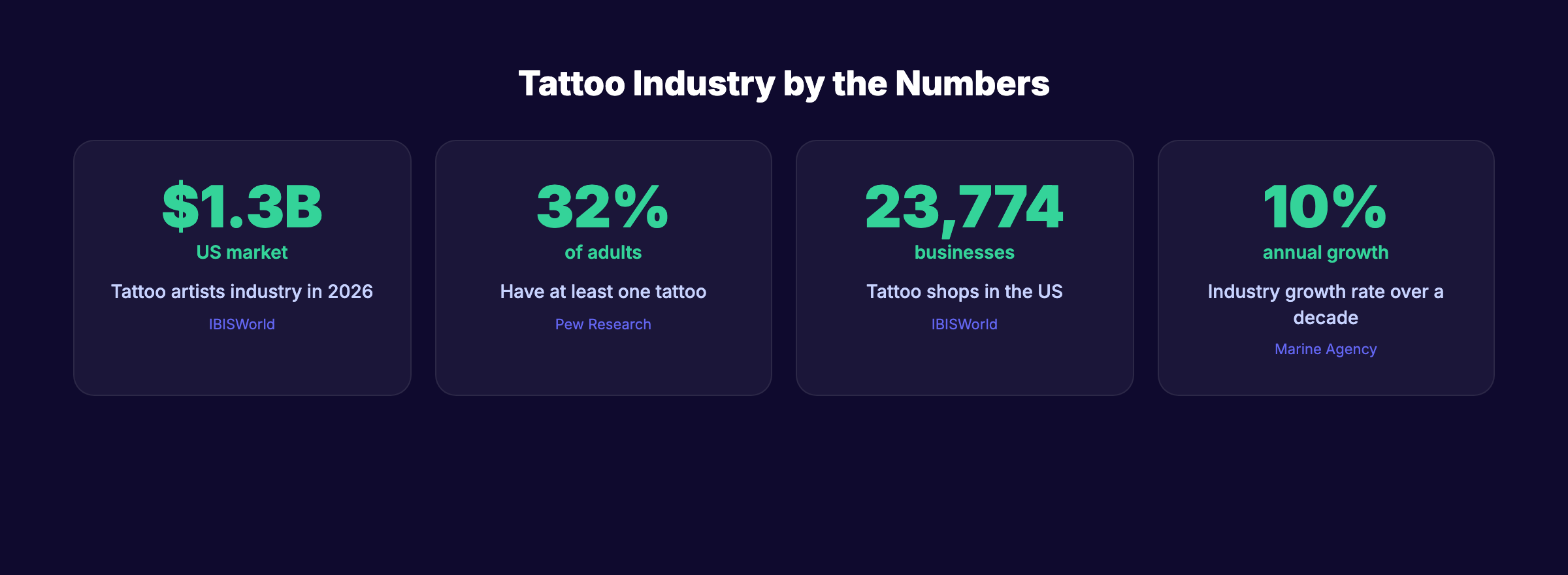
The U.S. tattoo industry is worth $1.3 billion in 2026 with 23,774 businesses competing for clients. 32% of American adults have at least one tattoo. The market grows 10% per year. Demand is strong. The shops that rank on Google capture the clients that competitors never see.
This guide covers tattoo shop SEO from Google Business Profile to portfolio image optimization. Every section is built for tattoo artists and shop owners, not generic businesses.
We have published 3,500+ SEO articles across 70+ industries. This guide reflects what drives bookings for tattoo studios right now.
Here is what you will learn:
- Why tattoo shops need SEO beyond Instagram
- How to optimize your Google Business Profile for tattoo searches
- The keyword strategy that captures clients by style and location
- How to make your portfolio images rank on Google
- Why reviews determine your local search visibility
- Content ideas that actually drive tattoo bookings
Why Tattoo Shops Need SEO Beyond Instagram
Most tattoo artists rely entirely on Instagram. When the algorithm changes, bookings drop. When an account gets restricted, revenue disappears. Instagram is rented space. Your website and Google presence are assets you own.
How Clients Find Tattoo Shops
| Discovery Channel | % of Clients | SEO Impact |
|---|---|---|
| 42% | You do not control the algorithm. Reach declining year over year | |
| Word of mouth | 23% | Valuable but unpredictable. Cannot scale |
| Google Search / Maps | 18% | You control this. Rankings compound over time |
| TikTok | 8% | Growing but difficult to convert to bookings |
| Walk-ins | 9% | Location-dependent. Drops when foot traffic drops |
The real story is in the conversion path. 80% of first-time clients at one Portland studio found them on Instagram, then researched the shop on Google, then booked through the website. Instagram drives discovery. Google builds trust. The website closes the booking.
Without a Google presence, you lose clients during the research phase. They find your Instagram, search your shop name on Google, see nothing (or worse, see a competitor), and move on.
For the full picture of local SEO fundamentals, see our complete guide.
Your SEO team. $99 per month. 30 optimized articles published automatically. Built for local businesses like tattoo studios. Start for $1 →
Google Business Profile for Tattoo Shops
Your Google Business Profile determines whether you appear in the map pack when someone searches “tattoo shop near me.” 42% of local searchers click on map pack results. Businesses with complete profiles are 70% more likely to attract in-person visits.
Set Up Your GBP Right
- Primary category: “Tattoo Shop” (most specific available)
- Secondary categories: “Body Piercing Shop” (if you offer piercings), “Art Studio”
- Business description: 750 characters. Lead with your styles, location, and what makes your shop different
- Services: List every service (custom tattoos, flash, cover-ups, piercings, tattoo removal consultations)
- Business hours: Include walk-in hours if different from appointment hours
- Phone number: Local number, not toll-free
- Website: Link to your homepage or booking page
- Booking link: Add a direct link to your online booking system
- Attributes: Wheelchair accessible, appointment required, walk-ins welcome, LGBTQ+ friendly
For more on choosing the right GBP categories, see our detailed guide.
Photos That Drive Bookings
GBP photos increase direction requests by 40%. For a tattoo shop, your photos are your portfolio. Upload:
- Healed tattoo work (not just fresh ink. Healed tattoos show true quality)
- Each artist’s best pieces across different styles
- Shop interior (clean, professional workspace builds trust)
- Team photos (clients want to know who will tattoo them)
- Process shots (setup, stencil application, in-progress work)
Add 5 to 10 new photos per month. Google rewards active listings with better visibility.
GBP Posts for Tattoo Studios
Post 2 to 3 times per week. GBP posts signal freshness to Google.
| Post Type | Example | Frequency |
|---|---|---|
| Portfolio highlights | ”New Japanese sleeve by [Artist Name]“ | 2x/week |
| Flash sales | ”Walk-in flash day this Saturday. Starting at $80” | Weekly |
| Artist availability | ”[Artist] has 2 openings next week. Book now.” | As available |
| Seasonal | ”Spooky flash sheet for October. Limited designs.” | Monthly |
Keyword Strategy for Tattoo Shop SEO
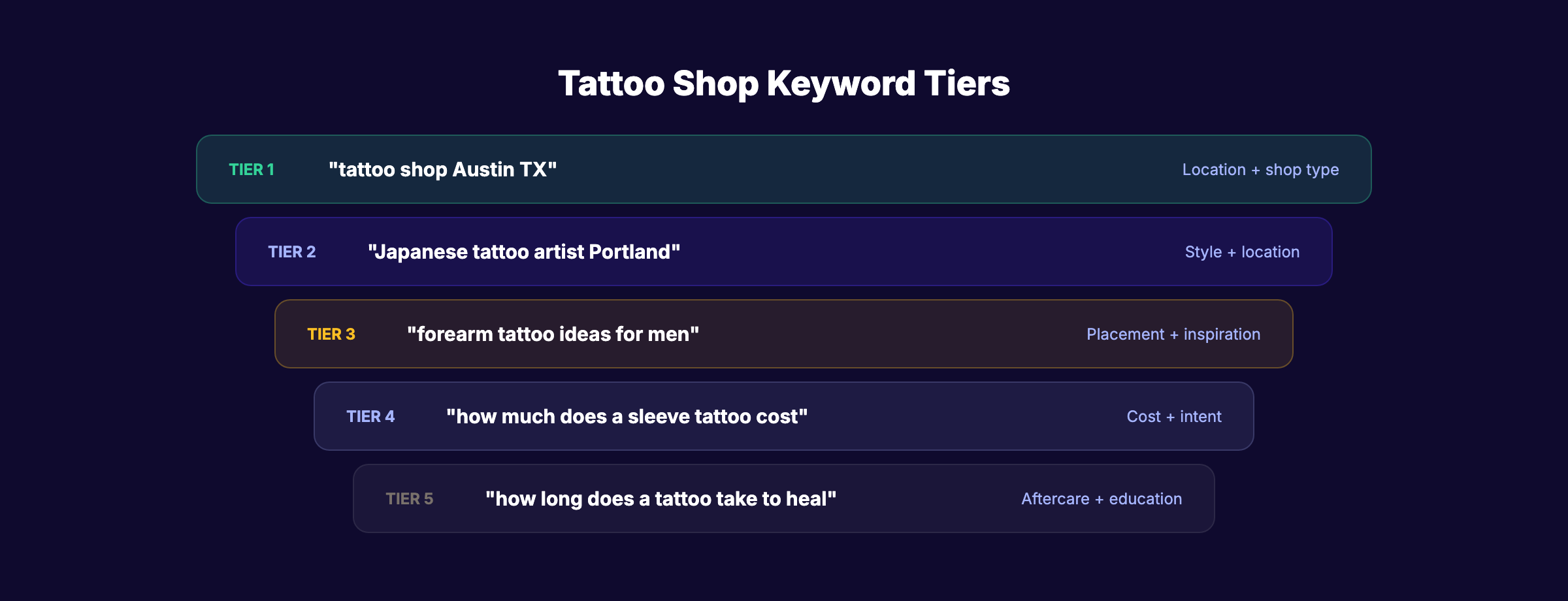
Most tattoo shops target “tattoo shop” or “tattoo artist.” Those terms are competitive and generic. The real wins come from combining style, location, and intent.
The Tattoo Keyword Framework
| Tier | Pattern | Example | Competition |
|---|---|---|---|
| Tier 1: Location + shop | ”tattoo shop [city]" | "tattoo shop Austin TX” | Medium |
| Tier 2: Style + location | ”[style] tattoo artist [city]" | "Japanese tattoo artist Portland” | Low |
| Tier 3: Placement + style | ”[body part] tattoo ideas" | "forearm tattoo ideas for men” | Very low (high volume) |
| Tier 4: Questions | ”how much does a [type] tattoo cost" | "how much does a sleeve tattoo cost” | Very low |
| Tier 5: Aftercare | ”tattoo aftercare [topic]" | "how long does a tattoo take to heal” | Very low |
Where to Start
Create dedicated pages for each tattoo style you offer:
/styles/traditional-tattoo— Target “traditional tattoo artist [city]”/styles/realism-tattoo— Target “realistic tattoo artist [city]”/styles/fine-line-tattoo— Target “fine line tattoo artist [city]”/styles/japanese-tattoo— Target “Japanese tattoo artist [city]”/styles/blackwork-tattoo— Target “blackwork tattoo artist [city]”
Each page includes example work, a description of the style, pricing guidance, and a booking link. These pages rank for long-tail keywords that generic portfolio pages never capture.
Artist Profile Pages
Create a dedicated page for each tattoo artist at your shop. Include their name, specialties, years of experience, a curated portfolio, and a direct booking link. Artist profile pages target “[artist name] tattoo” searches and capture clients who research specific artists before booking.
Artist pages also help with Google’s E-E-A-T signals. Named artists with verifiable portfolios and bios signal real expertise to Google. An anonymous shop with no artist information looks less trustworthy than one that showcases its team.
Local Landing Pages
If your shop serves clients from multiple cities, create dedicated landing pages for each city. “Tattoo Shop in Round Rock TX” and “Tattoo Shop in Georgetown TX” target different local searches. Each page needs unique content about serving that area. Do not duplicate the same text with only the city name swapped.
For keyword research methods, see our guide on building topical authority.
Portfolio Image SEO for Tattoo Shops
Tattoo shops live and die by visual content. Your portfolio is your biggest selling tool. But most tattoo websites have zero image SEO. Images named “IMG_4872.jpg” with no alt text. Google cannot index what it cannot read.
The Tattoo Image SEO Checklist
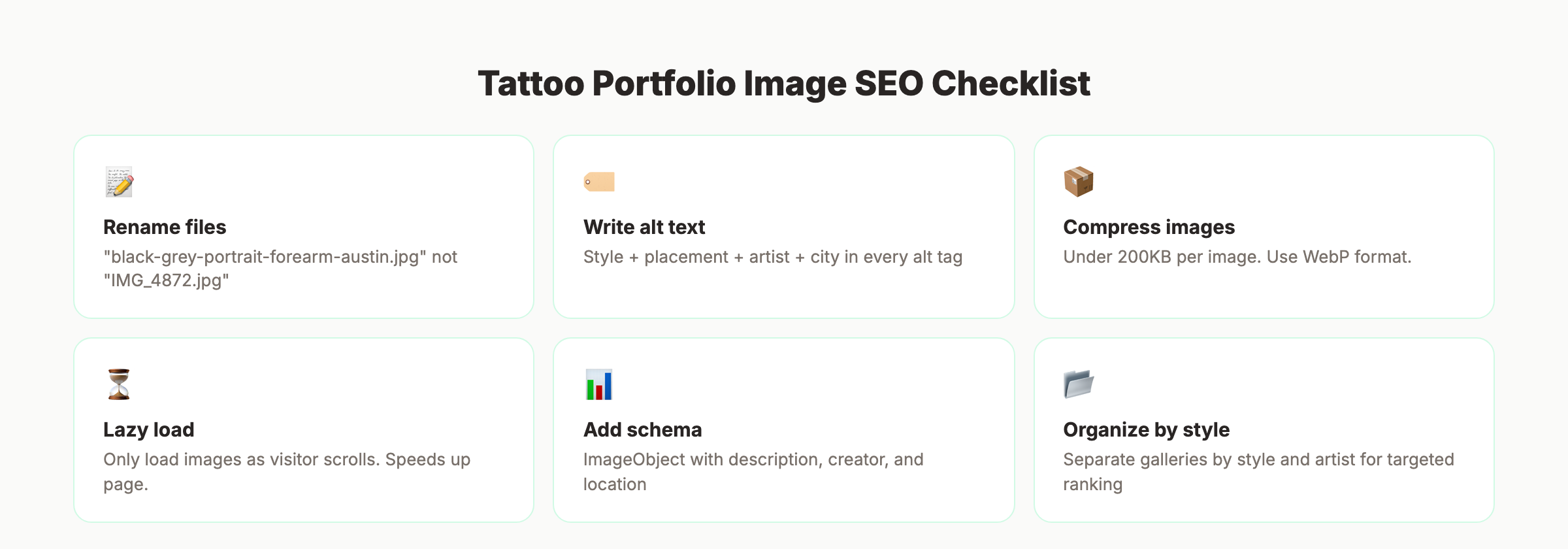
- Rename every file descriptively. “black-grey-portrait-tattoo-forearm-austin.jpg” ranks in Google Images. “IMG_4872.jpg” does not.
- Write alt text with keywords. “Black and grey portrait tattoo on forearm by [Artist Name] at [Shop Name], Austin TX.” This describes the image for Google and screen readers.
- Compress images to under 200KB. Use WebP format. Tools: ShortPixel, TinyPNG, or Squoosh. Large uncompressed images kill page speed.
- Use lazy loading. Only load images as the visitor scrolls down. Keeps initial page load fast.
- Add structured data. ImageObject schema with description, creator, and location properties.
- Organize by style and artist. Separate gallery pages by tattoo style and by artist. Each page becomes a ranking target.
For a deeper guide, see our post on blog image optimization for SEO.
Why Image SEO Matters for Tattoo Shops
People search Google Images for tattoo inspiration. “Forearm tattoo ideas,” “sleeve tattoo designs,” and “small tattoo ideas” generate millions of searches per month. If your portfolio images appear in those results with proper alt text and filenames, they drive traffic to your site without any additional effort.
3,500+ blogs published. 92% average SEO score. Every article passes a 40-point quality audit before it goes live. Start for $1 →
Reviews and Reputation for Tattoo Shops
Getting tattooed is a trust decision. Clients put permanent art on their body. They research heavily before booking. 68% of consumers only use businesses rated 4+ stars. For tattoo shops, that threshold is even higher. Most clients want 4.5+ stars before they trust an artist with their skin.
How to Build Reviews Consistently
62% of tattoo inquiries happen outside business hours, between 7 and 9 PM. That means your best review request window is immediately after the appointment, when the client is excited about their new piece.
The tattoo shop review system:
- At checkout: “We would love a Google review if you have a minute. Here is the link.” (Hand them a card with a QR code)
- Same-day text: Send an automated follow-up text 2 hours after the appointment with a direct Google review link
- Aftercare email (day 3): Send aftercare instructions with a gentle review reminder at the bottom
- Social media moment: When the client posts their tattoo and tags your shop, reply with a thank-you and a review request
For the complete review playbook, see our guide on getting more Google reviews.
Responding to Reviews
Respond to every review within 24 to 48 hours. Thank positive reviewers by name and mention their tattoo style or the artist who did the work. For negative reviews, acknowledge the concern, avoid being defensive, and take it offline. See our guide on responding to negative reviews.
Content That Drives Tattoo Bookings
Most tattoo shop websites have a homepage, a portfolio page, and a contact page. Three pages. That gives Google almost nothing to work with. Adding 4 to 8 blog posts per month transforms your site from a business card into a ranking machine.
Content Ideas for Tattoo Shops
| Content Type | Example Topics | Keyword Target |
|---|---|---|
| Aftercare guides | ”How to care for a new tattoo,” “Tattoo healing stages day by day” | High-volume informational |
| Cost guides | ”How much does a tattoo cost in [city],” “Sleeve tattoo pricing guide” | Commercial intent |
| Style explainers | ”What is American traditional tattooing,” “Realism vs hyperrealism tattoos” | Educational + local |
| Placement guides | ”Best places to get a first tattoo,” “Most painful spots for a tattoo” | High-volume, drives new clients |
| Artist spotlights | ”[Artist name]: Specialties, portfolio, and booking” | Named search + artist SEO |
| Seasonal content | ”Best tattoo ideas for summer,” “Halloween flash designs” | Seasonal traffic spikes |
Each blog post links to relevant style pages and the booking page. Every post builds topical authority that compounds over time.
The Instagram-to-Website Pipeline
Do not choose between Instagram and your website. Use both strategically.
Instagram drives discovery. Your website converts that discovery into bookings. The pipeline works like this:
- Client sees your work on Instagram
- Client searches your shop name on Google
- Client lands on your website, browses your portfolio, reads reviews
- Client books through your online booking system
Your website needs to be the strongest link in that chain. Clean design, fast load speed, mobile-friendly, and easy booking.
Online Booking: The Revenue Multiplier
62% of tattoo inquiries happen outside business hours. Peak inquiry time is 7 to 9 PM. If your shop only takes bookings by phone during business hours, you lose the majority of potential clients.
An online booking system with deposit collection solves 2 problems at once. It captures after-hours inquiries and reduces no-shows. Without deposits, no-show rates run 20% to 30%. With deposits, they drop to 2% to 8%. That alone can add $500 to $1,000 per week in recovered revenue for a busy shop.
Add a booking button to every page of your website, your GBP listing, and your Instagram bio.
Rank everywhere. Do nothing. Blog SEO, Local SEO, and Social on autopilot. Stacc starts at $99 per month with a $1 trial. Start for $1 →
On-Page SEO for Tattoo Shop Websites
Most tattoo shop websites prioritize aesthetics over structure. Dark themes, full-screen images, minimal text. Beautiful to look at. Invisible to Google.
The Tattoo Shop On-Page Checklist
- Title tags include style, service, and city (“Japanese Tattoo Artist Austin TX | [Shop Name]”)
- Meta descriptions describe your specialty and location (145 to 155 characters)
- H1 tag on every page matches the topic
- Artist pages include name, specialties, bio, and portfolio
- Style pages include descriptions, examples, and pricing ranges
- Schema markup with LocalBusiness type (use TattooParlor subtype if available)
- Mobile-responsive design (most tattoo clients browse on phones)
- Page loads under 3 seconds (compress portfolio images)
- NAP (Name, Address, Phone) in the footer of every page
- Online booking button visible on every page
For the full local SEO checklist, see our step-by-step resource.
Measuring Tattoo Shop SEO Results
Track these metrics monthly to know whether your SEO is working.
| Metric | Tool | What It Shows |
|---|---|---|
| Google Maps position | BrightLocal or manual search | Whether you appear in the 3-pack for “tattoo shop [city]“ |
| GBP views and actions | GBP Insights | How many people see your listing and click, call, or get directions |
| Organic website traffic | Google Analytics | Whether search visitors find your site |
| Booking requests from organic | Booking system analytics | Whether traffic converts to actual appointments |
| Review count + rating | GBP dashboard | Whether your review system produces results |
Realistic Timeline
| Timeframe | What to Expect |
|---|---|
| Month 1 | GBP optimized, photos uploaded, first blog posts published |
| Months 2-3 | Google indexes content. Style and location keywords start appearing in Search Console |
| Months 4-6 | Long-tail keywords rank. “Best [style] tattoo artist [city]” starts driving bookings |
| Months 7-12 | Authority builds. Portfolio images rank in Google Images. Organic bookings become consistent |
FAQ
Is SEO worth it for a tattoo shop?
Yes. 18% of tattoo clients find shops through Google Search and Maps. Those clients are actively looking to book, making them higher-intent than Instagram followers. SEO builds an asset you own. Unlike Instagram, your Google rankings do not disappear when an algorithm changes.
How long does tattoo shop SEO take?
Expect initial improvements within 3 to 6 months for style-specific and location keywords (“Japanese tattoo artist Austin”). GBP optimization often shows results within 30 to 60 days. Competitive city-level keywords (“tattoo shop NYC”) take 6 to 12 months of consistent effort.
Do tattoo artists need a website if they have Instagram?
Yes. Instagram drives discovery, but clients research on Google before booking. 80% of first-time clients at one studio found them on Instagram, then verified them on Google, then booked through the website. Without a website, you lose clients during the trust-building research phase.
What keywords should a tattoo shop target?
Start with “[tattoo style] tattoo artist [city]” keywords. Then create content targeting “how much does [type] tattoo cost” and “tattoo aftercare” guides. Avoid head terms like “tattoo” or “tattoo shop” where national competition is too high. Local and style-specific terms are where independent shops win.
How do I get more Google reviews for my tattoo shop?
Ask at 3 touchpoints: at checkout (QR code card), same-day text (automated with direct review link), and aftercare follow-up email (day 3). The window immediately after the tattoo session is when client excitement is highest. Aim for 2 to 3 new reviews per week.
How much does SEO cost for a tattoo shop?
SEO for tattoo shops ranges from $99 per month for automated content and local SEO to $1,500+ for full-service agency work. Most independent shops see strong results between $99 and $500 per month with consistent blog publishing and GBP management.
The tattoo shops winning new clients in 2026 are the ones visible where people search. Every blog post, every GBP update, and every Google review builds on the last. Start now and own the local search results in your market within 6 to 12 months.
Skip the agency. Keep the results. Stacc starts at $99 per month with a $1 trial. 30 articles. Published automatically. Start for $1 →
Written and published by Stacc. We publish 3,500+ articles per month across 70+ industries. All data verified against public sources as of March 2026.