Voice search SEO optimizes for spoken questions rather than typed keywords. Over a billion voice searches happen each month, and about 40% of voice results come from featured snippets. The work is conversational phrasing, direct answers near the top of the page, fast pages, and accurate local business data.
Over 1 billion voice searches happen every month. 72% of smart speaker owners use voice search daily. And 40% of voice search results come from featured snippets. Yet most businesses have zero strategy for voice search optimization.
Voice search is not a future trend. It is a current channel that most SEO strategies ignore entirely. The queries are different. The results are different. The optimization tactics are different. And the businesses that adapt first capture traffic their competitors never see.
We have published 3,500+ articles across 70+ industries. The sites that rank for voice queries share specific patterns. This guide covers every one of them.
Here is what you will learn:
- How voice search queries differ from typed searches
- The ranking factors that determine voice search results
- How to optimize content for featured snippets (voice answer source)
- Local voice search optimization for "near me" queries
- Technical SEO requirements for voice search visibility
- How to measure voice search performance
How Voice Search Works
Voice search uses natural language processing to interpret spoken queries and return a single spoken answer. The user asks a question. The assistant reads back one result. That result comes from your website or it does not. There is no page 2.
Voice Search vs Text Search
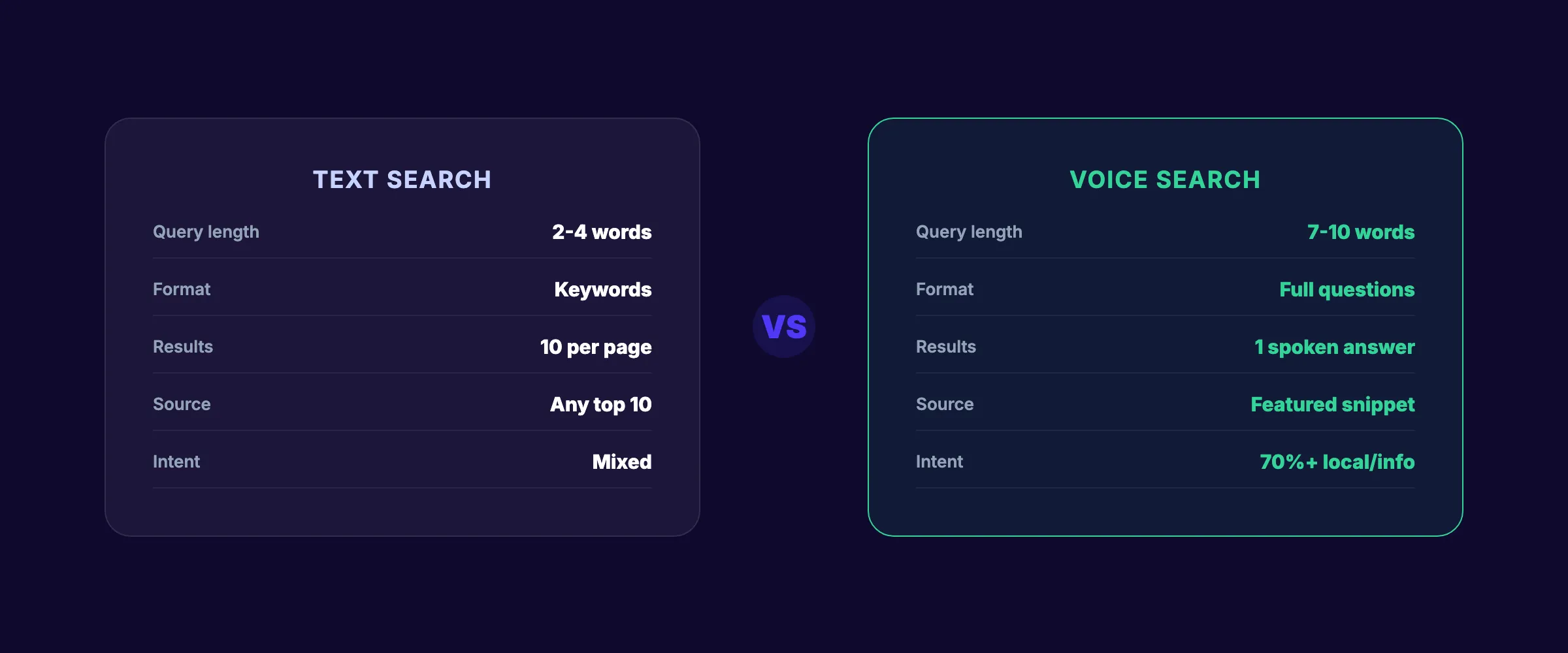
| Factor | Text Search | Voice Search |
|---|---|---|
| Query length | 2-4 words | 7-10 words (conversational) |
| Query format | Keywords | Full questions |
| Results shown | 10 per page | 1 spoken answer |
| Source | Any ranking page | Featured snippet or position 0 |
| Intent | Mixed | 70%+ local or informational |
| Device | Desktop + mobile | Phone, smart speaker, car |
The fundamental difference is this: text search shows 10 results. Voice search reads 1. Ranking #3 for text search still gets clicks. Ranking #3 for voice search gets nothing. You either win position 0 or you are invisible.
Where Voice Searches Happen
Voice search happens on 4 main platforms:
- Google Assistant (Android phones, Nest speakers, Pixel devices)
- Apple Siri (iPhone, iPad, HomePod, Apple Watch, CarPlay)
- Amazon Alexa (Echo devices, Fire TV, third-party integrations)
- Microsoft Cortana (Windows PCs, some enterprise apps)
Google Assistant handles the largest share of voice searches. It pulls answers from Google Search, which means standard SEO practices apply. The difference is how Google selects the one answer to read aloud.
Voice Search Ranking Factors
Google selects voice search answers differently from standard search results. Understanding these ranking factors is the foundation of voice search optimization.
1. Featured Snippets
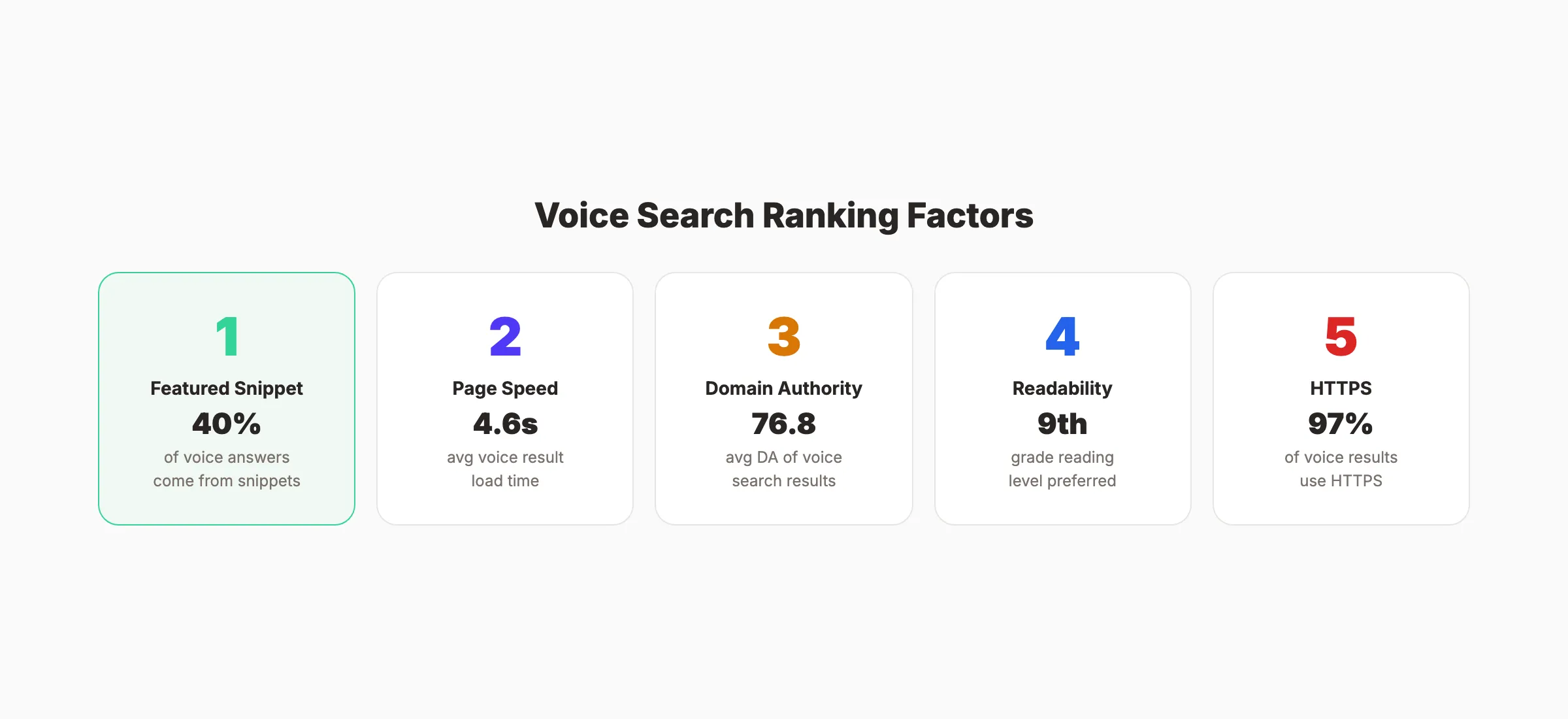
40% of all voice search answers come directly from featured snippets. If your content holds the featured snippet position for a query, Google reads it aloud as the voice answer.
Featured snippets appear in 3 formats:
| Snippet Type | Best For | Example |
|---|---|---|
| Paragraph | "What is" questions | Definition in 40-60 words |
| List | "How to" questions | Numbered or bulleted steps |
| Table | Comparison questions | Data in rows and columns |
To win featured snippets, answer the question directly within the first 50 words below the H2 heading. Then expand with detail. Google pulls the concise answer for the snippet and links to your full page.
2. Page Speed
Voice search results load 52% faster than the average web page. According to Backlinko's voice search study, the average voice search result page loads in 4.6 seconds. The average web page loads in 8.8 seconds.
Speed matters more for voice because users expect instant answers. A 3-second delay on a smart speaker feels like an eternity. Optimize your Core Web Vitals and target under 3 seconds for mobile page load.
3. Domain Authority
Voice search results come from high-authority domains. The average domain authority of a voice search result is 76.8 (out of 100). This is significantly higher than the average for standard search results.
Building domain authority requires consistent content publishing, quality backlinks, and time. There is no shortcut. But the businesses that invest in topical authority through regular content production see their voice search visibility increase alongside their standard rankings.
4. Content Readability
Google prefers voice answers written at a 9th-grade reading level. Complex, jargon-heavy content does not get selected for voice results. The answer needs to sound natural when read aloud.
Write for clarity. Use short sentences. Avoid technical terminology unless explaining it. If a sentence sounds awkward when spoken, rewrite it.
5. HTTPS
97% of voice search results come from HTTPS pages. If your site still runs on HTTP, you are excluded from nearly all voice search results. This is a baseline requirement, not a differentiator.
Your SEO team. $99 per month. 30 optimized articles, published automatically. Built to capture featured snippets and voice search answers.
How to Optimize Content for Voice Search
Voice search optimization is not a separate strategy. It is a layer on top of standard SEO that focuses on question-based content, concise answers, and featured snippet capture.
Target Question Keywords
Voice queries are questions. 70% start with who, what, where, when, why, or how. Your keyword research must include question-based terms.
Tools to find question keywords:
- Google's "People Also Ask" boxes (search your topic and capture every question)
- AnswerThePublic (generates question variations for any seed keyword)
- Google Search Console (filter queries containing "how," "what," "why")
- Ahrefs or Semrush keyword tools (filter for question modifiers)
For every topic you cover, identify 5 to 10 question keywords. Each question becomes an H2 or H3 heading in your content with a direct answer immediately below.
Write Direct Answers
Voice search answers average 29 words. That is 1 to 2 sentences. Google extracts this concise answer from your page and reads it aloud.
Structure your content like this:
## [Question as H2 heading]

[Direct answer in 1-2 sentences, under 40 words.]

[Extended explanation in 2-3 paragraphs with detail, examples, and data.]
The direct answer wins the featured snippet. The extended content satisfies users who click through for more detail. Both serve different parts of the same query.
Use Conversational Language
Voice queries sound like real speech. "What is the best restaurant near downtown" not "best restaurant downtown."
Write the way people talk. Use natural phrasing. Include the full question in your heading, not just the keyword fragment. This matches the conversational pattern of voice queries more accurately.
Optimize for "Near Me" Queries
58% of voice searches are local. "Find a plumber near me." "What time does the pharmacy close?" "Where is the nearest gas station?"
Local voice search optimization requires:
- A complete, optimized Google Business Profile
- Local SEO fundamentals (NAP consistency, citations, reviews)
- Location pages on your website for each service area
- Schema markup with geo coordinates
- Mobile-optimized pages (most voice searches happen on phones)
The businesses that dominate local voice search are the same ones that dominate the Google Maps pack. Voice search optimization and local SEO overlap almost entirely for location-based queries.
Build FAQ Sections
FAQ sections are voice search gold. Each question-answer pair is a potential featured snippet. A single FAQ section with 6 questions creates 6 voice search opportunities.
Format FAQs with:
- The full question as a bold heading
- A direct answer in 1 to 3 sentences
- FAQPage schema markup to signal the Q&A format to Google
Most competitor pages have zero FAQ sections. Adding structured FAQs to every blog post and service page gives you a significant voice search advantage.
3,500+ blogs published. Every article is SEO-scored before publish. See what theStacc can do for your site.
Technical SEO for Voice Search
Voice search has specific technical requirements. Meeting these requirements does not guarantee voice visibility. Missing them guarantees exclusion.
Schema Markup
Structured data helps Google understand your content format. For voice search, the most valuable schema types are:
| Schema Type | Voice Search Benefit |
|---|---|
| FAQPage | Marks Q&A pairs for direct extraction |
| HowTo | Marks step-by-step instructions |
| LocalBusiness | Provides location data for "near me" queries |
| Speakable | Explicitly marks content suitable for voice reading |
| Article | Signals content type and topic |
The Speakable schema is specifically designed for voice search. It tells Google which sections of your page are best suited for text-to-speech audio playback. Few sites implement it, which means early adopters gain a competitive edge.
Page Speed Optimization
Target these performance benchmarks for voice search readiness:
- ✓ Mobile page load under 3 seconds
- ✓ Largest Contentful Paint (LCP) under 2.5 seconds
- ✓ First Input Delay (FID) under 100 milliseconds
- ✓ Cumulative Layout Shift (CLS) under 0.1
- ✓ Server response time under 200 milliseconds
Compress images. Minimize JavaScript. Use a CDN. Enable browser caching. These standard Core Web Vitals optimizations directly impact voice search eligibility.
Mobile-First Design
Over 60% of voice searches happen on mobile devices. Google uses mobile-first indexing. If your mobile experience is poor, voice search visibility drops.
Ensure your site:
- ✓ Uses responsive design on all pages
- ✓ Has tap-friendly buttons and links (minimum 48x48 pixels)
- ✓ Loads fonts and images efficiently on mobile
- ✓ Does not use intrusive interstitials or popups
- ✓ Passes Google's Mobile-Friendly Test
Secure Site (HTTPS)
97% of voice search results are HTTPS. This is non-negotiable. If your site is not on HTTPS, fix that before anything else.
Voice Search for Local Businesses
Local businesses benefit from voice search more than any other category. The majority of voice queries have local intent. "Find a [business] near me" is the most common voice search pattern.
Local Voice Search Optimization Checklist
- ✓ Claim and optimize Google Business Profile
- ✓ Ensure NAP consistency across all directories
- ✓ Build citations on top local directories
- ✓ Collect 50+ Google reviews with a 4.5+ rating
- ✓ Create location-specific pages for each service area
- ✓ Add LocalBusiness schema with geo coordinates to every page
- ✓ Include your city and neighborhood in title tags and headings
- ✓ Optimize for "[service] near me" query patterns
- ✓ Post weekly updates to your Google Business Profile
- ✓ Respond to all reviews within 24 hours
Voice Search Opportunities by Business Type
| Business Type | Top Voice Queries | Optimization Priority |
|---|---|---|
| Restaurants | "restaurants near me," "best [cuisine] in [city]" | GBP hours, menu, reviews |
| Home Services | "emergency [service] near me" | GBP, service pages, phone number |
| Healthcare | "doctor near me," "pharmacy hours" | GBP, appointment booking, schema |
| Retail | "store hours," "[product] near me" | GBP, inventory, local pages |
| Professional Services | "[lawyer/accountant] near me" | GBP, reviews, service descriptions |
For every local business, GBP posting frequency and review velocity are the two highest-impact factors for voice search visibility. Google trusts active, well-reviewed businesses. Voice search rewards that trust.
Measuring Voice Search Performance
Voice search traffic is difficult to isolate in analytics. Google does not report voice vs text search separately. But you can track proxy metrics that indicate voice search visibility.
Metrics to Monitor
| Metric | Tool | What It Indicates |
|---|---|---|
| Featured snippet count | Ahrefs or Semrush | Voice answer potential |
| Question keyword rankings | Google Search Console | Voice query visibility |
| "Near me" keyword traffic | Google Search Console | Local voice traffic |
| Mobile organic traffic | Google Analytics | Voice search device |
| Position 0 keywords | Rank tracker | Direct voice answer source |
| Organic CTR | Google Search Console | Snippet performance |
Track Featured Snippet Wins
Every featured snippet you hold is a potential voice search answer. Track your snippet count monthly. Set a target to win 5 to 10 new featured snippets per month by adding structured Q&A content to existing pages.
Monitor Question Queries
In Google Search Console, filter your queries by questions. Look for searches starting with "how," "what," "where," "when," "why," and "who." Track impressions and clicks for these queries over time. Rising question-query traffic signals increasing voice search visibility.
Voice Search Traffic Estimation
A rough estimation method: take your total featured snippet traffic and assume 20 to 30% originates from voice devices. This is not precise, but it provides a directional metric for tracking voice search growth.
Rank everywhere. Do nothing. Blog SEO, Local SEO, and Social on autopilot. Starting at $99 per month.
Common Voice Search Optimization Mistakes
1. Ignoring Question Keywords
Most keyword research focuses on 2 to 4 word phrases. Voice queries are 7 to 10 words. If your keyword strategy does not include question-based long-tail terms, you are invisible to voice search.
Add a question keyword layer to every content piece. For every target keyword, identify 3 to 5 related questions. Answer each one directly in your content.
2. Writing Long-Winded Answers
Voice answers are 29 words on average. If your content buries the answer in paragraph 4 after a 200-word introduction, Google skips it. Lead with the answer. Expand after.
3. Ignoring Local SEO
58% of voice searches are local. Skipping local SEO fundamentals (GBP, citations, reviews) eliminates your business from the largest voice search category.
4. Slow Page Speed
Voice search results load 52% faster than average. If your site takes 6 to 8 seconds on mobile, you are excluded from voice results even if your content is perfect.
5. No Schema Markup
Without structured data, Google has to guess your content format. With FAQPage, HowTo, and Speakable schema, you tell Google exactly which content to read aloud. Few competitors implement these schemas. That is your advantage.
Voice Search and AI Assistants in 2026
Voice search is evolving alongside AI assistants. Google Assistant, Siri, and Alexa now pull answers from multiple sources, including AI-generated responses.
The Shift to Multimodal Answers
Smart speakers no longer just read snippets. In 2026, Google Assistant combines voice answers with visual cards on smart displays (Nest Hub, Echo Show). Your content needs to work in both formats.
Optimize for multimodal by including:
- Clear, concise text answers (for audio reading)
- Structured data that Google can format as visual cards
- Images with descriptive alt text (displayed on smart displays)
- Table data that renders cleanly on small screens
Voice Commerce Is Growing
27% of the global online population uses voice search on mobile. Voice-initiated purchases are growing 20%+ year over year. For ecommerce and local businesses, this means product descriptions, pricing, and availability need to be voice-search accessible.
Businesses that optimize for voice commerce include product schema markup with price, availability, and review data. This information feeds directly into voice assistant purchase recommendations.
AI Overviews and Voice Search Overlap
Google's AI Overviews (formerly SGE) and voice search increasingly draw from the same content. Pages that appear in AI Overviews are also strong candidates for voice answers. Optimizing for one channel reinforces the other.
The common thread is structured, authoritative content that answers questions directly. Every FAQ section, every featured snippet, and every schema-marked page serves both channels simultaneously.
What practitioners are saying on X
AI search advice ages quickly. Here is high-signal public discussion from SEO and growth operators — context for your roadmap, not a substitute for primary data.
- @hridoyreh (Mar 2026): Widely shared SEO skill tree: foundations, research, technical, on-page, content, links, AI SEO/GEO, analytics, UX, brand, programmatic — useful map for stats and how-to posts. See the post on X.
- @jakezward (Feb 2026): 2026 SEO predictions emphasize AI Overview share-of-SERP, schema for LLM token efficiency, brand mentions in AI answers as a KPI, proprietary data as a moat, and content refresh beating net-new AI slop. See the post on X.
Grok, AI Overviews, and multi-engine visibility
For “voice search seo”, multi-engine visibility still starts with clear definitions, sourced numbers, and extractable section answers. Grok additionally factors live X discussion — keep public claims consistent with this page.
- Google AI Overviews: Use passage-ready answers, tables, and FAQ schema where relevant.
- ChatGPT / Perplexity: Cite named sources next to key claims.
- Grok: Maintain accurate entity facts on-site and in high-signal X posts.
Publish content built for Google and AI citations. theStacc’s Content SEO module ships SEO-scored articles structured for rankings and generative engines — including clearer entity pages models like Grok can quote.
FAQ
Voice search accounts for approximately 20% of all mobile searches in 2026. Over 1 billion voice searches happen monthly worldwide. The share is growing 8 to 10% year over year as smart speaker adoption and AI assistant usage increases.
Yes. Voice search changes the type of queries your site needs to rank for. Voice queries are longer, question-based, and conversational. 40% of voice answers come from featured snippets. Optimizing for snippets improves both voice and traditional search visibility.
Focus on 4 areas. First, target question keywords with direct, concise answers. Second, win featured snippets by structuring content as Q&A. Third, improve page speed to under 3 seconds on mobile. Fourth, implement schema markup (FAQPage, HowTo, Speakable) to signal voice-ready content to Google.
Extremely. 58% of voice searches have local intent. "Near me" queries are the most common voice search pattern. Local businesses with optimized Google Business Profiles, strong reviews, and location-specific content capture the majority of local voice traffic.
FAQPage schema is the most impactful for voice search. It marks question-answer pairs that Google can extract directly as voice answers. HowTo schema works for step-by-step content. Speakable schema explicitly identifies content designed for text-to-speech. Implement all 3 on relevant pages.
Google does not separate voice from text traffic in analytics. Track proxy metrics instead: featured snippet count, question keyword rankings, "near me" traffic, and mobile organic sessions. Rising metrics in these areas indicate increasing voice search visibility.
Voice search is not replacing text search. It is adding a new layer where 1 answer wins everything. The businesses capturing that answer are the ones writing structured, question-focused content with fast-loading pages and strong local signals.
Start by adding FAQ sections to your top 10 pages. Implement schema markup. Speed up your site. And if producing the content volume needed to win featured snippets feels impossible, 30 optimized articles cost $99 per month when it happens automatically.
Related Tools & Resources
Free SEO Tools:
Best Lists:
Sources & references
- [1] Princeton / Georgia Tech et al. — GEO research (arXiv:2311.09735)
- [2] @hridoyreh on X — Widely shared SEO skill tree: foundations, research, technical, on-page, content, links, AI SEO/GEO, analytics, UX, bran
- [3] @jakezward on X — 2026 SEO predictions emphasize AI Overview share-of-SERP, schema for LLM token efficiency, brand mentions in AI answers
- [4] Referenced source — backlinko.com

Plan topics, review article drafts, and publish to a connected CMS.
Weekly local SEO teardowns
One practical email a week. Map Pack, GBP, AI Overviews — no fluff. Unsubscribe anytime.
Explore this topic: Voice Search · Voice Search Optimization.