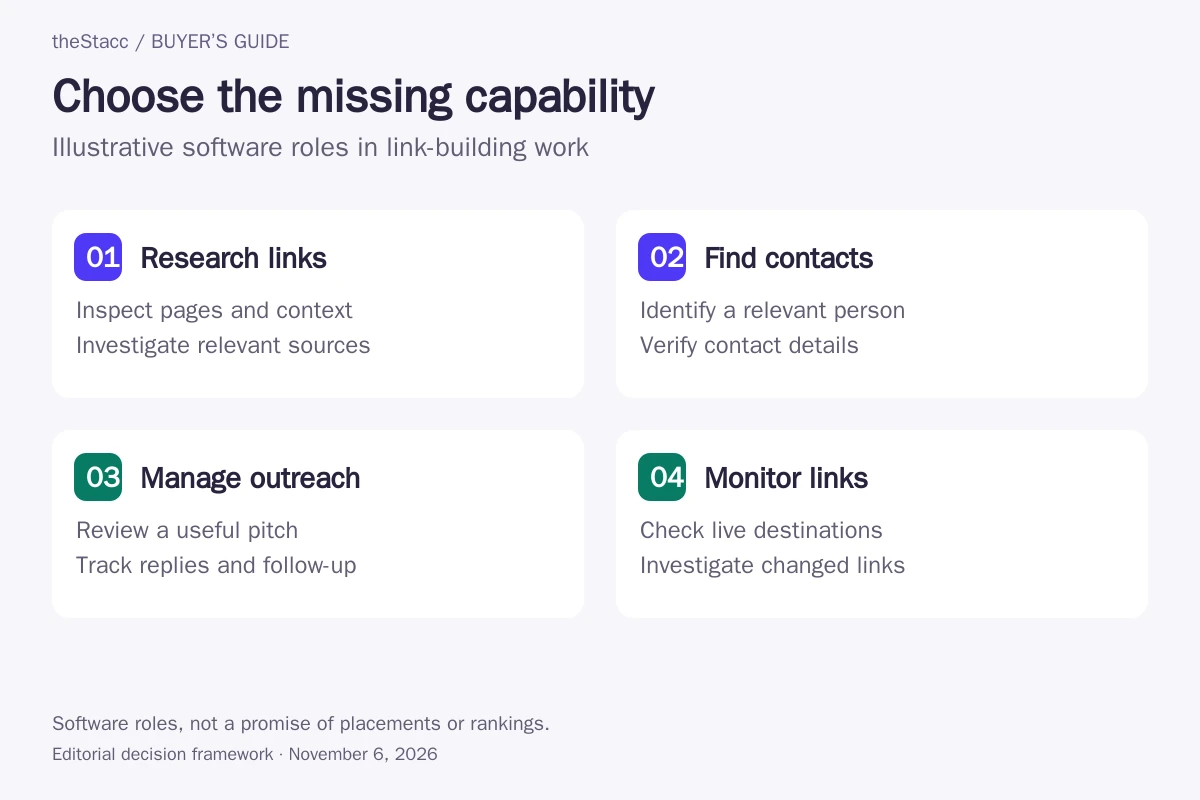
The four jobs link building tools can support
Link building tools help your team investigate websites and manage a process. Start by naming the decision you need to make. A backlink index can identify a page to inspect; an outreach tool can record a conversation. Neither decides whether a proposed link is useful to readers.
| Software category | What you inspect | Decision still owned by your team |
|---|---|---|
| Backlink research | Source pages, linked destinations, anchor context and competitor overlap | Whether the publication and page are relevant to the proposed contribution |
| Prospecting and contact checks | Named contacts, roles, source information and verification status | Whether there is a relevant reason to contact that person |
| Outreach management | Messages, replies, prior contacts and follow-up status | What to send, who approves it and when to stop |
| Monitoring | Live URLs, link attributes, changed targets and missing pages | Whether a change needs correction or simply recording |
The same product may cover several jobs. Keep the required outputs clear so you do not buy duplicate databases or assume an email tool supplies editorial judgment. If you need someone else to run the campaign, compare hired link-building services.
Compare the job, billing unit and current offer
| Option | Software job or category limitation | Published price and scope to confirm |
|---|---|---|
| theStacc | Publisher; adjacent content planning and publishing | Blog SEO from $99/month; separate from link outreach |
| Ahrefs | Backlink research and competitor investigation | Starter $29/month; Lite $129/month; feature limits differ |
| Semrush | Backlink analysis, audit and competitor gaps | SEO plan shown at $139/month; bundles and billing periods differ |
| BuzzStream | Outreach CRM and contact research | Starter $49/month; Growth $174/month for added automation |
| Pitchbox | Prospecting, outreach workflow and link monitoring | Pro $300/month billed monthly for one year, or $210/month equivalent billed annually |
| Hunter.io | Email finding, verification and outreach sequences | Starter $49/month, or $34/month equivalent billed annually |
| Respona | Current offer is placement delivery; software availability unverified | Current page advertises Starter at $100 per placement |
| Linkody | Backlink monitoring and competitor gap reports | Webmaster $14.90/month in the fetched USD display |
| Majestic | Backlink research with distinct Fresh and Historic Index access | Lite $49.99/month in USD; Pro $99.99/month, excluding VAT |
| Moz Link Explorer | Backlink, anchor and linking-domain research | Limited free queries; Moz Pro Standard $99/month |
How this shortlist was researched
theStacc sells SEO software and managed services and publishes this guide. Its entry covers adjacent content work, not a backlink database or a promise of earned links. This comparison uses official-source research and automated editorial assistance. We did not run paid outreach campaigns, compare index accuracy or measure placement results. Numbering preserves the existing list order and is not a performance ranking.
Options are grouped by useful fit rather than scored from first to last. Each profile links to its source. Confirm the selected plan or proposal before buying. See our editorial standards.
Ten existing options, with their current role made clear
1. theStacc
Good fit: A business that needs useful on-site material before approaching relevant publishers
theStacc’s Blog SEO page describes topic planning, AI drafts, review controls and publishing. Its listed entry monthly option is $99 for 30 articles. These are content-workflow functions; the page does not establish a backlink database or link-placement service.
Useful content can support an outreach idea, but publishing volume does not establish originality, citation value or earned links. Check sources and claims before treating an article as material another publisher should reference.
Before you buy: Confirm who reviews the content, which publishing destination is supported and what work remains with your team. Budget outreach separately.
2. Ahrefs
Good fit: A researcher comparing linking pages, referring domains and potential competitor gaps
Ahrefs describes Site Explorer as a way to inspect backlinks and referring domains. Its current pricing shows Starter at $29/month and Lite at $129/month; the broader Standard tier is $249/month.
Do not assume every link report is in the lowest plan. The pricing page places broken backlinks, broken links and outgoing-link reports under Standard additions. We have not compared the index’s accuracy or size with competing databases.
Before you buy: Run your actual domain query in a demonstration and confirm the report, history and export allowance on the proposed plan.
3. Semrush
Good fit: A team already using Semrush that wants to investigate its backlink profile in the same suite
Semrush’s current backlink feature page describes profile analysis, competitor gaps and backlink auditing. Its pricing page shows an SEO option at $139/month alongside separate SEO and AI Search bundles.
The older Link Building Tool workflow address redirected to the SEO Toolkit overview during research. Do not buy on the assumption that an older native outreach workflow is still included; request a current demonstration.
Before you buy: Confirm which backlink reports and export limits the chosen subscription includes, and identify the separate system that will hold contacts, messages and approvals.
4. BuzzStream
Good fit: A person or team that needs a shared record of prospects and conversations
The visible Starter card lists one user, 500 contacts, contact discovery, email templates and link monitoring for $49/month. The Growth card lists bulk sending, automated follow-ups, shared templates and reporting at $174/month.
Starter and Growth serve different operating needs. Choose by required automation and team access rather than assuming all outreach functions are available at the entry price. Older prices remained in parsed comparison content; the current visible cards are used here.
Before you buy: Confirm the price in checkout, contact allowance, connected mailbox requirements and the edition needed for follow-ups. Demonstrate how a reply or opt-out stops further contact.
5. Pitchbox
Good fit: A team that wants prospecting and outreach activity organized in one workspace
Pitchbox’s Pro plan lists an email finder and verifier, outreach tools, CRM, a unified inbox, link monitoring and reporting. Its displayed allowance includes two users, two email accounts and one workspace.
The $210 figure is an annual-billing monthly equivalent. The $300 option is billed monthly for one year, not a month-to-month commitment. Workspace and email allowances matter for separate brands; the pricing page places an approval workflow in Scale.
Before you buy: Confirm the commitment, included mailboxes, data credits and approval controls. Ask how existing contacts and suppression lists are imported without duplicating outreach.
6. Hunter.io
Good fit: A team whose immediate gap is finding and checking business contact addresses
Hunter’s current all-in-one platform combines finding, verification and email sequences. Starter lists 2,000 credits with monthly billing, three connected email accounts and unlimited team members. Annual billing shows a different price and annual credit allocation.
A verified address is a contact-data result, not permission to send an irrelevant pitch or proof that an editor will respond. Keep the reason for contacting a person with the prospect record and review message content before sending.
Before you buy: Confirm what consumes credits, how repeated checks are treated and what happens when credits run out. Separate data costs from mailbox or other optional add-ons.
7. Respona
Good fit: A reader checking whether the former outreach-software option still matches the purchase they need
Respona’s current pricing page advertises pay-per-placement delivery, starting with a $100 Starter placement. The page says the placement price includes content, outreach and publishing. We could not verify a current standalone outreach-software subscription.
This is a service purchase, so it is not interchangeable with the other software subscriptions. We retain the existing provider identity but do not repeat its old monthly software price or certify placement quality.
Before you buy: If you need software, ask whether a standalone product remains available. If considering placements, ask who is paid and require appropriate sponsored or nofollow qualification; use the service guide’s procurement questions.
8. Linkody
Good fit: A team that wants a maintained record of links and alerts when their status changes
Linkody’s Webmaster plan lists two monitored websites, 500 monitored links and one user. Its pricing FAQ says competitors share the website quota, while competitor links do not consume the monitored-link quota.
The product page describes link-status notifications, link-gap reports and landing-page monitoring. A change alert is a prompt to inspect the live page; it does not prove that search rankings changed or that a publisher owes you a followed link.
Before you buy: Count your own sites and competitors before choosing a plan. Confirm the displayed currency, reporting requirements and export access.
9. Majestic
Good fit: A researcher who needs to inspect link context or compare current and historical backlink records
Majestic’s Lite plan lists its Fresh Index, Site Explorer, Link Context and referring-domain reports. Its Pro plan adds the Historic Index, raw exports, site comparisons and backlink history.
Choose the plan by the records you need to inspect. Historical research is not the same entitlement as current link lookup. No database is treated here as proof of a publisher’s editorial standards or a promised search benefit.
Before you buy: Confirm index access, report and analysis limits, export needs and the selected currency. Establish how each historical observation will be checked against the current page.
10. Moz Link Explorer
Good fit: A researcher comparing linking domains, anchor text and competitor link opportunities
Moz’s Link Explorer page describes backlink and anchor-text research, newly discovered or lost linking domains and competitor-link opportunities. A free account provides ten queries per month; paid Moz Pro plans provide broader access.
The current Pro pricing page lists Standard at $99/month. Confirm its exact link-report limits rather than assuming the complete database is available without restrictions. Use link-level evidence when assessing a prospect.
Before you buy: Check the report rows, query allowance and export requirements for the actual work. Ask which features need a paid tier before standardizing your team’s process.
Nine checks before choosing link building software
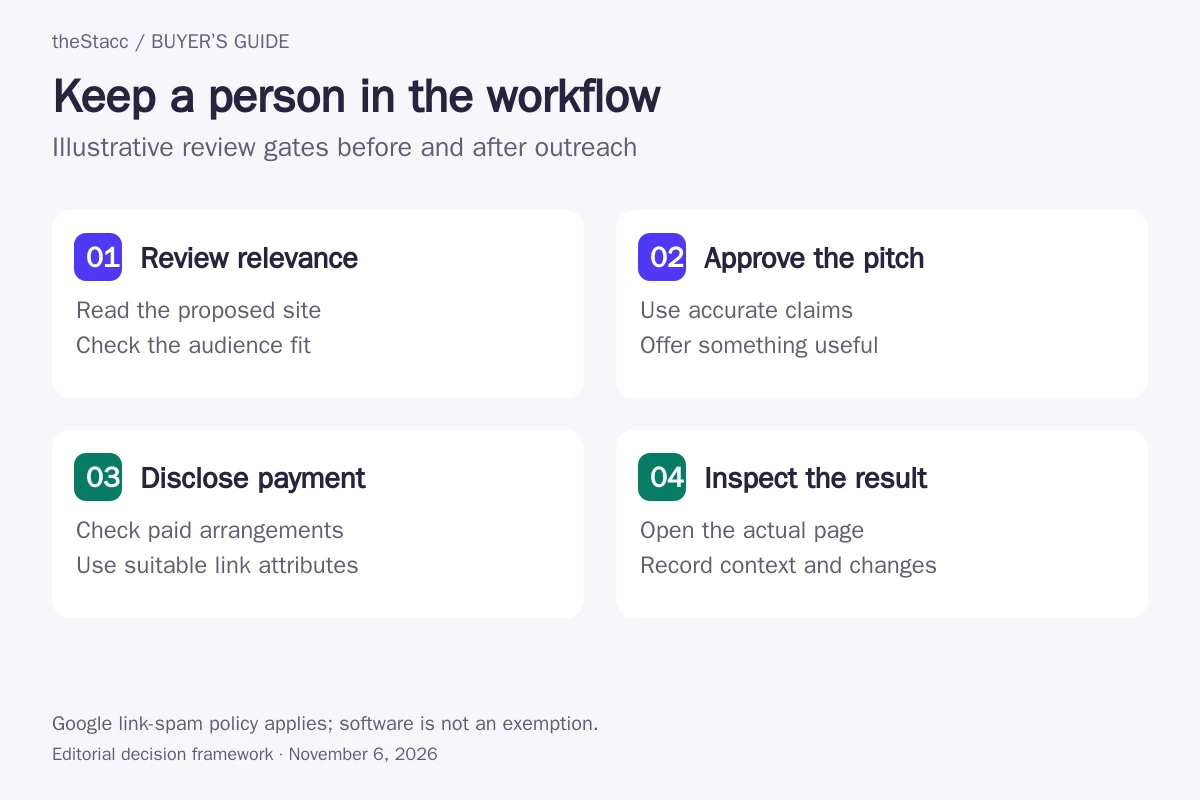
- Choose a real task. Bring a target page and a small prospect list to a demonstration. Ask which steps the proposed plan actually covers.
- Inspect the source page. Open a reported backlink. Check its context and destination instead of accepting a database summary as the final evidence.
- Check the data date. Record when the tool observed a link and when your team verified it. Distinguish an old database record from a live page.
- Review the contact. Confirm the person's role and a relevant reason for the approach. Keep contact verification separate from editorial fit.
- Prevent duplicate outreach. Demonstrate how the team sees prior conversations, blocked contacts and replies before another message is sent.
- Control automation. Review messages before sending and confirm how replies, opt-outs and a decision to stop suspend follow-ups.
- Inspect permissions. Establish who can import contacts, edit templates, send messages or approve a paid arrangement.
- Check exports and exit. Confirm access to prospect notes, correspondence and monitoring records if you change tools.
- Review a reported result. Open the published page and record its actual destination, anchor, link attributes and any payment arrangement.
These are proposed acceptance checks. We have not performed account-level tests of these products. Record any step that requires a higher plan, an integration or manual work before subscribing.
Price the workflow instead of the headline plan
A database subscription, a contact credit, an email account and a paid placement are different purchases. Count the units your team needs, then add the time required for research, fact-checking, replies and review. An annual monthly equivalent is not a flexible monthly contract.
| Cost component | What to confirm |
|---|---|
| Research access | Reports, history, rows, exports and the proposed plan's actual access |
| Contact data | Credit consumption, verification, repeats and overage costs |
| Outreach operation | Users, mailboxes, contacts, workspaces and approval controls |
| Monitoring | Own domains, competitor domains, link allowances and exports |
| Commercial terms | Billing period, currency, tax, renewal terms and cancellation |
For broader budget choices, see affordable SEO tools. The cheap SEO tools guide covers low-cost paid subscriptions, while free SEO tools covers work you can do without a paid plan. This guide focuses on the link workflow rather than recreating those lists.
Software access and hired link building are different purchases
With software, your team remains responsible for choosing prospects, checking facts, sending messages and reviewing any resulting publication. If that work has no owner, adding subscriptions does not solve the delivery gap. A hired provider needs a separate scope and approval process; use the link-building services comparison for those buying questions.
Keep outreach and paid placements within Google's policy
Google's link-spam policy covers links created primarily to manipulate search rankings, including automated link creation and paid links that pass ranking credit. A prospecting or email tool is not evidence that a campaign complies.
For an advertisement or paid placement, Google prefers rel="sponsored"; nofollow remains acceptable. See its outbound-link qualification guidance. Ask who receives payment and inspect the published link. Do not treat a publisher score or a vendor's placement promise as a substitute for that check.
theStacc can support the adjacent content workflow described above. A publishing subscription does not establish earned coverage, replace outreach decisions or guarantee that others will cite your work.
Choose the tool that fixes the next missing step
- You cannot explain the existing link profile: compare Ahrefs, Semrush, Majestic or Moz using the same target pages and required reports.
- You lose track of conversations: evaluate BuzzStream or Pitchbox around contact history, team roles and stopping rules.
- You lack usable contact details: assess Hunter's finding and verification workflow before buying a broader platform.
- You need to track existing links: assess Linkody's domain and link allowances against your inventory.
- You need outsourced execution: select a provider under a service contract; do not compare a placement fee with a software seat.
Request evidence of the workflow you need. No tool on this list is ranked by campaign outcomes, and none is a substitute for relevant content or editorial discretion.
Evaluate theStacc against your actual workflow
theStacc is the publisher and an adjacent content option. A software subscription does not provide earned links, outreach staff or paid placements. Review the current plans before choosing a paid service.
Start free → to explore the software, or Book a demo → to discuss your requirements.
Link building tools guide: questions answered
What is the best link building tool for a small team?
Choose by the missing task. Ahrefs, Semrush, Majestic and Moz cover backlink research; BuzzStream and Pitchbox organize outreach; Hunter focuses on contact data and sequences; Linkody monitors links. Test the required reports, limits and responsibilities in a demonstration. There is no measured performance winner in this comparison.
Do I need a paid link building tool?
Not automatically. Start with a defined research or outreach task and establish whether your existing tools cover it. Paid access can add report depth, capacity or shared records, but it does not guarantee placements or ranking gains. Compare the actual limits before taking on another subscription.
Is Ahrefs or Semrush better for backlink research?
Both publish backlink-research features. This guide has not benchmarked their index accuracy, coverage or refresh speed. Compare the same domains and required reports, including export and history limits. Choose the product that supports your decisions and existing workflow, rather than relying on an unsupported claim that one index is universally better.
What costs should I include in a link building software budget?
Include research access, contact-data credits, users, connected mailboxes, workspaces, monitoring allowances and any required integrations. Add the people who research, approve and respond. Keep annual billing separate from monthly billing, and keep any content-production or placement service outside the software subtotal.
Does Respona still sell the software plan listed in older comparisons?
A current standalone software subscription was not verified during this review. Respona’s public pricing page now advertises pay-per-placement delivery including content, outreach and publishing. Confirm availability directly if you want software. Treat a placement purchase as a separate service with publisher-payment and link-attribute checks.
Can outreach software make paid links acceptable to Google?
No. Google evaluates the link practice, not the brand of outreach software. Links bought to manipulate rankings are covered by its link-spam policy. Advertisements and paid placements should use sponsored qualification; nofollow is also acceptable. Inspect the arrangement and the actual published link rather than relying on a tool or provider label.
Can publishing content guarantee links without outreach?
No. A publisher decides whether to reference your work. Useful content may give someone a reason to cite it, but article volume or an automated publishing schedule does not establish that result. theStacc is included as an adjacent content option, not as a guarantee of passive links or a replacement for link research.
Sources and scope of this comparison
Official pricing and feature pages were checked on November 6, 2026 and are linked beside each entry. BuzzStream blocked direct fetching but its current offer was readable in a browser; parsed HTML also contained older comparison prices, so this guide uses the visible current plan cards. Semrush’s old link-building workflow URL redirected to its SEO Toolkit page, so native outreach availability is not assumed. Respona’s current pricing advertises paid placements; a current standalone software subscription was not verified. Linkody and Majestic showed different currency displays through different retrieval routes; confirm currency and billing terms before paying. These observations are vendor documentation, not hands-on performance tests.
Explore this topic: Broken Link Building: A Step-by-Step Outreach Guide · Ecommerce Link Building: Earn Links to Revenue Pages.