SEO for Daycare Centers: The Complete Guide (2026)
The complete daycare SEO guide — GBP, local rankings, service pages, reviews, and content strategy. Built for childcare centers. Updated 2026.
Siddharth Gangal • 2026-03-29 • Local SEO
In This Article
“Daycare near me” gets 673,000 searches per month on Google. “Preschool near me” gets 165,000. “Childcare near me” gets 49,500. Every one of those searches is a parent ready to enroll their child. If your daycare center does not appear in the results, a competitor down the street fills that spot.
Most daycare centers rely on word of mouth, community bulletin boards, and the occasional Facebook post. All three work. None of them scale. Daycare SEO builds a pipeline of enrollment inquiries that runs 24 hours a day without ad spend. The centers ranking in the top 3 of the local pack capture 75% of all clicks. Everyone else competes for scraps.
The problem is that generic SEO advice targets tech companies and ecommerce brands. Childcare is different. Parents search differently. Trust matters more. Your service area is hyperlocal. A guide written for SaaS companies misses all of that.
We have published 3,500+ blog posts across 70+ industries, including hundreds for local service businesses and childcare providers. Our average SEO score is 92%. This guide covers everything we know about daycare SEO.
Here is what you will learn:
- How to dominate the Google local pack for daycare searches
- The exact keywords childcare centers should target
- How to build program pages that convert visitors into tours
- Why reviews matter more for daycare than almost any other industry
- The content strategy that positions your center as the local authority
- A 90-day action plan to start ranking from scratch
Why SEO Matters More for Daycare Centers Than Most Industries
Childcare is a $68 billion industry in the United States as of 2026. The average family spends $10,000 to $15,000 per year on daycare. A single enrollment represents 2 to 5 years of recurring revenue. The lifetime value of one family easily exceeds $30,000.
Here is the math. A daycare center spending $500 per month on SEO that generates 8 tour requests per month has a cost per lead of $62.50. If 4 of those families enroll at $1,000 per month, that is $48,000 in annual revenue from $6,000 in marketing spend. That is an 8x return in year one alone.
Compare that to paid advertising. Google Ads for daycare keywords cost $3 to $8 per click. A $2,000 monthly ad budget generates clicks, not enrollments. The moment you stop paying, the leads stop. SEO compounds over time.
| Channel | Monthly Cost | Leads/Month | Cost Per Lead | Stops When You Stop Paying? |
|---|---|---|---|---|
| SEO | $500 | 8-15 | $33-$62 | No |
| Google Ads | $2,000 | 10-20 | $100-$200 | Yes |
| Facebook Ads | $1,500 | 8-15 | $100-$187 | Yes |
| Print flyers | $500 | 1-3 | $167-$500 | Yes |
| Word of mouth | $0 | Variable | $0 | Unpredictable |
SEO is the only channel that gets cheaper over time. Every blog post, every review, every optimized page builds on the last. After 6 months of consistent work, your cost per lead drops while your inquiry volume increases.
According to BrightLocal research, 28% of local searches result in a same-day action. For daycare, that action is a phone call or tour request.
Google Business Profile: Your Most Important Asset
Your Google Business Profile (GBP) is the single most important ranking factor for local daycare searches. GBP signals account for 32% of local ranking factors. That makes your profile more influential than your website, backlinks, and citations combined.
Claim and Verify Your Profile
If you have not claimed your GBP, do it today at business.google.com. Choose “Child Care Agency” as your primary category. Add secondary categories like “Preschool,” “Day Care Center,” and “After School Program” if applicable.
Optimize Every Field
Complete profiles appear in 70% more discovery searches than incomplete ones. Fill in every field:
- Business name: Your exact legal name. Do not keyword-stuff. “Sunshine Daycare” is correct. “Sunshine Daycare Best Childcare Center Dallas TX” gets flagged.
- Address: Your physical location where parents drop off children.
- Service areas: List your city and neighboring zip codes.
- Phone number: A local number builds trust. Parents want to call a local center, not a toll-free line.
- Business hours: Accurate drop-off and pickup hours. Update for holidays.
- Business description: 750 characters. Include your city, age groups served, and programs naturally.
- Services: Add every program individually. Infant care, toddler program, preschool, after-school, summer camp.
- Photos: Upload 20+ high-quality photos. Classrooms, playground, staff, meals, and activities.
GBP listings with over 100 photos get 1,065% more clicks than the average listing. Parents want to see where their children will spend the day. Show clean classrooms, engaged teachers, and happy kids (with parent permission for child photos).
Post Regularly
GBP posts signal activity to Google and engage parents. Post 2 to 3 times per week. Share curriculum highlights, seasonal activities, enrollment openings, and parent tips. For a complete posting strategy, see our GBP posting frequency guide.
Respond to Every Review
Response rate matters for rankings and for parents. Respond to every review within 24 hours. Thank positive reviewers by name. Address negative reviews professionally and empathetically. Use our review response generator to save time while maintaining a personal tone.
Your SEO team. $99/month. 30 optimized articles published automatically for daycare centers. Start for $1 →
Keyword Research for Childcare Centers
Most daycare owners target “daycare near me” and stop there. That keyword is extremely competitive. Smart keyword research targets dozens of terms that parents actually search when choosing childcare.
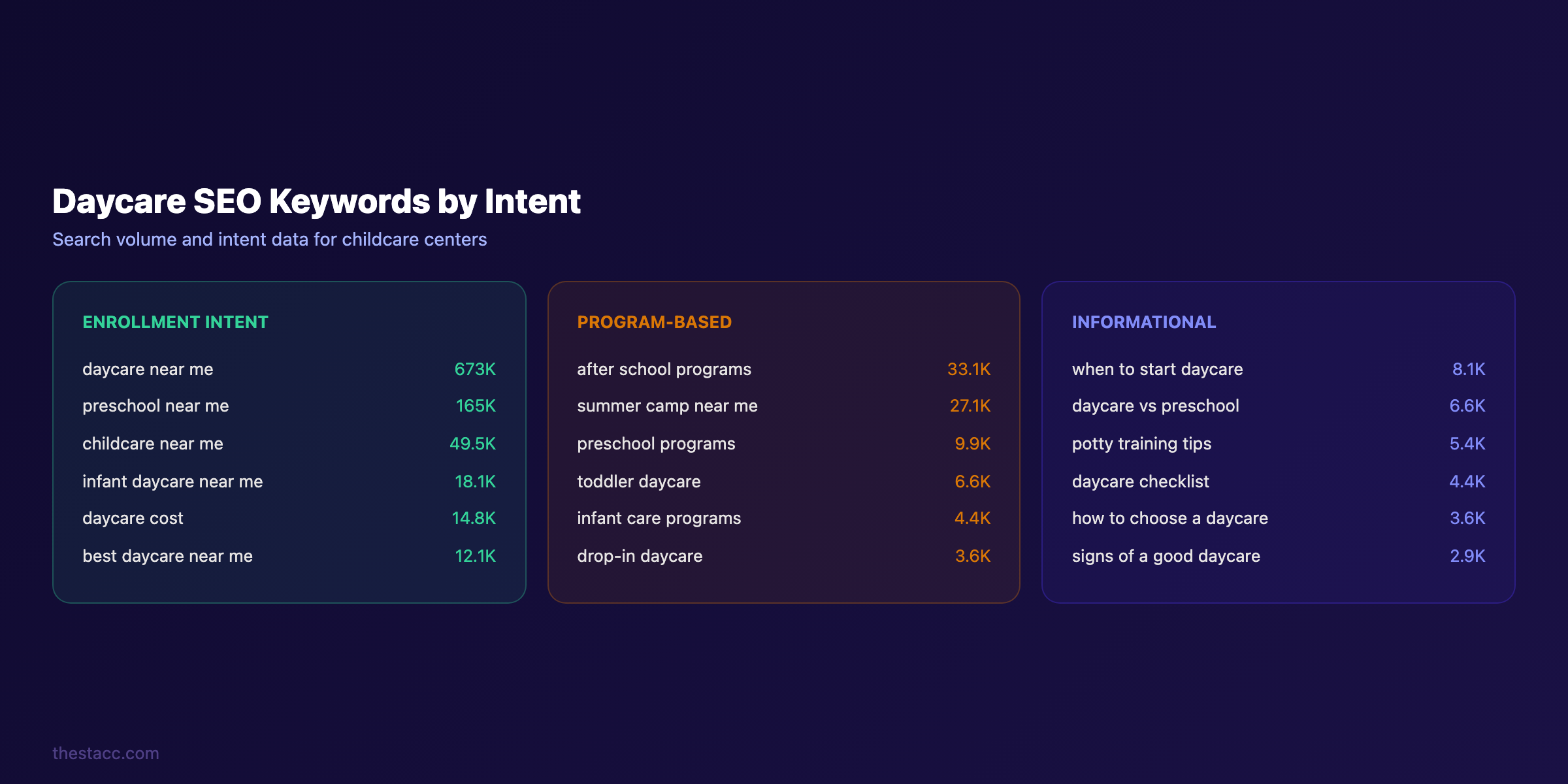
High-Intent Enrollment Keywords (Target First)
These keywords indicate a parent actively searching for daycare right now:
| Keyword | Monthly Volume | Intent |
|---|---|---|
| daycare near me | 673,000 | Enrollment |
| preschool near me | 165,000 | Enrollment |
| childcare near me | 49,500 | Enrollment |
| infant daycare near me | 18,100 | Enrollment |
| daycare cost | 14,800 | Enrollment |
| best daycare near me | 12,100 | Enrollment |
| toddler daycare near me | 8,100 | Enrollment |
| part time daycare | 6,600 | Enrollment |
Program-Based Keywords
These capture parents searching for specific programs:
| Keyword | Monthly Volume | Content Type |
|---|---|---|
| after school programs near me | 33,100 | Service page |
| summer camp near me | 27,100 | Service page |
| preschool programs | 9,900 | Service page |
| toddler daycare | 6,600 | Service page |
| infant care programs | 4,400 | Service page |
| drop-in daycare near me | 3,600 | Service page |
Informational Keywords (Build Authority)
These capture parents researching before they enroll:
| Keyword | Monthly Volume | Content Type |
|---|---|---|
| when to start daycare | 8,100 | Blog post |
| daycare vs preschool | 6,600 | Blog post |
| potty training tips for daycare | 5,400 | Blog post |
| daycare checklist for parents | 4,400 | Blog post |
| how to choose a daycare | 3,600 | Blog post |
| signs of a good daycare | 2,900 | Blog post |
Local Keywords (Highest Conversion)
Combine your programs with city names for your highest-converting pages:
- “[city] daycare”
- “daycare in [city]”
- “preschool [city] [state]”
- “best daycare in [city]”
- “infant care [city]”
- “after school program [city]”
Each city you serve should have its own landing page targeting these combinations.
Keywords Daycare Centers Should Skip
Not every childcare keyword is worth pursuing:
- “How to open a daycare” — These are aspiring owners, not parents.
- “Daycare worker salary” — Job seekers, not families.
- “Free daycare” — Low commercial intent. Most centers cannot serve this audience.
- “Daycare abuse statistics” — Negative association. Avoid.
Focus your effort on keywords where the searcher is a parent ready to schedule a tour.
Service Pages That Convert Visitors Into Tours
Your website needs a dedicated page for every program you offer. A single “Programs” page listing everything in bullet points will not rank for anything specific. Google rewards pages that go deep on a single topic.
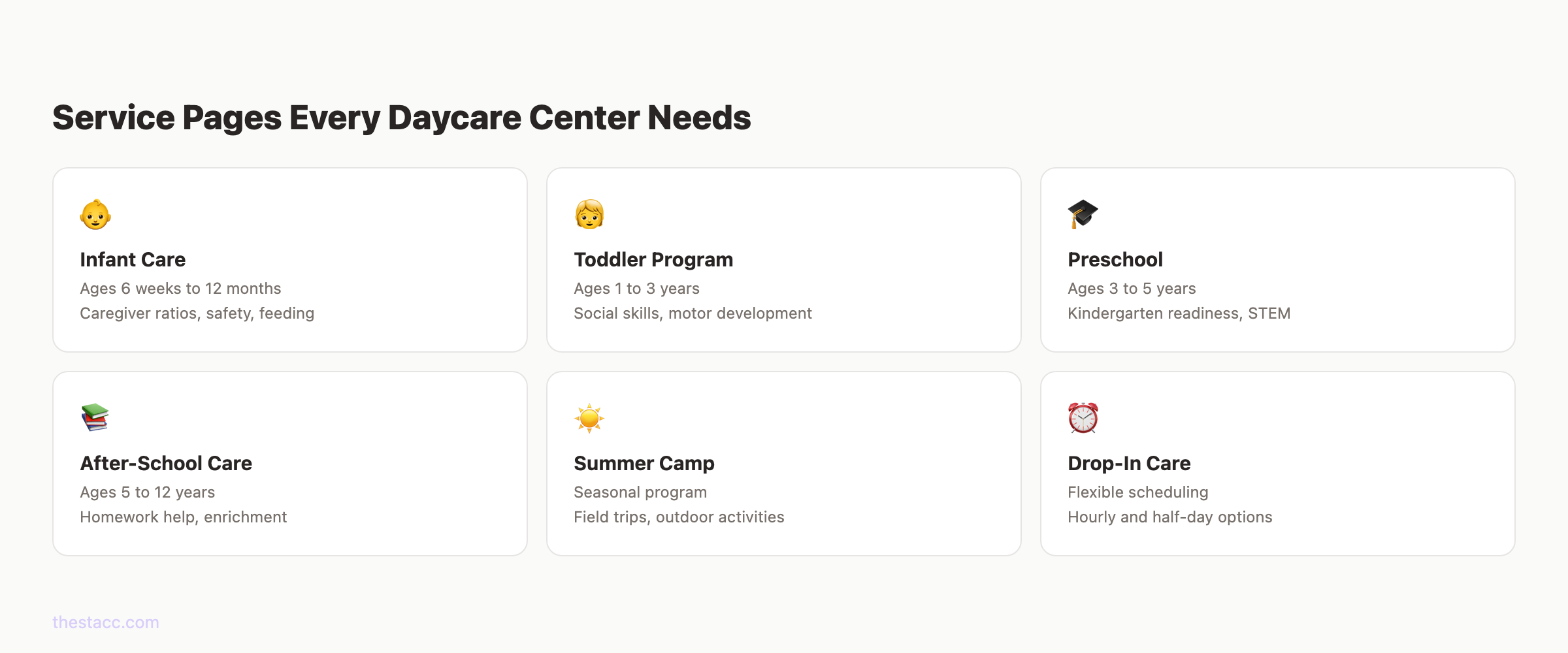
Required Program Pages
Create a separate page for each program you offer:
- Infant care (6 weeks to 12 months)
- Toddler program (1 to 3 years)
- Preschool (3 to 5 years)
- Pre-kindergarten (4 to 5 years)
- After-school care (5 to 12 years)
- Summer camp
- Drop-in care (if offered)
What Each Program Page Needs
Every program page should include:
- Title tag: “[Program] in [City] | [Center Name]” — under 60 characters.
- H1 heading: “[Program] in [Primary City].”
- 300+ words describing the program, curriculum, daily schedule, and what makes your approach different.
- Age range and class size clearly stated. Parents want specifics.
- Caregiver-to-child ratios. This is the first thing informed parents look for.
- Photos of the actual classroom used for that program (not stock photos).
- Tuition range. Transparency builds trust. Parents who cannot afford your rates self-select out, saving everyone time.
- Schema markup — ChildCare schema type with age ranges, hours, and pricing.
- Clear CTA: “Schedule a Tour” with phone number and form.
- Parent testimonials specific to that program.
City Landing Pages
If families come from multiple cities or neighborhoods, create a page for each one. A page targeting “daycare in Frisco TX” ranks better than a generic “daycare” page for Frisco-area searches.
Each city page should include:
- Specific mention of the city, neighborhoods, and school districts
- Driving directions or proximity to major landmarks
- Photos of your center with local context
- A Google Map embed showing your location
- Unique content (not copy-pasted from other city pages)
Google penalizes duplicate city pages with only the city name changed. Each page needs genuinely unique content. This is where consistent content publishing at scale makes a real difference.
Reviews: The Ranking Factor Parents Trust Most
Google reviews are not just a ranking factor for daycare centers. They are the deciding factor. Parents are entrusting their children to your care. No other local service industry carries that level of emotional weight. Reviews are how parents verify that your center is safe, loving, and professional.
The Numbers
- Businesses with 50+ reviews appear in the local pack 266% more often.
- 97% of parents read online reviews before choosing a daycare.
- A 4.5-star average is the sweet spot. A perfect 5.0 looks suspicious.
- Review velocity matters. 3 to 5 new reviews per month signals active enrollment.
- One negative review without a response scares away more parents than 10 positive reviews attract.
Why Reviews Matter Even More for Daycare
Choosing a daycare is not like choosing a restaurant or a plumber. Parents are making a decision about who watches their children for 8 to 10 hours a day. The emotional stakes are enormous. Parents read every review. They look for mentions of safety, cleanliness, communication, and teacher quality.
A parent searching “best daycare near me” will skip a center with 4 reviews and choose the one with 87 reviews and a 4.7-star average. Volume and quality both matter.
How to Generate Reviews Consistently
Do not wait for reviews to appear on their own. Build a system:
- Ask at the right moment. Request a review after a positive parent-teacher conference or milestone. Not during morning drop-off rush.
- Make it effortless. Send a direct link to your Google review form via text message. Text gets 3x the response rate versus email.
- Use a QR code in the lobby. Print a QR code linking to your Google review page and display it at pickup. Use our review QR code generator to create one.
- Follow up once. A single reminder 3 days after the initial request doubles completion rates.
- Respond to every review. Responses show prospective parents you are engaged and attentive. Read our guide on responding to Google reviews for templates.
For 21 specific strategies, see our complete guide to getting more Google reviews.
3,500+ blogs published. 92% average SEO score. See what Stacc can do for your daycare center. Start for $1 →
Content Marketing for Daycare Centers
Daycare centers that publish blog content consistently rank for more keywords, build topical authority, and generate more enrollment inquiries than centers with static websites.
Why Blog Content Works for Daycare
A parent searching “when to start daycare” today becomes a parent searching “daycare near me” in 3 months. Blog content captures early-stage researchers and puts your center in front of them before they are ready to enroll.
Every blog post also:
- Creates a new indexed page that can rank for additional keywords
- Builds internal links to your program pages (boosting their rankings)
- Demonstrates E-E-A-T signals (experience, expertise, authority, trust)
- Provides content for GBP posts and social media
Blog Topics for Daycare Centers (30-Day Content Plan)
| Week | Topic | Target Keyword |
|---|---|---|
| 1 | When Should You Start Daycare? A Parent Guide | when to start daycare |
| 1 | Daycare vs Preschool: What Is the Difference? | daycare vs preschool |
| 2 | The Complete Daycare Checklist for New Parents | daycare checklist |
| 2 | How to Choose a Daycare Center (10 Questions to Ask) | how to choose a daycare |
| 3 | Potty Training and Daycare: What Parents Need to Know | potty training tips daycare |
| 3 | How Much Does Daycare Cost in [City]? | daycare cost [city] |
| 4 | First Day of Daycare: Preparing Your Child (and Yourself) | first day of daycare tips |
| 4 | 7 Signs of a High-Quality Daycare Center | signs of a good daycare |
Each post should be 1,500 to 2,500 words, include photos, and link back to your relevant program pages. This creates a content cluster that signals authority to Google.
Content That Builds Links and Trust
Certain content types attract backlinks and establish your center as a community resource:
- Cost guides (“How Much Does Daycare Cost in [State]?”) — Cited by parenting blogs and local news
- Milestone guides (“Developmental Milestones: What to Expect at Every Age”) — Referenced by parenting publications
- Seasonal content (“Summer Activities for Toddlers in [City]”) — Shared by local family blogs
- Statistics posts (“Childcare Industry Statistics 2026”) — Cited by news outlets
Content Topics That Build Topical Authority
Expand your content cluster with these categories:
| Category | Example Topics |
|---|---|
| Enrollment | Daycare waitlist tips, how to tour a daycare, enrollment checklist |
| Child development | Language milestones by age, social skills at 2 years, screen time guidelines |
| Parent resources | Separation anxiety tips, packing lunch for daycare, communicating with teachers |
| Safety | Childproofing at home, car seat safety, illness policies at daycare |
| Education | Play-based learning benefits, STEM for preschoolers, reading readiness |
For tips on writing blog content that ranks, see our SEO content writing guide.
Technical SEO for Daycare Websites
Technical issues kill daycare websites silently. A slow site, broken mobile layout, or missing schema prevents everything else from working.
Site Speed
Parents searching on their phones expect fast results. Compress every image. Use WebP format. Target under 3 seconds for full page load on mobile. Google Core Web Vitals measure loading performance, and slow sites rank lower.
Mobile Optimization
Over 70% of daycare searches happen on mobile devices. Parents searching during lunch breaks or after bedtime are almost always on their phones. Your entire site must work on a 375px-wide screen. Test every page on your phone. Tap targets must be large enough for one-hand use.
Schema Markup
Add schema markup to tell Google exactly what your center offers:
- ChildCare schema (the specific schema.org type for daycare centers) with your name, address, phone, hours, age ranges, and pricing
- LocalBusiness schema with service area and operating hours
- Review schema to display star ratings in search results
- FAQ schema on pages with frequently asked questions
- Event schema for open houses, parent workshops, and community events
The ChildCare schema type is specific to daycare and childcare facilities. It supports properties like “age range,” “opening hours,” and “number of employees.” Most daycare websites do not use it. Adding it gives you an edge in search results.
SSL and Security
Every page must load over HTTPS. Parents researching daycare centers will not fill out a tour request form on an unsecured site. The “Not Secure” warning in Chrome destroys trust instantly for a parent about to share their contact information and child details.
Run an SEO Audit
Before investing in content or links, identify what is broken on your site. Use our free SEO audit tool to scan for technical issues, or follow our complete SEO audit guide.
Local Citations and Directories
Citations are online mentions of your business name, address, and phone number (NAP). Consistent citations across the web verify your business legitimacy to Google and help parents find you on the platforms they trust.
Priority Directories for Daycare Centers
Submit your center to these platforms first:
| Directory | Priority | Notes |
|---|---|---|
| Google Business Profile | Critical | Primary local ranking signal |
| Care.com | Critical | Largest childcare marketplace in the U.S. |
| Winnie | High | Parent-focused childcare search platform |
| ChildCareCenter.us | High | Dedicated childcare directory with reviews |
| Yelp | High | High domain authority, trusted by Google |
| Facebook Business | High | Social signal + parent review platform |
| Bing Places | High | Second-largest search engine |
| BBB (Better Business Bureau) | High | Trust signal, E-E-A-T boost |
| Nextdoor | Medium | Hyperlocal, strong in residential areas |
| Apple Maps | Medium | Growing mobile search share |
| Brightwheel Directory | Medium | Childcare management platform with listings |
| Local chamber of commerce | Medium | Community trust signal |
NAP Consistency Rules
Your business name, address, and phone number must be identical everywhere. Not similar. Identical.
- “Sunshine Learning Center LLC” and “Sunshine Learning Center” are not the same to Google.
- “123 Main St” and “123 Main Street” are not the same.
- List one phone number everywhere. Do not mix your front desk, cell, and tracking numbers.
Use a citation management tool to audit and fix inconsistencies. See our list of local citation tools for options.
Industry-Specific Listings
Beyond general directories, submit your center to:
- Your state childcare licensing agency database
- Local school district resource lists
- Community parenting groups and resource pages
- Local parent magazines and family websites
- Your city or county family services directory
These niche listings carry extra weight because they are contextually relevant to childcare.
Link Building for Daycare Centers
Backlinks remain a top ranking factor. For daycare centers, the best links come from local and community sources.
Local Link Opportunities
- Chamber of commerce membership pages (most include a backlink)
- Local sponsorships — Youth sports teams, school fundraisers, community events
- Parent-teacher organizations — Offer to host events or donate supplies
- Local news coverage — Share enrollment milestones, community involvement, or expert parenting advice
- Pediatrician partnerships — Many pediatrician offices maintain referral resource pages
- Real estate agent partnerships — Agents help relocating families find childcare
Community-Based Links
- Participate in local family festivals and get listed on event pages
- Offer free parenting workshops and get covered by local media
- Partner with local libraries for reading programs
- Join local business associations and parent networks
Links to Avoid
- Paid link schemes offering hundreds of backlinks for a flat fee
- Unrelated directories with no connection to childcare or local business
- Private blog networks
- Excessive reciprocal link exchanges
A few high-quality local links outperform hundreds of spammy ones every time.
Tracking Results and Measuring ROI
SEO without measurement is guesswork. Track these metrics monthly to know whether your investment is working.
Key Metrics
| Metric | Tool | Target |
|---|---|---|
| Local pack position | Google Search Console | Top 3 for “daycare + city” |
| Organic traffic | Google Analytics 4 | 20%+ growth month over month |
| Phone calls from GBP | GBP Insights | 10+ calls/month within 90 days |
| Direction requests | GBP Insights | Steady increase |
| Tour request forms | GA4 + CRM | Track by source |
| Keyword rankings | SEO tool (Ahrefs, Semrush) | Track 20-30 target keywords |
| Review count + rating | GBP | 3-5 new reviews per month |
Timeline Expectations
SEO is not instant. Here is a realistic timeline for a daycare center starting from scratch:
| Timeframe | Expected Results |
|---|---|
| Month 1-2 | Technical fixes, GBP optimization, program pages live |
| Month 3-4 | Initial ranking movement, GBP showing in more searches |
| Month 5-6 | Organic traffic increasing, first tour requests from SEO |
| Month 7-12 | Consistent inquiry flow, ranking for 50+ keywords |
| Month 12+ | Dominant local presence, decreasing cost per lead |
The timeline for SEO results varies by market. A daycare in a small town may see results in 60 days. A center in a major metro area may need 6 to 12 months.
The 90-Day Daycare SEO Action Plan
Here is the exact sequence to follow if you are starting daycare SEO from zero.
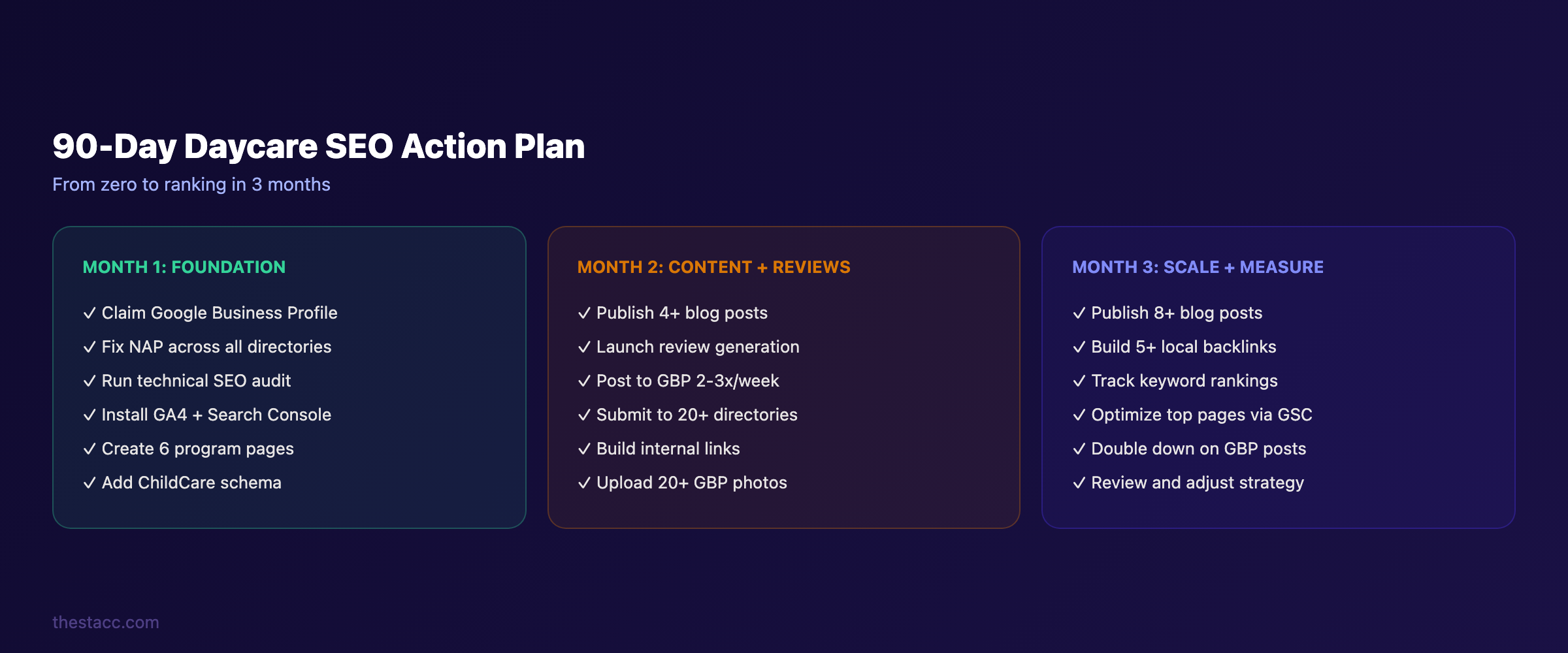
Weeks 1-2: Foundation
- Claim and verify your Google Business Profile
- Fix NAP consistency across all directories
- Run a technical SEO audit and fix critical issues
- Install Google Analytics 4 and Google Search Console
- Fix mobile speed issues (target under 3 seconds)
Weeks 3-4: Program Pages and On-Page SEO
- Create dedicated pages for each program (infant, toddler, preschool, after-school, summer camp)
- Optimize title tags and meta descriptions site-wide
- Add ChildCare and LocalBusiness schema markup
- Upload classroom and activity photos with keyword-rich alt text
- Build a city landing page for your primary service area
Month 2: Content and Reviews
- Publish 4+ blog posts targeting parenting and childcare keywords
- Launch a review generation system (text-based, post-conference)
- Post to GBP 2-3 times per week
- Submit to 20+ childcare and local directories
- Set up internal linking between blog posts and program pages
- Upload 20+ photos to your GBP (classrooms, playground, staff, activities)
Month 3: Scale and Measure
- Publish 8+ blog posts covering costs, development, safety, and seasonal topics
- Build 5+ local backlinks (chamber, pediatricians, schools, community events)
- Track keyword rankings and adjust strategy based on data
- Optimize top-performing pages based on Search Console impressions
- Review GBP Insights and double down on what drives calls and direction requests
- Create city pages for your secondary service areas
For our complete local SEO framework, see the local SEO checklist.
FAQ
How much does SEO cost for a daycare center?
DIY SEO costs $0 to $300 per month for tools. Hiring a freelancer runs $500 to $2,000 per month. Full-service local SEO agencies charge $1,500 to $5,000 per month. Stacc offers blog SEO starting at $99 per month and local SEO starting at $49 per month, covering content publishing and GBP management.
How long does it take for daycare SEO to work?
Expect initial ranking movement within 60 to 90 days. Consistent tour requests typically start at 4 to 6 months. Full local market dominance takes 12+ months of sustained effort. Smaller markets see faster results. See our guide on how long SEO takes for detailed timelines.
What is the best Google Business Profile category for a daycare?
Use “Child Care Agency” as your primary category. Add “Day Care Center,” “Preschool,” and “After School Program” as secondary categories. The primary category carries the most ranking weight for local searches.
Should a daycare center have a blog?
Yes. Blog content drives organic traffic, builds authority, and creates internal links to your program pages. Centers that publish 4+ posts per month rank for 3x more keywords than centers with static websites. Each post creates another opportunity to appear in search results and AI Overviews.
What are the most important keywords for daycare SEO?
Start with high-intent local keywords: “daycare in [city],” “preschool near me,” and “childcare [city].” Then target program keywords: “infant care [city],” “after-school program near me.” Finally, build authority with informational content: “when to start daycare,” “daycare vs preschool,” and “how to choose a daycare.”
How do reviews affect daycare SEO rankings?
Google reviews are a top-3 local ranking factor. Review quantity, quality, velocity, and response rate all influence your position in the local pack. For daycare centers specifically, reviews also serve as the primary trust signal for parents making enrollment decisions. A center with 80+ reviews at 4.5 stars will outrank and outconvert a center with 5 reviews at 5.0 stars.
Your SEO team. $99/month. 30 optimized articles published automatically for daycare centers. Start for $1 →
Daycare SEO is not optional in 2026. The centers filling enrollment are the ones appearing first when parents search. Every month you wait is another month a competitor builds their organic presence while yours stays invisible. Start with your Google Business Profile, build your program pages, and publish content consistently. The inquiries follow.
Written and published by Stacc. We publish 3,500+ articles per month across 70+ industries. All data verified against public sources as of March 2026.