Email Marketing for Chiropractors: Complete Guide
Build email campaigns that keep patients coming back. Covers drip sequences, reactivation, newsletters, and HIPAA compliance for chiropractors. Updated 2026.
Siddharth Gangal • 2026-03-30 • Content Strategy
In This Article
Email marketing for chiropractors returns $36 for every $1 spent. No other marketing channel comes close. Yet most chiropractic practices send one generic newsletter per month and wonder why patients stop showing up after their initial treatment plan.
The real problem is not marketing. It is retention. The average chiropractic practice loses patients between appointments because nothing keeps the practice top of mind. Patients finish their 6-visit plan, feel better, and vanish. Six months later, the pain returns. They search Google and find a different chiropractor closer to home.
Email prevents that. A well-built email system reminds patients to return, educates them on why ongoing care matters, and reactivates the ones who drifted away. It runs automatically. It costs almost nothing. And it generates more revenue from your existing patient base than any amount of advertising for new patients.
We have published 3,500+ SEO-optimized articles across 70+ industries, including dozens for chiropractic practices. This guide covers the exact email marketing system that keeps patients engaged, reduces no-shows, and fills your schedule without cold outreach.
In this guide, you will learn:
- Why email beats every other marketing channel for chiropractic practices
- How to build your patient email list ethically and fast
- The 8 email types every chiropractor needs
- Drip campaigns for new patients, lapsed patients, and referrals
- Segmentation strategies that keep your emails relevant
- HIPAA compliance rules for healthcare email marketing
- How to measure email performance and improve over time
Why Email Marketing Works for Chiropractic Practices
Most chiropractic marketing advice focuses on getting new patients. That is only half the equation. Acquiring a new patient costs 5 to 7 times more than retaining an existing one. Email is the most effective retention tool in healthcare marketing.
The Numbers Behind Chiropractic Email Marketing
| Metric | Value |
|---|---|
| Average email marketing ROI | $36 per $1 spent |
| Patients who prefer email contact from providers | 60% |
| Open rate increase with personalized subject lines | 29% |
| Exit-intent popup conversion rate | Up to 10% of website visitors |
| Reactivation target window | 90+ days since last appointment |
Compare that to paid advertising. A $600 Google Ads budget might bring in 20 new patients per month. But if half those patients leave after their first treatment plan, you are spending more to replace them than you would to keep them.
Why Chiropractic Practices Need Email More Than Most
Chiropractic care is not a one-time transaction. It is ongoing. Patients need maintenance adjustments, wellness visits, and injury prevention. But patients do not think about their chiropractor when they feel fine.
Email solves that gap. A weekly or biweekly email about posture, ergonomics, or spinal health keeps your practice in the patient’s mind. When their back starts hurting again, they do not Google “chiropractor near me.” They open your last email and book an appointment.
Practices that invest in both email and chiropractic SEO create a flywheel: SEO brings new patients in. Email keeps them coming back.
How to Build Your Patient Email List
You cannot market to patients who are not on your list. Building a quality email list is the foundation of every chiropractic email strategy.
In-Office Collection Methods
Your treatment room is the highest-converting email capture point. Every patient who walks through your door is a warm lead.
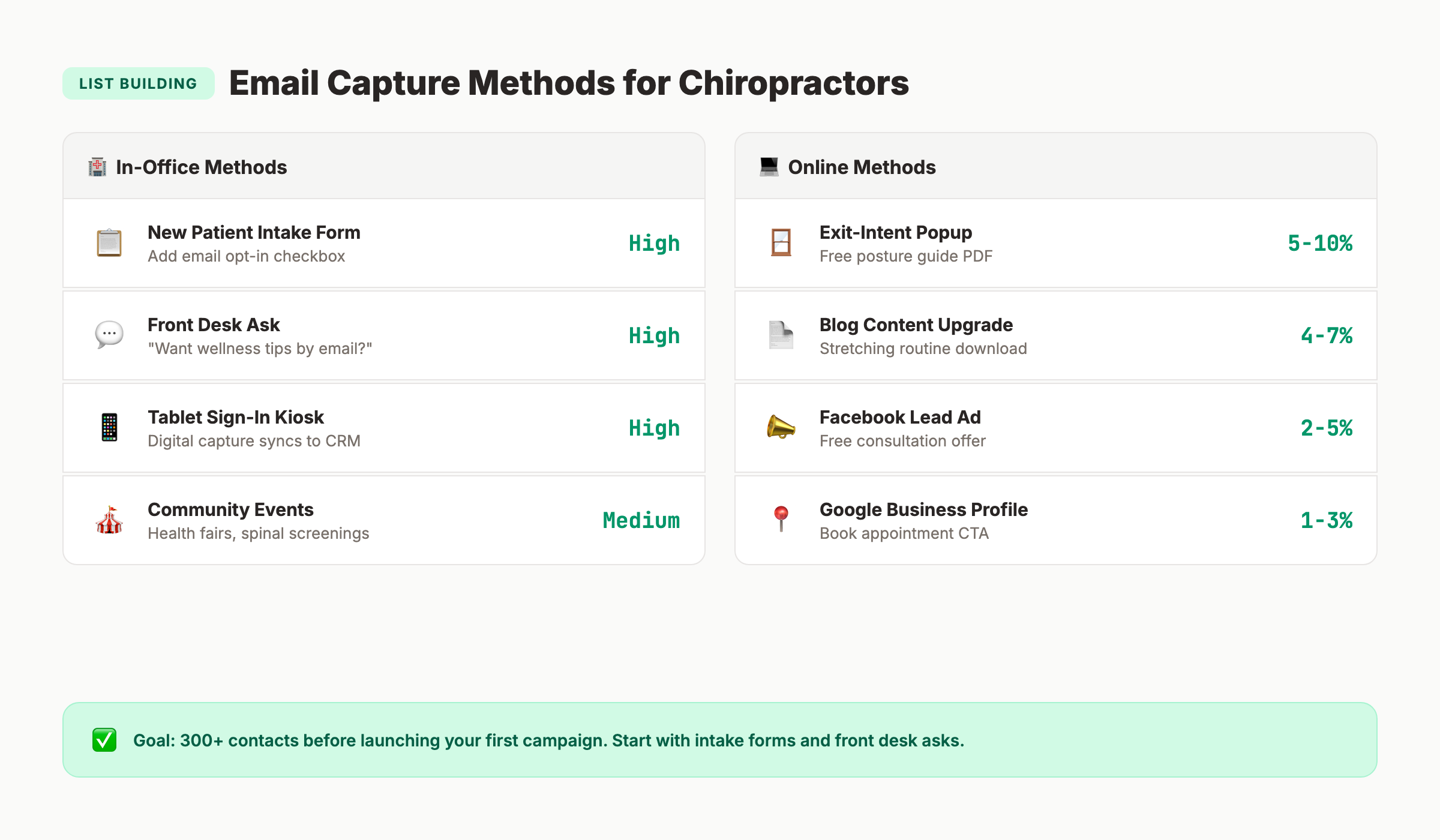
New patient intake forms: Add an email field and an opt-in checkbox. Make it clear what they will receive: “Check this box to receive weekly wellness tips and appointment reminders.”
Front desk process: Train your front desk team to ask every patient: “Would you like to receive appointment reminders and health tips by email?” Verbal consent plus a digital record is sufficient for marketing emails.
Tablet sign-in kiosks: Replace paper sign-in sheets with a tablet that captures name, email, and consent in one step. Digital records are easier to sync with your email platform.
Online Collection Methods
| Method | Conversion Rate | Best Lead Magnet |
|---|---|---|
| Website exit-intent popup | 5-10% | Free posture guide PDF |
| Blog content upgrade | 4-7% | Stretching routine download |
| Facebook lead ad | 2-5% | Free consultation offer |
| Google Business Profile | 1-3% | Book appointment CTA |
| Social media bio link | 1-2% | Wellness quiz or guide |
The most effective online lead magnet for chiropractors is a downloadable PDF. “5 Stretches to Fix Your Desk Posture” or “The Complete Guide to Choosing a Chiropractor” works because it delivers immediate value and attracts people who need chiropractic care.
If you have optimized your Google Business Profile, you already receive inbound leads. Add every new contact to your email list with proper consent.
List Hygiene for Healthcare Practices
Clean your list every 90 days. Remove:
- Hard bounces (invalid email addresses)
- Contacts who have not opened in 6+ months
- Duplicate entries from multiple intake forms
- Anyone who has requested removal
A smaller, engaged list always outperforms a large, unresponsive one. Email platforms charge by subscriber count. Removing 500 dead contacts saves money and improves deliverability for everyone else.
Stop writing. Start ranking. Stacc publishes 30 SEO articles per month for $99. Blog content brings new patients to your website. Email converts them into appointments. Start for $1 →
The 8 Email Types Every Chiropractor Needs
Sending only appointment reminders is like having a restaurant that only serves water. You need a mix of email types that educate, engage, and convert across the entire patient journey.
1. New Patient Welcome Series
The welcome series is your first impression after a patient joins your list. Welcome emails average an 86% open rate. Use that attention wisely.
Sequence (5 emails over 14 days):
| Timing | Content | |
|---|---|---|
| 1 | Immediately | Welcome + what to expect at your first visit |
| 2 | Day 2 | ”Meet Dr. [Name]” personal story + credentials |
| 3 | Day 5 | ”3 Things to Know Before Your First Adjustment” |
| 4 | Day 9 | Patient success story / testimonial |
| 5 | Day 14 | ”Your questions answered” FAQ + CTA to book |
This sequence builds trust before the patient even walks through the door. By email 5, they feel like they know you.
2. Appointment Reminders
No-shows cost chiropractic practices thousands of dollars annually. Automated reminders reduce no-shows by 30-50%.
Timing sequence:
- 3 days before: Appointment details + preparation tips
- 24 hours before: Quick reminder with address and parking info
- Morning of: “See you today at [time]” with directions link
Keep reminders short. 50-100 words maximum. Include the date, time, location, and one helpful detail.
3. Post-Visit Follow-Up
Send within 24 hours of every appointment. This email reinforces the value of the visit and sets up the next one.
Include:
- Thank them for coming in
- Recap any exercises or stretches recommended
- Link to a blog post about their condition (e.g., “How to maintain your adjustment between visits”)
- CTA to book their next appointment
Linking to educational blog content from your post-visit emails drives website traffic and positions you as the expert.
4. Educational Wellness Newsletter
Sent weekly or biweekly. This is your primary engagement tool for existing patients.
Content ideas:
- Posture tips for desk workers
- Stretching routines for common conditions
- Nutrition advice for reducing inflammation
- Myth-busting (e.g., “Do chiropractors actually crack your bones?”)
- Seasonal health tips (back pain in winter, sports injuries in summer)
Keep each newsletter to 250-400 words with one main topic. Patients skim. Give them one useful insight per email, not five.
5. Reactivation Campaign for Lapsed Patients
Target patients who have not visited in 90+ days. This is where email earns its ROI.
Sequence (4 emails over 21 days):
| Timing | Subject Line Example | |
|---|---|---|
| 1 | Day 0 | ”We miss you at [Practice Name]“ |
| 2 | Day 5 | ”Has it been a while since your last adjustment?“ |
| 3 | Day 12 | ”Special offer: $[X] off your next visit” |
| 4 | Day 21 | ”Last chance: Your offer expires Friday” |
Reactivation campaigns recover 5-15% of lapsed patients. For a practice with 200 inactive patients, that is 10-30 recovered appointments from a single sequence.
6. Referral Request Emails
Happy patients refer friends and family. But they rarely do it unprompted. A referral email gives them the nudge and makes it easy.
Send referral requests 7-10 days after a positive visit. Include:
- A direct link or printable referral card
- An incentive (discount on next visit, free add-on service)
- A personal note: “If you know someone dealing with back pain, I would love to help them too”
Practices that collect and promote patient reviews alongside referral campaigns see the strongest results. Social proof compounds when it appears in both emails and Google search.
7. Birthday and Milestone Emails
Simple but effective. Send automated birthday emails with a personal note and a small offer (10% off, free consultation for a friend). Track patient anniversaries too: “Congratulations on 1 year of wellness care with us.”
These emails take 5 minutes to set up and run forever. They make patients feel valued.
8. Special Offer and Promotion Emails
Use sparingly. Promotions work best for:
- New service launches (massage therapy, decompression, acupuncture)
- Seasonal campaigns (New Year wellness packages, back-to-school posture checks)
- Slow-period fills (summer/holiday gaps in the schedule)
Keep the 80/20 rule: 80% educational and relationship content, 20% promotional. Practices that send only promotions see high unsubscribe rates.
Drip Campaigns That Keep Patients Engaged
A drip campaign is a pre-scheduled email sequence that sends automatically. Set it up once. It runs for every patient who enters the sequence.
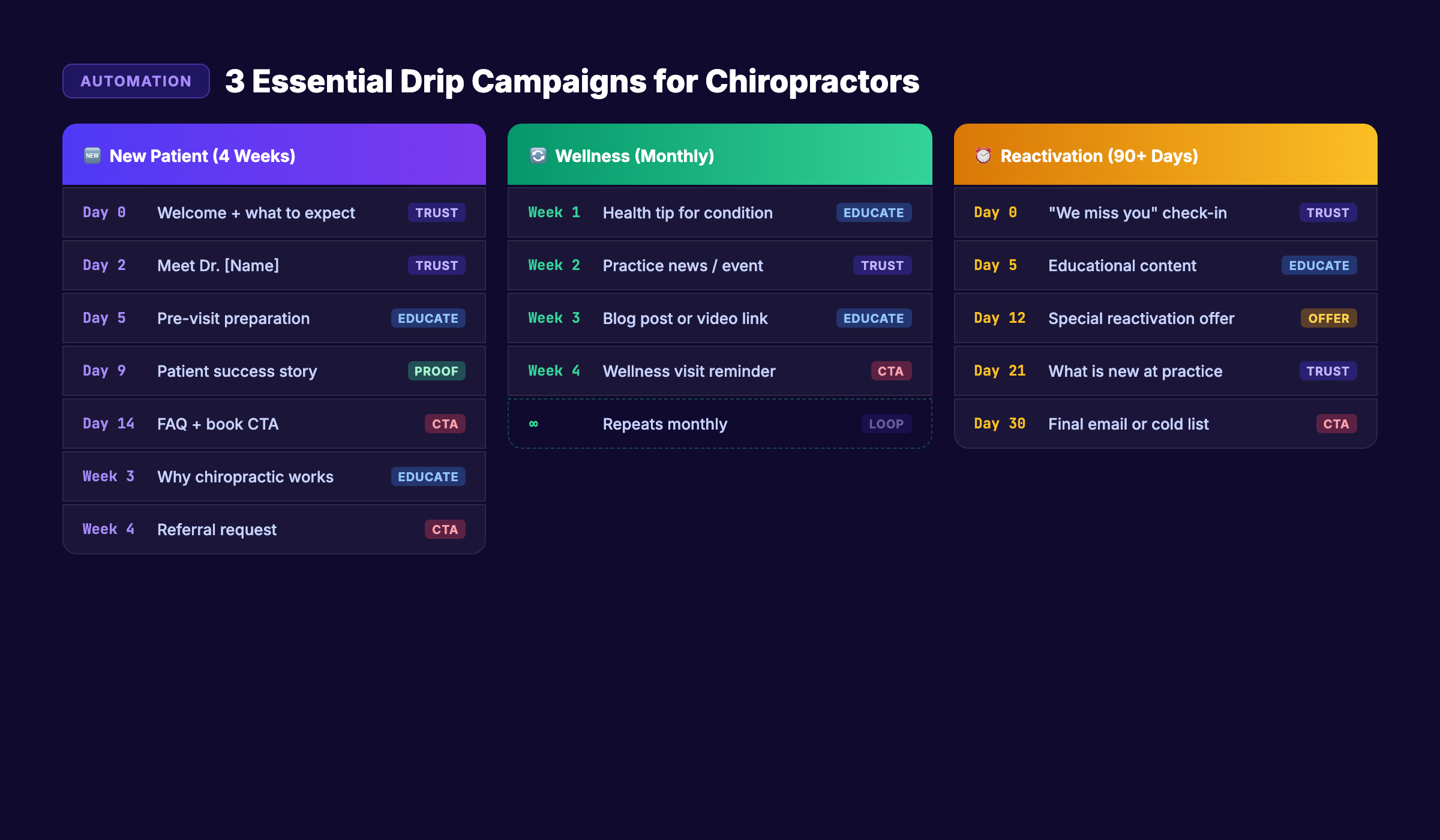
New Patient Onboarding Drip (Weeks 1-4)
This sequence bridges the gap between the first appointment and ongoing care.
| Week | Email Focus | Goal |
|---|---|---|
| 1 | Welcome + what to expect | Build trust |
| 1 | Pre-appointment preparation tips | Reduce anxiety |
| 2 | Post-first-visit follow-up + exercises | Reinforce value |
| 2 | ”Why chiropractic works” educational | Address skepticism |
| 3 | Patient success story | Social proof |
| 3 | ”Common questions new patients ask” | Overcome objections |
| 4 | Treatment plan check-in | Encourage commitment |
| 4 | Referral request + offer | Activate word-of-mouth |
The goal of the onboarding drip is simple: move patients from “trying chiropractic” to “committed to chiropractic care.” Most patients decide whether to continue within the first 4 weeks.
Wellness Maintenance Drip (Ongoing Monthly)
For patients who completed their treatment plan but benefit from ongoing care.
- Week 1: Health tip related to their condition
- Week 2: Practice news or community event
- Week 3: Educational content (link to blog post or video)
- Week 4: Soft CTA to schedule a wellness visit
This drip runs indefinitely. It keeps your practice in the patient’s inbox without being pushy.
Lapsed Patient Reactivation Drip (90+ Days Inactive)
Triggered automatically when a patient has not visited in 90 days.
- Day 0: “We noticed you have not been in for a while. How are you feeling?”
- Day 5: Educational email about the condition they were treated for
- Day 12: Special reactivation offer
- Day 21: “We would love to see you back. Here is what is new at our practice.”
- Day 30: Final email. If no response, move to cold list.
Your SEO team. $99 per month. 30 optimized articles, published automatically. Blog content educates patients. Email converts them into appointments. Start for $1 →
Segmentation for Chiropractic Practices
Sending the same email to every patient is the biggest mistake in chiropractic email marketing. A new patient who just had their first adjustment needs completely different content than a wellness patient who visits monthly.
The 5 Essential Segments
| Segment | Who | Email Content |
|---|---|---|
| New patients (0-30 days) | First-time visitors | Welcome series, education, trust-building |
| Active patients | Regular visitors on a treatment plan | Appointment reminders, exercise tips, progress updates |
| Wellness patients | Completed treatment, visit for maintenance | Monthly wellness tips, seasonal offers, referral requests |
| Lapsed patients (90+ days) | Have not visited in 3+ months | Reactivation campaigns, special offers, “we miss you” |
| Prospects | Signed up online but never booked | Lead nurture sequence, first-visit offer, social proof |
Segment by Condition
Beyond lifecycle stages, segment by the condition the patient sought treatment for:
- Back pain patients: Content about posture, ergonomics, lifting mechanics
- Neck pain / headache patients: Content about screen time, pillow selection, neck stretches
- Sports injury patients: Content about injury prevention, warm-up routines, performance
- Prenatal patients: Content about pregnancy discomfort, safe exercises, postpartum recovery
- Pediatric patients: Content for parents about child development, backpack safety, screen posture
Condition-based segmentation makes every email feel personally written for that patient. A runner does not care about prenatal stretches. A pregnant patient does not care about sport performance tips.
This same principle of matching content to audience applies to creating a content calendar for your blog. Different patient segments search for different topics.
Subject Lines That Get Opened
Your subject line determines whether a patient reads your email or ignores it. Most chiropractic practices write subject lines like “March Newsletter” or “Office Update.” Those get deleted.
Subject Line Formulas for Chiropractors
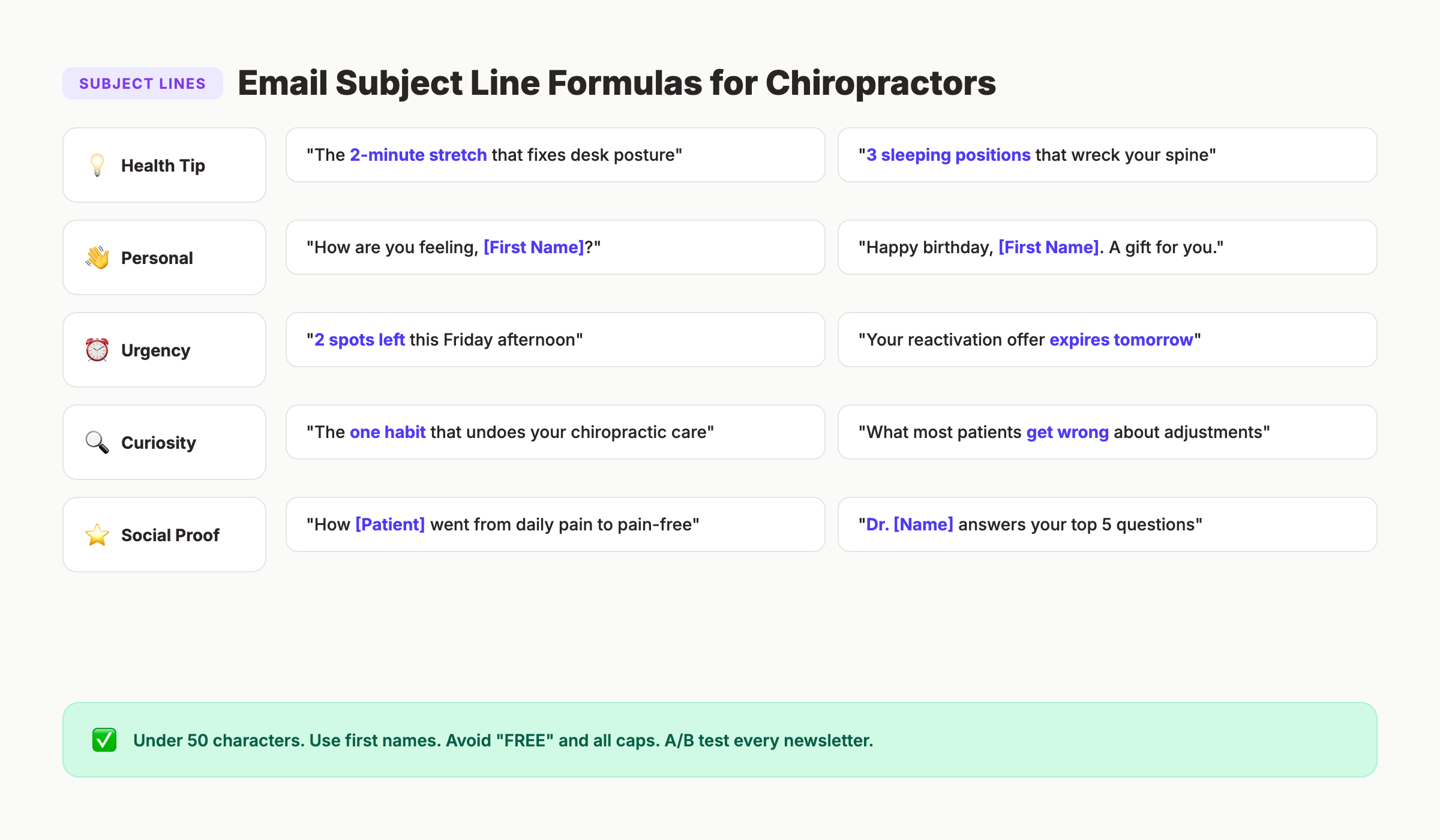
The health tip hook:
- “The 2-minute stretch that fixes desk posture”
- “Why your headaches might start in your neck”
- “3 sleeping positions that wreck your spine”
The personal touch:
- “How are you feeling, [First Name]?”
- “Your 6-month wellness check-in”
- “Happy birthday, [First Name]. A gift for you.”
The urgency trigger:
- “Last chance: $25 off your next adjustment”
- “2 spots left this Friday afternoon”
- “Your reactivation offer expires tomorrow”
The curiosity gap:
- “What most patients get wrong about adjustments”
- “The one habit that undoes your chiropractic care”
- “Dr. [Name] answers your top 5 questions”
Subject Line Rules
| Rule | Why |
|---|---|
| Keep under 50 characters | Mobile screens truncate longer lines |
| Use the patient’s first name | Personalization increases opens by 29% |
| Avoid spam triggers | ”FREE,” all caps, excessive punctuation |
| Be specific | ”Fix your desk posture” beats “Health tips” |
| Test two versions | A/B test every newsletter send |
Strong subject lines follow the same principles as effective headlines. Specificity wins. Vagueness loses.
HIPAA Compliance for Chiropractic Email Marketing
Healthcare email marketing has rules that other industries do not. HIPAA (Health Insurance Portability and Accountability Act) governs how you handle patient information. Violating HIPAA can result in fines from $100 to $50,000 per violation.
What You Can and Cannot Email
| Allowed | Not Allowed |
|---|---|
| General health tips and wellness content | Specific treatment details or diagnoses |
| Appointment reminders (date, time, location) | Lab results or imaging findings |
| Practice news and promotions | Billing information or insurance details |
| Birthday and milestone messages | Any Protected Health Information (PHI) |
| Referral requests (generic) | Patient names linked to conditions |
HIPAA Email Compliance Checklist
- Use a HIPAA-compliant email platform for any communication containing PHI
- Standard marketing platforms (Mailchimp, Constant Contact) are NOT HIPAA-compliant
- Keep marketing emails separate from clinical communications
- Never include diagnosis, treatment details, or health records in marketing emails
- Obtain written or digital consent before adding patients to your marketing list
- Use double opt-in to document consent
- Include an unsubscribe link in every email (CAN-SPAM requirement)
- Maintain records of consent for audit purposes
The Safe Approach
Use your practice management system (ChiroTouch, Jane App, etc.) for clinical emails that contain PHI. Use a separate marketing platform (Mailchimp, ActiveCampaign, Constant Contact) for newsletters, promotions, and educational content that contains zero PHI.
This separation keeps your marketing compliant and your patient data secure.
3,500+ blogs published. 92% average SEO score. Blog SEO drives new patients to your website. Email keeps them coming back. Start for $1 →
Tools and Platforms for Chiropractic Email Marketing
You need two things: an email marketing platform and a way to sync patient data from your practice management system.
Platform Comparison
| Platform | Best For | Starting Price | Key Feature |
|---|---|---|---|
| Mailchimp | Beginners | Free (500 contacts) | Easy templates, basic automation |
| Constant Contact | Simple newsletters | $12/mo | Healthcare templates, event tools |
| ActiveCampaign | Advanced automation | $29/mo | Behavior triggers, CRM built in |
| Patient Pilot | Chiropractic-specific | Varies | Pre-built chiro sequences, 11X ROI reported |
| Levitate | Healthcare email | Varies | AI-suggested content, compliance focus |
| Demandforce | Practice automation | Varies | Reviews + email + reminders in one |
For practices just starting, Mailchimp provides enough functionality at no cost. As your list grows past 1,000 patients, invest in a platform with advanced automation.
Chiropractic-specific platforms like Patient Pilot and Levitate come with pre-built email sequences designed for the patient lifecycle. The trade-off is higher cost and less flexibility than general platforms.
Measuring and Improving Email Performance
Sending emails without tracking results is guesswork. You need data to know what works.
The 5 Metrics That Matter
1. Open rate: Target 30%+ for chiropractic practices. Measures subject line quality and sender reputation.
2. Click-through rate (CTR): Target 3-5%. Measures content relevance and CTA effectiveness.
3. Appointment bookings from email: The metric that ties directly to revenue. Track using UTM parameters or unique booking links per email campaign.
4. Unsubscribe rate: Keep below 0.5% per send. Higher rates mean your content is off-target or too frequent.
5. Reactivation rate: What percentage of lapsed patients return after a reactivation sequence? Target 5-15%.
Monthly Email Audit Checklist
- Review open rates by segment. Fix underperforming subject lines.
- Check unsubscribe rate. If rising, reduce frequency or improve content.
- Clean list: remove bounces and 6-month non-openers.
- Review top-performing emails. What topics drove the most clicks?
- Test one new variable this month (subject line, send time, content format).
- Verify all automation sequences are running without errors.
- Check mobile rendering for the last 4 emails sent.
Consistent measurement is the same discipline that drives results in tracking content marketing ROI. Track weekly. Optimize monthly. The data tells you what patients want.
How to Combine Email With SEO and Content
Email marketing works best when paired with a content strategy. Every blog post you publish becomes an email topic. Every email drives traffic back to your website.
The Content-to-Email Loop for Chiropractors
- Publish a blog post targeting a chiropractic keyword (e.g., “how to fix lower back pain at home”)
- Send your weekly newsletter with a teaser and link to the post
- Patients visit your website, increasing organic engagement signals
- New website visitors see your lead magnet popup and join your list
- New subscribers enter your welcome drip sequence
- Repeat every week
This loop compounds. A chiropractor publishing 4 blog posts per month and sending weekly emails builds a self-reinforcing system where content feeds email and email feeds content.
Practices that invest in chiropractic SEO alongside email marketing outperform those using either channel alone. SEO attracts new patients from Google. Email retains them.
Repurpose Email Content Into Blog Posts
The reverse works too. Turn your best-performing emails into:
- Blog posts (expand a popular wellness tip into a full guide)
- Social media content (pull the key stat as a quote graphic)
- Patient handouts (print the stretching routine from your email)
- Video scripts (record yourself explaining the topic)
For more on turning one piece of content into multiple formats, see our guide on repurposing content for social media.
Skip the agency. Keep the results. Stacc starts at $99/mo. Blog content that ranks on Google and feeds your patient email system. Start for $1 →
FAQ
How often should a chiropractor send marketing emails?
Weekly is the sweet spot for most practices. Send a wellness newsletter once per week and let automated sequences (appointment reminders, follow-ups, reactivation) run on their own schedule. Going below biweekly causes patients to forget you. Going above 3 times per week causes unsubscribes.
Is Mailchimp HIPAA-compliant for chiropractic emails?
No. Mailchimp, Constant Contact, and most standard marketing platforms are not HIPAA-compliant. Use them only for marketing emails that contain zero Protected Health Information (PHI). For emails that include treatment details, diagnoses, or health records, use your practice management system or a HIPAA-compliant platform.
How do I get patients to sign up for my email list?
Start with your intake form. Add an email opt-in checkbox. Train your front desk to ask every patient. Online, use a lead magnet (free PDF guide, posture quiz) on your website with an exit-intent popup. Open houses, community events, and Facebook lead ads also work. The goal is 300+ contacts before launching your first campaign.
What should I include in a chiropractic newsletter?
One main topic per email. Rotate between health tips (posture, stretching, nutrition), practice news (new services, team updates), patient success stories, and seasonal content. Keep it to 250-400 words. Include one clear CTA such as “Book your next appointment” or “Share this with a friend.”
How do I win back patients who stopped coming?
Run a 4-email reactivation sequence targeting patients inactive for 90+ days. Start with a check-in (“How are you feeling?”), follow with educational content about their condition, offer a discount or incentive, and close with a deadline. This approach recovers 5-15% of lapsed patients on average.
Can email marketing replace advertising for a chiropractic practice?
Email excels at retention and reactivation. It does not replace advertising for acquiring brand-new patients who have never heard of you. The strongest practices use local SEO and Google Ads to attract new patients, then use email to retain them. Dropping either channel creates a gap. Email without acquisition starves your list. Acquisition without email wastes your marketing spend on one-time visits.
The chiropractic practices that grow fastest in 2026 are not the ones spending the most on Google Ads. They are the ones with the best email systems behind every patient interaction. Build your list from day one. Segment by patient journey. Automate the follow-up. And never let a patient drift away without a reason to come back.
Email marketing is not about sending more. It is about keeping every patient engaged for life.
Written and published by Stacc. We publish 3,500+ articles per month across 70+ industries. All data verified against public sources as of March 2026.