
SEO for Chiropractors: The Complete Guide (2026)
Rank your chiropractic practice on Google Maps and organic search. Covers GBP, local SEO, reviews, content, and technical SEO. Updated March 2026.
77% of patients research online before scheduling a healthcare appointment. For chiropractic practices, that number is even higher. 85% of chiropractic patients start their search with local terms like “chiropractor near me” or “best chiropractor in [city].”
Most chiropractor SEO advice tells you to “optimize your website.” That is not wrong. It is just incomplete. The practices filling their schedules from organic search do 6 things that their competitors skip entirely.
This guide covers the full chiropractor SEO playbook for 2026. Not generic SEO advice with “chiropractor” inserted. Specific strategies for a practice that serves patients in a local area, competes in a YMYL (Your Money or Your Life) category, and needs phone calls and bookings, not just traffic.
We publish 3,500+ blog posts across 70+ industries. We work with healthcare practices including chiropractors, dentists, and physical therapists. Our average SEO score is 92%.
Here is what you will learn:
- How to dominate the Google Maps 3-pack for your city
- The Google Business Profile setup that generates calls
- Which keywords chiropractors should target first
- How to build a content strategy around patient questions
- The review strategy that directly improves rankings
- Technical SEO fixes specific to chiropractic websites
- How to track which SEO efforts produce new patients
Chapter 1: Why SEO Matters More for Chiropractors Than Most Businesses
Chiropractic is a local, trust-dependent service in a competitive market. 35 million Americans visit chiropractors annually. Over 70,000 licensed chiropractors compete for those patients. The US chiropractic market hit $21.9 billion in 2026.
The Patient Search Journey
A typical new patient follows this path:
- Trigger: Back pain, neck pain, car accident, referral from a friend
- Search: “chiropractor near me” or “chiropractor for back pain [city]”
- Evaluate: Google Maps results, reviews, website, photos
- Contact: Phone call or online booking
- Visit: First appointment
SEO controls steps 2 and 3. If your practice does not appear in the Google Maps 3-pack or the first page of organic results, patients choose a competitor. 93% of clicks from local searches go to the top 3 Google Maps positions. Position 4 and below get almost nothing.
Chiropractors Face Unique SEO Challenges
YMYL classification. Google treats health-related content as “Your Money or Your Life.” This means higher quality standards. Thin content or unverified health claims can hurt rankings more than in other industries.
Local competition. Most cities have 20 to 50+ chiropractic practices within a 10-mile radius. Every one of them competes for the same “chiropractor near me” search.
Trust signals matter more. Patients choosing a healthcare provider weigh reviews, credentials, and website quality more heavily than someone choosing a restaurant or plumber.
Insurance and pricing complexity. Patients search for “chiropractor that accepts [insurance]” and “chiropractor cost without insurance.” These commercial queries need dedicated pages.
For a broader overview of ranking strategies, see our guide on how to rank higher on Google.
Chapter 2: Google Business Profile Optimization
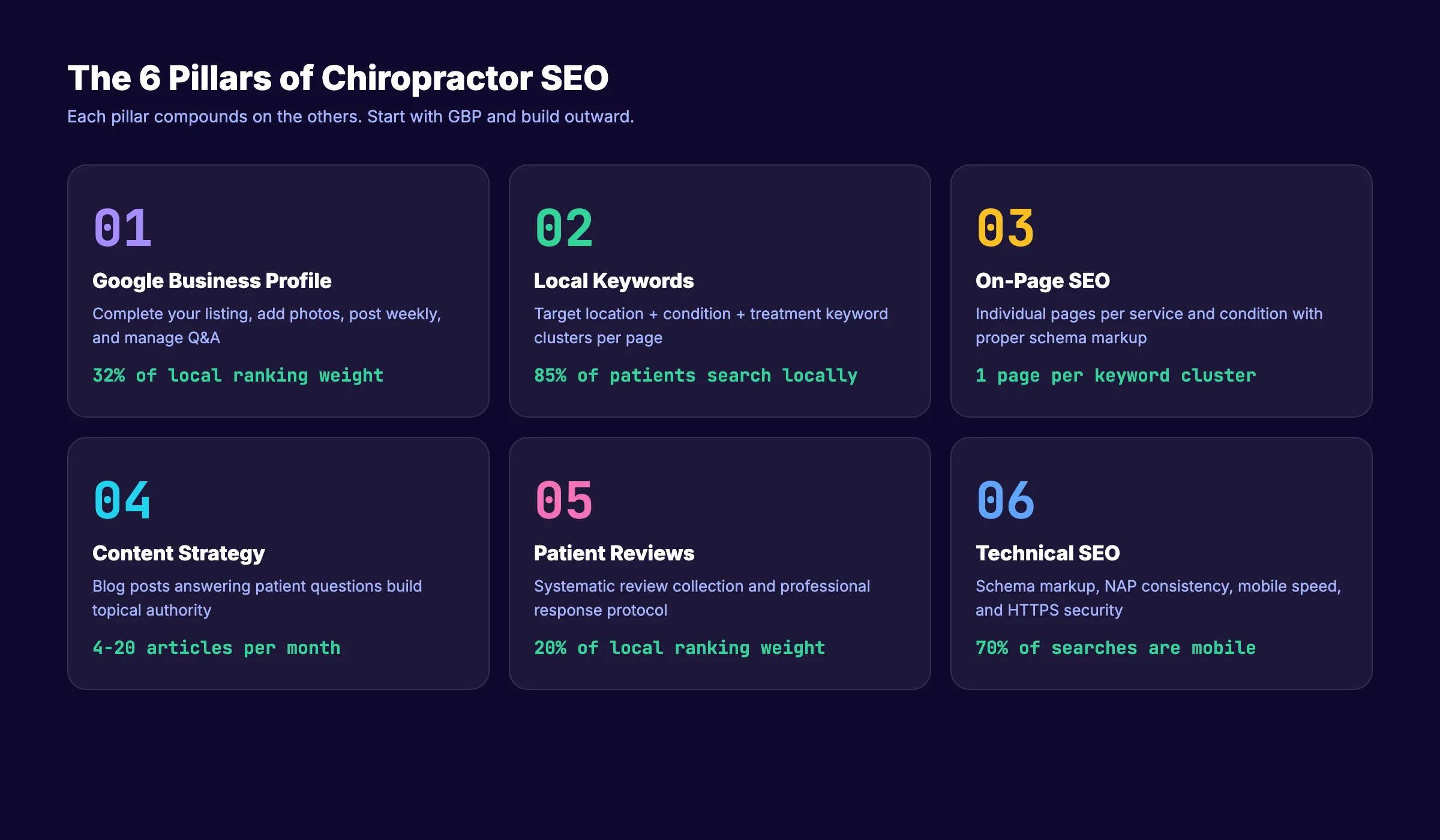
Your Google Business Profile is the single most important asset for chiropractor SEO. GBP signals account for 32% of local pack ranking factors. No other single factor carries as much weight.
The Complete GBP Setup Checklist
- Claim and verify your listing at business.google.com
- Use your exact legal business name (no keyword stuffing)
- Set primary category to “Chiropractor”
- Add secondary categories: “Sports Chiropractor,” “Pediatric Chiropractor,” or other specialties you offer
- Enter your full street address (no P.O. boxes)
- Add your local phone number (not a call tracking number as primary)
- Set accurate business hours including Saturday and evening availability
- Write a 750-word business description using your target keywords naturally
- Add all services with descriptions (spinal adjustment, decompression therapy, massage therapy, etc.)
- Upload 25+ high-quality photos (office exterior, reception, treatment rooms, team, equipment)
- Add your website URL and appointment booking link
- Enable messaging and Q&A
Photos Drive Engagement
Listings with 15+ photos see stronger engagement across all actions: calls, direction requests, and website clicks. Upload real photos of your practice, not stock images. Patients want to see the actual office they will visit.
Photo checklist for chiropractors:
- Exterior shot showing signage and parking
- Reception and waiting area
- Each treatment room
- Adjustment tables and equipment
- Team headshots (doctor in professional attire)
- Patient interaction shots (with consent)
- Before/after posture analysis images
GBP Posts
Post weekly. GBP posts appear in your listing and signal activity to Google. Share:
- Patient education tips (stretches, posture advice)
- New service announcements
- Seasonal offers (“Back-to-school posture check”)
- Community event participation
Our GBP post generator creates optimized posts in seconds. For a full tool comparison, see our list of GBP management tools.
Stop writing. Start ranking. Stacc publishes 30 SEO articles and 30 GBP posts per month starting at $99. Start for $1 →
Chapter 3: Local Keyword Strategy for Chiropractors
Generic keyword research does not work for chiropractors. You need a location-layered keyword strategy that matches how patients actually search.
The 4 Keyword Categories
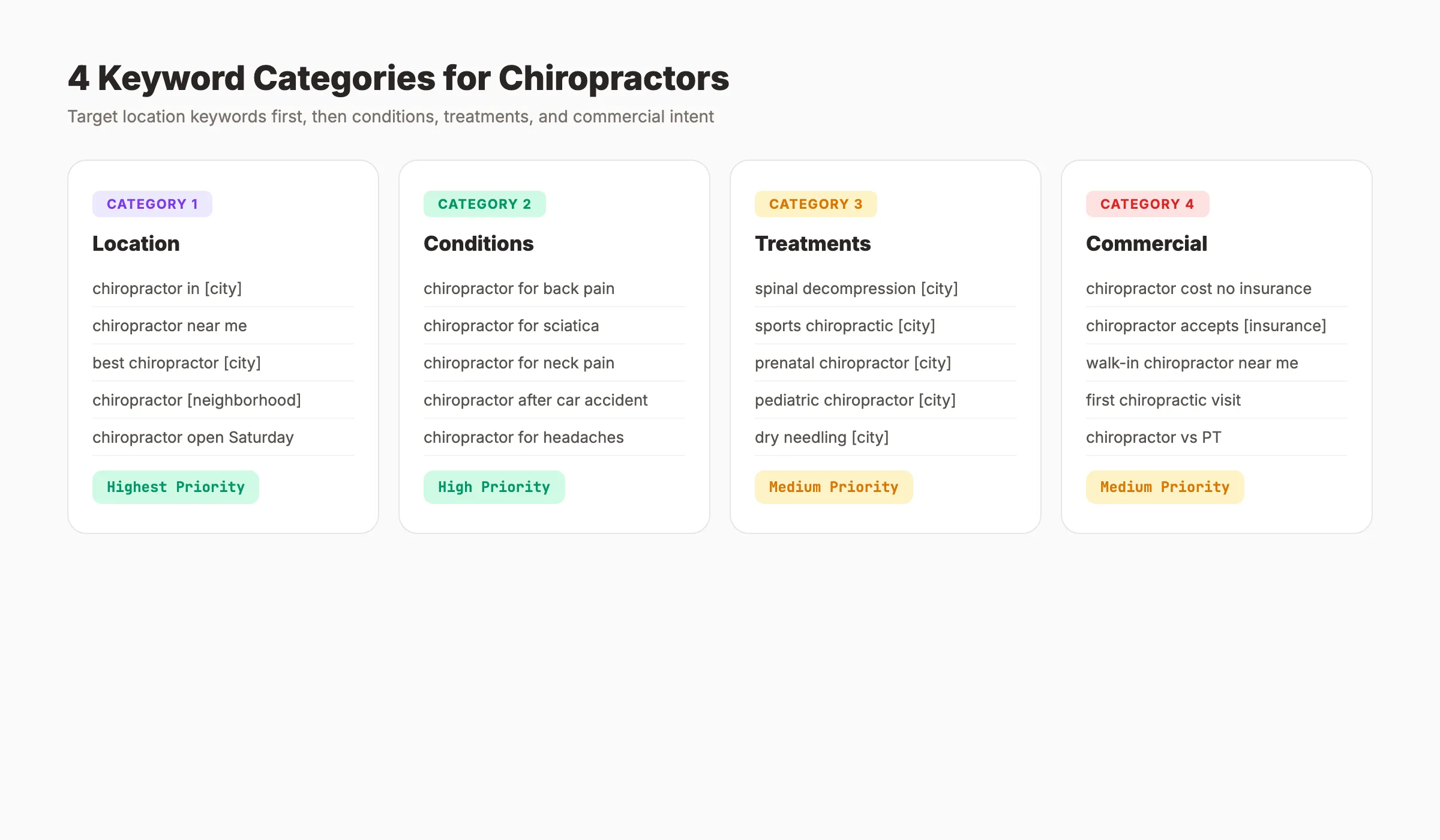
1. Location keywords (highest priority)
| Keyword Pattern | Example | Search Intent |
|---|---|---|
| chiropractor in [city] | chiropractor in Austin | Find a local provider |
| chiropractor near [landmark] | chiropractor near downtown Portland | Proximity-based |
| best chiropractor [city] | best chiropractor Denver | Evaluation/comparison |
| chiropractor [neighborhood] | chiropractor Buckhead Atlanta | Hyperlocal |
| chiropractor open [day/time] | chiropractor open Saturday | Urgency/convenience |
2. Condition keywords (patient pain points)
- chiropractor for back pain [city]
- chiropractor for sciatica
- chiropractor for neck pain
- chiropractor after car accident [city]
- chiropractor for headaches
- chiropractor for herniated disc
- chiropractor for whiplash
3. Treatment keywords (service-specific)
- spinal decompression therapy [city]
- chiropractic adjustment [city]
- sports chiropractic [city]
- prenatal chiropractor [city]
- pediatric chiropractor [city]
- dry needling chiropractor [city]
4. Commercial keywords (booking intent)
- chiropractor cost without insurance
- chiropractor that accepts [insurance name]
- walk-in chiropractor near me
- chiropractor first visit what to expect
- chiropractor vs physical therapist
Build a Keyword Map
Create one page per keyword cluster. Do not target multiple cities on one page. Each location gets its own dedicated page.
| Page | Primary Keyword | Supporting Keywords |
|---|---|---|
| Homepage | chiropractor [city] | best chiropractor, chiropractic clinic [city] |
| Back pain page | chiropractor for back pain [city] | lower back pain relief, spinal adjustment for back pain |
| Sciatica page | chiropractor for sciatica [city] | sciatica treatment, sciatic nerve pain relief |
| Car accident page | chiropractor after car accident [city] | auto injury chiropractor, whiplash treatment |
| Pricing page | chiropractor cost [city] | how much chiropractor, insurance accepted |
For more on the keyword research process, see our keyword research guide.
Chapter 4: On-Page SEO for Chiropractic Websites
Most chiropractic websites make the same mistake: one generic “Services” page listing everything. That approach targets zero specific keywords.
Create Individual Service Pages
Every treatment and condition you address needs its own page. Each page should include:
- H1 title with the treatment/condition + city name
- 200 to 500 words of unique content explaining the treatment, who it helps, and what to expect
- A clear CTA (book an appointment, call now)
- Schema markup for MedicalBusiness and the specific service
- Internal links to related conditions and treatments
A chiropractic practice offering 8 treatments across 3 service areas should have 24+ individual pages, not 1 generic page.
Title Tag and Meta Description Formulas
Title tag formula:
[Treatment/Condition] | [Practice Name] [City]Example: Sciatica Treatment | Austin Spine & Wellness Austin TX
Meta description formula:
[What you treat] + [what makes you different] + [CTA]. [Trust signal].Example: “Sciatica relief through targeted spinal adjustments. Same-day appointments available. Call (512) 555-0100. 200+ 5-star Google reviews.”
For more on writing effective meta tags, see our guide on how to write meta descriptions.
Header Hierarchy
Structure every service page with a clear header hierarchy:
H1: Chiropractor for [Condition] in [City]
  H2: What Causes [Condition]
  H2: How Chiropractic Treats [Condition]
    H3: [Technique 1]
    H3: [Technique 2]
  H2: What to Expect at Your First Visit
  H2: Insurance and Pricing
  H2: Book Your Appointment
Page Speed and Mobile
70% of chiropractic searches happen on mobile devices. If your site takes more than 3 seconds to load, half your visitors leave.
Run your site through our free SEO audit tool to check Core Web Vitals. For fixes, see our guide on improving Core Web Vitals.
Chapter 5: Content Strategy That Brings in Patients
Chiropractic practices that blog consistently rank for 5 to 10 times more keywords than those that do not. Content answers the questions patients ask before booking.
The Patient Question Framework
Every blog post should answer a real question patients search for. The best sources:
- Questions your front desk hears daily
- Google’s “People Also Ask” for your keywords
- Reddit threads about chiropractic care
- Condition-specific search queries
Content Calendar for Chiropractors
| Month | Blog Topics | Content Type |
|---|---|---|
| January | New year posture goals, desk ergonomics | Educational |
| February | Heart health and chiropractic, stress relief | Awareness |
| March | Spring sports injury prevention | Seasonal |
| April | Gardening back pain tips, allergy and chiropractic | Seasonal |
| May | Pregnancy and chiropractic care | Condition |
| June | Summer activity injury prevention, kids and chiropractic | Seasonal |
| July | Car accident injury guide, headache relief | Condition |
| August | Back-to-school posture, backpack safety | Seasonal |
| September | Fall sports chiropractic, running injuries | Seasonal |
| October | Spinal health awareness month | Awareness |
| November | Holiday travel tips, stress management | Seasonal |
| December | Year-end insurance benefits, gift of health | Commercial |
Blog Post Types That Work for Chiropractors
Condition explainers: “What Causes Sciatica and How Chiropractic Helps” Treatment guides: “What to Expect During Spinal Decompression Therapy” Comparison posts: “Chiropractor vs Physical Therapist: Which Do You Need?” Local content: “Best Stretches for Austin Office Workers” (targets local + informational) FAQ posts: “How Much Does a Chiropractor Cost Without Insurance?”
Publish at minimum 4 articles per month. More is better. Practices publishing 12 to 20 posts per month build topical authority faster.
For structuring your content plan, see our guide on building topical authority. For help creating posts, see how to write SEO blog posts.
Your SEO team. $99 per month. 30 optimized articles, published automatically. Start for $1 →
Chapter 6: The Review Strategy That Improves Rankings
Review signals account for 20% of local pack ranking factors. Reviews are not just social proof. They directly influence whether you appear in the Google Maps 3-pack.
The Numbers That Matter
- Each additional review generates 80 more website visits, 63 direction requests, and 16 phone calls
- 72% of patients read online reviews when selecting a new provider
- Chiropractors with consistent positive reviews rank up to 25% higher in local search
- 90% of consumers trust online reviews as much as personal recommendations
How to Get More Reviews Without Being Pushy
1. Ask at the right moment. The best time is immediately after a successful adjustment when the patient feels relief. Pain resolved = positive sentiment = honest positive review.
2. Make it effortless. Send a text or email with a direct link to your Google review page within 2 hours of the visit. Every extra click reduces completion rates.
3. Train your front desk. “We would love your feedback on Google. It helps other patients find us.” Simple, genuine, effective.
4. Use a review request template. Our review request generator creates personalized templates you can send via text or email.
Responding to Every Review
Respond to every review within 24 hours. Positive reviews get a thank-you that mentions the specific treatment. Negative reviews get a professional, HIPAA-compliant response that takes the conversation offline.
HIPAA warning: Never confirm or deny that someone is a patient in a public review response. Never mention specific treatments, conditions, or visit details. A safe response: “Thank you for your feedback. We take all concerns seriously. Please contact our office directly at [phone] so we can address this.”
For a full review strategy, see our guide on getting more Google reviews for local businesses. For tools, see our list of review management tools.
Chapter 7: Technical SEO for Chiropractic Websites
Technical issues silently kill rankings. Most chiropractor websites have at least 3 of these problems.
Schema Markup for Chiropractors
Add LocalBusiness and MedicalBusiness schema to every page. This tells Google exactly what your practice is, where it is located, and what services you offer.
Essential schema types:
| Schema Type | What It Does | Where to Add |
|---|---|---|
LocalBusiness / MedicalBusiness | Identifies your practice to Google | Homepage, about page |
MedicalClinic | Specifies clinic type | Homepage |
Service | Lists individual treatments | Each service page |
FAQPage | Marks up your FAQ sections | FAQ page, service pages with FAQs |
Review / AggregateRating | Shows star ratings in search results | Homepage, review page |
BreadcrumbList | Shows navigation path in search results | All pages |
Use our schema markup generator to create the JSON-LD code for your practice. For a deeper guide, see schema markup for blog posts.
NAP Consistency
NAP stands for Name, Address, Phone number. Your NAP must be identical everywhere it appears online. A mismatch between your website, GBP, Yelp, Healthgrades, and other directories confuses Google and hurts local rankings.
Audit your NAP across:
- Google Business Profile
- Website header and footer
- Yelp
- Healthgrades
- Zocdoc
- Apple Maps
- Bing Places
- Chamber of Commerce listings
- Chiropractic association directories
For citation management, see our list of local citation tools.
Site Architecture
Structure your website so Google can crawl every important page within 3 clicks of the homepage.
Homepage
├── Services
│   ├── Back Pain Treatment
│   ├── Sciatica Treatment
│   ├── Neck Pain Treatment
│   ├── Sports Chiropractic
│   ├── Prenatal Chiropractic
│   └── [Each treatment gets its own page]
├── Conditions We Treat
│   ├── Herniated Disc
│   ├── Whiplash
│   ├── Headaches & Migraines
│   └── [Each condition gets its own page]
├── About
│   ├── Meet the Doctor
│   └── Our Office
├── Blog
├── Reviews / Testimonials
├── Insurance & Pricing
└── Contact / Book Appointment
For more on site structure and internal linking, see our guide on internal linking for blog posts.
HTTPS and Security
Every chiropractic website must run on HTTPS. Google flags non-HTTPS health websites as “Not Secure.” Patients entering contact forms or booking appointments on an insecure site will leave.
3,500+ blogs published. 92% average SEO score. See what Stacc can do for your practice. Start for $1 →
Chapter 8: Measuring SEO Results for Your Practice
SEO without measurement is guessing. Track these metrics monthly to know what works.
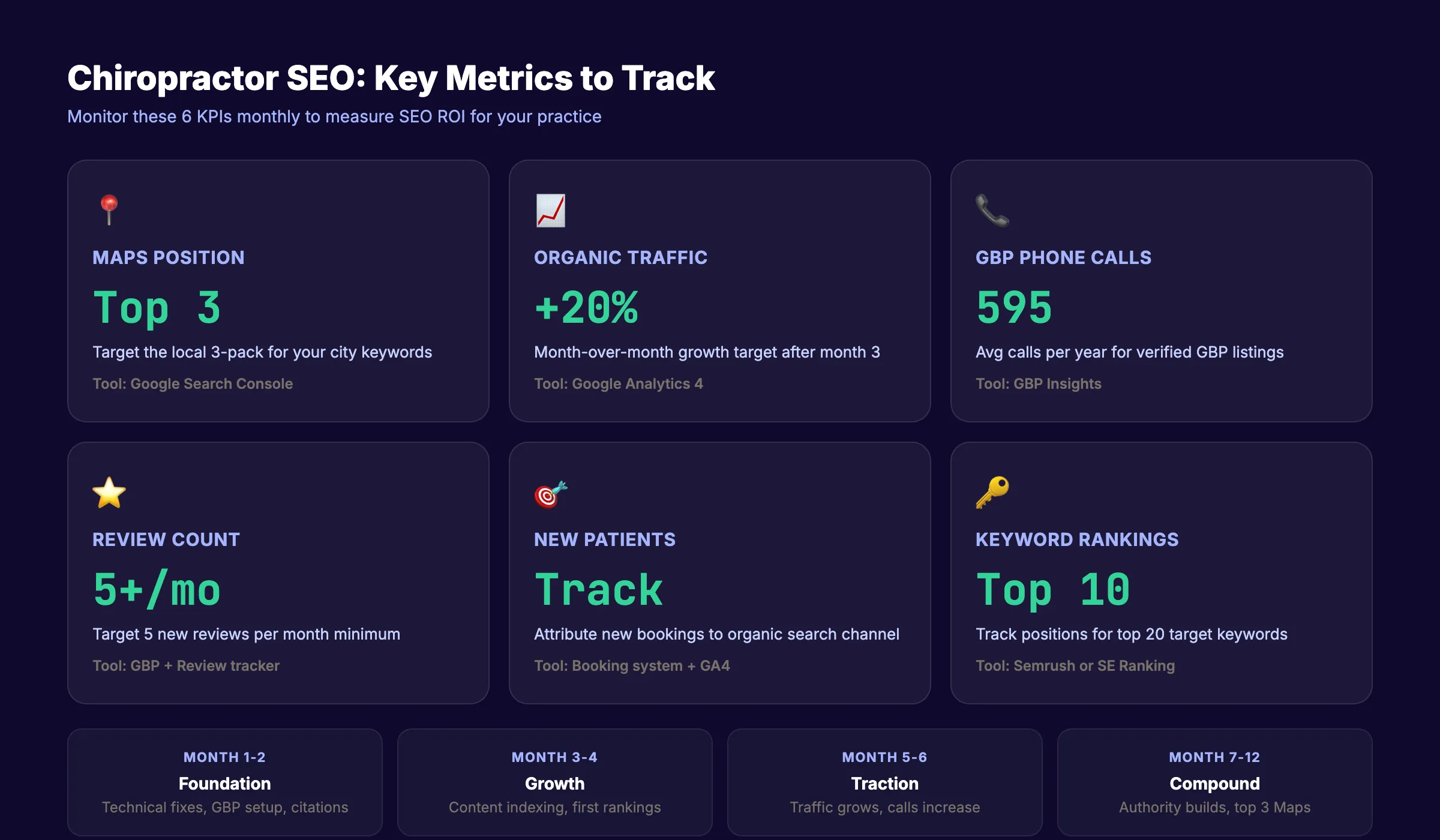
The 6 Metrics That Matter
| Metric | What It Tells You | Tool |
|---|---|---|
| Google Maps position | Where you rank in the local 3-pack | Google Search Console, local rank tracker |
| Organic traffic | How many people find your site through search | Google Analytics 4 |
| Phone calls from GBP | Direct patient inquiries from your listing | GBP Insights |
| Direction requests | Patients navigating to your office | GBP Insights |
| New patient bookings | Conversions from organic search | Your booking system + GA4 |
| Keyword rankings | Position tracking for target keywords | Semrush, Ahrefs, or SE Ranking |
Set Up Call Tracking
Phone calls convert to patients 3 times more often than web clicks. Track which pages and keywords drive calls using:
- Google Ads call tracking (free if running any Google Ads)
- CallRail or similar call tracking software
- Unique phone numbers per marketing channel
Monthly SEO Report Checklist
Run this review on the first of every month:
- Google Maps position for top 5 keywords
- Month-over-month organic traffic trend
- Number of new reviews received
- Average review rating
- GBP calls, direction requests, and website clicks
- New patient count attributed to organic search
- Top 10 blog posts by organic traffic
- Any new technical issues (crawl errors, speed problems)
For a complete analytics setup, see our Google Search Console guide. For a full site check, use our free SEO audit tool.
How Long Does Chiropractor SEO Take?
Expect this timeline:
- Month 1-2: Technical fixes, GBP optimization, citation building. Minimal ranking changes.
- Month 3-4: Content starts indexing. GBP begins climbing. First ranking improvements appear.
- Month 5-6: Consistent traffic growth. Review volume builds. Phone calls increase.
- Month 7-12: Compounding effect. Topical authority strengthens. Maps rankings stabilize in top 3.
Competitive markets (large cities with 50+ chiropractors) take longer. Smaller markets can see Maps results in 60 to 90 days.
FAQ
How much does SEO cost for chiropractors?
Chiropractor SEO services range from $149 to $5,000 per month depending on scope. Agencies typically charge $1,000 to $3,000 per month plus a setup fee. Automated content services like Stacc start at $99 per month for 30 SEO articles. The right budget depends on your market competition and how quickly you need results.
Do chiropractors really need SEO?
Yes. 93% of consumers use online searches to find local businesses. If your practice does not appear in the Google Maps 3-pack or on the first page of organic results, you are invisible to the majority of potential patients. Word of mouth still matters, but online search is how most new patients find chiropractors in 2026.
How long does chiropractor SEO take to work?
Expect initial ranking movement in 60 to 90 days for less competitive markets. Competitive metro areas take 6 to 12 months. GBP optimization and review building show results faster than organic content. The compounding effect means month 6 to 12 results are significantly stronger than month 1 to 3.
What keywords should chiropractors target first?
Start with location-based keywords: “chiropractor [your city]” and “chiropractor near me.” Then target condition keywords: “chiropractor for back pain [city],” “chiropractor for sciatica [city].” These have the highest conversion intent. Move to informational keywords (blog content) after your core service pages rank.
Is Google Ads or SEO better for chiropractors?
Both serve different purposes. Google Ads delivers immediate visibility but stops the moment you stop paying. SEO takes 3 to 6 months to build but generates free traffic indefinitely. The best approach: run Google Ads for immediate patient flow while building SEO for long-term compounding. Most successful practices use both.
How do I get my chiropractic practice into the Google Maps 3-pack?
Optimize your Google Business Profile completely (categories, photos, description, hours, services), build consistent citations across 20+ directories, generate a steady stream of patient reviews (aim for 5+ per month), and publish locally relevant content. GBP signals carry 32% of local pack ranking weight. See Chapter 2 of this guide for the full checklist.
The chiropractors filling their schedules from organic search in 2026 are not doing anything mysterious. They optimize their Google Business Profile. They build pages for every treatment and condition. They collect reviews consistently. They publish content that answers patient questions. Start with your GBP and 5 core service pages. The compounding begins from day one.
Rank everywhere. Do nothing. Blog SEO, Local SEO, and Social on autopilot. Start for $1 →

Written by
Siddharth GangalSiddharth is the founder of theStacc and Arka360, and a graduate of IIT Mandi. He spent years watching great businesses lose organic traffic to competitors who simply published more. So he built a system to fix that. He writes about SEO, content at scale, and the tactics that actually move rankings.



Automate your Google Business Profile content
30 GBP posts, local SEO articles, and review responses. Published every month automatically.
30-day trial · Cancel anytime
theStacc
Stop writing SEO content manually
30 blog articles, 30 GBP posts, and social media content. Published every month. Automatically.
Start Your $1 Trial$1 for 3 days · Cancel anytime