Email Marketing for Realtors: The Complete Guide
Learn how to build email lists, write drip campaigns, and close more deals as a real estate agent. Templates, examples, and strategies. Updated 2026.
Siddharth Gangal • 2026-03-30 • Content Strategy
In This Article
Email marketing for realtors is the single highest-ROI channel in real estate. Every dollar spent on email returns $36 on average. Yet most agents send the same generic “just listed” blast to their entire database and wonder why nobody responds.
There are over 3 million active real estate licenses in the United States. Your prospects receive emails from dozens of agents every week. The agents who win are not the ones sending the most emails. They are the ones sending the right email to the right person at the right time.
That requires a system. Not a template you found online and sent once. A system that segments your contacts, automates follow-ups, nurtures cold leads, and keeps you top of mind for 6 to 18 months until a prospect is ready to buy or sell.
This guide covers every part of email marketing that matters for real estate agents in 2026. We have published 3,500+ SEO-optimized articles across 70+ industries, including dozens of real estate content strategies. This is the playbook we recommend to every agent who wants more closings from their email list.
In this guide, you will learn:
- Why email outperforms social media and paid ads for real estate agents
- How to build a high-quality email list from scratch
- The 7 email types every realtor needs
- How to write drip campaigns that convert leads into clients
- Segmentation strategies that increase open rates by 30%
- Subject line formulas that get your emails opened
- Common mistakes that kill engagement and how to fix them
- How to measure email ROI and optimize over time
Why Email Marketing Works for Real Estate
Social media posts disappear from feeds within hours. Paid ads stop generating leads the moment you stop paying. Email sits in an inbox until someone reads it or deletes it. That difference matters in an industry where the average buying cycle is 6 to 12 months.
Email Beats Every Other Channel on ROI
| Channel | Average ROI | Lead Nurture Ability | Cost to Scale |
|---|---|---|---|
| Email marketing | $36 per $1 spent | Excellent | Low |
| Social media (organic) | Hard to measure | Moderate | Time-intensive |
| Google Ads (PPC) | $2-8 per $1 spent | Poor | High |
| Direct mail | $5-9 per $1 spent | Moderate | High |
| Cold calling | Varies widely | Low | Time-intensive |
Email is the only channel where you own the audience. Instagram can change its algorithm tomorrow. Google can raise ad costs. But your email list belongs to you.
Real Estate-Specific Email Benchmarks
Understanding industry averages helps you set realistic targets.
| Metric | Real Estate Average | Good Performance | Excellent |
|---|---|---|---|
| Open rate | 25-30% | 35-40% | 45%+ |
| Click-through rate | 2-3% | 4-5% | 6%+ |
| Unsubscribe rate | 0.2-0.5% | Under 0.2% | Under 0.1% |
| Bounce rate | 1-2% | Under 1% | Under 0.5% |
| Reply rate | 1-2% | 3-5% | 5%+ |
If your open rates are below 20%, the problem is usually your subject lines or sending frequency. If clicks are low but opens are strong, the issue is your email content or call to action.
For agents who also invest in content marketing, email becomes the distribution engine that drives traffic to every new piece of content you publish.
How to Build Your Email List
Most agents start with the wrong list. They buy a database of 10,000 contacts, blast a generic email, and get flagged as spam. A list of 500 people who actually want to hear from you will outperform a purchased list of 50,000 every time.
Lead Magnets That Work for Real Estate
Offer something valuable in exchange for an email address. The best lead magnets solve a specific problem for a specific audience.
For buyers:
- First-time homebuyer checklist (PDF download)
- “5 Neighborhoods Under $400K in [City]” guide
- Mortgage pre-approval calculator
- Weekly new listing alerts for specific zip codes
For sellers:
- Free home valuation tool
- “10 Renovations That Add the Most Value” guide
- Neighborhood market report (monthly)
- “How to Stage Your Home in a Weekend” checklist
For investors:
- Rental yield calculator for [City]
- Monthly cap rate report by neighborhood
- “Due Diligence Checklist for Investment Properties” PDF
Where to Capture Emails
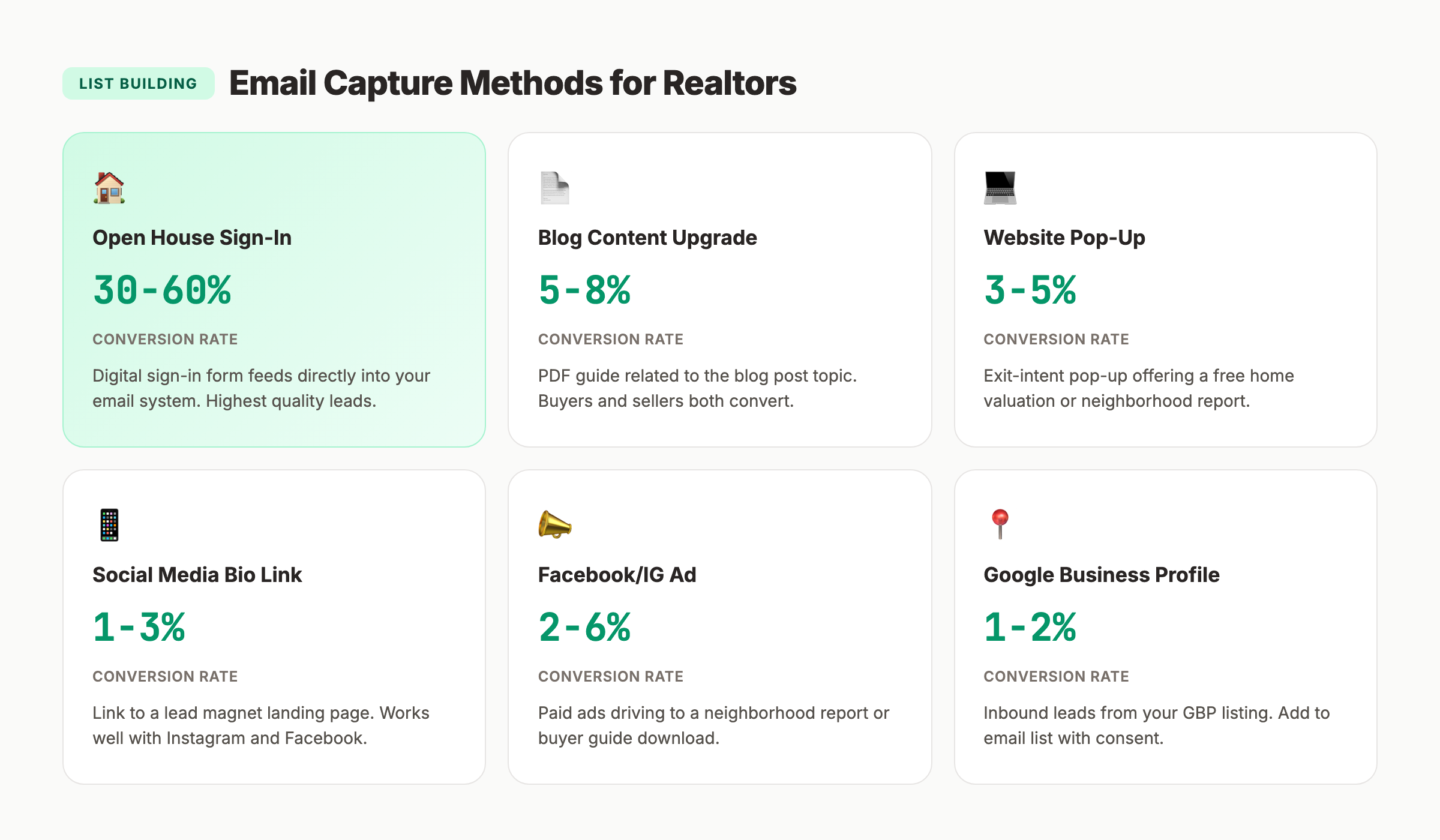
| Capture Point | Conversion Rate | Best Lead Magnet |
|---|---|---|
| Website pop-up (exit intent) | 3-5% | Home valuation |
| Blog post content upgrade | 5-8% | Related PDF guide |
| Open house sign-in sheet | 30-60% | Market report |
| Social media bio link | 1-3% | Free guide landing page |
| Facebook/Instagram ad | 2-6% | Neighborhood report |
| Google Business Profile | 1-2% | Contact form |
Open houses remain the highest-converting email capture method in real estate. Every attendee is a warm lead. Use a digital sign-in form (not paper) that feeds directly into your email system.
If you have optimized your Google Business Profile, you already receive inbound leads through your listing. Add those contacts to your email list with proper consent.
List Hygiene Rules
A dirty list kills deliverability. Clean your list every 90 days:
- Remove hard bounces immediately
- Remove contacts who have not opened in 6+ months (or send a re-engagement campaign first)
- Verify new email addresses with a double opt-in
- Never buy email lists. Ever. The contacts did not consent, and major email providers will penalize your sender reputation.
Stop writing. Start ranking. Stacc publishes 30 SEO articles per month for $99. Pair that with your email list and every article becomes a nurture touchpoint. Start for $1 →
The 7 Email Types Every Realtor Needs
Most agents send one type of email: listing announcements. That is one of seven types you need. Each serves a different purpose in the client journey.
1. Welcome Email (or Welcome Series)
Sent immediately after someone joins your list. Welcome emails average an 86% open rate. That is 3 to 4 times higher than any other email type. Use this window to make a strong first impression.
What to include:
- Thank them for subscribing
- Tell them what to expect (frequency, content types)
- Share your best piece of content (a popular blog post or guide)
- Include a personal note about who you are and why you do real estate
- Add one clear CTA: book a call, reply with what they are looking for, or download a resource
2. New Listing Alerts
Automated emails triggered when new properties match a subscriber’s criteria. These work best when tied to your MLS feed and segmented by buyer preferences (location, price range, property type).
Pro tip: Skip the raw MLS listing. Add your personal take: “This one has the best backyard in the neighborhood” or “Priced $20K below recent comps. It will not last.” Your opinion is the value-add that separates your email from Zillow notifications.
3. Market Update Newsletter
Sent weekly or biweekly. Covers local market data, price trends, inventory levels, and interest rate changes. Position yourself as the local market expert.
Structure:
- 1-2 key market stats with your interpretation
- 1 featured listing or neighborhood spotlight
- 1 helpful tip (staging, financing, home maintenance)
- 1 CTA (schedule a consultation, view all listings)
This is also the perfect place to link to your latest blog content, driving traffic to your website while nurturing your email list.
4. Drip Campaign Emails
Pre-written sequences that send automatically based on a trigger (new subscriber, attended open house, downloaded a guide). We cover these in detail in the next section.
5. Just Sold / Social Proof Emails
Every closed deal is a marketing asset. Send a “just sold” email with:
- Property photo and sale details
- How quickly it sold and final price vs. listing price
- A client testimonial (even 1-2 sentences works)
- CTA: “Thinking about selling? Let’s talk about your home.”
Social proof builds trust faster than any claim you can make about yourself. Agents who collect and share Google reviews in their emails see higher response rates.
6. Event and Open House Invitations
Invite your list to open houses, homebuyer seminars, community events, or market update webinars. Events create face-to-face opportunities that email alone cannot.
7. Re-engagement Emails
For contacts who have gone quiet (no opens in 60-90 days). A good re-engagement email acknowledges the silence and gives them a reason to stay:
- “Still looking for a home in [City]?”
- Share something new (a market shift, a price drop, a new guide)
- Give them an easy exit: “Click here to stay subscribed or we will remove you in 7 days”
Removing unengaged contacts improves your deliverability for everyone else on your list.
How to Build Drip Campaigns That Convert
A drip campaign is a pre-scheduled sequence of emails that sends automatically. Think of it as a salesperson who follows up perfectly every time, without you lifting a finger.
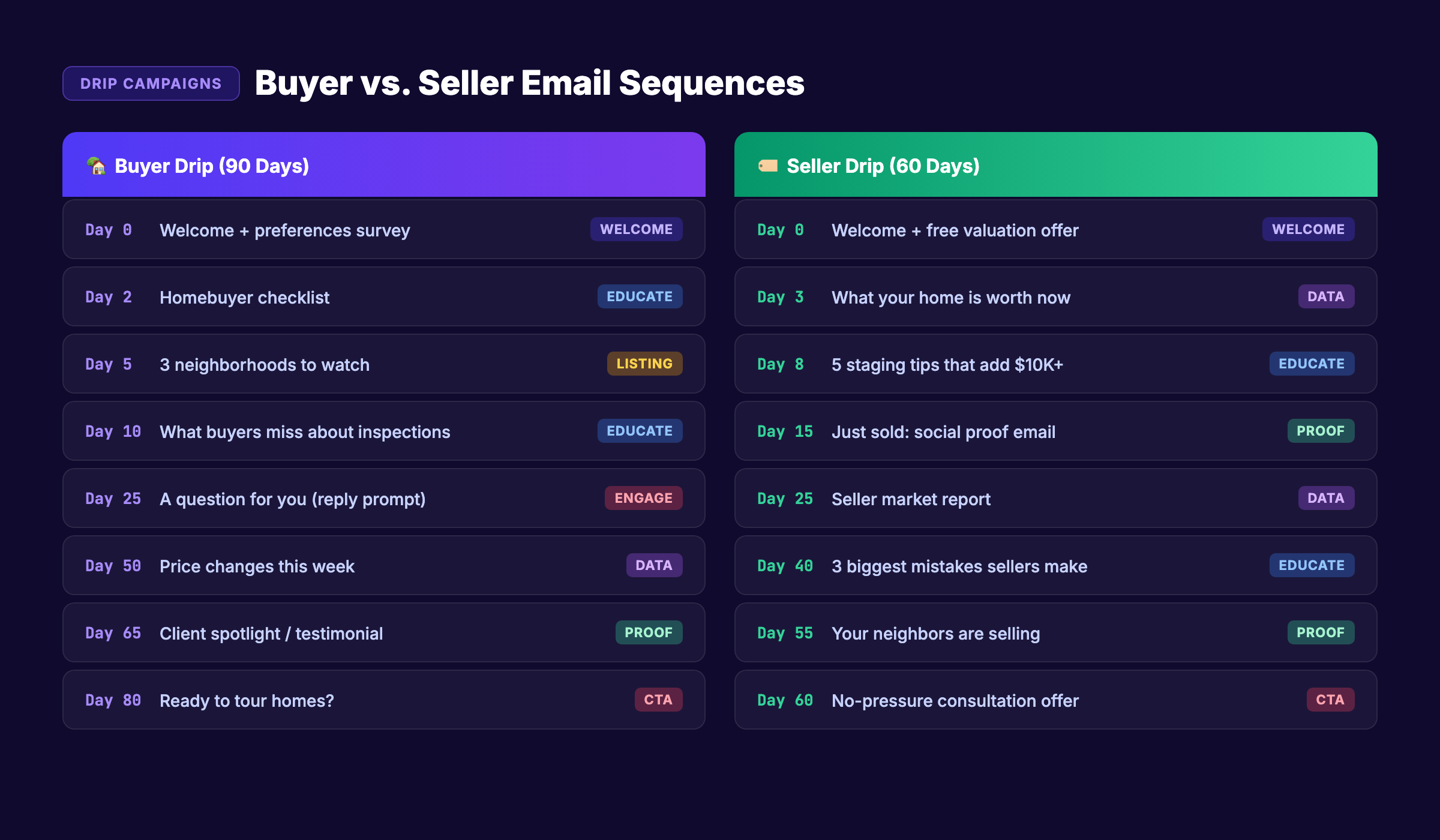
The Buyer Drip Campaign (8-12 Emails Over 90 Days)
| Timing | Subject | Content | |
|---|---|---|---|
| 1 | Immediately | Welcome + what to expect | Introduction, preferences survey link |
| 2 | Day 2 | ”[City] homebuyer checklist” | First-time buyer guide, pre-approval tip |
| 3 | Day 5 | ”3 neighborhoods worth watching” | Neighborhood profiles matching their budget |
| 4 | Day 10 | ”What most buyers miss about inspections” | Educational content, position yourself as expert |
| 5 | Day 17 | ”[City] market update: [Month]“ | Local market data, inventory trends |
| 6 | Day 25 | ”A question for you” | Simple reply-prompt to start a conversation |
| 7 | Day 35 | ”New listings matching your criteria” | Curated listings with personal commentary |
| 8 | Day 50 | ”Price changes this week in [City]“ | Price drops and new opportunities |
| 9 | Day 65 | ”Client spotlight: How [Name] found their home” | Case study / testimonial |
| 10 | Day 80 | ”Ready to tour some homes?” | Soft CTA to book a showing |
The goal is not to sell in every email. It is to stay top of mind and demonstrate expertise until the buyer is ready to act.
The Seller Drip Campaign (6-8 Emails Over 60 Days)
| Timing | Purpose | |
|---|---|---|
| 1 | Immediately | Welcome + free home valuation offer |
| 2 | Day 3 | ”What your home is worth in [Month] [Year]” market data |
| 3 | Day 8 | ”5 staging tips that add $10K+ to your sale price” |
| 4 | Day 15 | ”Just sold: [Address] for [Price]” social proof |
| 5 | Day 25 | ”[City] seller market report” with price-per-sqft data |
| 6 | Day 40 | ”The 3 biggest mistakes sellers make” educational |
| 7 | Day 55 | ”Your neighbors are selling. Here is what they are getting.” |
| 8 | Day 60 | ”Ready for a no-pressure consultation?” direct CTA |
Sellers need more social proof and market data than buyers. Every email should reinforce that you understand their specific market and can get top dollar.
The Open House Follow-Up Sequence (4 Emails Over 14 Days)
This short sequence targets people who attended an open house but did not make an offer.
- Same day: “Great meeting you at [Address] today” + property highlights
- Day 2: “Here are 3 similar homes you might like” + curated listings
- Day 7: “Thinking about [Address]? Here is what you should know” + inspection tips, neighborhood data
- Day 14: “Still house hunting? Let’s narrow it down together” + CTA to schedule a call
Open house leads are warm. Speed matters. The first email should send within 2 hours of the event ending.
Your SEO team. $99 per month. 30 optimized articles, published automatically. Every article drives organic traffic to your website where you capture emails. Start for $1 →
Segmentation Strategies That Increase Engagement
Sending the same email to your entire list is the fastest way to kill engagement. Segmented email campaigns generate 30% more opens and 50% more click-throughs than unsegmented ones.
The 6 Segments Every Realtor Needs
| Segment | Criteria | Email Content |
|---|---|---|
| First-time buyers | No purchase history, expressed interest in buying | Educational content, financing tips, neighborhood guides |
| Move-up buyers | Current homeowners looking to upgrade | Trade-up market data, equity calculators, luxury listings |
| Sellers | Expressed interest in selling or requested valuation | Market reports, staging tips, just-sold comparisons |
| Investors | Investment property interest | Cap rates, rental yields, multi-family listings |
| Past clients | Previous buyers/sellers (closed deals) | Referral requests, anniversary check-ins, market updates |
| Cold leads | No engagement in 60+ days | Re-engagement campaigns, fresh lead magnets |
Advanced Segmentation Tactics
By location: Create sub-lists for each neighborhood or zip code you serve. Send hyper-local market updates that reference specific streets, schools, and amenities. Generic “the market is hot” emails get deleted. “[Neighborhood] prices jumped 8% this quarter” gets read.
By funnel stage: A lead who downloaded a first-time buyer guide needs different emails than someone who toured 3 homes last weekend. Map your email content to where each contact sits in their journey.
By engagement level: Subscribers who open every email deserve your best content and most personal outreach. Subscribers who have not opened in 3 months need a re-engagement sequence or removal.
By property preference: If someone searches for condos, do not send them single-family listings. Tie your listing alerts to specific property types, price ranges, and bedroom counts.
Proper segmentation pairs well with a content calendar so you can plan different email content for each segment on a monthly cycle.
Subject Lines That Get Your Emails Opened
Your subject line determines whether someone opens or ignores your email. Everything else is irrelevant if the subject line fails.
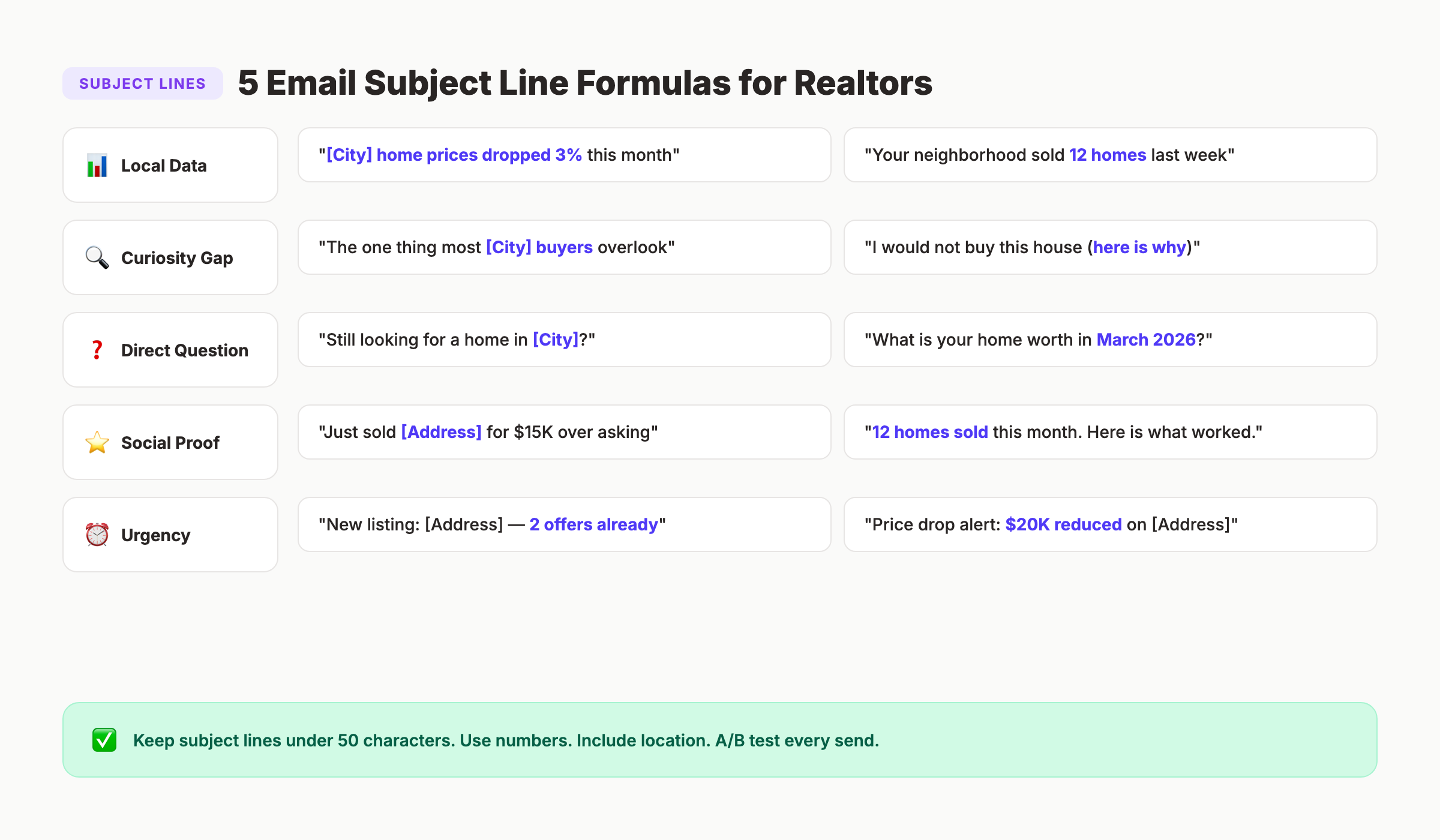
Subject Line Formulas for Real Estate
The local data hook:
- “[City] home prices dropped 3% this month”
- “Your neighborhood sold 12 homes last week”
- “[Zip code] market report: What sellers need to know”
The curiosity gap:
- “The one thing most [City] buyers overlook”
- “I would not buy this house (and here is why)”
- “3 streets in [Neighborhood] worth watching right now”
The direct question:
- “Still looking for a home in [City]?”
- “What is your home worth in March 2026?”
- “Ready to sell before summer?”
The social proof hook:
- “Just sold [Address] for $15K over asking”
- “How [Client name] found their dream home in 3 weeks”
- “12 homes sold this month. Here is what worked.”
The urgency trigger:
- “New listing: [Address] — 2 offers already”
- “Price drop alert: [Address] just reduced $20K”
- “Open house Saturday — 3 spots left for private tour”
Subject Line Rules
| Rule | Why |
|---|---|
| Keep under 50 characters | Mobile screens truncate at 40-50 chars |
| Use numbers and specifics | ”3 homes” beats “some homes” |
| Include location when possible | Local relevance increases opens |
| Avoid spam triggers | ”FREE,” all caps, excessive punctuation |
| Test two versions | A/B test every send with a 10% sample |
| Never mislead | Subject must match email content |
Good subject lines follow the same principles as good blog headlines. Specificity beats cleverness. Data beats adjectives.
Email Design and Copy Best Practices
A well-designed email does not mean a complicated email. For real estate, simpler performs better.
Keep Emails Short
The ideal real estate email is 150 to 300 words. Not 800. Not 1,200. Your subscribers are busy. They skim. Give them one clear message and one clear action.
Exception: market update newsletters can run 400-600 words because subscribers expect more detail.
Use One CTA Per Email
Every email should have one primary call to action. Not three. One.
| Email Type | Best CTA |
|---|---|
| New listing alert | ”View the full listing” |
| Market update | ”See all active listings” |
| Buyer drip email | ”Reply with your top 3 neighborhoods” |
| Seller drip email | ”Get your free home valuation” |
| Just sold | ”Schedule a consultation” |
| Open house invite | ”RSVP for Saturday” |
Multiple CTAs split attention. When you give readers 4 options, many choose none.
Mobile-First Design
67% of emails are opened on mobile devices. Design for phones first.
- Single-column layout
- Font size 16px minimum for body text
- Buttons large enough to tap (44x44px minimum)
- Images that resize (do not rely on wide property grids)
- Preview text optimized (first 90 characters after subject line)
Include Professional Photography
Real estate is visual. Every listing email should feature professional photos, not phone snapshots. For market updates and educational emails, use clean graphics or no images at all. Heavy image-to-text ratios trigger spam filters.
Brand Consistency
Use the same logo, colors, and email signature across every email. Your subscribers should recognize your emails before they read the subject line. Consistent branding builds the same kind of trust that consistent local SEO builds online.
3,500+ blogs published. 92% average SEO score. See what Stacc can do for your site. Blog SEO drives organic traffic. Your email list converts it. Start for $1 →
Common Email Marketing Mistakes Realtors Make
Most agents make the same 8 mistakes. Fixing even half of these will improve your results immediately.
1. Buying Email Lists
Purchased lists have low-quality contacts who never opted in. Result: high bounce rates, spam complaints, and damaged sender reputation. Building a list of 500 engaged contacts takes time. It is worth 100 times more than a purchased list of 50,000.
2. Sending Only Listing Announcements
If every email is “just listed” or “just sold,” you are a commercial. Nobody subscribes to commercials. Mix educational content, market data, and personal stories with your listing updates. The 80/20 rule works: 80% value, 20% promotion.
3. No Segmentation
Sending the same email to buyers, sellers, investors, and past clients treats them all as identical. They are not. A seller does not care about your first-time buyer guide. An investor does not need staging tips.
4. Ignoring Mobile
If your email looks broken on a phone, 67% of your audience sees a broken email. Always preview on mobile before sending.
5. Inconsistent Sending
Emailing once in January, then disappearing until April trains your contacts to forget you. Set a schedule and stick to it. Weekly or biweekly is the sweet spot for most agents. Going dark kills trust.
6. Generic Subject Lines
“Market Update” and “Newsletter #14” are invisible in a crowded inbox. Use specific data, questions, or local references. A subject line is an ad for your email. Make it earn the open.
7. No Clear CTA
Every email needs a specific action you want the reader to take. “Let me know if you have questions” is not a CTA. “Reply with your top 3 neighborhoods” is.
8. Skipping Analytics
If you do not track open rates, click rates, and replies, you are flying blind. Check your email analytics weekly. Identify what works and do more of it. Drop what does not. This same data-driven approach applies to measuring content marketing ROI across all your marketing channels.
Tools and Platforms for Real Estate Email Marketing
You do not need expensive software. But you need the right features.
What to Look For in a Real Estate Email Platform
| Feature | Why It Matters |
|---|---|
| Automation/drip campaigns | Set up once, follow up forever |
| Segmentation | Send targeted content to different audiences |
| Templates | Faster email creation with consistent branding |
| CRM integration | Sync with your real estate CRM |
| Analytics dashboard | Track opens, clicks, replies, conversions |
| Mobile preview | Test how emails render on phones |
| Deliverability tools | Domain authentication, spam testing |
Platform Comparison
| Platform | Best For | Starting Price | Real Estate Features |
|---|---|---|---|
| Mailchimp | Beginners | Free (500 contacts) | Templates, basic automation |
| ActiveCampaign | Advanced automation | $29/mo | Behavior-based triggers, CRM |
| Constant Contact | Simple newsletters | $12/mo | Real estate templates, event tools |
| Follow Up Boss | Real estate CRM + email | $58/mo | MLS integration, lead routing |
| kvCORE | Full real estate platform | Varies by brokerage | IDX integration, smart campaigns |
| Brevo (Sendinblue) | Budget-friendly | Free (300 emails/day) | Automation, SMS add-on |
For agents just starting, Mailchimp or Brevo provide enough functionality at no cost. As your list grows past 2,000 contacts, invest in a platform with stronger automation like ActiveCampaign or a real estate-specific CRM.
How to Measure and Improve Email Performance
Sending emails without measuring results is like showing houses without collecting feedback. You need data to improve.
The 5 Metrics That Matter
1. Open rate: Measures subject line effectiveness. Target: 30%+ for real estate.
2. Click-through rate (CTR): Measures content relevance and CTA strength. Target: 3-5%.
3. Reply rate: Measures engagement quality. Replies indicate real interest. Target: 2-5%.
4. Conversion rate: Measures how many email recipients take a meaningful action (book a call, attend an open house, request a valuation). This is the metric that ties directly to revenue.
5. Unsubscribe rate: Measures content-audience fit. If above 0.5% per send, your content is off-target or your frequency is too high.
A/B Testing Framework
Test one variable at a time to isolate what works.
| Variable | Test Examples | Sample Size |
|---|---|---|
| Subject line | Question vs. statement | 10% of list |
| Send time | Tuesday 9am vs. Thursday 7pm | Full list, alternating weeks |
| CTA text | ”View listing” vs. “See photos” | 10% of list |
| Email length | 150 words vs. 400 words | Full list, alternating |
| Personalization | First name vs. no name | 10% of list |
Run each test for at least 2 sends before drawing conclusions. Small sample sizes produce unreliable results.
Monthly Email Audit Checklist
- Review open rates by segment. Identify underperforming segments.
- Check unsubscribe rate. If rising, review frequency and content relevance.
- Clean list: remove hard bounces and 6-month non-openers.
- Review top-performing emails. What subject lines and topics drove the most engagement?
- Test one new element this month (subject line formula, send time, content format).
- Verify all drip campaigns are running without errors.
- Check mobile rendering for last 4 emails sent.
Consistent measurement turns email marketing from guesswork into a system. The same discipline applies to tracking the ROI of your content efforts across blog, social, and email channels.
Skip the agency. Keep the results. Stacc starts at $99/mo. Blog content that ranks and feeds your email nurture sequences. Start for $1 →
How to Combine Email With Content and SEO
Email marketing works best when paired with a content strategy. Every blog post you publish becomes an email touchpoint. Every email drives traffic back to your website.
The Content-to-Email Loop
- Publish a blog post targeting a real estate keyword (e.g., “best neighborhoods in [City]”)
- Send an email to the relevant segment with a teaser and link
- Readers visit your website, increasing organic engagement signals
- Website visitors see other content, capture forms, and listing pages
- New email signups enter your drip campaigns
- Repeat
This loop compounds. An agent publishing 4 blog posts per month and sending weekly emails builds a flywheel where content feeds email and email feeds content.
Agents who invest in real estate SEO alongside email marketing outperform those who rely on either channel alone. SEO brings in new leads. Email converts them.
Repurpose Emails Into Content
The reverse also works. Turn your best-performing emails into:
- Blog posts (expand the topic with more detail)
- Social media posts (pull the key insight as a quote graphic)
- Video scripts (film yourself delivering the email content)
- Lead magnets (compile a series of market updates into a quarterly report)
For more on turning one piece of content into multiple formats, see our guide on repurposing content for social media.
FAQ
What is the best email frequency for real estate agents?
Weekly or biweekly works for most agents. Active listing alerts can send more frequently (2-3 times per week) if the subscriber opted into that cadence. The key is consistency. Pick a schedule and maintain it. Disappearing for months between sends damages trust and deliverability.
How do I build an email list if I am a new agent?
Start with open house sign-in forms (digital, not paper), a lead magnet on your website (home valuation or buyer guide), and a link in your social media bios. Ask every person you meet in a professional context if they would like market updates. A list of 100 engaged contacts is enough to start seeing results from drip campaigns.
What is the best email marketing platform for realtors?
For new agents, Mailchimp or Brevo (free tiers) provide enough features. For agents with 1,000+ contacts who need advanced automation, ActiveCampaign is the strongest general option. For agents who want a real estate-specific CRM with built-in email, Follow Up Boss or kvCORE integrate with MLS systems.
How long should a real estate drip campaign run?
8 to 16 weeks for active leads. The buying cycle in real estate averages 6 to 12 months, so some agents run longer nurture sequences (6-12 months) with decreasing frequency. Start with a 90-day buyer drip and a 60-day seller drip, then extend based on your conversion data.
Should I use plain text or HTML emails?
Both have their place. Plain text emails feel personal and work well for one-to-one follow-ups and drip sequences. HTML emails with images work better for listing announcements, market updates, and newsletters. Test both formats with your audience and measure which generates more replies and clicks.
Can email marketing replace social media for realtors?
Email and social media serve different purposes. Social media builds awareness and brand recognition. Email nurtures leads and drives conversions. The strongest agents use both. Social media brings new people into your orbit. Email converts them into clients. Dropping either channel creates a gap in your marketing funnel.
The agents who close the most deals in 2026 are not the ones with the biggest advertising budgets. They are the ones with the best email systems. Build your list with intent. Segment your contacts by their needs. Send content that earns trust over time. Then automate the follow-up so no lead falls through the cracks.
Email marketing is not about sending more. It is about sending smarter.
Written and published by Stacc. We publish 3,500+ articles per month across 70+ industries. All data verified against public sources as of March 2026.