
Real Estate SEO (2026): Strategies, Tactics & Examples
Practical real estate seo guide strategies for 2026: step-by-step tactics, real examples, and tools to improve rankings and drive organic traffic.
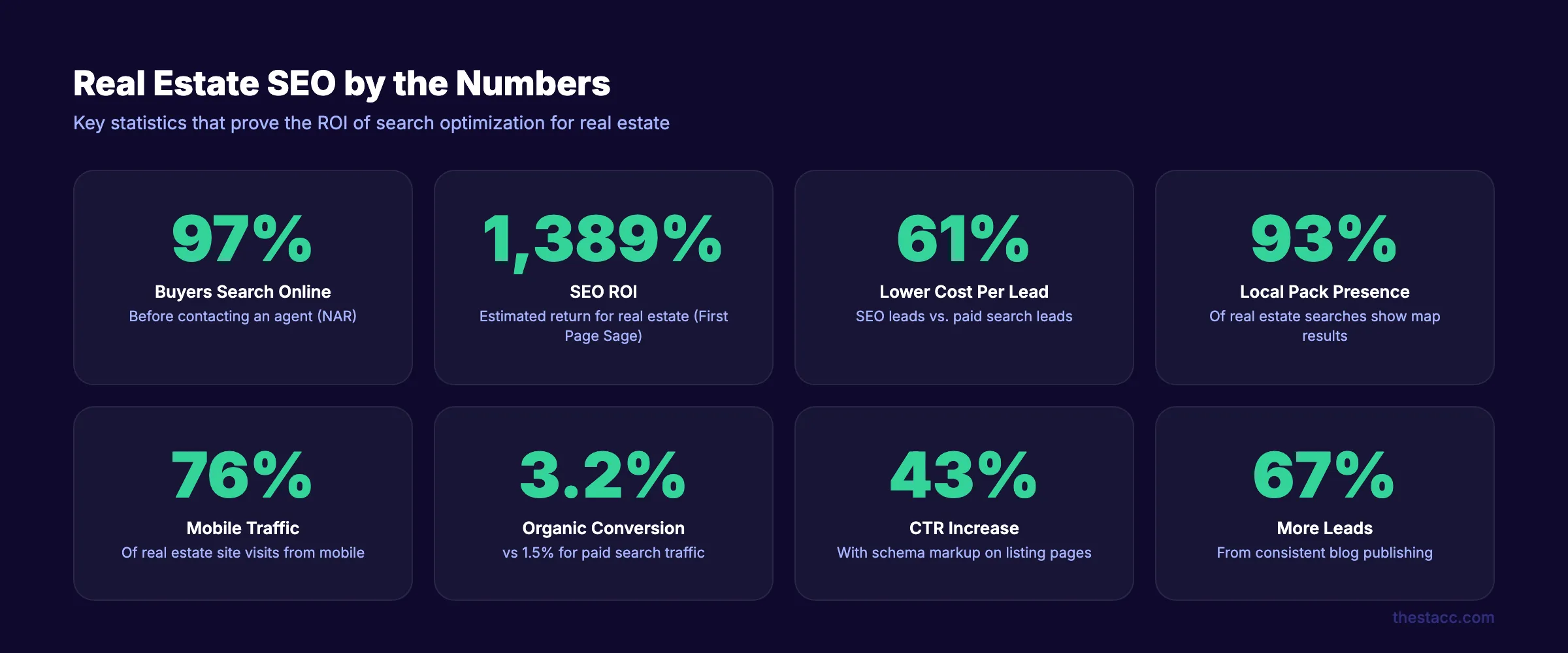
97% of homebuyers search online before contacting an agent. That stat comes from the National Association of Realtors. If your real estate website does not show up when those buyers search, you lose the lead before you even know it exists.
The problem is clear. Zillow, Redfin, and Realtor.com dominate 77% of page-one rankings for real estate terms. Independent agents cannot outspend them. But they can outrank them on local, hyperlocal, and long-tail searches where intent is highest and competition is lowest.
Real estate SEO is how agents and brokers win organic traffic without paying $25+ per click on Google Ads. And the ROI is hard to ignore. According to First Page Sage, real estate SEO delivered an estimated 1,389% ROI in 2025, with agents breaking even after 10 months.
We have published 3,500+ blogs across 70+ industries. Real estate is one of the most competitive. This guide covers everything we have learned about ranking real estate websites.
Here is what you will learn:
- How to find and target keywords that real estate portals ignore
- How to optimize your Google Business Profile for the local map pack
- How to build neighborhood content that outranks generic listing pages
- The exact schema markup types that increase real estate CTR by 43%
- How to earn backlinks with local market reports
- How to measure SEO ROI and track cost per lead from organic search
Chapter 1: What Real Estate SEO Is and Why It Matters
Real estate SEO is the process of optimizing a real estate website, Google Business Profile, and online presence to rank higher in organic search results. It combines on-page SEO, local SEO, content marketing, and technical optimization specifically for the real estate industry.
Why Real Estate Agents Need SEO
The numbers make the case. 44% of buyers start their home search online before ever contacting an agent. Organic search drives 53% of traffic to real estate websites. And 64% of buyers choose their agent based on Google visibility.
Paid ads work, but they stop working the moment you stop paying. SEO compounds. Every blog post, every optimized page, every review you collect builds long-term authority that continues generating leads for months and years.
SEO vs. Paid Ads for Real Estate
| Factor | SEO | Google Ads |
|---|---|---|
| Cost per lead | 61% lower | $25+ per click |
| Conversion rate | 3.2% | 1.5% |
| Timeline to results | 3 to 6 months | Immediate |
| Long-term value | Compounds over time | Stops when budget stops |
| Trust factor | Organic results trusted more | ”Sponsored” label reduces trust |
| ROI (annual) | 1,389% | Varies by market |
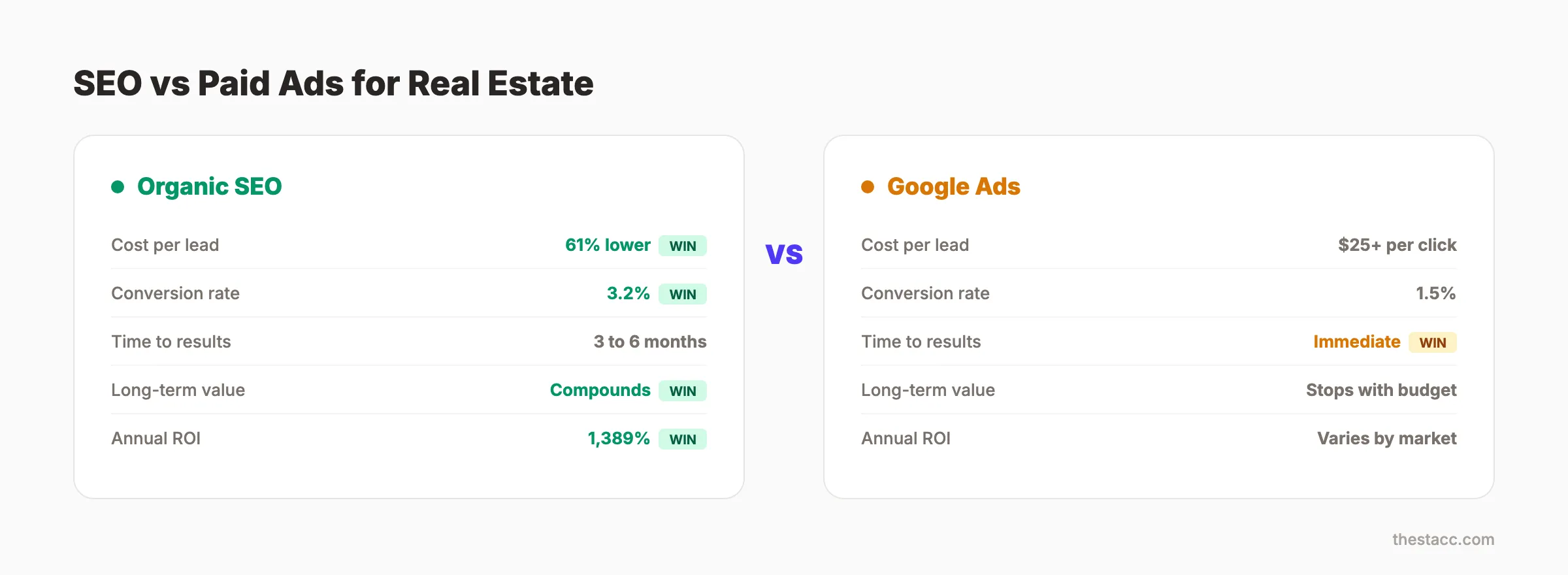
SEO takes longer to produce results. That is the tradeoff. But the cost per lead is 61% lower, the conversion rate is double, and the traffic does not disappear when you pause your budget.
The Zillow Problem
Independent agents cannot beat Zillow for “homes for sale in [city].” Zillow has a domain authority above 90 and millions of indexed pages. Trying to rank for broad, national terms is a losing strategy.
The winning strategy targets keywords Zillow ignores. Hyperlocal neighborhood guides. Specific buyer questions. Long-tail searches with high purchase intent. These are the terms where an independent agent with local expertise can outrank a national portal.
Chapter 2: Keyword Research for Real Estate
Most real estate agents target the wrong keywords. They chase “homes for sale” or “real estate agent” and wonder why they never rank. Those terms have astronomical competition and low conversion rates for individual agents.
The right approach targets long-tail keywords with local modifiers. These have less competition, higher intent, and better conversion rates.
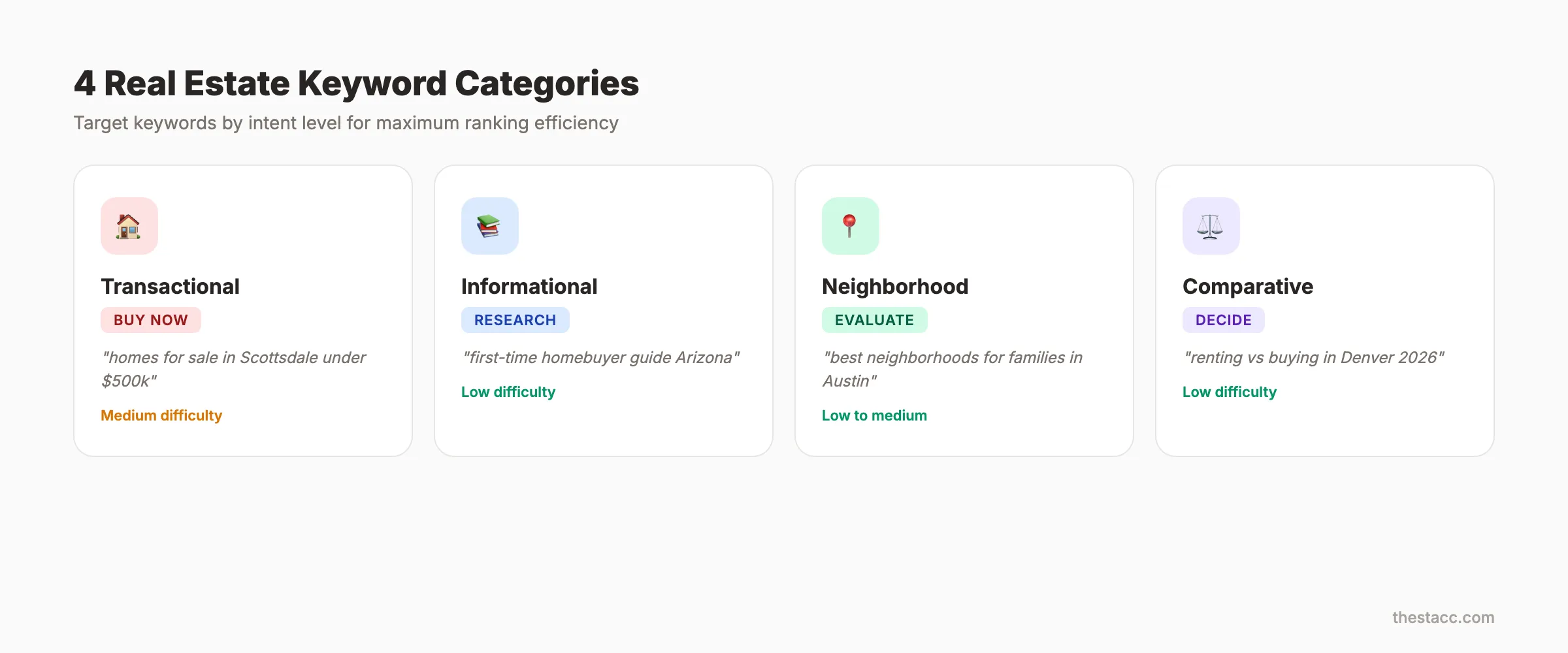
Four Keyword Categories for Real Estate
| Category | Example | Intent | Difficulty |
|---|---|---|---|
| Transactional | ”homes for sale in Scottsdale under $500k” | Buy now | Medium |
| Informational | ”first-time homebuyer guide Arizona” | Research | Low |
| Neighborhood | ”best neighborhoods for families in Austin” | Evaluate | Low to medium |
| Comparative | ”renting vs buying in Denver 2026” | Decide | Low |
Transactional keywords target buyers ready to act. Add price ranges, property types, and neighborhoods to narrow competition.
Informational keywords attract top-of-funnel traffic. These visitors are not ready to buy today, but they will remember the agent who answered their questions.
Neighborhood keywords are your biggest advantage over portals. Zillow cannot write a genuine neighborhood guide with personal opinions about school districts, restaurant recommendations, and commute insights. You can.
Comparative keywords capture buyers in the decision phase. “Renting vs buying” and “suburb vs downtown” content converts well when paired with local data.
How to Find Real Estate Keywords
Start with keyword research fundamentals, then apply a real estate filter:
- Search your city name + “homes for sale” on Google. Note the People Also Ask questions. Those are keyword opportunities
- Check Google Autocomplete for “[your city] + real estate” and note every suggestion
- Look at competitor agent websites that rank well. What topics do they cover?
- Use free tools like Google Keyword Planner or Ubersuggest to check volume and difficulty
- Browse local Reddit and Facebook groups. The questions buyers ask are keywords you should target
Pro tip: 76% of real estate searches include location-specific terms. Always add your city, neighborhood, or county to every keyword target. “How to buy a house” is unwinnable. “How to buy a house in Raleigh NC” is wide open.
Stop writing. Start ranking. Stacc publishes 30 SEO-optimized articles per month for real estate businesses. No writers. No briefs. No revisions. Start for $1 →
Chapter 3: Google Business Profile for Real Estate Agents
The Google Business Profile is the single most important local SEO asset for real estate agents. Google’s local map pack appears in 93% of real estate searches with location intent. If your GBP is not optimized, you are invisible in the results that matter most.
Set Up and Verify Your Profile
If you do not have a GBP yet, claim one at business.google.com. Select “Real estate agent” as your primary category. Complete verification through mail, phone, or video.
Essential profile elements:
- Business name matches your legal/brand name exactly
- Primary category set to “Real estate agent” or “Real estate agency”
- Secondary categories added (Real estate consultant, Property management company, etc.)
- Service area defined with your target cities and neighborhoods
- Business hours set and kept current
- Phone number matches your website and directory listings
- Website URL links to your homepage or a dedicated landing page
Optimize Your Profile for Rankings
Our guide to optimizing your Google Business Profile covers the full process. For real estate specifically:
Photos: Upload 20+ photos. Include headshots, team photos, office exterior and interior, and photos from closings and community events. Profiles with 100+ photos get 520% more calls than those with fewer than 5.
Services: Add every service you offer. “Buyer representation,” “Seller representation,” “Market analysis,” “Home staging consultation,” “First-time buyer guidance.”
Posts: Publish 2 to 3 GBP posts per week. Share new listings, market updates, client testimonials, and community event announcements. Agents posting consistently for 6+ months see a 25 to 40% increase in profile views.
Collect and Respond to Reviews
Reviews are ranking signals. They are also trust signals. 88% of consumers trust online reviews as much as personal recommendations.
Read our guide on how to get more Google reviews for the full strategy. The basics for real estate:
- Ask every client for a review at closing
- Send a direct link to your review page via text or email
- Respond to every review within 24 hours. Positive or negative
- Use a review QR code at open houses and client meetings
- Never buy fake reviews. Google detects and removes them, and the penalty damages your profile
NAP Consistency
NAP stands for Name, Address, Phone number. Every directory listing, social media profile, and website reference must use the exact same NAP data. Mismatches confuse Google and split your authority across multiple listings.
Check your NAP on: Google Business Profile, Zillow agent profile, Realtor.com, Yelp, Facebook, LinkedIn, your brokerage website, and local chamber of commerce directories. Fix any inconsistencies.
Chapter 4: On-Page SEO for Real Estate Websites
On-page SEO determines whether Google understands what your pages are about. Most real estate websites fail at the basics. 40% lack image alt text. 38% fail Core Web Vitals. These are fixable problems that directly affect rankings.
Title Tags and Meta Descriptions
Every page needs a unique title tag under 60 characters and a meta description between 145 and 155 characters. Both should include the target keyword and location.
| Page Type | Title Tag Formula | Example |
|---|---|---|
| Homepage | [Brand] - [Service] in [City] | “Smith Realty - Real Estate Agent in Austin TX” |
| Neighborhood page | [Neighborhood] Homes for Sale - [City] | “Mueller Homes for Sale - Austin TX Real Estate” |
| Blog post | [Topic] - [City] Real Estate | ”First-Time Buyer Guide - Austin TX Real Estate” |
| Listing page | [Address] - [Bedrooms] Bed [City] | “1234 Oak St - 3 Bed Home in Austin TX” |
Read our guide on writing meta descriptions for formatting rules that increase click-through rates.
Header Structure
Use one H1 per page with the primary keyword. Break content into H2 and H3 sections. Every heading should be descriptive. “Our Services” tells Google nothing. “Real Estate Services in North Austin” tells Google exactly what the page covers.
Image Optimization
Real estate sites are image-heavy. Every listing has 20 to 40 photos. Without optimization, those images destroy page speed and provide zero SEO value.
For every image:
- Compress to under 200KB (use WebP format when possible)
- Add descriptive alt text: “3-bedroom ranch home with backyard pool in Mueller Austin TX”
- Use descriptive file names:
mueller-austin-3bed-ranch-pool.webpnotIMG_4582.jpg - Lazy load images below the fold
Our blog image optimization guide covers the technical details.
Core Web Vitals
Only 23% of real estate websites pass Google’s Core Web Vitals test. 51% of mobile users abandon sites that load in more than 3 seconds. Speed matters.
The three metrics that matter:
- LCP (Largest Contentful Paint): Under 2.5 seconds. For real estate, this is usually the hero image
- INP (Interaction to Next Paint): Under 200 milliseconds. Affects search filters and map interactions
- CLS (Cumulative Layout Shift): Under 0.1. Prevent images and ads from shifting page content
Read our guide on improving Core Web Vitals for step-by-step fixes.
Your SEO team. $99 per month. 30 optimized articles for your real estate business, published automatically. Start for $1 →
Chapter 5: Content Strategy for Real Estate SEO
72% of top-ranking real estate pages contain blog content. Real estate blogs with consistent posting generate 67% more leads than those without. Content is how independent agents build authority that portals cannot replicate.
Neighborhood Guides (Your Highest-Value Content)
Neighborhood guides outperform standard listing pages by 47% in rankings. A local agent can write about school quality, restaurant options, commute times, park access, and community feel. Zillow cannot.
Structure each neighborhood guide with:
- Overview and location context
- Housing market snapshot (median price, price trends, inventory)
- Schools and school district ratings
- Dining, shopping, and entertainment
- Commute times to major employment centers
- Parks, recreation, and outdoor activities
- Pros and cons (honest assessment builds trust)
- Current listings in the area (link to your IDX or listing page)
Target the keyword “[Neighborhood] [City] homes for sale” or “living in [Neighborhood] [City].”
Market Report Content
Monthly or quarterly market reports are link magnets. According to industry data, market reports generate 2.3 times more backlinks than standard blog posts. Local media, other agents, and community organizations link to data-driven market analysis.
Include: median sale price, price change vs. last month/year, days on market, inventory levels, and your analysis of what the numbers mean for buyers and sellers.
Blog Topics That Drive Real Estate Traffic
| Topic Type | Example | Keyword Target |
|---|---|---|
| Buyer guide | ”First-Time Homebuyer Guide [City] 2026” | first time homebuyer [city] |
| Seller guide | ”How to Sell Your Home Fast in [City]“ | sell home fast [city] |
| Market update | ”[City] Housing Market Report Q1 2026” | [city] housing market |
| Neighborhood | ”Living in [Neighborhood]: Insider Guide” | [neighborhood] [city] homes |
| Seasonal | ”Best Time to Buy a Home in [City]“ | best time to buy home [city] |
| Comparison | ”[Neighborhood A] vs [Neighborhood B]“ | [neighborhood] vs [neighborhood] |
| Investment | ”Best Areas to Invest in [City] Real Estate” | real estate investment [city] |
Publish at least 2 to 4 blog posts per month. Consistency matters more than volume. Each post should target one primary keyword and include 3 to 5 internal links to related content on your site.
The IDX Duplicate Content Problem
IDX (Internet Data Exchange) pages display MLS listings on your website. The problem: hundreds of other agents display the exact same listings with the exact same descriptions. This creates massive duplicate content issues.
Fixes:
- Add unique descriptions to featured listings (your personal commentary, not the MLS copy)
- Use
noindextags on bulk IDX search result pages - Keep individual listing pages indexed only if you add unique content
- Create unique neighborhood landing pages that link to IDX-filtered results
- Use canonical tags to consolidate duplicate listing URLs
Chapter 6: Link Building for Real Estate
Backlinks remain one of Google’s top ranking factors. Real estate agents have natural link-building opportunities that most industries do not.
Local Link Opportunities
| Source | How to Get the Link | Difficulty |
|---|---|---|
| Local chamber of commerce | Join as a member | Easy |
| Local business directories | Submit your profile | Easy |
| Community event sponsorships | Sponsor a local 5K, festival, or school event | Medium |
| Local news and media | Pitch market data or housing trends | Medium |
| Partner businesses | Cross-promote with mortgage brokers, home inspectors, contractors | Medium |
| Real estate associations | Join and get listed in member directories | Easy |
| University housing resources | Offer student housing guides | Medium |
Build Links with Market Reports
Your monthly market report is your best link-building asset. Send it to local journalists, chamber of commerce newsletters, and community Facebook groups. When local media needs housing data, they link to the agent who publishes it.
Guest Posting on Local Blogs
Write for local lifestyle blogs, business publications, and community websites. Topics like “5 Things to Know Before Moving to [City]” fit naturally on local publications and include a link back to your site.
Avoid paid link schemes, link farms, and private blog networks. Google penalizes manipulative link building. Focus on earning links through genuine local involvement and useful content. For the full strategy, check our guide on building backlinks for your blog.
Chapter 7: Schema Markup for Real Estate
Schema markup helps Google understand your content and display rich results. Structured data increases click-through rates by 43% on listing pages. Most real estate websites do not use schema at all. This is a competitive advantage.
Essential Schema Types for Real Estate
LocalBusiness / RealEstateAgent:
Add this to your homepage and about page. It tells Google your business name, address, phone number, service area, and operating hours.
{
  "@context": "https://schema.org",
  "@type": "RealEstateAgent",
  "name": "Smith Realty Group",
  "address": {
    "@type": "PostalAddress",
    "streetAddress": "123 Main Street",
    "addressLocality": "Austin",
    "addressRegion": "TX",
    "postalCode": "78701"
  },
  "telephone": "+1-512-555-0123",
  "url": "https://smithrealtyaustin.com",
  "areaServed": ["Austin", "Round Rock", "Cedar Park"]
}
FAQPage:
Add to any page with a FAQ section. This generates expandable FAQ results directly in search.
BreadcrumbList:
Add to every page. Breadcrumbs help Google understand your site structure and display breadcrumb trails in search results.
Article:
Add to every blog post. Include the headline, author, date published, and date modified.
Use our schema markup generator to create the JSON-LD code for your site. Read the full schema markup guide for implementation details.
3,500+ blogs published. 92% average SEO score. Stacc handles content, optimization, and publishing for real estate businesses. Start for $1 →
Chapter 8: Measuring Real Estate SEO Results
SEO without measurement is guessing. Track these metrics to know whether your investment is working.
Key Metrics to Track
| Metric | Tool | What It Tells You |
|---|---|---|
| Organic traffic | Google Analytics 4 | Total visitors from search |
| Keyword rankings | Google Search Console | Position for target keywords |
| Local pack visibility | Google Business Profile Insights | Map pack impressions and actions |
| Leads from organic | GA4 key events | Form submissions, calls from organic |
| Cost per lead (organic) | Manual calculation | SEO spend / organic leads |
| Domain authority | Ahrefs or Moz | Overall site authority score |
| Core Web Vitals | PageSpeed Insights | Technical performance |
Set Up Tracking
Install Google Analytics 4 on your website. Set up key events for contact form submissions, phone clicks, and email link clicks. These are your conversion points.
Connect Google Search Console to monitor keyword positions, click-through rates, and indexing issues. Link GSC to GA4 for a unified view of search performance.
Realistic Timeline
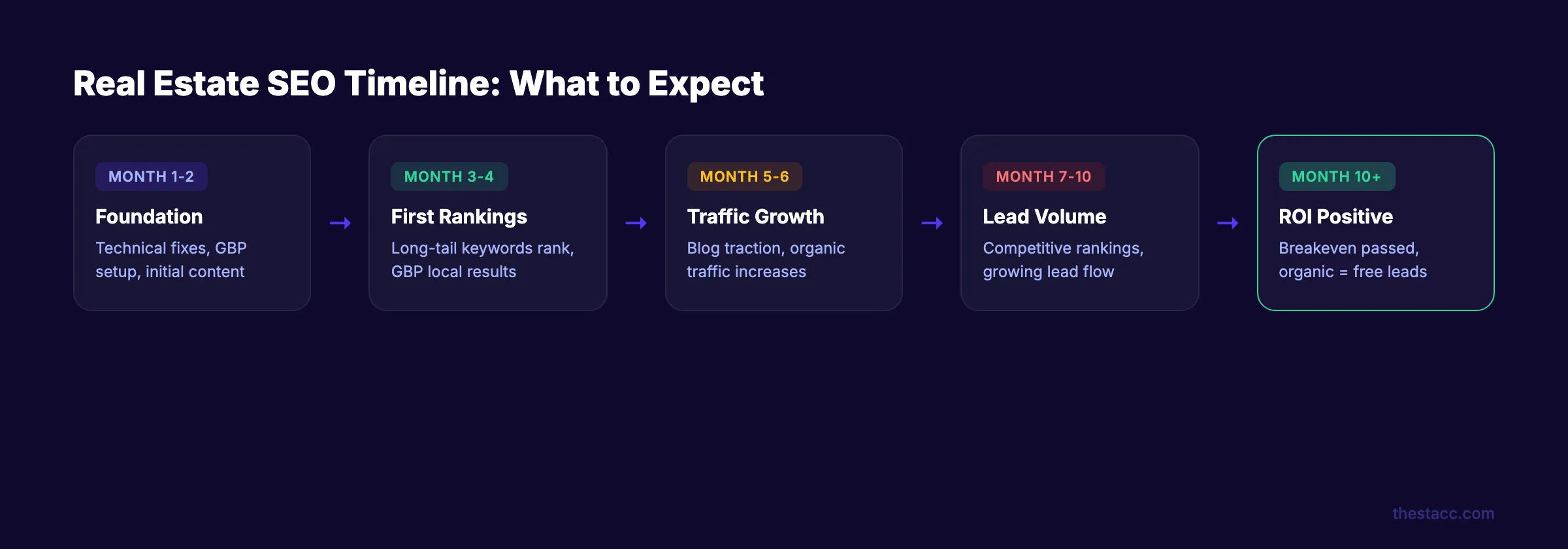
Do not expect page-one rankings in 30 days. Real estate SEO follows a predictable timeline:
- Month 1 to 2: Technical fixes, GBP optimization, initial content publishing
- Month 3 to 4: First ranking improvements for long-tail keywords. GBP starts appearing in local results
- Month 5 to 6: Blog content gains traction. Organic traffic increases measurably
- Month 7 to 10: Competitive keywords start ranking. Lead volume from organic grows
- Month 10+: Breakeven point for most agents. SEO ROI turns positive
The breakeven timeline of 10 months comes from First Page Sage’s ROI analysis. After that point, every month of organic traffic is effectively free lead generation.
Calculate Your SEO ROI
Use this formula:
SEO ROI = (Revenue from organic leads - SEO costs) / SEO costs x 100
Example: You spend $500 per month on SEO (content + tools). After 12 months, organic search generates 24 leads. You close 3 deals at $8,000 average commission. Total revenue: $24,000. Total cost: $6,000. ROI: 300%.
For agents using the best SEO tools for real estate, the cost baseline is even lower. Stacc starts at $99 per month for 30 optimized articles, which makes the breakeven math straightforward.
Chapter 9: Advanced Real Estate SEO Tactics
Once the fundamentals are in place, these advanced strategies create separation from competitors.
AI Search Optimization (AEO)
AI search is changing how buyers find information. ChatGPT, Perplexity, and Google AI Overviews now answer real estate questions directly. Getting cited by these tools requires a different approach than traditional SEO.
Our guide on optimizing for Google AI Overviews covers the full strategy. For real estate:
- Structure content with clear question-and-answer patterns
- Include specific data points and statistics that AI models can cite
- Write in a direct, factual tone (AI prefers concise, authoritative statements)
- Add FAQ sections to every guide and neighborhood page
Video SEO for Property Listings
Listings with video receive 403% more inquiries. Yet most agents upload videos with no SEO optimization.
For every property video:
- Upload to YouTube with keyword-rich titles (“[Address] - [Bedrooms] Bed Home Tour [City]”)
- Write a 200+ word description with the full property details and your contact information
- Add VideoObject schema markup to the page where the video is embedded
- Create a custom thumbnail that shows the property exterior
Seasonal Content Calendar
Real estate searches follow seasonal patterns. “Buy home in spring” spikes 4 times higher in Q2 than Q4. Plan your content around these patterns:
| Quarter | Content Focus | Example Posts |
|---|---|---|
| Q1 (Jan to Mar) | Spring market preparation | ”Spring 2026 [City] Market Preview,” “Home Prep Checklist for Spring Listing” |
| Q2 (Apr to Jun) | Peak buying season | ”[City] Neighborhood Guides,” “Best Time to Buy in [City]“ |
| Q3 (Jul to Sep) | Back-to-school, summer market | ”Best School Districts in [City],” “[City] Market Update Q3” |
| Q4 (Oct to Dec) | Year-end planning | ”[City] Housing Forecast 2027,” “Tax Benefits of Buying Before Year-End” |
Publishing seasonal content 4 to 6 weeks before the search spike gives Google time to index and rank the page.
Reddit and Community Engagement
Reddit’s organic search visibility has surged 1,300%. Real estate subreddits like r/realestate, r/firsttimehomebuyer, and local city subreddits have active communities asking questions every day.
The approach: answer questions genuinely. Do not promote your services. Share local market knowledge. Over time, your Reddit profile builds authority, drives referral traffic, and creates brand recognition. Some agents report that Reddit generates more qualified leads than their blog.
Chapter 10: Common Real Estate SEO Mistakes
Avoid these mistakes that cost agents rankings, traffic, and leads.
1. Targeting vanity keywords. “Real estate agent” and “homes for sale” are dominated by national portals. Target hyperlocal terms with purchase intent.
2. Ignoring Google Business Profile. The local map pack appears in 93% of location-intent searches. An unoptimized GBP means zero visibility in the results buyers click most.
3. Publishing generic content. “5 Tips for Buying a Home” without local data or personal expertise fails E-E-A-T standards. Google rewards content from authors with demonstrable experience.
4. Neglecting mobile optimization. 76% of real estate traffic comes from mobile devices. If your site is slow or hard to use on a phone, you lose most of your visitors. Run a Core Web Vitals audit quarterly.
5. NAP inconsistencies across directories. Mismatched business information across citations confuses Google and splits your local authority. Audit every listing and fix discrepancies.
6. Ignoring IDX duplicate content. Hundreds of agents display the same MLS listings. Without noindex tags or unique content, these pages dilute your site authority.
7. No schema markup. Structured data increases CTR by 43%. Most competitor agents do not use it. Adding schema markup is one of the fastest wins available.
8. Expecting instant results. Real estate SEO takes 6 to 12 months for competitive terms. The agents who succeed are the ones who commit to consistent effort past the initial months of low visibility.
Skip the agency. Keep the results. Stacc starts at $99 per month. Blog SEO, Local SEO, and Social on autopilot. Start for $1 →
FAQ
What is real estate SEO?
Real estate SEO is the process of optimizing a real estate website and Google Business Profile to rank higher in organic search results. It includes keyword research, on-page optimization, local SEO, content marketing, link building, and technical improvements specific to the real estate industry.
How much does real estate SEO cost?
Costs range from $99 per month for automated content publishing to $1,500 to $5,000 per month for a full-service SEO agency. Independent agents can start with GBP optimization (free) and a content tool like Stacc ($99 per month for 30 articles). The average breakeven point is 10 months.
How long does real estate SEO take to work?
Expect 3 to 6 months for initial ranking improvements on long-tail keywords. Competitive terms take 6 to 12 months. GBP optimization and local SEO tend to show results faster than organic blog content. Consistency is the deciding factor.
Is SEO better than paid ads for real estate?
SEO delivers 61% lower cost per lead and a 3.2% conversion rate compared to 1.5% for paid search. Paid ads produce immediate results but stop generating leads when the budget stops. SEO compounds over time. Most successful agents use both, with SEO for long-term lead generation and ads for short-term campaigns.
What are the best keywords for real estate agents?
Target hyperlocal, long-tail keywords with location modifiers. “[Neighborhood] homes for sale,” “first-time homebuyer guide [city],” “best neighborhoods in [city] for families,” and “cost of living in [city] 2026” are examples. Avoid broad national terms that portals dominate.
Do real estate agents need a blog?
Yes. 72% of top-ranking real estate pages contain blog content. Real estate blogs with consistent publishing generate 67% more leads. Blog content builds topical authority, targets long-tail keywords, and creates pages that rank for years.
Real estate SEO is a long-term investment. The agents who rank on page one today started building content, collecting reviews, and optimizing their GBP 6 to 12 months ago. Start now. The compounding effect rewards early action over delayed perfection.
Related Tools & Resources
Free SEO Tools:
Best Lists:

Written by
Siddharth GangalSiddharth is the founder of theStacc and Arka360, and a graduate of IIT Mandi. He spent years watching great businesses lose organic traffic to competitors who simply published more. So he built a system to fix that. He writes about SEO, content at scale, and the tactics that actually move rankings.
30 SEO blog articles published every month
Keyword-optimized, scheduled, and live on your site. Automatically.
30-day trial · Cancel anytime
theStacc
Stop writing SEO content manually
30 blog articles, 30 GBP posts, and social media content. Published every month. Automatically.
Start Your $1 Trial$1 for 3 days · Cancel anytime