Learn how to grow your marketing agency with 9 proven steps. From niche selection to client retention, this guide covers what actually works in 2026.
Most marketing agencies stall between $20,000 and $30,000 in monthly revenue. The founder is overwhelmed. The team is stretched thin. New clients come in through referrals, but they leave just as quickly through the back door. Growth feels like a treadmill that speeds up every month.
This plateau is not a talent problem. It is a systems problem.
Agencies that break past this ceiling do not work harder. They build repeatable systems for lead generation, service delivery, client retention, and team scaling. The global marketing agency market is projected to reach $473 billion in 2026, according to industry analysis from RevenueMemo. The agencies capturing that growth are the ones that stopped being freelancers with employees and started operating like real businesses.
This article gives you a 9-step playbook for how to grow your marketing agency. Each step includes specific actions you can implement this quarter. We publish 3,500+ blogs across 70+ industries. We have seen what separates agencies that scale from agencies that spin their wheels.
Here is what you will learn:
- Why niching down increases revenue per client by 25-40%
- How to build a lead generation system that does not depend on your personal network
- The exact pricing models that protect margins as you scale
- Why client retention, not new sales, is the real growth engine
- Which metrics to track weekly to spot problems before they kill momentum
Pick a Niche and Own It
Generalist agencies compete on price. Specialist agencies compete on results. That difference determines whether you grow or stall.
The data is clear. Agencies with deep specialization report net profit margins of 25-40%. Generalist agencies average 15-20%, according to 2026 agency benchmark data. Clients pay more for expertise they cannot get elsewhere. They also stay longer. The specialist understands their industry, their customers, and their competitive pressures at a level no generalist can match.
How to Choose Your Niche
Start with your existing client base. Look at the last 20 clients you served. Which 3-5 produced the best results, the highest margins, and the shortest sales cycles? Those are your signals.
Next, evaluate market demand. A niche with no budget is a hobby, not a business. Look for industries where:
- Customer lifetime value is high enough to justify marketing spend
- The buyer understands that marketing is an investment, not a cost
- Competition among agencies is moderate, not saturated
- You have some existing case studies or domain knowledge
Common high-growth niches in 2026 include SaaS, healthcare, financial services, home services, and e-commerce. Each has distinct buyer behavior, compliance requirements, and seasonality. The agency that masters one of these verticals becomes the default choice for companies in that space.
Positioning Statement Formula
Your positioning should fit this sentence: "We help [specific audience] achieve [specific outcome] through [your method]."
Bad: "We are a full-service digital marketing agency." Good: "We help HVAC companies generate 15-20 qualified leads per month through local SEO and paid search."
The second version tells prospects exactly who you serve, what they get, and how you deliver it. It also makes content marketing, outreach, and referrals easier because everyone knows who to send your way.
Specialization is the fastest path to premium pricing. Agencies that niche down can charge 30-50% more. The perceived risk of hiring a generalist is higher than the premium. Start publishing niche content for $99/month →
Build a Predictable Lead Generation System
Referrals are wonderful until they stop coming. The agencies that scale build lead generation systems that produce meetings whether the founder is networking or not.
Your lead generation system needs three channels: inbound, outbound, and partnership. Relying on one is fragile. Combining all three creates stability.
Inbound: Become Your Own Best Case Study
Inbound marketing works when you demonstrate expertise before asking for a meeting. The most effective inbound channels for agencies are:
SEO-optimized content. Write about the exact problems your niche faces. If you serve dentists, publish articles about dental patient acquisition costs, Google Business Profile optimization for practices, and case studies showing ranking improvements. This content ranks over time and attracts prospects who are actively searching for answers.
Case studies with specific metrics. Generic testimonials do not convert. Case studies that show "before" and "after" numbers do. Structure each case study around: the client's starting point, the strategy you implemented, the exact results achieved, and a quote from the client.
Lead magnets. Offer a free audit, template, or guide in exchange for an email address. A "Local SEO Checklist for HVAC Companies" will convert better than a generic "Digital Marketing Guide" because it speaks to a specific pain point.
Outbound: Systematic Outreach That Converts
Outbound works when it is targeted, personalized, and consistent. The spray-and-pray approach is dead.
Build a list of 100 ideal prospects. Research each one. Find a specific trigger. A recent funding round, a new product launch, a website redesign, or a gap in their current marketing all work. Then send a short, personalized email that references that trigger and offers a specific insight.
Follow up 3-4 times over two weeks. Most responses come on the third or fourth touch. Track your numbers: open rates, reply rates, and meeting booking rates. A 20% open rate and 5% reply rate are solid benchmarks for cold outreach.
Partnerships: The Hidden Growth Channel
Partner with non-competing service providers who serve your niche. Web designers, business consultants, and software vendors all have clients who need marketing help. Offer them a referral fee or reciprocal referrals. One strong partnership can produce 5-10 qualified leads per month with zero ad spend.

Productize Your Services for Scalable Delivery
Custom proposals kill scalability. Every custom scope requires new thinking, new pricing, and new project management. Productized services eliminate that friction.
A productized service has three characteristics:
- Fixed scope. The deliverables are the same for every client.
- Fixed price. Clients know the cost before the sales call ends.
- Fixed timeline. Delivery happens on a predictable schedule.
Example Productized Service Tiers
| Tier | Price | Deliverables | Best For |
|---|---|---|---|
| Starter | $1,500/mo | 4 blog posts, basic on-page SEO, monthly report | New businesses building foundation |
| Growth | $3,500/mo | 8 blog posts, advanced SEO, 2 social platforms, GBP management | Established businesses ready to scale |
| Premium | $7,500/mo | 15 blog posts, full SEO, social, paid ads management, weekly calls | Companies with aggressive growth targets |
Productized services make sales faster because prospects do not need a custom proposal. They make delivery faster because your team follows a repeatable process. They make hiring easier because you can train new team members on a standard workflow.
The exception is enterprise clients with unique needs. For those, custom scopes still make sense. But 80% of your revenue should come from productized packages that your team can deliver in their sleep.
Productized services turn your agency into a machine. Standardized delivery means you can hire and train. The founder no longer checks every output. See how we productize content at scale →
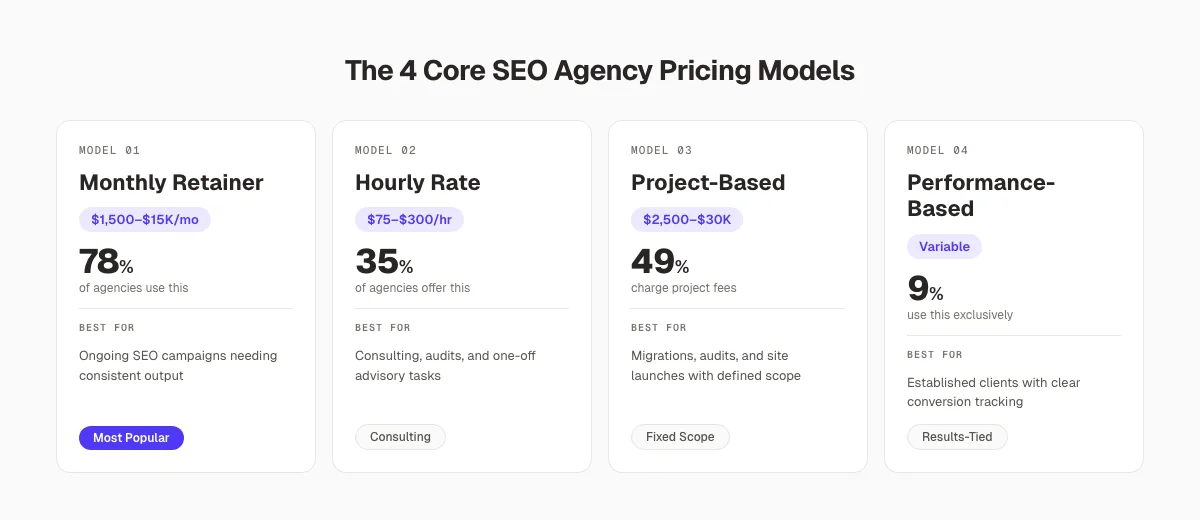
Fix Your Pricing to Protect Margins
Most agencies undercharge. They set prices based on what competitors charge or what they think clients will pay. Then they wonder why they cannot afford to hire good people or invest in growth.
Your pricing should be based on value delivered, not hours worked. A client who pays $5,000 per month and generates $50,000 in new revenue is getting a 10x return. That is a bargain. A client who pays $2,000 per month and generates $3,000 in revenue is getting a worse deal. The price is lower, but the return is worse.
Three Pricing Models Compared
| Model | How It Works | Pros | Cons |
|---|---|---|---|
| Hourly | Bill by the hour | Simple to calculate | Punishes efficiency, caps revenue |
| Retainer | Fixed monthly fee | Predictable revenue, easier to scale | Scope creep risk if not defined |
| Value-based | Price tied to client outcomes | Highest margins, aligns incentives | Harder to sell, requires trust |
Retainers are the standard for agencies that want predictable revenue. The average retainer-based agency retains 82% of clients annually. Project-based agencies retain only 58%, per 2026 agency churn research from Focus Digital. Retainer clients also stay 56 months on average versus 24 months for project clients.
Raising Prices Without Losing Clients
If you have not raised prices in 12 months, you are undercharging. Here is how to do it without a mass exodus:
- Give existing clients 60-90 days notice
- Frame the increase around new value: additional services, better reporting, or dedicated account management
- Offer a loyalty discount for clients who commit to a longer contract
- Grandfather your longest-tenured clients at their current rate for one more cycle
Agencies that adopt value-based or performance-linked pricing report 22% higher retention rates than those stuck on hourly billing. The reason is simple. When your fee is tied to results, the client sees you as a partner, not a vendor.
Retain Clients Through Results, Not Reports
Client retention is the single most important growth metric for agencies. A 5% increase in retention can increase profits by 25-95%. Yet most agencies obsess over new client acquisition while neglecting the clients they already have.
The agencies with the highest retention rates share one trait: they focus on business outcomes, not marketing activities.
The Retention Checklist
- ✓ Set clear success metrics in the first 30 days
- ✓ Report on business outcomes, not vanity metrics
- ✓ Schedule monthly strategy calls, not just status updates
- ✓ Proactively recommend improvements before clients ask
- ✓ Celebrate wins publicly and acknowledge challenges honestly
- ✓ Ask for feedback quarterly, not just at renewal
Why Clients Leave
The top reason agencies lose clients is not poor performance. It is poor communication. Clients who do not understand what you are doing will find a reason to leave. This happens even when the results are good. Communication matters more than output.
Fix this by structuring every report around three questions:
- What did we do this month?
- What results did it produce?
- What are we doing next month and why?
Agencies with frequent client touchpoints see 30% higher retention than those that only communicate at renewal time. Monthly strategy sessions, even brief ones, build the relationship that keeps clients from shopping around.
The second most common reason for churn is clients moving work in-house. This happens when the client feels they have learned enough from you to handle it themselves. Prevent it by continuously adding value that requires your expertise. Offer new channel expansion, advanced analytics, competitive intelligence, and strategic consulting that goes beyond execution.
Retention is cheaper than acquisition. It costs 5-7x more to acquire a new client than to retain an existing one. Agencies that master retention grow faster with less stress. See our client retention tools →
Hire for Delivery, Not Just Credentials
The founder trap hits every growing agency. You built the business by doing great work yourself. Now you are managing people, selling to prospects, and still reviewing every deliverable. You are the bottleneck.
Breaking out requires hiring people who can deliver results without your daily involvement. This means hiring for judgment and systems thinking, not just technical skills.
The First Five Hires
| Role | When to Hire | Why They Matter |
|---|---|---|
| Account Manager | $15K-20K MRR | Frees founder from client communication |
| SEO/Ads Specialist | $25K-30K MRR | Handles core delivery work |
| Content Writer | $30K-40K MRR | Scales content production |
| Project Manager | $50K+ MRR | Keeps deliverables on track |
| Sales Rep | $75K+ MRR | Builds predictable pipeline |
Hire generalists early. Specialists later. Your first few team members need to wear multiple hats. A content writer who can also manage social media is more valuable at $30,000 MRR. A specialist who refuses to work outside their lane is a luxury you cannot afford yet.
Building a Culture of Accountability
Document every process. Create standard operating procedures for onboarding, content production, reporting, and client communication. When a process lives in the founder's head, the agency cannot scale beyond the founder's capacity.
Set clear KPIs for every role. An SEO specialist should know their targets for organic traffic growth, keyword rankings, and client retention. An account manager should know their targets for client satisfaction scores and upsell revenue. What gets measured gets managed.

Automate the Repetitive Work
Agencies waste 30-40% of their time on repetitive tasks: reporting, scheduling, data entry, and status updates. Automation reclaims that time for strategy and client relationships.
The agencies scaling fastest in 2026 are not the ones with the biggest teams. They are the ones using AI and automation to multiply the output of every team member.
What to Automate First
Reporting. Manual report creation takes 2-4 hours per client per month. Automated dashboards connected to Google Analytics, Google Search Console, and ad platforms update in real time. Tools like Google Looker Studio, AgencyAnalytics, or custom dashboards save hundreds of hours monthly.
Content production. AI writing tools can produce first drafts, outlines, and briefs at scale. The best agencies use AI for speed and humans for quality control. A writer who edits and refines AI-generated drafts can produce 3-4x more content than one who writes from scratch.
Social media scheduling. Batch-create content once per week and schedule it across platforms. Tools like Buffer, Hootsuite, or native schedulers handle distribution while your team focuses on strategy and engagement.
Client onboarding. Automated welcome sequences, contract signing, and intake forms reduce friction for new clients and ensure nothing falls through the cracks.
The AI Advantage
75% of marketers report reduced manual task time with AI tools, according to HubSpot research. Agencies using AI for account intelligence, not just content production, are pulling away from competitors. The median payback period on AI investment is 4.2 months.
The key is using AI for the right tasks. AI excels at data analysis, pattern recognition, and first-draft creation. It does not excel at strategy, creative direction, or relationship building. Automate the former. Invest human time in the latter.
Start with the tasks that eat the most time but require the least judgment. Automate your SEO workflow first.

Track the Metrics That Actually Matter
You cannot grow what you do not measure. But most agencies track vanity metrics that feel good without driving decisions.
The Agency Growth Dashboard
| Metric | Target | Why It Matters |
|---|---|---|
| Monthly Recurring Revenue (MRR) | Growing 10-15% monthly | Predictable income stability |
| Client Retention Rate | 85%+ | Profitability indicator |
| Client Lifetime Value (CLV) | 3x CAC minimum | Long-term viability |
| Utilization Rate | 75-82% | Team productivity |
| Net Profit Margin | 20-30% | Financial health |
| Average Revenue Per Client | Growing quarterly | Pricing power and upsell success |
Track these metrics weekly, not monthly. By the time you see a problem in monthly numbers, it has already cost you money. Weekly tracking lets you course-correct before small issues become big problems.
Red Flags to Watch
- Churn rate above 15% annually. This means one in six clients leaves every year. Fix your retention before chasing new logos.
- Utilization rate below 60%. Your team has too much idle time. Either sell more work or reduce capacity.
- MRR flat for 3+ months. You are losing clients as fast as you are gaining them. This is the definition of running in place.
- Net profit margin below 15%. You are underpricing, overservicing, or both. Review your pricing and scope immediately.
Agencies that track these metrics and act on them grow 2-3x faster than agencies that fly blind.

Expand Through Partnerships and White-Label Deals
Organic growth is reliable but slow. Strategic partnerships and white-label arrangements can accelerate growth without the overhead of hiring.
Partnership Models That Work
Referral partnerships. Partner with web designers, business consultants, and software vendors who serve your niche. Offer a 10-20% referral fee for clients they send your way. Reciprocate by referring clients who need their services.
White-label services. If you are an SEO agency, partner with a PPC agency to offer paid search without hiring a PPC team. If you are a content agency, white-label SEO services from a specialist. The client gets a full-service experience. You get additional revenue without additional headcount.
Joint ventures. Co-host webinars, publish research, or create joint case studies with complementary businesses. This expands your reach to their audience while positioning both parties as industry leaders.
Choosing the Right Partners
Not every partnership is worth your time. Evaluate potential partners on:
- Audience overlap. Do they serve the same niche but with different services?
- Reputation. Will associating with them help or hurt your brand?
- Commitment. Are they willing to promote the partnership, or do they expect you to do all the work?
- Financial terms. Is the revenue share fair and clearly defined?
Agencies with active partnership programs report 15-25% of new revenue coming from partner referrals. That is growth you do not have to generate through cold outreach or paid ads.
Consider white-label SEO services to expand your offerings. Start with one service area. Test it with a few clients before building it into your core packages.

What practitioners are saying on X
Agency and white-label models evolve fast. Here is operator signal from X on tooling and service delivery.
- @syedbalkhi (Sep 2024): White-label pro services can add multi-six-figure revenue without building an in-house services org — partner delivery behind the brand. See the post on X.
- @ConnorGillivan (Jul 2026): 2026 SEO stack favorite list: Semrush/Ahrefs, GSC, Surfer, KeywordInsights, ChatGPT, SEOwind, Screaming Frog, ClearScope, GA4, Notion/Airtable — tools amplify systems, they don’t replace them. See the post on X.
- @jakezward (Feb 2026): 2026 SEO predictions emphasize AI Overview share-of-SERP, schema for LLM token efficiency, brand mentions in AI answers as a KPI, proprietary data as a moat, and content refresh beating net-new AI slop. See the post on X.
Grok, AI Overviews, and multi-engine visibility
For “grow marketing agency”, multi-engine visibility still starts with clear definitions, sourced numbers, and extractable section answers. Grok additionally factors live X discussion — keep public claims consistent with this page.
- Google AI Overviews: Use passage-ready answers, tables, and FAQ schema where relevant.
- ChatGPT / Perplexity: Cite named sources next to key claims.
- Grok: Maintain accurate entity facts on-site and in high-signal X posts.
Publish content built for Google and AI citations. theStacc’s Content SEO module ships SEO-scored articles structured for rankings and generative engines — including clearer entity pages models like Grok can quote.
How to Grow Your Marketing Agency: Frequently Asked Questions
Scale by productizing your services. Build repeatable lead generation systems. Hire for delivery so the founder is not the bottleneck. Focus on retainer-based revenue for predictability. Track MRR, retention rate, and utilization weekly. Automate reporting and routine tasks to free your team for strategy and client relationships.
The best strategies are niche specialization, productized service tiers, value-based pricing, systematic client retention, and strategic partnerships. Agencies that combine these elements grow 2-3x faster than those relying on referrals alone. Content marketing and SEO for your own agency also produce compounding returns over time.
Promote your agency through case studies with specific metrics. Publish SEO-optimized content for your niche. Run targeted outbound outreach. Build partnerships with complementary service providers. Host free workshops or webinars to demonstrate expertise. Use LinkedIn consistently to share insights and build authority in your vertical.
Agency owner income varies widely based on size, niche, and pricing model. Small agencies under 10 employees typically see net profit margins of 10-18%. Mid-sized agencies average 15-25%. Top-performing agencies with strong specialization and efficient operations achieve margins of 25-40%. Revenue per employee in digital marketing averages $155,000 annually.
The most common challenges are founder dependency, inconsistent lead generation, scope creep eroding margins, and difficulty hiring quality talent. Cash flow gaps between client payments and payroll also create stress. Most agencies hit a plateau around $20,000-30,000 MRR. The founder has not yet built systems that allow the team to operate independently.
Retention is critical because acquiring a new client costs 5-7x more than retaining an existing one. Retainer-based agencies retain 82% of clients annually versus 58% for project-based agencies. A 5% improvement in retention can increase profits by 25-95%. Existing clients also provide upsell opportunities and referrals that fuel organic growth.
Growing a marketing agency is not about working more hours. It is about building systems that produce consistent results without your constant involvement. Pick a niche. Productize your services. Price for value. Retain clients through outcomes. Hire people who can execute without you. Automate the repetitive work. Track the metrics that matter. Build partnerships that multiply your reach.
The agencies that win in 2026 are not the ones with the flashiest websites or the biggest teams. They are the ones with the most disciplined operations. Start with one step from this playbook. Implement it this month. Then add the next.
Your SEO team. $99/month. We publish 3,500+ blogs across 70+ industries. Stop writing. Start ranking.
Sources & references
- [1] Princeton / Georgia Tech et al. — GEO research (arXiv:2311.09735)
- [2] @hridoyreh on X — Widely shared SEO skill tree: foundations, research, technical, on-page, content, links, AI SEO/GEO, analytics, UX, bran
- [3] @jakezward on X — 2026 SEO predictions emphasize AI Overview share-of-SERP, schema for LLM token efficiency, brand mentions in AI answers
- [4] Referenced source — www.revenuememo.com

Plan topics, review article drafts, and publish to a connected CMS.
Weekly local SEO teardowns
One practical email a week. Map Pack, GBP, AI Overviews — no fluff. Unsubscribe anytime.