Learn how to become an SEO freelancer in 7 steps. Build skills, land clients, set rates, and scale past $10K/month. Updated with 2026 income data.
Most people who want to become an SEO freelancer freeze at the starting line. They read 40 blog posts, buy 3 courses, and still do not know what to do on Monday morning.
That indecision is expensive. Every month you wait costs you roughly $4,000 in potential income based on median SEO freelancer earnings. And the skills you need are not hard. They are just hidden behind noise.
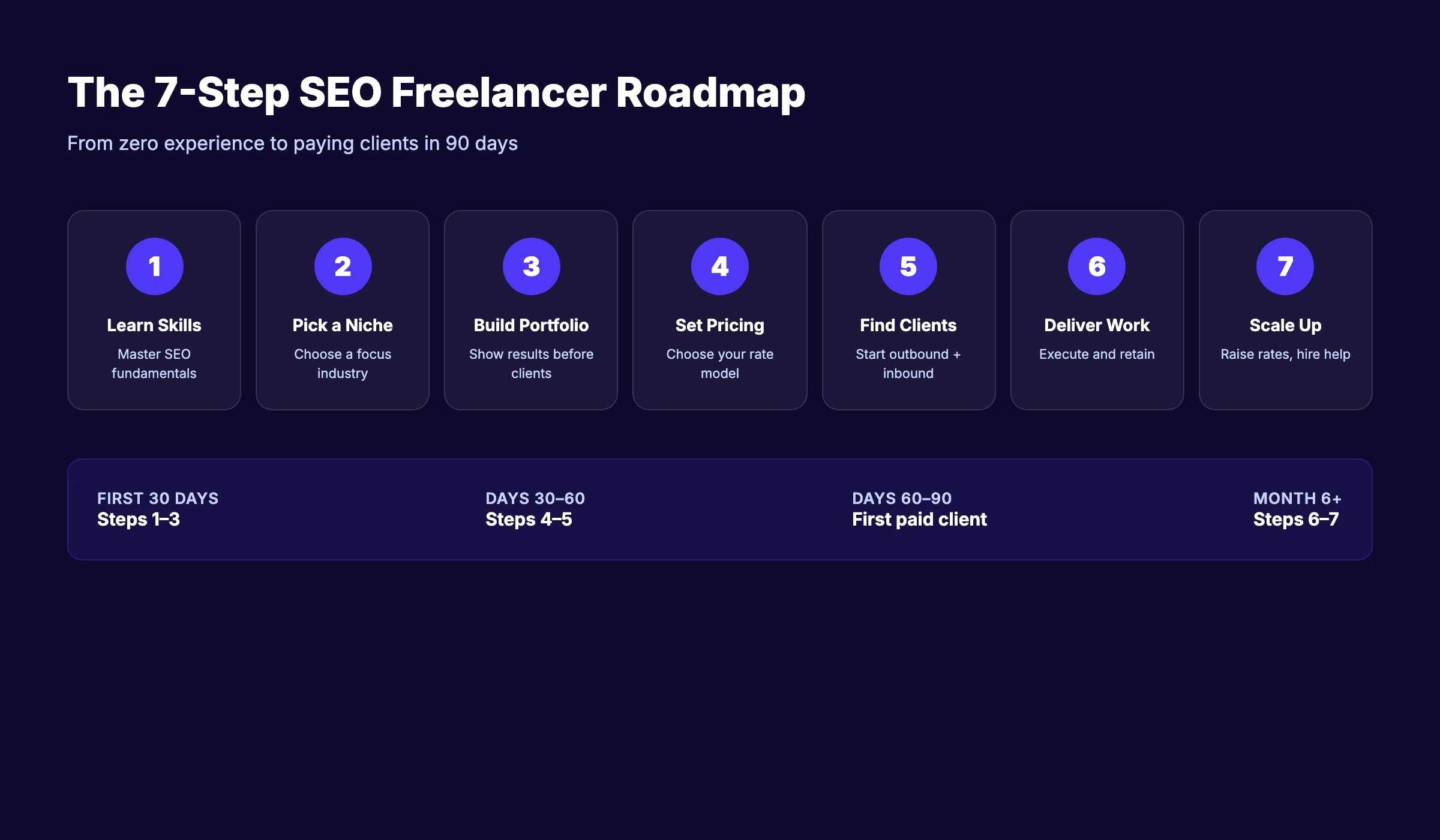
This guide strips that noise out. It is the exact sequence for how to become an SEO freelancer in 2026, ordered the way a new freelancer should actually execute it. No theory. No 40-step checklists that never end.
We have published more than 3,500 SEO articles for clients across 70+ industries at theStacc. The patterns below are what works when you start from zero and need paying clients in 90 days. The rest is padding.
Here is what you will learn:
- The real income SEO freelancers earn by experience level
- The 5 skills that matter (and the 10 that do not)
- How to build a portfolio with zero paying clients
- How to set rates without undercharging
- The 6 client acquisition channels, ranked by effectiveness
- How to deliver work clients will pay retainer for
- How to scale past solo work to $15K+ per month
Time to first paid client: 60–90 days of focused work Difficulty: Beginner to Intermediate What you will need: A laptop, Google Search Console (free), Google Analytics (free), a niche focus, and 10 hours per week minimum
What an SEO Freelancer Actually Does
An SEO freelancer helps businesses rank higher on Google, which means more leads, more sales, and less ad spend. The job is not a single task. It is a bundle of services. Audits, keyword research, on-page optimization, link building, content strategy, and reporting.
Most freelancers specialize within that bundle. A technical SEO freelancer fixes crawl errors and site speed. A local SEO freelancer optimizes Google Business Profiles and local citations. A content SEO freelancer plans and publishes articles that rank. Each niche pays differently and sells to different buyers.
The work also splits into two modes. Some freelancers sell projects. A one-time audit, a site migration, a keyword map. Others sell retainers. Ongoing monthly work for a fixed fee. Retainers compound. A freelancer with four $3,000 retainers earns $144,000 per year without chasing new work every month.
The last thing every new SEO freelancer needs to understand: you are not just selling SEO. You are selling outcomes. Clients do not care about your rank tracking dashboard. They care about phone calls, demos booked, and revenue. If you cannot translate your work into business outcomes, you will always be a commodity.
SEO Freelancer Income: What to Expect
Before you commit, know what you are working toward. SEO freelancer income varies wildly. From side hustle money to six-figure operations. The variables are experience, niche, and delivery model.
According to ZipRecruiter data for April 2026, the average SEO freelancer in the United States earns $54.49 per hour or roughly $113,333 per year. SE Ranking reports that freelance SEOs out-earn in-house SEO specialists by 14.4 percent at the median, and nearly 14 percent of freelancers earn over $150,000 per year.
Here is how that income typically shakes out by experience level.
| Experience Level | Monthly Income | Hourly Rate | Clients |
|---|---|---|---|
| Beginner (Year 1) | $2,000–$5,000 | $25–$50 | 1–3 small businesses |
| Mid-Level (Year 2–3) | $5,000–$12,000 | $75–$125 | 3–6 mid-market retainers |
| Senior (Year 4+) | $12,000–$25,000+ | $150–$200+ | 4–8 premium retainers |
| Top 10% | $25,000+ | $200–$500 | Specialized niche |
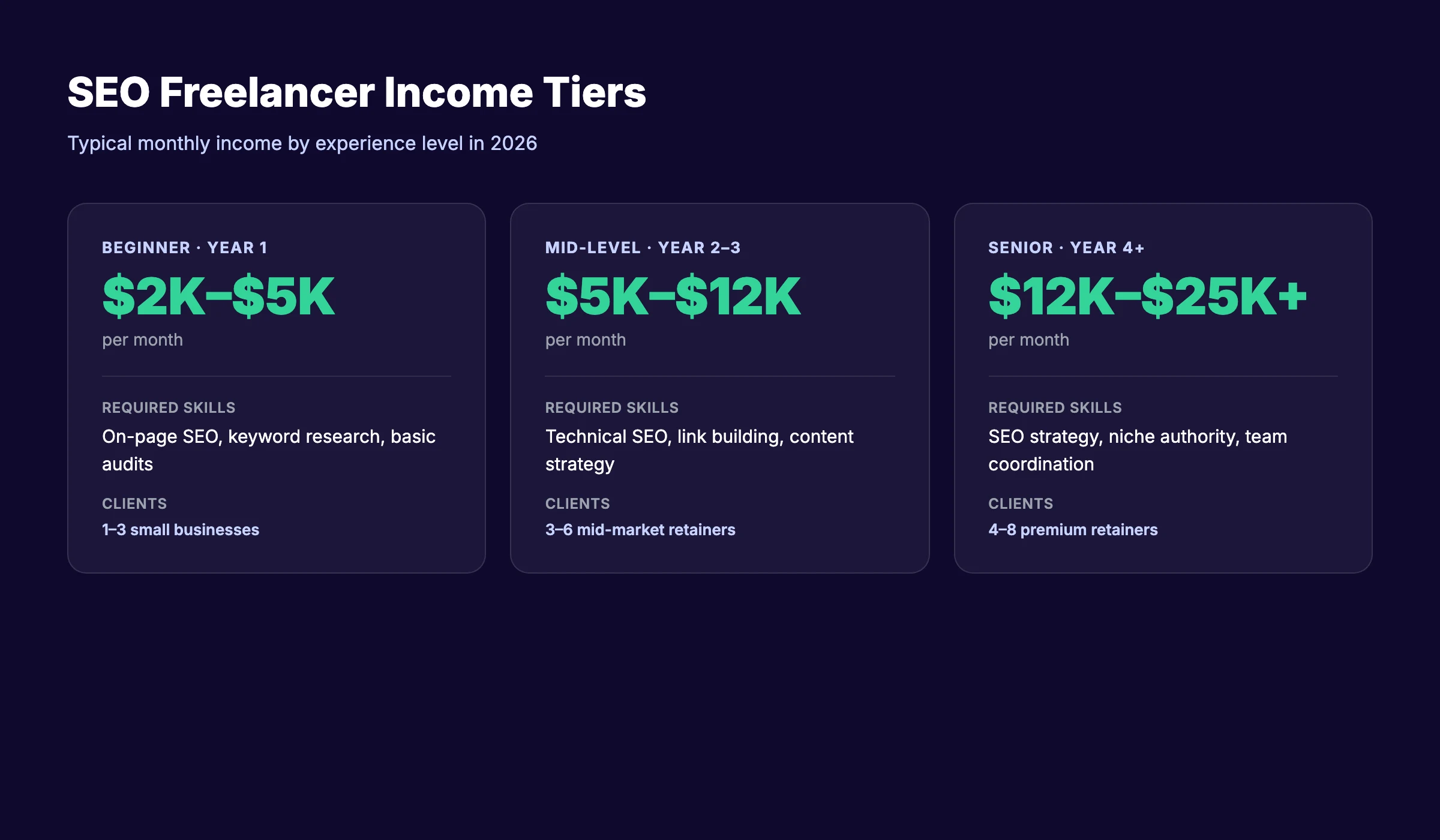
The jump from beginner to mid-level usually takes 12–18 months. The jump from mid-level to senior takes another two years and almost always requires a niche. Generalists plateau near $8,000 per month. Specialists break through it.
The freelance SEO services market was valued at $17.52B in 2025 and is projected to hit $32.87B by 2029. Demand is not the problem. Standing out is.
Step 1: Learn the Core SEO Skills
You do not need to know everything. You need to know the right things deeply enough to get results. Five skill areas carry 90 percent of client work. Everything else is a bonus.
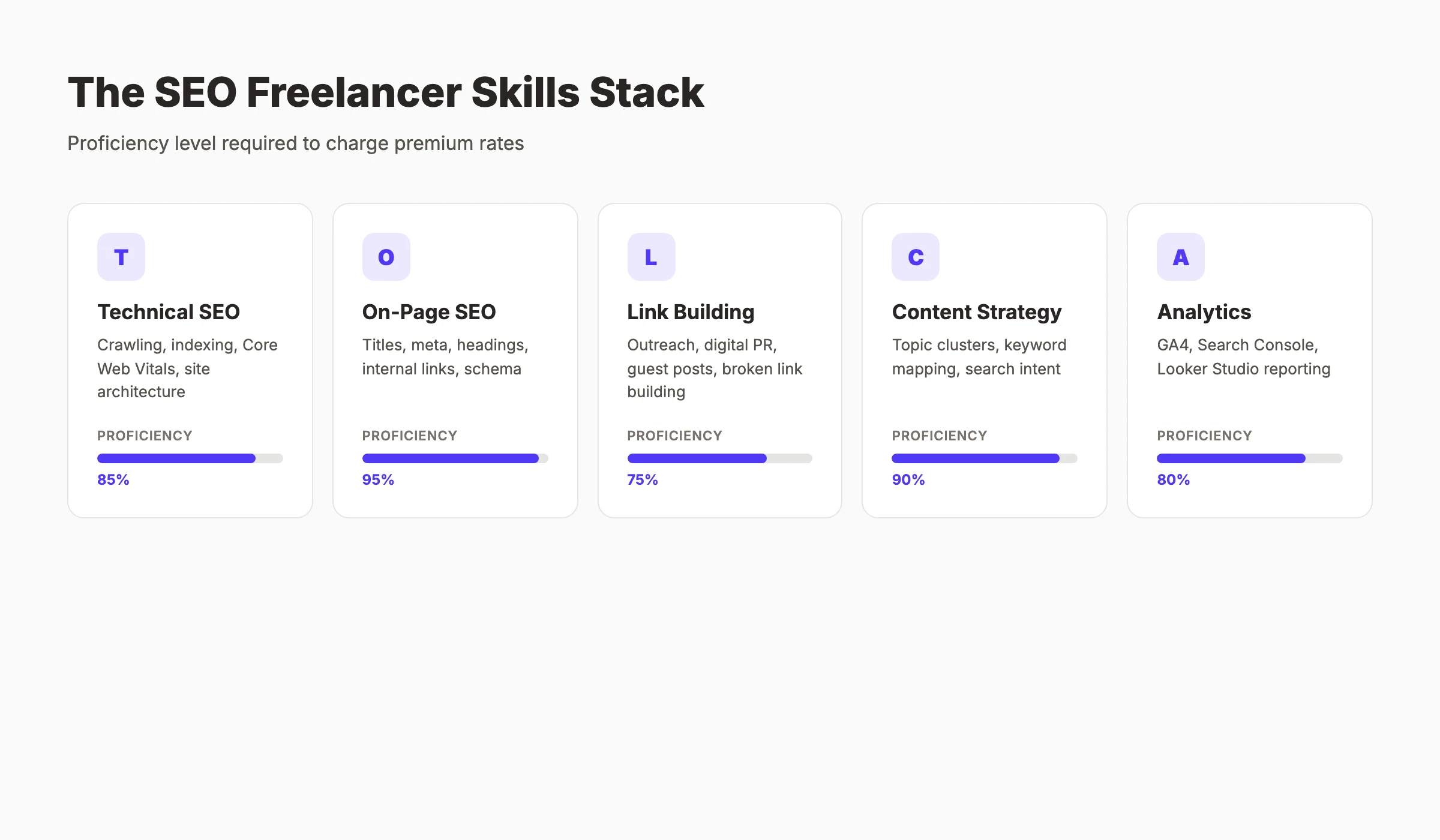
The five skills that matter:
- On-page SEO. Titles, meta descriptions, headings, internal links, schema markup
- Keyword research. Finding the queries real buyers type, not just the ones with high volume
- Technical SEO. Crawling, indexing, site speed, Core Web Vitals, structured data
- Content strategy. Topic clusters, search intent mapping, editorial calendars
- Analytics and reporting. Google Search Console, GA4, Looker Studio
Learn these in this order. On-page first, because it is immediate and visible. Keyword research second, because it drives every decision after. Technical third, because it unblocks everything else. Content strategy fourth, because it scales impact. Analytics last, because you cannot report on work you have not done.
Where to learn (in order of return on time):
- Free: Google Search Central docs, Ahrefs blog, Search Engine Land, Backlinko, theStacc blog
- Cheap: Ahrefs Academy (free), Semrush Academy (free), HubSpot Academy (free)
- Paid: Traffic Think Tank, The SEO Playbook (Jackie Chou), SEO Mastery by Neil Patel
Give yourself 8 weeks to reach working proficiency. Study two hours a day. Apply every concept to a real site. Ideally your own. The same day you learn it. Reading about SEO without doing it is the most common trap new freelancers fall into.
Why this step matters: Clients will ask questions on discovery calls. If you cannot answer "how would you fix our indexing issue" with specificity, the call ends. You cannot fake this.
Pro tip: Build your first project as a personal blog in a niche you care about. Rank it for 10 keywords. Screenshot the progress every month. That blog becomes your credibility forever.
Step 2: Pick a Niche That Pays
Generalists are replaceable. Specialists are scarce. That scarcity is how you charge $5,000 per month instead of $500.
A niche is a combination of industry and service. "Local SEO for dentists" is a niche. "Technical SEO for SaaS" is a niche. "SEO for everyone" is not a niche. It is a signal that you are new.
The right niche has three properties. The businesses have budget. The businesses have a real SEO problem. And the buyer can make a decision quickly. If any one of those is missing, the niche will starve you.
High-paying SEO freelancer niches in 2026:
| Niche | Typical Retainer | Buyer | Why It Pays |
|---|---|---|---|
| B2B SaaS SEO | $4,000–$10,000/mo | VP Marketing | High LTV per customer |
| Local SEO for home services | $1,500–$4,000/mo | Owner/Operator | Each lead is worth $500+ |
| Ecommerce SEO (Shopify) | $3,000–$8,000/mo | Brand Owner | Revenue tracking is clean |
| Law firm SEO | $3,000–$7,000/mo | Partner | Each case is worth $5K+ |
| Healthcare SEO | $3,000–$8,000/mo | Practice Manager | High patient LTV |
| Financial services SEO | $4,000–$10,000/mo | CMO | Large deal sizes |
Pick one. Not two. Not "I will figure it out." One.
The fastest way to choose: write down three industries you already understand. From a past job, a side interest, or a family business. Then cross out the ones with no budget. What remains is your starting niche. You can expand later. You cannot expand before you have proven you can deliver in one.
Why this step matters: Every marketing decision downstream depends on your niche. Your portfolio, your website copy, your outbound targets, your case studies. All of them get sharper when the niche is clear. Freelancers who skip this step take 3x longer to hit $5,000 per month.
Ranking a niche site is hard. Publishing for it is not. theStacc publishes 30 SEO articles a month for your niche, on autopilot. No writers, no agencies, no missed deadlines.
Step 3: Build Your Portfolio Before You Have Clients
The first question every client asks is "what have you done?" The first mistake every new freelancer makes is saying "nothing yet." Do not be that freelancer.
A portfolio is not client logos. A portfolio is proof you can deliver. You can build one before a paying client ever writes you an email.
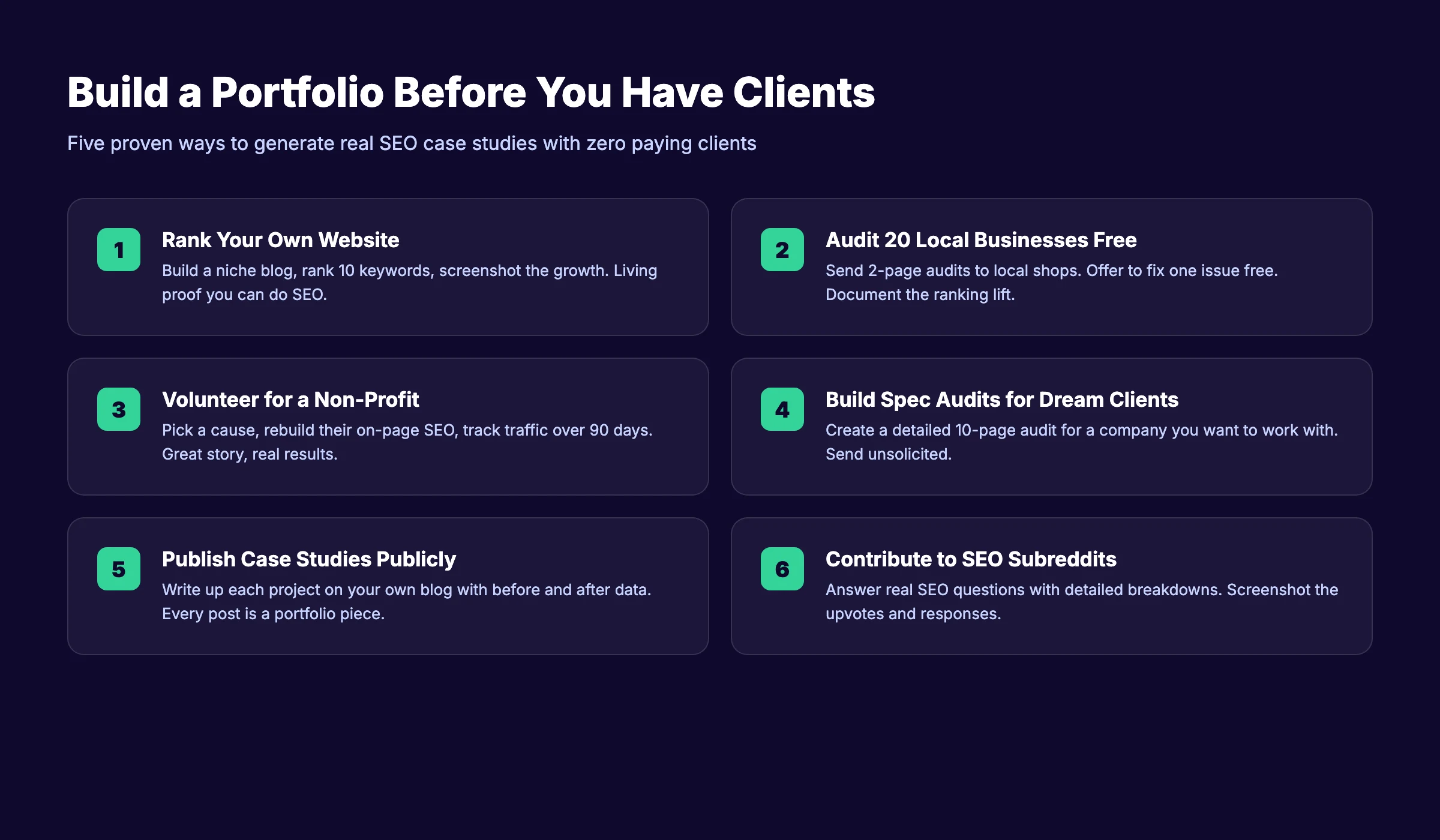
Six ways to build a portfolio from zero:
- Rank your own site. Start a niche blog in your target industry. Publish 20 articles. Screenshot the traffic growth every 30 days for six months. A site that went from 0 to 5,000 organic visitors is a case study no junior freelancer can fake.
- Audit 20 local businesses free. Run a short audit for 20 small businesses in your city. Send each one a 2-page report with three specific fixes. Offer to implement one free. Document the before and after ranking data.
- Volunteer for a non-profit. Non-profits have real websites and real traffic problems. Pick one you care about. Spend 90 days fixing their SEO. Get written permission to publish the results. You now have a detailed case study with real stakes.
- Build spec audits for dream clients. Pick 10 companies you would love to work with. Build a 10-page SEO audit for each one. No permission needed. Send it unsolicited with a note that says "I noticed these issues on your site. Here is how I would fix them." This converts at 5–10 percent into paying engagements in our experience.
- Publish case studies publicly. Every project you finish gets written up on your own blog. Screenshots. Timelines. What worked. What failed. Those posts become your portfolio and rank for your name at the same time.
- Answer SEO questions on Reddit, LinkedIn, and X. Find five SEO questions a day. Write detailed answers with specific data. Bookmark every upvoted reply. Social proof compounds.
The goal is simple. By day 60 of your freelance journey, you should have three documented case studies with real numbers. Not "my friend said I did a good job." Actual traffic charts, keyword rankings, and business outcomes. If you do not have that, you are not ready to charge premium rates.
Why this step matters: Portfolio is the single biggest predictor of whether you close $3,000/month retainers or $300/month gigs. Clients who see proof pay premium rates. Clients who see promises pay rock-bottom rates.
Step 4: Set Your Rates and Pricing Model
Underpricing is the most common new-freelancer mistake. It does not make you more attractive. It makes you look unsure. Clients who pay $200 per month are a different species from clients who pay $3,000 per month. You want the second group.
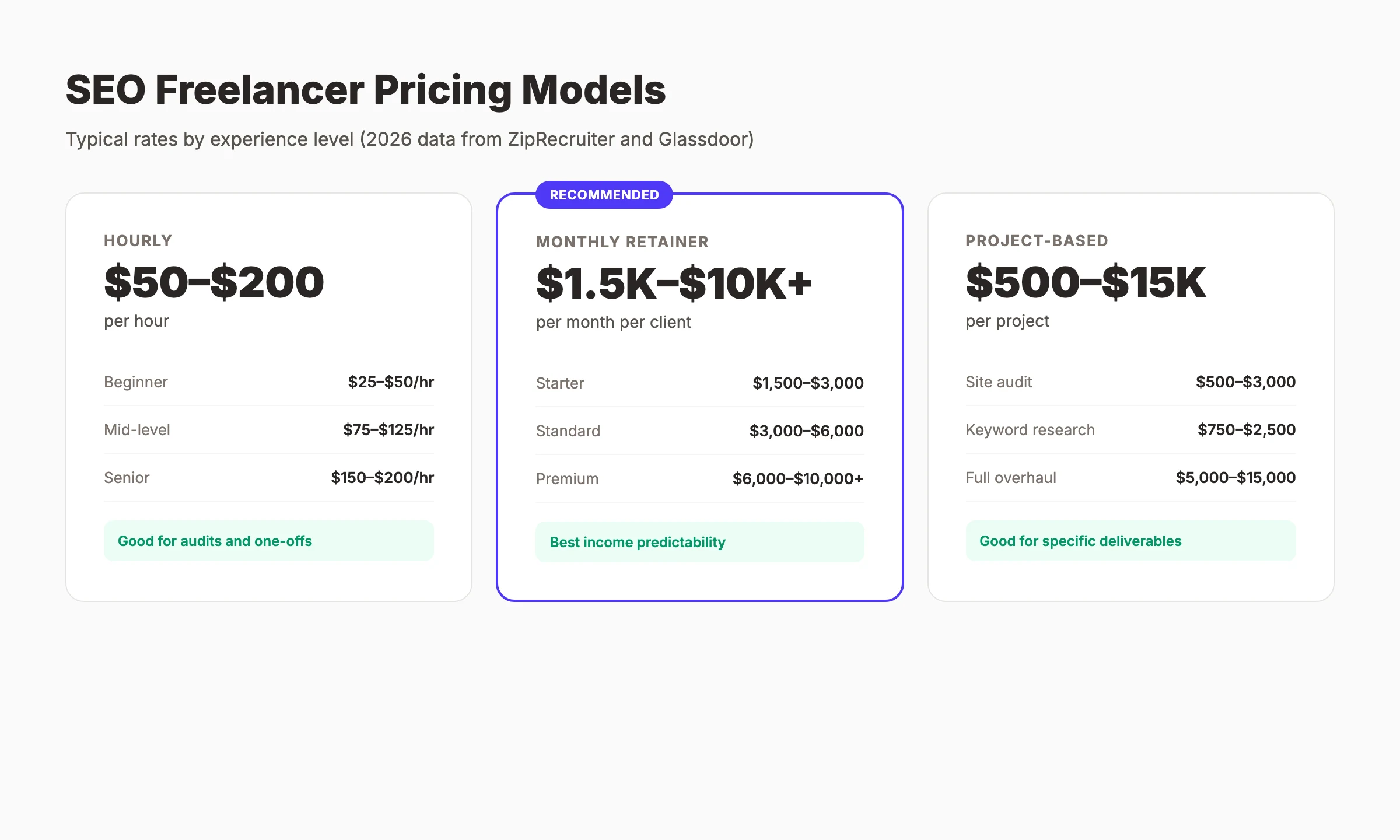
There are three pricing models for SEO freelancers. Each has a place.
Hourly pricing ($50–$200/hr): Good for audits and one-off tasks. Bad for ongoing work because clients hate surprise invoices, and you get punished for being fast. Use hourly for scoping discovery engagements only.
Monthly retainer ($1,500–$10,000/mo): The gold standard. Predictable income for you, predictable spend for the client. Start every new engagement with a 90-day retainer minimum. Retainers are how you hit $10K/month without working 80 hours a week.
Project-based ($500–$15,000 per project): Good for audits, site migrations, and keyword research projects. Price based on value delivered, not hours spent. A site audit that uncovers $500,000 of lost revenue should not cost $500.
How to set your first rate:
Look at what freelancers in your niche charge. Price yourself at the 60th percentile. Not the bottom, not the top. If the typical local SEO retainer is $2,000 per month, charge $2,400. If you are too cheap, clients assume low quality. If you are too expensive with no portfolio, you do not close. The 60th percentile threads that needle.
Set a rate floor and stick to it. Every time you take work below your floor, you train yourself and the market that you will work cheap. Once a client pays $500 per month, they will never pay $3,000 per month. New clients, new rates.
Why this step matters: Your rate decides what kind of business you build. Charge $500/month and you need 20 clients to reach $10K. Charge $3,000/month and you need four. Four is a manageable business. Twenty is a second job with no boss.
Pro tip: Quote in writing. Always. Verbal quotes get misremembered, renegotiated, and ghosted. Send a one-page proposal with scope, deliverables, and price every time.
For a deeper breakdown, our agency pricing models guide covers hourly, retainer, performance, and hybrid pricing in full.
Step 5: Find Your First Clients
Your portfolio is ready. Your rates are set. Now you need someone to pay you. This is the step that kills most freelancers. Not because clients are hard to find, but because freelancers pick the wrong channels.
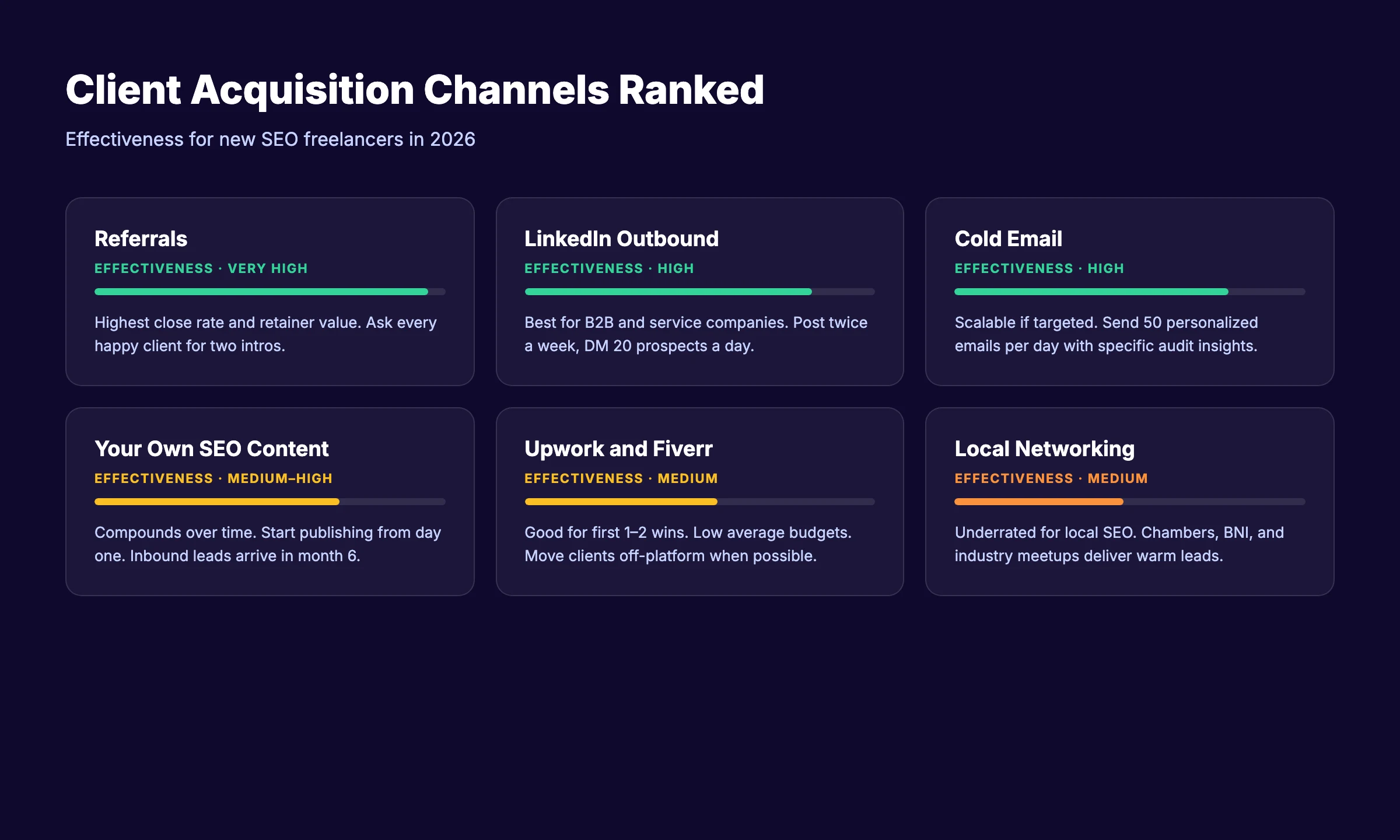
The six channels, ranked by effectiveness:
- Referrals. The highest close rate and the highest retainer value. Ask every happy client. Including the free ones from Step 3. For two introductions. Most will give them. This one habit alone can fill your pipeline within six months.
- LinkedIn outbound. Best channel for B2B and service companies. Optimize your profile for your niche. Post twice a week. DM 20 prospects a day with a specific observation about their site. Expect 1–2 discovery calls per week.
- Cold email. Scalable if personalized. Send 50 targeted emails per day with a specific audit insight: "I noticed your top 10 competitor has 3x the indexed pages you do. Here is why that matters." Expect a 5–8 percent reply rate and a 1–2 percent close rate.
- Your own SEO content. Compounds over time. Start publishing SEO articles from day one. It takes roughly 6 months before meaningful inbound traffic arrives. The freelancers who publish early dominate inbound three years in.
- Upwork and Fiverr. Good for your first 1–2 wins, especially if you are brand new. Low average budgets. High competition. Use them to build initial case studies, then graduate to off-platform clients. Learn the client onboarding process before you take your first retainer.
- Local networking. Underrated for local SEO. Chambers of Commerce, BNI, industry meetups, and local Facebook groups all produce warm leads. A single networking breakfast can fill half your pipeline if you have the right niche.
The 10-week pipeline build:
- Weeks 1–2: Publish your portfolio. Optimize your LinkedIn. Pick your niche message.
- Weeks 3–4: Send 50 cold emails per day. Post 3 LinkedIn posts per week.
- Weeks 5–6: Follow up with every cold email twice. Book discovery calls.
- Weeks 7–8: Close first 1–2 clients. Deliver onboarding.
- Weeks 9–10: Ask first clients for referrals. Publish case studies.
Most freelancers give up at week 4 because "no one is responding." Week 4 is when the responses start. Week 6 is when the calls happen. Week 8 is when the money lands. Do not stop at week 4.
For the pitch itself, our 7-step system for pitching SEO services covers the exact conversation flow from first email to signed contract. Use the client questionnaire to scope every engagement cleanly.
Why this step matters: Clients do not appear. You create them. The freelancers who treat client acquisition as a daily habit. Not a one-time event. Build stable six-figure businesses.
Step 6: Deliver the Work and Retain the Client
Getting a client is harder than keeping one. But losing a client is easier than either. The average SEO retainer lasts 7 months. Top freelancers push that to 18+ months. That single metric. Retention. Decides whether your business grows or runs in place.
The first 30 days are everything. Most clients decide whether you are worth keeping within 30 days. Not 90. Not 60. Thirty. Front-load value in the first month.
A retention-focused first month looks like this:
- Day 1: Kickoff call. Set goals in business terms (leads, calls, revenue). Not keyword rankings.
- Day 2–7: Run a full SEO audit. Share findings by end of week 1.
- Day 8–14: Ship the three highest-impact on-page fixes. Document before and after.
- Day 15–21: Publish first piece of content or first technical win.
- Day 22–30: Send a 1-page month-one report. Book month-two planning call.
Reporting rules:
- Report monthly. Every month. Without exception. The clients who churn are the ones who stop hearing from you.
- Lead with business outcomes. Rankings matter, but only in context. "Form submissions up 34%" beats "average position up 2.3."
- Include what failed. Clients trust freelancers who admit what did not work. Hiding failures breeds skepticism.
- Always end with what you will do next month.
The upsell conversation: At month 4, every retainer gets an upsell conversation. You have proven results. The client trusts you. This is the moment to expand scope. From on-page SEO to content, from content to link building, from SEO to local SEO. Missed upsells are the number one reason freelancer income plateaus.
Why this step matters: A 4-client book with 18-month retention is a $144,000/year business. The same book with 4-month retention is a $32,000/year business. Retention is the real lever.
Step 7: Scale Beyond Solo Freelancing
At $8,000–$10,000 per month, most solo SEO freelancers hit a wall. Days are full. Every new client means firing someone or working weekends. This is where scaling starts. Or where freelancers stay stuck for years.
You have four scaling paths. Pick one.
Path 1: Raise rates. The easiest scale. Every 90 days, new clients get a 15–25 percent higher rate. Existing clients get a 10 percent rate lift at renewal. Do this three times and your average client doubles in value without you working a single extra hour.
Path 2: Productize. Turn one service into a fixed-price package. "Local SEO Starter: $1,997 flat" sells faster than "it depends." Productized services scale because the scope is fixed, the workflow is repeatable, and the delivery can be partly automated or delegated.
Path 3: Hire a VA or subcontractor. Offload the repetitive work. Link outreach, on-page fixes, reporting. To a $15–$30 per hour specialist. Keep the strategy, sales, and client relationships yourself. A good VA buys back 10+ hours per week.
Path 4: Productize with automation. Many freelancers scale by automating the content engine. Instead of writing 20 client articles per week manually, they use a service to publish those articles on autopilot and focus their own time on strategy and client management. The numbers work: 4 clients at $3,000 per month with content outsourced is $144K in revenue with maybe 15 hours of weekly work.
Your clients need 30 articles a month. You should not be writing them. theStacc publishes SEO articles automatically for you or your clients: 30 articles a month from $99. White-label ready.
The agency transition: Around $15K–$20K per month, many freelancers transition to a micro-agency. Two or three contractors, one operations person, formal processes. If that path interests you, our guide to starting a digital marketing agency walks through the switch. Our SEO team guide covers the structure you will need.
Why this step matters: Solo freelancing has an earnings ceiling. The freelancers who break through it do one of these four things deliberately. The ones who do not, burn out at $8K/month and quit within two years.
Common Mistakes New SEO Freelancers Make
Five mistakes account for most failed SEO freelance careers. Avoid them and you will be ahead of 80 percent of the field.
Mistake 1: Taking every client who says yes. Bad fit clients drain energy, damage reputation, and block you from the right ones. Say no to small budgets, unclear scope, or bad vibes. Your calendar is your most valuable asset.
Mistake 2: Undercharging "just to get started." Every low-rate engagement teaches the market that you work cheap. It is easier to start at $2,000/month and get one client than to start at $500/month and get five. Fewer clients at higher rates is the whole game.
Mistake 3: Offering every service. "Technical SEO, content, link building, paid search, social, web design" is not a service list. It is an admission you do not know what you do best. Specialists command premium rates. Generalists beg for work.
Mistake 4: Skipping the contract. Every engagement gets a written agreement. Scope, deliverables, price, cancellation terms, reporting cadence. A 1-page contract has prevented more client disputes than any software tool ever will.
Mistake 5: Ignoring your own SEO. If you sell SEO and your own site does not rank for your name or your niche, you have a credibility problem. Publish your own content weekly. Prove you can do for yourself what you sell to clients.
Results: What to Expect in Your First 12 Months
Realistic expectations prevent most of the quits. Here is what the average SEO freelancer achieves when they follow this roadmap.
| Timeframe | Milestone |
|---|---|
| Month 1 | Core skills learned, niche picked, portfolio started |
| Month 2 | 3 case studies documented, pricing set, outbound active |
| Month 3 | First paid client signed, $2,000–$5,000 in revenue |
| Month 6 | 2–3 retainers, $5,000–$8,000/month |
| Month 9 | First upsells and referrals, $8,000–$12,000/month |
| Month 12 | 3–5 retainers, $10,000–$15,000/month, waitlist forming |
The variance is wide. Some freelancers hit $10K in month four. Others take 18 months. The single biggest predictor of speed is consistency. Daily outreach, daily content, daily learning. For 90 straight days without stopping.
Want to start your own SEO content engine before you have a first client? theStacc publishes SEO-optimized articles to your site automatically. Proof you can rank, and a real asset from day one.
What practitioners are saying on X
AI search advice ages quickly. Here is high-signal public discussion from SEO and growth operators — context for your roadmap, not a substitute for primary data.
- @hridoyreh (Mar 2026): Widely shared SEO skill tree: foundations, research, technical, on-page, content, links, AI SEO/GEO, analytics, UX, brand, programmatic — useful map for stats and how-to posts. See the post on X.
- @jakezward (Feb 2026): 2026 SEO predictions emphasize AI Overview share-of-SERP, schema for LLM token efficiency, brand mentions in AI answers as a KPI, proprietary data as a moat, and content refresh beating net-new AI slop. See the post on X.
Grok, AI Overviews, and multi-engine visibility
For “how to become seo freelancer”, multi-engine visibility still starts with clear definitions, sourced numbers, and extractable section answers. Grok additionally factors live X discussion — keep public claims consistent with this page.
- Google AI Overviews: Use passage-ready answers, tables, and FAQ schema where relevant.
- ChatGPT / Perplexity: Cite named sources next to key claims.
- Grok: Maintain accurate entity facts on-site and in high-signal X posts.
Publish content built for Google and AI citations. theStacc’s Content SEO module ships SEO-scored articles structured for rankings and generative engines — including clearer entity pages models like Grok can quote.
Frequently Asked Questions
No. A degree helps nothing in SEO freelancing. Clients hire based on proof of results, not credentials. A portfolio of ranked sites and case studies matters 100x more than any certification. Most successful SEO freelancers have no formal SEO education at all. They self-taught through blog posts, free courses, and real projects.
Most people can learn enough SEO to take on a first paid client within 60–90 days of focused effort. Getting to $5,000 per month typically takes 6–12 months. Getting to $10,000+ per month takes 12–24 months. The variable that matters most is how consistently you publish, pitch, and deliver. Not how much you study.
Three methods work best for the first client: (1) audit 20 local businesses for free and convert one into a paid retainer, (2) pitch three dream clients with an unsolicited 10-page audit, and (3) win one gig on Upwork or Fiverr specifically to get the first case study. Do all three at once. One will land.
Yes, more than before. The freelance SEO services market is projected to grow from $17.52B in 2025 to $32.87B by 2029. AI has changed what freelancers need to learn, not whether the work exists. Businesses still need humans to set strategy, interpret data, and pitch clients. AI handles execution at scale. Which is exactly why SEO freelancers who use it right earn more, not less.
Start with the free stack: Google Search Console, Google Analytics 4, Google Keyword Planner, and Screaming Frog (free version, up to 500 URLs). Add one paid tool when you have your first client. Ahrefs or Semrush at around $129/month. Do not buy 10 tools before you have a single paying client. Tool cost scales with revenue, not the other way around.
Both. Upwork is a good source of your first 1–2 paid projects because the marketplace brings buyers to you. Your own website is a long-term compounding asset that delivers inbound leads after 6–12 months. Use Upwork to get started. Build your website and content engine from day one so that by month 9 you can leave Upwork behind.
You set expectations in the first call. SEO takes 3–6 months for meaningful results. Any freelancer who promises top-3 rankings in 30 days is either lying or working on zero-competition keywords. Show prospects the real timeline: 30 days for technical fixes, 60 days for indexing changes, 90 days for initial ranking shifts, 6 months for traffic growth. Clients who reject that timeline are not your clients.
Start Now, Not Next Month
You now know how to become an SEO freelancer. The skills, the niche, the portfolio, the pricing, the clients, the retention, and the scale. The only thing left is execution.
Pick a niche by end of day. Publish your first portfolio post by end of week. Send your first cold email by end of next week. The freelancers who start win. The ones who keep studying stay stuck.
And if you want to rank your own site while you pitch clients, theStacc can publish your SEO content for you: 30 articles a month starting at $99. First 3 articles free, no credit card.
Your SEO team. $99/month. Start ranking your freelance site in weeks, not months. 30 articles per month, published automatically.
Related Tools & Resources
Free SEO Tools:
Best Lists:
Sources & references
- [1] Princeton / Georgia Tech et al. — GEO research (arXiv:2311.09735)
- [2] @hridoyreh on X — Widely shared SEO skill tree: foundations, research, technical, on-page, content, links, AI SEO/GEO, analytics, UX, bran
- [3] @jakezward on X — 2026 SEO predictions emphasize AI Overview share-of-SERP, schema for LLM token efficiency, brand mentions in AI answers
- [4] Referenced source — www.ziprecruiter.com

Researched, written, and published articles that compound organic traffic.
Weekly local SEO teardowns
One practical email a week. Map Pack, GBP, AI Overviews — no fluff. Unsubscribe anytime.