SEO agency pricing models explained: monthly retainers ($1,500-$10,000+), hourly rates ($75-$300), project fees, and value-based pricing. Real numbers and when to use each model.
Most SEO agencies bill through one of four models: monthly retainer, hourly rate, per-project fee, or value-based pricing. Retainers run roughly $1,500 to $10,000 a month, hourly work $75 to $300. The model an agency picks shapes its margin more than the quality of its work does.
Agencies that price by gut feel end up taking on bad-fit clients, absorbing endless scope creep, and working 60-hour weeks to break even. The agencies that grow use a clear pricing structure tied to their costs, the market, and the real value they deliver.
We have published 3,500+ SEO articles across 70+ industries. The businesses we work with. From local service companies to national B2B firms. Pay agencies anywhere from $500 to $20,000 per month. This guide covers everything we have observed about what works and what does not.
In this guide, you will learn:
- The 4 core agency pricing models and when to use each
- How to calculate your true cost baseline before setting any rate
- How to package services into tiers that close faster
- The 7 pricing mistakes that destroy agency margins
- How to raise your rates without losing the clients you want to keep
Table of Contents
- Chapter 1: The 4 Core Agency Pricing Models
- Chapter 2: Monthly Retainer Pricing. The Agency Standard
- Chapter 3: Hourly and Project-Based Pricing
- Chapter 4: Value-Based Pricing. The Highest-Margin Model
- Chapter 5: How to Calculate Your True Costs
- Chapter 6: How to Package SEO Services Into Tiers
- Chapter 7: 7 Pricing Mistakes That Cost Agencies the Most
- Chapter 8: How to Raise Rates Without Losing Clients
Chapter 1: The 4 Core Agency Pricing Models
Before deciding what to charge, you need to decide how to charge. The pricing model you choose shapes every client relationship, contract, and deliverable that follows.
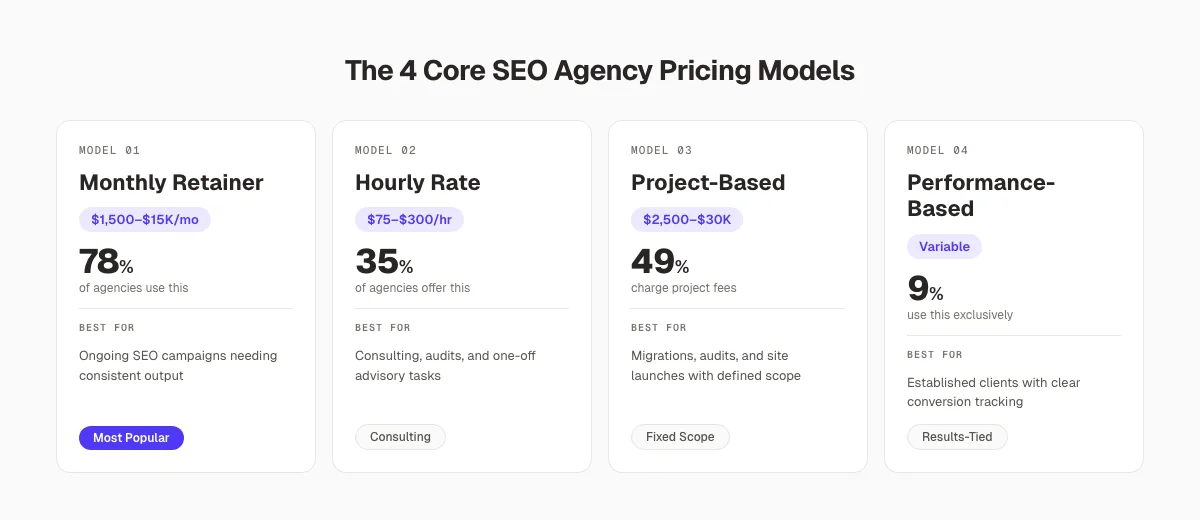
According to a 2025 agency pricing survey by SE Ranking, 78.2% of SEOs charge monthly retainers, 34.8% bill by the hour, and 48.9% charge project-based fees. A smaller 9% use performance-based pricing. Most agencies blend 2 or 3 models depending on the client type and scope.
Here is how all 4 compare:
| Pricing Model | Best For | Typical Range | % of Agencies |
|---|---|---|---|
| Monthly Retainer | Ongoing SEO campaigns | $1,500–$15,000/mo | 78% |
| Hourly Rate | Consulting, audits, one-off tasks | $75–$300/hr | 35% |
| Project-Based | Site migrations, audits, launches | $2,500–$30,000 | 49% |
| Performance-Based | Established clients, lead gen | Variable | 9% |
Understanding what SEO typically costs from the client side helps you set prices that convert. Clients who have done their research expect to pay somewhere in these ranges. Pricing far below the market signals low quality. Not good value.
The global SEO market reached $60 billion in 2023 and is projected to hit $106.9 billion by 2030. The agencies winning that growing spend are not the cheapest. They are the most clearly positioned.
The core principle: Each model serves a different purpose. Monthly retainers work best for long-term relationships where consistent output drives compounding results. Hourly billing suits defined consulting engagements. Project-based pricing works when the scope is clearly bounded. Performance-based models are a last resort. Not a default.
The agencies that earn the most pick one primary model and use the others selectively.
Chapter 2: Monthly Retainer Pricing. The Agency Standard
Monthly retainers are the backbone of most SEO agencies. They create predictable revenue, enable long-term planning, and align agency incentives with client growth.
SEO is not a one-time project. It requires ongoing technical maintenance, content creation, link building, and continuous adaptation to algorithm changes. A retainer model funds that work over the 6–12 months it takes to see meaningful results.
What Retainer Pricing Looks Like in 2026
| Client Type | Monthly Range | Typical Scope |
|---|---|---|
| Local business (1–2 locations) | $1,500–$3,000 | Local SEO, 4–8 pages/mo, GBP optimization |
| Small business (regional) | $2,500–$5,000 | On-page, blog content, monthly reporting |
| Mid-market (national) | $5,000–$10,000 | Full-service, 15–20 articles/mo, link building |
| Enterprise | $10,000–$30,000+ | Multi-team, technical SEO, digital PR |
The range is wide because scope varies dramatically. A service business with 3 target locations needs entirely different work than a national e-commerce brand competing for 2,000 keywords.
What a Retainer Should Include
A well-structured retainer is not "up to 10 hours per month." That is consulting with monthly billing. A true retainer promises deliverables. A defined number of articles, optimizations, and reports. Per month. Specifically:
- Technical SEO monitoring and priority fixes
- Content production (blog posts, landing pages, location pages)
- On-page optimization for existing pages
- Link acquisition or digital PR outreach
- Monthly reporting and strategy calls
How to Structure Retainer Tiers
Most agencies offer 3 tiers: a small business tier focused on local and basic on-page, a growth tier with full content production and link building, and an enterprise tier with custom scope. This mirrors how buyers evaluate budget. They naturally anchor on the middle option.
Minimum viable retainer for a legitimate SEO operation: $1,500 per month. Below that, the hours required to do meaningful work push your effective hourly rate below break-even.
Skip the agency bill. Keep the results. theStacc publishes 30 SEO articles per month for $99. Fully optimized, automatically delivered to your site.
Chapter 3: Hourly and Project-Based Pricing. When Each Works
Not every SEO engagement fits a retainer. Hourly and project-based models fill specific niches. And knowing when to use them protects your margins.
Hourly Pricing: When It Works
Hourly billing works best for:
- Technical SEO audits with a clearly defined question to answer
- One-off consulting for in-house marketing teams
- Training sessions for client teams learning SEO fundamentals
- Troubleshooting specific algorithm-related ranking drops
In 2026, North American SEO consultants typically charge $75–$300 per hour, depending on specialization and track record. Senior technical consultants with documented results in competitive verticals charge $200–$400+.
The problem with hourly billing for ongoing work is that it penalizes efficiency. The faster you work, the less you earn. It also creates unpredictable costs for clients, which slows buying decisions. Use hourly billing as a diagnostic or advisory model. Not as your core delivery structure.
Where hourly billing backfires: Without a clear contract, a $150/hour engagement can quietly become a $50/hour one once you factor in client communication, email threads, and revision rounds. Every extra Slack message is unbilled work.
Project-Based Pricing: When It Works
Project-based fees work best for:
- Technical SEO audits ($2,500–$10,000)
- Website migrations ($5,000–$25,000)
- New site launches with full SEO setup ($3,000–$15,000)
- Penalty recovery or manual action removal ($5,000–$20,000)
The key to accurate project pricing is scoping before quoting. Define exactly what is and is not included: how many pages, how many revision rounds, and what the final deliverable looks like.
A standard project pricing formula:
Estimated hours × your hourly rate × 1.3 buffer = Project price
The 1.3 buffer accounts for scope surprises, client revisions, and admin time. Without it, most projects end up marginally profitable at best.
Project-based pricing pairs naturally with a retainer upsell. Complete the audit or migration. Then offer an ongoing retainer to execute the recommendations. The project gives the client a taste of your work; the retainer is where the relationship becomes profitable.
Chapter 4: Value-Based Pricing. The Highest-Margin Model
Value-based pricing is the hardest model to sell and the most profitable to operate.
Instead of asking "how many hours will this take?" you ask "what is this result worth to the client?" A 30% increase in organic traffic that generates 50 new leads per month at $3,000 average lead value is worth far more than the 40 hours it took to achieve it.
The Value-Based Pricing Formula
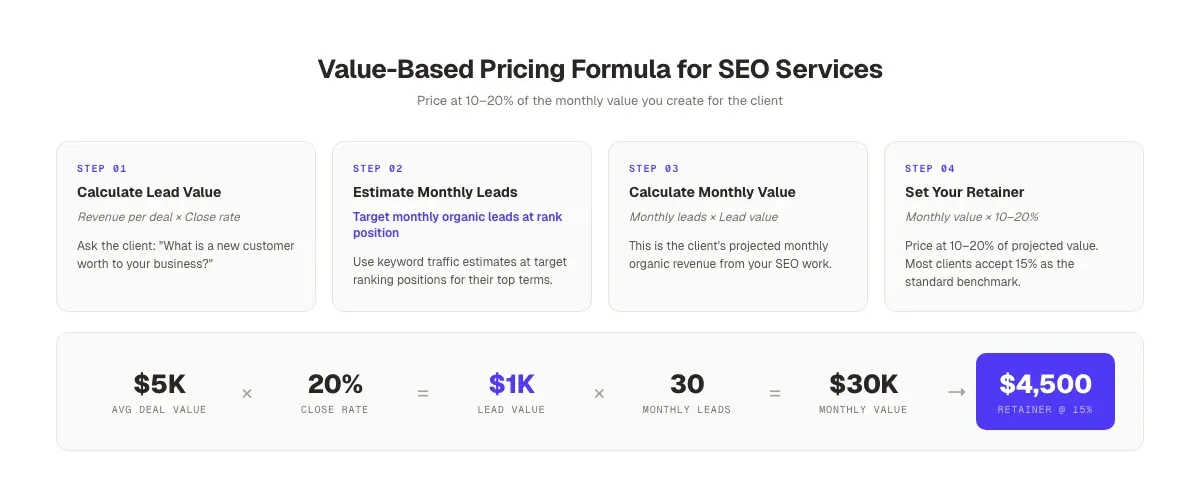
- Calculate the client's average lead value: Revenue per closed deal × close rate from organic
- Estimate monthly organic leads at your target ranking positions
- Multiply: Monthly leads × lead value = Monthly organic revenue potential
- Price at 10–20% of that projected monthly value
Example:
A law firm has a $5,000 average case value and closes 20% of inbound leads. Their lead value is $1,000. Your SEO target is 30 organic leads per month. Monthly value to the client: $30,000. At 15%, your retainer: $4,500 per month.
That same engagement priced at cost: 40 hours × $150/hr = $6,000. Is actually lower margin in real terms because cost-based pricing ignores how much the client gains.
When Value-Based Pricing Works
Value-based pricing works best with:
- High-ticket B2B service providers with defined average deal sizes
- Professional services firms. Legal, finance, healthcare, accounting
- Any business where a single converted lead pays back months of SEO spend in full
It works worst with:
- E-commerce businesses with low average order values
- Startups without existing conversion rate data
- Clients who are fundamentally skeptical of projections
Before pitching value-based pricing, verify your numbers directly with the client. Ask them: "What is a new customer worth to your business?" If they cannot answer, revert to a retainer model. Our SEO ROI data shows median organic search ROI at 275%. That is the context for the pricing conversation. Not your hourly rate.
Value-based pricing also requires confidence in your results. If you are not consistently tracking and reporting the business outcomes from your work, you have no foundation for a value-based conversation.
Your SEO team. $99/month. 30 optimized articles, published automatically. No agency markup, no long contracts.
Chapter 5: How to Calculate Your True Costs Before Setting Any Rate
Most agencies that undercharge do not know what they actually cost to run. They set prices based on what competitors charge or what feels reasonable. And discover months later that they are losing money on their best clients.
Pricing starts with a single hard number: your minimum sustainable hourly rate.
The Base Hourly Cost Formula
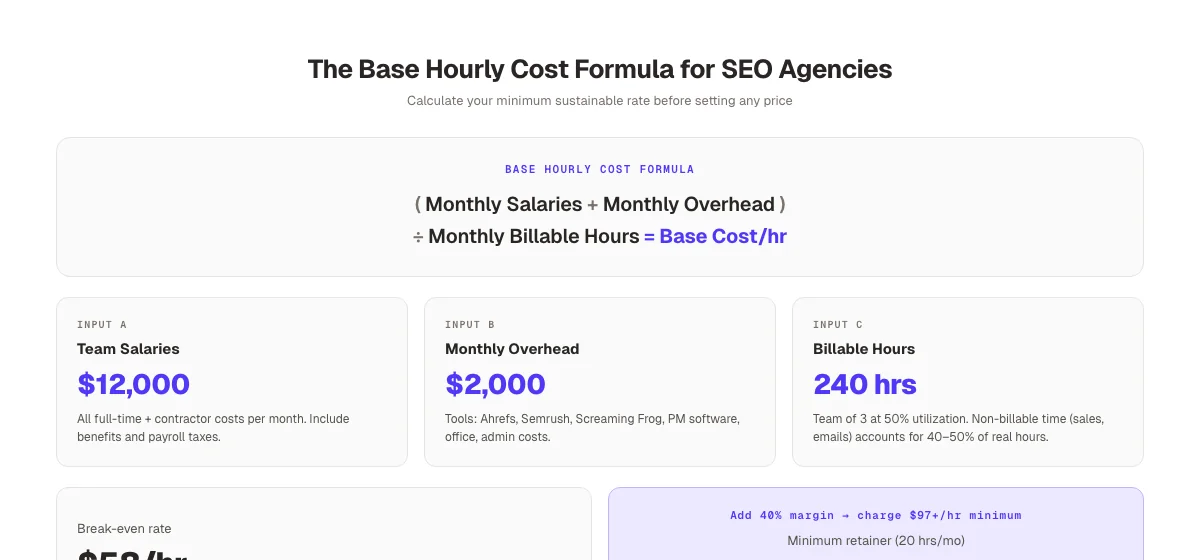
(Total Monthly Salaries + Total Monthly Overhead) / Total Monthly Billable Hours = Base Hourly Cost
Example:
- Team salaries: $12,000/month (2 employees + contractor)
- Overhead. Tools, software, admin, office: $2,000/month
- Total monthly costs: $14,000
- Billable hours at 50% utilization (team of 3): 240 hours/month
- Base hourly cost: $14,000 / 240 = $58/hour break-even
To hit a 40% profit margin, divide by the inverse: $58 / (1 - 0.40) = $97/hour minimum rate.
That is not what you charge clients. That is your floor. Every rate you quote should be above it.
Costs Most Agencies Miss
Non-billable time. Sales calls, proposals, onboarding, reporting prep, and account management account for 30–40% of most agency hours. These hours cost money but generate no direct revenue. Factor them in before setting rates.
Tool subscriptions. Ahrefs, Semrush, Screaming Frog, Surfer SEO, DataForSEO, Slack, project management software. A mid-size agency spends $1,000–$3,000 per month on tools alone. Most agencies forget to attribute these costs to specific client accounts.
Client communication overhead. An 8-hour project often has 3–4 hours of emails, calls, and revisions attached. That 40% overhead is real labor cost.
Employee training and ramp time. Hire a new team member and your effective capacity drops for 4–8 weeks while they learn your systems.
Calculating a Minimum Retainer Floor
Once you know your base hourly cost, apply it to your smallest retainer. If a small business retainer requires 20 hours per month to deliver properly, and your base hourly cost is $97, your floor is $1,940. Before any profit margin.
Agencies that automate SEO workflows reduce per-client hours by 30–50%, which either widens margins or allows them to take on more clients at the same headcount. Speed and systems are what let you price competitively while staying profitable.
Want to build your SEO team before setting rates? Start by mapping which roles are full-time, contractor-based, or tool-assisted. That determines your real cost structure.
Chapter 6: How to Package SEO Services Into Tiers
Packaging services into tiers is the single most impactful change most agencies can make to improve close rates and reduce time spent on custom proposals.
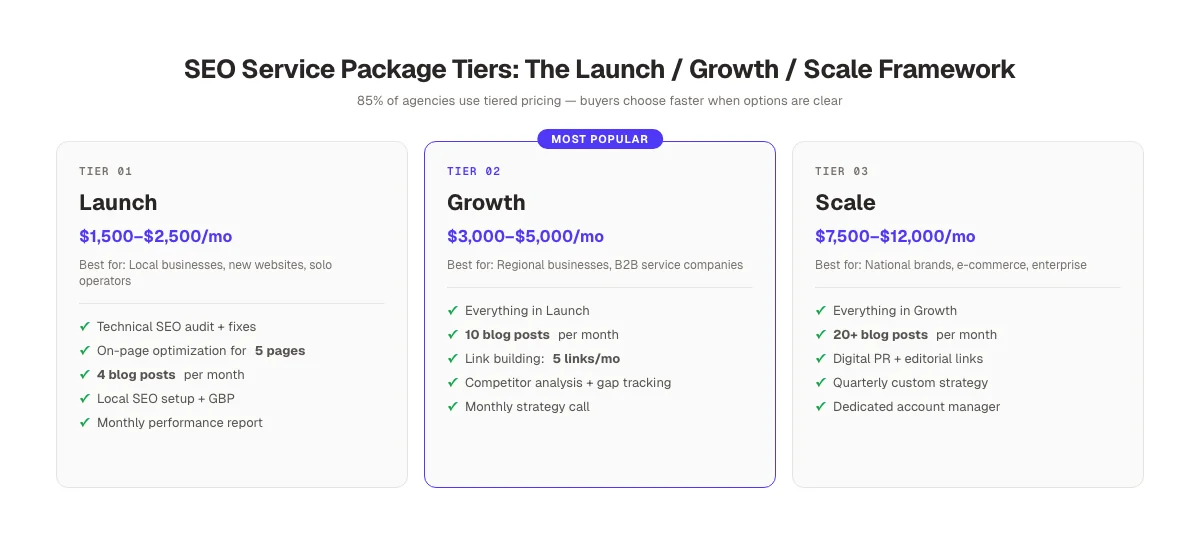
According to industry data, 85% of agencies use tiered pricing packages. The reason is buyer psychology. Clients prefer choosing between options over evaluating a blank-slate proposal. Tiers anchor expectations, simplify the sales conversation, and eliminate most scope arguments before they start.
The Launch / Growth / Scale Framework
| Tier | Monthly Price | Core Deliverables | Best For |
|---|---|---|---|
| Launch | $1,500–$2,500 | Technical audit + on-page for 5 pages + 4 blog posts | Local businesses, new websites |
| Growth | $3,000–$5,000 | Above + 10 blog posts + link building (5 links/mo) + GBP | Regional businesses, B2B companies |
| Scale | $7,500–$12,000 | Above + 20 blog posts + digital PR + quarterly strategy | National brands, e-commerce, enterprise |
3 rules for effective tier design:
Rule 1: Most clients should choose the middle tier. Price your tiers so the Growth option looks like the obvious value. If more than 60% of clients pick the top tier, your top tier is underpriced. If most pick the bottom tier, your middle tier is overpriced. Adjust until the middle is the natural landing spot.
Rule 2: Name tiers for outcomes, not deliverables. "Growth" sells better than "20 Blog Posts + 5 Links." Buyers respond to what they want to become. Not to task lists.
Rule 3: Tie each tier to a timeline and business outcome. "Launch: ideal for businesses targeting local search rankings within 90 days." Clients who understand the expected result close faster and stay longer.
What to Include at Each Tier
Every tier should include tracking the right SEO KPIs. Monthly dashboards showing keyword rankings, organic traffic, and conversion trends turn your retainer from a line-item cost into a visible investment.
SEO reporting is not optional. Build reporting time into your tier costs. Or you will deliver it unpaid every single month. A 2-hour report for a $1,500/month client at $97/hour costs you $194, which is 13% of the retainer before profit.
Selling Tiers to Clients
Present all 3 options in the same proposal. Brief each tier in 2 sentences: what it includes and who it is best for. Give the client permission to start at Launch and upgrade. Agencies that offer upgrade paths keep clients 40–60% longer than those with fixed-scope retainers.
Chapter 7: 7 Pricing Mistakes That Cost Agencies the Most
The gap between agencies that grow and agencies that stagnate is rarely quality. It is almost always pricing. These are the 7 most expensive mistakes.
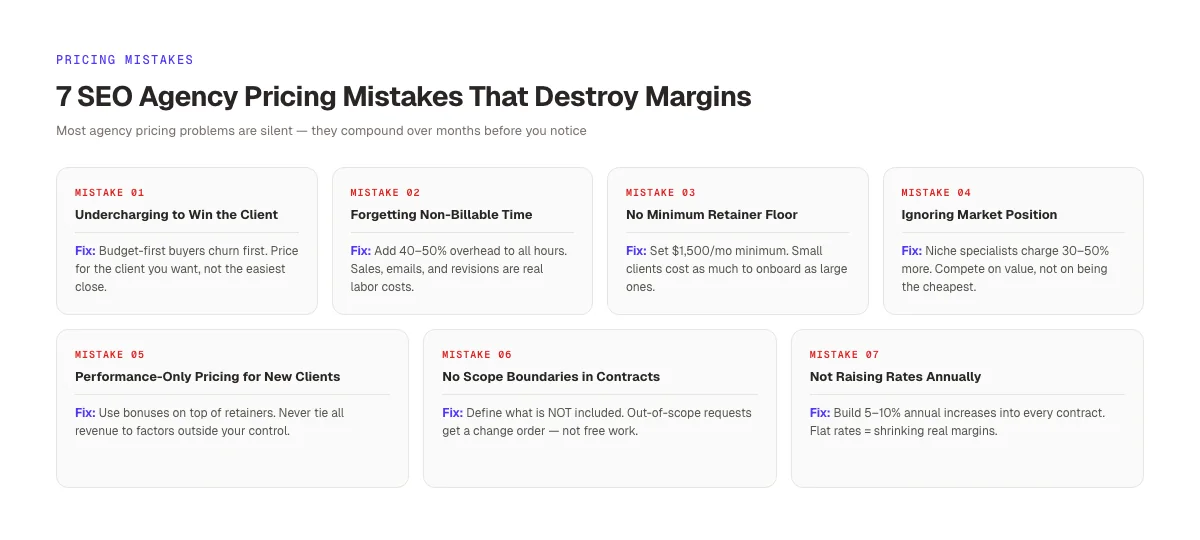
Mistake 1: Undercharging to Win the Client
Dropping price to close a skeptical client rarely works long-term. Budget-first buyers churn earliest, demand the most support, and refer budget-first clients. A $999/month client who leaves in 3 months is worse for your business than no client at all. Because you spent onboarding, reporting, and strategy hours that return nothing.
Price for the client you want to keep, not the easiest one to close.
Mistake 2: Forgetting Non-Billable Time
Most agencies price based on the hours they spend on deliverables. They forget the hours spent on sales calls, proposals, kickoffs, revisions, and client emails. For every 10 billable hours, most agencies spend 4–6 non-billable hours on the same account. That inflates real labor cost by 40–60%.
Account for non-billable overhead before setting any rate.
Mistake 3: No Minimum Retainer Floor
"We work with any budget" destroys margins. A $500/month client typically requires the same onboarding, reporting infrastructure, and communication overhead as a $3,000/month client. At one-sixth the revenue.
Set a minimum and hold it. $1,500/month is a defensible floor for a legitimate SEO operation. Below that, the economics rarely work.
Mistake 4: Ignoring Your Market Position
Agencies that price against their cheapest competitor always lose. There is always someone cheaper somewhere. Pricing based on your unique value. Niche expertise, track record, documented client results. Lets you compete on a dimension that discounters cannot match.
Current SEO trends in 2026 show that agencies with documented results in specific verticals command 30–50% premium pricing over generalists. The premium comes from the answer to one client question: "Have you done this for someone like me before?"
Mistake 5: Performance-Only Pricing for New Clients
Performance-based pricing sounds attractive to clients because they pay for results. The problem: SEO results depend on factors outside the agency's control. Client site speed, content approval delays, algorithm updates, domain authority gaps.
Use performance bonuses as add-ons to retainers. Not as the entire pricing structure. A $3,000 retainer + $500 bonus per 10-position improvement is sustainable. A "you only pay when you rank" model is not.
Mistake 6: No Scope Boundaries in Contracts
Without defined scope, every month brings new requests that expand the workload without expanding the revenue. Scope creep starts as small favors: "can you also take a look at our Google Ads?". And compounds into unpaid overtime.
Every retainer contract needs an explicit "what is not included" clause. Out-of-scope requests get a change order. Not a conversation about whether to do it for free.
Mistake 7: Not Raising Rates Annually
32% of agencies raised their rates in 2025, and 38% planned to do so. Inflation, rising tool costs, and competitive salary expectations make a flat rate schedule a slow margin squeeze. An agency that has not raised rates in 3 years is running at lower real margins each year.
Build annual rate adjustments into contracts from day one. A clause allowing a 5–10% annual increase removes the awkward renegotiation later. Most clients who value the work will accept it. Especially when results are visible.
Chapter 8: How to Raise Rates Without Losing Clients
Rate increases are uncomfortable. They do not have to be catastrophic.
Agencies that raise rates most successfully follow the same pattern: advance notice, a clear reason, and a reference to real results.
The 4-Step Rate Increase Process
Step 1: Give 60–90 days notice. A rate change communicated 2 months in advance gives clients time to budget and signals that you operate as a professional agency. It also removes the emotional sting of a surprise invoice.
Step 2: Anchor the increase to results delivered. "We have driven 2,400 new organic visits and 48 qualified leads for your business over the last 12 months. Our new retainer rate reflects the sustained investment in your account." A client who sees their ROI accepts a rate increase. A client who does not know their ROI fights it.
Step 3: Reference rising costs honestly. Tool costs, team costs, and SEO budget planning all shift year to year. Briefly explaining cost pressures makes you seem transparent. Not opportunistic.
Step 4: Offer a grandfather window for loyal clients. Clients with 2+ years of tenure and a clean payment history can keep the current rate for 6 more months before the new rate takes effect. This rewards loyalty and reduces churn from your most valuable accounts.
Rate increases are not requests for permission. They are announcements of a business decision. Frame them as professional decisions backed by data. And most clients who value the relationship will stay.
For context on how to document the results that justify those increases, our SEO reporting guide covers the metrics that matter most to agency clients.
3,500+ blogs published. Every article is SEO-scored before publish. See what theStacc delivers for your organic growth. Starting at $99/month. See Pricing →
What practitioners are saying on X
Systems and fundamentals still move numbers; AI search adds measurement layers.
- @jakezward (Feb 2026): 2026 SEO predictions emphasize AI Overview share-of-SERP, schema for LLM token efficiency, brand mentions in AI answers as a KPI, proprietary data as a moat, and content refresh beating net-new AI slop. See the post on X.
- @hridoyreh (Mar 2026): Widely shared SEO skill tree: foundations, research, technical, on-page, content, links, AI SEO/GEO, analytics, UX, brand, programmatic — useful map for stats and how-to posts. See the post on X.
- @HlynurStefDev (Jul 2026): Public case: niche site traffic jumped from ~18 to 4,162 Google visits/month after focused technical/on-page SEO work (GSC screenshots claimed) — reminds that fundamentals still move numbers. See the post on X.
Grok, AI Overviews, and multi-engine visibility
For “agency pricing models seo services”, multi-engine visibility still starts with clear definitions, sourced numbers, and extractable section answers. Grok additionally factors live X discussion — keep public claims consistent with this page.
- Google AI Overviews: Use passage-ready answers, tables, and FAQ schema where relevant.
- ChatGPT / Perplexity: Cite named sources next to key claims.
- Grok: Maintain accurate entity facts on-site and in high-signal X posts.
Publish content built for Google and AI citations. theStacc’s Content SEO module ships SEO-scored articles structured for rankings and generative engines — including clearer entity pages models like Grok can quote.
FAQ
The standard range for small-to-mid-size business SEO is $1,500–$5,000 per month. Local SEO for a single-location business typically falls between $1,500 and $2,500. National campaigns start at $3,000–$5,000 and scale from there. Use the base hourly cost formula to establish your floor, then price above it based on the value you deliver. Our SEO cost guide shows what clients expect to pay at each market level.
Monthly retainers dominate the industry. According to a 2025 SE Ranking survey, 78.2% of SEOs charge on a monthly retainer basis. Retainers create predictable agency revenue and a recurring, budgeted investment for the client. Which is why they remain the default pricing structure across the industry.
At minimum: technical SEO monitoring, content production (blog posts or landing pages), on-page optimization for existing pages, and monthly reporting. Higher tiers add link building, competitor analysis, digital PR, and quarterly strategy sessions. Define deliverables precisely in the contract. Vague retainers create scope disputes.
Start by understanding what small businesses are comparing your proposal against. Our done-for-you vs. DIY vs. agency SEO guide covers the full decision framework. Most small businesses have budgets of $500–$2,500 per month. If your cost floor is above $1,500, target small businesses where the scope actually fits that range. Not ones who want full-service SEO at $500.
Yes. Performance-based pricing puts agency revenue at the mercy of factors the agency does not fully control. Algorithm updates, client site performance, seasonal demand shifts. Use performance bonuses layered on top of a base retainer rather than as the sole pricing mechanism. Reserve pure performance deals for accounts where you have strong historical data, full execution control, and a client relationship built on demonstrated results.
Closing
Agency pricing is the foundation every other business decision rests on. Set it correctly and you can hire, grow, and serve clients at a high level. Set it wrong and every new client adds pressure instead of margin.
Pick one primary pricing model, calculate your true cost floor, package your services into clear tiers, and build annual rate adjustments into your contracts from day one. That is the difference between an agency that compounds and one that grinds.
Related Tools & Resources
Free SEO Tools:
Best Lists:
Sources & references
- [1] Princeton / Georgia Tech et al. — GEO research (arXiv:2311.09735)
- [2] @hridoyreh on X — Widely shared SEO skill tree: foundations, research, technical, on-page, content, links, AI SEO/GEO, analytics, UX, bran
- [3] @jakezward on X — 2026 SEO predictions emphasize AI Overview share-of-SERP, schema for LLM token efficiency, brand mentions in AI answers
- [4] Referenced source — seranking.com

Plan topics, review article drafts, and publish to a connected CMS.
Weekly local SEO teardowns
One practical email a week. Map Pack, GBP, AI Overviews. No fluff. Unsubscribe anytime.