
How to Build an SEO Team in 8 Steps (2026)
Learn how to build an SEO team in 8 practical steps. Covers roles, salaries, hiring, tech stack, workflows, and scaling with 2026 cost benchmarks.
You know SEO matters. You also know your current setup is not working.
Maybe you have 1 person doing everything. Maybe nobody owns SEO at all. Either way, organic traffic stays flat while competitors pull ahead.
The cost of doing nothing is real. Companies without a dedicated SEO function miss 53% of all website traffic that starts with an organic search. That gap compounds every quarter you wait.
This guide gives you the exact 8-step process to build an SEO team that produces results. No theory. No org-chart fantasies. Just a practical framework you can start using this week.
We publish 3,500+ blog posts across 70+ industries at Stacc. We have seen what works inside small teams and enterprise departments alike. The patterns are consistent.
Here is what you will learn:
- How to define your SEO goals before making a single hire
- The 6 core roles every SEO team needs (and which to fill first)
- In-house vs. agency vs. hybrid: real cost comparisons
- How to hire for skills that actually move rankings
- The tech stack and workflows that keep a team productive
- How to scale from a team of 1 to a team of 10+
Overview: What You Need Before You Start
Time required: 2 to 4 weeks for planning and first hires. 3 to 6 months to reach full capacity.
Difficulty: Intermediate. Requires budget authority and hiring access.
What you will need:
- Access to your analytics (GA4, Search Console)
- A clear SEO budget allocation
- Approval from leadership for headcount or contractor spend
- A list of your top 10 competitor domains
Step 1: Define Your SEO Goals and Scope
Most teams fail before they start because nobody defined what “SEO success” means. A vague goal like “get more traffic” leads to unfocused hiring, scattered priorities, and burned budget.
Start with 3 questions:
- What is the business outcome? Revenue from organic leads, reduced cost per acquisition, or market share in a specific vertical.
- What channels matter? Blog content, local search, product pages, or all 3.
- What is the timeline? SEO compounds over time. Expect 3 to 6 months for measurable results.
Write this down in a 1-page brief. Share it with every stakeholder. This document becomes your hiring filter.
Specifically:
- Set 1 primary KPI (organic revenue, organic traffic, or keyword rankings)
- Set 2 supporting KPIs (click-through rate, conversion rate, or domain authority)
- Define which pages or sections of your site drive the most value
- Identify your top 5 keyword clusters using a keyword research process
| Goal Type | Primary KPI | Timeline |
|---|---|---|
| Lead generation | Organic leads per month | 4 to 6 months |
| Ecommerce revenue | Organic revenue | 3 to 6 months |
| Brand visibility | Non-branded organic traffic | 6 to 12 months |
| Local dominance | Local pack rankings | 2 to 4 months |
Why this step matters: Without defined goals, you will hire the wrong people. A team built for content production looks different from a team built for technical SEO. Get the goals right first.
Pro tip: Tie your SEO KPIs to a revenue number. “Increase organic traffic 40%” is good. “Generate $200K in organic pipeline” gets budget approved faster.
Step 2: Audit Your Existing SEO Resources
Before you hire anyone, map what you already have. Most companies undercount their existing SEO resources. And most overestimate what they need to buy.
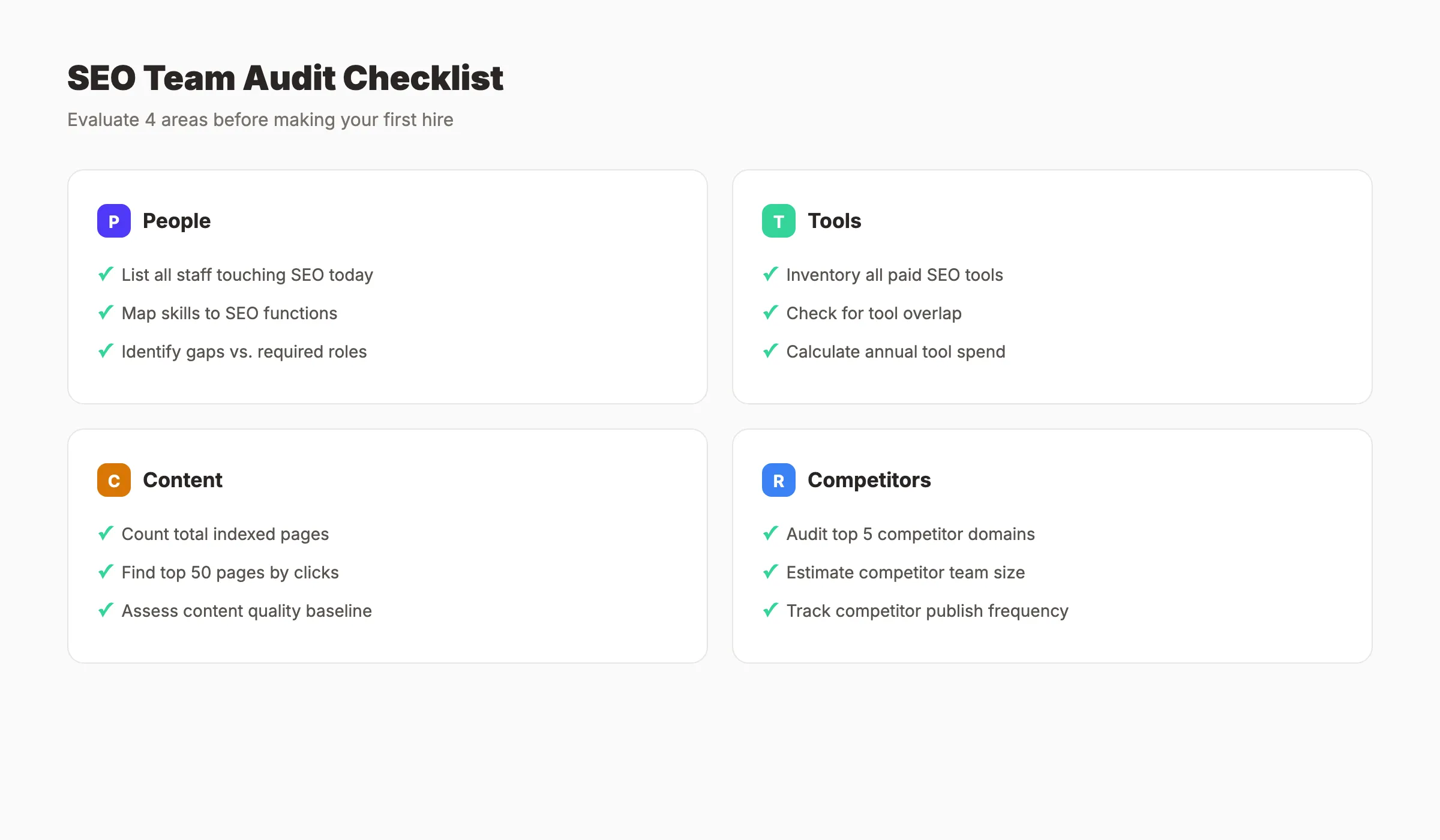
Run a 4-part audit:
People: Who currently touches SEO? Developers, content writers, marketers, product managers. List every person and what they contribute today.
Tools: What SEO tools do you already pay for? Google Search Console, GA4, Ahrefs, Semrush, Screaming Frog. Note overlap and gaps.
Content: How many pages does your site have? How many generate organic traffic? Use Search Console to find your top 50 pages by clicks. This reveals your content strengths.
Competitors: Audit your top 5 competitors. How many people are on their SEO teams? How often do they publish? What content types do they produce? Use tools like Ahrefs or Semrush to analyze competitor keywords.
Specifically:
- Export your Search Console performance data for the last 12 months
- List every team member who currently contributes to SEO
- Inventory all paid SEO tools and annual costs
- Run a site crawl to identify technical health baseline
- Pull competitor organic traffic estimates
Why this step matters: Hiring without auditing wastes money. You may already have a developer who can handle technical SEO. You may already own tools nobody uses. The audit prevents duplicate spending and reveals the real gaps.
Step 3: Map the Core SEO Roles You Need
An SEO team needs 6 core functions. Not 6 people. In a small team, 1 person may cover 2 or 3 functions. In a large team, each function may have its own specialist.
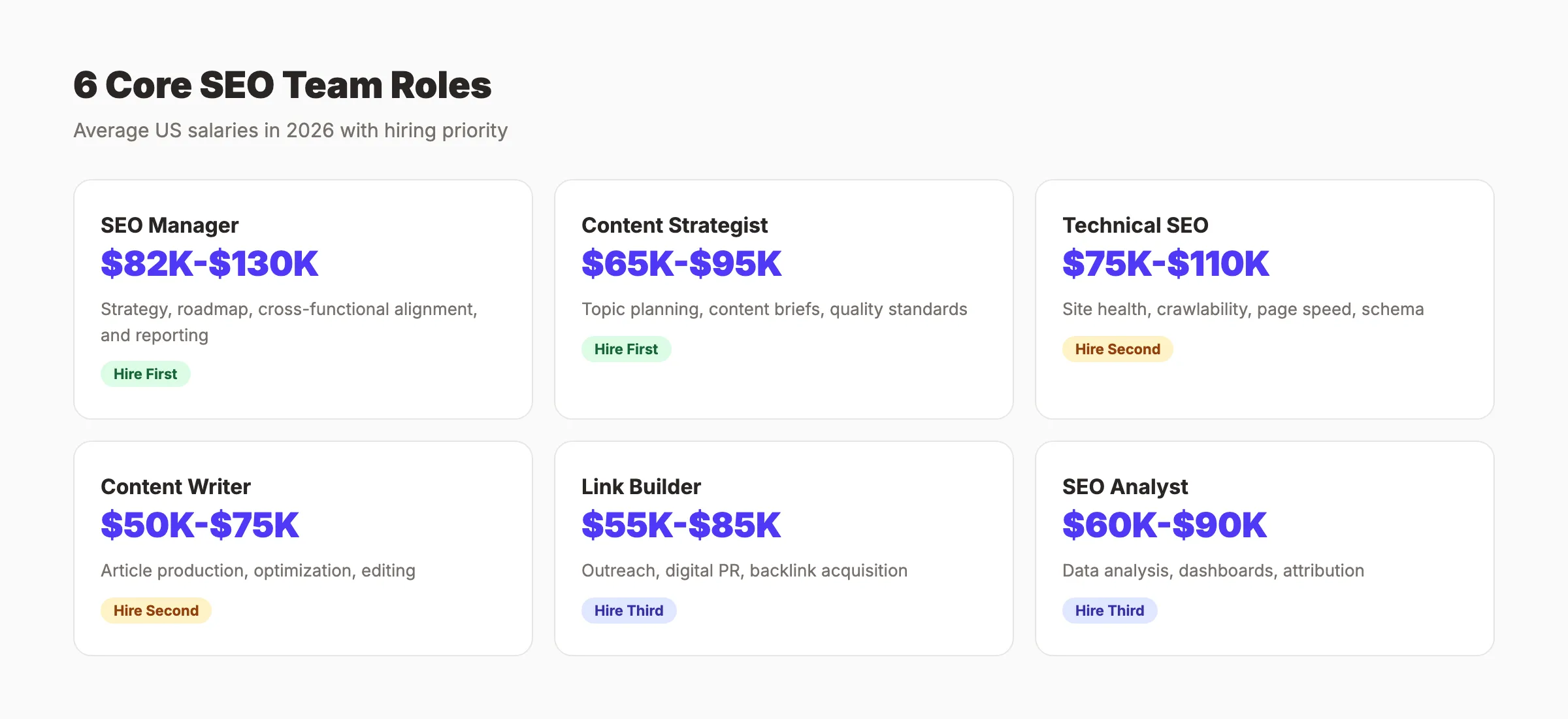
Here are the 6 functions, ranked by hiring priority:
| Role | Function | Avg. US Salary (2026) | Hire First If… |
|---|---|---|---|
| SEO Manager | Strategy, roadmap, reporting | $82,000 to $130,000 | You have no SEO leadership |
| Content Strategist | Topic planning, briefs, quality | $65,000 to $95,000 | Content is your main growth lever |
| Technical SEO Specialist | Site health, speed, crawlability | $75,000 to $110,000 | Your site has technical debt |
| Content Writer | Article production, optimization | $50,000 to $75,000 | You need volume |
| Link Building Specialist | Outreach, digital PR, backlinks | $55,000 to $85,000 | Your domain authority is low |
| SEO Analyst | Data, dashboards, reporting | $60,000 to $90,000 | You need attribution clarity |
Salary data sourced from an analysis of 3,900 SEO job listings in 2026. Senior leadership roles now account for 59% of all SEO job listings. That signals a market shift toward experienced hires over junior volume.
For small businesses: Start with 1 SEO generalist who can handle strategy, content planning, and basic technical fixes. Add specialists as revenue grows. Or skip hiring entirely and automate your SEO workflow with a service like Stacc.
For mid-market companies: Hire an SEO manager first. Then add a content writer and a technical specialist within 90 days.
For enterprise: Build a pod structure with dedicated specialists in each function. Most enterprise SEO teams run 5 to 20 people across markets, according to Conductor research.
Why this step matters: Hiring without a role map creates overlap and gaps. Two people doing keyword research while nobody handles link building is a common failure pattern.
Pro tip: In 2026, add GEO (Generative Engine Optimization) to your requirements. AI search is reshaping SEO roles. Your team needs at least 1 person who understands how AI Overviews and LLMs process content.
Step 4: Choose Your Team Model
You have 3 options. Each has real trade-offs in cost, control, and speed.
Option A: In-House Team
You hire full-time employees. They report to you. You control everything.
Cost: $250,000 to $500,000+ per year for a full team including salaries, benefits, tools, and management overhead. That number comes from industry cost analysis covering 2026 data.
Best for: Companies with $5M+ revenue, long-term SEO investment commitment, and complex technical needs.
Downside: Slow to hire. High fixed costs. Requires management bandwidth.
Option B: Agency or Service
You outsource SEO to an agency or done-for-you service. They execute. You review.
Cost: $1,000 to $12,000+ per month depending on scope. A content-focused service like Stacc starts at $99 per month for 30 articles.
Best for: Small to mid-size businesses, companies that need speed, teams with no in-house content capacity.
Downside: Less control over daily execution. Quality varies by provider.
Option C: Hybrid Model
You keep strategy and management in-house. You outsource execution (content production, link building, technical audits) to specialists.
Best for: Most companies. This is the model that balances cost and control.
| Model | Annual Cost | Time to Results | Control Level |
|---|---|---|---|
| Full in-house | $250K to $500K+ | 3 to 6 months | High |
| Agency/Service | $12K to $144K | 1 to 3 months | Medium |
| Hybrid | $100K to $300K | 2 to 4 months | High |
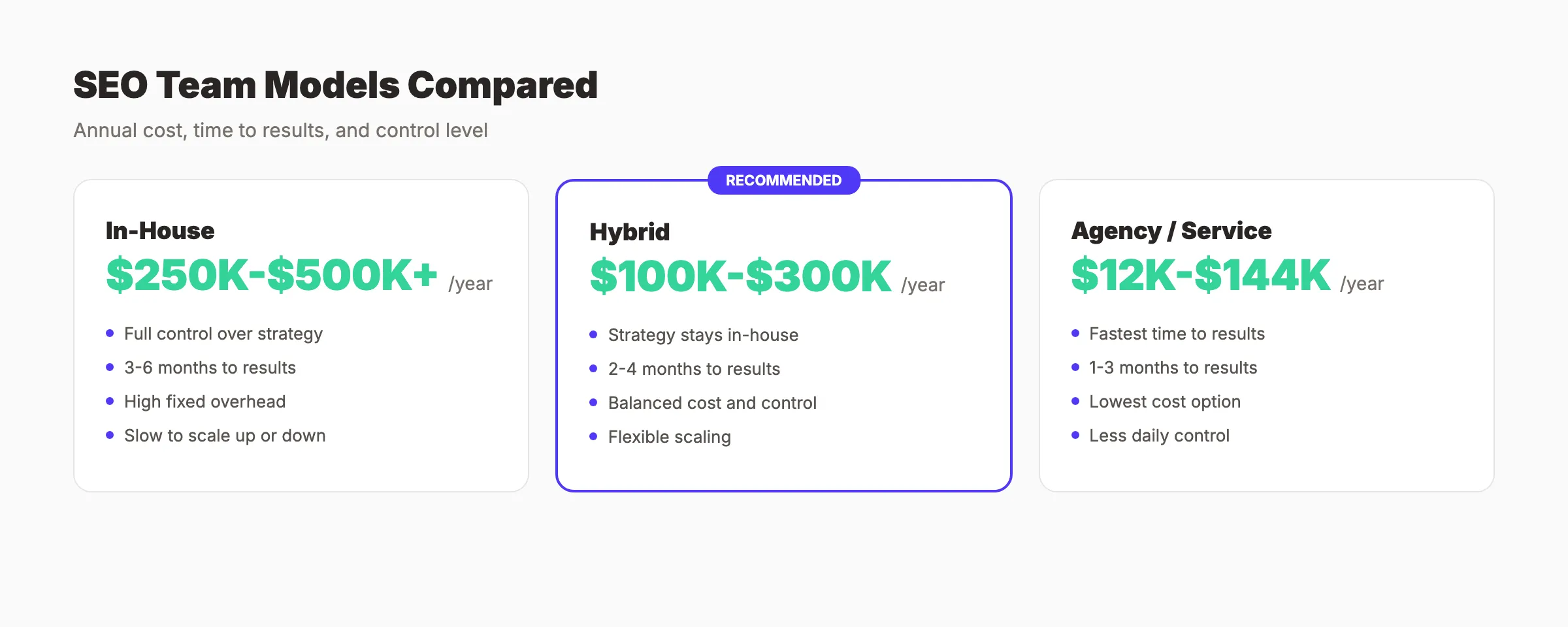
The hybrid approach works because it lets you invest in strategic thinking while outsourcing the volume work. A single SEO manager paired with a content automation service can produce the output of a 5-person team.
Why this step matters: The wrong model drains budget without producing results. An enterprise trying to run SEO with just an agency loses strategic alignment. A small business hiring 3 full-time SEO specialists burns cash on overhead.
Building an SEO team does not have to cost $250K. Stacc handles content production, optimization, and publishing for your team. 30 articles per month. $99. Start for $1 →
Step 5: Hire for Skills, Not Just Titles
Job titles in SEO are meaningless. One company’s “SEO Manager” is another company’s “Content Coordinator.” Focus on skills instead.
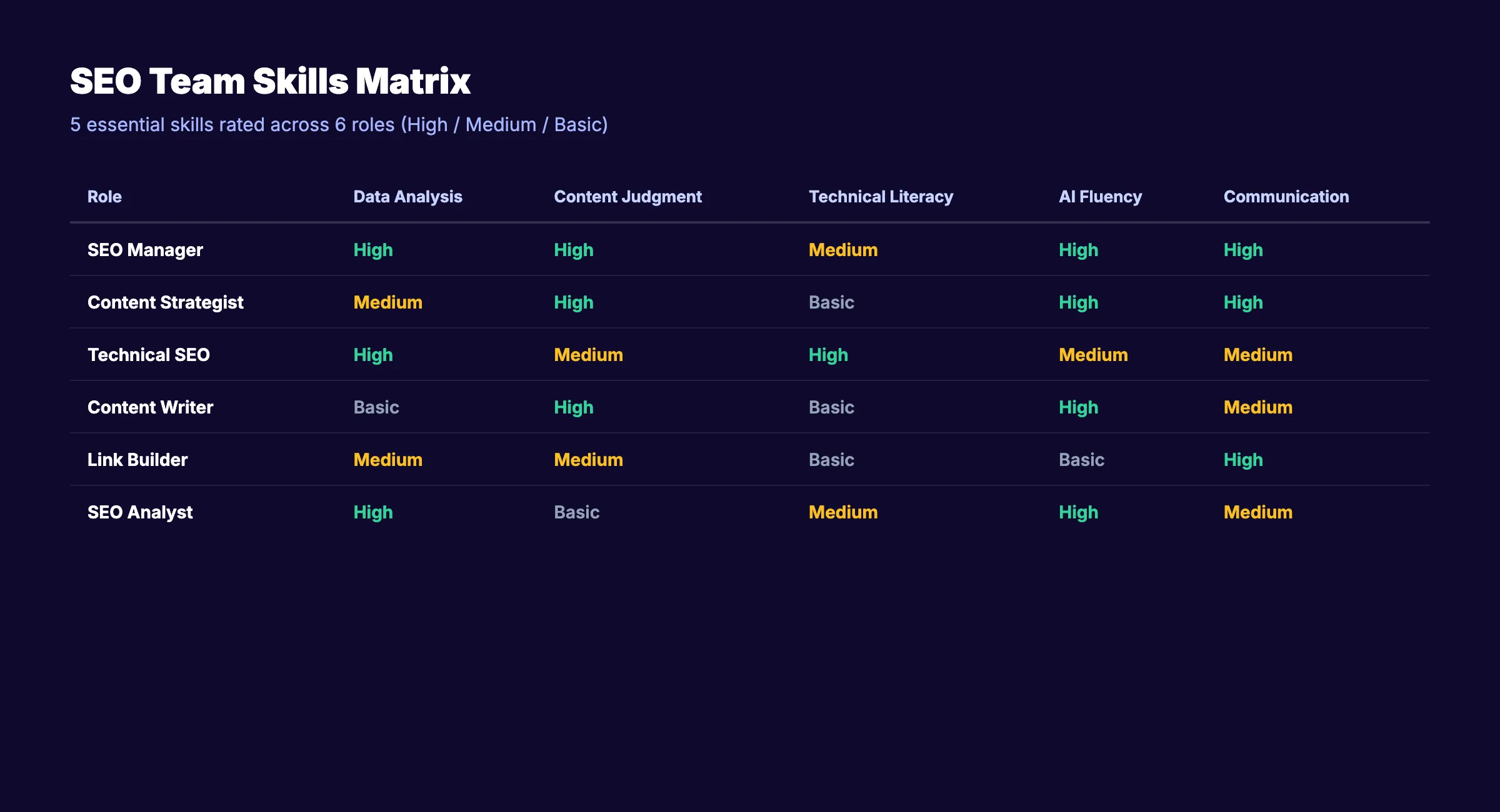
Here are the 5 non-negotiable skills for every SEO hire in 2026:
1. Data analysis. Every SEO role requires the ability to read GA4, Search Console, and ranking data. Someone who cannot interpret a traffic drop is not ready.
2. Content judgment. Even technical SEOs need to evaluate whether content matches search intent. This skill separates functional teams from failing ones.
3. Technical literacy. Your content people do not need to code. But they need to understand page speed, crawl budgets, and on-page SEO fundamentals. Your technical people need deep platform knowledge.
4. AI fluency. According to the Search Engine Journal State of SEO 2026 report, 78% of SEO teams now use AI tools daily. Hire people who know how to use AI SEO agents and understand content governance for AI workflows.
5. Communication. SEO is cross-functional. Your team will work with developers, designers, product managers, and executives. People who cannot explain SEO priorities in business terms will fail.
Specifically:
- Create a skills matrix for each role (map skills to job requirements)
- Include a practical test in every interview (analyze this Search Console report, audit this page)
- Ask for specific results with numbers (not just responsibilities)
- Check for AI tool experience and specific workflows
Why this step matters: A bad hire costs 6 to 12 months of lost progress. Skills-based hiring reduces that risk. Title-based hiring amplifies it.
Pro tip: The best SEO candidates have built something. A personal blog that ranks. A client project with documented results. Ask to see the work.
Step 6: Set Up Your SEO Tech Stack
A team without tools is a team doing manual work at half speed. But a team with 15 overlapping subscriptions is wasting budget.
Here is the essential SEO tech stack organized by function:
Research and Analysis
- Google Search Console (free). Your single source of truth for organic performance
- GA4 (free). Traffic, conversions, and user behavior
- Ahrefs or Semrush ($99 to $449 per month). Keyword research, backlink analysis, competitor tracking
Content Production
- Content brief tool (Frase, Clearscope, or Surfer). Standardizes content quality
- CMS with SEO features. WordPress, Webflow, or Ghost
- Automated publishing service. Stacc publishes 30+ SEO-optimized blog posts per month
Technical SEO
- Screaming Frog ($259 per year). Site crawling and technical audits
- PageSpeed Insights (free). Core Web Vitals monitoring
- Schema markup tools. For structured data implementation
Reporting
- Looker Studio (free). Custom SEO dashboards and reports
- Rank tracking tool. Ahrefs, Semrush, or dedicated trackers like AccuRanker
| Stack Level | Monthly Cost | Best For |
|---|---|---|
| Starter (free tools + 1 paid) | $0 to $99 | Solo operators, small businesses |
| Growth (3 to 4 tools) | $200 to $500 | Mid-size teams, agencies |
| Enterprise (full suite) | $500 to $2,000+ | Large teams, multi-market operations |
Why this step matters: Tools multiply output. One analyst with the right tools produces better insights than 3 analysts using spreadsheets. But tool sprawl kills budgets. Audit your stack every quarter.
Pro tip: Start with Google Search Console, GA4, and 1 paid tool. Add more only when a specific workflow demands it. Every tool should have a named owner on your team.
Skip the content production tools entirely. Stacc handles keyword research, writing, optimization, and publishing. Your team focuses on strategy. Start for $1 →
Step 7: Build Workflows and Reporting Cadences
Talent and tools do not produce results without process. The difference between a productive SEO team and a chaotic one is documented workflows.
Weekly Rhythm
Every SEO team needs a weekly standup. Keep it under 30 minutes. Cover 3 things:
- What shipped last week? (articles published, pages optimized, links built)
- What is blocked? (developer tickets, content approvals, tool access)
- What ships this week? (specific deliverables with owners)
Monthly Reporting
Build a monthly SEO report that covers:
- Organic traffic (total and by landing page)
- Keyword rankings (movement by cluster)
- Content production (articles published vs. planned)
- Content ROI (leads or revenue from organic)
- Technical health (crawl errors, page speed scores)
Quarterly Planning
Every quarter, review your content marketing strategy and adjust. Questions to answer:
- Which content clusters drove the most organic traffic?
- Which keywords moved into the top 10?
- Where did competitors gain ground?
- What new opportunities emerged from SEO trend shifts?
Content Production Workflow
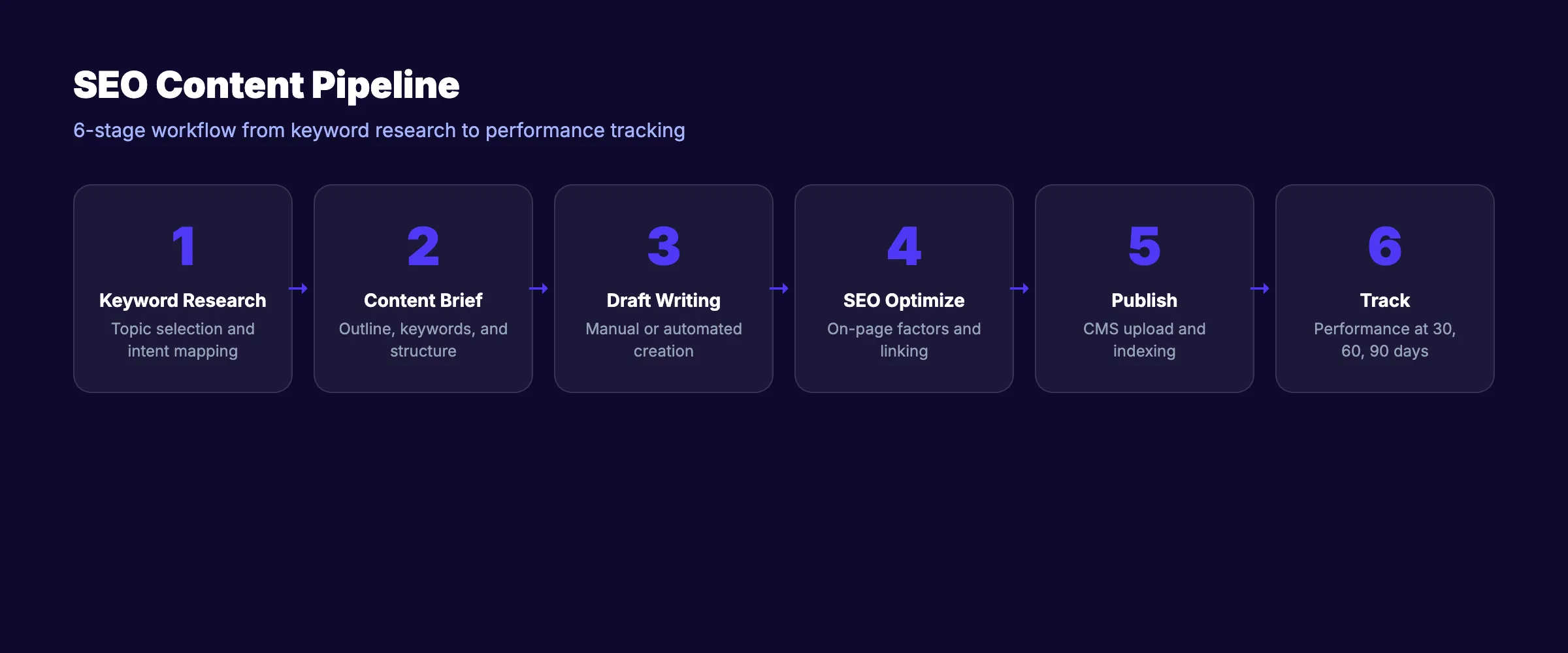
Map your content pipeline from idea to published page:
- Keyword research and topic selection
- Content brief creation
- Draft writing (or automated creation)
- SEO optimization and editing
- Publishing and internal linking
- Performance tracking at 30, 60, and 90 days
Specifically:
- Document every recurring workflow in a shared wiki or project tool
- Assign a single owner to every deliverable
- Set publishing frequency targets (companies that blog 11+ times per month get 3.5x more traffic)
- Create templates for briefs, reports, and audits
Why this step matters: Process turns a group of specialists into a team. Without it, you get duplicated effort, missed deadlines, and no accountability. With it, you get compounding output.
Step 8: Scale and Optimize Over Time
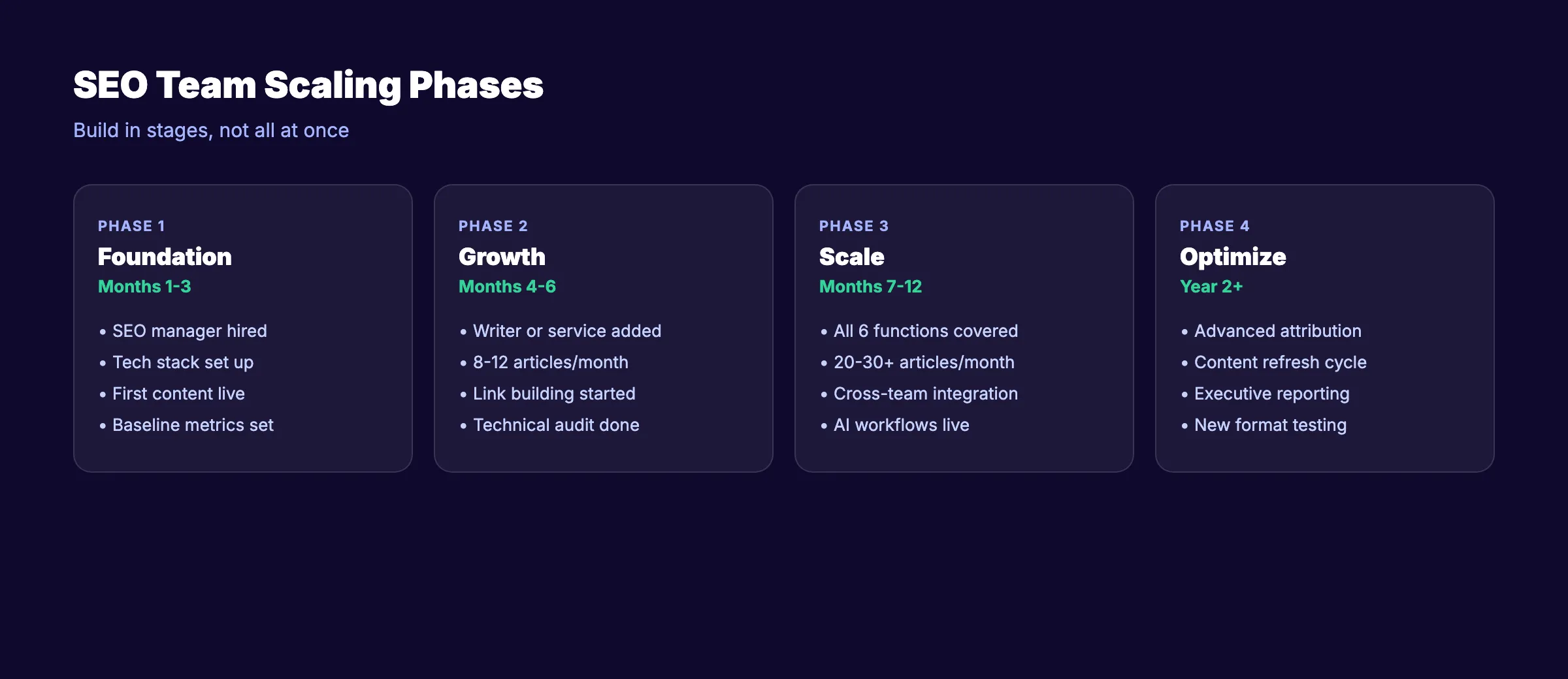
Your SEO team at month 1 should not look like your team at month 12. Build in phases.
Phase 1: Foundation (Months 1 to 3)
- SEO manager or generalist in place
- Tech stack operational
- First content published
- Baseline metrics recorded
Phase 2: Growth (Months 4 to 6)
- Content writer or production service added
- Publishing frequency at 8 to 12 articles per month
- Link building program started
- Technical SEO audit completed
Phase 3: Scale (Months 7 to 12)
- Full role coverage (all 6 functions staffed or outsourced)
- Publishing frequency at 20 to 30+ articles per month
- Cross-functional integration with product and development teams
- AI workflows integrated for research and optimization
Phase 4: Optimization (Year 2+)
- Advanced attribution modeling
- Content refresh and pruning program
- SEO ROI reporting at the executive level
- Testing new formats (video, podcasts, interactive tools)
Why this step matters: Teams that try to do everything at once burn out and fail. Phased scaling builds momentum and lets you learn from data before investing more.
Pro tip: Revisit your team model every 6 months. A hybrid team that starts with an agency for content production may later bring content in-house as revenue grows. Stay flexible.
Stacc scales with your team. Start at 30 articles per month and grow to 80. No extra hires needed. Your SEO manager directs strategy. We handle production. Start for $1 →
Results: What to Expect
After completing these 8 steps, here is a realistic timeline:
- Week 1 to 2: Goals defined, audit complete, roles mapped
- Month 1 to 2: First hires or service contracts in place. Tech stack operational. First content published.
- Month 3 to 4: Publishing cadence established. Initial keyword movement visible in Search Console.
- Month 6: Measurable organic traffic growth. First leads or revenue attributed to SEO.
- Month 12: Compounding returns. Your blog generates consistent organic traffic and inbound leads.
SEO is not a quick win. It is a compounding asset. Every article published, every page optimized, and every link built stacks on the last. Teams that stick with the process for 12 months see the strongest return on investment.
Frequently Asked Questions
How many people do you need on an SEO team?
That depends on your company size and goals. A small business can start with 1 SEO generalist plus a content production service. Mid-size companies typically need 3 to 5 people. Enterprise teams run 5 to 20+ across markets. The key is covering all 6 core functions, not filling a specific headcount.
How much does it cost to build an SEO team?
A full in-house SEO team costs $250,000 to $500,000 per year in the US including salaries, benefits, and tools. A hybrid model using 1 to 2 in-house staff plus an outsourced content service costs $100,000 to $200,000. A fully outsourced approach with a service like Stacc starts at $99 per month for 30 articles.
Should I hire an SEO agency or build an in-house team?
Neither is universally better. Agencies deliver faster results and lower upfront cost. In-house teams offer more control and deeper institutional knowledge. Most companies get the best results from a hybrid model: in-house strategy with outsourced execution. Read our full comparison in the in-house vs. outsource guide.
What should I look for when hiring an SEO manager?
Look for 3 things: a track record of measurable results (specific rankings and traffic numbers), the ability to explain SEO strategy to non-technical stakeholders, and experience with AI-driven SEO workflows. Ask candidates to present a case study from their previous work. Avoid candidates who only talk about theory.
How long does it take for an SEO team to show results?
Most SEO teams see initial keyword movement within 60 to 90 days of consistent publishing. Meaningful traffic growth typically appears at 4 to 6 months. Compounding returns, where SEO becomes a reliable lead channel, usually start around month 9 to 12. Consistency matters more than speed.
Building an SEO team is not about filling seats. It is about assembling the right skills, choosing the right model, and building workflows that compound over time.
Start with Step 1. Define your goals. Audit what you have. Then build from there.
Your SEO team starts here. Stacc publishes 30 to 80 SEO articles per month so your team can focus on strategy, not production. Start for $1 →

Written by
Siddharth GangalSiddharth is the founder of theStacc and Arka360, and a graduate of IIT Mandi. He spent years watching great businesses lose organic traffic to competitors who simply published more. So he built a system to fix that. He writes about SEO, content at scale, and the tactics that actually move rankings.

30 SEO blog articles published every month
Keyword-optimized, scheduled, and live on your site. Automatically.
30-day trial · Cancel anytime
theStacc
Stop writing SEO content manually
30 blog articles, 30 GBP posts, and social media content. Published every month. Automatically.
Start Your $1 Trial$1 for 3 days · Cancel anytime