
9 SEO Trends Shaping 2026 (Data-Backed)
Practical seo trends 2026 strategies for 2026: step-by-step tactics, real examples, and tools to improve rankings and drive organic traffic.
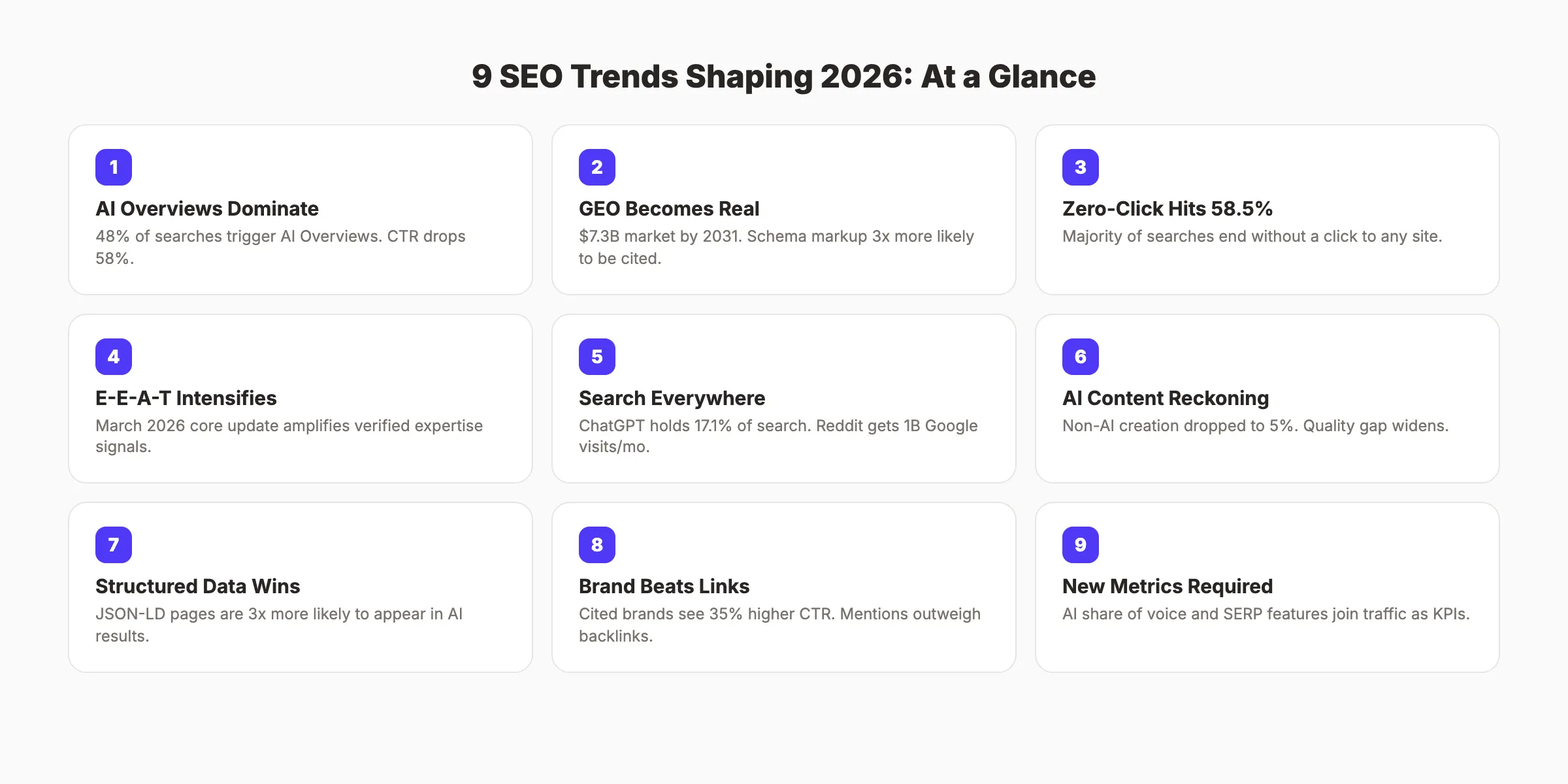
SEO trends 2026 come down to one shift: Google is answering questions directly instead of sending traffic to websites. AI Overviews now trigger on 48% of all searches. Zero-click rates hit 58.5% in the US. And 61% of marketers say this is the biggest disruption the industry has seen in 20 years.
The old model of “rank #1, get traffic” still works. But it works differently. The rules are changing, and the data shows exactly how.
This post identifies 9 SEO trends reshaping search in 2026. Each one is backed by specific data from Ahrefs, Semrush, BrightEdge, HubSpot, and SparkToro. No speculation. No vague predictions. Just what the numbers reveal.
We have published 3,500+ SEO articles across 70+ industries. We track ranking performance, traffic patterns, and AI citation rates daily. These trends are what we see in real data, not just industry headlines.
Here is what you will learn:
- How AI Overviews are reshaping organic click-through rates
- Why Generative Engine Optimization (GEO) is now a real discipline
- What the zero-click explosion means for your content strategy
- How E-E-A-T requirements intensified after the March 2026 core update
- Which metrics replace traditional organic traffic in the new era
Trend 1: AI Overviews Dominate Informational Search
The trend: Google AI Overviews now appear on nearly half of all searches, fundamentally changing how organic results perform.
The data:
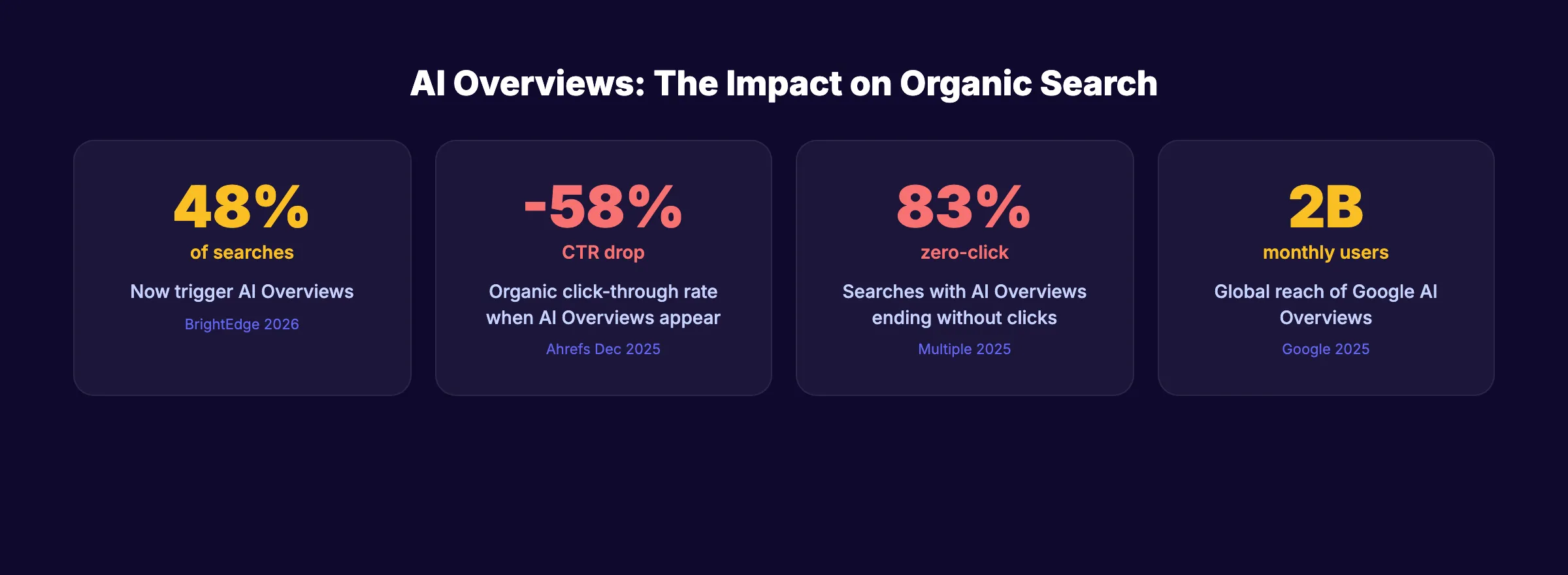
- AI Overviews trigger on 48% of all Google searches, up 58% year-over-year (BrightEdge)
- 88% of queries triggering AI Overviews have informational intent
- AI Overviews reach 2 billion monthly users globally (Google)
- Organic CTR drops 58% on queries where AI Overviews appear (Ahrefs, December 2025)
Why this is happening: Google launched AI Overviews to compete with ChatGPT and Perplexity. The feature answers informational queries directly in the search results. Users get what they need without clicking through to a website. Google keeps users on its platform longer and shows more ads.
What this means for your business: Informational blog posts that once drove traffic now compete with Google’s own summary. The impact is not uniform. Commercial and transactional queries still send clicks. Local searches still drive calls and visits. The hardest-hit content is pure informational (“what is X” and “how does X work”).
Adjust your content mix. Prioritize commercial keywords where searchers need to compare, evaluate, or purchase. Target local keywords where Google shows map results. Informational content still has value for topical authority and brand awareness, but expect less direct traffic from it. For a full guide on adapting, see our post on optimizing for AI Overviews.
Trend 2: Generative Engine Optimization Becomes Real
The trend: GEO (Generative Engine Optimization) moved from buzzword to measurable discipline with dedicated tools, metrics, and career roles.
The data:
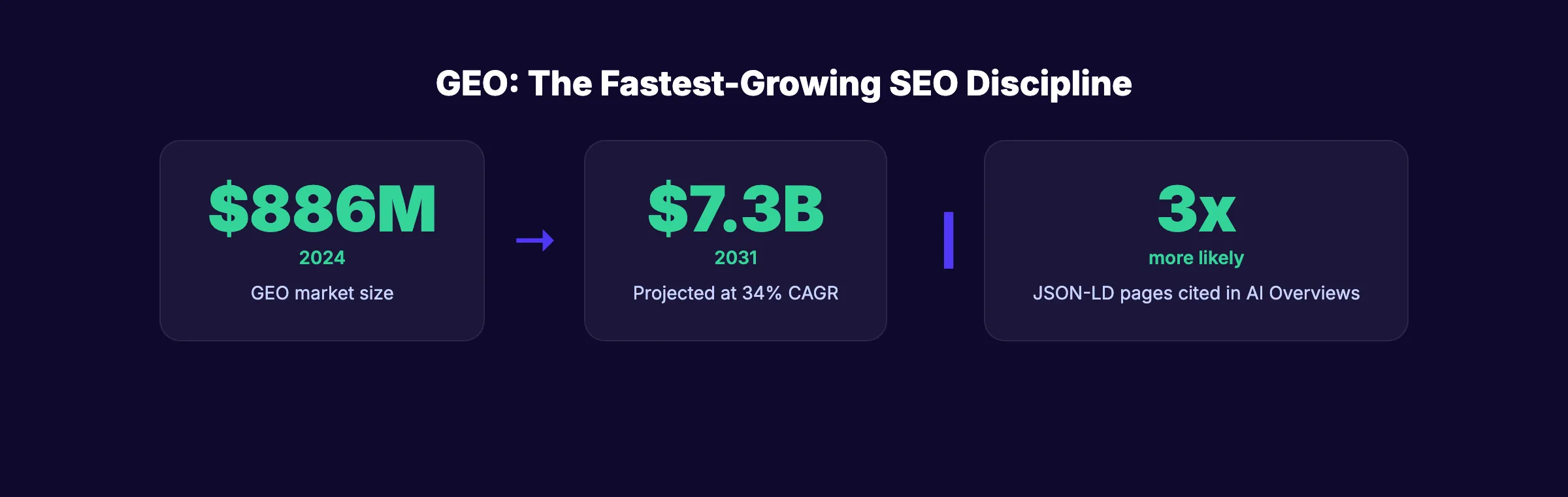
- The GEO market is projected at $7.3 billion by 2031 at 34% CAGR
- 85% of AI Overview citations come from content published in the last 2 years (Seer Interactive)
- Pages with JSON-LD structured data are 3x more likely to appear in AI Overviews (Position Digital)
- Brands cited in AI Overviews see 35% higher organic CTR on their traditional results (BrightEdge)
Why this is happening: AI search engines (Google AI Overviews, ChatGPT, Perplexity, Gemini) select sources differently than traditional search. They prioritize content depth, clear structure, authoritative sourcing, and machine-readable markup. Traditional SEO alone does not guarantee AI citation.
What this means for your business: Optimizing for AI citation is now a distinct activity. Add schema markup to every page. Structure content with clear H2/H3 hierarchies. Include specific data points with sources. Write content designed to be cited by AI. The businesses that appear in AI Overviews gain both visibility and a halo effect that lifts their organic CTR on traditional results.
For a detailed comparison, see our guide on GEO vs SEO.
Your SEO team. $99 per month. 30 optimized articles published automatically. Built for the AI search era. Start for $1 →
Trend 3: Zero-Click Search Hits 58.5%
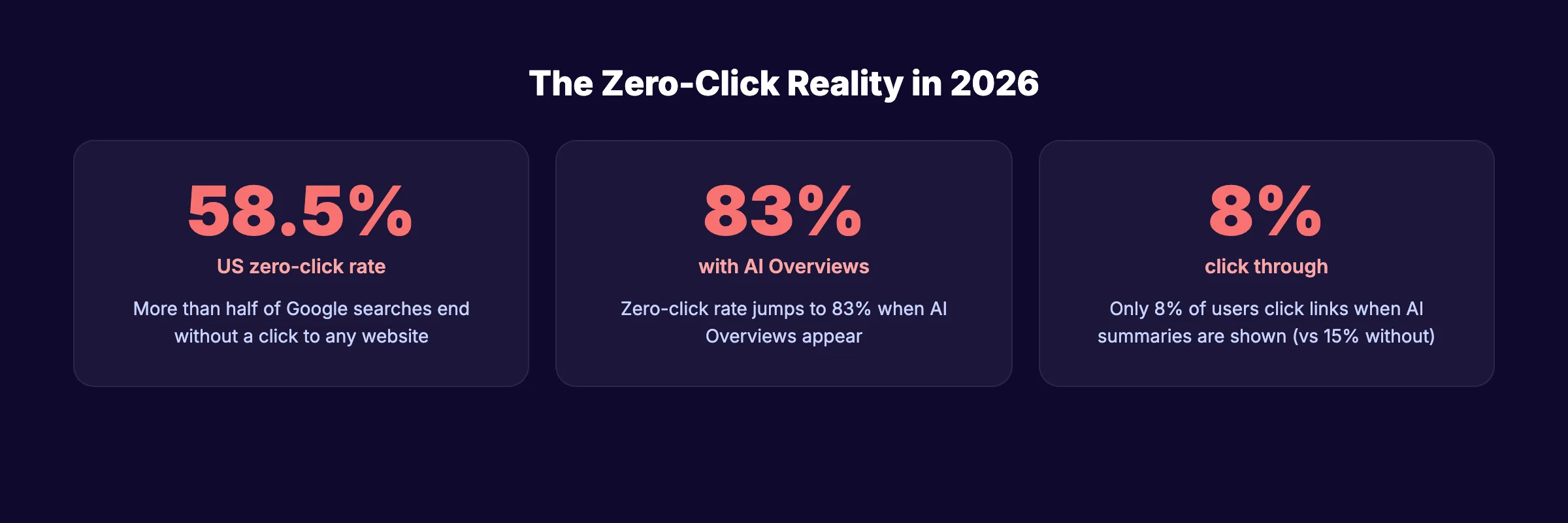
The trend: More than half of all Google searches end without a click to any website.
The data:
- 58.5% of US Google searches result in zero clicks (SparkToro/Datos)
- 59.7% of EU searches end without clicks
- Searches with AI Overviews have an 83% zero-click rate
- Only 8% of users click traditional links when AI summaries appear, compared to 15% without (Pew Research)
Why this is happening: Google provides more answers directly in the search results. Featured snippets, Knowledge Panels, People Also Ask boxes, and AI Overviews all satisfy user queries without requiring a click. Google’s revenue model benefits from keeping users on its platform.
What this means for your business: Traffic is no longer the only SEO success metric. Visibility matters even when users do not click. Your brand name appearing in an AI Overview or featured snippet builds recognition. Track impressions, SERP feature appearances, and brand search volume alongside traffic. See our full breakdown of zero-click search strategies. Focus content investment on commercial and transactional queries where clicks still happen.
Trend 4: E-E-A-T Enforcement Intensifies
The trend: Google’s March 2026 core update amplified Experience, Expertise, Authoritativeness, and Trustworthiness signals more aggressively than any previous update.
The data:
- The March 2026 core update specifically targets “relevant, satisfying, high-quality content”
- Sites with AI-generated content and minimal editorial oversight saw the sharpest ranking declines
- Named authors with verifiable credentials outperform anonymous content across every niche tested
- 92% of marketers plan to optimize for both traditional and AI search in 2026 (HubSpot)
Why this is happening: The flood of AI-generated content in 2024-2025 forced Google to differentiate between content that demonstrates real expertise and content that merely sounds authoritative. Google now looks for verifiable signals: author credentials, cited sources, original research, and first-hand experience markers.
What this means for your business: Every blog post needs a named author with a bio. Include credentials relevant to the topic. Cite specific sources for claims. Share first-hand experience whenever possible.
Generic, authorless content no longer performs. If your blog posts list “Admin” or “Staff” as the author, fix that immediately. Google looks for author entities that exist across the web. An author with a LinkedIn profile, industry mentions, and consistent publishing history signals real expertise. For implementation details, see our guide on E-E-A-T for blogs and our quality guidelines overview.
Trend 5: Search Happens Everywhere, Not Just Google
The trend: Users now search across YouTube, TikTok, Reddit, ChatGPT, and Amazon. Google is no longer the only search engine that matters.
The data:
- ChatGPT holds 17.1% of all digital search volume (Circles Studio)
- ChatGPT processes 2.5 billion daily prompts, with 31% triggering web search (Nectiv)
- 40% of Americans use at least one AI chatbot monthly (SparkToro)
- Reddit receives 1 billion organic monthly visits via Google (Ahrefs)
- AI search traffic grew 527% year-over-year (Search Engine Land)
Why this is happening: Different platforms serve different search intents better than Google. YouTube for how-to content. Reddit for authentic opinions. TikTok for discovery. ChatGPT for research and comparison. Users go where they get the best answers fastest.
What this means for your business: Optimize content for multiple platforms, not just Google. Ensure AI crawlers can access your site. Consider adding an llms.txt file to help AI systems understand your content.
Repurpose blog content into formats that work on YouTube, Reddit, and social platforms. A single blog post can become a YouTube script, a Reddit discussion starter, and 5 social media posts. Track referral traffic from AI chatbots alongside traditional organic traffic. Our guide on tracking AI search visibility covers the exact metrics to monitor.
3,500+ blogs published. 92% average SEO score. Every article passes a 40-point quality audit before it goes live. Start for $1 →
Trend 6: AI Content Faces a Quality Reckoning
The trend: AI-generated content is everywhere. But the gap between AI content that ranks and AI content that fails is widening.
The data:
- Non-AI blog creation dropped from 65% to just 5% of all new content published (DemandSage)
- 80%+ of marketers use AI for content creation (DemandSage)
- 56% of marketers use generative AI specifically for SEO tasks (DemandSage)
- AI SEO companies report difficulty re-signing clients after initial contracts (Marketer Milk)
Why this is happening: The initial wave of AI content flooded the web with generic, shallow articles. Google’s algorithm updates now penalize this content. What works is AI-assisted content with human expertise layered on top: original insights, real data, first-hand experience, and editorial judgment.
What this means for your business: Using AI to draft content is fine. Publishing unedited AI output is not. Every article needs human review for accuracy, brand voice, and originality. Add unique data, examples, and perspectives that AI cannot generate on its own.
The winning formula is speed from AI plus depth from humans. Draft with AI. Edit with expertise. Include real examples, original screenshots, and specific numbers from your own experience. The sites that do this well publish 10x more content without sacrificing quality. Those that skip the human layer lose rankings within 3 to 6 months. For strategies on making AI content rank, see our guide on SEO content writing.
Trend 7: Structured Data Becomes a Ranking Differentiator
The trend: Pages with proper schema markup are dramatically more visible in AI-driven search results.
The data:
- Pages with JSON-LD markup are 3x more likely to appear in AI Overviews (Position Digital)
- 85% of AI Overview citations come from recently published content with structured data
- Featured snippets capture 42.9% CTR when they appear (Backlinko)
Why this is happening: AI systems need machine-readable signals to identify, categorize, and cite content. Schema markup provides those signals. A page with Article schema, author properties, datePublished, and speakable markup gives AI models clear information about what the content covers and who wrote it.
What this means for your business: Add schema markup to every page on your site. At minimum, implement Article, Organization, LocalBusiness (if applicable), FAQPage, and BreadcrumbList schemas. Use JSON-LD format. Test with Google’s Rich Results Test. This is no longer optional for businesses that want visibility in AI search results.
Trend 8: Brand Signals Outweigh Pure Link Building
The trend: Google’s algorithm increasingly favors recognized brands over sites with strong backlink profiles but weak brand identity.
The data:
- Brands cited in AI Overviews see 35% higher organic CTR and 91% higher paid CTR (BrightEdge)
- AI systems aggregate all online brand mentions to determine citation worthiness
- Reddit is among the most-cited domains in Google AI Mode because Google trusts its authentic user signals
- The March 2026 core update amplified brand authority signals alongside E-E-A-T
Why this is happening: AI models do not just count links. They evaluate brand mentions across the entire web. A business mentioned on Reddit, cited in industry publications, reviewed on Google, and discussed in forums signals real-world authority that link counts alone do not capture.
What this means for your business: Build brand presence beyond your website. Get listed in industry directories. Earn mentions in relevant publications. Encourage genuine discussions about your business on forums and social platforms.
Link building still matters. But brand building now matters more. A site with 1,000 backlinks and zero brand mentions performs worse than a site with 200 backlinks and active discussion across Reddit, industry forums, and news sites. Strengthen topical authority by publishing consistently in your core subject areas. Our free SEO audit tool checks your current authority signals.
Rank everywhere. Do nothing. Blog SEO, Local SEO, and Social on autopilot. Stacc starts at $99 per month with a $1 trial. Start for $1 →
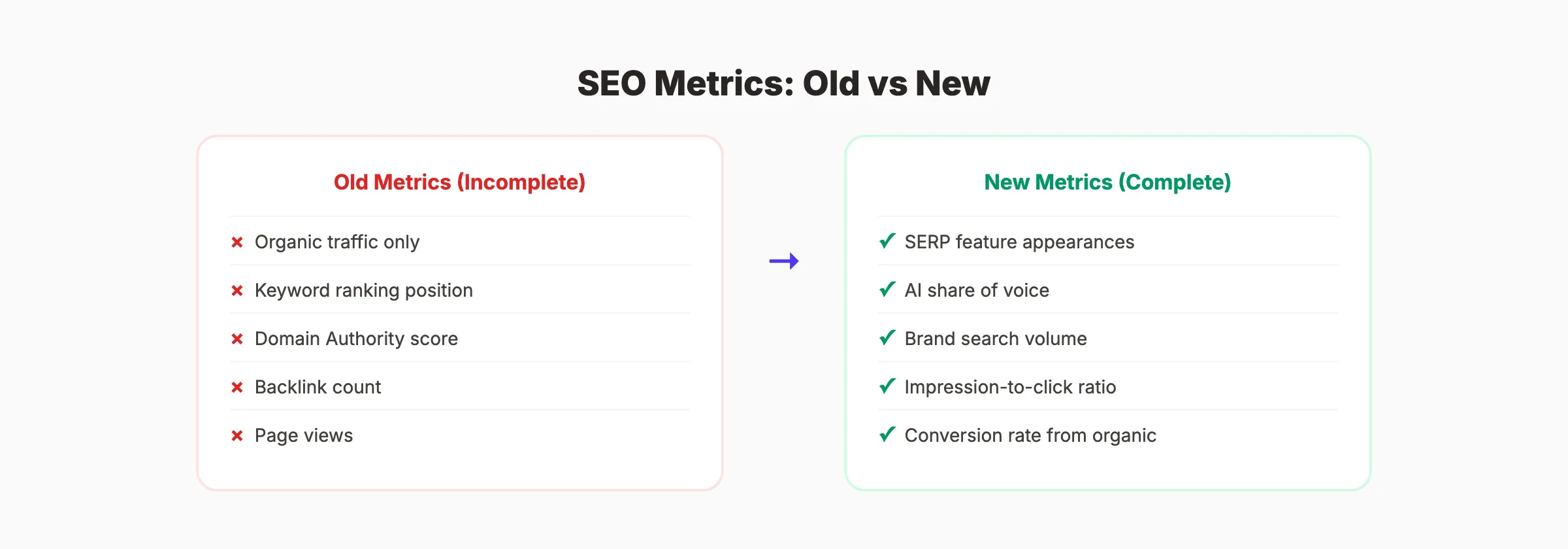
Trend 9: New Metrics Replace Traffic as the Primary KPI
The trend: Traditional organic traffic is declining for many sites even as their SEO performance improves. The industry is shifting to new measurement frameworks.
The data:
- 73% of B2B websites saw significant traffic losses in 2024-2025 (AdExchanger)
- Google referrals dropped 33% globally for news publishers in the 12 months ending November 2025
- Digital Trends went from 8.5 million to 264,000 monthly clicks (97% decline) between March 2024 and January 2026
- 93% of AI Mode sessions end without a click (Semrush)
Why this is happening: AI Overviews answer queries directly. Zero-click searches absorb traffic that previously went to websites. Traffic declines do not necessarily mean SEO is failing. They mean the search results page itself changed.
What this means for your business: Add these metrics to your SEO dashboard alongside traffic:
| New Metric | What It Measures | Why It Matters |
|---|---|---|
| SERP feature appearances | How often your content appears in AI Overviews, featured snippets, PAA | Visibility without clicks still builds brand |
| AI share of voice | How often AI chatbots cite your content | Emerging authority signal |
| Brand search volume | How many people search your brand name | Indicates if visibility converts to awareness |
| Impression-to-click ratio | CTR trends over time | Separates real performance from SERP layout changes |
| Conversion rate from organic | Revenue per organic visit | A smaller but higher-intent audience may convert better |
For a full measurement framework, see our guide on SEO statistics and AI metrics.
What These Trends Mean for Businesses
The big picture: SEO is splitting into two disciplines. Traditional SEO still drives traffic through organic rankings. Generative Engine Optimization (GEO) builds visibility inside AI-generated answers. Businesses that excel at both will dominate search in 2026 and beyond.
For small and local businesses:
- Local searches still drive high-intent traffic. The local 3-pack and Google Business Profile remain strong
- Informational blog content now serves brand building more than direct traffic generation
- Reviews, citations, and local schema markup matter more than ever for local SEO
- Commercial keywords (“best [service] in [city]”) hold up better than informational ones
- Consistent publishing builds the topical authority that both Google and AI models reward
The risk of ignoring these trends: Businesses that continue optimizing only for traditional organic rankings will see declining traffic as AI Overviews expand. Those that adapt early will capture visibility in both traditional and AI-driven search results.
Key Takeaways
- AI Overviews on 48% of searches: Organic CTR drops 58% on queries where they appear. Shift content toward commercial and local keywords.
- GEO is a $7.3B market by 2031: Optimize for AI citation with structured data, clear content hierarchy, and authoritative sourcing.
- 58.5% zero-click rate: Measure visibility and brand impact alongside traffic.
- E-E-A-T enforcement intensified: Named authors, cited sources, and verifiable expertise are required.
- Search is multi-platform: ChatGPT holds 17.1% of search volume. Optimize for AI crawlers and multiple platforms.
- AI content quality reckoning: Human-edited, experience-rich content outranks pure AI output.
- Structured data is 3x more likely to get cited: JSON-LD schema markup is no longer optional.
- Brand signals outweigh links: Build brand presence across the web, not just backlink counts.
- New metrics needed: SERP feature appearances, AI share of voice, and brand search volume join traffic as primary KPIs.
Methodology
Data sources: Ahrefs, Semrush, BrightEdge, SparkToro/Datos, HubSpot State of Marketing 2026, Backlinko, Pew Research, Google Search Central, Search Engine Land, Position Digital, DemandSage.
Time period: Data collected January 2025 through March 2026.
Trend selection criteria: Each trend required at least 2 independent data points from credible sources, evidence of year-over-year change, and clear practical implications for businesses.
Last updated: March 2026.
The SEO trends shaping 2026 reward businesses that read the data, adapt their strategy, and execute consistently. The search results page is changing. The businesses that change with it capture the visibility that others lose.
Stop writing. Start ranking. Stacc publishes 30 SEO articles per month for $99. Built for the AI search era. Start for $1 →
FAQ
Is SEO dead in 2026?
No. Organic search still drives 53% of all website traffic. What changed is how results appear. AI Overviews reduce clicks for informational queries, but commercial, transactional, and local searches still generate strong traffic. The businesses ranking on page 1 still capture the majority of clicks in their market.
How are AI Overviews affecting SEO traffic?
AI Overviews reduce organic CTR by 58% on queries where they appear. They trigger on 48% of all searches, primarily informational ones. Commercial and local queries are less affected. The net impact depends on your keyword mix. Sites focused on informational content see the biggest declines. Sites focused on commercial and local content see minimal impact.
What is Generative Engine Optimization (GEO)?
GEO is the practice of optimizing content to appear in AI-generated search results. AI Overviews, ChatGPT responses, Perplexity answers, and Gemini summaries all pull from web content. GEO focuses on structured data, content depth, authoritative sourcing, and machine readability. See our GEO vs SEO guide for a full comparison.
What is the best SEO strategy for 2026?
Combine traditional SEO with GEO. Publish consistent, high-quality content with named authors and cited sources. Add schema markup to every page. Build brand presence beyond your website. Focus keywords on commercial and local intent where clicks still happen. Monitor AI citation rates alongside traditional ranking metrics.
How do I prepare my site for AI search?
Ensure AI crawlers can access your content. Add an llms.txt file. Implement JSON-LD schema markup. Structure content with clear headings and direct answers in the first 100 words. Include specific data points with citations. Build topical authority through consistent publishing in your core subject area.
Related Tools & Resources
Free SEO Tools:
Best Lists:

Written by
Siddharth GangalSiddharth is the founder of theStacc and Arka360, and a graduate of IIT Mandi. He spent years watching great businesses lose organic traffic to competitors who simply published more. So he built a system to fix that. He writes about SEO, content at scale, and the tactics that actually move rankings.
30 SEO blog articles published every month
Keyword-optimized, scheduled, and live on your site. Automatically.
30-day trial · Cancel anytime
theStacc
Stop writing SEO content manually
30 blog articles, 30 GBP posts, and social media content. Published every month. Automatically.
Start Your $1 Trial$1 for 3 days · Cancel anytime