
Automated Content Creation (2026): Strategies, Tactics & Examples
automated content creation guide for 2026: strategies, tactics, real examples, and implementation steps to get results faster.
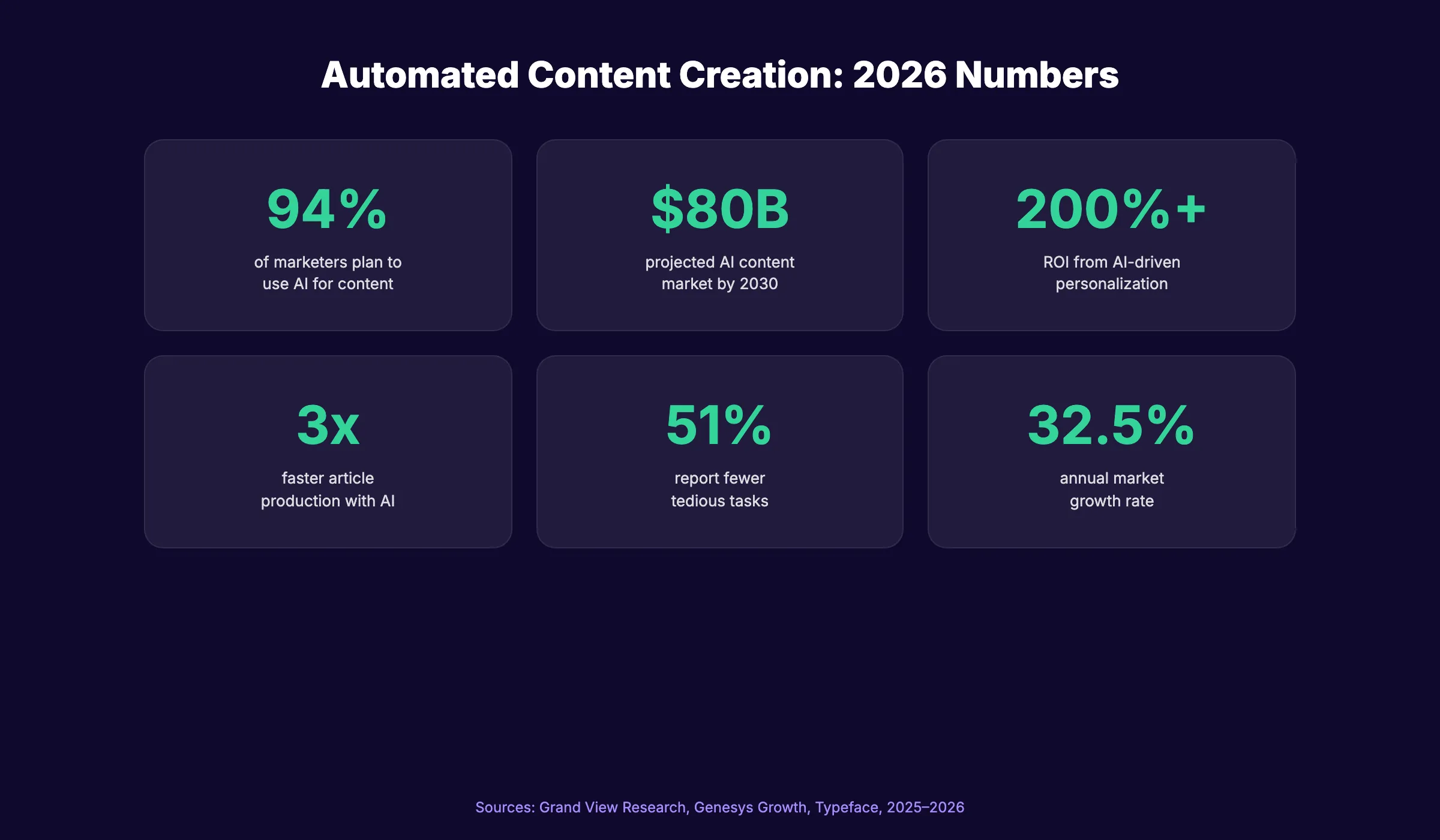
94% of marketers plan to use AI for content creation in 2026. The ones already using automated content creation are publishing 10 to 20 times more content than their competitors.
The math is simple. A business publishing 2 blog posts per month cannot compete with one publishing 30. Manual content creation cannot keep up with the volume that search engines and social platforms reward. Automated content creation closes that gap.
But automation without strategy produces garbage at scale. The businesses that fail with automation skip the fundamentals. They publish generic AI output, ignore brand voice, and expect rankings without optimization. The businesses that succeed treat automation as an execution engine fed by human strategy.
We have published 3,500+ blog posts across 70+ industries using automated content creation workflows. Our average SEO score is 92%. This guide covers everything we know about automating content production.
Here is what you will learn:
- What automated content creation actually means (and what it does not mean)
- The real numbers on cost savings, time efficiency, and ROI
- A 5-step workflow for automating blog, social, and email content
- Which content types automate well and which do not
- The 7 most common mistakes that kill automated content performance
- How to maintain quality and brand voice at scale
- How automated content fits into a full SEO strategy
What Automated Content Creation Actually Means
Automated content creation uses AI and software to produce written, visual, or multimedia content with minimal manual effort. It is not pressing a button and getting a finished article. It is building a system that handles repetitive production work while humans manage strategy and quality.
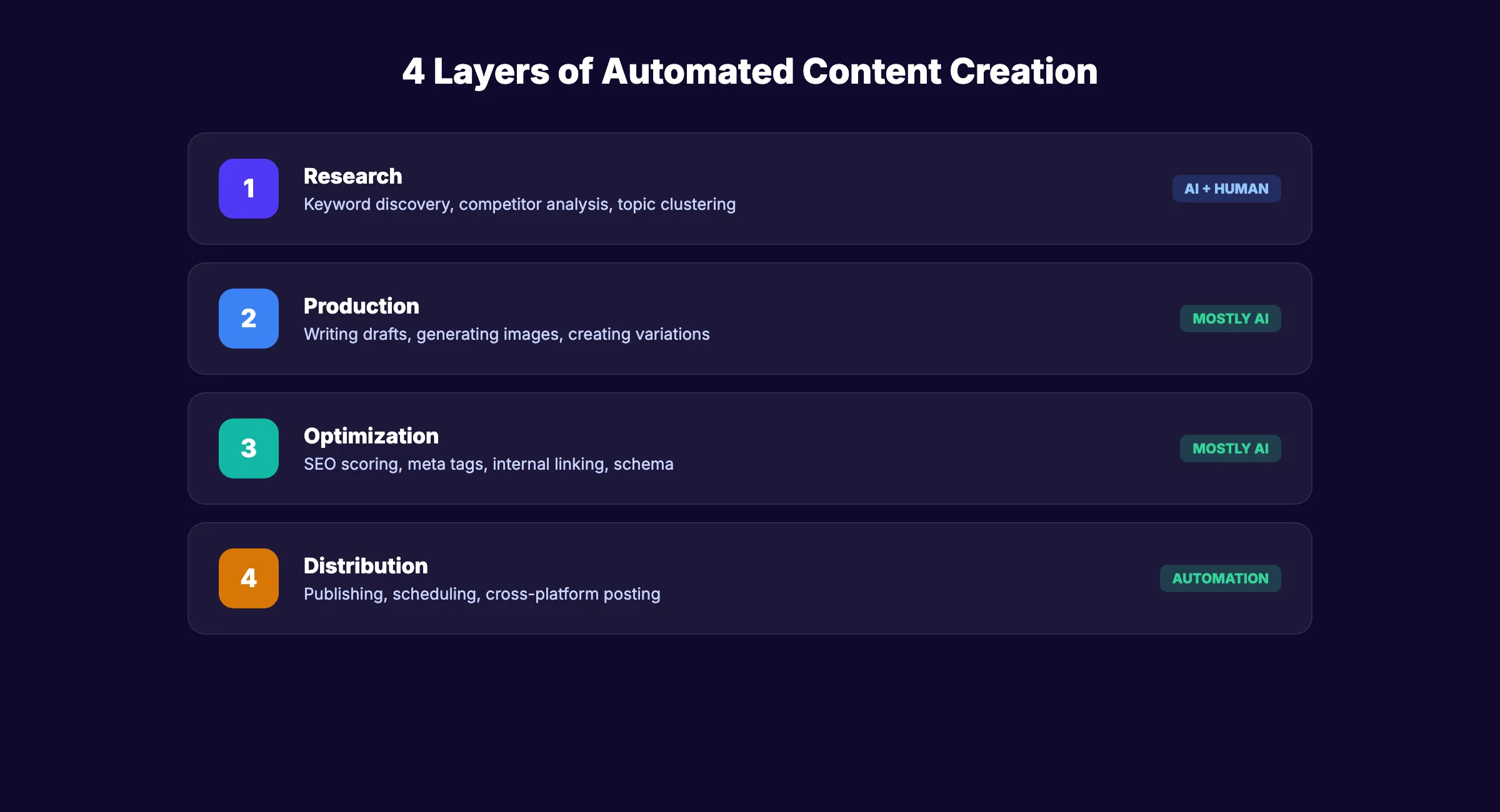
The 4 Layers of Content Automation
| Layer | What Gets Automated | Human Role |
|---|---|---|
| Research | Keyword discovery, competitor analysis, topic clustering | Setting goals and priorities |
| Production | Writing drafts, generating images, creating variations | Reviewing and editing output |
| Optimization | SEO scoring, meta tag generation, internal linking | Final approval and adjustments |
| Distribution | Publishing, scheduling, cross-platform posting | Monitoring performance |
Most businesses automate layers 2 and 3 first. Research and distribution follow as the system matures.
What Automation Is Not
Automation is not a replacement for content marketing strategy. It does not decide what topics to cover, which audience to target, or how to position your brand. Those decisions require human judgment.
Automation also does not eliminate the need for quality control. Every piece of automated content needs human review before publishing. The businesses that skip review produce content that reads like AI and performs like spam.
Stop writing. Start ranking. Stacc publishes 30 SEO articles per month for your business, automatically. Start for $1 →
The Numbers Behind Automated Content Creation
The data on content automation adoption and ROI tells a clear story. Businesses that automate content production outperform those that do not.
Market Growth
The generative AI content creation market reached $14.8 billion in 2024 and will hit $80 billion by 2030. That is a 32.5% annual growth rate. The broader content creation market will reach $277 billion in 2026.
These numbers reflect a fundamental shift. Content production is moving from manual craft to automated system.
Time Savings
38% of marketers who do not use AI spend 3 or more hours writing a single long-form article. Marketers using AI tools reduce that time to under 1 hour. For a business publishing 30 articles per month, that is the difference between 90 hours and 30 hours of production work.
The time savings compound across content types. Blog posts, social media content, email sequences, and GBP posts all benefit from the same automation workflows.
ROI Impact
70% of marketers using AI for advanced personalization report 200% ROI or higher. Content that is personalized, optimized, and published consistently drives more traffic, more leads, and more revenue than manual content published sporadically.
The comparison is stark. A freelance writer producing 30 articles costs $2,400 to $7,500 per month. An SEO agency charges $1,000 to $5,000 per month for fewer deliverables. Automated content creation at scale costs a fraction of both.
Adoption Rates
94% of marketers plan to use AI for content creation. 51% of organizations using automation report fewer tedious tasks. 45% report more efficient workflows. The businesses that adopted early are compounding their advantage while late adopters scramble to catch up.
The 5-Step Automated Content Creation Workflow
This is the exact workflow we use to produce automated content at scale. Each step builds on the previous one.
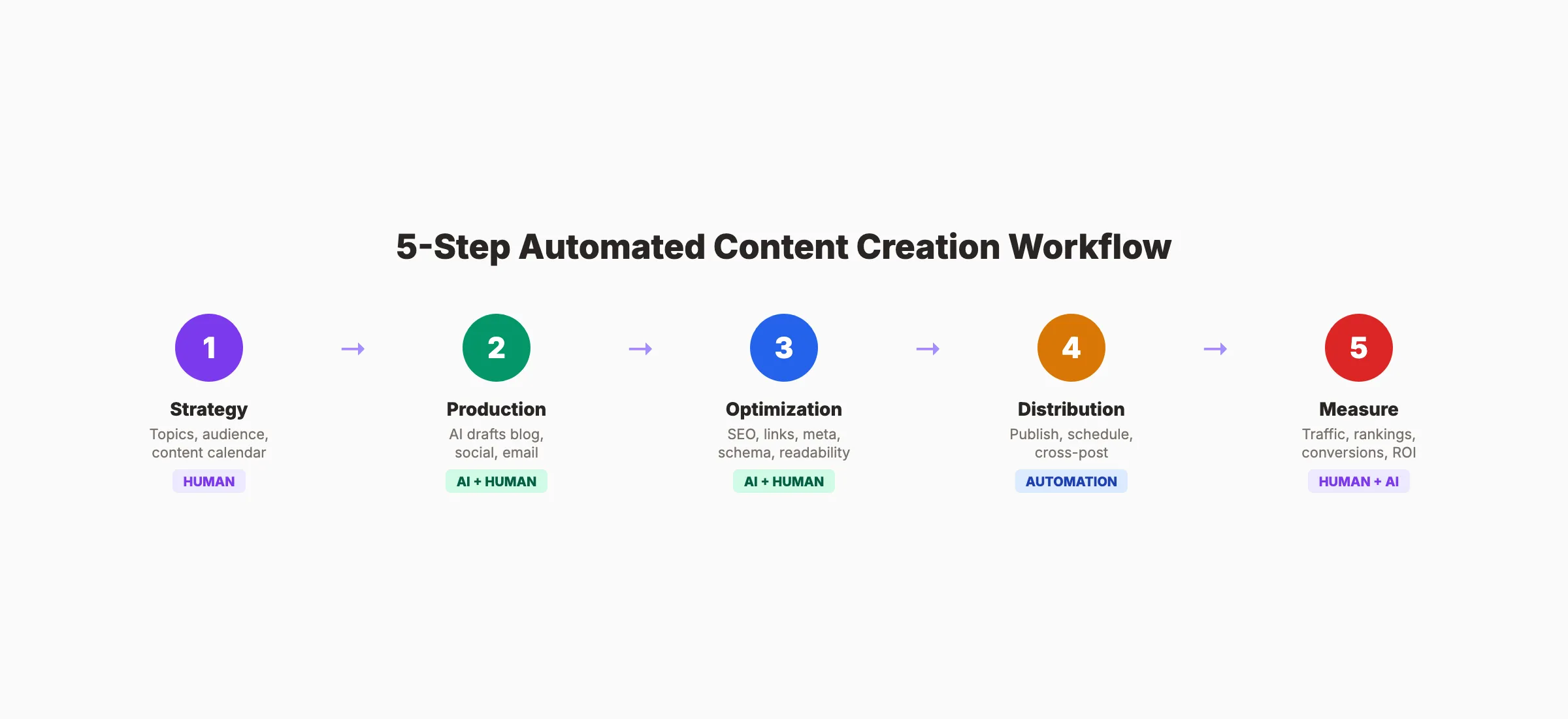
Step 1: Build Your Content Strategy (Human)
Automation executes. Strategy directs. Before automating anything, define:
- Target audience: Who reads this content and what do they need?
- Topic clusters: What subjects build topical authority in your niche?
- Content calendar: How many pieces per week and on which channels?
- Success metrics: What defines a good piece of content (traffic, leads, rankings)?
A topical map anchors the entire system. It defines pillar topics, cluster articles, and the internal linking structure that connects them.
Step 2: Set Up Content Production (AI + Human)
This is where automation takes over the heavy lifting. The production system handles:
- Blog content: AI generates SEO-optimized drafts based on keyword targets, competitor data, and content briefs
- Social media: AI creates platform-specific posts from blog content for Instagram, LinkedIn, X, and Facebook
- Email: AI writes email sequences, newsletters, and promotional messages
- GBP posts: AI generates Google Business Profile updates tied to services and promotions
The key is feeding the system quality inputs. Keyword data, competitor analysis, and brand voice guidelines produce better output than generic prompts.
Step 3: Optimize Every Piece (AI + Human)
Raw AI output is not ready to publish. Optimization includes:
- On-page SEO checks (keyword placement, meta tags, headers)
- Internal linking to existing content
- Image optimization with descriptive alt text
- Readability scoring (short sentences, active voice, clear structure)
- Brand voice alignment (removing generic AI phrasing)
Automated SEO auditing tools score each piece against ranking factors. Human editors review the top-priority items.
Step 4: Publish and Distribute (Automation)
Publishing automation handles:
- Scheduling posts across platforms on a consistent cadence
- Formatting content for each channel (blog, social, email, GBP)
- Adding structured data and schema markup to blog posts
- Triggering distribution workflows when new content goes live
Consistency matters more than perfection. A business publishing 30 optimized articles per month outranks one publishing 4 perfect articles per month.
Step 5: Measure and Improve (Human + AI)
Track performance at both the individual and system level:
| Metric | What It Tells You | Action |
|---|---|---|
| Organic traffic per post | Content resonance | Double down on winning topics |
| Average SEO score | Optimization quality | Adjust production workflow |
| Time to publish | System efficiency | Identify bottlenecks |
| Cost per article | Financial efficiency | Compare to manual production |
| Lead conversion rate | Business impact | Refine CTAs and targeting |
AI analyzes the data. Humans make the strategic decisions. Review performance monthly and adjust the content calendar based on what ranks and converts.
Your SEO team. $99 per month. 30 optimized articles, published automatically. No writers. No agencies. Start for $1 →
Which Content Types Automate Well
Not all content benefits equally from automation. Some types produce near-publish-ready output. Others require heavy editing.
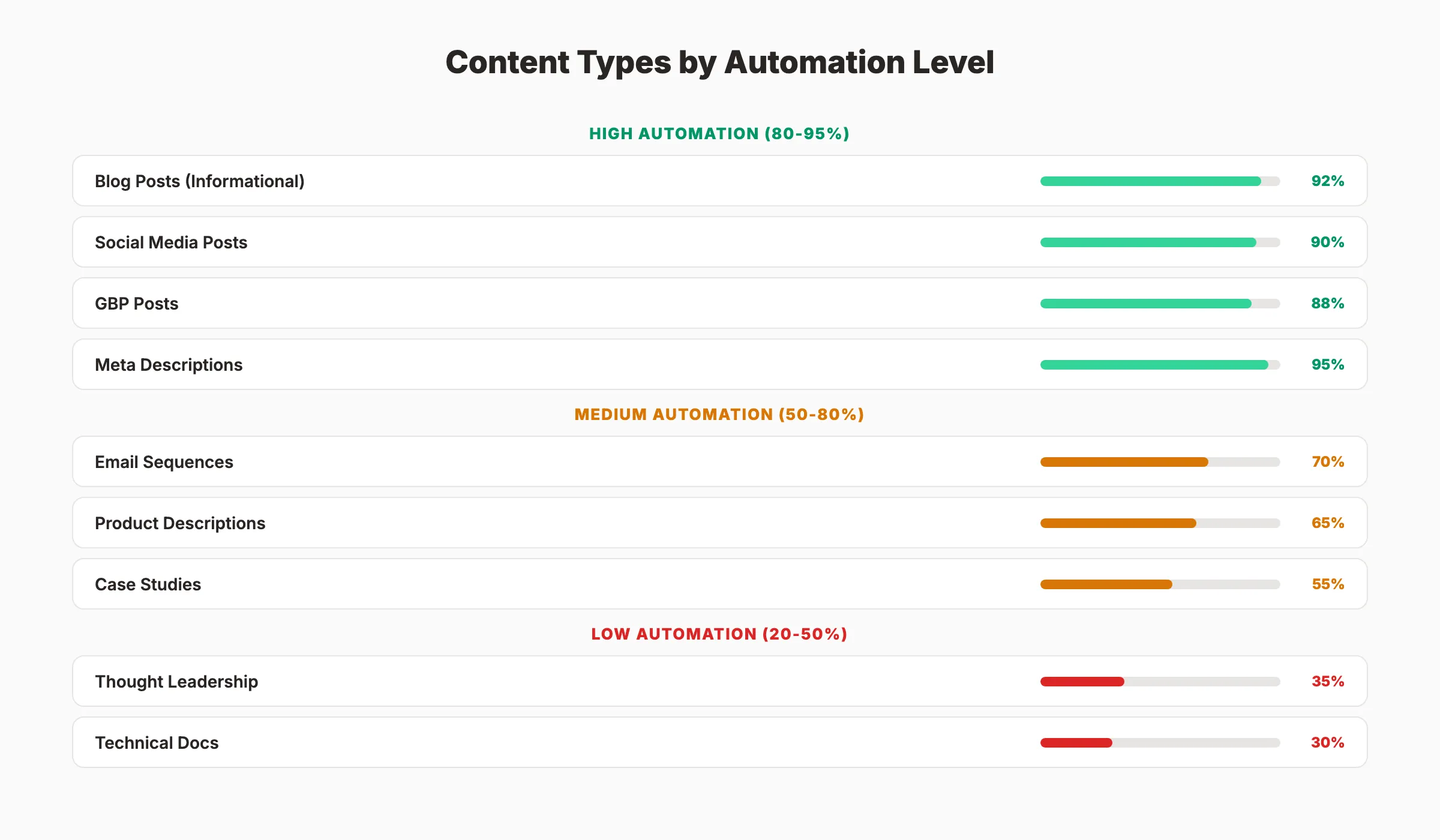
High Automation (80-95% AI, Minimal Editing)
Blog posts targeting informational keywords. “How to” guides, listicles, and educational content follow predictable patterns. AI generates structured drafts that need light editing for voice and accuracy. This is the highest-volume, highest-impact automation use case.
Social media posts. AI generates platform-specific posts from existing blog content. A single article produces 5 to 10 social posts across platforms. Social media automation is one of the fastest ROI wins.
Google Business Profile posts. Service highlights, promotions, and updates follow templates. AI fills in the specifics. Consistent GBP posting signals activity to Google.
Meta descriptions and title tags. AI generates multiple variations. Humans pick the best option. Automating meta descriptions across hundreds of pages saves weeks of manual work.
Medium Automation (50-80% AI, Moderate Editing)
Email marketing sequences. AI drafts the structure and copy. Humans adjust tone, personalization, and offers. Email automation handles the sending, but the content needs more oversight than blog posts.
Product descriptions and service pages. AI generates base copy. Humans add specific claims, differentiators, and compliance language.
Case studies and testimonials. AI structures the narrative. Humans provide the facts, quotes, and specific results. These require more original data than AI can generate.
Low Automation (20-50% AI, Heavy Editing)
Thought leadership and opinion pieces. These require original perspectives that AI cannot produce. AI assists with research, outlining, and drafting, but the core argument must come from a human.
Technical documentation. Accuracy requirements are too high for unsupervised AI output. AI accelerates drafting. Humans verify every detail.
Crisis communications and PR. Tone sensitivity and reputational risk make full automation inappropriate.
The Content Type Decision Matrix
Before automating any content type, ask 3 questions:
- Does this content follow a repeatable pattern?
- Can factual accuracy be verified quickly?
- Is the cost of a quality error low?
If the answer to all 3 is yes, automate it. If any answer is no, keep humans in the loop. Blog posts and social media pass all 3 tests. Thought leadership and crisis communications fail on questions 2 and 3.
7 Mistakes That Kill Automated Content Performance
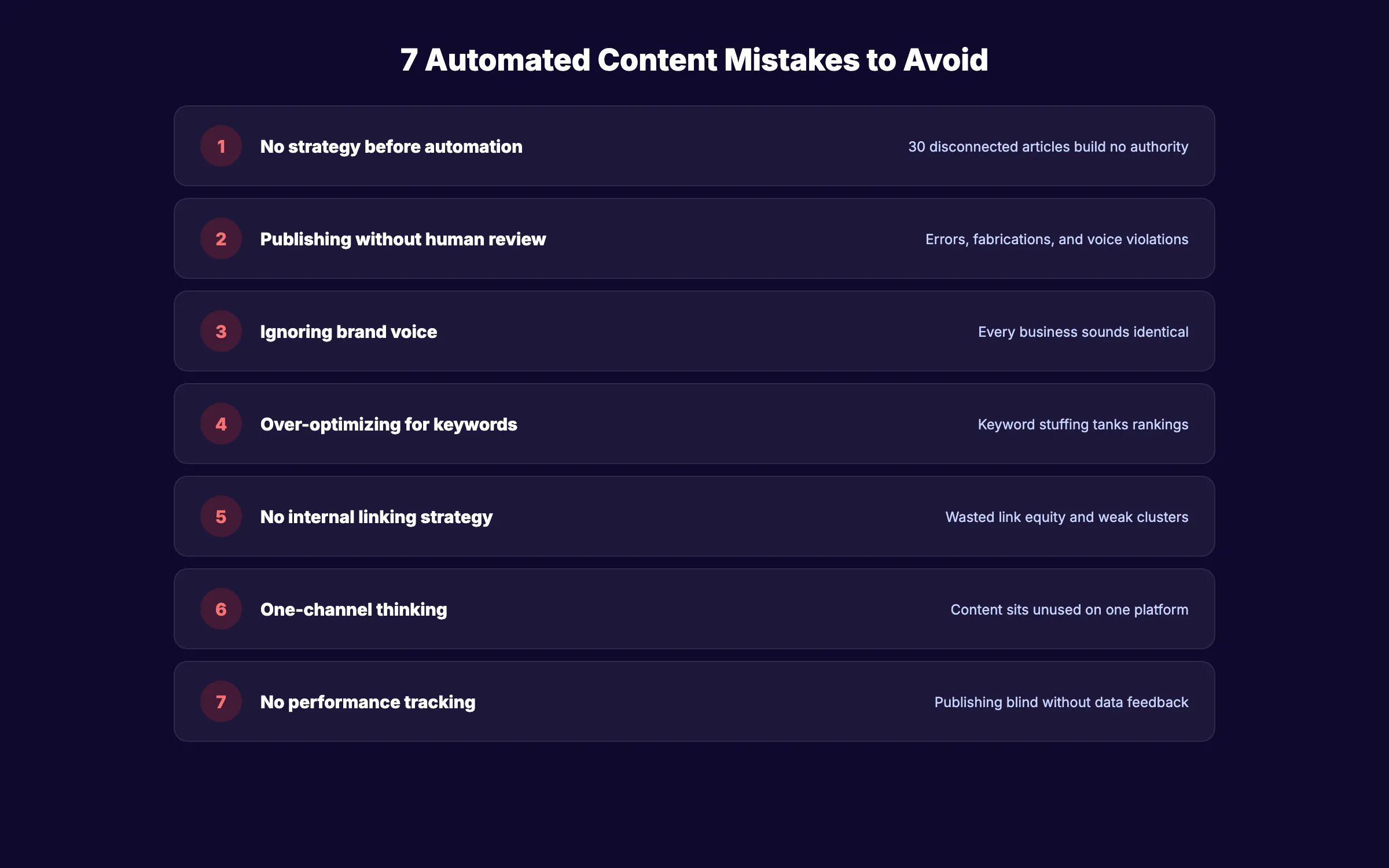
The gap between businesses that succeed with automation and those that fail comes down to avoidable mistakes. 87% of AI projects never make it into production. Here is why.
1. No Strategy Before Automation
Automation amplifies what you feed it. If you feed it a random list of keywords with no topical structure, you get 30 disconnected articles that build no authority. Build a content strategy first. Automate the execution second.
2. Publishing Without Human Review
AI generates plausible text that contains errors. Wrong statistics, fabricated sources, awkward phrasing, and brand voice violations slip through without review. Every piece needs a human read-through. 5 minutes per article prevents the credibility damage of publishing incorrect information.
3. Ignoring Brand Voice
AI defaults to a generic professional tone. Without voice guidelines, every business using the same tool sounds identical. Define your vocabulary, sentence length, tone, and prohibited phrases. Feed these to the AI with every prompt.
4. Over-Optimizing for Keywords
Automated SEO tools can produce keyword-stuffed content that ranks briefly and then drops. Google rewards natural language and genuine helpfulness. Set keyword density limits and prioritize readability over keyword frequency.
5. No Internal Linking Strategy
Automated content that lacks internal links wastes link equity and fails to build topical clusters. Every article should link to 3 to 5 related pages. Map these links before production begins.
6. One-Channel Thinking
A blog post that sits on your website does nothing until you distribute it. Repurpose content across social media, email, and GBP. Automated content creation should feed a multi-channel distribution system.
7. No Performance Tracking
Publishing without measuring is flying blind. Track organic traffic, ranking positions, engagement rates, and conversions per content piece. Use the data to refine the automation system monthly.
3,500+ blogs published. 92% average SEO score. See what Stacc can do for your site. Start for $1 →
How to Maintain Quality at Scale
The biggest fear with automated content creation is quality degradation. That fear is justified when automation runs without guardrails. Here is how to maintain quality while scaling output.
The Quality Control Framework
Build a 3-layer review process:
- Automated checks: SEO scoring, readability analysis, plagiarism detection, grammar checking. These catch 70% of issues instantly.
- Human spot-check: A human editor reviews every 5th article in full. This catches voice, accuracy, and strategic alignment issues.
- Performance review: Monthly analysis of which content performs and which does not. Feed insights back into the production system.
Voice Consistency at Scale
Create a brand voice document that includes:
- 10 example paragraphs of ideal content
- 20 words and phrases you always use
- 20 words and phrases you never use
- Sentence length targets (maximum 20 words)
- Paragraph length targets (maximum 3 sentences)
- Tone descriptors (direct, practical, confident)
This document becomes the style input for every piece of automated content. It is the difference between content that sounds like your brand and content that sounds like AI.
The Content Velocity Sweet Spot
More content is better, but only when quality stays above the threshold. For most businesses, the sweet spot is:
| Business Size | Monthly Articles | Review Capacity |
|---|---|---|
| Solo operator | 10-15 | Self-review all |
| Small team (2-5) | 20-30 | Spot-check 20% |
| Marketing team (5-15) | 30-50 | Full review 10%, spot-check 30% |
| Enterprise | 50-80+ | Dedicated editorial review |
Start at the lower end. Scale up as your review process matures.
Automated Content Creation for SEO
Search engine optimization is the highest-ROI application of automated content creation. Consistent publishing drives organic traffic. Organic traffic compounds over time.
The Publishing Frequency Advantage
Google rewards fresh, relevant content. Businesses that publish 20 to 30 articles per month build topical authority faster than those publishing 2 to 4. Each article targets a new keyword, covers a new question, and adds another entry point to your site.
Manual content teams cap out at 4 to 8 articles per month. Automated systems produce 30 to 80 without increasing headcount.
The Content Compound Effect
Every article you publish today builds authority for every article you published before. An article targeting “how to write meta descriptions” strengthens the ranking of your “on-page SEO guide.” Internal linking connects them. Topical coverage signals expertise.
This is why consistent volume matters. The 100th article performs better than the 10th because it sits on a foundation of 99 related pieces. Automation makes this compounding possible by maintaining the publishing cadence.
Automated SEO Optimization
Modern automation handles most on-page SEO tasks:
- Keyword placement in titles, headers, and body text
- Meta description generation with keyword inclusion
- Internal link suggestions based on content relevance
- Schema markup generation for rich results
- Image alt text optimization
- Readability and sentence length analysis
These checks run automatically during production. The output is content that scores 80 to 95 on SEO audits before a human even touches it.
How Stacc Automates SEO Content
Stacc publishes 30 to 80 optimized articles per month for each client. The process is fully automated:
- We build a topical map for your industry
- AI generates keyword-targeted articles with proper structure
- Each article includes internal links, meta tags, and schema
- Content publishes to your site on a consistent schedule
- Monthly reporting shows traffic, rankings, and leads
No writers. No editors. No manual publishing. The entire content pipeline runs on autopilot while you focus on serving customers.
Rank everywhere. Do nothing. Blog SEO, Local SEO, and Social on autopilot. Start for $1 →
FAQ
What is automated content creation?
Automated content creation uses AI and software to produce blog posts, social media content, email sequences, and other marketing materials with minimal manual effort. It handles the repetitive production work while humans manage strategy, quality control, and creative direction.
Does automated content rank on Google?
Yes. Google does not penalize content based on how it was created. Google penalizes low-quality content regardless of authorship. Automated content that follows SEO best practices, targets the right keywords, and provides genuine value ranks comparably to manually written content.
How much does automated content creation cost?
Costs range from $49 to $199 per month for done-for-you services like Stacc (30 articles at $99/month) to $20 to $200 per month for DIY AI tools. Compare that to $2,400 to $7,500 per month for 30 freelance-written articles or $1,000 to $5,000 per month for an SEO agency.
Will automated content replace human writers?
No. Automation replaces the repetitive production tasks. Strategy, creative direction, quality review, and original thinking remain human responsibilities. The best results come from combining AI with human oversight. Automation is the engine. Humans are the driver.
How many articles should I publish per month with automation?
Start with 15 to 20 and scale based on your review capacity. Most businesses see the best ROI at 30 articles per month. The key is maintaining quality. 30 optimized articles outperform 80 generic ones. Content velocity matters, but quality is the baseline.
Is automated content creation ethical?
Yes, when done responsibly. Disclose AI use where required. Maintain accuracy through human review. Do not fabricate quotes, data, or expertise. Automate the production. Keep the accountability human.
Automated Content for Local Businesses
Local businesses benefit from automated content creation more than any other segment. A dentist, plumber, or lawyer does not have time to write blog posts, manage social media, and update their Google Business Profile. Automation handles all 3 simultaneously.
A single automation system produces 30 blog posts targeting local keywords, 30 GBP posts highlighting services, and 30 social media updates per month. That level of output would require a full-time marketing hire at $4,000 to $6,000 per month. Automation delivers it for under $200.
The local SEO compounding effect is real. Every blog post, GBP update, and social post builds local authority. After 3 to 6 months, automated local content generates a steady stream of organic leads that paid ads cannot match for long-term cost efficiency.
Automated content creation is the operational advantage that separates businesses scaling their organic traffic from those stuck publishing 2 posts per month. The technology is mature. The ROI is proven. The businesses that build their automation system now will compound that advantage every month while competitors do the work manually.
Related Tools & Resources
Free SEO Tools:
Best Lists:

Written by
Siddharth GangalSiddharth is the founder of theStacc and Arka360, and a graduate of IIT Mandi. He spent years watching great businesses lose organic traffic to competitors who simply published more. So he built a system to fix that. He writes about SEO, content at scale, and the tactics that actually move rankings.
30 SEO blog articles published every month
Keyword-optimized, scheduled, and live on your site. Automatically.
30-day trial · Cancel anytime
theStacc
Stop writing SEO content manually
30 blog articles, 30 GBP posts, and social media content. Published every month. Automatically.
Start Your $1 Trial$1 for 3 days · Cancel anytime