
How to Market a Small Business With No Team (7 Steps)
A 7-step system for marketing a small business with zero dedicated staff. Covers SEO, social, email, and automation. Updated March 2026.
50% of small businesses have zero employees dedicated to marketing. The owner handles operations, serves customers, manages finances, and somehow needs to bring in new leads. Most give marketing 1-10 hours per week. That is not enough time to run paid ads, write blog posts, manage social media, and send email campaigns.
Here is how to market a small business with no team. Not a list of 30 tactics. A sequenced system that tells you what to do first, what to automate, and where to invest the limited hours you have. We publish 3,500+ articles across 70+ industries for businesses in this exact situation. The pattern that works is always the same.
Here is what you will learn:
- The 7 marketing steps in the right order (sequence matters)
- Which channels deliver the best ROI on a small budget
- How to build a marketing system that runs in 5 hours per week
- What to automate and what requires your personal attention
- The real cost breakdown by channel and budget tier
- Why 83% of small businesses say referrals are their top lead source (and how to formalize it)
Time required: 5-10 hours per week (after initial setup) Difficulty: Beginner What you will need: A website, a Google Business Profile, and an email provider
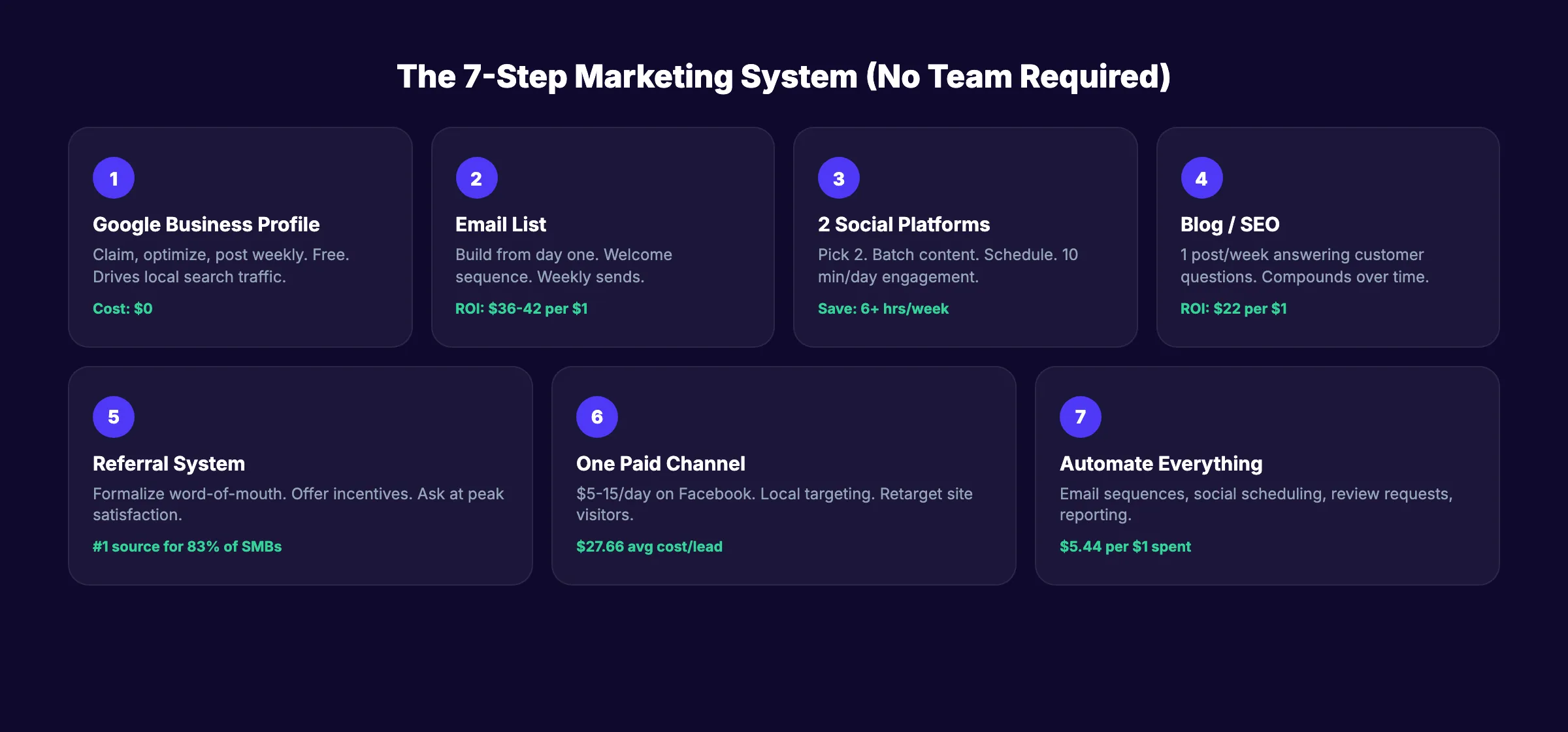
Step 1: Claim and Optimize Your Google Business Profile
Your Google Business Profile (GBP) is the single highest-ROI marketing asset for a local business. It costs nothing. It appears in Google Search and Maps. And it drives phone calls, directions, and website visits directly.
Specifically:
- Claim your profile at business.google.com
- Complete every field: business name, address, phone, hours, website, categories, description
- Add 10+ high-quality photos (storefront, interior, team, products)
- Write a business description with your primary service and location
- Select the most specific business categories available (not just “Restaurant” but “Italian Restaurant”)
83% of small businesses say customer referrals are their number-one acquisition source. But the second source is local search. An optimized GBP puts your business in front of people actively searching for what you sell.
Why this step matters: 70% of Facebook users visit a local business page weekly, but Google search intent is higher. Someone searching “plumber near me” is ready to hire. Someone scrolling Facebook is not. GBP captures that intent.
Pro tip: Post on your GBP at least once per week. GBP posts signal freshness to Google’s local algorithm and keep your profile active. This takes 5 minutes per post.
Step 2: Build an Email List From Day One
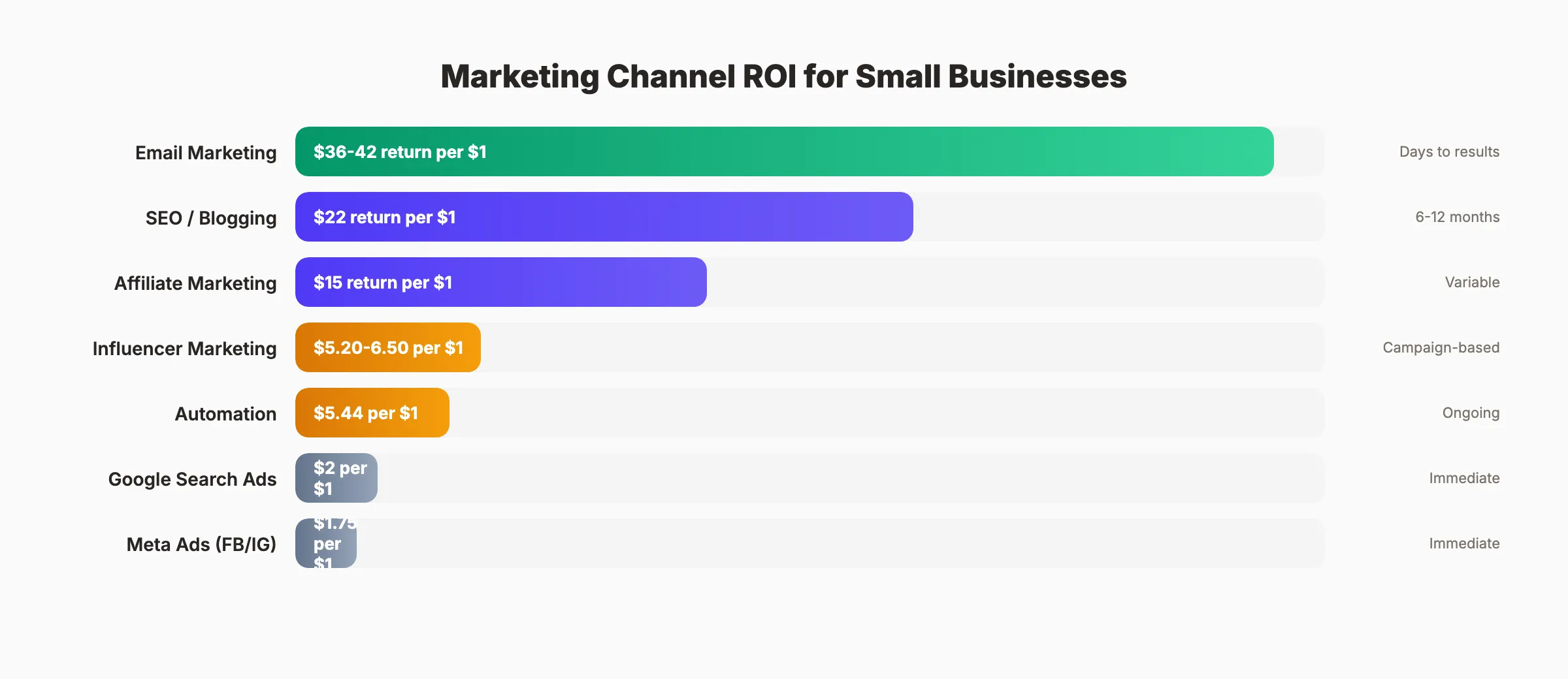
Email marketing generates $36-42 for every $1 spent. That is the highest ROI of any marketing channel. And unlike social media followers, you own your email list. No algorithm change can take it away.
Specifically:
- Sign up for a free email provider (Mailchimp, Brevo, or MailerLite all offer free tiers)
- Add a signup form to your website (homepage, footer, and a dedicated landing page)
- Offer something in exchange for the email: a discount, a free guide, a checklist, or early access
- Set up a 3-email welcome sequence that introduces your business and drives a first purchase
- Send at least 1 email per week to your list
Why this step matters: Social media reach is declining. Facebook organic reach for business pages averages 5.2%. Instagram sits around 9%. Email reaches 90%+ of inboxes. An email list of 500 engaged subscribers is worth more than 5,000 social followers.
Pro tip: Automated email sequences (welcome series, abandoned cart, post-purchase follow-up) generate 76% higher open rates than standard emails. Set them up once and they run forever.
Step 3: Pick 2 Social Media Platforms and Automate
Managing 4+ social platforms manually takes 12-15 hours per week. That is a part-time job. A business owner with no marketing team cannot sustain that.
Specifically:
- Choose 2 platforms based on where your customers spend time
- Use the platform selection guide:
| Business Type | Platform 1 | Platform 2 |
|---|---|---|
| Restaurants, retail, salons | ||
| Service businesses (plumbing, HVAC, legal) | Google Business Profile | |
| Professional services (accounting, consulting) | ||
| Visual brands (fitness, fashion, real estate) | TikTok |
- Create content in batches: spend 2 hours every 2 weeks producing 2 weeks of posts
- Use a social media scheduling tool to automate publishing
- Spend 10 minutes per day responding to comments and DMs
For content ideas, follow the 70-20-10 rule: 70% value content (tips, behind-the-scenes), 20% shared content (customer features, local events), 10% promotional (offers, services). Read our full social media marketing guide for local businesses for the detailed framework.
Why this step matters: 96% of small businesses use social media. The ones that fail spread across 5 platforms and post inconsistently. Dominating 2 platforms beats being mediocre on 5.
Pro tip: Companies that automate social media posting save more than 6 hours per week. A free tool like Buffer (3 channels, AI caption generation included) handles scheduling with zero cost.
Your SEO team. $99/month. 30 optimized articles published automatically. Blog SEO, Local SEO, and Social Media on autopilot. Zero staff required. Start for $1 →
Step 4: Start Publishing Blog Content for SEO
SEO returns $22 for every $1 invested. Organic leads convert at 14.6% versus 1.7% for outbound marketing. But SEO takes 6-12 months to show meaningful results. That is why you start now, even if results come later.
Specifically:
- Identify 10-15 questions your customers ask before buying
- Write one blog post per week answering each question (or outsource it)
- Target long-tail keywords: “how much does a kitchen remodel cost in [city]” beats “kitchen remodel”
- Structure every post with a clear answer in the first 100 words, then expand with detail
- Add internal links between related posts to build topical authority
A single well-optimized blog post can drive traffic for years. The content compound effect means each new article strengthens every previous article. After 20-30 posts, the entire site gains authority.
Why this step matters: 53% of small businesses invest in SEO. The 47% that do not leave the highest-ROI organic channel untapped. Paid ads stop the moment you stop paying. SEO compounds.
Pro tip: If writing one post per week is too much, content automation services produce 30 SEO-optimized articles per month for $99. That is $3.30 per article versus $150-500 per article from a freelancer.
Step 5: Set Up a Referral System
83% of small businesses say referrals are their top customer acquisition source. Yet most have no formal referral program. They rely on word-of-mouth without a system to encourage, track, or reward it.
Specifically:
- Create a simple referral offer: “Refer a friend, both of you get $25 off”
- Print referral cards for in-person businesses
- Add a referral page or form to your website
- Ask for referrals at the moment of highest satisfaction (after a completed service, positive review, or repeat purchase)
- Follow up via email with a referral reminder 1 week after every transaction
- Track referrals in a simple spreadsheet or CRM
Why this step matters: Referred customers have a 37% higher retention rate and 25% higher profit margins. A formal program turns occasional word-of-mouth into a predictable acquisition channel.
Pro tip: Pair the referral ask with a Google review ask. “If you enjoyed your experience, would you leave us a review? And if you know someone who needs [your service], here is a referral card.” One conversation, two marketing wins.
Step 6: Run One Paid Channel at a Small Budget
Organic marketing builds slowly. Paid advertising delivers results immediately. A small budget ($150-500/month) on one channel fills the gap while your SEO and email efforts compound.
Specifically:
- Start with Facebook/Instagram ads for local businesses (best geographic targeting at lowest cost)
- Set a daily budget of $5-15 per day
- Target people within a specific radius of your business
- Run one ad format: a customer testimonial or before-and-after photo with a clear CTA
- Test 2-3 ad variations for 2 weeks, then scale the winner
Budget tiers and what they buy:
| Monthly Budget | What You Get |
|---|---|
| $0 | Organic only (GBP, social, email, blog) |
| $150-300 | Boosted posts, basic local targeting, 5,000-15,000 local impressions |
| $300-500 | Dedicated ad campaigns, audience testing, retargeting |
| $500-1,000 | Multi-platform ads, lookalike audiences, lead gen forms |
Facebook lead ads average $27.66 cost per lead versus Google’s $70.11. For budget-constrained businesses, Facebook delivers more leads per dollar.
Why this step matters: 40% of small businesses are increasing their marketing budget in 2026. Early advertisers on Facebook and Instagram captured cheaper inventory before competition drove prices up. The window for low CPMs is still open for local businesses in most markets.
Pro tip: Start with retargeting. Install the Meta Pixel on your website. Then run ads only to people who already visited your site. These audiences convert at 2-3 times the rate of cold traffic, meaning your small budget goes further.
Skip the agency. Keep the results. theStacc starts at $99/mo. Blog SEO, Local SEO, and Social Media handled for you. Start for $1 →
Step 7: Automate Everything You Repeat
The difference between a business owner who spends 20 hours per week on marketing and one who spends 5 is automation. Every task you do more than once per week should be automated or eliminated.
What to automate:
| Task | Automation Option | Time Saved |
|---|---|---|
| Social media posting | Buffer, SocialBee, Later (free plans available) | 6+ hrs/week |
| Email welcome sequence | Mailchimp, Brevo, MailerLite (free tiers) | 2+ hrs/week |
| Review requests | Automated email 24 hours after purchase | 1+ hrs/week |
| GBP posting | GBP post generator or theStacc | 1+ hrs/week |
| Blog content | theStacc ($99/mo for 30 articles) | 10+ hrs/week |
| Lead follow-up | CRM with automated sequences (HubSpot free, Brevo) | 2+ hrs/week |
| Reporting | Google Analytics 4 automated reports | 1+ hr/week |
What NOT to automate:
- Responding to customer DMs and comments (personal touch matters)
- Replying to Google reviews (your voice, not a template)
- Referral conversations (authenticity drives referrals)
- Sales calls and proposals
Companies using marketing automation earn $5.44 in revenue per $1 spent. 76% see positive ROI within the first year. Most businesses recoup their automation investment in under 6 months.
Why this step matters: 60% of small businesses spend only 1-10 hours per week on marketing. Automation is the only way to run a full marketing system in that window. Without it, you either spend 20+ hours or abandon channels entirely.
Pro tip: Start with the 3 highest-impact automations: email welcome sequence, social media scheduling, and review request emails. These 3 alone save 9+ hours per week.
The Weekly Marketing System (5 Hours Total)
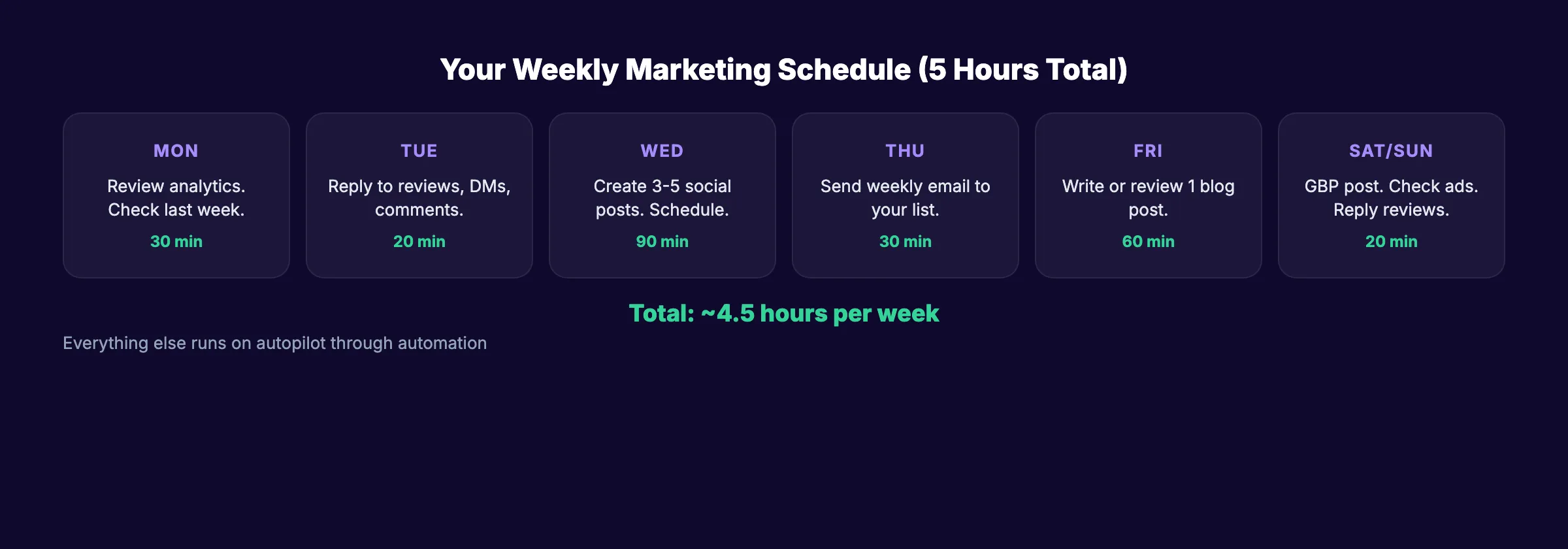
Once all 7 steps are set up, here is what a typical marketing week looks like.
| Day | Task | Time |
|---|---|---|
| Monday | Review analytics. Check what worked last week. Adjust if needed. | 30 min |
| Tuesday | Respond to reviews, DMs, and comments across all platforms. | 20 min |
| Wednesday | Create 3-5 social media posts for the next week. Schedule them. | 90 min |
| Thursday | Send weekly email to your list. | 30 min |
| Friday | Write or review 1 blog post. Publish or schedule. | 60 min |
| Weekend | Post 1 GBP update. Check ad performance. Reply to any new reviews. | 20 min |
Total: ~4.5 hours per week. Everything else runs on autopilot through the automations you set up in Step 7.
For businesses that want even less time investment, theStacc handles blog content, GBP posts, and social media for as little as $99/month. That reduces the weekly commitment to under 2 hours (analytics, reviews, and email only).
What to Expect: Timeline and Results
| Timeframe | What Happens |
|---|---|
| Month 1 | GBP optimized. Email list building. Social posting begins. First blog posts published. |
| Month 2-3 | Social engagement grows. Email list reaches 100-300. Paid ads tested. First blog traffic. |
| Month 4-6 | SEO begins showing results. Email drives repeat business. Referral program generates leads. |
| Month 7-12 | SEO compounds. Blog becomes a traffic source. Social grows organically. Marketing system runs in 5 hrs/week. |
Businesses that maintain consistent marketing for 6-12 months report significantly better results than those who evaluate after 30 days. Marketing compounds. The first 90 days feel slow. Months 6-12 are where the returns appear.
Rank everywhere. Do nothing. Blog SEO, Local SEO, and Social Media on autopilot. theStacc starts at $99/mo with a $1 trial. Start for $1 →
FAQ
How do I market my small business with no money?
Start with free channels: optimize your Google Business Profile, post on 2 social platforms, build an email list with a free provider (Mailchimp, Brevo), and answer customer questions on your blog. Ask every satisfied customer for a referral and a Google review. These 4 activities cost nothing and generate leads.
How many hours per week should a small business spend on marketing?
5-10 hours per week is enough if you automate repetitive tasks. According to LocaliQ, 60% of small businesses spend 1-10 hours per week on marketing. The key is using that time on high-ROI activities (email, SEO, referrals) rather than low-ROI busywork.
What is the most effective marketing channel for a small business?
Email marketing delivers the highest measurable ROI ($36-42 per $1 spent). SEO delivers the best long-term return ($22 per $1). Customer referrals are the number-one acquisition source for 83% of small businesses. The best approach combines all three.
Should I hire a marketing agency or do it myself?
If your budget is under $1,000/month, do it yourself using automation tools. Agencies typically charge $1,000-5,000/month. For businesses between those tiers, done-for-you services like theStacc publish 30 SEO articles, GBP posts, or social media posts per month starting at $49. That fills the gap between DIY and agency pricing.
How long does it take for marketing to work for a small business?
Email and paid ads show results within days. Social media builds engagement over 2-4 months. SEO takes 6-12 months for meaningful rankings. The marketing system described in this guide shows measurable results by month 4-6 when all channels work together.
What marketing tasks should I automate first?
Start with email welcome sequences, social media scheduling, and review request emails. These 3 automations save 9+ hours per week. Companies using marketing automation earn $5.44 per $1 spent, and 76% see positive ROI within the first year.
The Bottom Line
Marketing a small business with no team is not about doing everything. It is about doing the right things in the right order and automating everything you repeat. GBP first. Email second. Social third. Blog fourth. Referrals fifth. Paid ads sixth. Automate everything else.
The businesses that succeed are not the ones with the biggest budgets. They are the ones that build a system and stick to it for 6-12 months.

Written by
Siddharth GangalSiddharth is the founder of theStacc and Arka360, and a graduate of IIT Mandi. He spent years watching great businesses lose organic traffic to competitors who simply published more. So he built a system to fix that. He writes about SEO, content at scale, and the tactics that actually move rankings.
30 SEO blog articles published every month
Keyword-optimized, scheduled, and live on your site. Automatically.
30-day trial · Cancel anytime
theStacc
Stop writing SEO content manually
30 blog articles, 30 GBP posts, and social media content. Published every month. Automatically.
Start Your $1 Trial$1 for 3 days · Cancel anytime