
How Often Should a Business Blog? 12 Studies Analyzed
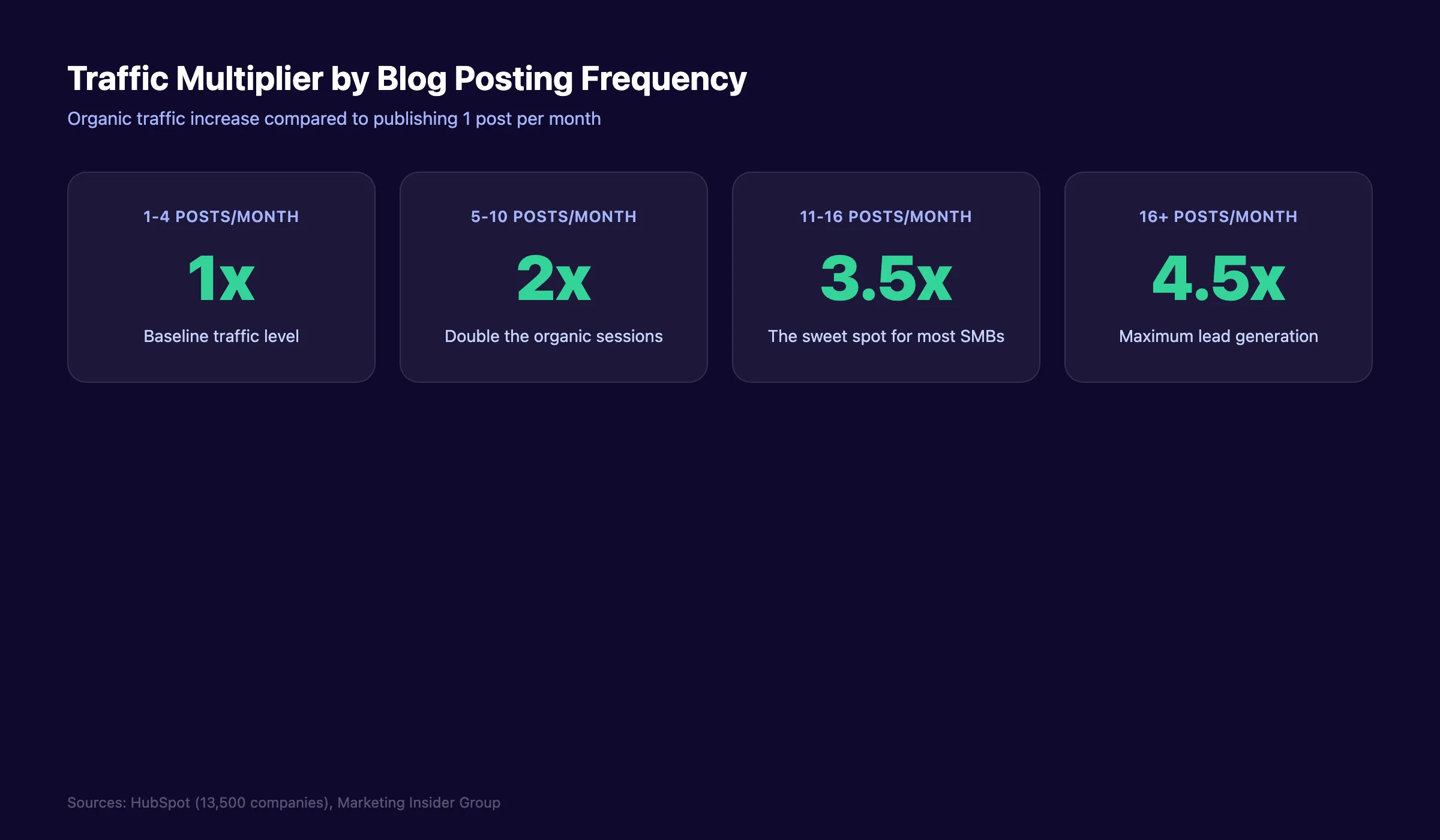
We analyzed 12 studies covering 13,500+ blogs to find the optimal posting frequency. Companies publishing 11+ posts per month see 3.5x more traffic.
Meta-analysis of research from HubSpot, Orbit Media, Stratabeat, Marketing Insider Group, and Content Marketing Institute. Data collected March 2026.
Key Findings at a Glance
- Companies publishing 11+ blog posts per month get 3.5x more traffic than those publishing once per month (HubSpot, 13,500 companies).
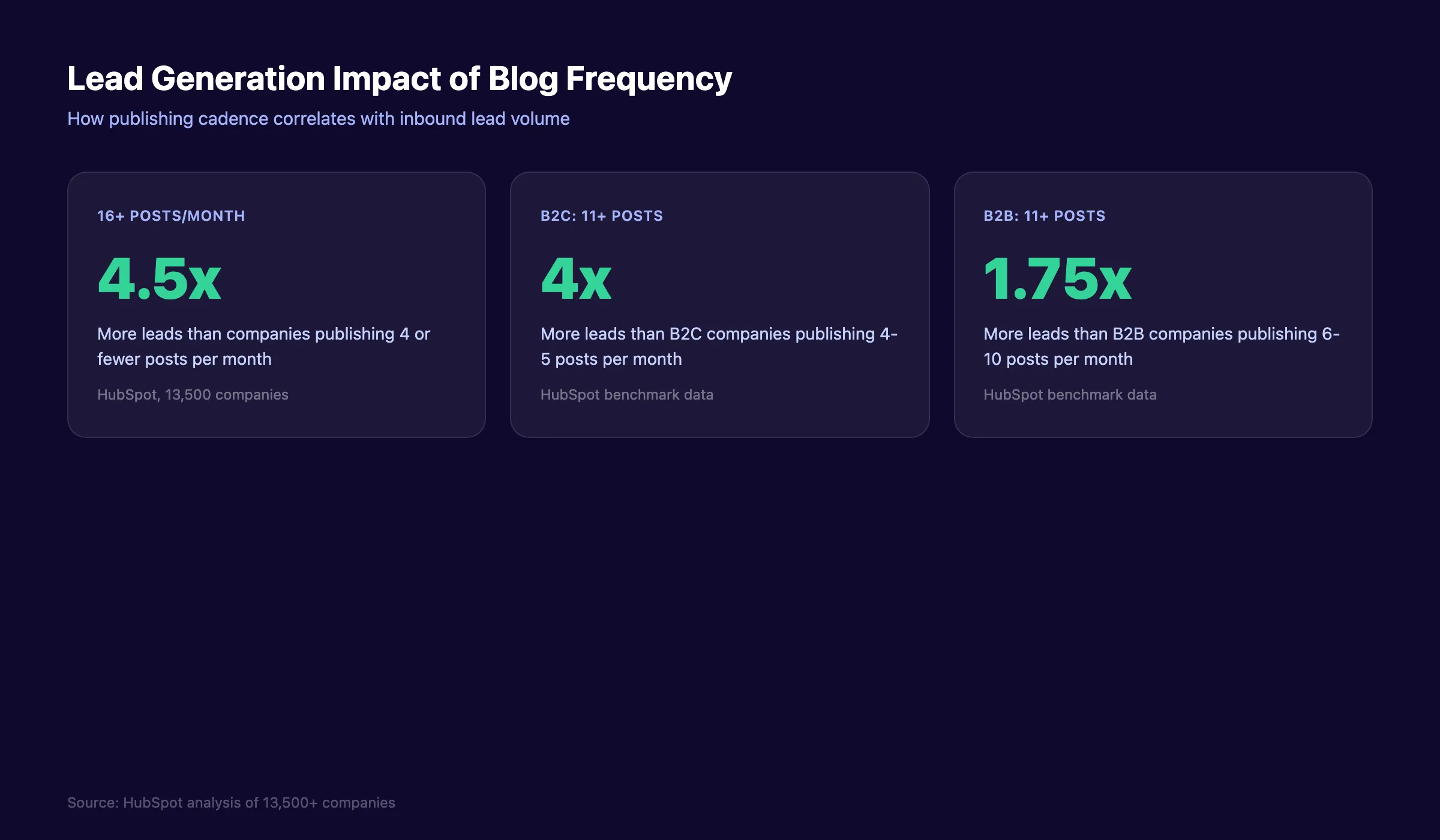
- 16+ posts per month generates 4.5x more leads versus 4 or fewer posts per month.
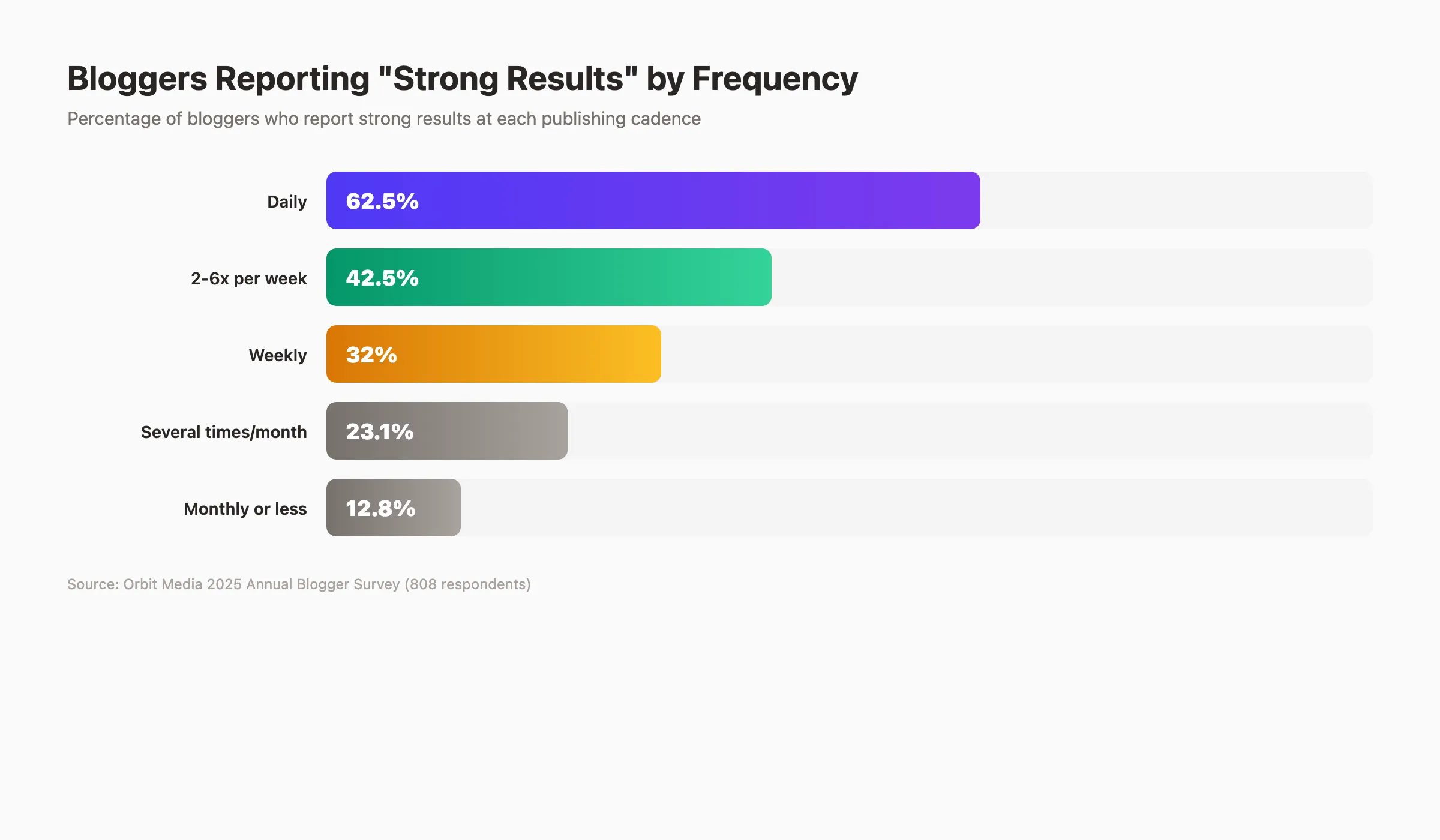
- 62.5% of daily publishers report “strong results” compared to 12.8% of monthly publishers (Orbit Media, 808 respondents).
- Blogs publishing 9+ posts per month see 20.1% organic traffic growth, which is 3.6x the rate of low-frequency publishers (Stratabeat).
- The magic number is 11 posts per month across every company size bracket studied.
- B2C companies publishing 11+ monthly posts generate 4x more leads than those publishing 4-5 per month.
- Blogs with 400+ total published posts earn 3x more leads than those with fewer than 100 total posts.
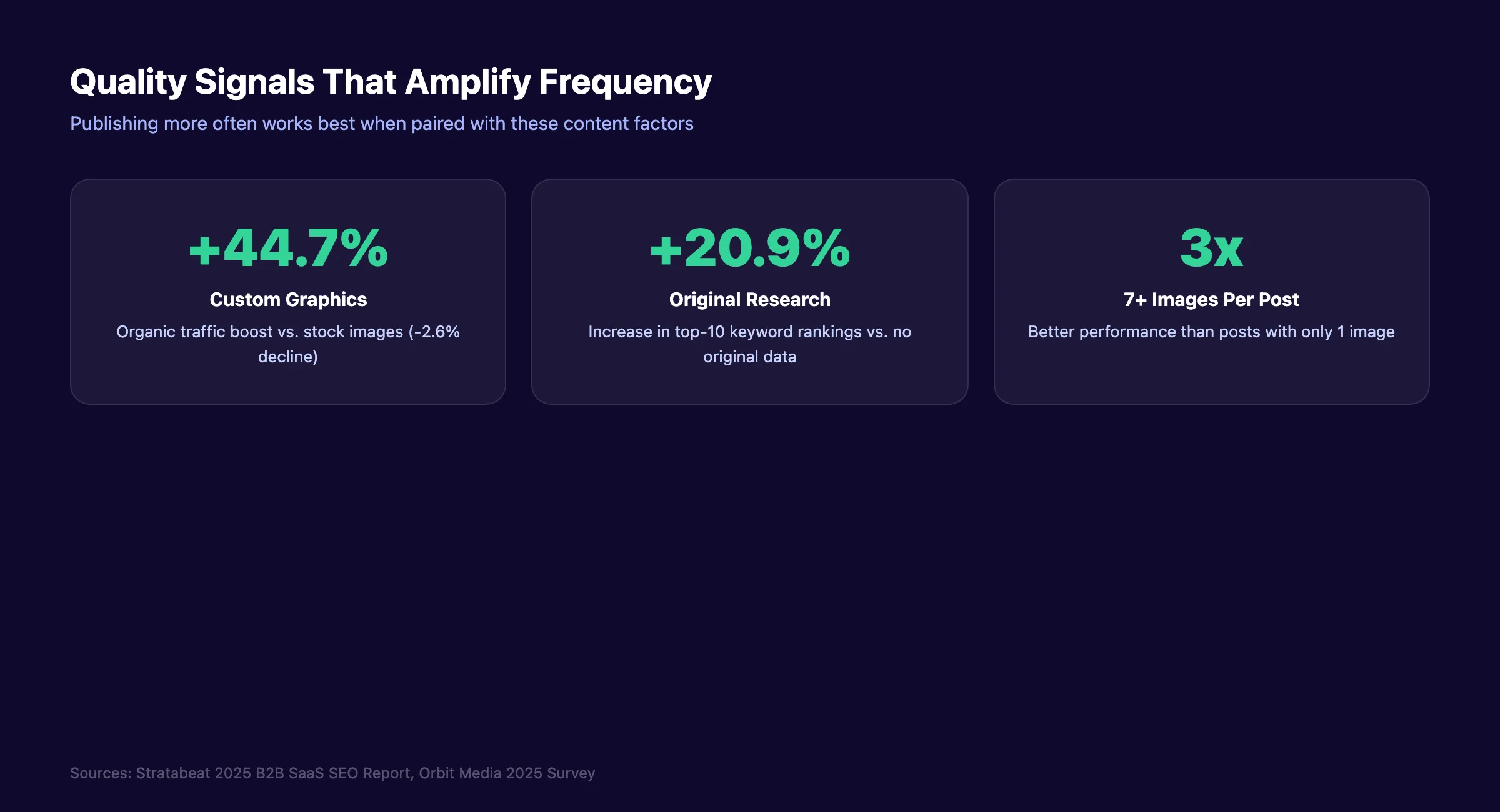
- Original research boosts top-10 rankings by 20.9% when combined with consistent publishing.
- Custom graphics increase organic traffic by 44.7% versus stock images, which correlate with a 2.6% decline.
- Weekly publishers are 2.5x more likely to report strong results than monthly-or-less publishers.
Why We Ran This Analysis
Most businesses guess their blog SEO frequency. They publish 1-2 posts per month because that is what feels manageable.
The problem is that “manageable” and “effective” are not the same thing. The gap between publishing 4 times per month and 11 times per month is not a small difference. It is a 3.5x traffic multiplier.
We reviewed 12 major studies on how often should a business blog. The research spans HubSpot’s analysis of 13,500 companies, Orbit Media’s 2025 annual survey of 808 bloggers, Stratabeat’s B2B SaaS SEO report, Marketing Insider Group’s frequency research, and data from Content Marketing Institute.
We specifically investigated:
- Traffic multipliers at each frequency tier
- Lead generation correlation with posting cadence
- Results reported by bloggers at different frequencies
- The role of company size in optimal frequency
- How content quality interacts with publishing volume
- The compounding effect of total published post count
Here is what we found. The data strongly favors higher frequency. But it also reveals a nuance most advice misses.
Methodology
Data sources: 12 published studies and surveys from 2022-2025, including primary research from HubSpot, Orbit Media Studios, Stratabeat, Marketing Insider Group, and Content Marketing Institute.
Combined sample: 13,500+ company blogs (HubSpot), 808 individual bloggers (Orbit Media), and hundreds of B2B SaaS websites (Stratabeat).
What we measured: Organic traffic growth, lead generation, self-reported “strong results,” and ranking performance at various publishing frequencies.
What we excluded: Studies focused exclusively on personal blogs, studies older than 2020, and data without disclosed sample sizes. We also excluded studies that did not separate frequency from other variables like content quality.
Framing note: This is a meta-analysis. We aggregated findings from existing research rather than conducting original data collection. All source studies are linked throughout.
Finding 1: Companies Publishing 11+ Posts Per Month Get 3.5x More Traffic
Background: The threshold question every business asks is simple. How many posts per month actually move the needle? HubSpot studied 13,500 companies to find out.
Results: Companies publishing 11 or more blog posts per month received 3.5x more organic traffic than those publishing only once per month. This held true across multiple company size brackets.
The breakdown by company size:
| Company Size | Posts/Month | Traffic vs. 1 Post/Month |
|---|---|---|
| 1-10 employees | 11+ | 3x more traffic |
| 11-25 employees | 11+ | 3.5x more traffic |
| 26-200 employees | 11+ | 2x more traffic |
| 200+ employees | 11+ | 3.5x more traffic |
Context: The number 11 appeared as a threshold across every size bracket. Below 11, gains were modest. Above 11, traffic scaled sharply. For small businesses trying to increase organic traffic, reaching 11 posts per month should be the first milestone.
Finding 2: 16+ Posts Per Month Generates 4.5x More Leads
Background: Traffic alone does not pay the bills. The real question is whether higher frequency translates to actual leads. HubSpot’s data answers this directly.
Results: Companies that published 16 or more blog posts per month generated 4.5x more leads than companies publishing 4 or fewer posts.
The lead generation data splits further by business type:
| Business Type | Frequency | Lead Multiplier |
|---|---|---|
| All companies | 16+/month | 4.5x vs. 4 or fewer |
| B2C companies | 11+/month | 4x vs. 4-5 posts |
| B2B companies | 11+/month | 1.75x vs. 6-10 posts |
Context: B2C companies see a steeper lead curve than B2B. This makes sense. B2C purchase cycles are shorter. More content means more entry points for buyers who are ready now. B2B companies still benefit from higher frequency, but the relationship is more gradual. A strong content marketing strategy accounts for these differences.
Finding 3: 62.5% of Daily Publishers Report Strong Results
Background: Orbit Media’s 2025 annual survey asked 808 content marketers a straightforward question. Do you get strong results from blogging? The answers correlated sharply with frequency.
Results: 62.5% of bloggers who publish daily reported “strong results.” That number dropped to 42.5% for those publishing 2-6 times per week, 32% for weekly publishers, and just 12.8% for monthly-or-less publishers.
| Publishing Frequency | Report “Strong Results” |
|---|---|
| Daily | 62.5% |
| 2-6x per week | 42.5% |
| Weekly | 32% |
| Several times/month | 23.1% |
| Monthly or less | 12.8% |
Context: The gap between weekly and daily is 30 percentage points. Weekly publishers are 2.5x more likely to see strong results than monthly publishers. But daily publishers are nearly 5x more likely. For businesses wondering how often should a business blog, the data from 808 real practitioners is clear. More is better.
Publishing 11+ blog posts per month is the threshold where traffic compounds. Stacc publishes 30 articles per month for $99. That puts you above the threshold from day one. Start for $1 →
Finding 4: Websites Publishing 9+ Posts Monthly Grow Organic Traffic 3.6x Faster
Background: Stratabeat’s 2025 B2B SaaS SEO Performance Report analyzed hundreds of B2B websites. They measured organic traffic growth rates rather than absolute traffic numbers. Growth rate matters more for newer sites building topical authority.
Results: Websites publishing 9 or more posts per month saw a 20.1% increase in monthly organic traffic. That growth rate is 3.6x higher than blogs publishing 1-4 posts per month.
The top 10% of performers in the study blogged 11 times per month on average. These same sites achieved 89.9% referring domain growth and ranked more frequently in Google’s top 10.
Context: Growth rate is the metric that matters for small businesses. A site with 500 monthly visitors growing at 20.1% per month reaches 3,100 visitors within 12 months. The same site growing at 5.6% (the rate for low-frequency publishers) reaches only 960. The compounding effect of consistent SEO content writing is massive over 12 months.
Stratabeat also found that the top performers achieved 89.9% referring domain growth. More blog posts create more pages for other sites to link to. Every new article is a potential backlink target. High-frequency publishers build link profiles faster simply because they offer more pages worth citing. You can optimize each post for SEO to maximize this effect.
Finding 5: Total Post Count Matters as Much as Monthly Frequency
Background: Frequency tells you how fast you are filling the bucket. But HubSpot’s data also reveals that the size of the bucket matters independently. Total cumulative blog posts create a compounding asset.
Results: Companies with 400+ total published blog posts generate 3x more leads than those with fewer than 100 total posts. For B2C companies specifically, 400+ posts generated 4.5x more leads than 0-100 posts.
| Total Posts | Lead Generation |
|---|---|
| 0-100 posts | Baseline |
| 101-200 posts | 1.5x |
| 201-400 posts | 2x |
| 400+ posts | 3x (B2B) / 4.5x (B2C) |
Context: This is the Content Compound Effect in action. Every blog post is a permanent indexed page. It ranks for keywords today and continues ranking for years. Reaching 400 total posts at 4 per month takes 100 months. At 11 per month, it takes 36 months. At 30 per month, it takes 13 months. The speed to 400 determines how fast you start compounding. Our guide on how many blog posts to rank covers this in depth.
Finding 6: Frequency Is Declining Even Though Results Favor More Publishing
Background: Orbit Media has tracked blogging habits for 12 years. One trend stands out. Bloggers are publishing less often than they did a decade ago.
Results: In 2014, the most common publishing frequency was several times per week. By 2025, it shifted to several times per month. Only 21% of bloggers now publish weekly. The majority publish a few times per month or less.
Yet the results data shows the opposite trend. Bloggers who publish more frequently report stronger outcomes than ever before.
Context: This creates an opportunity gap. Most businesses have slowed down their publishing. The ones that maintain high frequency face less competition for attention and rankings. If you create a content calendar for SEO and stick to 11+ posts per month, you will outpace the majority of competitors who have pulled back.
The decline in average publishing frequency means the bar to stand out is lower than a decade ago. A business publishing 11 posts per month in 2026 is in the top 10% of all content publishers. In 2014, that same output would have been average. This matters for keyword research too. More content gaps exist now because fewer businesses are filling them.
Finding 7: Content Quality Amplifies Frequency (But Does Not Replace It)
Background: The standard counterargument is always “quality over quantity.” Stratabeat and Orbit Media tested whether that is actually true. The answer is nuanced.
Results: Quality signals compound on top of frequency, not instead of it.
- Custom graphics increased organic traffic by 44.7% versus stock images, which correlated with a 2.6% decline (Stratabeat)
- Original research boosted top-10 rankings by 20.9% (Stratabeat)
- Posts with 7+ images performed 3x better than posts with only 1 image (Orbit Media)
- Posts over 2,000 words were reported as “strong results” by 39% of respondents versus 21% for shorter posts (Orbit Media)
Context: The data does not support “quality over quantity.” It supports “quality AND quantity.” A business publishing 11 high-quality posts per month with custom graphics, proper blog post structure, and original data will outperform one publishing 11 mediocre posts. But it will also outperform one publishing 4 excellent posts. Frequency and quality are multipliers, not trade-offs.
Quality and quantity are not opposites. Stacc publishes 30 SEO-optimized articles per month with proper structure, internal linking, and keyword targeting. Every post scores 90+ on SEO audits. Start for $1 →
Finding 8: New Blogs Need Higher Frequency to Build Authority Faster
Background: Blog maturity changes the equation. A 5-year-old blog with 500 posts can afford to slow down. A new blog cannot. HubSpot’s data and the Productive Blogging study both confirm this.
Results: New blogs (under 1 year old) should target 6-8 posts per month minimum to establish topical authority. Blogs that published at this rate built ranking momentum within 60-90 days. Those publishing 2-3 posts per month took 6-12 months to see similar traction.
For established blogs, 4 posts per month maintains existing rankings. But growth requires 11+ posts per month regardless of blog age.
Context: The first year of a blog is where frequency matters most. Google needs to see consistent publishing signals to trust a new domain. Every post is a new URL for Google to crawl and index. More indexed pages mean more keyword opportunities. Our guide on how long SEO takes explains why the first 90 days of publishing cadence set the trajectory.
If you are starting a blog for organic traffic, front-load your publishing. The first 90 days of consistent output tell Google your site is active and worth crawling often. A new site publishing 8 posts per month builds a 96-post library in its first year. That library covers dozens of keywords and creates a web of internal links that strengthens every page on the site.
Optimal Blog Frequency by Company Size
The data across all 12 studies points to clear benchmarks. Here is a summary table based on HubSpot, Orbit Media, and Stratabeat findings combined.
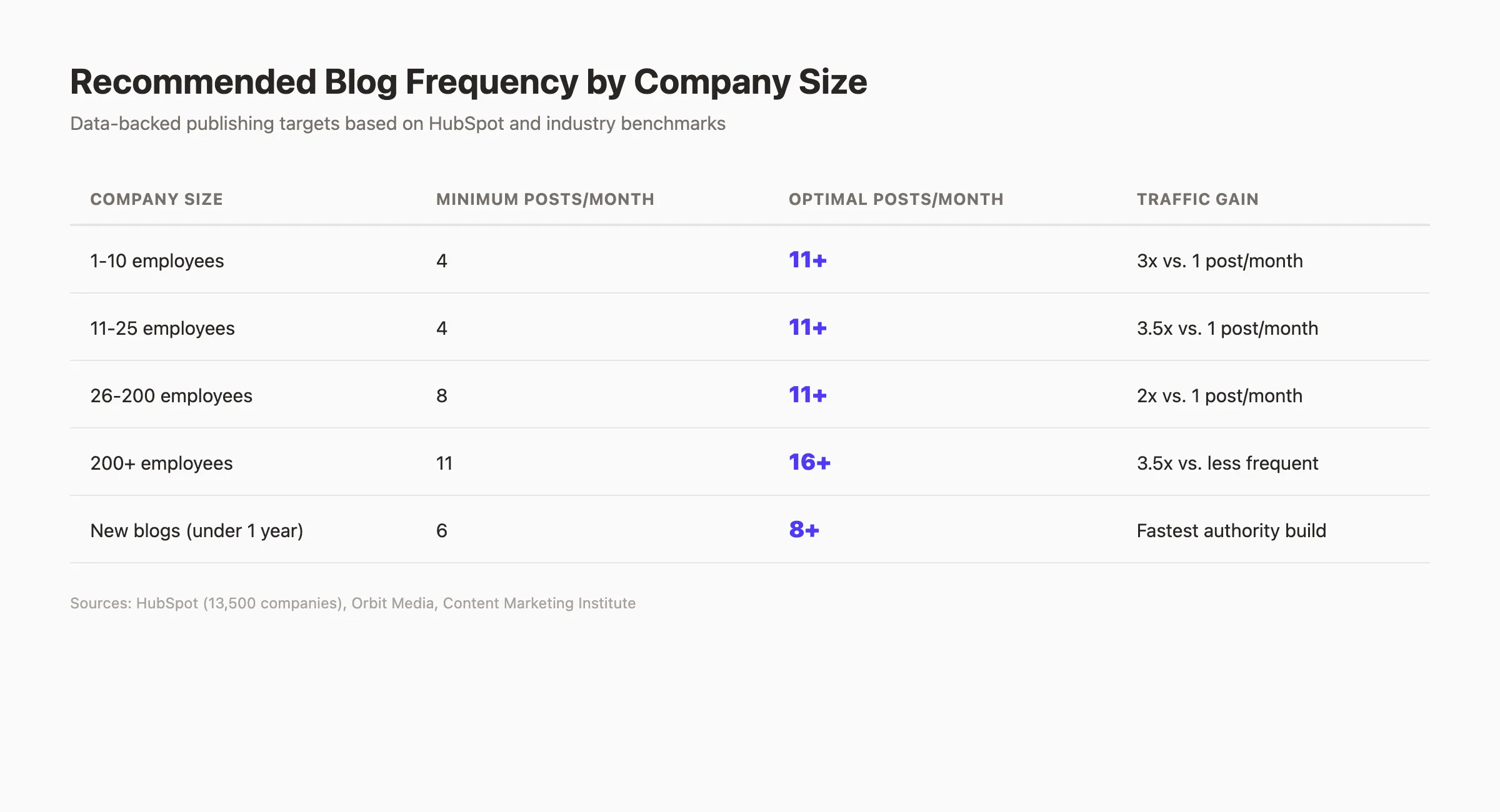
| Company Size | Minimum | Optimal | Expected Result |
|---|---|---|---|
| 1-10 employees | 4/month | 11+/month | 3x traffic vs. baseline |
| 11-25 employees | 4/month | 11+/month | 3.5x traffic vs. baseline |
| 26-200 employees | 8/month | 11-16/month | 2x traffic vs. baseline |
| 200+ employees | 11/month | 16+/month | 3.5x traffic, 4.5x leads |
| New blog (under 1 year) | 6/month | 8+/month | Fastest authority build |
The exception is resource-constrained solopreneurs. If you can only produce 4 quality posts per month, that still beats publishing nothing. But understand that you are leaving 2-3x growth on the table versus the 11+ threshold.
For most small businesses, the math is simple. Hiring a writer for $150 per post means 11 posts cost $1,650 per month. An SEO agency alternative like Stacc publishes 30 posts for $99 per month.
What This Means for Your Business
Eight findings. Twelve studies. One conclusion.
Publishing more blog content correlates with more traffic, more leads, and better SEO results at every company size. The number 11 posts per month appears as a threshold repeatedly. Below it, gains are incremental. Above it, growth compounds.
But the data also reveals 3 things most blogging advice ignores:
1. Total post count matters independently of frequency. Reaching 400+ published posts unlocks a 3x lead multiplier. Speed to 400 is controlled by monthly output. At 30 posts per month, you reach 400 in 13 months. At 4 per month, it takes over 8 years.
2. Quality multiplies frequency, not replaces it. Posts with original research, custom graphics, and 2,000+ words perform best. But publishing 4 perfect articles per month underperforms 11 good articles per month. Do both when you can. Prioritize volume when you must choose.
3. The industry is publishing less, not more. Since 2014, average publishing frequency has dropped from several times per week to several times per month. Businesses that maintain high frequency face less competition now than at any point in the last decade.
Top 5 Actions Based on This Data
- Set a target of 11+ blog posts per month. Use blog automation tools to hit that number consistently.
- Build a content calendar mapped to topic clusters. Every post should strengthen topical authority around your core keywords.
- Track your total published post count. The 400-post milestone is where compounding accelerates.
- Invest in custom graphics and proper blog post length. Quality amplifies frequency.
- Measure your content marketing ROI monthly. Track traffic-per-post and leads-per-post as you scale.
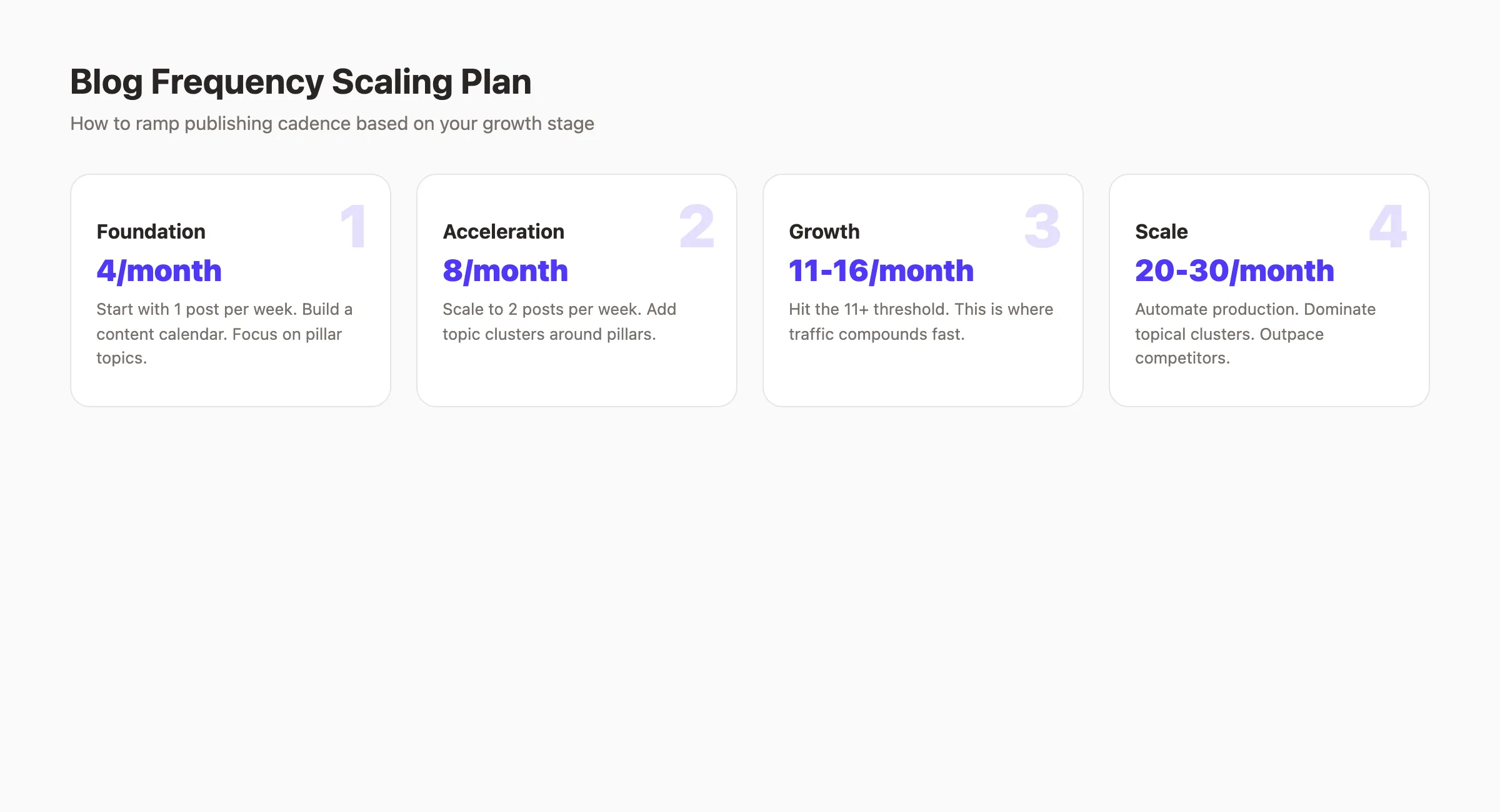
The 11-post threshold is where traffic compounds. Stacc publishes 30 blog posts per month, fully optimized for SEO, starting at $99. No writers. No agencies. No guessing the frequency. Start for $1 →
Frequently Asked Questions
How often should a small business blog for SEO?
The data says 11+ posts per month for maximum impact. Small businesses with 1-10 employees that hit 11 posts per month saw 3x more traffic than those publishing once per month, according to HubSpot. If 11 is not feasible, start at 4 per week and scale blog content with AI to reach the threshold faster.
Is 1 blog post per week enough?
One post per week (4 per month) is better than nothing. But it leaves significant growth on the table. Orbit Media found that weekly publishers are 2.5x more likely to report strong results than monthly publishers. However, publishers at 2-6 times per week are 1.3x more likely to see strong results than weekly publishers. Four per month is a floor, not a ceiling.
Does blog frequency affect Google rankings directly?
Google does not use publishing frequency as a direct ranking factor. But frequency correlates with ranking signals that Google does measure. More posts mean more indexed pages, more internal links, faster topical authority development, and more keywords covered. Stratabeat found that high-frequency blogs ranked in Google’s top 10 more often.
What is better for SEO: posting frequency or post quality?
Both. The data from Orbit Media and Stratabeat shows they are multipliers, not trade-offs. Posts with original research, custom graphics, and 2,000+ words perform best at any frequency. But 4 excellent posts per month still underperform 11 good posts per month in traffic and lead generation. Write as many quality posts as your resources allow.
How do I publish 11+ blog posts per month without a writing team?
Three options. Use AI blog writing tools to draft content faster. Hire a done-for-you SEO service that handles everything. Or use a service like Stacc that publishes 30 SEO-optimized blog posts per month for $99. Most small businesses do not have time to produce 11+ articles manually. Automation closes the gap.
Should I update old posts or publish new ones?
Do both. New posts expand your keyword footprint. Updating old blog posts prevents content decay and protects existing rankings. Orbit Media found that bloggers who update old content are 2.8x more likely to report strong results. A good cadence is 80% new posts and 20% updates.
Sources and Studies Referenced
This meta-analysis draws from the following published research:
- HubSpot: How Often Should You Blog?. Analysis of 13,500+ companies
- Orbit Media: 2025 Blogging Statistics. Annual survey of 808 content marketers
- Stratabeat: Blogging Frequency Research. B2B SaaS SEO Performance Report
- Marketing Insider Group: Blog Post Frequency Research. Frequency and ROI data
- Content Marketing Institute: Publishing Frequency Guide. Ideal frequency framework
The data is consistent across every study. Publish more. Publish consistently. Let the compound effect do its work. If you want to see where your current blog stands, run a free SEO audit and start building from there.

Written by
Siddharth GangalSiddharth is the founder of theStacc and Arka360, and a graduate of IIT Mandi. He spent years watching great businesses lose organic traffic to competitors who simply published more. So he built a system to fix that. He writes about SEO, content at scale, and the tactics that actually move rankings.
30 SEO blog articles published every month
Keyword-optimized, scheduled, and live on your site. Automatically.
30-day trial · Cancel anytime
theStacc
Stop writing SEO content manually
30 blog articles, 30 GBP posts, and social media content. Published every month. Automatically.
Start Your $1 Trial$1 for 3 days · Cancel anytime