
What Is an AI SEO Agent? Complete Guide (2026)
AI SEO agents automate keyword research, content creation, and technical audits autonomously. Learn how they work and which to use. Updated 2026.
90.3% of marketing organizations already use AI agents in some capacity. The global AI agent market hit $5.4 billion in 2024 and is projected to reach $50.3 billion by 2030. SEO is one of the fastest-growing adoption categories.
An AI SEO agent is not a chatbot. It is not a content spinner. It is an autonomous system that plans, executes, and iterates on multi-step SEO workflows using real data, persistent memory, and independent decision-making. You give it a goal. It figures out how to get there.
This guide covers what AI SEO agents actually are, how they differ from AI tools you already use, which agents exist in 2026, and how to decide whether your business needs one.
We have published 3,500+ blog posts across 70+ industries. We use AI agents across our entire content pipeline. This is not theory. It is operating experience.
Here is what you will learn:
- The exact definition of an AI SEO agent and how it differs from AI tools
- The 6 SEO tasks agents can handle autonomously
- Real agents available in 2026 with pricing
- How to evaluate whether an AI agent fits your workflow
- The limitations and risks you need to understand
- How agents interact with Google’s quality guidelines
AI SEO Agent vs AI SEO Tool: The Core Distinction
Most people confuse AI SEO agents with AI SEO tools. The difference is fundamental.
AI SEO Tools
An AI SEO tool responds to a single prompt and produces a single output. You ask ChatGPT to write a meta description. It writes one. You ask Surfer SEO to analyze a page. It produces a report. The tool does what you tell it, one task at a time.
Examples: ChatGPT, Jasper, Surfer SEO, Frase, Clearscope.
AI SEO Agents
An AI SEO agent receives a goal and autonomously plans a multi-step workflow to achieve it. It breaks the goal into subtasks. It executes each subtask using real tools and data. It evaluates results. It adjusts its approach based on what it learns. It does this without waiting for your next prompt.
The 4 capabilities that define an agent:
- Planning. The agent creates a strategy to achieve the goal. It decides which tasks to run, in what order, and with what parameters.
- Tool use. The agent connects to external tools and data sources. It queries search APIs, crawls websites, checks rankings, and accesses analytics.
- Memory. The agent remembers context across tasks. It knows what it did in step 1 when executing step 5. It retains information across sessions.
- Autonomous execution. The agent runs tasks without human prompts between steps. You set the goal. The agent handles the rest.
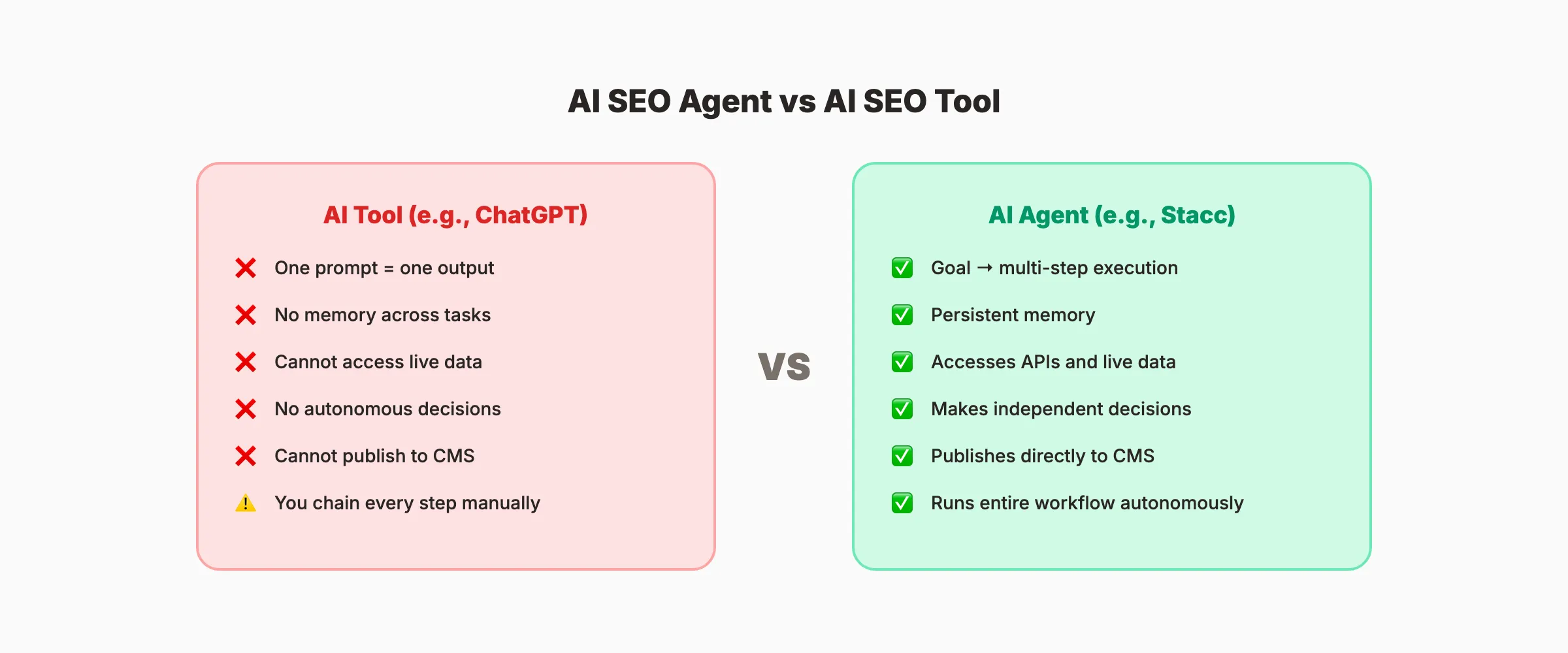
| Capability | AI Tool | AI Agent |
|---|---|---|
| Single-task execution | Yes | Yes |
| Multi-step workflows | No (manual chaining) | Yes (autonomous) |
| Accesses external data | Limited | Yes (APIs, crawlers, databases) |
| Remembers past context | Per conversation only | Persistent across sessions |
| Makes independent decisions | No | Yes |
| Adjusts strategy based on results | No | Yes |
| Requires prompt per task | Yes | No (goal-based) |
The simplest way to think about it: an AI tool is a calculator. An AI SEO agent is an employee who uses multiple calculators, spreadsheets, and data sources to complete a project without you standing over their shoulder.
For a deeper look at how this shift affects SEO strategy, read our guide on agentic SEO.
The 6 SEO Tasks AI Agents Handle
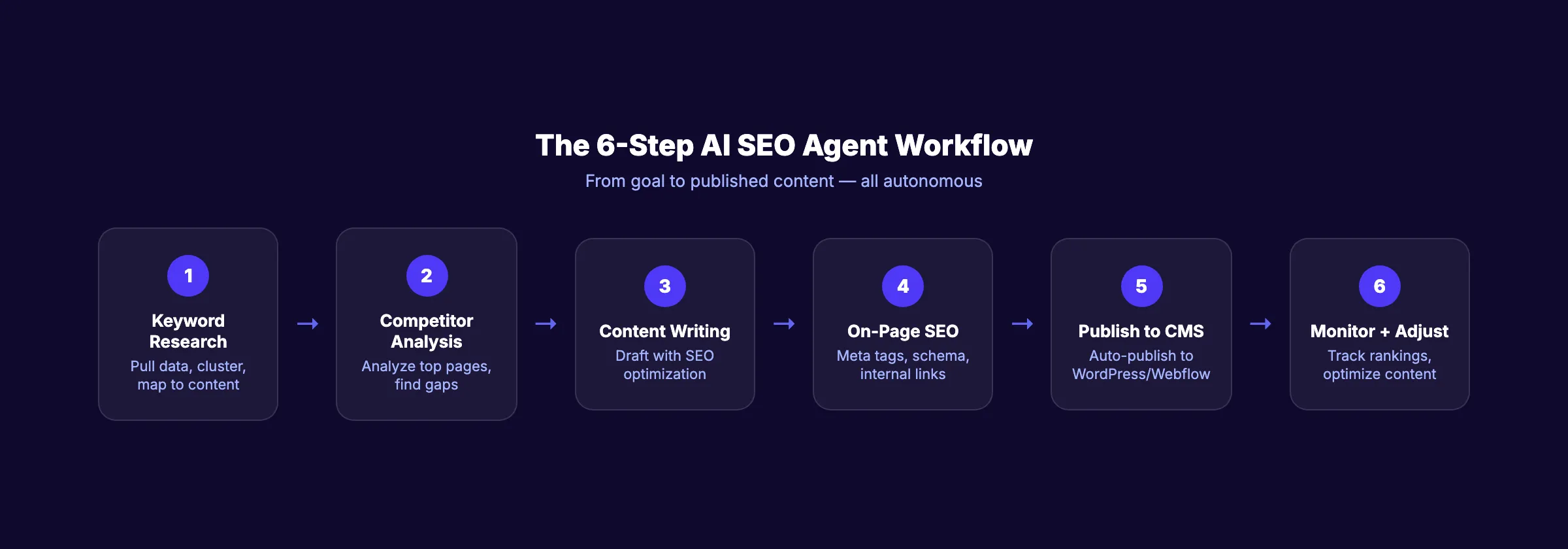
AI SEO agents are not general-purpose assistants. They specialize in specific SEO workflows. Here are the 6 tasks where agents add the most value.
1. Keyword Research and Clustering
An AI SEO agent does not just suggest keywords. It pulls search volume data from APIs, analyzes search intent, clusters related keywords into topical groups, maps keywords to content types, and identifies gaps in your existing coverage.
A manual keyword research process takes 4-8 hours per topic cluster. An agent completes the same analysis in minutes. The output includes keyword clusters, content type recommendations, and a prioritized publishing plan.
2. Content Creation and Optimization
The most visible use case. AI SEO agents generate blog posts, landing pages, and product descriptions with built-in optimization. But unlike a simple AI writer, an agent:
- Analyzes top-ranking competitors for the target keyword
- Identifies content gaps that competitors miss
- Structures the article based on search intent patterns
- Writes the content with proper heading hierarchy and internal links
- Optimizes meta descriptions and title tags
- Checks for keyword density and semantic coverage
The entire pipeline runs in sequence without manual intervention.
3. Technical SEO Audits
AI agents crawl your site, identify technical issues, and prioritize fixes by impact. They check Core Web Vitals, crawlability, indexation status, broken links, redirect chains, schema markup errors, and mobile usability.
The difference from a standard SEO audit tool is that the agent does not just produce a list of issues. It explains the impact of each issue, suggests the specific fix, and in some cases, implements the fix automatically.
4. Rank Tracking and Reporting
Agents monitor keyword rankings, detect changes, and generate reports that include analysis, not just data. When rankings drop, the agent investigates potential causes: algorithm updates, new competitors, content decay, or technical issues.
Traditional rank trackers show you a number went down. AI agents tell you why and what to do about it.
5. Link Building Research
AI agents identify link building opportunities by analyzing competitor backlink profiles, finding broken link targets, identifying unlinked brand mentions, and suggesting outreach targets. They do not send the emails (most cannot), but they produce the research that makes outreach efficient.
6. Content Publishing and Distribution
Some AI SEO agents connect to your CMS (WordPress, Webflow, Ghost) and publish content directly. They schedule posts, add featured images, set categories and tags, and distribute content to social media channels.
This is the full end-to-end pipeline: research, write, optimize, publish, distribute. All from a single goal.
The publishing step is what separates a true AI SEO agent from a fancy writing tool. If you still copy-paste the output into WordPress, the “agent” is really just a tool with extra steps. The value of an agent is measured in human steps eliminated, not in output quality alone.
Stop writing. Start ranking. Stacc publishes 30 SEO articles per month for $99. Our agents handle everything from keyword research to publishing. Start for $1 →
AI SEO Agents Available in 2026
The market is moving fast. Here are the notable AI SEO agents and what they do.
| Agent / Platform | Focus | Starting Price | Key Capability |
|---|---|---|---|
| Frase | Content + research | $49/mo | Covers 6/6 SEO pipeline stages |
| Surfer AI | Content optimization | $89/mo | SERP analysis + writing + NLP scoring |
| Alli AI | Technical + on-page | $141/mo | Auto-implements on-page changes |
| NightOwl | Full SEO pipeline | $32/mo | Keyword to publish workflow |
| KIVA | Keyword research | $32/mo | AI-driven keyword clustering |
| WordLift | Schema + entities | $879/mo | Knowledge graph optimization |
| Semrush Copilot | Analysis + insights | Included with Semrush | Proactive SEO recommendations |
| Stacc | Content + local SEO | $99/mo | 30 articles published automatically |
The distinction between “AI tool with agent features” and “true AI agent” is blurry. Most platforms fall somewhere on a spectrum. The key question is not “is this a real agent?” but rather “does this reduce the manual steps in my SEO workflow?”
The market is evolving weekly. New AI SEO agents launch every month. Existing tools add agent capabilities. The pricing ranges from $32 per month for basic agent features to $879 per month for enterprise knowledge graph optimization. For most small businesses, the $49-$149 per month range covers the essential agent capabilities.
86% of SEO professionals have already integrated AI into their workflows. The AI SEO tools market is projected to grow from $1.2 billion to $4.5 billion by 2033. Early adopters are building content libraries and topical authority that late adopters will struggle to match.
For a full comparison of AI SEO tools, read our best AI SEO tools guide.
How to Evaluate an AI SEO Agent
Not every AI SEO agent fits every business. Use this framework to evaluate.
The Autonomy Spectrum
| Level | Description | Example |
|---|---|---|
| Level 1: Assisted | AI suggests. Human executes. | Semrush Copilot suggesting fixes |
| Level 2: Semi-autonomous | AI executes with human approval. | Stacc writing and queuing articles for review |
| Level 3: Autonomous | AI executes without human intervention. | Agent publishing content directly to CMS |
| Level 4: Self-optimizing | AI monitors results and adjusts strategy. | Agent updating content based on ranking changes |
Most businesses should start at Level 2. Let the agent do the work. Review before publishing. Build trust over time. Move toward Level 3 only after validating quality.
Questions to Ask Before Choosing
- Does it connect to your CMS (WordPress, Webflow, Ghost)?
- Does it access real search data (not just training data)?
- Does it handle the specific SEO tasks you need?
- Can you review and approve output before it goes live?
- What is the cost per article compared to freelancers and agencies?
- Does it maintain consistent brand voice?
- What happens when it makes a mistake?
Cost Per Article: Agent vs Human vs Agency
| Production Method | Cost Per Article | Quality | Speed |
|---|---|---|---|
| Freelance writer | $80-$250 | High (varies) | 3-7 days |
| SEO agency | $200-$500 | High | 5-14 days |
| AI tool (ChatGPT) + manual editing | $5-$20 | Medium (needs editing) | 1-3 hours |
| AI SEO agent | $3-$15 | Medium-High | Minutes |
| Stacc (done-for-you) | $3.30 ($99/30 articles) | High (92% avg SEO score) | Automatic |
The cost advantage of AI agents is significant at scale. A single freelance article costs $80-$250. An AI agent produces 30 articles for the same monthly cost. The trade-off is editorial control. Human writers produce more nuanced content. AI agents produce more consistent, scalable content.
Your SEO team. $99 per month. 30 optimized articles, published automatically. No AI prompt engineering required. Start for $1 →
Limitations and Risks
AI SEO agents are powerful. They are not perfect. Ignoring these limitations leads to poor results.
Hallucination
AI agents generate facts that do not exist. Statistics, company names, product features, and dates can all be fabricated. Every factual claim in agent-generated content needs human verification. This is non-negotiable.
Quality Inconsistency
Agent output quality varies by topic. Well-documented topics (like “what is SEO”) produce strong content. Niche topics with limited training data produce thin, generic results.
E-E-A-T Compliance
Google’s E-E-A-T framework values Experience, Expertise, Authoritativeness, and Trustworthiness. AI agents have zero first-hand experience. Content from AI agents that lacks human editorial review risks failing Google’s quality standards.
The fix: use AI agents for the first draft. Add human experience, specific examples, and expert opinions during review. The agent handles 80% of the work. A human handles the 20% that matters most.
Over-Optimization
AI agents optimize aggressively by default. They may stuff keywords, over-link internal pages, or produce content that reads like it was written for search engines rather than people. Set quality guidelines in the agent configuration. Review output against on-page SEO best practices.
Data Privacy
AI agents access your analytics, search console data, and content. Understand where that data goes. Review the agent platform’s data handling policies. For enterprises with sensitive data, on-premise or private cloud deployment matters.
Google’s Stance
Google evaluates content on quality, not production method. AI-generated content is not inherently penalized. But “scaled content abuse” (mass-producing low-quality content) violates Google’s spam policies. AI agents make it easy to produce volume. Quality gates prevent that volume from becoming a liability.
Who Benefits Most from AI SEO Agents
Small Businesses (2-20 Employees)
Small businesses benefit most from done-for-you AI SEO agents that handle the entire pipeline. No SEO knowledge required. No content team required. The agent produces and publishes content on a schedule.
Best fit: Stacc, NightOwl, or similar end-to-end platforms. Pair with a local SEO strategy for maximum impact.
Agencies (5-100 Employees)
Agencies benefit from AI agents that scale content production across multiple clients. The agent handles research and first drafts. The agency team handles strategy, client communication, and quality review.
Best fit: Frase, Surfer AI, or custom agent workflows built on frameworks like Claude Agent SDK.
Enterprise (100+ Employees)
Enterprise teams benefit from AI agents that integrate with existing tech stacks, handle programmatic SEO at scale, and provide granular control over output quality.
Best fit: WordLift, Alli AI, or custom-built agents with enterprise data governance.
The Future of AI SEO Agents
The trajectory is clear. AI SEO agents will handle more of the SEO workflow with less human oversight over the next 2-3 years.
What Is Coming
- Real-time optimization. Agents that monitor rankings continuously and adjust content in real time based on performance data.
- Cross-channel agents. Agents that optimize across Google, YouTube, Reddit, and AI search engines simultaneously. This aligns with the broader search everywhere optimization trend.
- Self-improving content. Agents that update published content based on ranking signals, user engagement data, and competitor changes. The concept of content decay becomes less relevant when agents fix it automatically.
- Voice and visual search agents. Agents that optimize for AI Overviews, voice queries, and visual search surfaces.
What Will Not Change
Human judgment still matters. The best AI SEO agents in 2026 produce strong first drafts and solid technical audits. They do not replace strategic thinking, brand positioning, or the editorial judgment that separates good content from great content.
The winning model is human strategy plus AI execution. You decide what to rank for, who to target, and what voice to use. The agent handles the research, writing, optimization, and publishing.
The companies that try to remove humans entirely from the loop produce mediocre content at scale. That content ranks briefly, then loses ground as Google’s quality signals catch up. The companies that pair AI agents with human oversight produce high volumes of high-quality content. That is the durable advantage.
AI search traffic grew 527% in 2025. As AI chatbots become a primary discovery channel, the agents that optimize for AI search visibility alongside traditional Google rankings will deliver the highest ROI. This cross-platform optimization is the natural extension of the search everywhere optimization framework.
Skip the agency. Keep the results. Stacc starts at $99/mo with a $1 trial. 30 SEO articles published automatically every month. Start for $1 →
FAQ
What is an AI SEO agent?
An AI SEO agent is an autonomous AI system that plans and executes multi-step SEO tasks without requiring a human prompt for each step. It uses real data access, tool integration, persistent memory, and independent decision-making to complete SEO workflows from research through publishing. This differs from AI tools that require manual prompting for each task.
How is an AI SEO agent different from ChatGPT?
ChatGPT is an AI tool. It responds to one prompt at a time. An AI SEO agent receives a goal (like “write and publish a blog post about local SEO”) and autonomously handles every step: keyword research, competitor analysis, content writing, optimization, and publishing. ChatGPT needs a separate prompt for each of those tasks.
Are AI SEO agents safe to use with Google?
Yes, with caveats. Google evaluates content on quality, not production method. AI-generated content is not penalized if it meets quality standards. However, mass-producing low-quality content (which AI agents make easy) violates Google’s spam policy on “scaled content abuse.” Use quality gates and human review to stay safe.
How much do AI SEO agents cost?
Pricing ranges from $32/mo (KIVA, NightOwl) to $879/mo (WordLift enterprise). Most mid-range options cost $49-$149/mo. At $99/mo for 30 published articles, Stacc offers one of the lowest cost-per-article ratios at approximately $3.30 per article.
Can AI SEO agents replace SEO agencies?
For basic content creation and technical SEO audits, yes. For strategic planning, competitive positioning, and custom campaigns, no. AI agents handle execution well. They do not replace the strategic thinking that experienced SEO professionals provide. The most effective approach combines AI agent execution with human strategy.
Which AI SEO agent is best for small businesses?
For small businesses that want hands-off SEO, a done-for-you agent like Stacc ($99/mo for 30 articles) is the most practical choice. For businesses that want more control, Frase ($49/mo) offers the broadest pipeline coverage. For budget-conscious businesses, NightOwl ($32/mo) provides basic agent functionality at the lowest price.
AI SEO agents are the most significant shift in SEO tooling since rank trackers went cloud-based. The technology is real, the cost savings are measurable, and the quality is improving every quarter. The businesses that adopt agents now build a compounding content advantage. The ones that wait will spend 3 times as much catching up later.
Related Tools & Resources
Free SEO Tools:
Best Lists:

Written by
Siddharth GangalSiddharth is the founder of theStacc and Arka360, and a graduate of IIT Mandi. He spent years watching great businesses lose organic traffic to competitors who simply published more. So he built a system to fix that. He writes about SEO, content at scale, and the tactics that actually move rankings.
30 SEO blog articles published every month
Keyword-optimized, scheduled, and live on your site. Automatically.
30-day trial · Cancel anytime
theStacc
Stop writing SEO content manually
30 blog articles, 30 GBP posts, and social media content. Published every month. Automatically.
Start Your $1 Trial$1 for 3 days · Cancel anytime