
What Is Search Everywhere Optimization? (2026)
Search Everywhere Optimization means ranking on Google, YouTube, TikTok, Reddit, AI chatbots, and more. Learn how to optimize for 12 platforms.
Google handles only 18% of the estimated 45 billion daily searches happening across all platforms globally. The other 82% happen on YouTube, TikTok, Reddit, Amazon, ChatGPT, Perplexity, Google Maps, and a dozen other surfaces.
Search Everywhere Optimization is the strategy of ranking your brand across every platform where your audience searches. Not just Google. Everywhere.
This is not a new acronym. It is a recognition that the SEO acronym itself needs updating. Rand Fishkin of SparkToro argues that SEO should stand for Search Everywhere Optimization, not just Search Engine Optimization. Ashley Liddell coined the term at BrightonSEO in 2022 and subsequently trademarked “Search Everywhere.”
We have published 3,500+ blog posts across 70+ industries. We optimize content for Google, AI search engines, and social platforms simultaneously. This guide covers the full framework.
Here is what you will learn:
- Why traditional Google-only SEO is no longer enough
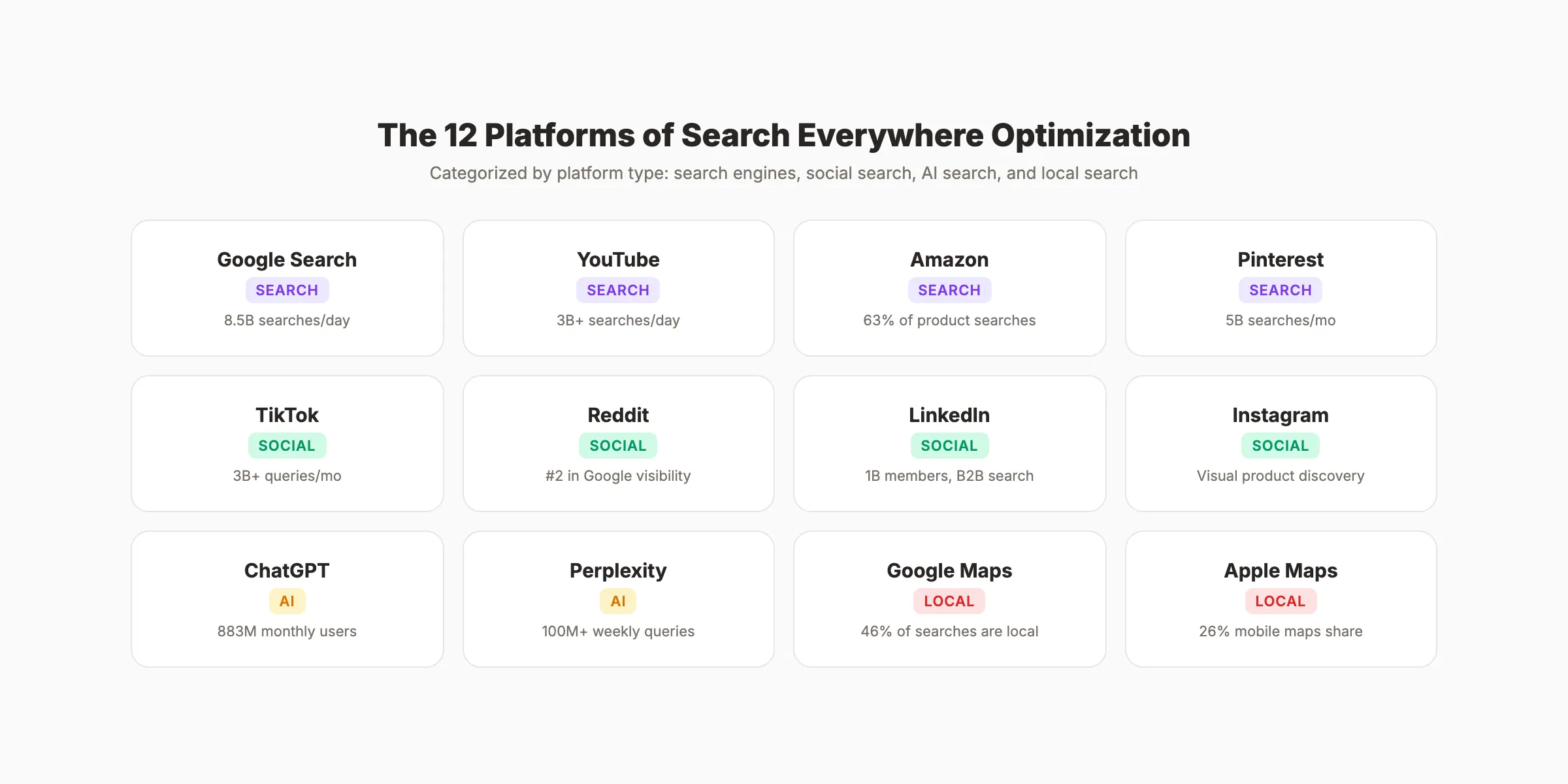
- The 12 platforms that matter for search visibility in 2026
- How to optimize for each platform without spreading too thin
- How AI search engines change the equation
- A practical prioritization framework based on your business type
Why Search Is Fragmenting
58.5% of Google searches end without a click. When AI Overviews appear, that number rises to 83%. When Google’s AI Mode is active, 93% of searches produce zero clicks to external sites.
This is the zero-click problem. Google answers queries directly. Users never visit your website.
At the same time, search behavior is shifting to other platforms entirely. YouTube processes over 3 billion searches per day. TikTok became the search engine of choice for Gen Z (51% preferred it over Google in 2023, though that preference has since moderated). Reddit became the 2nd most visible website in Google after Wikipedia.
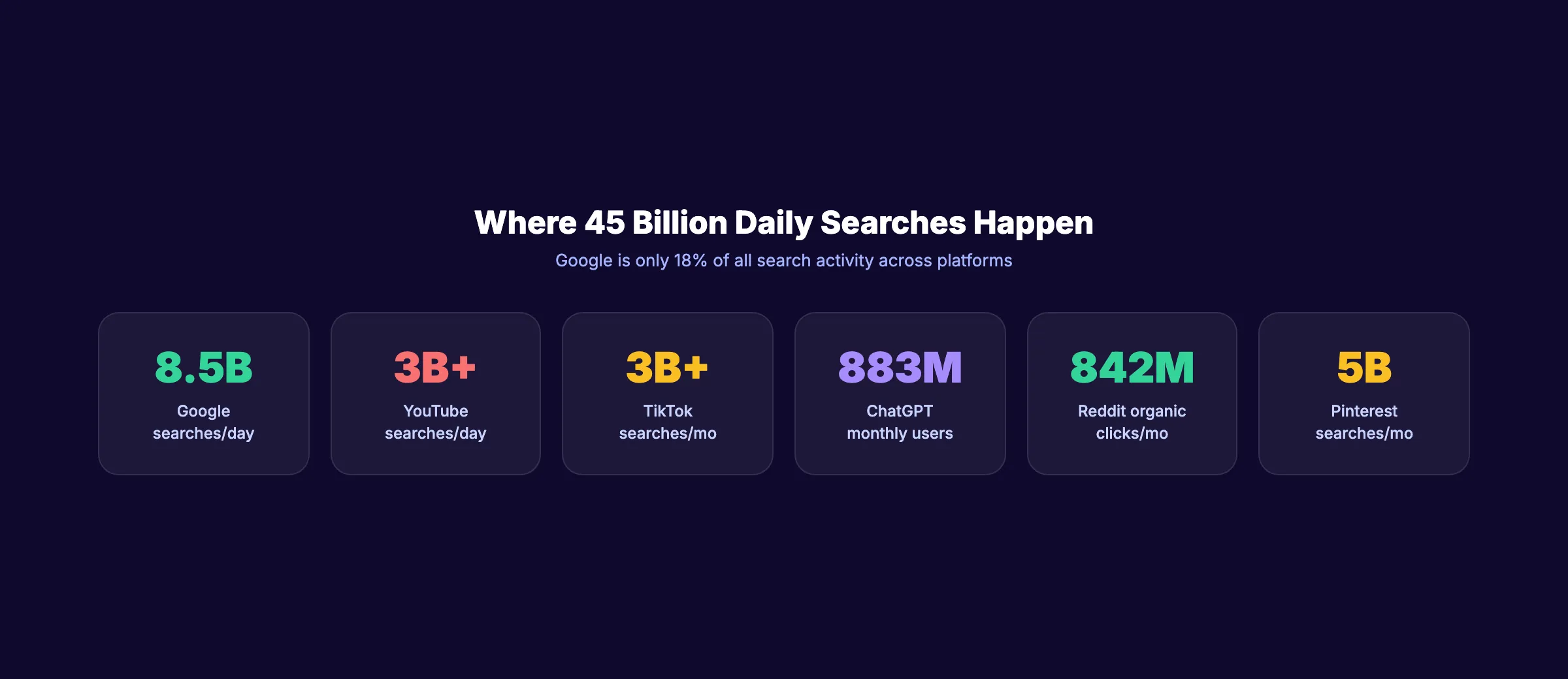
The result is a fragmented search ecosystem. Your audience does not search in one place. They search on Google for informational queries, YouTube for how-to content, TikTok for product recommendations, Reddit for honest opinions, Amazon for purchase decisions, and ChatGPT for quick answers.
Search Everywhere Optimization is the strategic response to this fragmentation. Instead of putting all resources into Google rankings, you optimize for every surface where your audience looks for information.
Search Everywhere Optimization vs Traditional SEO
Traditional SEO focuses on Google organic search. On-page optimization, technical SEO, and backlink building drive rankings in a single search engine.
Search Everywhere Optimization expands the definition. The same principles apply, but the execution extends across multiple platforms.
| Factor | Traditional SEO | Search Everywhere Optimization |
|---|---|---|
| Primary platform | Google + 11 other surfaces | |
| Success metric | Google rankings + organic traffic | Total brand visibility across platforms |
| Content format | Blog posts + web pages | Blog posts, videos, short-form, social, AI-cited content |
| Technical focus | Crawlability, speed, schema | Platform-specific algorithms + AI crawler access |
| Link building | Backlinks to website | Cross-platform presence + brand mentions |
| Keyword research | Google search volume | Multi-platform search intent analysis |
| Timeline | 3-6 months | Varies by platform (TikTok: days, Google: months) |
This is not a replacement for traditional SEO. It is an expansion. Google still drives the most organic traffic for most businesses. But Google alone leaves significant visibility on the table.
The key distinction: traditional SEO optimizes one channel deeply. Search Everywhere Optimization maintains presence across channels strategically.
Rank everywhere. Do nothing. Stacc handles Blog SEO, Local SEO, and Social on autopilot. 30 articles per month, published automatically. Start for $1 →
The 12 Platforms That Matter
Not every platform matters for every business. But these 12 represent the primary search surfaces in 2026.
1. Google Search
Still the foundation. 8.5 billion searches per day. 92% global market share for traditional web search. Every business needs Google visibility.
Optimize through: on-page SEO, technical SEO, content quality, backlinks, Core Web Vitals, and schema markup.
2. Google AI Overviews and AI Mode
AI Overviews appear on 30%+ of Google queries. AI Mode (the conversational interface) generates zero-click answers for 93% of queries where it activates.
Optimize through: structured content, clear definitions, FAQ sections, Speakable schema, and content that AI systems can easily cite. Read our full guide on optimizing for Google AI Overviews.
3. YouTube
The second largest search engine. 3 billion+ searches per day. 2.7 billion monthly active users. YouTube is the primary search surface for how-to content, tutorials, product reviews, and educational material.
Optimize through: keyword-rich titles and descriptions, chapter markers, closed captions, thumbnail click-through rate, watch time, and engagement signals.
4. TikTok
TikTok Search processes over 3 billion queries per month. The platform’s search functionality has evolved from a novelty to a legitimate search engine, especially for product discovery, restaurants, travel, and lifestyle queries.
Optimize through: keyword-rich captions and hashtags, text overlays that match search terms, trending sounds, and engagement rate. TikTok’s algorithm rewards content velocity more than any other platform.
5. Reddit
Reddit is the 2nd most visible domain in Google U.S. results. 842 million monthly organic clicks. 37% of AI Overview social citations come from Reddit. Read our full Reddit SEO guide for detailed strategies.
Optimize through: genuine community participation (90/10 rule), helpful answers, brand mention building, and transparent engagement.
6. Amazon
63% of product searches start on Amazon, not Google. For e-commerce businesses, Amazon search optimization is not optional. It is the primary discovery channel.
Optimize through: keyword-rich product titles, bullet points, backend search terms, A+ content, review volume, and sales velocity.
7. ChatGPT and AI Chatbots
ChatGPT has 883 million monthly users and 60.7% AI search market share. Perplexity AI, Claude, and Gemini add additional surfaces. Together, AI chatbots represent a growing share of information discovery.
Optimize through: generative engine optimization, brand authority signals, structured data, clear and citable content, and AI crawler access. Being cited by AI chatbots requires content that reads like an authoritative source.
8. Google Maps and Local Pack
For local businesses, the Google Business Profile and Maps results drive more leads than organic search. The local pack appears for 46% of all Google searches.
Optimize through: GBP completeness, Google reviews, local citations, NAP consistency, and local content. Read our local SEO guide for the full framework.
9. Pinterest
Pinterest processes 5 billion searches per month. It functions as a visual search engine for home decor, fashion, recipes, DIY, wedding planning, and design inspiration.
Optimize through: keyword-rich Pin descriptions, board titles, alt text on images, Rich Pins, and fresh content published consistently.
10. LinkedIn
LinkedIn’s search function drives B2B discovery. 1 billion members. The platform’s algorithm increasingly favors original content, thought leadership posts, and newsletter subscriptions.
Optimize through: keyword-optimized profiles, consistent post publishing, article optimization, and engagement within industry groups.
11. Apple Maps
Apple Maps has 26% of the mobile maps market. iPhone users default to Apple Maps for local business discovery. Most SEO strategies ignore Apple Maps entirely.
Optimize through: Apple Business Connect registration, accurate business information, photos, and category selection. Apple Maps pulls data from Yelp and TripAdvisor, so accuracy on those platforms matters.
12. Perplexity AI
Perplexity AI processes 100+ million weekly queries. It cites sources directly with linked references, making it the most transparent AI search engine. Being cited by Perplexity drives direct referral traffic to your site, unlike ChatGPT or Google AI Overviews which often keep users on their platform.
Optimize through: authoritative content, clear structure, llms.txt files, and content that provides specific, quotable answers. Perplexity heavily weights content that includes data, statistics, and direct answers to questions. Read our guide on optimizing for Perplexity.
How AI Search Changes Everything
AI search engines are the biggest disruptor since Google introduced featured snippets. They change how users discover information and how brands earn visibility.
The Citation Model
Traditional search sends users to your website via blue links. AI search engines cite your content without sending a click. The user gets the answer. You get a mention. Maybe.
This fundamentally changes the value proposition. Visibility in AI search means brand recognition and authority, not direct traffic. Getting cited by AI search engines requires a different content strategy than ranking in Google.
GEO: The AI Optimization Framework
Generative Engine Optimization (GEO) is the practice of optimizing content specifically for AI search engines. It overlaps with Search Everywhere Optimization but focuses on the AI-specific surfaces.
GEO tactics include:
- Writing content with clear, quotable statements
- Adding structured data that AI systems can parse
- Creating llms.txt files for AI crawler guidance
- Ensuring AI crawlers can access your content
- Building brand mentions across platforms AI models train on (Reddit, Wikipedia, industry forums)
The Cross-Platform Effect
AI search engines do not just crawl your website. They train on Reddit threads, YouTube transcripts, forum posts, and social media content. Your Reddit presence influences your AI search visibility. Your YouTube content shapes what ChatGPT knows about your brand.
This is the core argument for Search Everywhere Optimization. Presence on multiple platforms creates a compound effect where each platform reinforces your visibility on every other platform.
Your SEO team. $99 per month. 30 optimized articles, published automatically. We handle Google, GBP, and social media content. Start for $1 →
The Prioritization Framework
Trying to optimize for all 12 platforms simultaneously is a mistake. Most businesses should focus on 3-4 platforms strategically.
Prioritize by Business Type
| Business Type | Priority Platforms | Secondary Platforms |
|---|---|---|
| Local service business | Google, Google Maps, Reddit | YouTube, ChatGPT |
| E-commerce / D2C | Amazon, Google, TikTok | Pinterest, YouTube |
| B2B SaaS | Google, LinkedIn, ChatGPT | Reddit, YouTube |
| Content creator | YouTube, TikTok, Google | Reddit, Pinterest |
| Restaurant / hospitality | Google Maps, TikTok, Reddit | Instagram, Apple Maps |
| Professional services | Google, LinkedIn, Google Maps | ChatGPT, Reddit |
The 3-Platform Rule
Start with Google plus 2 platforms where your specific audience searches most actively. Master those 3 before expanding. Spreading thin across 12 platforms produces mediocre results everywhere. Depth on 3 platforms beats breadth across 12.
Measurement Across Platforms
Track different metrics for each platform:
| Platform | Primary Metric | Tool |
|---|---|---|
| Organic traffic + rankings | Google Search Console | |
| YouTube | Watch time + search impressions | YouTube Studio |
| TikTok | Views + search visibility | TikTok Analytics |
| Brand mentions + referral traffic | Google Alerts + GA4 | |
| Amazon | Search rank + conversion rate | Amazon Seller Central |
| AI chatbots | Brand citations | Manual testing + monitoring tools |
| Google Maps | GBP views + direction requests | GBP Insights |
Practical Implementation: A 90-Day Plan
Most Search Everywhere Optimization guides stop at theory. Here is a concrete action plan.
Days 1-30: Foundation
- Audit your current presence across all 12 platforms
- Identify your 3 priority platforms based on business type
- Run a full SEO audit on your website
- Claim and optimize your Google Business Profile
- Set up Google Search Console and GA4
- Create accounts on your 2 secondary platforms
- Research what your audience searches for on each platform
Days 31-60: Content Production
- Publish 10-15 blog posts optimized for Google and AI search
- Repurpose blog content into platform-native formats (video, short-form, posts)
- Begin genuine participation on Reddit in relevant subreddits
- Optimize existing content with schema markup
- Create or update your llms.txt file for AI crawlers
- Build your topical authority through content clusters
Days 61-90: Scale and Measure
- Review performance data across all platforms
- Double down on platforms showing traction
- Add 1 secondary platform if resources allow
- Test whether AI chatbots cite your content for target queries
- Adjust content calendar based on platform performance
- Plan the next 90-day cycle
The goal is not to be everywhere at once. The goal is to be excellent on your priority platforms, then expand methodically.
3,500+ blogs published. 92% average SEO score. We handle the content creation so you can focus on platform strategy. Start for $1 →
Common Mistakes
1. Abandoning Google for Newer Platforms
Google still drives the majority of organic traffic for most websites. TikTok and Reddit are additive channels, not replacements. Businesses that shift resources away from Google to chase TikTok trends often lose their primary traffic source.
2. Copying Content Across Platforms
Every platform has its own algorithm, format, and culture. A blog post does not work on TikTok. A TikTok video does not work on LinkedIn. Repurpose the insight, not the content. Adapt the format to match each platform’s expectations.
3. Chasing Every Platform
Spreading across 10 platforms with minimal effort on each produces zero results. Better to dominate 3 platforms than to have a weak presence on 10. Resource allocation matters more than platform count.
4. Ignoring AI Search
AI search is not a future trend. ChatGPT has 883 million monthly users now. Perplexity processes 100+ million weekly queries. Ignoring AI search in 2026 is like ignoring mobile optimization in 2015. The shift is already here.
5. No Cross-Platform Measurement
Most businesses measure Google Analytics and nothing else. Search Everywhere Optimization requires tracking visibility across multiple platforms. Without measurement, you cannot prioritize. Without prioritization, you waste resources.
The Honest Critique
Search Everywhere Optimization is a useful framework. It is also partly a rebrand of advice that good marketers have followed for years.
Smart marketers have always optimized YouTube descriptions with keywords. They have always maintained Google Business Profiles. They have always participated in industry forums. Calling it “Search Everywhere Optimization” packages existing best practices into a buzzier framework.
The genuine value is in the mindset shift. Thinking about search beyond Google forces you to ask better questions. Where does my audience actually discover information? What platforms do they trust? How do AI systems learn about my brand?
Those questions matter. The label matters less.
What has changed is the AI dimension. AI search engines training on Reddit, YouTube, and forum data creates a genuine cross-platform compounding effect that did not exist 3 years ago. That part is new. That part is worth optimizing for.
The practical takeaway: do not adopt Search Everywhere Optimization as a buzzword. Adopt the mindset of meeting your audience where they search. Use data to determine where that is. Then allocate resources accordingly. For most businesses, that means Google first, 2 additional platforms second, and AI search optimization woven throughout.
The businesses that win are not the ones present on the most platforms. They are the ones present on the right platforms with the right content, published consistently. That is what content strategy has always been about. Search Everywhere Optimization just makes the scope explicit.
FAQ
What is Search Everywhere Optimization?
Search Everywhere Optimization is the practice of optimizing your brand presence across all platforms where people search for information. This includes Google, YouTube, TikTok, Reddit, Amazon, AI chatbots (ChatGPT, Perplexity), Google Maps, Pinterest, LinkedIn, and Apple Maps. The term was coined by Ashley Liddell at BrightonSEO in 2022.
How is Search Everywhere Optimization different from SEO?
Traditional SEO focuses exclusively on Google organic search rankings. Search Everywhere Optimization extends the same principles (keyword research, content optimization, technical optimization) across multiple platforms. It does not replace traditional SEO. It adds platform-specific optimization on top of your existing Google strategy.
Which platforms should I prioritize for Search Everywhere Optimization?
Start with Google plus 2 platforms where your audience searches most. Local businesses should prioritize Google Maps and Reddit. E-commerce brands should focus on Amazon and TikTok. B2B companies should optimize for LinkedIn and ChatGPT. Master 3 platforms before expanding to more.
Does Search Everywhere Optimization help with AI search visibility?
Yes. AI search engines like ChatGPT and Perplexity train on content from Reddit, YouTube, forums, and websites. Building presence across multiple platforms increases the probability that AI models cite your brand. This cross-platform effect is one of the strongest arguments for Search Everywhere Optimization. Read our GEO guide for specific AI optimization tactics.
Is Search Everywhere Optimization worth it for small businesses?
For most small businesses, a focused approach works best. Optimize Google and Google Maps first. Add 1-2 secondary platforms based on your industry. Do not try to be everywhere at once. A single-location business benefits more from a well-optimized Google Business Profile than a presence on 10 platforms with minimal effort on each.
How do I measure Search Everywhere Optimization success?
Track different metrics per platform: Google rankings and traffic via Search Console, YouTube watch time and search impressions, Reddit brand mentions, Amazon search rank, and AI chatbot citations. There is no single dashboard that measures all platforms. Build a monthly reporting cadence that covers your 3 priority platforms.
Search Everywhere Optimization is where SEO is headed. Not because Google is dying. Google still processes 8.5 billion searches daily. But because your audience searches on more surfaces than ever before, and AI systems learn about your brand from all of them. Optimize where it matters most. Then expand strategically.

Written by
Siddharth GangalSiddharth is the founder of theStacc and Arka360, and a graduate of IIT Mandi. He spent years watching great businesses lose organic traffic to competitors who simply published more. So he built a system to fix that. He writes about SEO, content at scale, and the tactics that actually move rankings.
30 SEO blog articles published every month
Keyword-optimized, scheduled, and live on your site. Automatically.
30-day trial · Cancel anytime
theStacc
Stop writing SEO content manually
30 blog articles, 30 GBP posts, and social media content. Published every month. Automatically.
Start Your $1 Trial$1 for 3 days · Cancel anytime