
What Is Agentic SEO? The Complete Guide (2026)
Agentic SEO uses AI agents to automate search optimization. Learn what it is, how it works, tools, and how to adapt your strategy. Updated April 2026.
What Is Agentic SEO? The Complete Guide (2026)
SEO used to be simple. Research keywords. Write content. Build links. Wait. That process worked for 20 years. In 2026, it is not enough.
Agentic SEO is the shift that explains why. It is the use of autonomous AI agents to plan, execute, and continuously optimize search strategies without step-by-step human instruction. You give an agent a goal. The agent figures out how to achieve it.
This is not another AI writing tool. AI writing tools need a prompt for every task. Agentic SEO systems research your competitors, identify content gaps, write optimized articles, fix technical issues, publish to your CMS, and monitor rankings. All autonomously. All in sequence.
According to BrightEdge research, ChatGPT user agent activity doubled between July and August 2025. AI agents are not a future prediction. They are here now, reshaping how search works from both sides: how we optimize and how users search.
We have published 3,500+ blogs across 70+ industries with a 92% average SEO score. Agentic workflows are central to how we operate. This guide covers everything you need to know about agentic SEO in 2026.
Here is what you will learn:
- What agentic SEO actually means (2 distinct definitions)
- How agentic SEO differs from traditional SEO and basic AI tools
- The core capabilities of agentic SEO systems
- Real tools and platforms using agentic approaches
- How to optimize for AI agents that search on behalf of users
- What this means for your SEO strategy starting today
Agentic SEO: Two Definitions You Need to Know
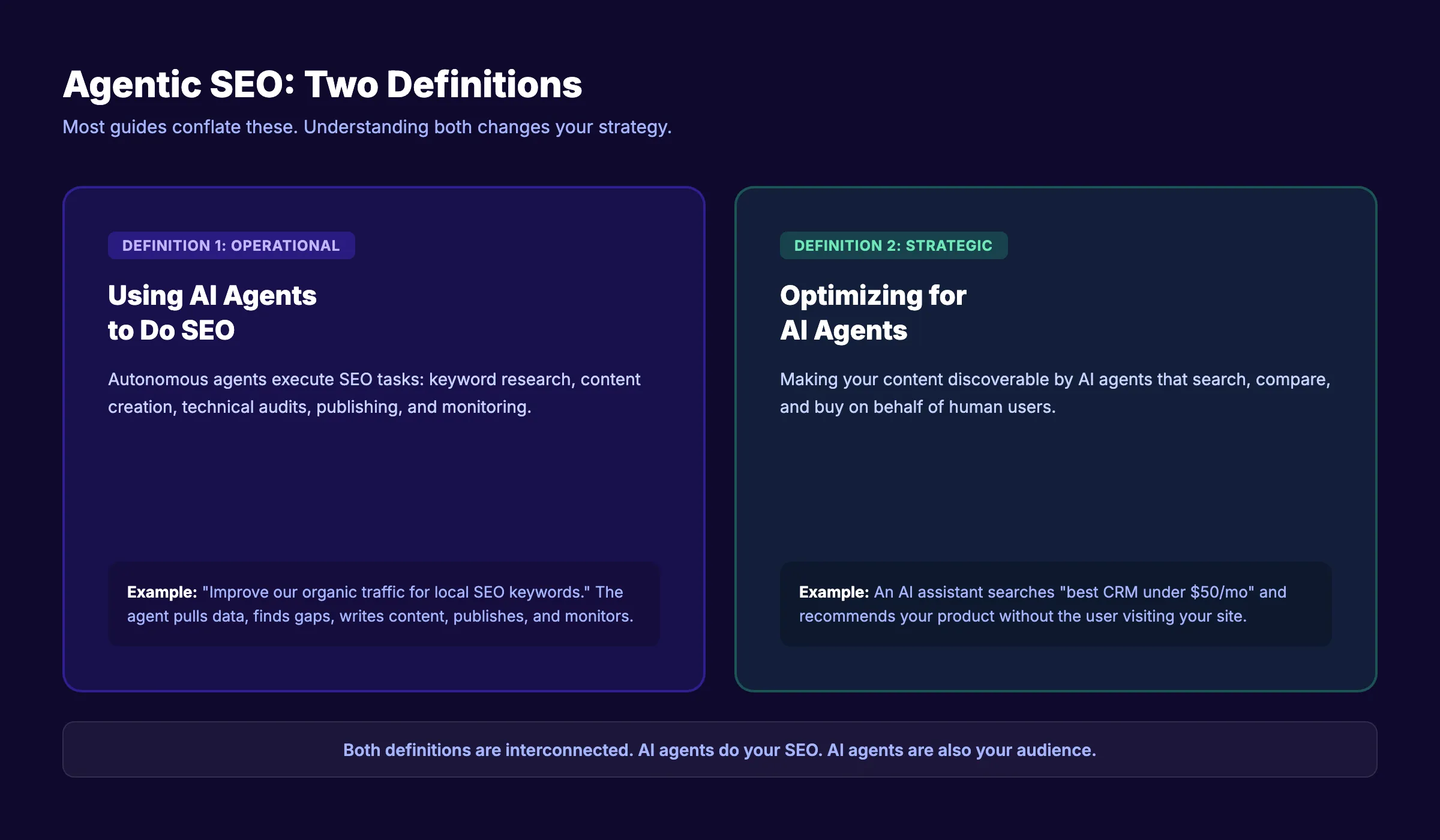
The term “agentic SEO” carries 2 distinct meanings in 2026. Both matter. Most guides conflate them. Understanding the difference changes how you approach your entire strategy.
Definition 1: Using AI Agents to Do SEO
The first meaning is operational. Agentic SEO refers to using autonomous AI agents to execute SEO tasks that previously required human effort. Keyword research. Content creation. Technical audits. Link building. Publishing. Monitoring.
An AI agent is different from an AI tool. A tool responds to a single prompt. An agent receives a goal, breaks it into subtasks, selects the right tools, executes each step, evaluates results, and adjusts its approach. It operates with memory, reasoning, and multi-step planning.
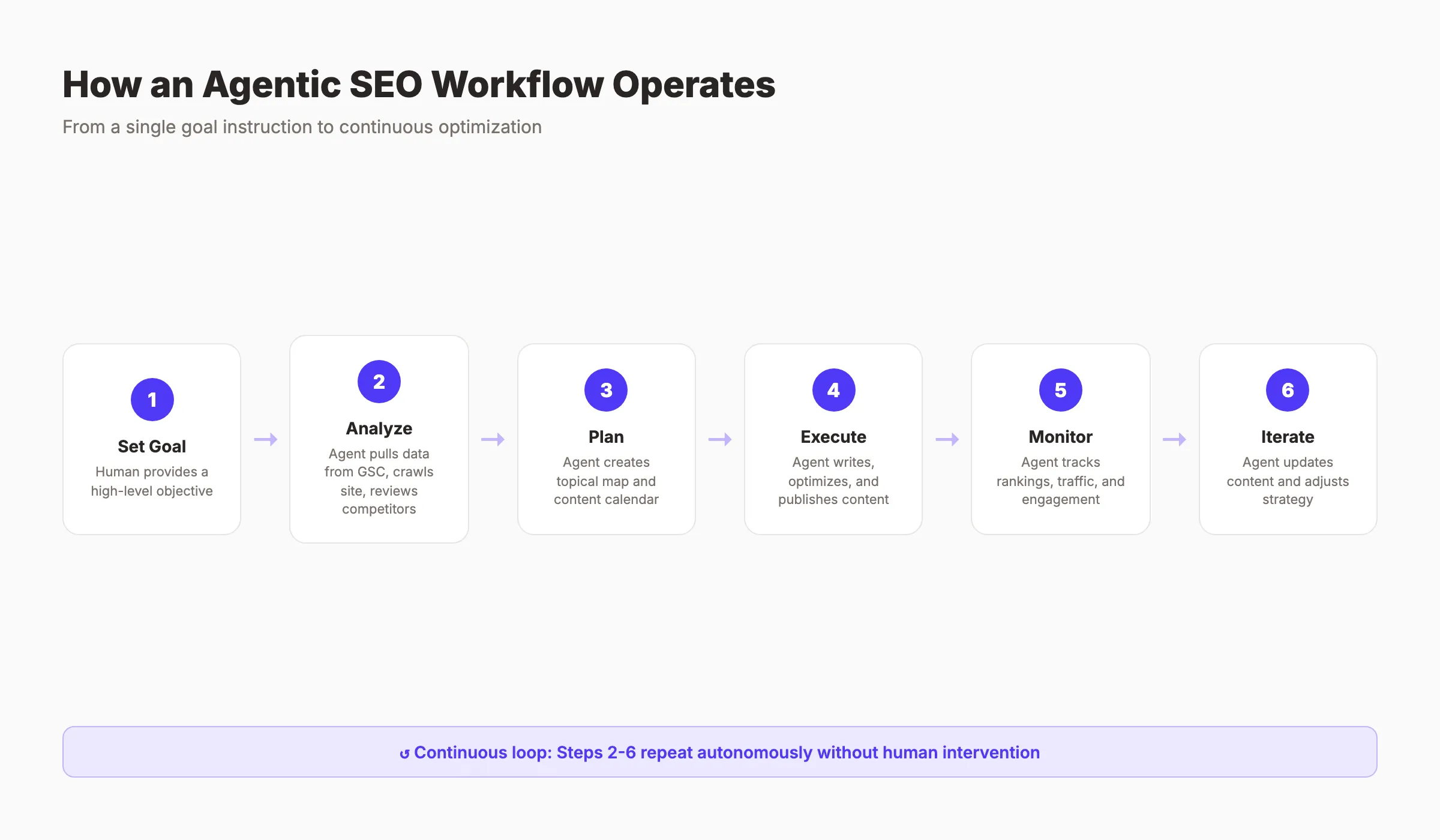
Example: You tell a traditional AI tool “write a blog post about local SEO.” It writes one post. You tell an agentic system “improve our organic traffic for local SEO keywords.” The agent:
- Pulls your Google Search Console data
- Identifies keywords where you rank positions 5 through 20
- Analyzes the top-ranking competitors for those keywords
- Finds content gaps in your existing articles
- Creates a topical map of missing supporting content
- Writes and optimizes new articles
- Publishes them to your CMS
- Monitors rankings and iterates
That entire workflow runs with a single instruction. No prompt engineering. No manual handoffs.
Definition 2: Optimizing for AI Agents That Search for Users
The second meaning is strategic. Agentic SEO also refers to optimizing your content so that AI agents can find, evaluate, and act on it when those agents search the web on behalf of human users.
In 2026, users increasingly delegate purchase research to AI assistants. “Find me the best CRM under $50 per month.” “Book a dentist near me with 4.5+ stars.” The AI agent searches, compares, filters, and sometimes completes the transaction. The human never visits your website.
This changes what SEO optimization means. You are no longer optimizing only for human readers. You are optimizing for machines that evaluate content programmatically.
Both definitions are interconnected. AI agents do your SEO work. AI agents also represent your potential customers. The tools and the audience are converging.
How Agentic SEO Differs From Traditional SEO
Traditional SEO is reactive. You research keywords after they trend. You fix technical issues after a crawl report flags them. You update content after rankings drop. Every step requires a human decision.
Agentic SEO is proactive. The system monitors, predicts, and acts before problems become visible.
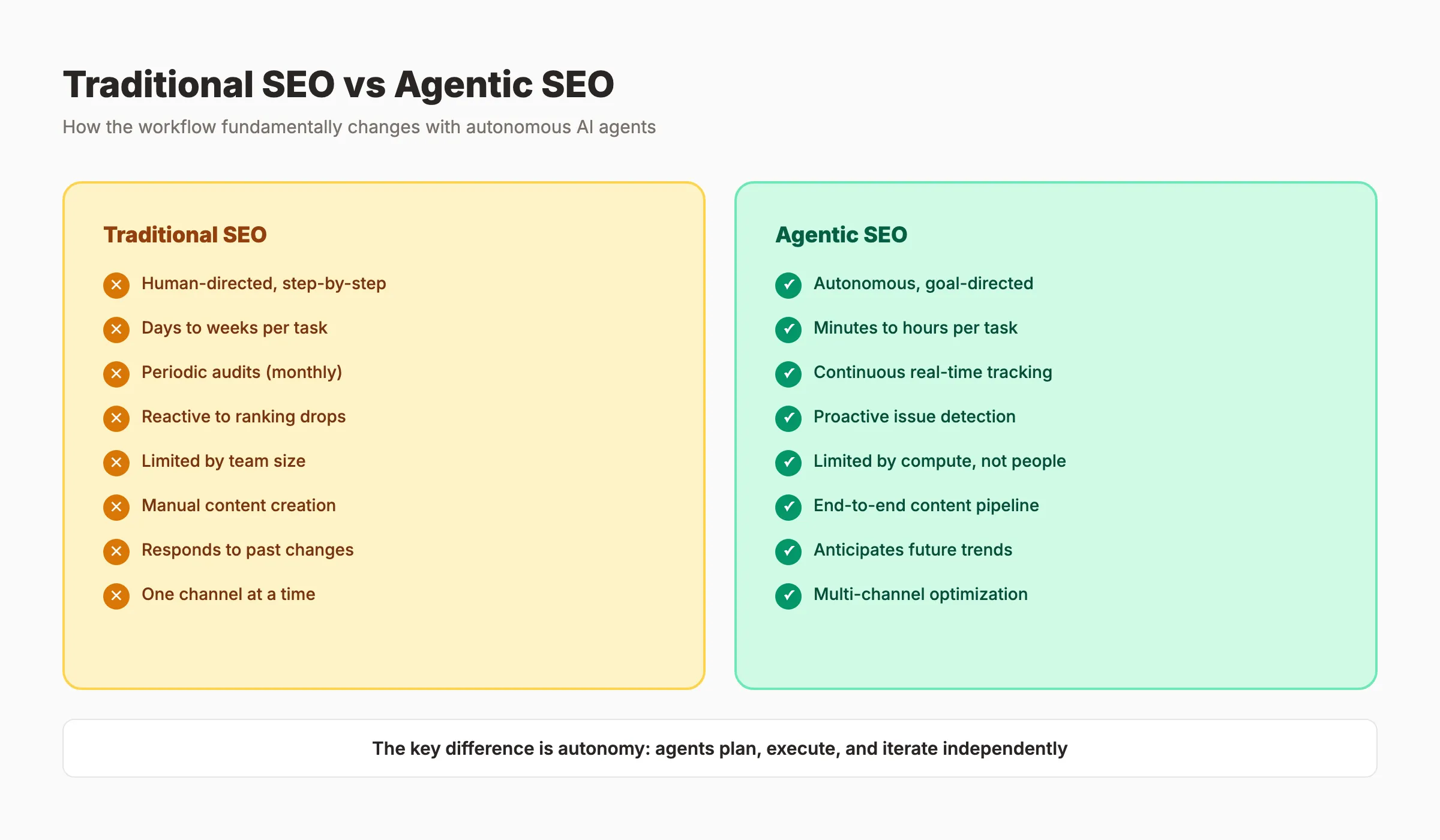
Side-by-Side Comparison
| Dimension | Traditional SEO | Agentic SEO |
|---|---|---|
| Workflow | Human-directed, step-by-step | Autonomous, goal-directed |
| Speed | Days to weeks per task | Minutes to hours per task |
| Monitoring | Periodic (weekly/monthly) audits | Continuous real-time tracking |
| Decision making | Human analyzes data, decides action | Agent analyzes, decides, and acts |
| Scaling | Limited by team size | Limited by compute, not people |
| Error handling | Reactive (fix after discovery) | Proactive (detect and fix pre-emptively) |
| Content creation | Prompt > draft > edit > publish | Goal > research > draft > optimize > publish |
| Technical SEO | Manual audits, manual fixes | Automated scanning and remediation |
| Adaptation | Responds to past algorithm changes | Anticipates trends from real-time signals |
The Key Difference: Autonomy
The gap between a basic AI writing tool and an agentic system is the same gap between a calculator and a spreadsheet analyst. A calculator computes what you ask. An analyst identifies what needs computing, runs the numbers, interprets results, and recommends actions.
AI tools for blog writing are calculators. They do one task per prompt. Agentic systems are analysts. They manage multi-step workflows independently.
This does not mean humans disappear from the process. The best agentic SEO workflows keep humans in the loop for strategy, brand voice, and quality control. But the execution burden shifts from people to agents.
Your SEO team. $99 per month. 30 optimized articles, published automatically. Start for $1 →
Core Capabilities of Agentic SEO Systems
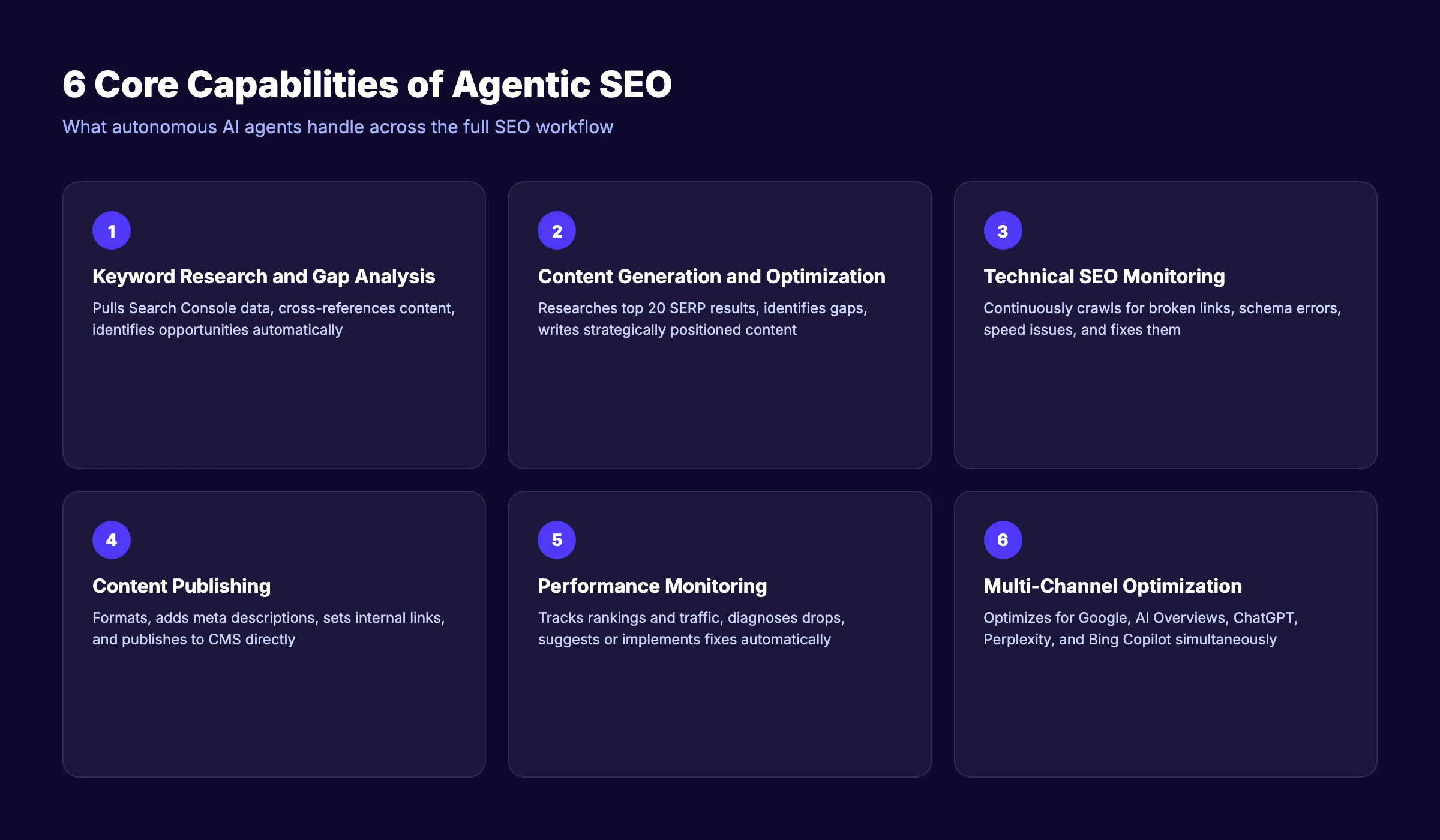
Agentic SEO is not one tool. It is a category of capabilities that span the entire SEO workflow. Here are the 6 core functions.
1. Autonomous Keyword Research and Gap Analysis
Traditional keyword research means opening Ahrefs, running searches, exporting spreadsheets, and manually identifying opportunities. An agentic system connects to your Search Console API, cross-references your existing content, identifies content gaps, and delivers a prioritized list of keywords to target. Time saved: 2 to 3 hours per analysis.
2. Content Generation and Optimization
Agents do not just write. They research the top 10 to 20 ranking pages for a target keyword. They identify what topics, entities, and structures those pages share. They generate content that fills gaps the competitors miss. Then they optimize heading structure, keyword placement, and readability scores.
This is different from prompting ChatGPT to “write an article about X.” The agent performs competitive analysis before writing a single word. The output is strategically positioned, not generically produced.
For the human side of this process, read our guide on SEO content writing.
3. Technical SEO Monitoring and Remediation
Agentic systems continuously crawl your site for broken links, duplicate content, missing alt text, schema markup errors, slow page speeds, and indexing issues. When they find a problem, they either fix it automatically or flag it with a specific remediation plan.
Traditional SEO audits happen monthly or quarterly. Agentic audits run daily. The difference is catching a broken redirect before it costs you 3 weeks of lost traffic.
4. Content Publishing and Distribution
The most advanced agentic systems publish directly to your CMS. They format articles, set meta descriptions, add internal links, compress images, and schedule publication. Some systems also distribute content to social platforms and email lists after publishing.
This end-to-end automation is what makes scaling blog content with AI practical. Without it, the bottleneck moves from writing to publishing.
5. Performance Monitoring and Iteration
Agents track rankings, traffic, and engagement for every piece of content. When a page drops from position 3 to position 8, the agent identifies why. Competitor published a stronger page? Content is outdated? Technical issue? The agent diagnoses and suggests (or implements) the fix.
This is the capability that separates agentic SEO from one-time automation. The system does not stop after publishing. It monitors, learns, and adapts. Read our guide on tracking AI search visibility for the metrics that matter.
6. Multi-Channel Optimization
Search is no longer just Google. AI Overviews, ChatGPT web search, Perplexity, and Bing Copilot all pull from web content. Agentic systems optimize for discoverability across every channel simultaneously. They structure content for Google AI Overviews, add citation-friendly formatting for AI models, and maintain topical authority signals.
Agentic SEO Tools and Platforms in 2026
The agentic SEO market is young but growing fast. Here are the major categories and notable platforms.
Full-Stack Agentic Platforms
| Platform | Key Capability | Best For |
|---|---|---|
| BrightEdge Autopilot | Auto-rewrites titles and meta descriptions at scale. 23% average CTR improvement | Enterprise sites with 1,000+ pages |
| Alli AI | Deploys title tags, schema markup, and internal links automatically | Mid-size sites needing technical fixes |
| WordLift | Knowledge graph integration and entity-based optimization | Content-heavy sites focused on E-E-A-T |
| Frase | Analyzes top 20 SERP results and identifies content gaps in under 5 minutes | Content teams producing 10+ articles per month |
Content-Focused Agents
Platforms like Surfer, Clearscope, and MarketMuse have added agentic features. They analyze competitor content, score your pages against top-ranking articles, and suggest specific optimizations. But they still require human writers to create the content.
The next wave of tools handles the full loop: research, write, optimize, and publish. This is where services like Stacc operate. We run the entire blog SEO pipeline as a done-for-you agentic workflow. You set the strategy. We execute 30 to 80 articles per month.
For a full comparison, check our list of AI SEO agents and SEO automation tools.
Custom Agent Workflows
Teams with engineering resources build custom agents using frameworks like n8n, LangChain, and CrewAI. These workflows chain together APIs. A typical setup connects Google Search Console, Ahrefs, an LLM (Claude or GPT-4), and a CMS API into a single automated pipeline.
Custom builds offer maximum flexibility. But they require significant setup and maintenance. For most businesses, a managed service or pre-built platform delivers better ROI.
3,500+ blogs published. 92% average SEO score. See what Stacc can do for your site. Start for $1 →
Optimizing for AI Agents: The New Search Audience
This is the part most businesses miss. Agentic SEO is not just about using agents. It is about being found by agents.
In 2026, AI assistants perform web searches, compare products, and make recommendations without the user ever visiting a website. Google’s SAGE research project explores how AI agents can act on behalf of users within search results. Search Engine Journal reported that this represents the biggest mindset shift in SEO history.
What AI Agents Look For
AI agents evaluate content differently than human readers. Here is what matters:
Structured data. Agents parse structured information faster than prose. Use tables, lists, and schema markup extensively. JSON-LD structured data helps agents extract facts without reading full articles.
Clear entity relationships. Agents understand entities (people, products, organizations) and their relationships. Mentioning your brand name alongside relevant topics builds entity recognition. This aligns with E-E-A-T principles.
Factual density. AI agents prioritize content with specific numbers, dates, and verifiable claims. Vague statements get ignored. “We analyzed 500 websites” is more citable than “many websites show this trend.”
Machine-readable formats. APIs, llms.txt files, and well-structured HTML make your content accessible to agents. Read our llms.txt guide for implementation details.
Freshness signals. Agents check publication dates and update frequency. Stale content gets deprioritized. Keep your most important pages updated quarterly.
The Zero-Click Agent Economy
Here is the uncomfortable truth. In many agentic search scenarios, the user never clicks through to your website. The AI agent extracts the information it needs and presents a summary. Your content feeds the answer. Your brand may or may not receive attribution.
This is not entirely new. Zero-click searches already account for a large share of Google queries. Agentic search accelerates this trend.
The strategic response: optimize for AI search citations. Make your content the source that agents reference. Brand mentions in AI responses drive awareness even without clicks. Over time, awareness converts to direct searches, which convert to visits and customers.
How to Adapt Your SEO Strategy for an Agentic World
You do not need to rebuild your entire SEO strategy. But you do need to add new layers. Here is a practical checklist.
Technical Foundations
- Add JSON-LD structured data to every key page
- Create an
llms.txtfile that maps your site structure for AI systems - Ensure your
robots.txtallows AI crawlers (GPTBot, ClaudeBot, PerplexityBot). Read our AI crawlers guide for details. - Improve page speed. Agents time out on slow pages just like users bounce.
- Fix all broken links and redirect chains. Agents follow links programmatically.
Content Strategy Adjustments
- Add comparison tables and structured data to commercial pages
- Include specific numbers, dates, and sources in every article
- Maintain a clear content marketing strategy with regular publishing cadence
- Build topical authority across entire keyword clusters, not individual keywords
- Update high-value pages quarterly with fresh data
Agentic SEO Workflow Adoption
- Audit your current SEO workflow for tasks that can be automated
- Start with one agentic tool for a specific function (content, technical, or monitoring)
- Keep humans in the loop for strategy decisions and quality review
- Humanize AI content to maintain brand voice and reader trust
- Measure time saved and quality maintained after each automation step
Optimization for AI Discovery
- Optimize for Generative Engine Optimization (GEO) across AI platforms
- Monitor your brand mentions in AI search responses
- Create FAQ content that directly answers questions agents ask
- Structure product and service pages for easy agent comparison
- Track AI search visibility alongside traditional rankings
Rank everywhere. Do nothing. Blog SEO, Local SEO, and Social on autopilot. Start for $1 →
The Risks and Limitations of Agentic SEO
Agentic SEO is powerful. It is not perfect. Ignoring the risks leads to expensive mistakes.
Quality Control Remains Essential
AI agents produce content at scale. Scale amplifies mistakes. A single factual error, published across 30 articles, damages credibility across your entire site. Human review at critical checkpoints is non-negotiable.
BrightEdge Autopilot achieves strong results because it operates within defined guardrails. Fully autonomous systems without guardrails produce unpredictable results.
Over-Automation Kills Differentiation
If every business uses the same agentic tools to analyze the same competitors and produce similar content, the output converges. Every article reads the same. Every page targets the same keywords. Differentiation disappears.
The fix: use agents for execution. Use humans for strategy, brand voice, original research, and creative angles. The work that makes your content unique cannot be fully automated.
Technical Barriers Are Real
Building custom agentic workflows requires API access, engineering time, and ongoing maintenance. Pre-built platforms reduce this burden but limit customization. The right choice depends on your team size, technical capacity, and budget.
Most small and mid-size businesses benefit more from managed agentic services than from building their own systems. The ROI calculation favors outsourcing the execution while retaining strategic control.
Algorithm Dependency
Agentic systems optimize based on current ranking factors and AI behavior. When Google or AI platforms change their algorithms, agents trained on old patterns can produce suboptimal results. Regular recalibration is necessary.
FAQ
What is agentic SEO?
Agentic SEO has 2 meanings. First, it refers to using autonomous AI agents to execute SEO tasks like keyword research, content creation, technical audits, and publishing without step-by-step human instruction. Second, it means optimizing your content so AI agents that search on behalf of users can find, evaluate, and recommend it.
Is agentic SEO the same as AI SEO?
No. AI SEO is a broad term covering any use of AI in search optimization. That includes basic AI writing tools, keyword suggestion features, and automated reports. Agentic SEO specifically refers to autonomous systems that plan and execute multi-step workflows independently. Every agentic SEO system uses AI, but not every AI SEO tool is agentic.
Does Google penalize agentic SEO content?
Google does not penalize content based on how it was produced. Google penalizes low-quality content regardless of whether a human, an AI tool, or an agentic system created it. The helpful content guidelines focus on value to users, not production method.
What are the best agentic SEO tools in 2026?
The top platforms include BrightEdge Autopilot (enterprise), Frase (content research), Alli AI (technical implementation), WordLift (entity optimization), and Surfer (on-page scoring). For a full comparison, see our list of AI SEO agents. Managed services like Stacc handle the entire pipeline as a done-for-you workflow.
How much does agentic SEO cost?
Costs range widely. Pre-built platforms charge $49 to $500+ per month. Custom agent workflows require engineering time ($5,000 to $20,000+ in setup). Managed agentic services like Stacc start at $99 per month for 30 articles written, optimized, and published automatically.
Will agentic SEO replace human SEO professionals?
No. Agentic systems replace repetitive execution tasks. Keyword research, content drafts, technical audits, and publishing can all be automated. But strategy, brand positioning, original research, and creative direction require human judgment. The role of SEO professionals shifts from doing the work to directing the agents that do it.
What Comes Next
Agentic SEO is not a trend. It is the structural shift in how search optimization works. AI agents execute faster, monitor continuously, and scale without adding headcount. Businesses that adopt agentic workflows now build a compounding advantage over those that wait.
The winners will not be the companies with the most agents. They will be the companies that combine agentic execution with human strategy. Agents handle the volume. Humans handle the vision. That combination is what makes SEO work in 2026 and beyond.
Related Tools & Resources
Free SEO Tools:
Best Lists:

Written by
Siddharth GangalSiddharth is the founder of theStacc and Arka360, and a graduate of IIT Mandi. He spent years watching great businesses lose organic traffic to competitors who simply published more. So he built a system to fix that. He writes about SEO, content at scale, and the tactics that actually move rankings.
30 SEO blog articles published every month
Keyword-optimized, scheduled, and live on your site. Automatically.
30-day trial · Cancel anytime
theStacc
Stop writing SEO content manually
30 blog articles, 30 GBP posts, and social media content. Published every month. Automatically.
Start Your $1 Trial$1 for 3 days · Cancel anytime