
SEO for Service Businesses: Rank on Google and Win More Leads
SEO for service businesses explained step by step. GBP optimization, service pages, local keywords, reviews, and content strategy to rank and get calls.
A plumber in Dallas pays $14 per click on Google Ads. An HVAC company in Phoenix pays $22. A personal injury lawyer in Los Angeles pays over $100. Every month, these service businesses spend thousands to buy leads that SEO would deliver for free.
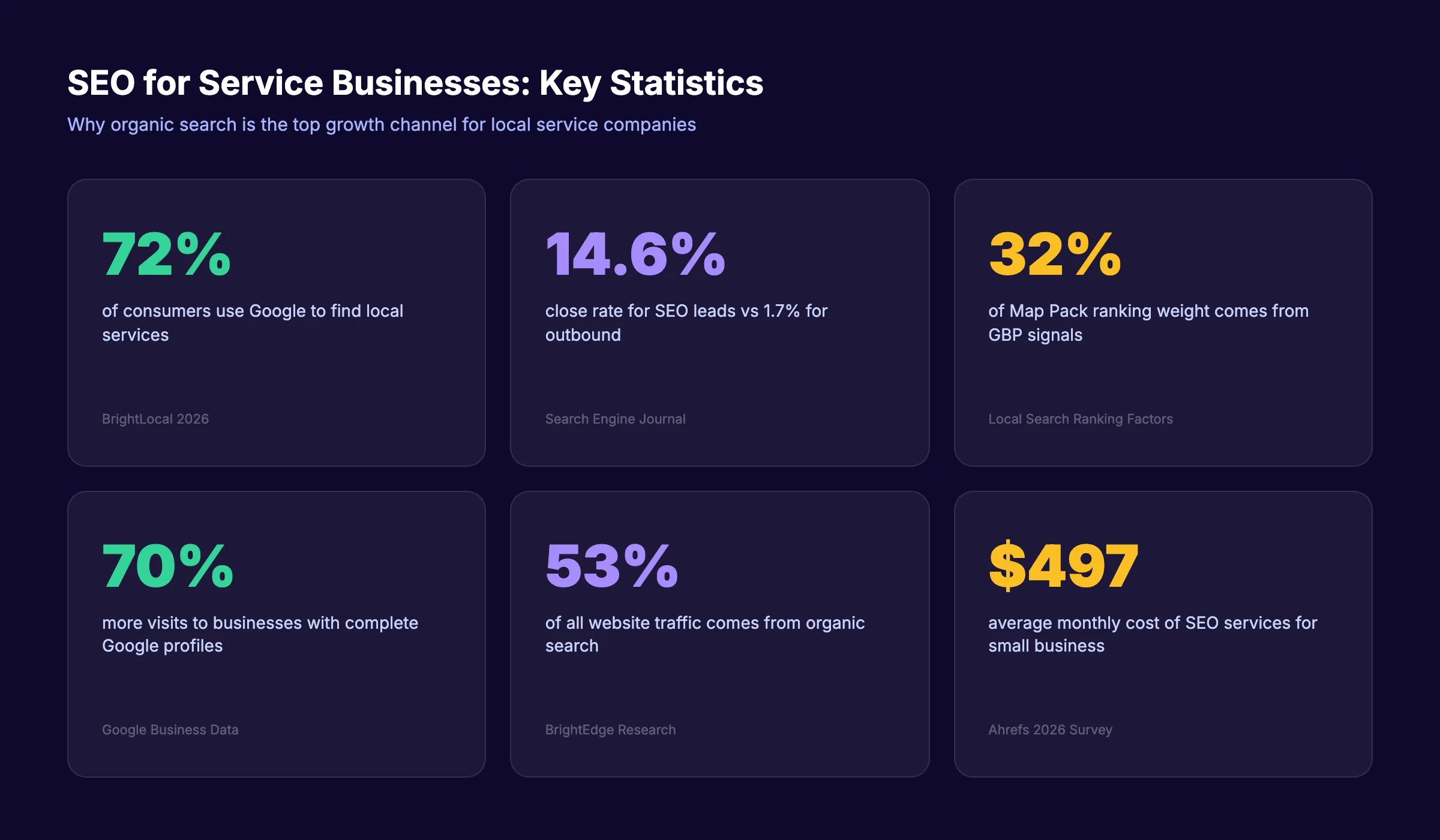
SEO for service businesses is the process of making your company visible in Google Search and Google Maps when local customers search for what you do. 72% of consumers use Google to find local services (BrightLocal). If your business does not appear in the top 3 results, you lose those calls to the competitor who does.
The problem is not effort. Most service business owners have tried SEO at some point. They paid an agency $2,000 per month, got a monthly PDF report, and saw no phone calls. Or they built a website, added a few pages, and wondered why Google ignored them.
The real issue is consistency. SEO for service businesses requires steady content publishing, active Google Business Profile management, review generation, and local link building. Not a one-time project. A compounding system.
We publish 3,500+ blogs across 70+ industries at Stacc, and local SEO for service companies is our most active category. This guide covers everything from Google Business Profile optimization to content strategy, service page structure, and measuring ROI.
Here is what you will learn:
- Why service businesses need a different SEO approach than product companies
- How to optimize your Google Business Profile for the Map Pack
- The right way to build service pages and location pages
- Content strategies that generate inbound leads month after month
- Technical SEO essentials every service business must fix
- How to build local links without cold outreach
- Common SEO mistakes that cost service businesses thousands
Why Service Businesses Need SEO Differently Than Product Companies
Product businesses sell items that ship anywhere. Service businesses serve a specific area. That geographic constraint changes every part of your SEO strategy.
A roofer in Denver does not compete with a roofer in Miami. They compete with 15 other roofers within a 30-mile radius. The keywords are different. The ranking factors are different. The content that converts is different.
Three factors make service business SEO unique:
1. Local intent dominates search behavior. 46% of all Google searches have local intent (GoGulf). When someone types “emergency plumber near me” or “divorce lawyer in Austin,” Google serves a Map Pack with 3 results, followed by organic listings. Your SEO must target both.
2. Trust signals outweigh domain authority. A dentist with 200 Google reviews and a fully optimized profile will outrank a dental chain with a higher domain authority score. Google Maps ranking factors prioritize relevance, distance, and prominence, not raw backlink counts.
3. Service area businesses lack a storefront advantage. Plumbers, electricians, landscapers, and cleaning companies often have no public-facing office. Google treats service area businesses differently from storefront businesses. Your service area pages must compensate for the lack of a physical address visible to customers.
| Factor | Product Business | Service Business |
|---|---|---|
| Target Reach | National or global | 10-50 mile radius |
| Primary Channel | Organic search + shopping | Map Pack + local organic |
| Trust Signal | Product reviews on Amazon | Google reviews on GBP |
| Content Focus | Product descriptions, comparisons | Service pages, location pages, how-to guides |
| Conversion | Add to cart | Phone call or form submission |
| Key Ranking Signal | Backlinks + content | GBP signals + reviews + proximity |
Understanding these differences prevents wasting months on strategies built for ecommerce or SaaS companies.
Stop paying $2,000+ per month for an agency that writes 4 blog posts. Stacc publishes 30 SEO articles per month for $99, built for service businesses. Start for $1 →
How to Optimize Your Google Business Profile for the Map Pack
Google Business Profile signals carry roughly 32% of the total Map Pack ranking weight (Whitespark Local Search Ranking Factors). That makes GBP the single most important asset for any service business doing SEO.
A complete Google Business Profile makes your business 70% more likely to attract location visits and 50% more likely to be considered for a purchase. An incomplete one is invisible.
Here is the step-by-step GBP optimization process:
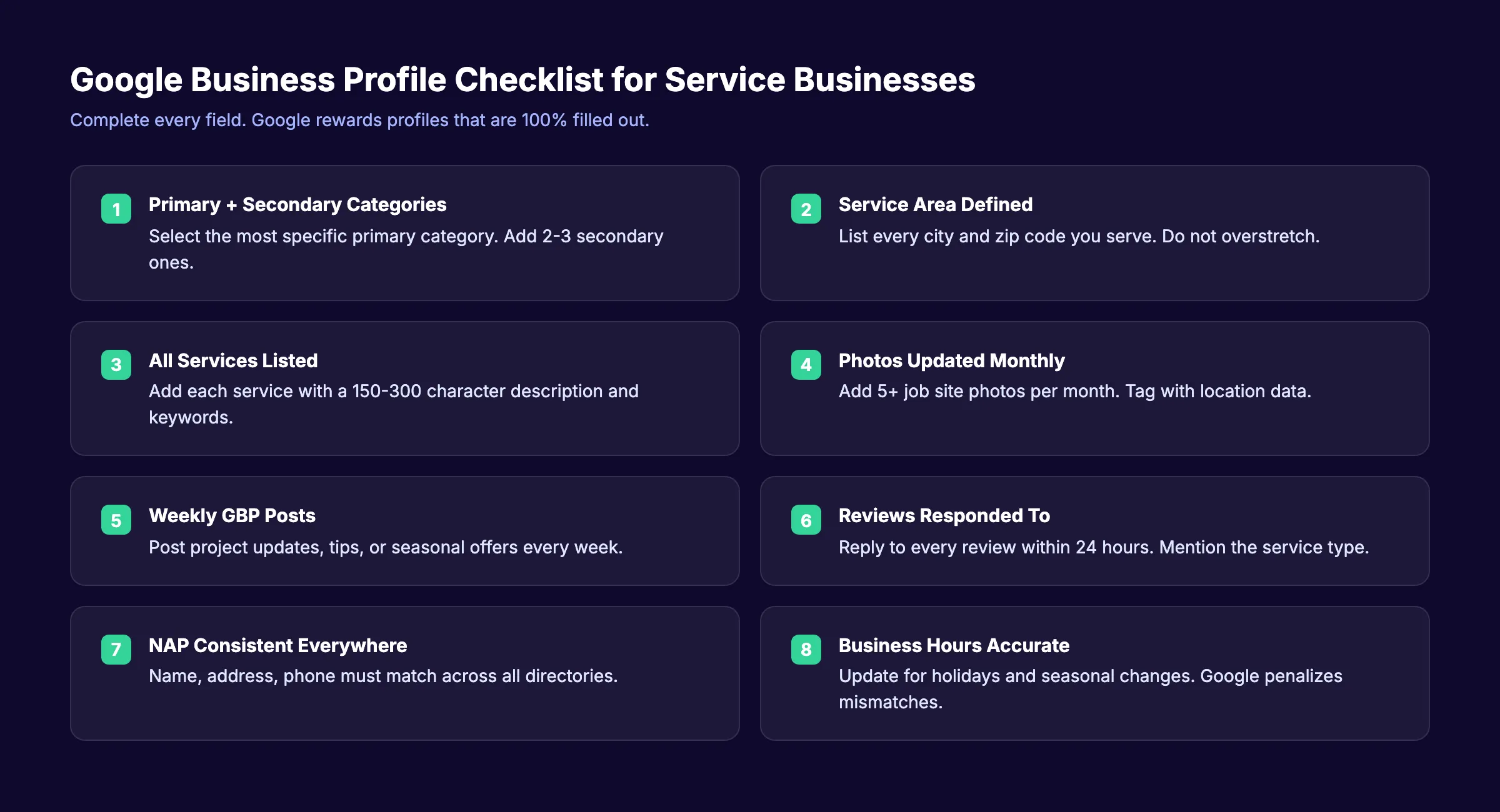
Choose the Right Categories
Your primary category is the strongest ranking signal in GBP. Select the most specific option available. A plumber should choose “Plumber,” not “Home Services.” An HVAC contractor should choose “HVAC Contractor,” not “Contractor.”
Add 2-3 secondary categories that reflect other services you offer. A roofing company might add “Gutter Cleaning Service” and “Siding Contractor” as secondary categories.
Define Your Service Area Accurately
List every city, zip code, and neighborhood you actually serve. Do not claim areas outside your real coverage. Google tracks where your calls and direction requests originate. If customers never come from a claimed area, it signals dishonesty.
For service area businesses without a storefront, hide your physical address but list your service areas clearly.
List Every Service With Descriptions
Use the GBP Services feature to list each service individually. Write a 150-300 character description for each one. Include the keywords customers actually search for.
A landscaping company should list “Lawn Mowing,” “Tree Trimming,” “Landscape Design,” “Irrigation System Installation,” and “Seasonal Cleanup” as separate services, not one generic “Landscaping” entry.
Post Weekly Updates
Google rewards active profiles. Businesses that post weekly on GBP see measurably higher engagement than those that post monthly or never. Share project completions, seasonal tips, promotions, and team updates.
A dentist might post “5 Signs You Need a Root Canal” with a photo. A contractor might share a before-and-after kitchen remodel. The format matters less than the consistency.
Build a Review Generation System
Reviews are the second most influential local SEO ranking factor at approximately 16% of total weight. But volume alone is not enough. Google values recency, velocity, and keyword content in reviews.
Ask every customer for a review within 24 hours of completing a job. Use text message follow-ups. Make the Google review link one tap away. Respond to every review, positive or negative, within 24 hours. Mention the service type in your response.
Read our full guide on how to get more Google reviews for your local business.
Building Service Pages and Location Pages That Rank
Most service businesses make a critical mistake with their website structure. They create one “Services” page that lists everything they do in a single bullet list. Google cannot rank a page for 15 different keywords at once.
The fix is simple. Create one dedicated page for each service you offer and one page for each location you serve.
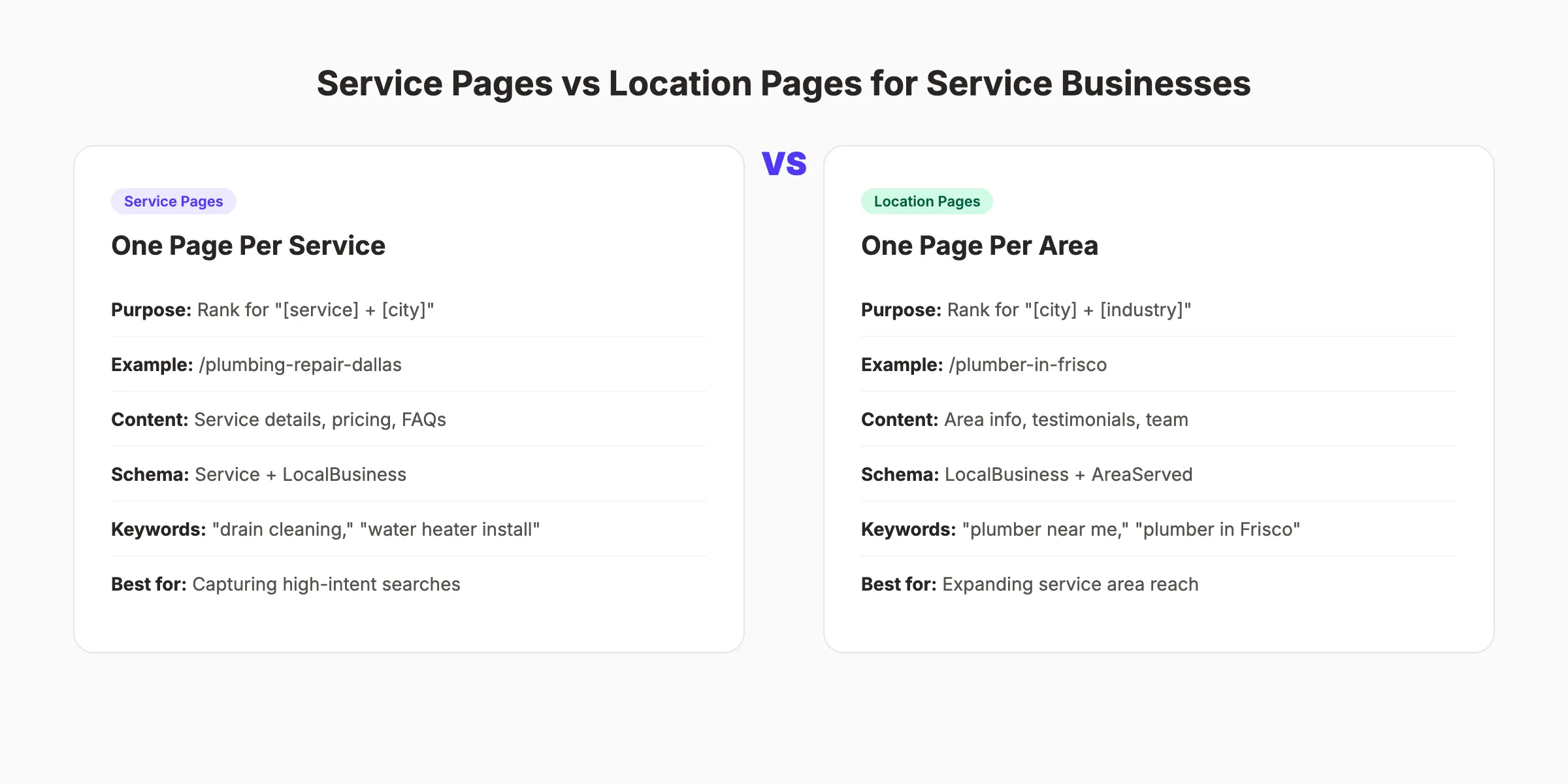
Service Pages: One Page Per Service
Every service your business offers needs its own page. A plumbing company needs separate pages for drain cleaning, water heater installation, pipe repair, sewer line replacement, and emergency plumbing. Each page targets a specific keyword cluster.
Every service page should include:
- A title tag with the service name and city: “Drain Cleaning in Dallas | ABC Plumbing”
- 500+ words of unique content about that specific service
- Pricing information or at least a price range
- 3-5 frequently asked questions about the service
- A clear call to action (phone number, contact form)
- Schema markup for Service and LocalBusiness types
- Before-and-after photos when applicable
Location Pages: One Page Per Service Area
If you serve multiple cities or neighborhoods, create a dedicated location page for each one. A pest control company serving the Dallas-Fort Worth metro might have pages for Dallas, Fort Worth, Arlington, Plano, Frisco, and McKinney.
The key rule: every location page must have unique content. Do not copy-paste the same template and swap city names. Google considers this duplicate content and will ignore most of the pages.
Unique content for location pages includes:
- Local landmarks and neighborhood references
- Customer testimonials from that specific area
- Service-specific information relevant to the area (e.g., common pests in that climate)
- Team members who serve that area
- Driving directions or coverage map
URL Structure That Signals Relevance
Use a clean, descriptive URL structure for all pages:
| Page Type | URL Pattern | Example |
|---|---|---|
| Service Page | /services/[service-name] | /services/drain-cleaning |
| Service + City | /[service]-[city] | /drain-cleaning-dallas |
| Location Page | /areas/[city] | /areas/frisco-tx |
| Blog Post | /blog/[topic] | /blog/how-to-unclog-drain |
Keep URLs short. Avoid stop words. Include the primary keyword. Use hyphens, not underscores.
Content Strategy That Generates Inbound Leads
Blog content is the engine that drives organic traffic for service businesses. Without it, your site has 10-20 pages and no topical authority. Google sees a thin website that does not warrant top rankings.
Businesses that publish 16+ blog posts per month get 3.5 times more traffic than those publishing 0-4 times per month (HubSpot). For service businesses, even 4-8 posts per month creates a measurable advantage over competitors who publish nothing.
Content Types That Convert
Not all blog content drives leads equally. Prioritize these content types based on their ability to generate phone calls and form submissions.
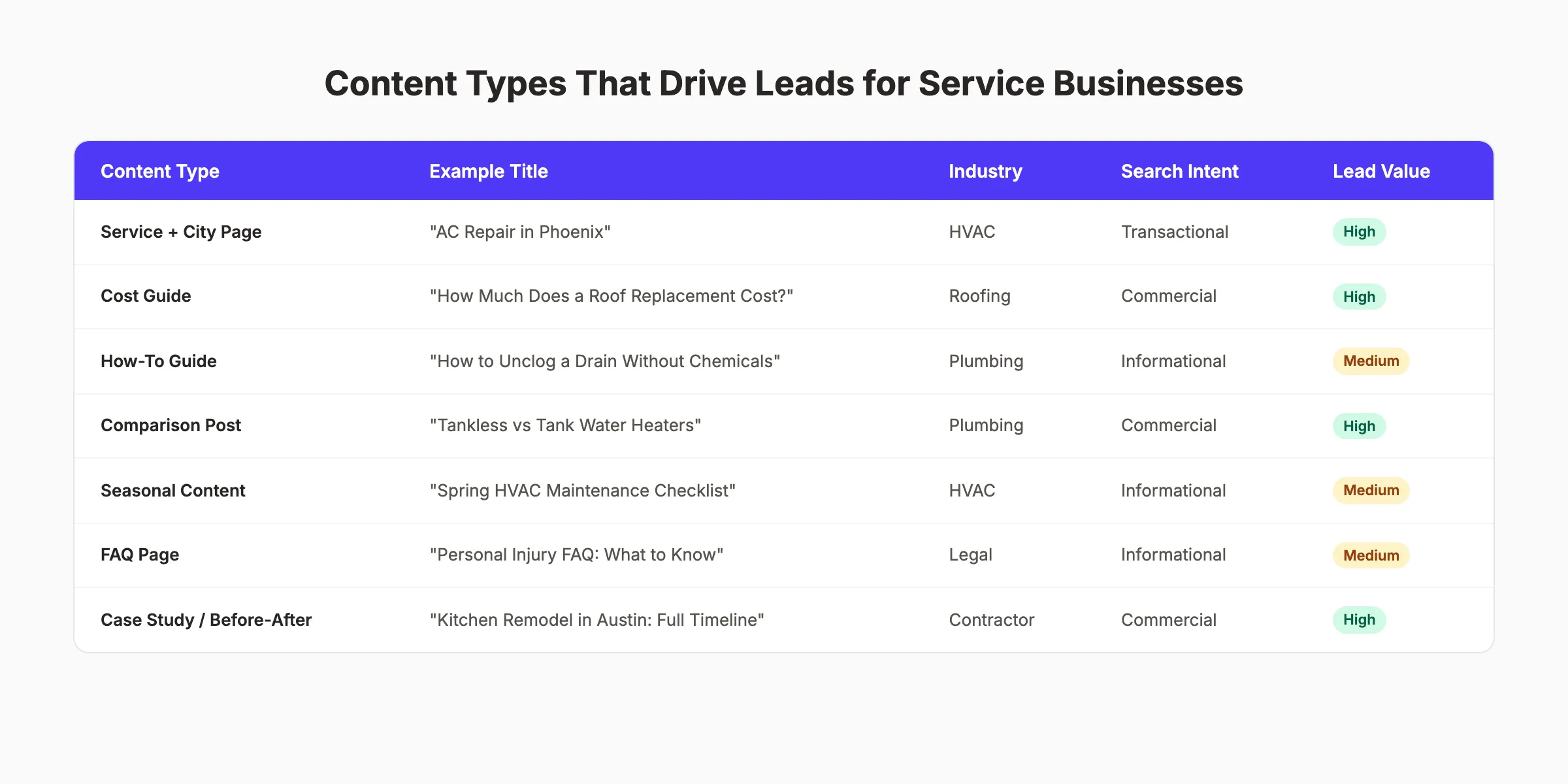
Cost guides are the highest-converting content type for service businesses. When someone searches “how much does a roof replacement cost,” they are actively planning to hire a roofer. Write detailed cost breakdowns with price ranges, factors that affect cost, and a clear CTA to get a quote.
Service + city pages target the most valuable transactional keywords. “AC repair in Phoenix” has direct buying intent. These pages should exist as standalone service pages, not blog posts.
How-to guides build topical authority. A plumber writing “How to Fix a Running Toilet” demonstrates expertise. Some readers will DIY the fix. Many will realize they need a professional and call the author.
Comparison and vs posts capture commercial intent. “Tankless vs Tank Water Heaters” attracts homeowners researching a major purchase. The plumber who educates them earns the install.
Seasonal content drives traffic in predictable waves. “Spring HVAC Maintenance Checklist” ranks every March through May. “How to winterize your sprinkler system” ranks every October through December.
Building a Content Calendar
Plan content around 3 pillars:
- Service keywords (bottom of funnel): One page per service per city
- Informational keywords (top of funnel): How-to guides, cost guides, comparison posts
- Seasonal keywords (recurring traffic): Maintenance checklists, seasonal tips, holiday-related content
A content marketing strategy for a dental practice might include service pages for teeth whitening, dental implants, and emergency dentistry, plus blog posts on “How Often Should You Visit the Dentist,” “Dental Implants vs Dentures,” and “What to Do If You Chip a Tooth.”
The compounding effect matters most. Publish consistently for 6 months and each new post reinforces the authority of every previous one. This is the Content Compound Effect in action.
30 SEO articles per month, published automatically. Stacc builds your content engine so you can focus on running your business. Start for $1 →
Technical SEO Essentials for Service Businesses
Technical SEO problems silently prevent service businesses from ranking. You can have great content and a perfect GBP, but if your site loads slowly or confuses search engine crawlers, none of it matters.
Here are the non-negotiable technical fixes:
Mobile Speed
76% of local searches happen on mobile devices. Google uses mobile-first indexing, meaning it evaluates your mobile site, not your desktop site, for rankings. Sites that load in under 2 seconds retain 70% of visitors. Sites over 3 seconds lose half their traffic.
Run your site through Google PageSpeed Insights. Target a score of 90+ on mobile. Common fixes include compressing images, enabling browser caching, and removing unused JavaScript.
Schema Markup
Schema markup tells Google exactly what your business is, where you operate, and what services you offer. For service businesses, implement these schema types:
- LocalBusiness (or a more specific sub-type like Plumber, Dentist, LegalService)
- Service for each service page
- FAQPage for any page with FAQ content
- Review and AggregateRating for testimonials
Businesses with proper schema markup appear in rich results more frequently, increasing click-through rates by 20-30%.
Site Architecture
Keep your site structure flat. Every important page should be reachable within 3 clicks from the homepage. Use an internal linking strategy that connects service pages, location pages, and blog posts into a logical hierarchy.
A typical service business site structure:
Homepage
├── Services (hub page)
│   ├── Service A
│   ├── Service B
│   └── Service C
├── Areas We Serve (hub page)
│   ├── City A
│   ├── City B
│   └── City C
├── Blog
│   ├── How-to posts
│   ├── Cost guides
│   └── Seasonal content
└── About / Contact
HTTPS, Indexing, and Crawlability
Confirm your site uses HTTPS. Submit an XML sitemap to Google Search Console. Check for crawl errors weekly. Block irrelevant pages (thank-you pages, admin pages) with robots.txt or noindex tags.
Run a full SEO audit at least quarterly to catch technical issues before they erode rankings.
Link Building for Service Businesses
Backlinks remain a top 3 ranking factor for organic search. Service businesses do not need hundreds of links. They need 10-20 high-quality local links that signal geographic relevance and industry expertise.
Local Link Building Strategies
The most effective link building strategies for local SEO require no cold outreach:
Local business directories. Claim listings on Yelp, Angi, HomeAdvisor, BBB, and your local Chamber of Commerce. These provide both links and citation signals.
Industry associations. Join your state or regional trade association. Plumbers can join the Plumbing-Heating-Cooling Contractors Association. Lawyers join their state bar association. These memberships come with a backlink from a high-authority domain.
Community sponsorships. Sponsor a little league team, a local 5K run, or a charity event. The event website links back to your business.
Local news and PR. Offer expert commentary to local journalists. A roofer commenting on storm damage recovery for a local news station earns a valuable link plus brand visibility.
Vendor and partner links. If you are an authorized dealer for a brand (Trane, Carrier, Lennox for HVAC), request a listing on their dealer locator page. These links carry strong relevance signals.
| Link Source | Difficulty | SEO Value | Example |
|---|---|---|---|
| Google Business Profile | Easy | High | Free listing |
| Local directories (Yelp, BBB) | Easy | Medium | $0-200/year |
| Chamber of Commerce | Easy | High | $200-500/year membership |
| Industry association | Medium | High | Trade group membership |
| Local sponsorship | Medium | High | $100-500 per event |
| Local news mention | Hard | Very High | Expert quote in article |
Focus on earning 2-3 new local links per month. Over 12 months, that builds a link profile strong enough to outrank most local competitors.
Measuring SEO ROI for Service Businesses
SEO ROI for service businesses comes down to one question: how many phone calls and form submissions did organic search generate this month?
Track these metrics in Google Search Console and Google Analytics:
Organic traffic by page. Which pages drive the most visits? Service pages and location pages should rank highest.
Phone calls from organic. Use call tracking software (CallRail, WhatConverts) to attribute calls to specific landing pages and keywords. This is the single most important metric for service businesses.
Form submissions from organic. Track form completions on service pages and contact pages. Exclude blog pages from this metric since they serve a different purpose.
Map Pack impressions and actions. Google Business Profile Insights shows how many people saw your listing, clicked for directions, visited your website, or called directly. Track these monthly.
Keyword rankings. Monitor positions for your top 20-30 service keywords. Focus on keywords with buying intent: “emergency plumber [city],” “roof repair near me,” “[service] cost.”
Calculating Your SEO ROI
Use this formula:
SEO ROI = (Revenue from organic leads - SEO costs) / SEO costs x 100
If you spend $99 per month on Stacc and generate 10 new customers from organic search at an average job value of $500, your monthly SEO revenue is $5,000. That is a 4,949% ROI.
SEO leads close at a 14.6% rate compared to 1.7% for outbound marketing. For service businesses, the close rate is often even higher because local search intent is so strong.
Common SEO Mistakes Service Businesses Make
After working with service businesses across 70+ industries, we see the same mistakes repeatedly. Avoiding these saves months of wasted effort.
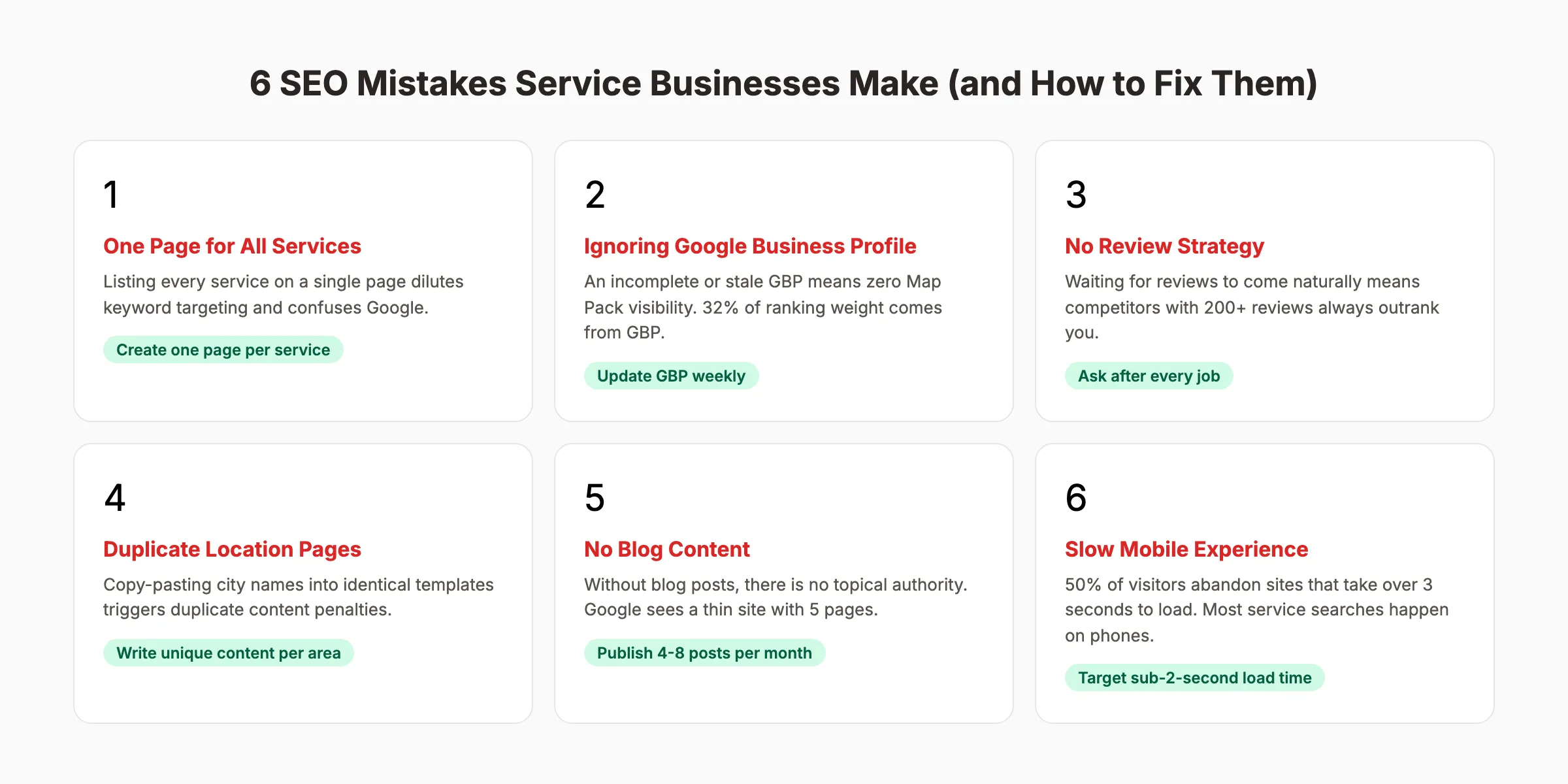
Mistake 1: One Page for All Services
A single “Our Services” page listing everything you do cannot rank for any specific keyword. Google needs dedicated pages to understand what each service is and match it to search queries.
The fix: create one page per service. A dental practice needs separate pages for cleanings, whitening, implants, crowns, and emergency care. A law firm needs pages for each practice area.
Mistake 2: Ignoring Google Business Profile
Some service businesses set up their GBP once and forget it. An inactive profile with outdated hours, no posts, and no recent reviews signals abandonment to Google.
The fix: treat GBP like a marketing channel. Post weekly. Respond to reviews daily. Update photos monthly. Add new services as you offer them.
Mistake 3: No Review Strategy
Waiting for reviews to happen organically means competitors with 200+ reviews will always outrank you. Reviews are a critical ranking factor and the primary trust signal for consumers.
The fix: ask every customer for a review within 24 hours of completing the job. Send a text with a direct link to your Google review page. Use review response templates to reply quickly.
Mistake 4: Duplicate Location Pages
Creating 50 location pages with identical content except the city name is a penalty waiting to happen. Google recognizes thin, templated content and devalues it.
The fix: write genuinely unique content for each location page. Reference local landmarks, neighborhoods, and area-specific information. Include testimonials from customers in that area.
Mistake 5: No Content Publishing
A 5-page website with no blog cannot build topical authority. Google sees no reason to rank a thin site over competitors publishing helpful content every week.
The fix: publish blog content consistently. Even 4 posts per month creates a compounding advantage. Cost guides, how-to articles, and seasonal content drive the most qualified traffic.
Mistake 6: Ignoring Mobile Experience
Over 76% of local searches happen on mobile. A slow, hard-to-navigate mobile site loses half its visitors before they even see your phone number.
The fix: test every page on a mobile device. Ensure your phone number is tappable. Load times must be under 3 seconds. Forms should have 3-5 fields maximum.
Your SEO should run itself. Stacc handles blog content, GBP posts, and review management so service businesses can focus on their craft. Start for $1 →
Industry-Specific SEO Strategies
Every service industry has unique keywords, search patterns, and customer expectations. Here is how SEO differs across the most common service verticals:
| Industry | Top Keywords | Content Priority | Avg. Lead Value |
|---|---|---|---|
| HVAC | ”AC repair near me,” “furnace installation [city]“ | Seasonal guides, emergency content | $150-$8,000 |
| Plumbing | ”plumber near me,” “drain cleaning [city]“ | Cost guides, emergency how-tos | $200-$3,000 |
| Roofing | ”roof replacement cost,” “roofer near me” | Storm damage content, cost calculators | $5,000-$15,000 |
| Dental | ”dentist near me,” “teeth whitening [city]“ | Procedure explainers, patient FAQs | $200-$5,000 |
| Legal | ”personal injury lawyer [city],” “divorce attorney” | Practice area pages, case results | $3,000-$50,000+ |
| Landscaping | ”landscaper near me,” “lawn care [city]“ | Seasonal maintenance guides | $100-$5,000 |
| Cleaning | ”house cleaning [city],” “commercial cleaning” | Pricing pages, service comparisons | $100-$500/visit |
| Contractors | ”general contractor [city],” “kitchen remodel” | Before-after galleries, cost guides | $5,000-$100,000+ |
The highest-ROI move for every service industry is the same: dominate the “[service] + [city]” keyword for your primary offering. A roofer in Phoenix who ranks #1 for “roof repair Phoenix” will receive more calls than any amount of paid advertising can deliver.
For industry-specific deep dives, read our guides on dental SEO, law firm SEO, home services SEO, and contractor SEO.
How Much Does SEO Cost for Service Businesses?
The average service business pays $1,500-$3,000 per month for an SEO agency. Most get monthly reports and 2-4 blog posts in return. Some get results. Many do not.
Here is the honest cost breakdown:
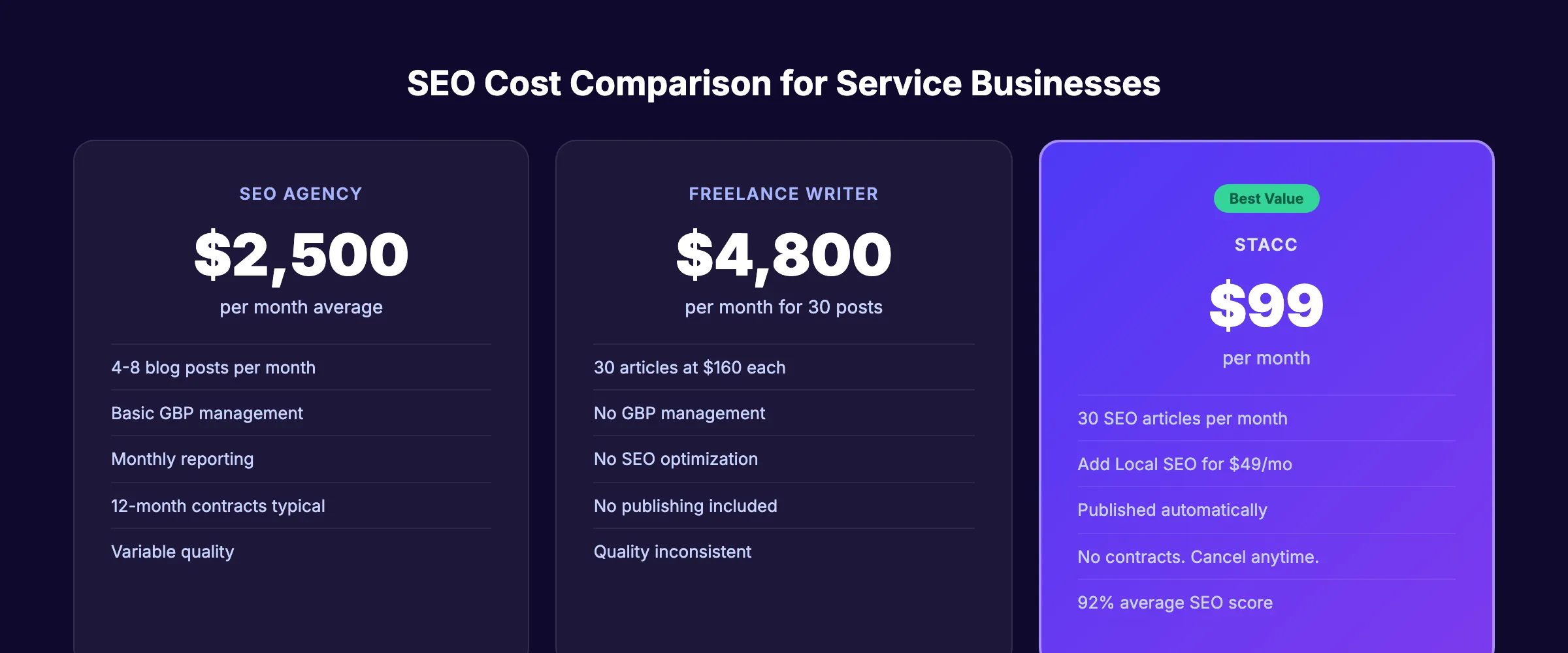
| Approach | Monthly Cost | Content Volume | GBP Management | Contract |
|---|---|---|---|---|
| SEO Agency | $1,500-$5,000 | 4-8 posts | Sometimes | 6-12 months |
| Freelance Writers | $2,400-$7,500 | 30 posts at $80-250 each | No | None |
| DIY | $0 + your time | 1-2 posts if any | Self-managed | None |
| Stacc | $99 (Blog) + $49 (Local) | 30 posts | 30 GBP posts | No contract |
For a service business spending $2,500 per month on SEO, 30 articles plus GBP management through Stacc costs $148 per month. That is a 94% reduction in cost with 4-7 times the content volume.
The question is not whether SEO is worth it. SEO leads close at 14.6% vs 1.7% for outbound. The question is whether you are overpaying for underdelivery.
FAQ
How long does SEO take for a service business?
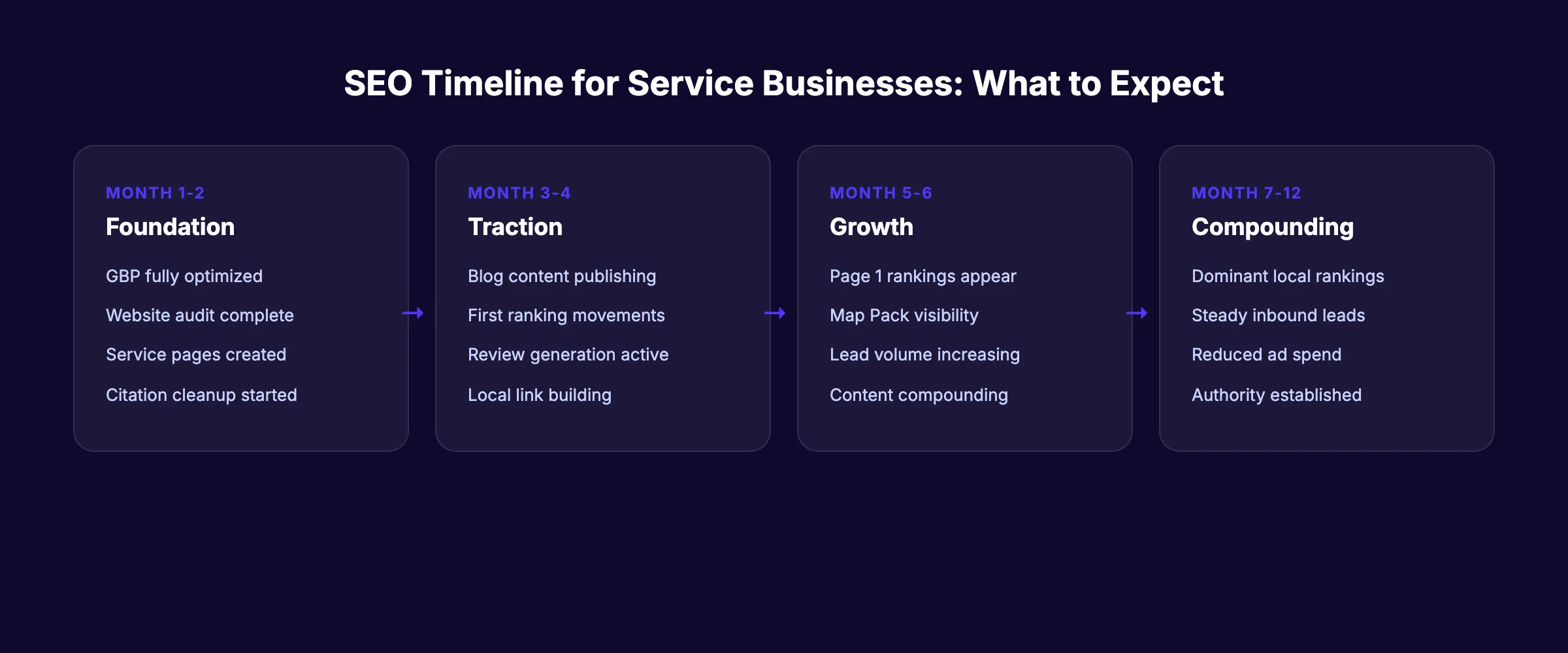
Most service businesses see initial ranking movements within 60-90 days. Meaningful lead generation typically starts between month 4 and month 6. By month 7-12, SEO compounds into a consistent lead source. Read our detailed breakdown of how long SEO takes for a full timeline.
What is the most important SEO factor for service businesses?
Google Business Profile optimization is the single most influential factor for Map Pack rankings, carrying 32% of total ranking weight. For organic rankings below the Map Pack, on-page content relevance and backlinks matter most. Review our guide to local SEO ranking factors for the complete breakdown.
Should service businesses focus on SEO or Google Ads?
Both have a place, but SEO delivers a higher ROI over time. Google Ads produce immediate results but stop the moment you pause spending. SEO builds an asset that generates leads month after month without per-click costs. The best strategy uses Google Ads for immediate leads while building SEO for long-term growth.
How many blog posts should a service business publish per month?
A minimum of 4-8 blog posts per month moves the needle. Businesses publishing 16+ posts per month see 3.5 times more traffic than those publishing fewer than 4. Consistency matters more than perfection. Publishing 30 articles per month through Stacc gives service businesses the volume needed to build topical authority fast.
Do service businesses need separate pages for each city they serve?
Yes, if you serve multiple cities. Each location page must contain unique, helpful content specific to that area. Thin, template-based pages with swapped city names will not rank and may trigger duplicate content issues. Focus on your top 5-10 cities first.
Can a service business do SEO without hiring an agency?
Absolutely. Many service businesses handle GBP optimization, review management, and basic on-page SEO themselves. The hardest part to DIY is consistent content production. That is exactly what Stacc automates: 30 SEO-optimized blog posts per month, published automatically, for $99.
Start Ranking on Google and Winning More Leads
Service businesses that invest in SEO build an asset that generates leads every month without paying per click. The cost of inaction grows with every quarter as competitors claim the search results you are missing.
The formula is straightforward: optimize your Google Business Profile, build dedicated service and location pages, publish content consistently, generate reviews, and earn local links. Execute these 5 pillars and your rankings will compound over time.
Your SEO team. $99 per month. Stacc publishes 30 SEO articles per month for service businesses. No contracts. No writing required. Start for $1 →

Written by
Siddharth GangalSiddharth is the founder of theStacc and Arka360, and a graduate of IIT Mandi. He spent years watching great businesses lose organic traffic to competitors who simply published more. So he built a system to fix that. He writes about SEO, content at scale, and the tactics that actually move rankings.
Automate your Google Business Profile content
30 GBP posts, local SEO articles, and review responses. Published every month automatically.
30-day trial · Cancel anytime
theStacc
Stop writing SEO content manually
30 blog articles, 30 GBP posts, and social media content. Published every month. Automatically.
Start Your $1 Trial$1 for 3 days · Cancel anytime