
Google Maps Ranking Factors (2026): Guide
google maps ranking factors guide for 2026: strategies, tactics, real examples, and implementation steps to get results faster.
Google Maps Ranking Factors: The Complete Guide (2026)
Your business does not show up in the local pack. Competitors with fewer reviews and worse websites rank above you. That costs you calls, direction requests, and revenue every single day.
Google uses over a dozen signal categories to rank local businesses on Maps. Understanding exactly which signals matter most. And how much weight each one carries. Gives you a clear path to higher visibility.
This guide breaks down every Google Maps ranking factor based on the latest industry research. We publish 3,500+ blogs across 70+ industries and track local ranking data closely.
Here is what you will learn:
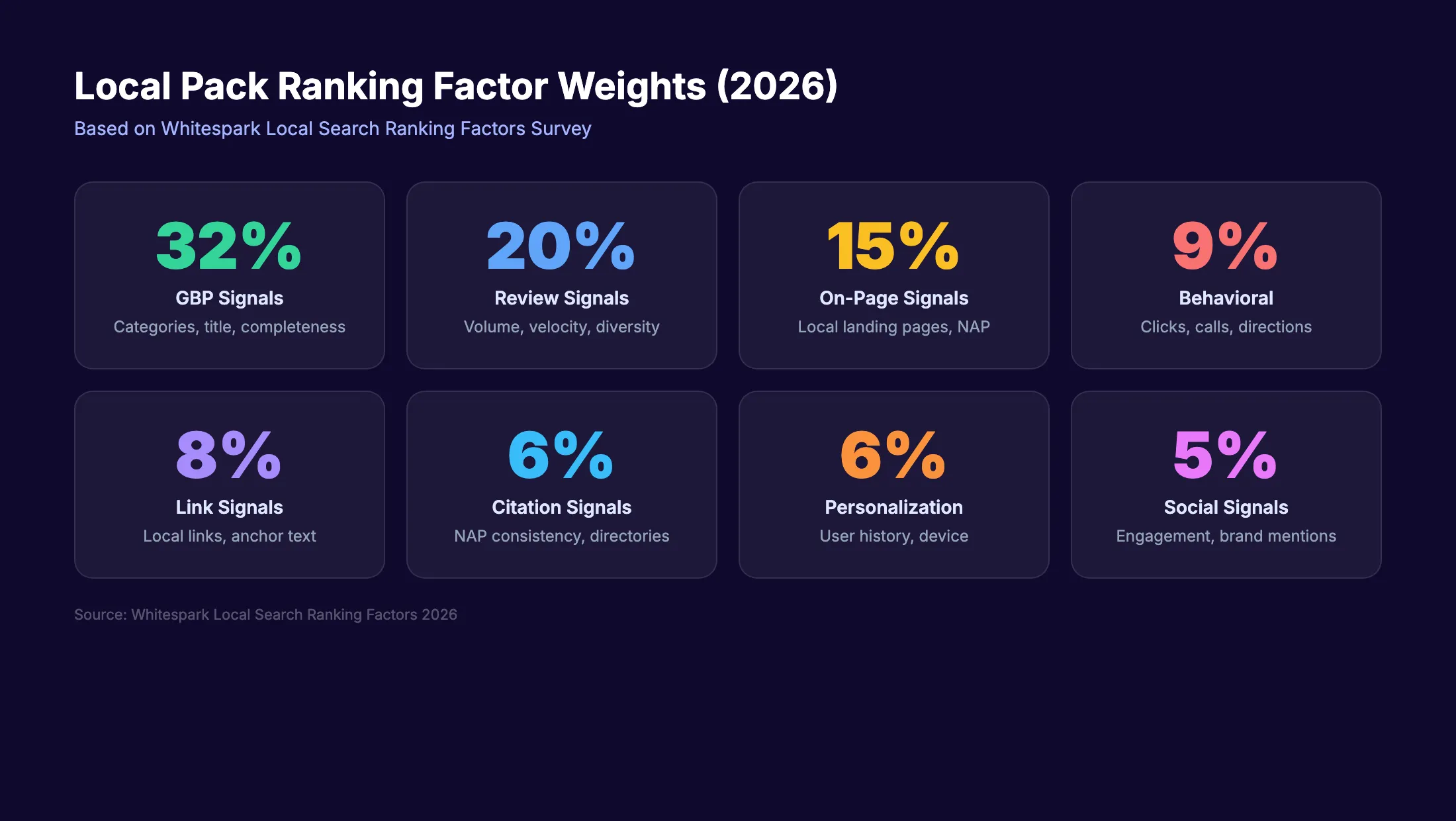
- The 8 ranking factor categories and their exact percentage weights
- How to optimize your Google Business Profile for maximum visibility
- Why review signals now carry 20% of local pack weight
- Which citation and link strategies move the needle in 2026
- The negative factors that silently destroy your rankings
Table of Contents
- Google’s 3 Core Ranking Pillars
- Google Business Profile Signals (32% Weight)
- Review Signals (20% Weight)
- On-Page and Website Signals (15% Weight)
- Behavioral Signals (9% Weight)
- Link Signals (8% Weight)
- Citation Signals (6% Weight)
- Negative Ranking Factors
- How to Rank on Google Maps: Action Plan
- FAQ
Google’s 3 Core Ranking Pillars
Google confirms 3 primary factors that determine local search rankings: relevance, distance, and prominence. Every other ranking signal feeds into one of these 3 pillars.
Relevance
Relevance measures how well your business profile matches the search query. A plumber who lists “emergency plumbing” as a service ranks higher for “emergency plumber near me” than one who only lists “plumbing.”
Your GBP categories, business description, services, and products all feed relevance signals. The more specific and complete your profile, the more queries you match.
Distance
Distance is the one factor you cannot optimize. It measures how far your business sits from the searcher or the location in their query.
A user searching “dentist downtown Austin” will see results clustered near downtown. Google weights distance differently based on query type. Generic searches weight proximity heavily. Branded or high-intent searches weight prominence more.
Prominence
Prominence reflects how well-known your business is. Google measures this through review count, review quality, citation volume, backlink profiles, and overall web presence.
This is where most of the optimization opportunity lives. The Whitespark Local Search Ranking Factors survey breaks prominence into several sub-categories that we cover below.
Google Business Profile Signals (32% Weight)
GBP signals account for 32% of local pack rankings according to the 2026 Whitespark survey. That makes your Google Business Profile the single most important asset for Google Maps visibility.
Primary Category Selection
Your primary GBP category is the strongest individual ranking factor. Experts rank it as the number 1 signal for local pack placement.
Choose the category that most precisely describes your core service. “Personal Injury Attorney” outperforms “Lawyer” for personal injury searches. Check our GBP categories guide for the full list and selection strategy.
Secondary Categories
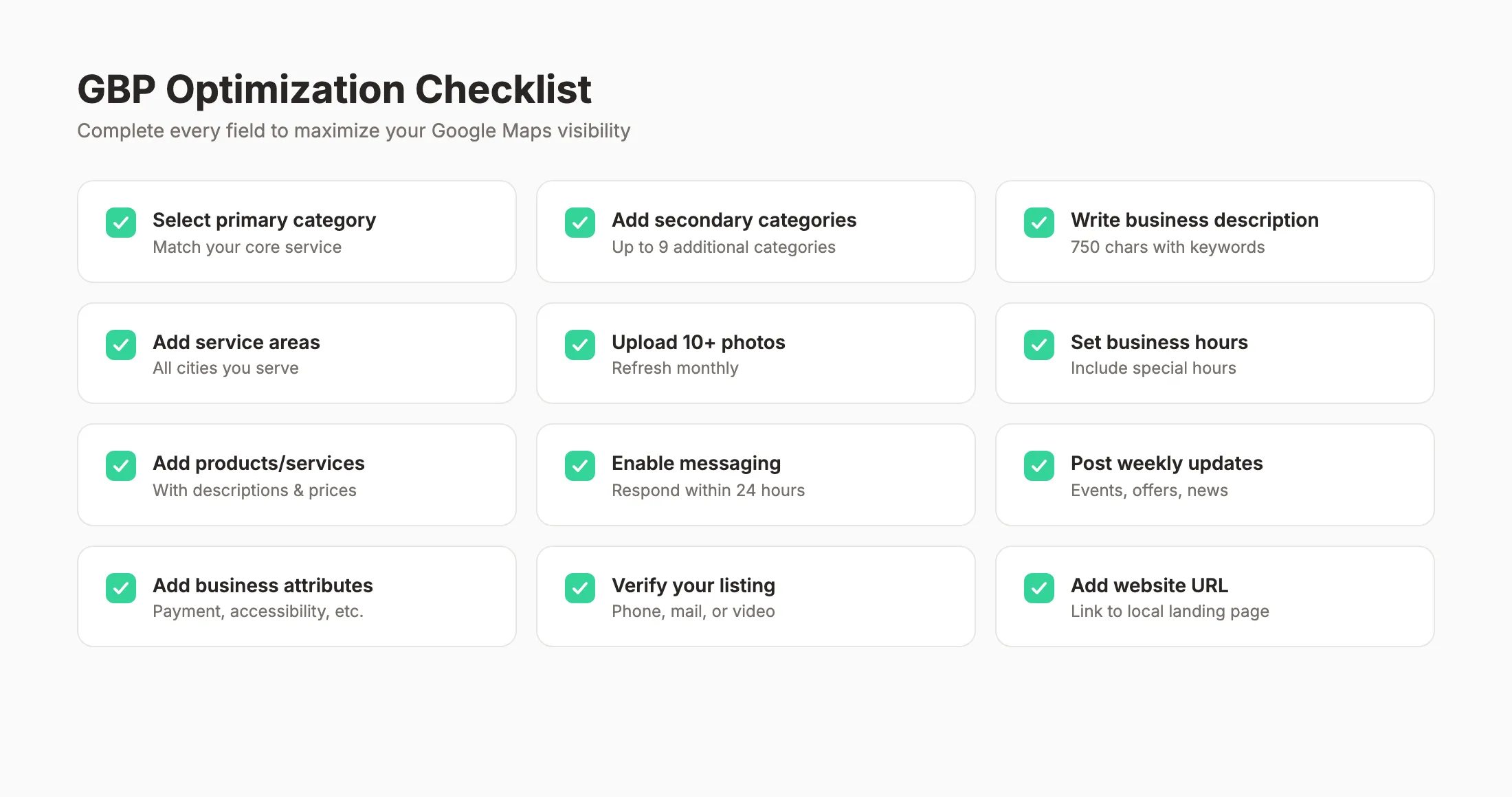
Google allows up to 9 secondary categories. Add every relevant category, but only relevant ones. A dental practice should add “Cosmetic Dentist,” “Pediatric Dentist,” and “Emergency Dental Service” if those services exist.
Irrelevant categories dilute your signals. Never add categories for services you do not provide.
Business Name and Title
Keywords in your GBP business name correlate with higher rankings. However, Google’s guidelines prohibit adding keywords to your name.
Your business name must match your real-world signage and legal name. Stuffing keywords into your title violates guidelines and risks suspension.
Complete Profile Information
The March 2026 core update tightened the connection between profile completeness and local pack visibility. Businesses with incomplete profiles saw ranking drops across competitive local markets.
Fill every available field. That includes business hours, special hours, payment methods, accessibility attributes, service areas, products, services with descriptions, and a full 750-character business description.
GBP Posts and Updates
Posting regular updates signals an active, engaged business. Research shows that businesses posting weekly maintain stronger visibility than those posting sporadically.
The 2026 update penalized businesses that had not posted or uploaded a photo in over 30 days. Aim for 1 helpful update per week at minimum.
Photos and Visual Content
Upload at least 10 high-quality photos to your profile. Include exterior shots, interior shots, team photos, and product or service images. According to BrightLocal, businesses with photos receive 42% more direction requests.
Refresh your photos monthly. Outdated images signal a neglected listing.
Want your Google Business Profile optimized and updated on autopilot? Stacc publishes 30 GBP posts per month, keeping your profile active and visible. Start for $1 →
Review Signals (20% Weight)
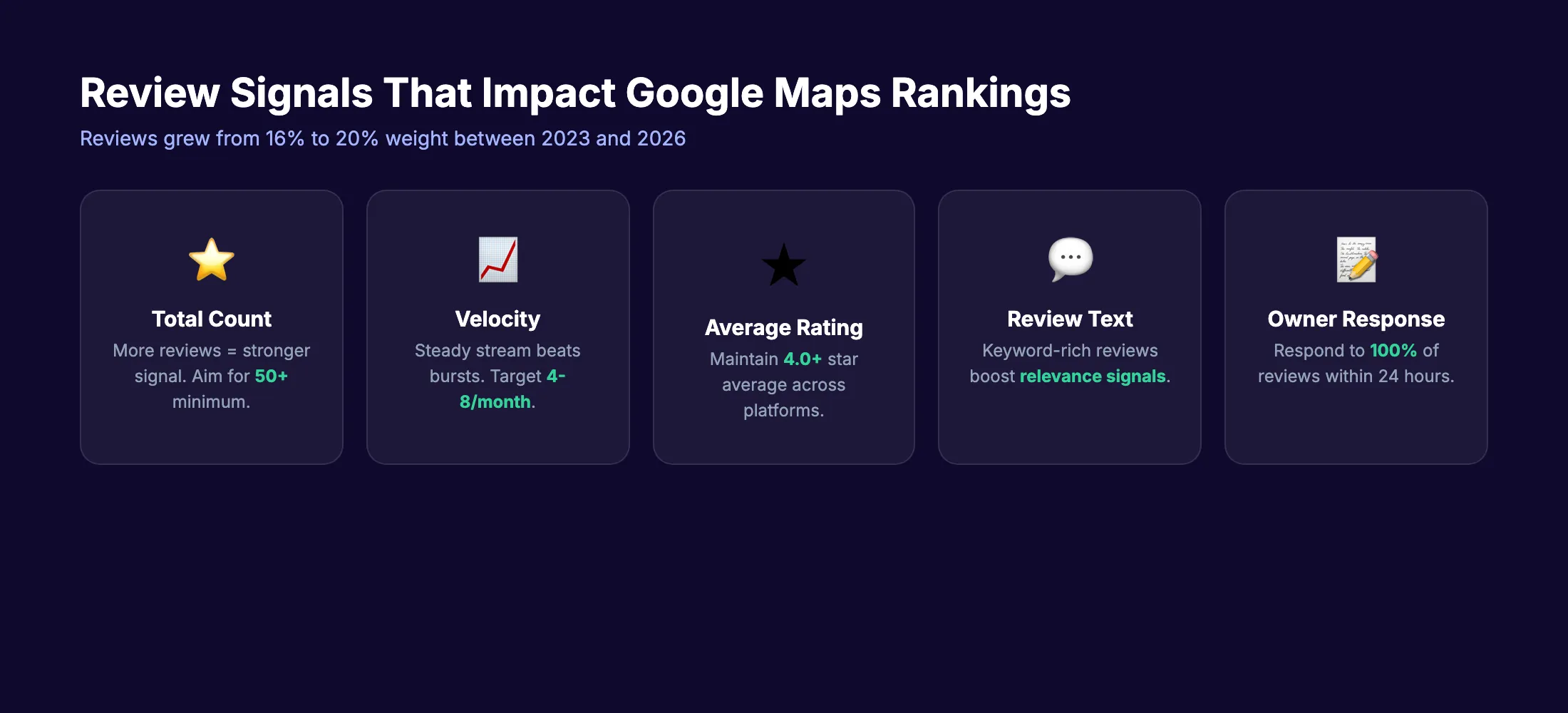
Review signals grew from 16% in 2023 to 20% in 2026. That 4-point jump makes reviews the fastest-growing ranking factor category for Google Maps.
Review Count
More reviews create a stronger ranking signal. Data from the Whitespark survey shows that businesses ranking in the top 3 local pack positions average significantly more reviews than those outside the pack.
Aim for 50 reviews as a baseline. In competitive markets, top performers often exceed 200. Read our guide on how to get more Google reviews for proven strategies.
Review Velocity
Google rewards a steady stream of reviews over time. A business earning 4 to 8 reviews per month builds a stronger signal than one receiving 50 reviews in a single week.
Sudden spikes trigger spam filters. Consistent, organic review acquisition is the safest and most effective approach.
Average Star Rating
Maintain a 4.0 or higher star rating. Ratings below 4.0 reduce click-through rates and can suppress your visibility in filtered results.
Google sometimes filters local results to show only businesses above a certain rating threshold. A 3.8-star rating might exclude you from searches where users apply a “4+ stars” filter.
Review Text and Keywords
Google’s AI now analyzes the actual text of customer reviews. Reviews mentioning specific services, products, or experiences help Google match your business to relevant queries.
A review stating “best emergency plumber in Austin” sends relevance signals for those exact keywords. You cannot control what customers write, but you can ask them to describe their experience in detail.
Owner Response Rate
The 2026 algorithm update increased the weight of owner response rate. Businesses responding to 100% of reviews outperform those ignoring feedback.
Respond to every review. Positive and negative. Within 24 hours. Use each response to naturally reinforce your services and location. Our review response guide covers exact templates and best practices.
Review Diversity
Reviews on Google alone are not enough. Google also considers reviews on third-party platforms like Yelp, Facebook, and industry-specific sites. A diverse review profile across multiple platforms strengthens your prominence signal. See our Google Reviews guide for a complete strategy.
On-Page and Website Signals (15% Weight)
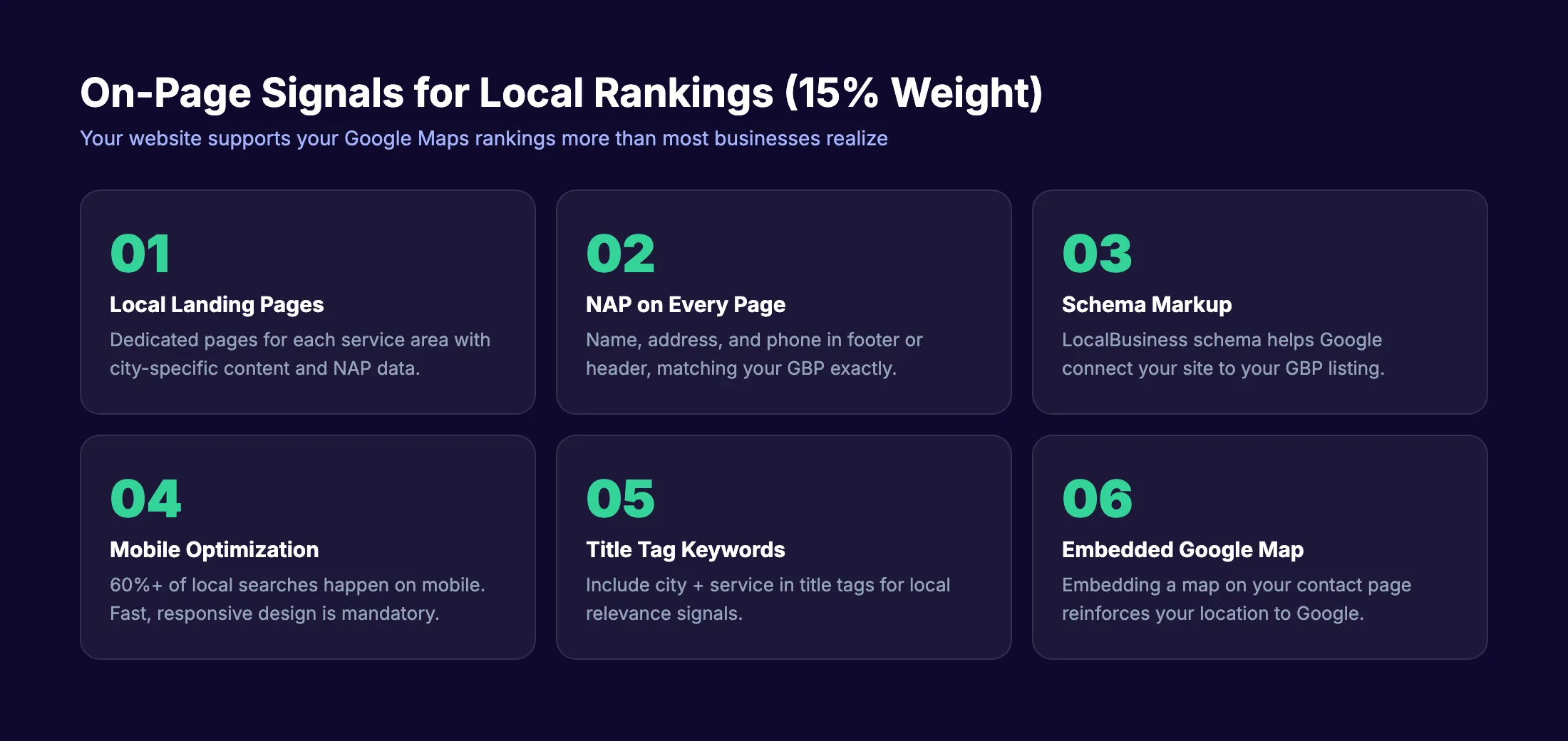
Your website directly impacts your Google Maps rankings. On-page signals carry 15% of local pack weight and 33% of local organic weight. These are the factors Google evaluates on your site.
Local Landing Pages
Dedicated pages for each service and each location send strong relevance signals. A page titled “Emergency Plumbing in Austin, TX” tells Google exactly what you do and where you do it.
Each landing page should include your NAP (name, address, phone), service descriptions, customer testimonials, and a clear call to action. Avoid thin, duplicate pages with only the city name swapped out.
NAP Consistency on Your Website
Your business name, address, and phone number must appear on every page of your website. Place it in your footer or header. Match it exactly to your GBP listing. Character for character.
Businesses maintaining accurate NAP data across directories are 40% more likely to appear in local pack results. Even small differences like “St.” vs “Street” can create confusion.
Schema Markup
LocalBusiness structured data helps Google connect your website to your GBP listing. It explicitly tells search engines your business name, address, hours, services, and review ratings.
Implement LocalBusiness schema on your homepage and every location page. Include opening hours, geo coordinates, price range, and accepted payment methods.
Mobile Optimization
Over 60% of local searches happen on mobile devices. Google indexes the mobile version of your site first. A slow, unresponsive mobile experience directly hurts your local rankings.
Test your site on Google’s PageSpeed Insights. Target a Largest Contentful Paint under 2.5 seconds and a Cumulative Layout Shift below 0.1.
Title Tags and Headers
Include your city and primary service in title tags and H1 headers. “Austin Emergency Plumber | 24/7 Service | Company Name” sends clear local relevance signals.
Use H2 and H3 headers to structure content around specific services, service areas, and frequently asked questions.
Embedded Google Map
Place an embedded Google Map on your contact page and location pages. This reinforces your physical location to Google and improves user experience for visitors seeking directions.
Need a local SEO content engine running on autopilot? Stacc publishes locally optimized blog content and GBP posts every month. Zero effort required. Start for $1 →
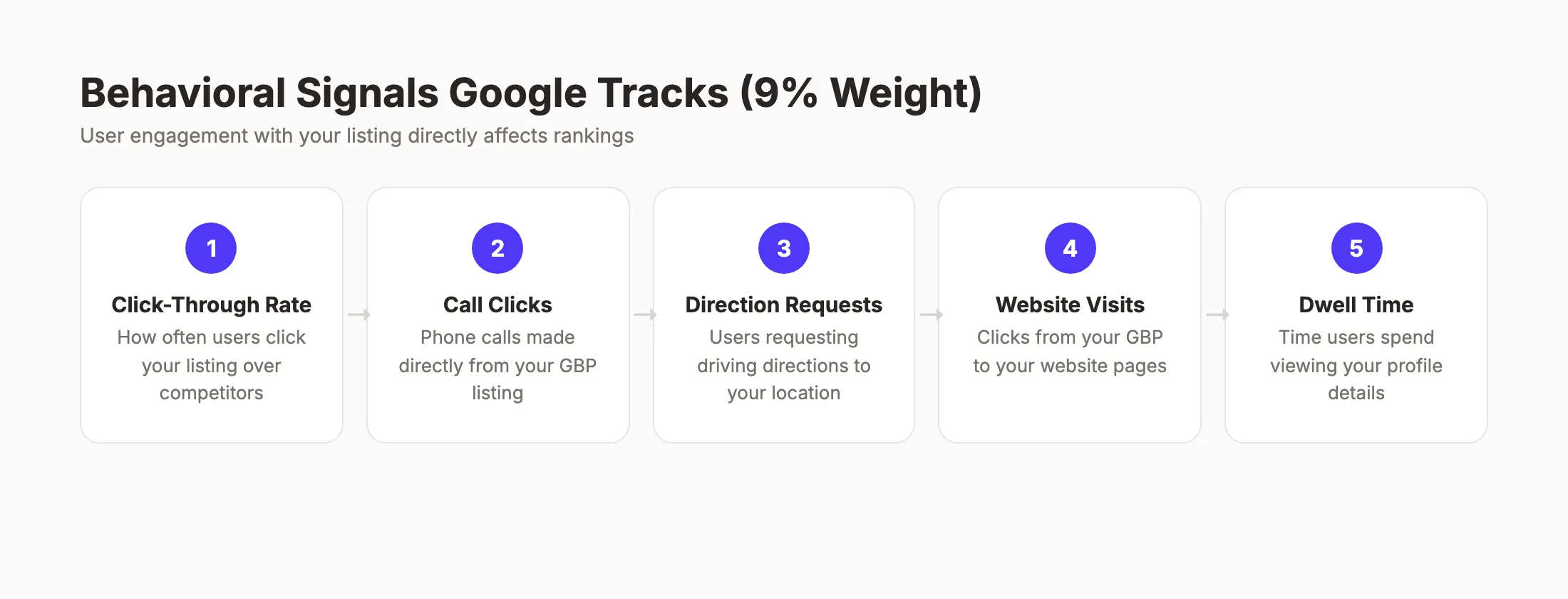
Behavioral Signals (9% Weight)
Behavioral signals measure how users interact with your listing. Google tracks these engagement patterns to determine which businesses deliver the best user experience.
Click-Through Rate
When your listing appears in the local pack, how often do users click it? A higher click-through rate signals that your listing is relevant and appealing.
Optimize your CTR with compelling photos, a strong review count, accurate business hours, and a complete profile. Listings with 50+ reviews and professional photos earn significantly more clicks.
Phone Calls
Google tracks when users tap the call button on your GBP listing. More calls signal a business that users trust and want to contact.
Enable call tracking in your GBP dashboard to monitor this metric. Ensure your phone number is always accurate and that someone answers during business hours.
Direction Requests
Users requesting driving directions to your business send a strong engagement signal. This metric matters most for businesses with physical storefronts.
Add compelling photos of your storefront and parking area to encourage direction requests. Clear, accurate address information reduces friction.
Website Clicks
Clicks from your GBP listing to your website indicate user interest. Google measures both the click rate and what happens after the user lands on your site.
Link your GBP to a relevant local landing page. Not just your homepage. A page specific to the user’s search intent keeps visitors engaged longer.
Dwell Time on Profile
How long users spend viewing your GBP profile matters. Longer dwell times suggest your listing provides useful information.
Complete profiles with photos, Q&A responses, service descriptions, and recent posts keep users engaged. Sparse profiles get skipped quickly.
Link Signals (8% Weight)
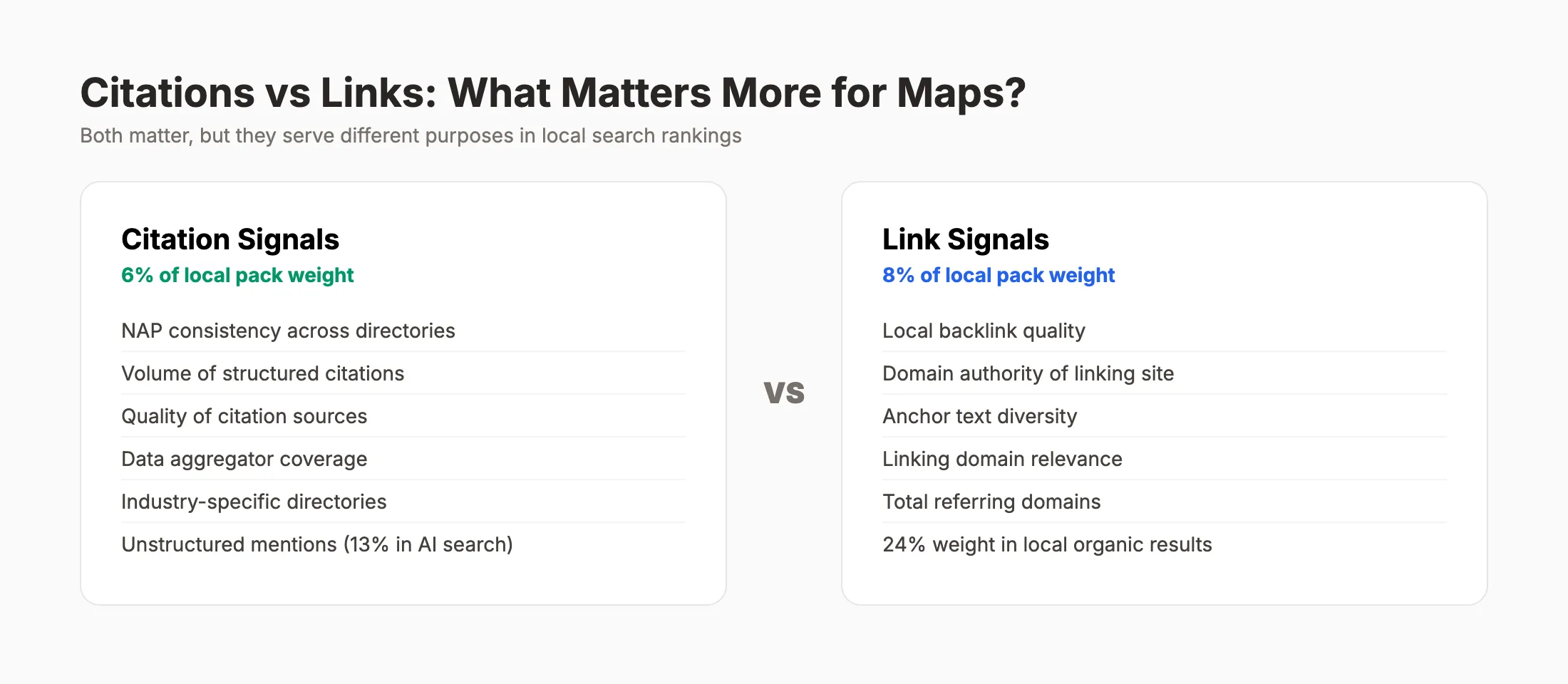
Link signals carry 8% of local pack weight but 24% of local organic weight. Backlinks remain critical for local businesses targeting both Maps and organic search results.
Local Backlink Quality
Links from local businesses, local news sites, chambers of commerce, and community organizations carry more weight than random directory links.
A single link from your city’s newspaper or a local university website outperforms 50 links from generic directories. Focus on quality over quantity.
Domain Authority
The overall authority of your website strengthens all your local ranking signals. Higher domain authority correlates with better local pack placement.
Build authority through consistent content publishing, earning links from relevant industry sources, and maintaining a clean backlink profile. Our guide on building an online presence covers these strategies in detail.
Anchor Text Diversity
Natural anchor text profiles include your brand name, location-based terms, service keywords, and generic phrases. Avoid over-optimizing with exact-match anchor text.
A healthy link profile might include: “Austin Plumbing Co,” “best plumber in Austin,” “click here,” and “this local plumber.” Variety signals organic link building.
Local Link Building Strategies
The most effective local link building strategies include sponsoring local events, joining the chamber of commerce, partnering with complementary businesses, and earning press coverage.
| Link Source | Difficulty | Impact | Example |
|---|---|---|---|
| Chamber of Commerce | Low | Medium | Annual membership |
| Local Sponsorships | Low | Medium | Youth sports, charity events |
| Local News Coverage | Medium | High | Press releases, expert quotes |
| Local Business Partners | Medium | Medium | Cross-promotion links |
| University or .edu Sites | High | High | Guest lectures, scholarships |
| Local Blog Features | Medium | Medium | Interviews, local guides |
Citation Signals (6% Weight)
Citation signals account for 6% of local pack weight. While their direct impact has declined over the years, citations play a growing role in AI search visibility. Carrying 13% weight in AI search results.
NAP Consistency
Consistent name, address, and phone number across all online directories is the foundation of citation signals. Even minor inconsistencies create trust issues.
Audit your citations quarterly. Use tools like BrightLocal or Whitespark to identify and fix inconsistencies. Matching your NAP exactly to your GBP listing is non-negotiable.
Data Aggregators
Submit your business data to the 4 major data aggregators: Data Axle, Localeze/Neustar, Foursquare, and Factual. These aggregators distribute your information to hundreds of smaller directories.
Getting your data right at the aggregator level prevents errors from spreading across the web.
Structured vs. Unstructured Citations
Structured citations appear in business directories with formatted NAP fields. Unstructured citations are mentions of your business in blog posts, news articles, and forum threads.
Both matter. Unstructured citations have gained importance in AI search results, where they carry 13% of ranking weight. Getting mentioned on industry blogs, local news sites, and community forums builds this signal.
Industry-Specific Directories
List your business on directories specific to your industry. Dentists should be on Healthgrades and Zocdoc. Lawyers should be on Avvo and FindLaw. Restaurants should be on Yelp and TripAdvisor.
Industry directories send stronger relevance signals than general business directories.
Stop manually managing citations and content. Stacc handles your local SEO content on autopilot so you can focus on serving customers. Start for $1 →
Negative Ranking Factors
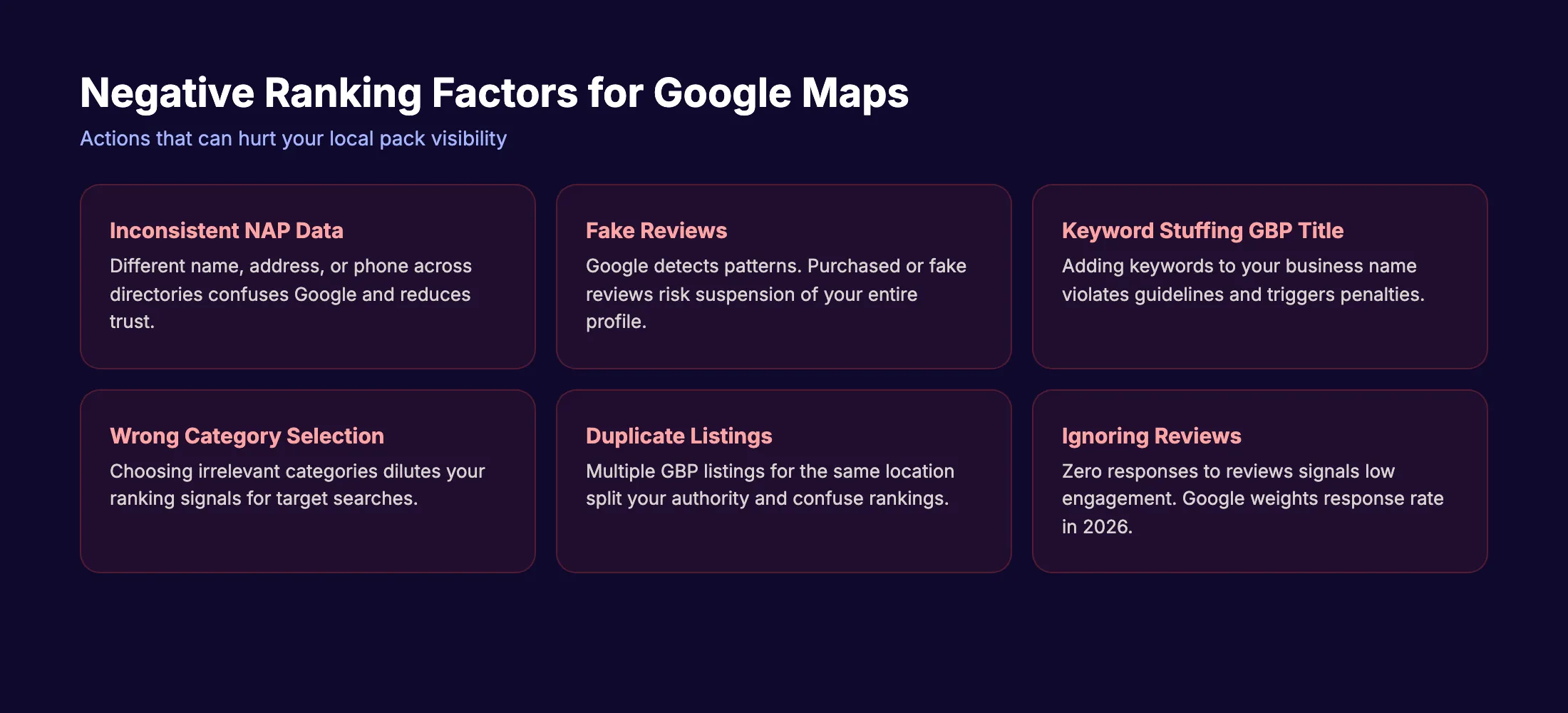
Some actions actively hurt your Google Maps rankings. Avoid these mistakes to protect your local visibility.
Inconsistent NAP Information
Mismatched business information across directories is the most common negative factor. One listing says “123 Main St” while another says “123 Main Street, Suite A.” Google cannot determine which is correct and reduces trust.
Audit every directory, social profile, and website mention of your business. Standardize the format and update every instance.
Fake or Purchased Reviews
Google’s detection systems identify review manipulation patterns. Purchased reviews, reviews from employees, and review exchanges with other businesses all carry suspension risk.
The penalty is severe. Google can remove all your reviews, suspend your listing, or permanently ban your business. Never buy reviews. Read about handling fake reviews if competitors are targeting you.
Keyword Stuffing in Business Name
Adding keywords to your GBP business name violates Google’s guidelines. “Best Austin Emergency Plumber. Fast 24/7 Plumbing” is not a business name. It is spam.
Google regularly audits and corrects keyword-stuffed names. Repeated violations lead to suspension.
Duplicate Listings
Multiple GBP listings for the same business at the same location split your authority. They also confuse Google about which listing to show.
Merge or remove duplicate listings. Keep only 1 verified listing per physical location.
Ignoring Reviews
Zero responses to customer reviews signals disengagement. The 2026 algorithm increased the weight of owner response rate. Businesses that ignore reviews lose ranking positions to competitors who respond consistently.
Respond to every review. Our guides on responding to negative reviews and positive reviews provide templates and strategies.
Listing Violations
Other violations that hurt rankings include using a virtual office address, setting incorrect business hours, hiding your address when you serve customers at your location, and using a tracking phone number that does not match your website.
Follow Google’s Business Profile guidelines to the letter. Compliance protects your visibility.
How to Rank on Google Maps: Action Plan
Knowing the ranking factors is only half the battle. Here is a prioritized action plan based on factor weights and ease of implementation.
Week 1: GBP Foundation (Highest Impact)
- Select the most specific primary category for your business
- Add all relevant secondary categories (up to 9)
- Write a complete 750-character business description with target keywords
- Verify all business hours, including special hours
- Upload 10+ high-quality photos (exterior, interior, team, products)
- Add all services with descriptions and pricing
- Link to a local landing page (not just your homepage)
Week 2: Review Engine
- Set up a review request system for every customer interaction
- Respond to all existing reviews you have not answered
- Create review response templates for positive and negative feedback
- Add review links to email signatures, invoices, and follow-up messages
- Target 4 to 8 new reviews per month as a baseline
Week 3: Website and On-Page
- Create local landing pages for each service and each location
- Add NAP to your website footer, matching GBP exactly
- Implement LocalBusiness schema markup
- Optimize title tags with city + service keywords
- Embed a Google Map on your contact page
- Run PageSpeed Insights and fix mobile performance issues
Week 4: Citations and Links
- Submit to the 4 major data aggregators
- List on 10 to 15 industry-specific directories
- Audit existing citations for NAP consistency
- Join your local chamber of commerce for a backlink
- Identify 5 local sponsorship or partnership opportunities
- Check out our local SEO checklist for a complete task list
Ongoing: Content and Engagement
- Post 1 GBP update per week (events, offers, tips)
- Publish locally focused blog content monthly
- Monitor and respond to all reviews within 24 hours
- Refresh GBP photos monthly
- Track rankings with a local SEO tool and adjust strategy quarterly
| Factor Category | Weight | Your Priority | Time to Impact |
|---|---|---|---|
| GBP Signals | 32% | Immediate | 2 to 4 weeks |
| Review Signals | 20% | Immediate | 1 to 3 months |
| On-Page Signals | 15% | High | 4 to 8 weeks |
| Behavioral Signals | 9% | Medium | Ongoing |
| Link Signals | 8% | Medium | 3 to 6 months |
| Citation Signals | 6% | High | 2 to 6 weeks |
| Personalization | 6% | Low | Cannot control |
| Social Signals | 5% | Low | Ongoing |
FAQ
What are the most important Google Maps ranking factors in 2026?
The most important Google Maps ranking factors are GBP signals (32%), review signals (20%), and on-page signals (15%). Together, these 3 categories account for 67% of local pack ranking weight according to the Whitespark Local Search Ranking Factors survey. Your primary GBP category and proximity to the searcher are the 2 strongest individual signals.
How long does it take to rank higher on Google Maps?
Most businesses see initial ranking improvements within 2 to 4 weeks after optimizing their GBP profile. Meaningful position changes typically take 1 to 3 months. Competitive markets may require 3 to 6 months of consistent optimization across reviews, citations, and link building. The timeline depends on your starting point and competition level.
Do Google reviews actually help Maps rankings?
Yes. Review signals carry 20% of local pack ranking weight. Up from 16% in 2023. Google evaluates review count, velocity, average rating, review text content, and owner response rate. Businesses with 50+ reviews and a 4.0+ star rating consistently outperform competitors with fewer reviews. Read our complete guide to Google reviews for strategies.
Can I rank on Google Maps without a physical address?
Service-area businesses can rank on Google Maps without displaying a physical address. You still need a real physical location to verify your listing. Google allows you to hide your address while setting service areas. However, businesses with a visible storefront address typically rank higher for “near me” searches due to stronger proximity signals.
What is the difference between local pack and local organic rankings?
The local pack (or map pack) is the map with 3 business listings that appears at the top of local search results. Local organic results are the standard blue link results below the map. They use different ranking factor weights. GBP signals carry 32% weight in the local pack but only 7% in local organic. Links carry 8% in the pack but 24% in organic. Optimizing for both requires a balanced strategy. Our local SEO guide covers the full picture.
How often should I post on Google Business Profile?
Post at least once per week on your Google Business Profile. The 2026 algorithm update showed ranking drops for businesses that had not posted in over 30 days. Weekly posts keep your profile active, signal engagement to Google, and give potential customers fresh content. Events, offers, tips, and behind-the-scenes updates all work. See our guide on GBP posting frequency for more detail.
Google Maps ranking factors are not a mystery. The data is clear: optimize your GBP profile first, build a steady review engine, and support both with strong on-page signals and local links. Start with the highest-weight factors and work down the list.
Get local SEO content published on autopilot. Stacc writes and publishes GBP posts and blog articles every month. Starting at $49/month. Start for $1 →

Written by
Siddharth GangalSiddharth is the founder of theStacc and Arka360, and a graduate of IIT Mandi. He spent years watching great businesses lose organic traffic to competitors who simply published more. So he built a system to fix that. He writes about SEO, content at scale, and the tactics that actually move rankings.
Automate your Google Business Profile content
30 GBP posts, local SEO articles, and review responses. Published every month automatically.
30-day trial · Cancel anytime
theStacc
Stop writing SEO content manually
30 blog articles, 30 GBP posts, and social media content. Published every month. Automatically.
Start Your $1 Trial$1 for 3 days · Cancel anytime