
SEO for Contractors (2026): Strategies, Tactics & Examples
Practical construction contractor seo guide strategies for 2026: step-by-step tactics, real examples, and tools to improve rankings and drive organic traffic.
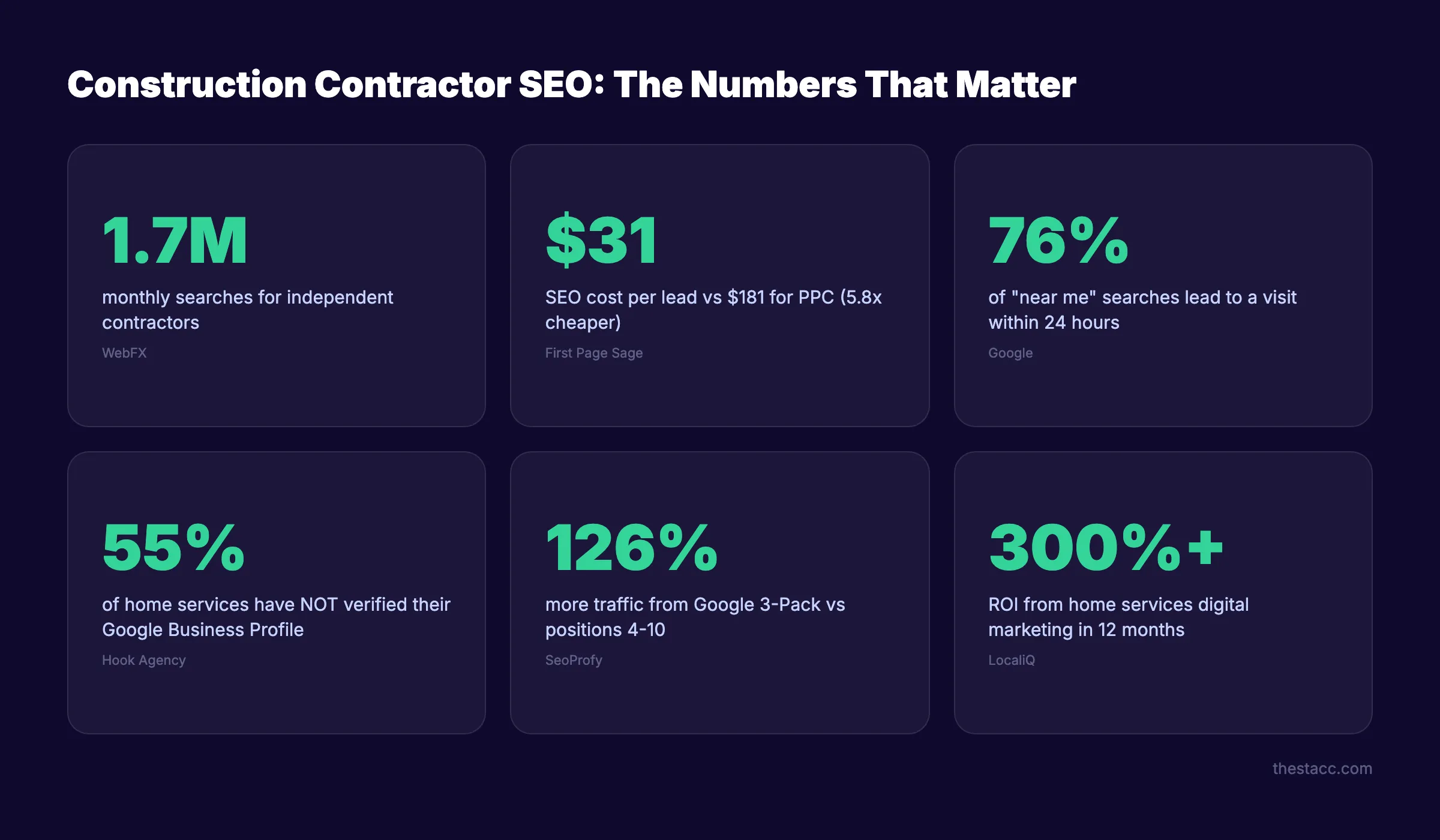
There are 1.7 million monthly searches for independent contractors on Google. Your construction company either shows up for those searches or loses every one of those potential jobs to a competitor who does.
Most contractors rely on referrals and word-of-mouth. Both work. Neither scale. And neither protect you when a slow season hits or a major referral source dries up. Contractor SEO builds a pipeline of inbound leads that runs 24/7 without ad spend.
The problem is that most SEO advice is written for SaaS companies and e-commerce stores. Construction is different. You serve specific areas, your projects are visual, your customers search differently, and your busy seasons dictate your marketing calendar. Generic SEO guides miss all of that.
We have published 3,500+ blog posts across 70+ industries, including hundreds for home services and construction companies. Our average SEO score is 92%. This guide covers everything we know about contractor SEO.
Here is what you will learn:
- How local search works for construction companies (and why it matters)
- How to optimize your Google Business Profile for maximum visibility
- The exact process for building service-area pages that rank
- How to turn project photos into ranking assets
- Content strategies specific to construction (seasonal, cost, permit content)
- How to prepare for AI search and voice search in 2026
Why SEO Matters for Construction Companies
Construction is one of the most searched industries on Google. 46% of all Google searches have local intent, and home services sit at the center of that volume.
The numbers tell a clear story:
| Metric | Value |
|---|---|
| Monthly searches for contractors | 1.7 million |
| ”Near me” searches leading to visits within 24 hours | 76% |
| Consumers who read reviews before hiring | 98% |
| SEO cost per lead vs. PPC | $31 vs. $181 |
| Google 3-Pack traffic vs. positions 4-10 | 126% more |
That last stat is critical. The Google 3-Pack (the map results at the top of local search) captures more traffic than the next 7 organic positions combined. If your construction company is not in those top 3 map results, you are invisible for the highest-intent searches.
SEO also costs dramatically less per lead than paid advertising. First Page Sage found that SEO generates leads at $31 each, compared to $181 for PPC. That is 5.8x cheaper. Over 12 months, home services companies see 300-500% ROI from digital marketing.
Referrals will always matter in construction. But SEO gives you a second pipeline that does not depend on anyone else.
Google Business Profile for Contractors
Your Google Business Profile is the single most important asset for contractor SEO. GBP signals account for 32% of local pack ranking weight. Yet only 45% of home services businesses have a verified GBP, the lowest rate of any industry.
That gap is your opportunity.
Claim and Complete Every Field
A half-finished profile loses to a complete one every time. Fill out:
- Business name. Your exact legal name. Do not add “Best Contractor in Dallas.”
- Primary category , “General Contractor” or the most specific option (Roofing Contractor, Plumber, Electrician, etc.).
- Secondary categories. Add every relevant specialty. A general contractor might add “Home Builder,” “Kitchen Remodeler,” and “Bathroom Remodeler.”
- Service area. List every city, county, or ZIP code you serve. Be specific.
- Phone number. Use a local number, not toll-free.
- Business hours. Keep accurate. Being open at search time is a ranking signal.
- Services. List every service with descriptions. Google uses these to match queries.
- Business description , 750 characters. Include your primary services and areas.
- Attributes. Mark “Veteran-owned,” “Licensed,” “Insured,” or any that apply.
Upload Project Photos
Profiles with 100+ photos receive 520% more calls and 2,700% more direction requests than profiles with fewer photos. For contractors, photos are your portfolio.
Upload these types:
- Before-and-after shots. The most powerful visual proof in construction
- Active job site photos. Show your crew at work
- Completed project photos. High-resolution, well-lit, multiple angles
- Equipment and fleet. Signals professionalism
- Team photos. Builds trust with homeowners
- Short videos , 30-second walkthroughs of finished projects
Name every photo file with descriptive keywords before uploading: kitchen-remodel-dallas-texas.jpg instead of IMG_4382.jpg.
Post Weekly
GBP posts keep your profile active and signal to Google that your business is engaged. Post:
- Recently completed projects with photos
- Seasonal service promotions (storm damage repair, winterization)
- Tips for homeowners (when to replace a roof, how to spot foundation issues)
- Team updates and certifications
For a deeper walkthrough, read our full Google Business Profile optimization guide.
Stop writing. Start ranking. Stacc publishes 30 GBP posts per month for contractors on autopilot. Start for $1 →
Service-Area Pages That Rank
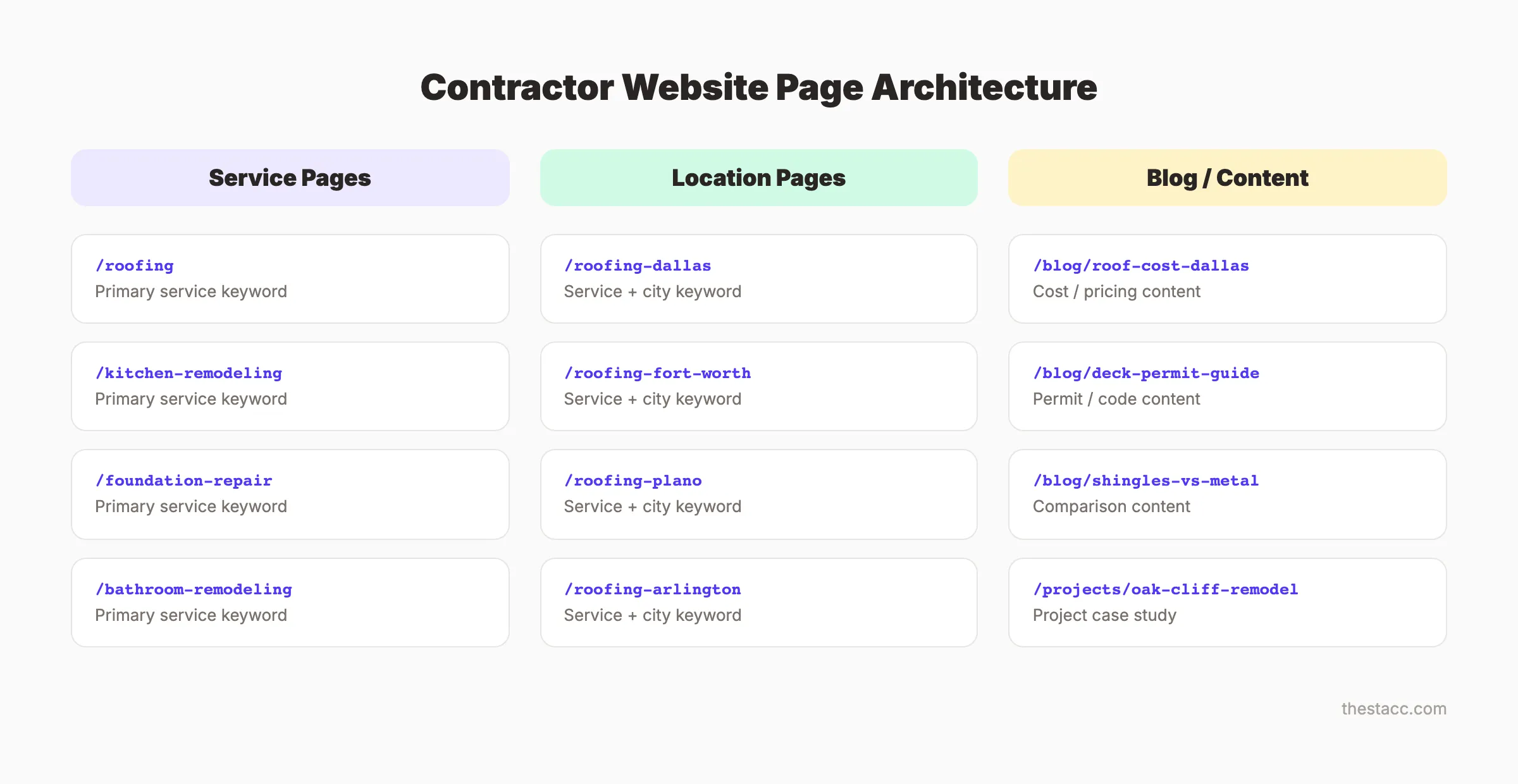
Most contractor websites have a single “Service Areas” page that lists 20 cities. That page will never rank for any of them. Google rewards dedicated, unique pages for each location you serve.
Build One Page Per City
If you serve Dallas, Fort Worth, Arlington, and Plano, you need 4 separate pages:
/roofing-contractor-dallas/roofing-contractor-fort-worth/roofing-contractor-arlington/roofing-contractor-plano
Make Each Page Unique
The biggest mistake contractors make is duplicating one page and swapping city names. Google detects this immediately. Each location page must include:
- Location-specific service details. Mention neighborhoods, landmarks, zip codes
- Local project examples , “We recently completed a full roof replacement on a 1960s ranch-style home in Oak Cliff”
- Area-specific challenges. Dallas clay soil causes foundation issues. Fort Worth has different building codes for historic districts.
- Local testimonials. Reviews from customers in that specific city
- Embedded Google Map. Centered on the service area
- Local schema markup. LocalBusiness JSON-LD with the specific address or service area
Service Pages vs. Location Pages
You need both:
| Page Type | Example URL | Purpose |
|---|---|---|
| Service page | /kitchen-remodeling | Ranks for service keywords nationally |
| Location page | /kitchen-remodeling-dallas | Ranks for service + city keywords |
| Project page | /projects/oak-cliff-kitchen-remodel | Ranks for long-tail, builds authority |
The service page links to all location pages. Each location page links back to the service page. This creates a cluster structure that Google rewards. Learn more about building topical authority through content clusters.
Local Keyword Research for Contractors
Contractor keywords follow predictable patterns. Your customers search differently depending on where they are in the buying process.
The 4 Types of Contractor Keywords
| Intent Stage | Keyword Pattern | Example | Priority |
|---|---|---|---|
| Emergency | ”[service] emergency [city]" | "emergency roof repair Dallas” | Highest |
| Ready to hire | ”[service] [city]" | "general contractor Fort Worth” | High |
| Researching | ”how much does [service] cost" | "how much does a kitchen remodel cost” | Medium |
| Early stage | ”[service] ideas” or “do I need [service]" | "bathroom remodel ideas” | Lower |
How to Find Your Keywords
Step 1: List every service. Roofing, siding, kitchen remodel, bathroom remodel, foundation repair, room addition, deck building, garage construction, commercial build-out.
Step 2: Combine with locations. Each service paired with every city and neighborhood you serve.
Step 3: Add cost modifiers. “Cost,” “price,” “estimate,” and “how much” keywords have enormous search volume and high commercial intent.
Step 4: Mine Google Autocomplete. Type “contractor in [city]” and capture every suggestion.
Step 5: Check People Also Ask. These questions become blog post topics.
For a complete keyword research walkthrough, see our keyword research guide.
Map Keywords to the Right Pages
| Keyword Type | Assign To |
|---|---|
| ”[service] [city]“ | Location page |
| ”[service] cost/price” | Blog post |
| ”best [service] [city]“ | Location page |
| ”do I need [service]“ | Blog post |
| ”[service] vs [service]“ | Blog post |
| ”how to choose a contractor” | Blog post |
| ”[service] permit [city]“ | Blog post |
On-Page SEO for Contractor Websites
Every page on your website must send clear signals to Google about what services you offer and where you offer them. Follow the same on-page SEO fundamentals that apply to all websites, plus these construction-specific tactics.
Title Tags
Your title tag formula for service/location pages:
[Service] in [City] | [Company Name]Examples:
- “Roof Replacement in Dallas | ABC Roofing”
- “Kitchen Remodeling in Fort Worth | Smith Construction”
- “Foundation Repair in Plano | DFW Foundation Pros”
Keep every title under 60 characters.
Meta Descriptions
Write benefit-driven meta descriptions for every page:
Licensed roof replacement in Dallas. 15+ years experience, 500+ projects completed. Free estimates. Call today.Include your primary keyword, a trust signal (years, projects, reviews), and a call to action. Keep between 145-155 characters. Use our meta description generator to check length.
Header Structure
Every service page needs this H2 structure:
- H1: [Service] in [City]
- H2: Our [Service] Process
- H2: Why Choose [Company Name]
- H2: Service Areas
- H2: Recent Projects
- H2: Pricing / Free Estimate
- H2: FAQ
NAP Consistency
Your Name, Address, and Phone Number must be identical everywhere it appears online. Put it in your website footer on every page. 68% of consumers stop using a business after seeing inaccurate information in online listings.
Your SEO team. $99 per month. 30 optimized articles published automatically. No writers. No agencies. Start for $1 →
Project Photos as SEO Assets
Construction is one of the most visual industries. Your project photos are not just portfolio pieces. They are ranking assets.
Photo SEO Best Practices
Every project photo should follow these rules:
- Descriptive file names ,
bathroom-remodel-highland-park-dallas.jpgnotIMG_4392.jpg - Alt text with keywords , “Completed bathroom remodel in Highland Park, Dallas showing new tile shower and vanity”
- Geo-tagged EXIF data. Most phone cameras embed GPS coordinates. Keep this data intact.
- Compressed file size. Under 200KB per image. Use WebP format when possible.
- Multiple angles , 3-5 photos per project from different angles and stages
Before-and-After Content
Before-and-after photo pairs are the highest-performing content format for contractors. They:
- Demonstrate the transformation (builds trust)
- Keep visitors on the page longer (engagement signal)
- Get shared on social media (earns links)
- Rank in Google Image search (additional traffic source)
Create dedicated project pages for your best work. Each page should include: project description, 5-10 photos, scope of work, timeline, location, and a CTA for a free estimate.
Image Schema Markup
Add ImageObject schema to project pages so Google understands what the photos show:
{
  "@context": "https://schema.org",
  "@type": "ImageObject",
  "name": "Kitchen Remodel in Highland Park Dallas",
  "contentUrl": "https://yoursite.com/images/kitchen-remodel-hp.jpg",
  "description": "Complete kitchen remodel with custom cabinetry and quartz countertops",
  "contentLocation": {
    "@type": "Place",
    "name": "Highland Park, Dallas, TX"
  }
}
Reviews: The Trust Factor for Contractors
Hiring a contractor is a high-stakes decision. Homeowners are inviting strangers into their homes to do expensive work. Reviews are how they decide who to trust.
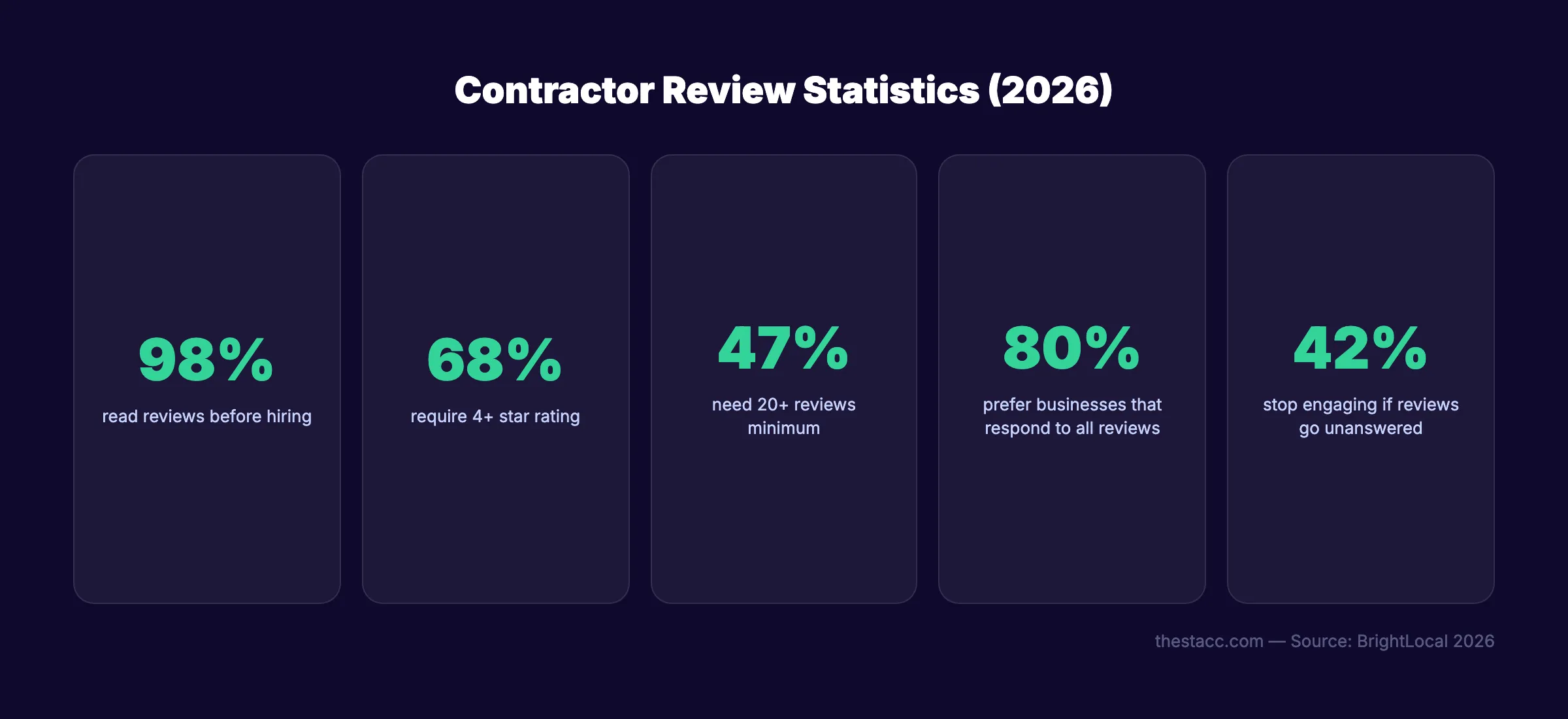
98% of consumers read online reviews for local businesses. For contractors, that number is likely even higher because the financial risk is greater.
The Review Numbers That Matter
| Metric | 2026 Data |
|---|---|
| Consumers requiring 4+ stars | 68% |
| Consumers requiring 20+ reviews | 47% |
| Expect same-day review response | 19% |
| More likely to choose if all reviews answered | 80% |
| Stop engaging if reviews go unanswered | 42% |
A 4.2-star rating with 12 reviews will lose to a 4.7-star rating with 85 reviews every time. Volume and quality both matter.
How to Get More Reviews
Build a system. Do not leave reviews to chance.
- Ask at project completion. Walk through the finished project with the homeowner, confirm satisfaction, then ask in person.
- Follow up with a text or email. Send a direct link to your Google review page within 24 hours of project completion.
- Use QR codes. Print them on business cards, invoices, and yard signs. Our review QR code generator creates these instantly.
- Ask subcontractors to remind homeowners. If you work with painters, electricians, or plumbers, ask them to mention leaving a review.
Respond to Every Review
80% of consumers are more likely to choose businesses that respond to all reviews. Respond within 24 hours.
For positive reviews: Thank the homeowner by name. Mention the specific project. Keep it under 3 sentences.
For negative reviews: Acknowledge the concern. Apologize without being defensive. Offer to resolve it offline. Never argue publicly. A professional response to a negative review often impresses potential customers more than the positive reviews.
Use our review response generator for personalized responses. For a full review strategy, read our guide on getting more Google reviews.
Content Strategy for Construction Companies
Most contractor websites have 5 pages: Home, About, Services, Gallery, Contact. That is not enough to rank. Google rewards websites that demonstrate expertise through depth of content.
The Content Types That Work for Contractors
1. Cost and pricing content. “How much does a kitchen remodel cost in Dallas?” is a high-volume, high-intent keyword that almost no contractors are targeting with dedicated content. These pages attract featured snippets and AI Overview citations.
2. Permit and code content. “Do I need a permit for a deck in [city]?” is a question homeowners search before hiring. Writing this content positions you as the knowledgeable local expert.
3. Seasonal content. Construction has natural cycles. Align your content calendar:
| Season | Content Topics |
|---|---|
| Spring | Roof inspection, storm damage assessment, deck building |
| Summer | Room additions, new construction, outdoor living |
| Fall | Winterization, gutter cleaning, insulation upgrades |
| Winter | Interior remodels, planning for spring projects |
4. Project case studies. Detailed write-ups of completed projects with photos, scope, timeline, challenges, and results. Each case study is a long-tail keyword opportunity.
5. Comparison content. “Asphalt shingles vs. metal roofing” or “quartz vs. granite countertops.” These pages attract decision-stage searchers.
Publishing Frequency
Consistency matters more than volume. Even 4 blog posts per month builds momentum. The Content Compound Effect means every article stacks on the last. See our data on how many blog posts you need to rank.
For help planning your calendar, use our content calendar for SEO guide.
3,500+ blogs published. 92% average SEO score. See what Stacc can do for your construction company. Start for $1 →
Schema Markup for Contractors
Schema markup helps Google understand your business details and enables rich results in search (star ratings, price ranges, service areas). Most contractor websites have zero schema. Adding it gives you an immediate edge.
Essential Schema Types
LocalBusiness (or more specific type):
{
  "@context": "https://schema.org",
  "@type": "GeneralContractor",
  "name": "ABC Construction",
  "image": "https://abcconstruction.com/logo.png",
  "address": {
    "@type": "PostalAddress",
    "streetAddress": "123 Builder Lane",
    "addressLocality": "Dallas",
    "addressRegion": "TX",
    "postalCode": "75201"
  },
  "telephone": "+1-555-123-4567",
  "url": "https://abcconstruction.com",
  "areaServed": ["Dallas", "Fort Worth", "Plano", "Arlington"],
  "priceRange": "$$-$$$",
  "aggregateRating": {
    "@type": "AggregateRating",
    "ratingValue": "4.8",
    "reviewCount": "142"
  }
}
Use the most specific @type available: RoofingContractor, Plumber, Electrician, HVACBusiness, or GeneralContractor.
Service schema. Add for each service you offer.
FAQ schema. Add to any page with FAQ sections. Google can display these as expandable results.
For full implementation details, see our schema markup guide. Generate schema instantly with our schema markup generator.
Link Building for Contractors
Backlinks remain one of the strongest ranking signals. For contractors, local links matter more than high-authority national links.
High-Value Link Sources for Contractors
| Link Source | How to Get It |
|---|---|
| Local chamber of commerce | Pay membership dues, get listed |
| Home builders association | Join your local HBA chapter |
| Supplier websites | Ask suppliers to list you as an authorized installer |
| Real estate agent websites | Partner with agents, offer home inspection content |
| Local news coverage | Pitch stories about community projects or unique builds |
| Charity/Habitat for Humanity | Volunteer, get featured on their site |
| Home show and expo websites | Exhibit at events, get sponsor links |
| Local blog features | Reach out to home improvement bloggers in your area |
Sponsor Local Events
Every sponsorship typically earns a link from the event website plus local news mentions. Sponsor a youth sports team, a charity 5K, or a local business expo.
Create Link-Worthy Content
A “Cost of Home Renovation in [City] 2026” page or a “Building Permit Guide for [County]” page earns links from local blogs, real estate sites, and community resources. These pages attract links naturally because they answer questions that other websites need to reference.
For more link building tactics, see our backlink building guide.
AI Search and Voice Search for Contractors
Two new channels are reshaping how homeowners find contractors: AI search and voice search. Ignoring them in 2026 means missing a growing share of leads.
AI Search (AI Overviews, ChatGPT, Perplexity)
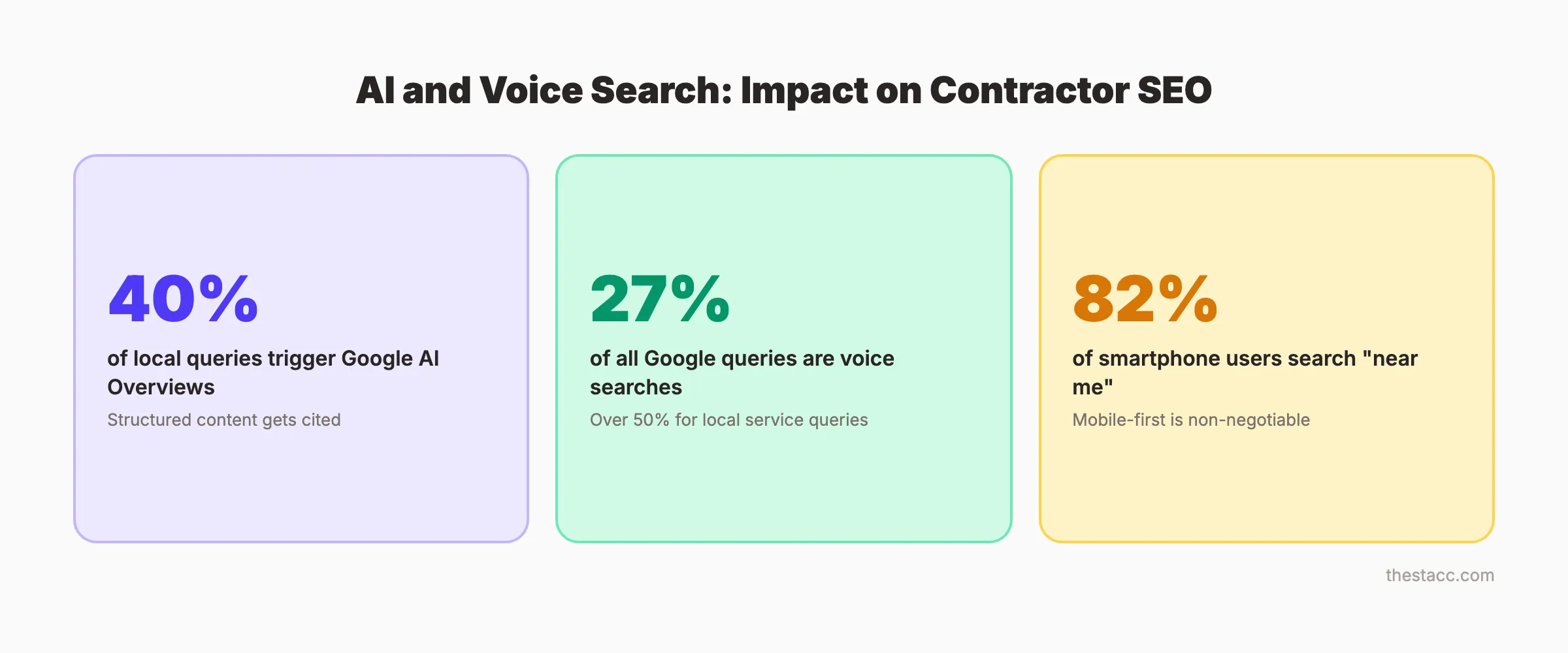
40% of local business queries now trigger Google AI Overviews. When someone searches “best roofing contractor in Dallas,” Google may show an AI-generated summary instead of traditional results.
To appear in AI search results:
- Structure content clearly. Use headings, lists, and tables. AI systems pull from well-organized content.
- Answer questions directly. Start FAQ answers with a direct 1-2 sentence response, then elaborate.
- Include specific data. AI models prefer citing content with numbers, pricing, and concrete details.
- Keep your GBP complete. AI Overviews pull business data directly from GBP profiles.
- Build authority. AI systems cite businesses with strong review profiles, consistent NAP, and quality backlinks.
For a complete strategy, read our generative engine optimization guide.
Voice Search
27% of all Google queries are voice searches. For local service queries, voice share exceeds 50%. Common voice searches for contractors:
- “Find a roofer near me”
- “How much does it cost to remodel a bathroom?”
- “Who is the best general contractor in Fort Worth?”
Optimize for voice by targeting question keywords, writing concise answers (voice assistants read from featured snippets), and keeping your GBP hours and phone number current.
Tracking Contractor SEO Results
You cannot improve what you do not measure. Track these metrics monthly.
Key Metrics for Contractors
| Metric | Tool | Why It Matters |
|---|---|---|
| Map Pack rankings | Local rank tracker | Are you in the top 3 map results? |
| Organic rankings | Google Search Console | Which keywords bring traffic? |
| GBP views and actions | GBP Insights | How many people see your profile? |
| Phone calls from GBP | Call tracking / GBP | Direct lead measurement |
| Direction requests | GBP Insights | In-person visit intent |
| Website form submissions | Google Analytics 4 | Lead capture tracking |
| Review count and rating | GBP / BrightLocal | Trust signal strength |
| Cost per lead | All channels combined | SEO vs. PPC efficiency |
Set Up Your Tracking Stack
- Google Search Console. Free. Shows which queries bring traffic. Read our Google Search Console guide.
- Google Analytics 4. Free. Tracks website behavior and conversions. See our GA4 setup guide.
- GBP Insights. Built into your Business Profile. Shows searches, views, and actions.
- Call tracking. Use a service like CallRail to attribute phone calls to SEO vs. ads vs. referrals.
Timeline Expectations
Local SEO is not instant. Expect this timeline:
- Month 1-2: GBP optimized, citations built, review system running, first content published
- Month 3-4: First ranking movement for low-competition keywords
- Month 6-9: Map Pack appearances, steady increase in calls and form submissions
- Month 12+: Dominant positions for primary keywords, SEO generating more leads than paid ads
Common Contractor SEO Mistakes
Most construction companies make the same SEO mistakes. Fixing these puts you ahead of the majority of competitors.
- No Google Business Profile. 55% of home services businesses have not verified their GBP. Free visibility, wasted.
- One “Service Areas” page listing 20 cities. Create individual pages for each city. One page per location.
- Duplicate content on location pages. Swapping city names on identical pages does not work. Write unique content for each location.
- No photos on GBP. Construction is visual. Profiles without photos lose to competitors who upload regularly.
- Ignoring reviews. 42% of consumers stop engaging with businesses that do not respond to reviews.
- No blog content. A 5-page website cannot compete with a competitor who publishes cost guides, project case studies, and seasonal content.
- Keyword stuffing. “Best roofer Dallas cheap roofer Dallas TX roofer” in your title tag will get you penalized.
- No schema markup. You are missing rich results that increase click-through rates.
- No mobile optimization. Over 82% of “near me” searches happen on mobile. A slow or unresponsive site kills leads.
- Not tracking results. If you do not know which keywords generate calls, you cannot optimize.
Fix these before chasing advanced tactics. The basics done well beat sophisticated strategies done poorly.
Rank everywhere. Do nothing. Blog SEO, Local SEO, and Social on autopilot for contractors. Start for $1 →
FAQ
How much does SEO cost for a construction company?
SEO agencies charge $1,500-$5,000 per month for contractor SEO. Freelancers charge $500-$2,000. You can implement many tactics yourself using this guide, or use a service like Stacc that handles blog content and GBP posts from $99 per month. SEO generates leads at roughly $31 each compared to $181 for PPC.
How long does contractor SEO take to work?
Most contractors see initial ranking movement within 60-90 days. Consistent phone calls and form submissions from SEO typically start at 6-9 months. The timeline depends on your market competition, how many competitors are actively doing SEO, and how consistently you execute.
Do contractors need a blog for SEO?
Yes. A blog is how you rank for long-tail keywords like “how much does a roof replacement cost” or “do I need a permit for a deck.” These searches have high commercial intent and drive qualified leads. Even 4 posts per month builds meaningful ranking momentum over time.
What is the most important SEO factor for contractors?
Google Business Profile optimization is the highest-impact single action. GBP signals account for roughly 32% of local pack ranking weight. A complete, verified, and actively maintained profile with photos, reviews, and regular posts will move the needle faster than any other tactic.
Should contractors do SEO or Google Ads?
Both. Google Ads deliver immediate leads but stop the moment you stop paying. SEO builds compounding visibility over time. Start with Google Ads for immediate pipeline, then invest in SEO to reduce your long-term cost per lead. Most contractors find that SEO overtakes paid ads in lead generation within 12-18 months.
How do contractors get more Google reviews?
Ask at project completion when homeowner satisfaction is highest. Follow up within 24 hours with a direct link to your Google review page via text or email. Print QR codes on business cards, invoices, and yard signs. Respond to every review within 24 hours. Consistent effort builds review volume faster than any single campaign.
Every contractor who ranks on Google today started with the same decision you are making now. SEO is not magic. It is a system. Optimize your GBP, build service-area pages, publish content, earn reviews, and track results. Do it consistently and your pipeline fills itself.
The hardest part is execution. Writing blog posts, managing your GBP, building citations, and responding to reviews takes real time. Time you should spend running jobs. That is exactly the problem Stacc solves. We handle the content, the GBP posts, and the SEO so you can focus on building.
Skip the agency. Keep the results. Stacc starts at $99/mo with a $1 trial. Start for $1 →
Related Tools & Resources
Free SEO Tools:
Best Lists:

Written by
Siddharth GangalSiddharth is the founder of theStacc and Arka360, and a graduate of IIT Mandi. He spent years watching great businesses lose organic traffic to competitors who simply published more. So he built a system to fix that. He writes about SEO, content at scale, and the tactics that actually move rankings.
Automate your Google Business Profile content
30 GBP posts, local SEO articles, and review responses. Published every month automatically.
30-day trial · Cancel anytime
theStacc
Stop writing SEO content manually
30 blog articles, 30 GBP posts, and social media content. Published every month. Automatically.
Start Your $1 Trial$1 for 3 days · Cancel anytime