
Med Spa SEO: The Complete Guide (2026)
The complete med spa SEO guide. Google Business Profile, service pages, reviews, local keywords, and content strategy to fill your calendar. Updated April 2026.
Siddharth Gangal • 2026-04-02 • Local SEO
In This Article
The medical spa industry hit $21.4 billion in 2025. It is projected to reach $66.1 billion by 2033. That growth means more med spas fighting for the same local search results.
Most med spas rely on paid ads and Instagram. Both work. Neither compound. The moment you stop paying, the leads stop. Med spa SEO builds the opposite: a pipeline that grows every month without increasing your ad spend.
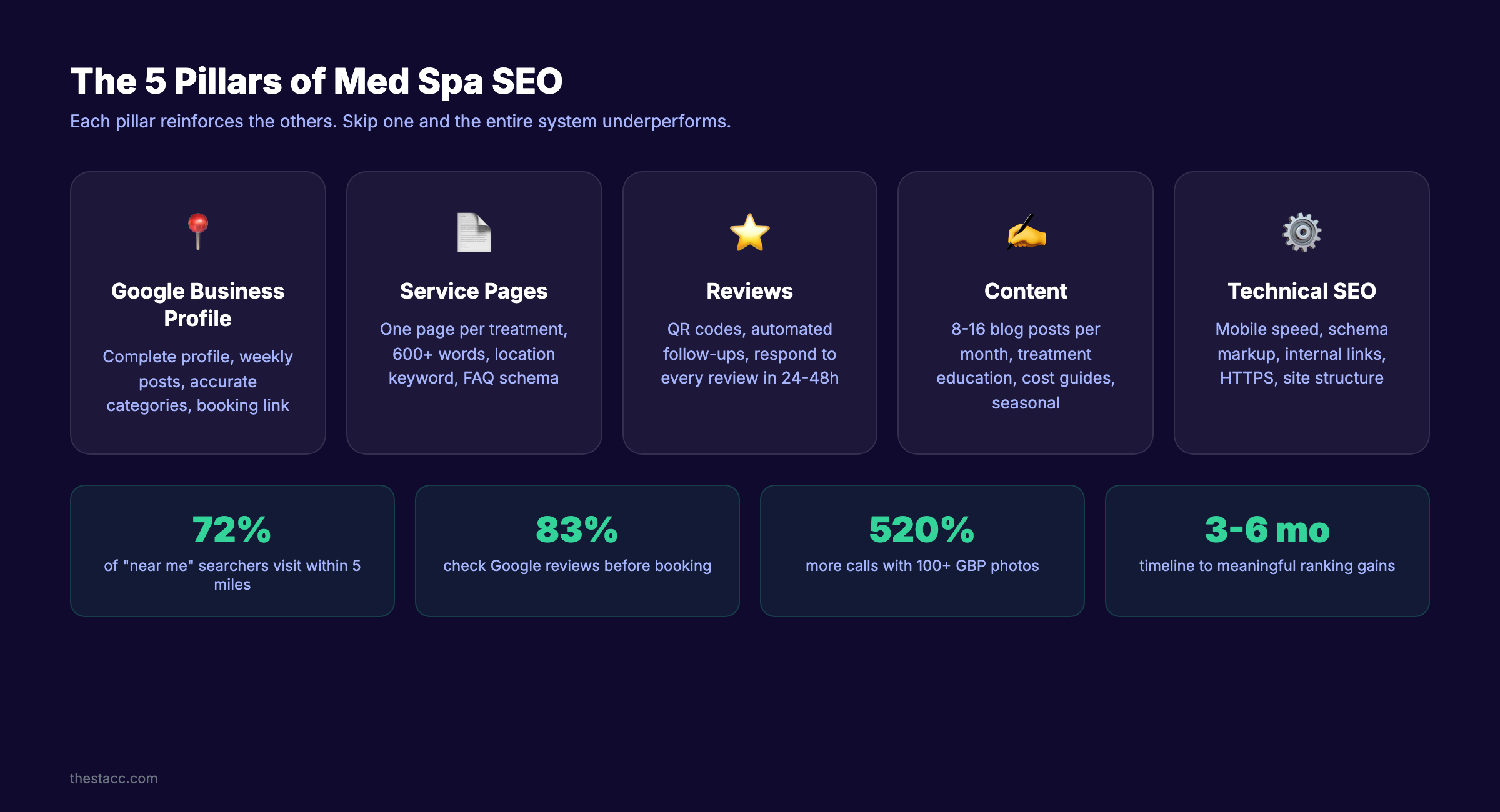
72% of consumers who search “med spa near me” visit a business within 5 miles. 83% check Google reviews before booking. If your med spa does not show up in those local searches, you are invisible to the clients who are ready to book right now.
This guide covers every part of med spa SEO. From Google Business Profile optimization to service page structure, review strategy, local keywords, and content that ranks.
We have published 3,500+ blogs across 70+ industries. Our average SEO score is 92%. We work with healthcare and wellness businesses every day.
Here is what you will learn:
- How to optimize your Google Business Profile for the Map Pack
- The exact service page structure that ranks for treatment keywords
- A keyword strategy built around local intent and treatment searches
- How to turn Google reviews into a ranking factor
- Content ideas that attract patients at every stage of the booking journey
- Technical SEO basics every med spa website needs
- How to track results and measure SEO ROI
Why Med Spa SEO Matters More Than Ads
Paid ads deliver immediate traffic. SEO delivers compounding traffic. The difference matters more for med spas than most industries.
The Cost Problem with Ads
Med spa keywords are expensive. “Botox near me” costs $5 to $12 per click on Google Ads. “Laser hair removal [city]” runs $4 to $8. A med spa spending $3,000 per month on ads might generate 300 to 500 clicks. At a 5% conversion rate, that is 15 to 25 new patient inquiries.
The same budget invested in SEO content and local optimization produces results that last. A service page ranking for “Botox in [city]” generates free clicks every month. After 6 months, you have 6 pages ranking. After 12 months, 12 pages. The traffic compounds while the cost stays flat.
The Local Search Opportunity
Med spas are hyperlocal businesses. Patients search for treatments within driving distance. That makes local SEO the highest-ROI channel available.
Google Business Profile optimization drives Map Pack visibility. Service pages target treatment-specific keywords. Reviews build trust signals. Together, these three elements create a local search presence that paid ads cannot replicate.
What Competitors Get Wrong
Most med spa SEO advice focuses on broad tactics: “optimize your website” or “post on social media.” That advice is too generic to execute. This guide gives you the exact structure, keywords, and process for each element of med spa SEO.
Google Business Profile: Your Most Important Asset
Your Google Business Profile (GBP) accounts for over 30% of local ranking signals. It is the first thing patients see when they search “med spa near me” or “[treatment] in [city].”
Claim and Verify
If you have not claimed your GBP listing, do it today. Go to business.google.com, search for your med spa, and follow the verification process. Google may verify by phone, email, postcard, or video.
An unclaimed profile means someone else could edit your listing. It also means you cannot respond to reviews, post updates, or add services.
Optimize Every Field
Fill out every available field. Incomplete profiles rank lower.
| GBP Field | What to Enter | Why It Matters |
|---|---|---|
| Business name | Exact legal name (no keyword stuffing) | Matching NAP across all directories |
| Primary category | Medical Spa | Determines which searches you appear in |
| Secondary categories | Day Spa, Skin Care Clinic, Laser Hair Removal | Expands visibility for treatment searches |
| Description | 750 chars: services, location, differentiator | Helps Google match you to relevant queries |
| Services | List every treatment with description | Shows in GBP service menu |
| Appointment URL | Direct booking link | Removes friction from search to booking |
| Hours | Accurate hours including holidays | Prevents patients from showing up to a closed location |
| Photos | Reception, treatment rooms, team, results | Profiles with 100+ photos get 520% more calls |
Post Weekly Updates
GBP posts signal that your business is active. Post at least once per week.
Post types that work for med spas:
- New treatment announcements
- Seasonal specials (spring skin prep, summer body contouring)
- Before-and-after results (with patient consent)
- Educational tips (sunscreen guidance, skincare routines)
- Event announcements (open houses, VIP nights)
Each post should include a call to action: “Book Now,” “Learn More,” or “Call Today.”
Stop writing. Start ranking. Stacc publishes 30 SEO articles per month for $99. Plus Google Business Profile posts on autopilot. Start for $1 →
Med Spa Keywords: What Patients Actually Search
Keyword research for med spas follows a predictable pattern. Patients search by treatment, location, and intent.
The 4 Keyword Categories
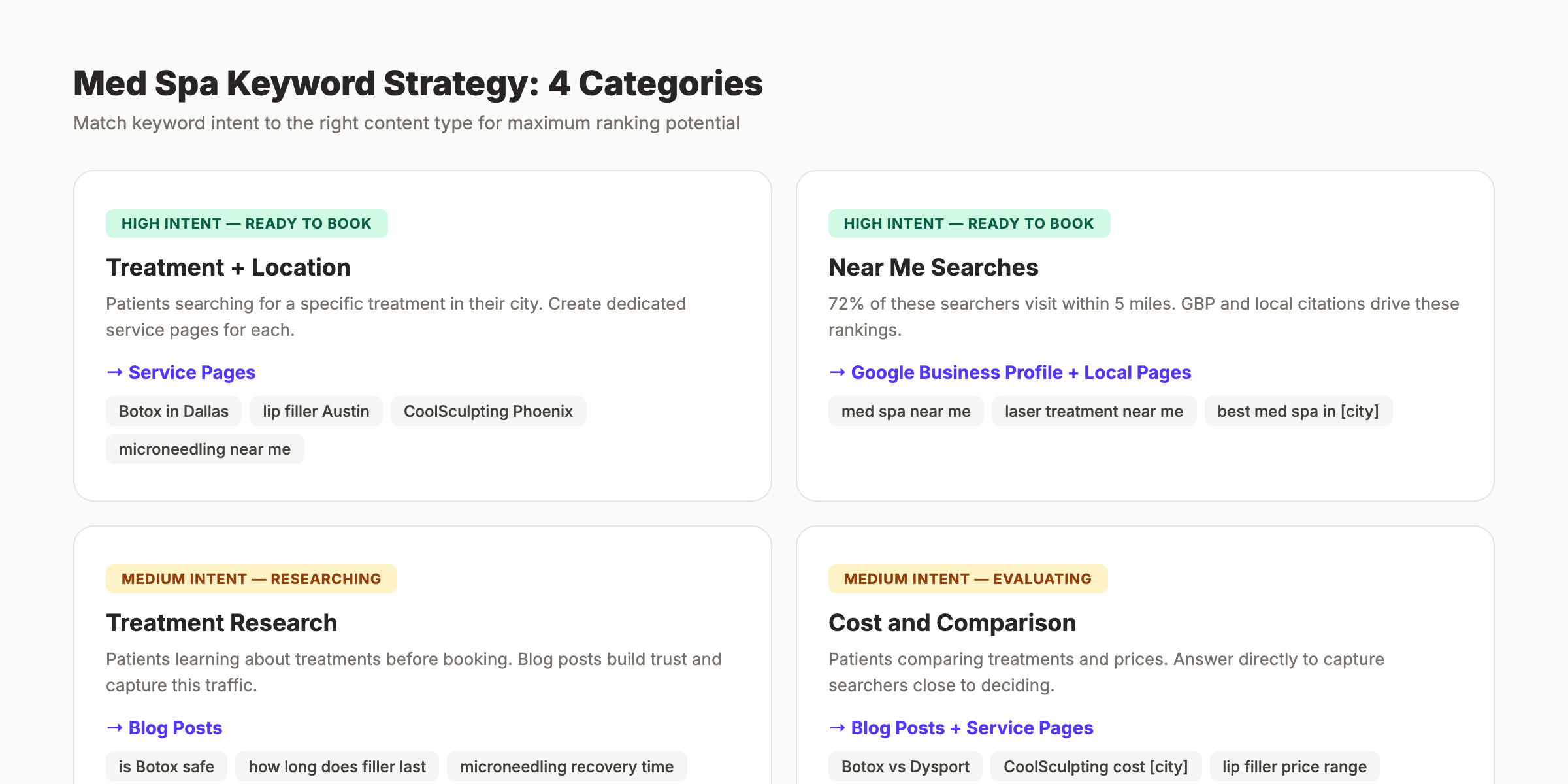
Every med spa keyword falls into 1 of 4 categories. Your content strategy needs all 4.
| Category | Example Keywords | Search Intent | Content Type |
|---|---|---|---|
| Treatment + Location | ”Botox in Dallas,” “lip filler Austin” | High (ready to book) | Service pages |
| Near Me | ”med spa near me,” “laser treatment near me” | High (ready to book) | GBP + local pages |
| Treatment Research | ”is Botox safe,” “how long does filler last” | Medium (considering) | Blog posts |
| Comparison/Cost | ”Botox vs Dysport,” “lip filler cost” | Medium (evaluating) | Blog posts |
High-Value Treatment Keywords
These are the money keywords for med spas. Each one deserves its own dedicated service page.
Injectable treatments:
- Botox + [city]
- Lip filler + [city]
- Dermal fillers + [city]
- Kybella + [city]
- PRP facial + [city]
Body treatments:
- CoolSculpting + [city]
- Body contouring + [city]
- Laser hair removal + [city]
- Cellulite treatment + [city]
Skin treatments:
- Chemical peel + [city]
- Microneedling + [city]
- HydraFacial + [city]
- IPL photofacial + [city]
- Laser skin resurfacing + [city]
Wellness treatments:
- IV therapy + [city]
- Hormone therapy + [city]
- Weight loss injections + [city]
Long-Tail Keywords That Convert
Long-tail keywords have lower volume but higher intent. A patient searching “how much does CoolSculpting cost in Phoenix” is closer to booking than someone searching “body contouring.”
Use Google autocomplete to find these. Type your treatment name and note every suggestion. Each suggestion is a proven keyword with real search volume.
Examples:
- “Botox for forehead lines cost [city]”
- “best lip filler for thin lips [city]”
- “laser hair removal Brazilian [city]”
- “how many units of Botox for crow’s feet”
- “microneedling before and after acne scars”
Target these long-tail keywords in blog posts and FAQ sections on your service pages.
Service Pages: The Foundation of Med Spa SEO
A single “Services” page listing all your treatments is not enough. Each treatment needs its own dedicated page. This is the single most impactful change most med spas can make.
Why Individual Service Pages Win
Google ranks pages, not websites. A page titled “Botox in Dallas” targets that specific keyword. A page titled “Our Services” targets nothing.
Individual service pages also give you:
- A unique URL to rank for each treatment keyword
- Space for treatment-specific content (600+ words)
- A dedicated landing page for Google Ads
- Structured data (schema markup) for each service
- Internal linking opportunities between related treatments
The Ideal Service Page Structure
Every med spa service page should follow this structure:
1. H1 headline with treatment + location Example: “Botox in Dallas, TX | [Med Spa Name]”
2. Opening paragraph (60 to 80 words) What the treatment is, who it is for, and why patients choose your med spa for it. Include the primary keyword in the first sentence.
3. How it works section (H2) Explain the procedure in plain language. Patients want to know what happens during their appointment. Cover preparation, procedure duration, and what to expect.
4. Benefits section (H2) List 5 to 8 specific benefits. Use bullet points. Focus on outcomes patients care about: reduced wrinkles, smoother skin, no downtime, natural-looking results.
5. Ideal candidate section (H2) Who is a good candidate for this treatment. This helps with search intent matching and reduces unqualified inquiries.
6. Before and after gallery (H2) Real patient photos with consent. Before-and-after images build trust and keep visitors on the page longer. Both signals help rankings.
7. Pricing or cost range (H2) Patients search for pricing. If you do not publish it, they leave your site and find someone who does. A price range (“Botox starts at $12 per unit”) is sufficient.
8. FAQ section (H2) Answer the 4 to 6 most common questions about the treatment. Use the exact questions patients ask (from Google autocomplete and “People Also Ask”). FAQ schema markup can earn rich results in search.
9. Call to action A clear booking button or contact form above the fold and at the bottom. Include your phone number for patients who prefer calling.
Minimum Content Length
Each service page needs a minimum of 600 words. The top-ranking med spa service pages average 800 to 1,200 words. More content gives Google more context to understand what the page is about and which queries to rank it for.
Do not pad content with fluff. Every sentence should inform, educate, or move the patient closer to booking.
Local SEO: Ranking in the Map Pack
The Google Map Pack (the 3-pack of local results with a map) appears for nearly every “near me” and location-based med spa search. Ranking in the Map Pack puts your med spa above all organic results.
The 3 Factors Google Uses
Google ranks local results based on 3 factors:
- Relevance — How well your profile matches the search query. Detailed service descriptions and accurate categories improve relevance.
- Distance — How close your med spa is to the searcher. You cannot change your location, but you can target nearby neighborhoods in your content.
- Prominence — How well-known your business is online. Reviews, citations, backlinks, and website authority all contribute to prominence.
NAP Consistency
NAP stands for Name, Address, Phone Number. Your NAP must be identical everywhere it appears online: GBP, website, Yelp, Healthgrades, RealSelf, Facebook, and every other directory.
Inconsistent NAP confuses Google and reduces your local ranking. Use the same format everywhere. If your address is “123 Main St, Suite 200,” do not list it as “123 Main Street #200” on another site.
Build Local Citations
Citations are mentions of your med spa on other websites. The more consistent citations you have, the stronger your local signals.
Priority directories for med spas:
- Google Business Profile
- Yelp
- Healthgrades
- RealSelf
- Zocdoc
- Vitals
- Apple Maps
- Bing Places
- YellowPages
Each directory listing should include your NAP, website URL, business hours, and a description of services. Local citation building is one of the most reliable ways to improve Map Pack rankings.
Your SEO team. $99 per month. 30 optimized articles, published automatically. Built for local service businesses like med spas. Start for $1 →
Reviews: The Ranking Factor You Control
Google reviews directly influence your Map Pack rankings and your conversion rate. 83% of patients check Google reviews before booking a med spa appointment. The med spas with the most reviews and highest ratings win.
How Many Reviews You Need
There is no magic number. But the data is clear: med spas with 50+ Google reviews appear in the Map Pack far more often than those with 10 or fewer. Aim for a consistent flow of new reviews every month.
Review velocity matters more than total count. A med spa that gets 8 new reviews per month outranks one with 200 total reviews but none in the last 3 months. Google values recency.
How to Get More Reviews
The best time to ask for a review is right after a positive experience. Build a system around it.
Review generation checklist:
- Place a QR code at the front desk linking to your Google review page
- Send an automated text or email 24 hours after each appointment
- Train staff to ask satisfied patients for a review before they leave
- Include a review link in your post-treatment follow-up emails
- Respond to every review within 24 to 48 hours
The QR code and automated follow-up combination consistently generates the most reviews. Make it as easy as possible. One tap. No login required.
How to Respond to Reviews
Respond to every review. Positive and negative. Google has confirmed that review responses are a local ranking signal.
For positive reviews: Thank the patient by name (if they shared it). Mention the treatment they received. Invite them back.
For negative reviews: Acknowledge the concern. Apologize for the experience. Offer to resolve it offline. Never argue, get defensive, or share patient details.
Review responses also show prospective patients that you care about the experience. That trust signal influences booking decisions more than most marketing tactics.
For detailed strategies, see our guide on getting more Google reviews for local businesses.
Content Strategy: Blog Posts That Attract Patients
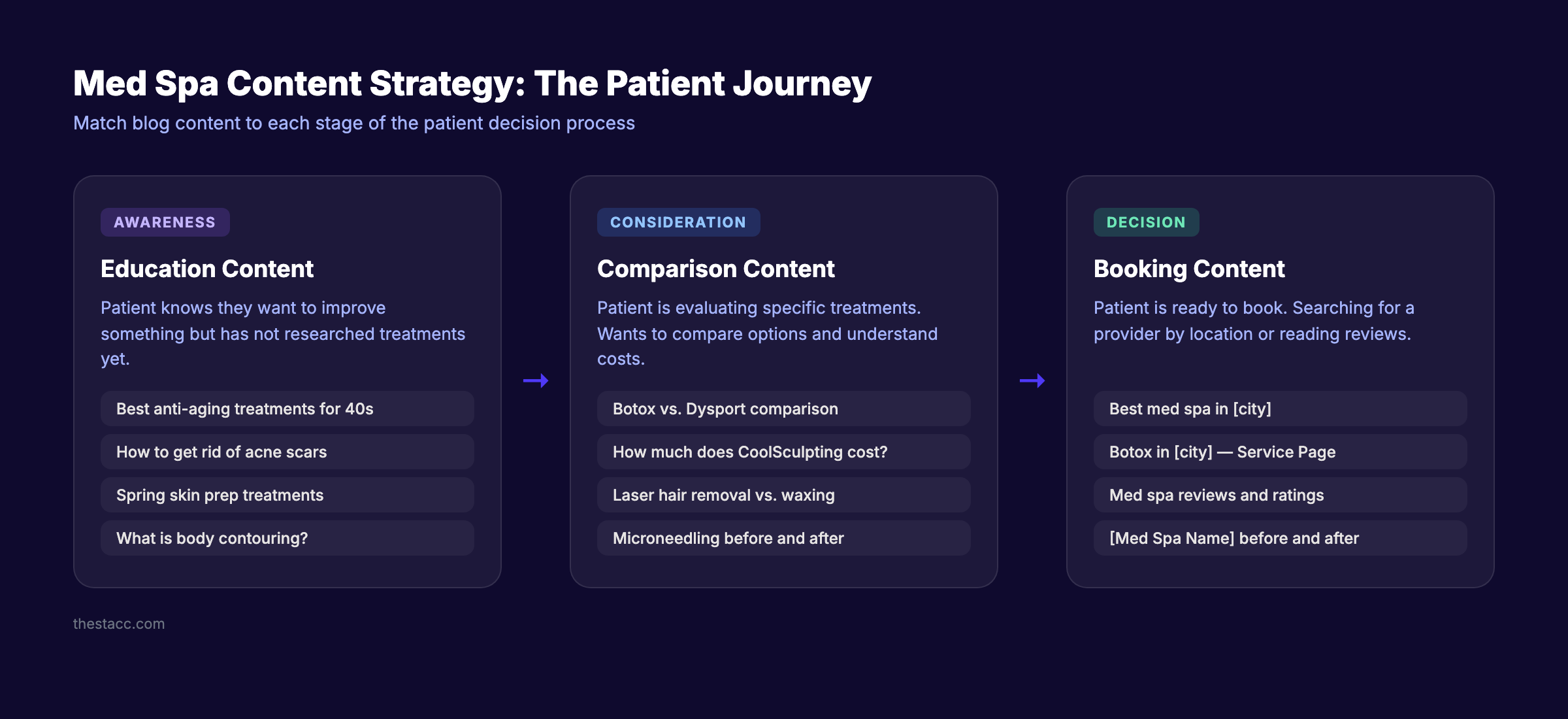
Med spa blog content serves 2 purposes: ranking for informational keywords and building topical authority that strengthens your service pages.
Content Topics That Work
Treatment education posts:
- “What Is Microneedling? Everything You Need to Know”
- “Botox vs. Dysport: Which Is Right for You?”
- “How Long Does Lip Filler Last?”
- “Chemical Peel Recovery: What to Expect Day by Day”
Cost and comparison posts:
- “How Much Does CoolSculpting Cost in [City]?”
- “Laser Hair Removal vs. Waxing: Permanent Results vs. Temporary Fix”
- “Is PRP Worth It? Results, Costs, and What to Expect”
Seasonal and trend posts:
- “Spring Skin Prep: 5 Treatments to Book Before Summer”
- “Best Anti-Aging Treatments for Your 30s, 40s, and 50s”
- “New Med Spa Treatments in 2026: What to Know”
Local content:
- “Best Med Spa in [City]: What to Look For”
- “[City] Med Spa Guide: Treatments, Costs, and What to Expect”
Publishing Frequency
The med spas ranking highest on Google publish 8 to 16 blog posts per month. Most med spas publish 0 to 2. That gap is your opportunity.
Consistent publishing builds topical authority. Google sees a med spa that publishes weekly about skincare, injectables, and body treatments as more authoritative than one with a dormant blog.
You do not need to write every post yourself. A content automation approach lets you publish at volume without hiring a full content team.
Content Structure for Rankings
Every blog post should follow the same SEO structure:
- H1 title with the target keyword
- Opening paragraph that answers the core question in 2 to 3 sentences
- H2 sections breaking the topic into logical subtopics
- Internal links to relevant service pages and other blog posts
- FAQ section with schema markup
- Call to action for booking or consultation
Posts targeting treatment keywords should link to the corresponding service page. A blog post about “Botox recovery timeline” should link to your Botox service page. That internal link passes authority and helps both pages rank.
Technical SEO for Med Spa Websites
Technical SEO ensures Google can crawl, index, and rank your pages. Most med spa websites have fixable issues that hold them back.
Mobile Optimization
Over 70% of med spa searches happen on mobile devices. If your site is not mobile-friendly, you lose both rankings and patients.
Mobile checklist:
- Pages load in under 3 seconds on mobile
- Text is readable without zooming
- Buttons and links are large enough to tap
- Images resize correctly on smaller screens
- No horizontal scrolling required
- Booking forms work on mobile
Use Google PageSpeed Insights to test your site. Fix anything scoring below 80 on mobile. Core Web Vitals are a confirmed ranking factor. Slow pages rank lower.
Schema Markup
Schema markup helps Google understand your content. For med spas, 3 types matter most:
LocalBusiness schema: Tells Google your name, address, phone, hours, and service area. Required for strong local SEO.
MedicalBusiness schema: A more specific type that identifies your business as a healthcare provider. Adds credibility signals.
FAQPage schema: Turns your FAQ sections into rich results in Google search. More SERP real estate means more clicks.
Add schema to every service page and your homepage. Use JSON-LD format. Most website builders support it through plugins or custom code.
Site Structure and Internal Linking
A clean site structure helps Google crawl your pages efficiently.
Recommended med spa site structure:
Homepage
├── Services (hub page)
│   ├── Botox
│   ├── Lip Filler
│   ├── CoolSculpting
│   ├── Microneedling
│   └── [Each treatment]
├── About
├── Before & After Gallery
├── Blog
│   ├── Treatment articles
│   ├── Cost/comparison articles
│   └── Seasonal content
├── Contact / Book Now
└── Locations (if multi-location)
Link related service pages to each other. Link blog posts to relevant service pages. This internal linking structure distributes authority across your site and helps Google understand the relationship between your content.
HTTPS and Security
Your site must use HTTPS. Google flags non-HTTPS sites as “Not Secure.” For a healthcare business handling patient inquiries, that warning destroys trust instantly.
If your site still runs on HTTP, contact your hosting provider. Most offer free SSL certificates through Let’s Encrypt.
3,500+ blogs published. 92% average SEO score. See what Stacc can do for your med spa. Start for $1 →
Tracking Med Spa SEO Results
SEO without measurement is guesswork. Track these metrics monthly to know whether your strategy is working.
Key Metrics to Monitor
| Metric | Tool | What It Tells You |
|---|---|---|
| Organic traffic | Google Analytics 4 | Total visitors from search |
| Keyword rankings | Google Search Console | Which queries your pages rank for |
| Map Pack impressions | GBP Insights | How often you appear in local results |
| GBP actions | GBP Insights | Calls, direction requests, website clicks |
| Review count and rating | Google Business Profile | Trust signals and local ranking factor |
| Conversion rate | GA4 + booking system | Percentage of visitors who book |
| Page load speed | PageSpeed Insights | Technical performance |
Realistic Timeline
Med spa SEO is not instant. Here is what to expect:
Month 1 to 2: Technical fixes, GBP optimization, service page creation. Minimal ranking changes.
Month 3 to 4: New pages start indexing. Long-tail keywords begin ranking. GBP visibility improves with consistent posting and reviews.
Month 5 to 6: Service pages gain traction for treatment keywords. Blog content starts ranking for informational queries. Organic traffic increases 20 to 40%.
Month 7 to 12: Compounding effect. Multiple pages ranking across treatment categories. Map Pack appearances increase. Organic traffic grows 50 to 100%+ from starting point.
The timeline for SEO results varies by competition level in your market. Med spas in smaller cities often see results faster than those in major metros.
Connecting SEO to Revenue
Track which organic landing pages generate the most bookings. If your “CoolSculpting in [city]” page drives 15 consultations per month at a $2,000 average treatment value, that page generates $30,000 in monthly revenue. Compare that to your SEO investment.
Most med spas see 5x to 10x ROI on SEO within 12 months. The key is consistent execution across all the elements covered in this guide.
Common Med Spa SEO Mistakes
Avoid these mistakes. Each one costs rankings and revenue.
1. One page for all services. Every treatment needs its own URL. A single “Services” page cannot rank for Botox, fillers, and CoolSculpting simultaneously.
2. Ignoring Google Business Profile. Your GBP is your most powerful local SEO asset. An incomplete or inactive profile is invisible to local searches.
3. No review strategy. Hoping patients leave reviews does not work. You need a system: QR codes, automated follow-ups, and staff training.
4. Keyword stuffing. Repeating “best med spa in Dallas” 15 times on a page hurts rankings. Write naturally. Use the keyword in the title, first paragraph, 1 H2, and once or twice in the body.
5. Neglecting mobile. Over 70% of your traffic is mobile. If the booking form does not work on a phone, you lose conversions.
6. Publishing nothing. A dormant blog signals an inactive business. Publishing consistently is the single biggest differentiator between med spas that rank and those that do not.
7. No internal links. Service pages and blog posts should link to each other. Without internal links, Google cannot discover and rank all your pages efficiently.
8. Duplicate content across locations. Multi-location med spas often copy the same service page text across locations. Each location page needs unique content specific to that area.
FAQ
How long does med spa SEO take to work?
Most med spas see meaningful ranking improvements within 3 to 6 months. Long-tail keywords and Google Business Profile optimizations often show results within 60 to 90 days. Competitive treatment keywords in major metros take 6 to 12 months.
How much does med spa SEO cost?
SEO agencies charge $1,000 to $5,000 per month for med spa SEO. A DIY approach using the strategies in this guide costs time but not money. Automated content services like Stacc publish 30 optimized articles per month starting at $99.
What are the best keywords for a med spa?
Treatment + location keywords drive the most bookings: “Botox in [city],” “lip filler [city],” “laser hair removal near me.” Layer in informational keywords like “how long does Botox last” and “CoolSculpting results timeline” for blog content.
Does blogging help med spa SEO?
Yes. Med spas publishing 8 to 16 blog posts per month rank significantly higher than those with no blog content. Blog posts target informational keywords, build topical authority, and create internal linking opportunities to service pages.
How do I get my med spa in the Google Map Pack?
Optimize your Google Business Profile with complete information, accurate categories, and weekly posts. Build consistent local citations across directories. Generate a steady flow of new Google reviews. These 3 factors account for over 70% of Map Pack ranking signals.
Should my med spa invest in SEO or paid ads?
Both. Paid ads deliver immediate traffic while SEO builds. SEO delivers compounding returns over time. The best strategy uses paid ads for short-term patient acquisition and SEO for long-term growth. Most successful med spas allocate 60% of their marketing budget to SEO and content after the first 6 months.
Med spa SEO is not a single tactic. It is a system of interconnected elements: GBP optimization, service pages, reviews, content, and technical performance. The med spas dominating local search in 2026 execute all of these consistently.
Start with your Google Business Profile. Build individual service pages. Launch a review system. Publish content weekly. The compounding effect will fill your calendar.
Rank everywhere. Do nothing. Blog SEO, Local SEO, and Social on autopilot. Built for local service businesses. Start for $1 →
Written and published by Stacc. We publish 3,500+ articles per month across 70+ industries. All data verified against public sources as of March 2026.
