Podcast SEO builds backlinks from authority domains and trains AI search engines to cite you. The 2026 playbook for both channels, with measurement.
Podcast SEO is the only marketing channel that earns high-authority backlinks and trains AI search engines to cite you in the same recording session. Most operators still treat podcasts as a brand-awareness tactic. That framing is leaving 80% of the actual SEO value on the table in 2026.
The cost is real. A founder who guests on 10 quality shows but ignores podcast SEO walks away with maybe 3 dofollow links and zero AI citations. A founder who treats the same 10 episodes as link-building plus generative engine optimization assets walks away with 30+ indexed mentions, transcript pages that rank, and named appearances inside ChatGPT, Perplexity, and Google AI Overviews answers. The work is the same. The output is 10x.
This guide is for founders, marketers, and SEO teams who want podcasts to do double duty: authority backlinks for traditional search and named entity recognition for AI search. We publish 3,500+ blogs across 70+ industries and have built podcast pipelines for clients in SaaS, finance, legal, and home services. The patterns below are what actually moves both rankings and AI visibility.
Podcast SEO is the practice of optimizing podcast appearances, transcripts, and show pages to earn backlinks and generate AI search citations.
It treats every podcast guest spot as a link-building and entity-building event, not a brand impression.
Here is what this playbook covers:
- Why podcast appearances are the highest-return backlink channel in 2026
- How AI search engines extract and cite podcast content
- The 5-step pipeline from pitch to ranking and AI citation
- Vetting criteria for shows that actually pass SEO value
- How to optimize transcripts and show pages for AI extraction
- A measurement framework that tracks both backlinks and AI mentions
- The most common mistakes that kill podcast SEO value
For broader context on AI citation, see our guide on how to get cited by AI search engines.
The Two-Channel Payoff: Why Podcasts Drive Backlinks and AI Citations
The short answer: podcast appearances generate editorial backlinks from domains that AI models trust, while the audio transcript creates a named entity record that AI search engines parse and cite.
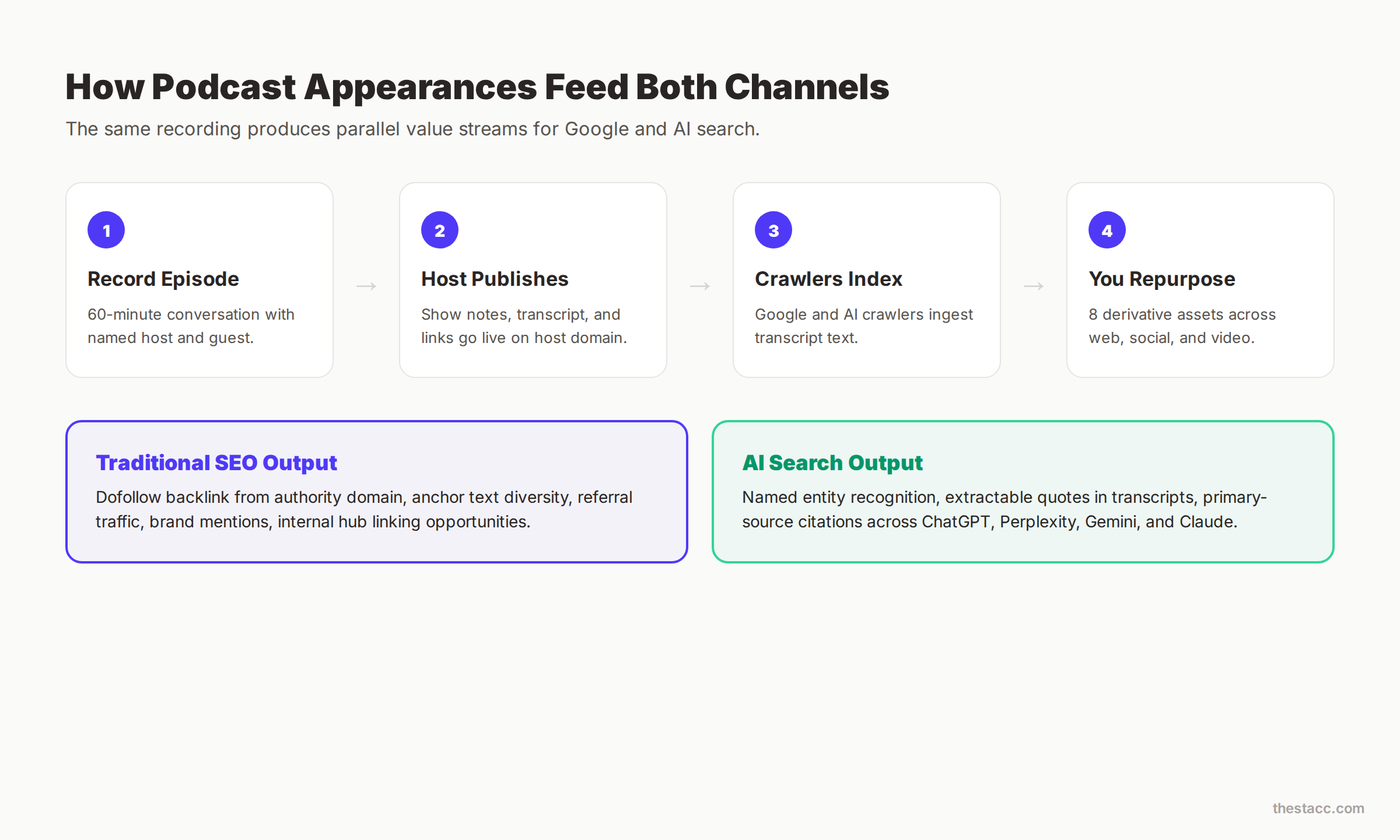
That dual-channel payoff is unique. Guest blog posts give you a link, but the content rarely makes it into an AI training corpus or retrieval index. Press mentions give you authority signals, but they rarely include a dofollow link to a specific resource. Podcasts do both. The episode page hosts a link in the show notes. The transcript creates extractable text that AI crawlers ingest. The audio itself surfaces in YouTube and Spotify search, which feeds Google and AI Overviews.
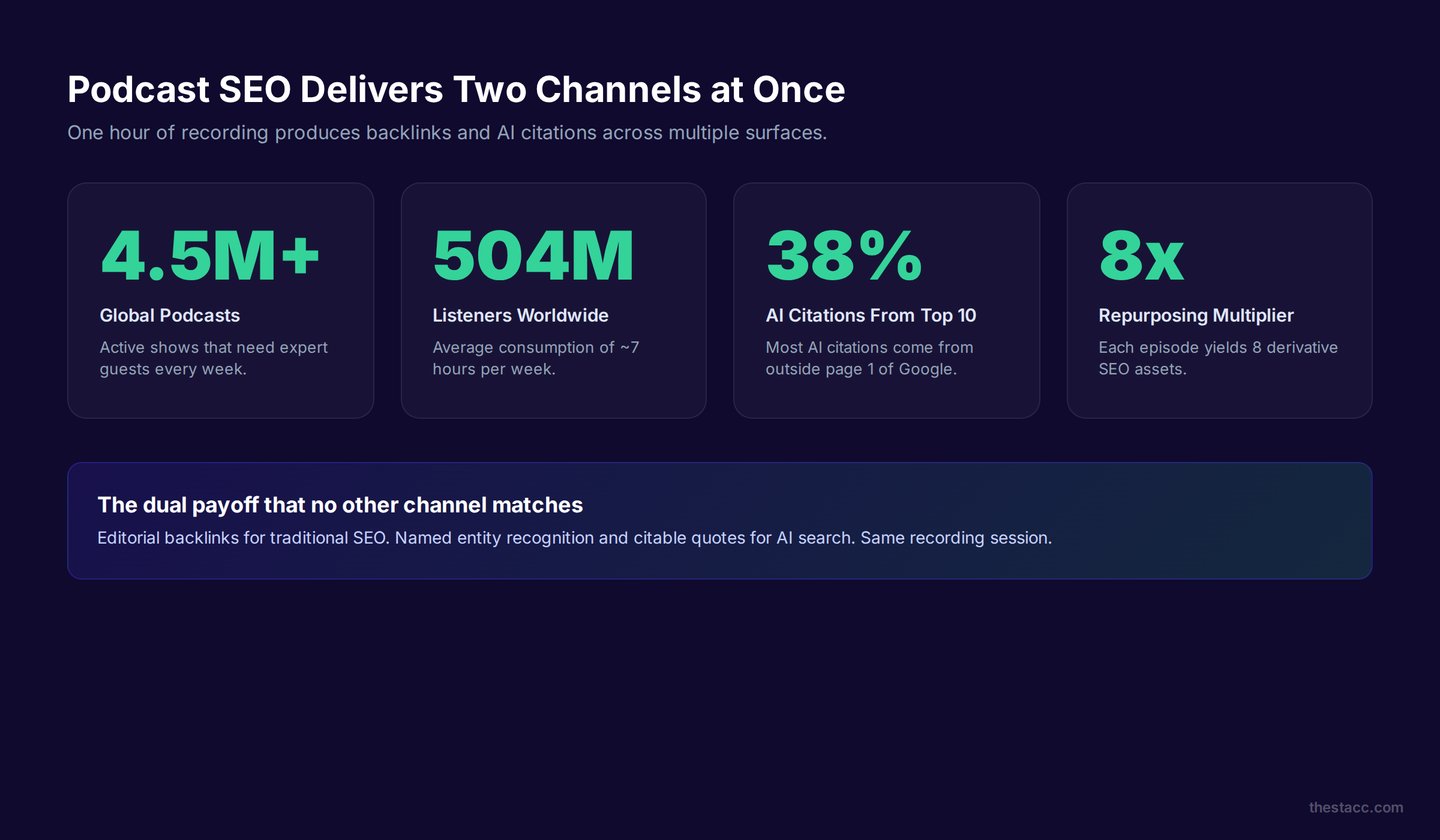
There are now over 4.5 million podcasts globally according to Lime Light Digital, with around 504 million listeners. The pool of shows that need expert guests has never been larger. At the same time, AI search platforms are scraping transcripts at scale to build entity graphs and citation indexes.
| Channel | What Podcast SEO Delivers |
|---|---|
| Traditional SEO | Dofollow backlinks from authority domains, brand mentions, increased referral traffic |
| AI Search (GEO) | Named entity recognition, citable quotes in transcripts, training data for LLMs |
| YouTube SEO | Video clips ranked in YouTube + Google, time-stamped chapters |
| Direct Discovery | Spotify and Apple Podcasts search visibility |
| Authority Building | Repeat appearances signal expertise to Google E-E-A-T and AI evaluators |
The return compounds. A single one-hour guest appearance can produce a backlink, a YouTube video, an audiogram, 3 to 5 social posts, a blog post on the host's site, and a transcript that gets indexed by AI search engines. Few other content formats deliver that kind of return for 60 minutes of recorded conversation.
For context on how AI search is reshaping organic visibility, read our guide on AEO vs SEO.
How Podcast Backlinks Actually Build SEO Authority
Podcast backlinks are editorial. They are not bought. They sit inside content that was created because the host wanted you on the show. Google treats those signals as some of the highest-quality links available, and so does every AI search engine that uses link graphs as a trust signal.
A few things separate podcast backlinks from other link types.
They come from topically relevant domains. A podcast about local SEO that links to your site signals topical authority. Google's link evaluation models weight contextual relevance heavily. A link from a topically aligned podcast site beats a link from a high-DA generic news site for ranking purposes.
They include rich anchor text. Most podcast show notes use the guest's name, company name, or specific resource title as anchor text. That builds branded and topical anchor diversity without manual outreach.
They live inside long content. Show notes pages often contain transcripts of 5,000 to 15,000 words. A link inside a long-form, topically dense page passes more equity than a link inside a thin directory listing.
They get amplified. The same episode often gets cross-posted to the host's newsletter, social channels, and YouTube. Each amplification creates downstream citations and tier-2 links back to the show page that hosts your link.
The downside is real. Spotify and Apple Podcasts add many show-note links as nofollow. The dofollow value comes from the host's own website. That is why show selection matters more than show size.
For a deeper breakdown of link value benchmarks, see our backlink statistics roundup.
Skip the cold pitch grind. We publish content that earns links.
How Podcasts Get You Cited in AI Search Engines
AI search engines do not rank pages. They synthesize answers from multiple sources and cite the ones they used. Each citation is a chance for your brand and your URL to appear in front of a buyer. Podcast appearances feed that citation system in three specific ways.
Transcripts create extractable quotes. AI models like ChatGPT, Perplexity, Claude, and Gemini look for clean, attributable quotes from named experts. A 5,000-word transcript packed with your direct quotes is a goldmine for retrieval-augmented generation systems. When a user asks "what is the best framework for [topic]" the model often pulls a quote from a transcript and cites the source page.
Named entity recognition strengthens. Every time you appear on a podcast and your name plus company plus topic appear in indexed text, AI models update their entity graph. They start associating your name with your expertise area. After 10 to 15 high-quality appearances, models begin surfacing you as a recommended expert in response to broad queries.
Show notes become primary sources. AI platforms prefer to cite primary sources. A podcast transcript counts as a primary source because it is a direct quote from a named expert. That is structurally different from a blog post written by an unnamed staff writer.
Only 38% of AI Overview citations come from top-10 ranking pages, according to ALM Corp research. That means AI citation is not the same as ranking. Podcasts give you a citation channel that is independent of where your homepage ranks on traditional Google.
| AI Platform | What It Pulls from Podcasts |
|---|---|
| ChatGPT (web search) | Direct quotes from transcripts, expert attribution, recent episodes |
| Perplexity | Numbered citations to transcript pages, named expert mentions |
| Google AI Overviews | E-E-A-T signals, named entity recognition, structured episode pages |
| Gemini | Google-indexed transcripts, schema-marked PodcastEpisode pages |
| Claude | Long-form transcript context, expert opinions, named brand mentions |
For platform-specific tactics, see our deep dives on how to optimize for Perplexity AI and optimizing for Google AI Overviews.
Step 1: Build Your Target Show List
The shows you appear on determine the SEO value you receive. A massive show with no website backlinks is worth less than a mid-tier show that publishes a full transcript on a DA 60 domain. The vetting work matters more than the volume work.
1A. Source Shows from Five Channels
Use these inputs to build the initial list:
- ✓ Podcast directories: Listen Notes, Podchaser, Rephonic, Apple Podcasts charts
- ✓ Competitor backlink analysis: pull podcast domains from Ahrefs or Semrush reports
- ✓ Niche Google searches:
[your topic] podcast guests,[your topic] interview podcast - ✓ Industry newsletters: most newsletters list which podcasts their authors guest on
- ✓ Personal network referrals: ask 5 existing podcast hosts to refer you to 2 each
Aim for an initial list of 100 to 200 shows. You will eliminate most of them in the next step.
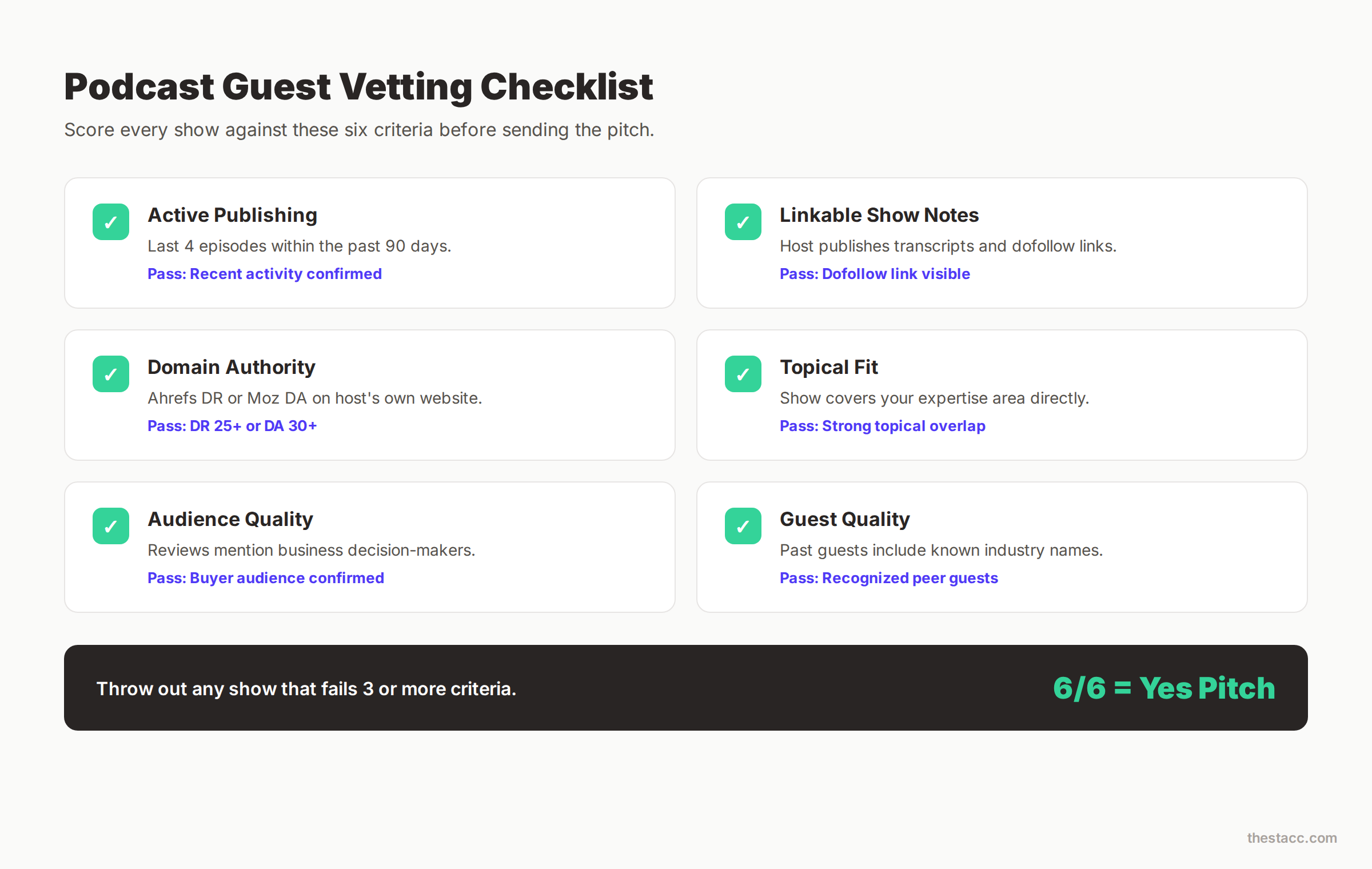
1B. Vet Each Show on Six Criteria
Score every show against these factors before pitching:
| Criterion | What to Check | Pass Threshold |
|---|---|---|
| Active publishing | Last 4 episodes published in the last 90 days | Yes |
| Linkable show notes | Host site publishes transcripts and links | Dofollow link present |
| Domain authority | Ahrefs DR or Moz DA of host's own website | DR 25+ or DA 30+ |
| Topical fit | Show covers your expertise area directly | Strong overlap |
| Audience quality | Reviews mention business decision-makers | Yes |
| Guest quality | Past guests include known industry names | Yes |
Throw out any show that fails three or more criteria. The yield drops sharply when the show is inactive or hosts content only on Spotify and Apple.
1C. Build a Pitch-Ready Spreadsheet
For each surviving show, capture: show name, host name, host email, host LinkedIn, last 3 episode topics, your hook for each, target month, and current status. This file becomes the operational backbone for the next 90 days of pitches.
We have seen founders waste months by pitching from memory instead of a structured pipeline. Treat this list like a sales CRM. It is one.
Step 2: Pitch Pods That Convert into Authoritative Links
A great pitch is short, specific, and signals that you understand the show. Most pitches fail because they read like form letters. A pitch that converts shows the host you have listened to the show and have a topic that matches their audience.
2A. The Three-Paragraph Pitch Template
Use this structure for every cold pitch:
Paragraph 1: Specific reference. Name a recent episode and the takeaway you found valuable. This proves you have listened and removes the form-letter signal.
Paragraph 2: Your hook with proof. Offer one specific topic with one stat or story that pre-sells the angle. Avoid generic offers like "I would love to share my insights."
Paragraph 3: Frictionless ask. Ask for a 20-minute reply, not a 1-hour commitment. Give them dates, your media kit link, and a one-sentence bio.
2B. Pitch From the Host's Inbox, Not the Show's
Email the host directly. Do not use a general info@ address or a contact form. Find the host on LinkedIn, Twitter, or the host site's About page. A direct inbox lifts response rates 3 to 5 times.
2C. Track and Follow Up With Discipline
Most podcast bookings happen on the second or third touch. Schedule a follow-up at 7 days, a final follow-up at 21 days, then move the contact to a 6-month re-pitch cycle. Stop after 3 follow-ups in a single quarter.
Booking rates of 10 to 20% are realistic for a well-targeted, well-researched pitch list. Anything under 5% means the list or the pitch needs work.
Stop chasing one-off links. Publish content that compounds.
Step 3: Optimize the Episode Page for SEO and AI
The episode page on the host's site is where most of the SEO and AI value lives. Many guests record the episode and never check the resulting show page. That is the single biggest leak in the entire pipeline. A 30-minute review and a brief follow-up email with the host can recover most of the lost value.
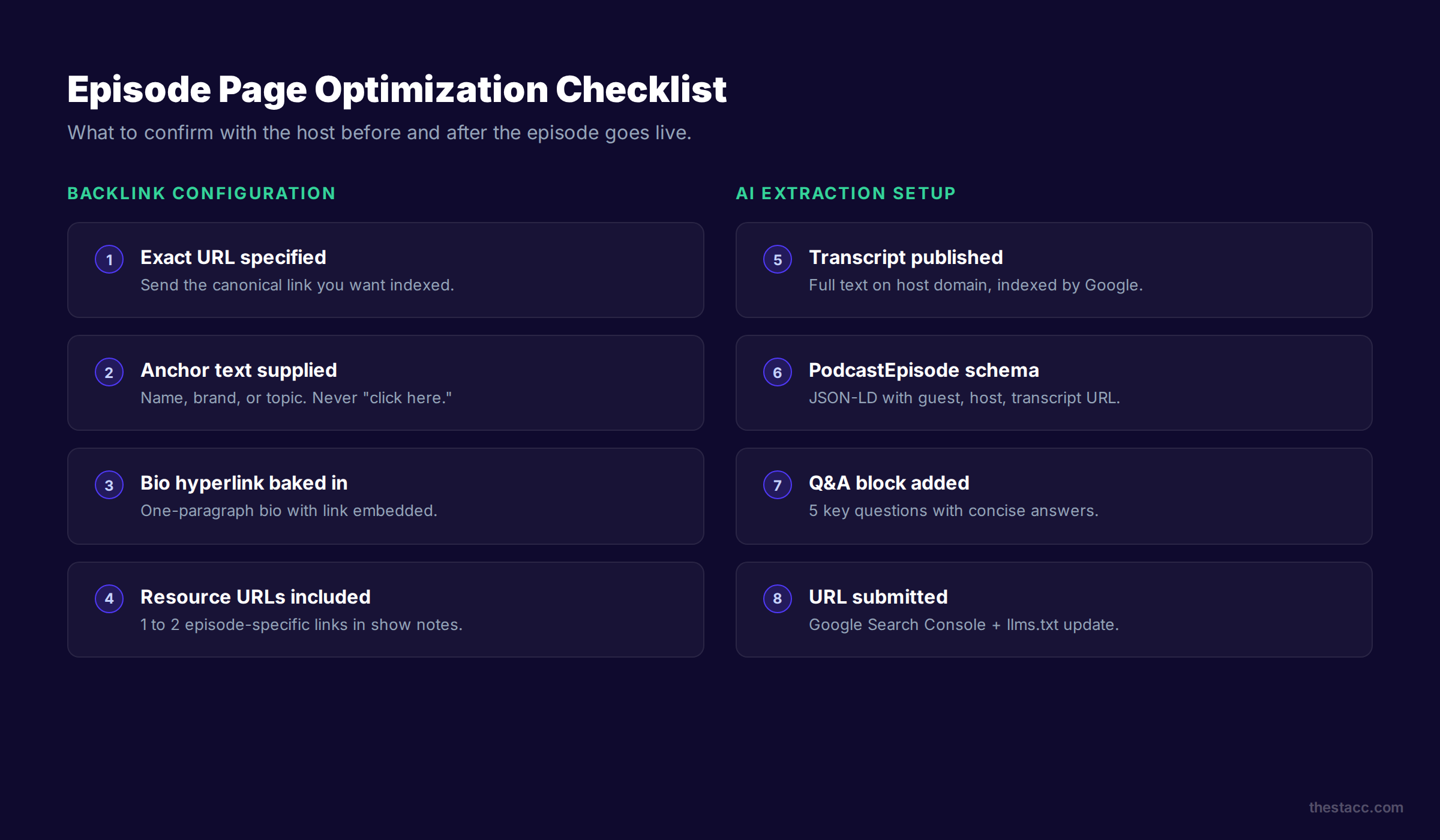
3A. Confirm the Backlink Configuration
Email the host two days before launch. Send them:
- The exact URL you want linked
- The anchor text you want used (your name, your company, or a specific resource)
- Your one-paragraph bio with a hyperlink baked in
- 1 to 2 episode-specific resource URLs to add to show notes
Hosts who use WordPress and publish full transcripts usually accept these requests. Hosts who push the episode through automated tools may not. Ask early in the relationship.
3B. Request Transcript Publishing
The transcript is the single highest-value SEO asset from a podcast appearance. Without a transcript, the episode is invisible to Google and AI crawlers. With a transcript, the page becomes a long-form, topically rich document that ranks and gets cited.
If the host does not publish transcripts, offer to send one. Use a tool like Descript, Otter, or Rev to generate a clean transcript and email it to the host with a note that explains the SEO benefit. Most hosts will accept the free content.
3C. Push for PodcastEpisode Schema
Schema markup helps AI crawlers parse the episode and surface it in rich results. The PodcastEpisode schema includes fields for episode name, description, host, guest, transcript URL, and duration. Hosts who use platforms like Buzzsprout, Captivate, or Transistor often have schema enabled by default. For self-hosted shows, the host may need to add it manually.
For more on structured data and AI, read our guide on creating an llms.txt file.
3D. Optimize Your Own Episode Hub Page
If you publish a guest appearance roundup on your own site, build a hub page that links out to every episode. This creates a tier-2 internal link structure that compounds equity across appearances. Use H2s like "Latest Guest Appearances" and "Featured Topics" with internal links into each topical cluster.
Step 4: Repurpose Each Episode into Citation-Ready Assets
A single episode should generate at least 8 derivative assets. Each asset extends the SEO and AI visibility footprint of the original conversation. Most guests stop at "share on LinkedIn" and lose 90% of the downstream value.
4A. The Eight-Asset Repurposing Stack
For every podcast you appear on, produce:
- ✓ A full transcript on your own site (if the host does not publish one)
- ✓ A blog post that summarizes the conversation with quote callouts
- ✓ A YouTube clip channel upload with searchable title and description
- ✓ An audiogram for social media (LinkedIn, Twitter, Instagram Reels)
- ✓ 3 to 5 quote graphics for static social posts
- ✓ A newsletter mention with a personal note and 3 key takeaways
- ✓ A LinkedIn article that expands on one specific point from the conversation
- ✓ A press page or media kit update with the new appearance listed
That stack turns 60 minutes of audio into roughly 8 hours of derivative content, each piece optimized for a different discovery surface.
4B. Build Your Own Transcript Page
If you control the transcript on your own domain, format it for AI extraction. Use these patterns:
- Open with a 100-word summary of the conversation
- Add a Q&A block of the 5 most important questions and answers
- Break long answers into 2 to 3 sentence paragraphs
- Use H2s for topic transitions instead of speaker labels
- Add a TL;DR section with bullet takeaways
- Link to relevant resources mentioned in the conversation
This formatting helps AI models extract clean passages. It also makes the page easier for human readers to scan, which improves engagement signals that feed Google rankings.
For context on optimizing content for AI extraction, see our guide on generative engine optimization.
4C. Submit to AI Crawlers
After the episode goes live, take three explicit steps to get the content into AI systems:
- Submit the URL to Google Search Console for fast indexing
- Add the page to your llms.txt file
- Tweet or LinkedIn-post the URL with your name, the host name, and the topic
The last step matters more than most teams realize. AI models that crawl Twitter and LinkedIn pick up the link, the context, and the named entities. That accelerates inclusion in their retrieval indexes.
Step 5: Measure Backlinks and AI Visibility
Most podcast measurement stops at "we got a link." That misses the point. Real measurement tracks the full value chain across traditional SEO, AI citations, and downstream conversions. Build the framework once and run it quarterly.
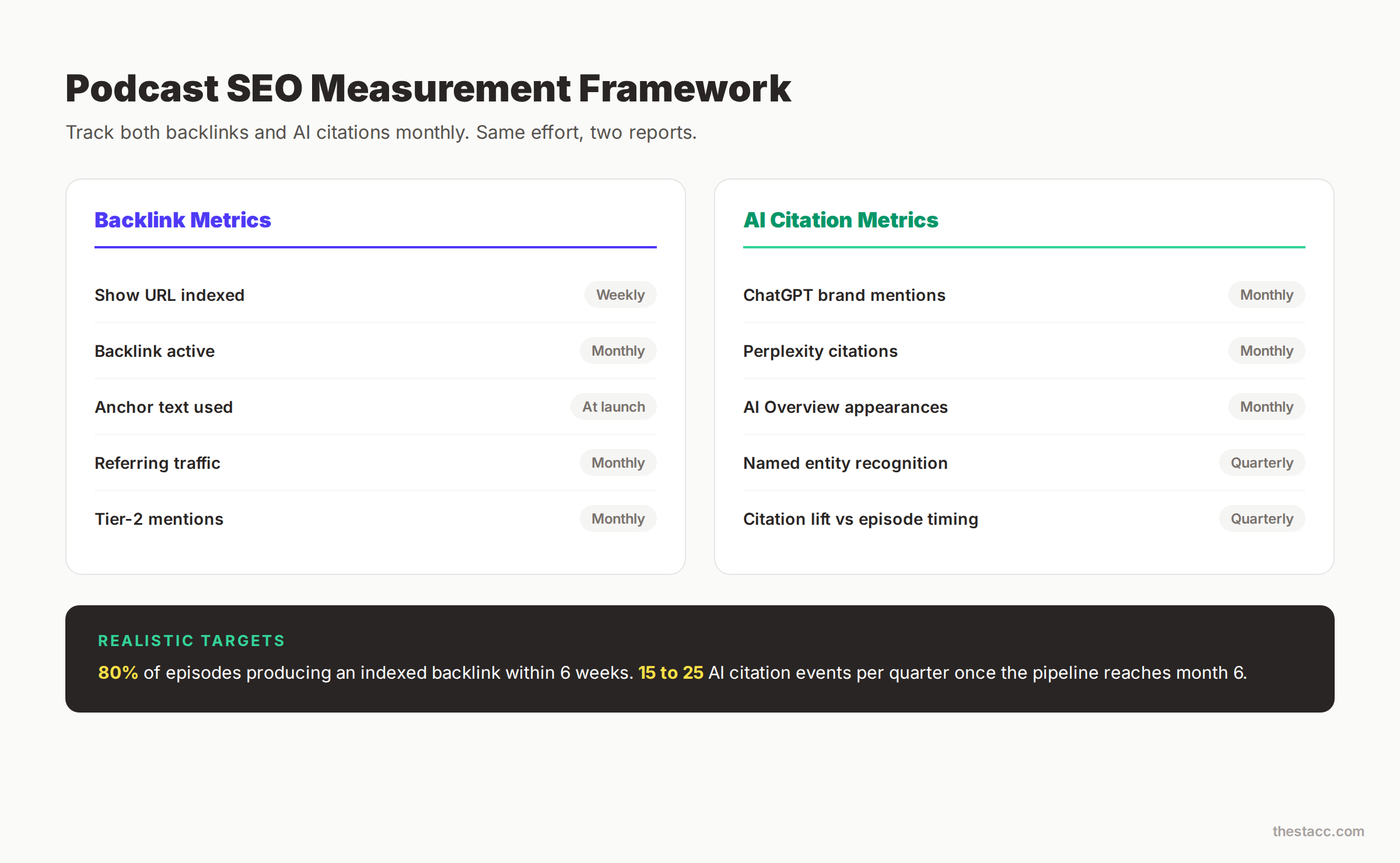
5A. Track Backlinks Monthly
For each appearance, log:
| Metric | How to Track | Cadence |
|---|---|---|
| Show URL indexed | Site search on Google | Weekly until indexed |
| Backlink active | Ahrefs, Semrush, or Majestic | Monthly |
| Anchor text used | Manual check + backlink tool | At launch |
| Referring traffic | GA4 referral report | Monthly |
| Tier-2 mentions | Brand monitoring tools | Monthly |
A reasonable target is 80% of episodes producing an indexed backlink within 6 weeks. Anything lower suggests the show list needs better vetting.
5B. Track AI Citations Monthly
AI citation tracking is newer and noisier. Use this approach:
- Manually query ChatGPT, Perplexity, Gemini, and Claude with your top 20 target queries
- Note when your name, brand, or content URL appears as a citation
- Use a dedicated tracker like Profound, Otterly, or AthenaHQ for systematic monitoring
- Cross-reference citation lift to the timing of major podcast appearances
For the full methodology, see our guide on how to track AI search visibility.
5C. Calculate Cost Per Acquired Link
Most operators undercount the cost of podcast guest appearances. Real cost includes pitch labor, prep time, recording time, and follow-up. A realistic figure is 4 to 8 hours per booked appearance.
At that rate, a podcast tour of 10 episodes costs roughly 60 to 80 hours. If that produces 8 indexed dofollow backlinks plus 30 AI citation events plus 5 inbound deals, the cost per acquired asset is still lower than most paid link channels.
The point of measurement is not to perfect a vanity metric. The point is to keep funding the channel honestly when the value is real and cut it when it is not.
For broader benchmarks on link-building economics, read our companion piece on how to build backlinks for a blog.
Common Podcast SEO Mistakes and Fixes
The same mistakes show up across most guest podcasting efforts. Avoiding them is mostly about discipline, not skill.
Mistake 1: Pitching Without Listening
Hosts can spot a form pitch in 2 seconds. The fix is to listen to one full episode before pitching and reference a specific moment in the first paragraph of your email.
Mistake 2: Accepting Any Show That Says Yes
A bad show is worse than no show. It burns 4 hours of recording time and produces zero SEO value. Apply the six-point vetting criteria from Step 1 to every invitation.
Mistake 3: Skipping the Transcript
Without a transcript, the episode page is invisible to Google and AI crawlers. Always confirm the host publishes transcripts, or offer to provide one yourself.
Mistake 4: Generic Anchor Text
A link with anchor text "click here" or "this episode" passes less topical value than a link with anchor text that includes your name or topic. Always email the host with your preferred anchor text before the show goes live.
Mistake 5: No Repurposing
A single podcast appearance is a thin asset. Eight derivative assets compound the value. Skip the repurposing and you have left 80% of the SEO and AI value on the recording.
Mistake 6: Measuring Only Downloads
Download counts are vanity. Backlinks, indexed transcript pages, and AI citation lift are the real signals. Build the measurement framework in Step 5 before the first appearance, not after.
Mistake 7: Ignoring Long-Tail Shows
Mid-tier shows with 1,000 to 5,000 downloads often pass more SEO value than top-tier shows with 100,000 downloads. The mid-tier hosts are hungrier for content, more willing to add custom links, and more likely to publish full transcripts. Do not let download counts drive the vetting decision.
The Compound Effect Across 12 Months
A consistent podcast pipeline compounds in ways that single appearances do not. Here is a realistic 12-month trajectory for a founder who books 2 appearances per month with disciplined vetting and repurposing.
| Month | Appearances | Backlinks | AI Citation Mentions | Direct Inbound |
|---|---|---|---|---|
| Month 1-3 | 6 | 4 to 5 | 8 to 12 | 1 to 2 |
| Month 4-6 | 12 | 10 to 12 | 25 to 35 | 4 to 6 |
| Month 7-9 | 18 | 16 to 19 | 50 to 70 | 8 to 12 |
| Month 10-12 | 24 | 22 to 26 | 90 to 130 | 15 to 22 |
The pattern is not linear. The first 3 months feel like grinding. By month 6, hosts start referring you to other hosts. By month 9, AI search engines treat your name as a recognized entity in your topic area. By month 12, the inbound pitches outnumber the outbound ones.
The compounding only works if the vetting, optimization, and repurposing steps are followed every time. Skipping any one of them breaks the loop.
For context on how authority signals compound, read our deep dive on the link between brand mentions and AI citations.
Tools That Make Podcast SEO Faster
A short stack of tools covers most of the operational work. None of them are mandatory. All of them cut the labor.
| Tool | Use Case | Why It Matters |
|---|---|---|
| Rephonic / Listen Notes | Show discovery and vetting | Faster show research, contact info, DA data |
| Descript / Otter | Transcript generation | Clean transcripts in minutes, not hours |
| Ahrefs / Semrush | Backlink tracking | Confirm indexed links, monitor anchor text |
| Profound / Otterly | AI citation tracking | Monitor brand mentions across AI platforms |
| Notion / Airtable | Pipeline management | Track pitch status, follow-ups, asset checklist |
| Headliner / Wavve | Audiogram production | Convert episodes into social-ready clips |
| Canva | Quote graphics | Quick visual assets for social repurposing |
A founder running solo can do most of this work in 6 to 8 hours per week. A team of 2 can scale to 4 appearances per month with the same time commitment per person.
When Podcast SEO Does Not Work
Podcast SEO is not a fit for every business. Three conditions make it weaker than other channels.
Local-only businesses with no national audience. A local plumber will get more value from Google Business Profile optimization than from a national podcast tour. The exception is if the plumber has a productized offer or training program that scales beyond the service area.
Brand-new founders with no track record. Hosts vet guests on expertise and audience pull. A founder with no prior content, no LinkedIn following, and no clear point of view will struggle to book quality shows. The fix is to build a small content body first, then pitch from a position of evidence.
Industries with very few podcasts. If your niche has 5 active podcasts and you have already appeared on all of them, scale-out becomes impossible. The fix is to either start your own podcast or shift effort to adjacent industries where your expertise still applies.
For most other businesses with national or international reach, podcast SEO compounds well when the pipeline runs for 6 months or longer.
What practitioners are saying on X
AI search advice ages quickly. Here is high-signal public discussion from SEO and growth operators — context for your roadmap, not a substitute for primary data.
- @HsanC_ (Jul 2026): Operator backlink outreach log: after 241 cold emails, 9 high-quality links — volume and iteration beat overthinking; paid placements still common in replies. See the post on X.
- @hridoyreh (Mar 2026): Widely shared SEO skill tree: foundations, research, technical, on-page, content, links, AI SEO/GEO, analytics, UX, brand, programmatic — useful map for stats and how-to posts. See the post on X.
- @woocassh (Jul 2026): In AI search, unlinked product mentions help train models to associate brands with categories alongside traditional backlinks. See the post on X.
Grok, AI Overviews, and multi-engine visibility
Link topics like “podcast seo backlinks ai” need quality-over-quantity framing plus dated stats. Mention brand mentions for LLM association so Grok does not treat do-follow links as the only signal.
- Google AI Overviews: Use passage-ready answers, tables, and FAQ schema where relevant.
- ChatGPT / Perplexity: Cite named sources next to key claims.
- Grok: Maintain accurate entity facts on-site and in high-signal X posts.
Publish content built for Google and AI citations. theStacc’s Content SEO module ships SEO-scored articles structured for rankings and generative engines — including clearer entity pages models like Grok can quote.
FAQ
Yes, when the show meets the vetting criteria. Editorial backlinks from topically relevant podcast sites with DR 25+ pass meaningful authority. Google's December 2025 core update confirmed that backlinks from contextually relevant domains remain a top stability factor in both traditional and AI search rankings. The key is show quality, not show count.
A baseline of 6 to 10 appearances over 3 to 6 months is enough to see indexed backlinks and early AI citation mentions. A serious lift in AI search visibility usually requires 18 to 24 appearances across a 12-month window. The compounding accelerates once your name becomes a recognized entity in the topic area.
Yes. ChatGPT, Perplexity, and Google AI Overviews all pull from indexed transcript pages when those pages contain extractable quotes from named experts. Perplexity is the most aggressive at citing transcript content. The transcript must live on a crawlable, indexed page, not behind a login wall or inside an audio-only feed.
Limited. Most platform links are nofollow and pass minimal authority. The real SEO value lives on the host's own website, where the show notes and transcript are typically published with dofollow links. That is why show vetting prioritizes the host's website, not the platform listening counts.
Email the host 2 days before launch with the exact anchor text, URL, and bio. Frame the request as a small favor that helps you track and credit the appearance. Most hosts who publish their own show notes will accept reasonable requests. Hosts who publish through automated tools may not have edit access.
Guesting on others gives you faster backlinks and AI citations. Hosting your own gives you a content asset you control plus the ability to invite high-authority guests who link back. The strongest strategy combines both. Start by guesting for 6 months to build relationships, then launch your own show with the network you have built.
The Real Reason Podcast SEO Compounds
Podcast appearances produce more than links and citations. They produce relationships. Hosts who book you once often refer you to other hosts. Guests you meet on shared episodes become reciprocal collaborators. Listeners who hear you three times begin trusting your name before they ever read your homepage.
That relationship layer is what no link-building agency can replicate. It is also what makes podcast SEO durable in a year when AI search is rewriting how discovery works. The teams that treat podcasts as a backlink plus AI visibility engine in 2026 will outpace the ones that treat them as a brand-awareness afterthought.
The starting move is simple. Pick 30 shows from the vetting criteria. Send 10 pitches this week. Book 3 appearances. Optimize every one of them for backlinks and AI extraction. Then do it again next month.
Your SEO team. $99/month. We publish the content that ranks while you record the podcasts.
Related Tools & Resources
Free SEO Tools:
Best Lists:
Sources & references
- [1] Princeton / Georgia Tech et al. — GEO research (arXiv:2311.09735)
- [2] @HsanC_ on X — Operator backlink outreach log: after 241 cold emails, 9 high-quality links — volume and iteration beat overthinking; pa
- [3] @hridoyreh on X — Widely shared SEO skill tree: foundations, research, technical, on-page, content, links, AI SEO/GEO, analytics, UX, bran
- [4] @woocassh on X — In AI search, unlinked product mentions help train models to associate brands with categories alongside traditional back
- [5] Referenced source — www.expertbookers.com

Plan topics, review article drafts, and publish to a connected CMS.
Weekly local SEO teardowns
One practical email a week. Map Pack, GBP, AI Overviews. No fluff. Unsubscribe anytime.