How to get cited by ChatGPT, Perplexity and AI Overviews: the structure, entities, sources and formatting that generative engines reuse in answers.
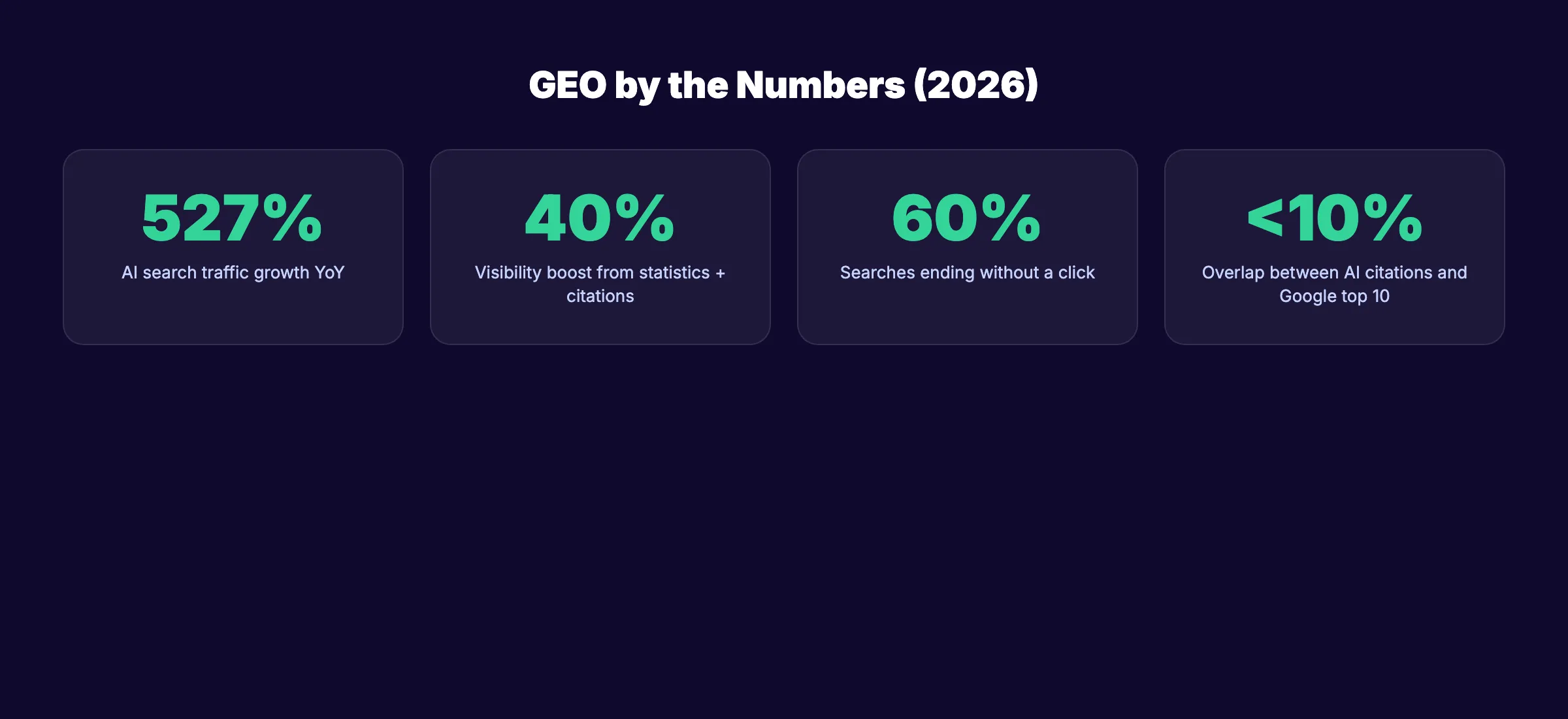
AI search engines now answer questions directly. They cite your content, summarize it, or ignore it entirely. If your pages are not optimized for generative engines, you are invisible to a segment of searchers that grew 527% year-over-year between 2024 and 2025.
Generative engine optimization (GEO) is the practice of optimizing content so AI platforms cite and recommend it. ChatGPT has 883 million monthly users. Google AI Overviews reach 1.5 billion. The GEO market hit $848 million in 2025 and is projected to reach $33.7 billion by 2034 at a 50.5% CAGR.
This guide covers every GEO tactic backed by peer-reviewed research and real citation data. We publish 3,500+ articles across 70+ industries with a 92% average SEO score. We optimize every piece for both traditional search and AI engines.
Here is what you will learn:
- What generative engine optimization is and how it differs from SEO
- The Princeton research proving which GEO tactics boost visibility by 40%
- Platform-specific strategies for ChatGPT, Perplexity, and AI Overviews
- Why brand mentions outperform backlinks 3:1 for AI visibility
- How to audit and score your pages for GEO readiness
- How to measure success when clicks are not the metric
Chapter 1: What Is Generative Engine Optimization
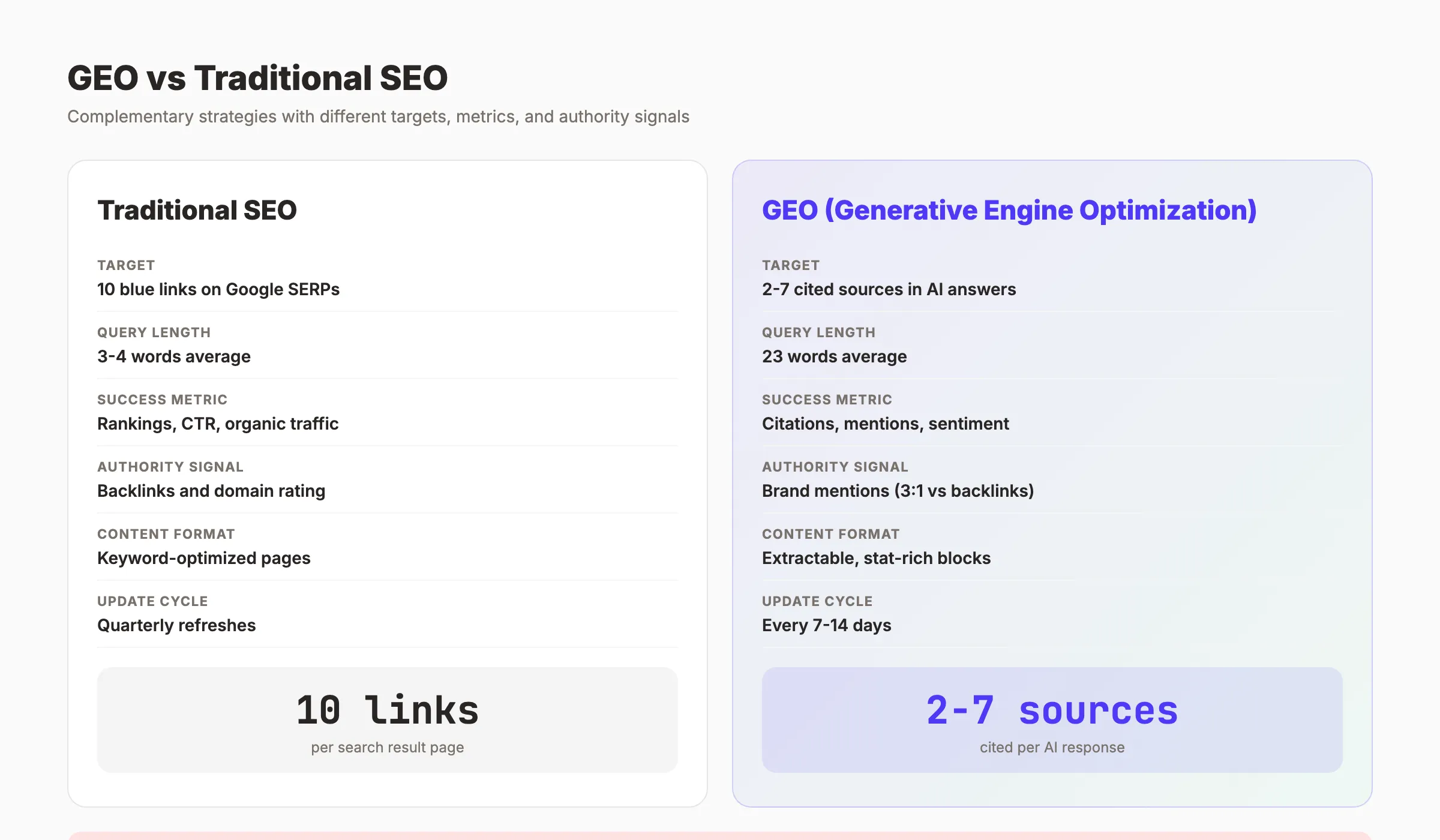
Generative engine optimization is the practice of optimizing your content so AI search platforms retrieve, cite, and recommend it when answering user queries. Where traditional SEO targets a spot among 10 blue links, GEO targets a place among the 2 to 7 sources AI engines cite in a single response.
The term originates from a 2023 research paper by Princeton University, Georgia Tech, IIT Delhi, and the Allen Institute for AI. That paper tested 9 optimization methods across 10,000 queries and found that specific content techniques boost AI citation rates by up to 40%.
How Generative Engines Work
When a user asks an AI engine a question, the engine breaks it into roughly 20 sub-queries. It crawls, retrieves, and synthesizes information from multiple sources into one answer. The engine decides which sources to cite based on content quality, structure, freshness, and authority.
Your content is either part of that answer or it is not. There is no position 7. There is no page 2. You are cited or you are invisible.
GEO vs Traditional SEO
GEO and SEO are complementary disciplines with different targets. The most critical insight: fewer than 10% of sources cited by AI engines rank in Google's top 10 for the same query.
| Factor | Traditional SEO | GEO |
|---|---|---|
| Target | Search engine result pages (10 blue links) | AI-generated responses (2-7 cited sources) |
| Query length | 3-4 word average | 23 word average |
| Success metric | Rankings, CTR, organic traffic | Citations, mentions, brand sentiment |
| Content format | Keyword-optimized pages | Extractable, stat-rich content blocks |
| Authority signal | Backlinks and domain rating | Brand mentions (3:1 advantage over backlinks) |
| Measurement | Google Search Console, rank trackers | AI visibility tools (Otterly, Profound) |
| Click model | Drives clicks to website | 93% of sessions end without a click |
Strong SEO rankings do not guarantee AI citations. You need both strategies working in parallel.
Why GEO Matters in 2026
Three forces make GEO critical right now.
AI search usage is exploding. Gartner predicts traditional search volume will drop 25% by end of 2026 and 50% by 2028. That traffic is shifting to AI platforms. AI referral traffic already surged 693% during the 2025 holiday season.
Zero-click searches dominate. 60% of searches end without a click. 93% of AI sessions end without a website visit. If your brand is not in the AI-generated answer, users never see your name.
Early movers win disproportionately. The average brand appears in only 17.2% of relevant AI responses. Category leaders appear in 56.7%. The gap between acting now and waiting is enormous. AI search is already changing SEO at a fundamental level.
Your content should work in both Google and AI search. We publish 3,500+ articles optimized for traditional SEO and generative engines.
Chapter 2: The Princeton Research Behind GEO
GEO is not guesswork. It is backed by peer-reviewed research published at ACM SIGKDD 2024, one of the top data science conferences in the world.
GEO-Bench: 10,000 Queries, 9 Methods
Researchers from Princeton, Georgia Tech, the Allen Institute for AI, and IIT Delhi created GEO-Bench. This benchmark contains 10,000 diverse queries across multiple domains. They tested 9 content optimization methods against a baseline.
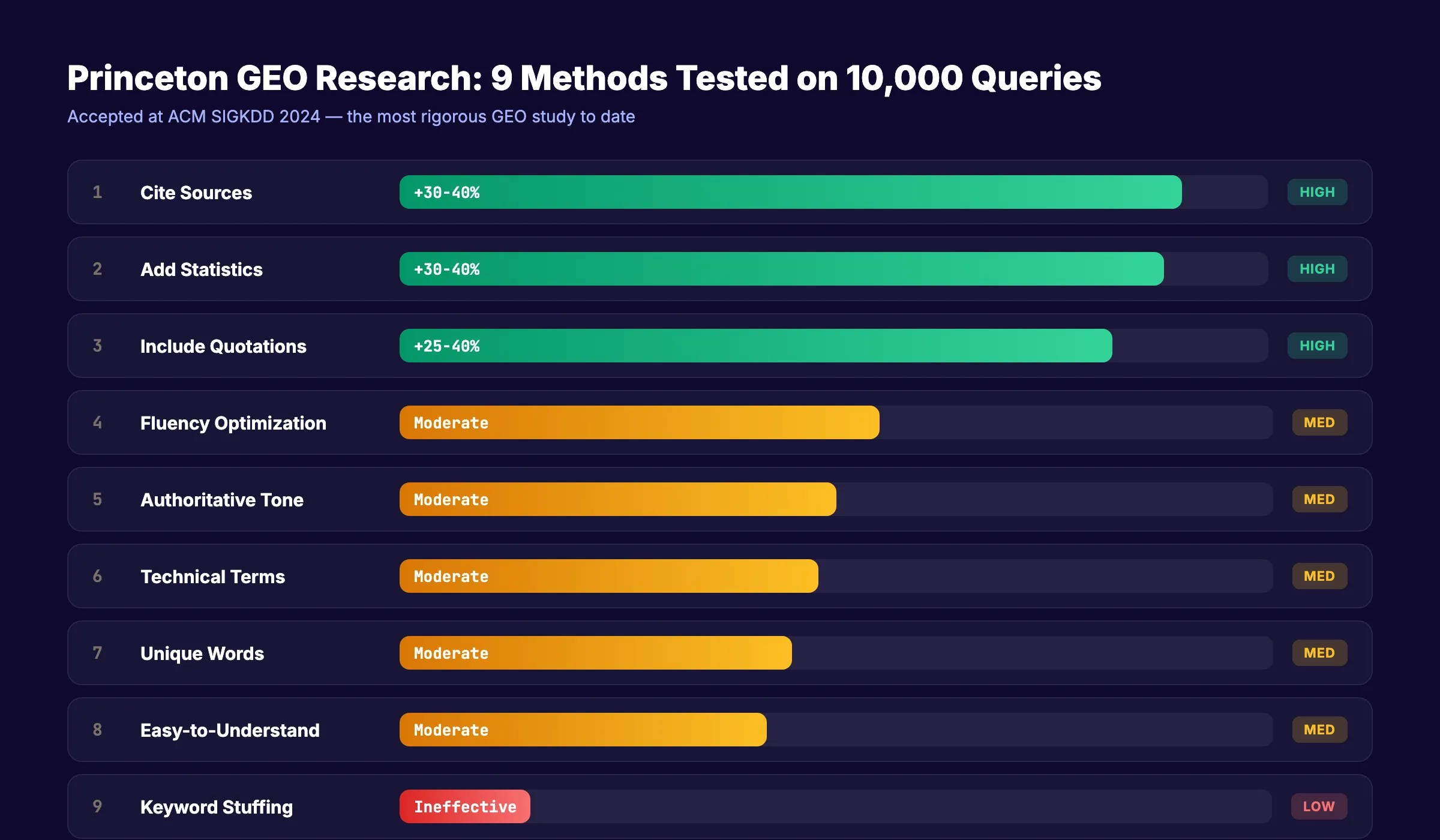
| Method | Description | Effectiveness |
|---|---|---|
| Cite sources | Add inline citations to claims | High (+30-40%) |
| Add statistics | Include specific numbers and data | High (+30-40%) |
| Include quotations | Quote authoritative sources | High (+25-40%) |
| Fluency optimization | Improve readability and flow | Moderate |
| Authoritative tone | Write with confidence and expertise | Moderate |
| Technical terms | Add domain-specific language | Moderate |
| Unique words | Use distinctive vocabulary | Moderate |
| Easy-to-understand | Simplify language | Moderate |
| Keyword stuffing | Repeat target terms | Low (ineffective) |
What the Data Shows
The top 3 strategies (citations, statistics, quotations) improved visibility by 30 to 40% compared to baseline. Combining fluency optimization with statistics addition outperformed any single strategy by more than 5.5%.
Keyword stuffing performed poorly. Repeating your target phrase does not help with generative engines. AI models care about information density, specificity, and source credibility.
Different query domains respond to different techniques. Opinion-based queries benefit most from quotations and authoritative tone. Fact-based queries benefit most from statistics and citations. Your GEO strategy should adapt based on content type.
Additional Citation Research
A study of 8,000 AI citations by Rankscale revealed more actionable data:
- Content with FAQ sections receives 4.9 citations per query vs 4.4 without
- Content with structured data and schema markup gets 44% more citations
- Content with author schema is 3 times more likely to appear in AI answers
- Optimal content length for citations: 1,500+ words
- Ideal section length: 100 to 150 words
- Readability sweet spot: grade 6 to 8 reading level (4.6 citations vs 4.0 for grade 11+)
- Content updated within 60 days gets cited 1.9 times more often
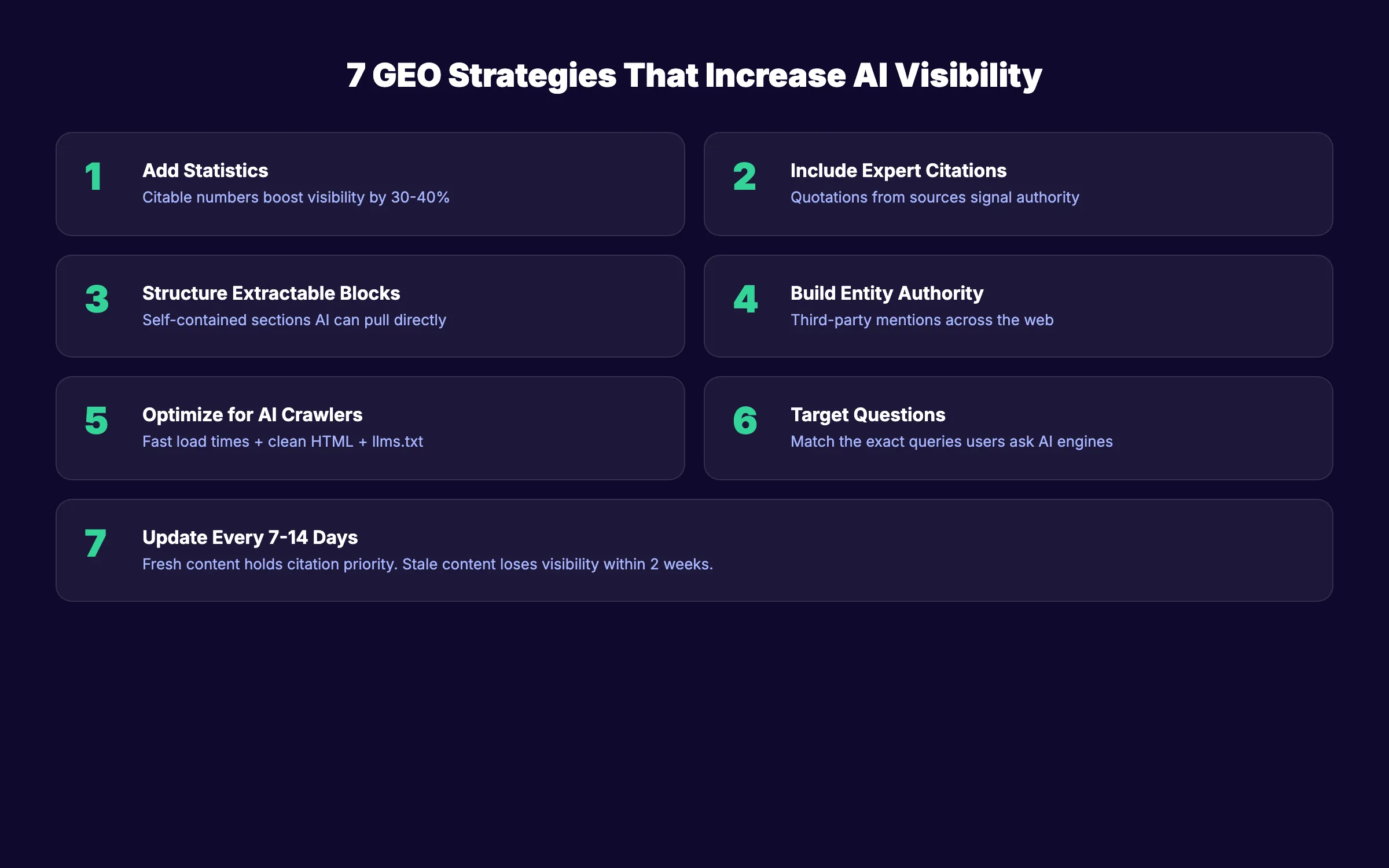
Chapter 3: 7 Generative Engine Optimization Strategies
These strategies are drawn from the Princeton research, the 8,000-citation study, and patterns we observe across 70+ industries.
1. Add Statistics and Quantifiable Claims
Vague statements get ignored. Specific numbers get cited.
"Email marketing has good ROI" tells an AI model nothing citable. "Email marketing delivers an average ROI of $36 for every $1 spent" gives the model a concrete fact it can reference.
The Princeton study found that adding statistics increased visibility by over 30%. Every major section of your content should include at least 1 specific number with a source.
How to apply this:
- Replace qualitative claims with quantitative ones
- Cite your sources so the AI model can verify the data
- Use recent statistics (2025 or 2026 data when available)
- Front-load numbers near the beginning of paragraphs
When you write SEO blog posts, start each section with a stat. It serves both human readers and AI engines.
2. Include Quotations and Expert Citations
AI models treat quotations as trust signals. A direct quote from a research paper or authoritative source signals that your content synthesizes real expertise.
The Princeton research showed quotations boosted visibility by 25 to 40% depending on the query type. Opinion-based and advisory queries saw the highest gains.
How to apply this:
- Quote industry reports, named experts, or research papers
- Use blockquote formatting so the quote is structurally distinct
- Attribute every quote to a specific person or organization
- Place quotes near the claims they support
3. Structure Content in Extractable Blocks
AI engines do not read your entire article and summarize it. They extract specific blocks. Each section needs to function as a standalone answer.
A "content block" is a self-contained section with a clear heading, a direct answer, and supporting evidence. If someone removed that section from your article and read it alone, it should make complete sense.
How to apply this:
- Use descriptive H2 and H3 headings that match user questions
- Open each section with a direct answer in 1 to 2 sentences
- Follow with evidence, examples, or data
- Keep sections between 100 and 150 words (the citation sweet spot)
- Use proper blog post structure with clear hierarchy
4. Build Entity Authority Across the Web
This is the biggest paradigm shift from traditional SEO. Brand mentions outperform backlinks 3:1 for AI visibility. Third-party signals are 6.5 times more likely to earn citations than on-site optimization alone.
AI engines trust brands that appear across multiple independent sources. Your own website is not enough.
How to apply this:
- Get mentioned on industry blogs, review sites, and news outlets
- Maintain active profiles on Reddit, LinkedIn, and Quora
- Earn unlinked brand mentions (AI values these as much as links)
- Reddit accounts for 46.7% of Perplexity's top citations
- Build topical authority with consistent publishing on your core topics
5. Optimize Technical Accessibility for AI Crawlers
AI engines need to crawl your content before they can cite it. Many AI crawlers do not execute JavaScript. Server-side rendering matters.
How to apply this:
- Ensure pages load under 2.5 seconds (check Core Web Vitals)
- Use server-side rendering or static HTML
- Configure your robots.txt to allow AI crawlers (GPTBot, ClaudeBot, PerplexityBot)
- Create an llms.txt file that describes your site structure for AI models
- Read our full guide on AI crawlers to understand what each bot needs
6. Target Questions, Not Keywords
AI users write queries averaging 23 words. They ask questions, not keywords. Structure your content around the exact questions your audience asks.
How to apply this:
- Research questions on Reddit, Quora, and People Also Ask boxes
- Use question-format H2 and H3 headings
- Answer each question directly in the first 2 sentences of each section
- Build FAQ sections (content with FAQs gets 4.9 citations vs 4.4 without)
Strong keyword research should now include a question-mapping step for GEO.
7. Update Content Every 7 to 14 Days
AI engines favor fresh content. Content updated within 30 days gets 3.2 times more Perplexity citations with an 82% citation rate. Content updated within 60 days gets cited 1.9 times more often across all platforms.
This is the biggest behavioral shift GEO requires. SEO content can be updated quarterly. GEO content needs continuous freshness signals.
How to apply this:
- Add new statistics, examples, or data points regularly
- Update timestamps and "last updated" dates
- Refresh sections that reference changing information
- Internal linking from new posts to existing pages also signals freshness
Keeping 30+ articles fresh every month is a full-time job. We publish and update SEO content on autopilot for 70+ industries.
Chapter 4: Optimize for Each AI Search Platform
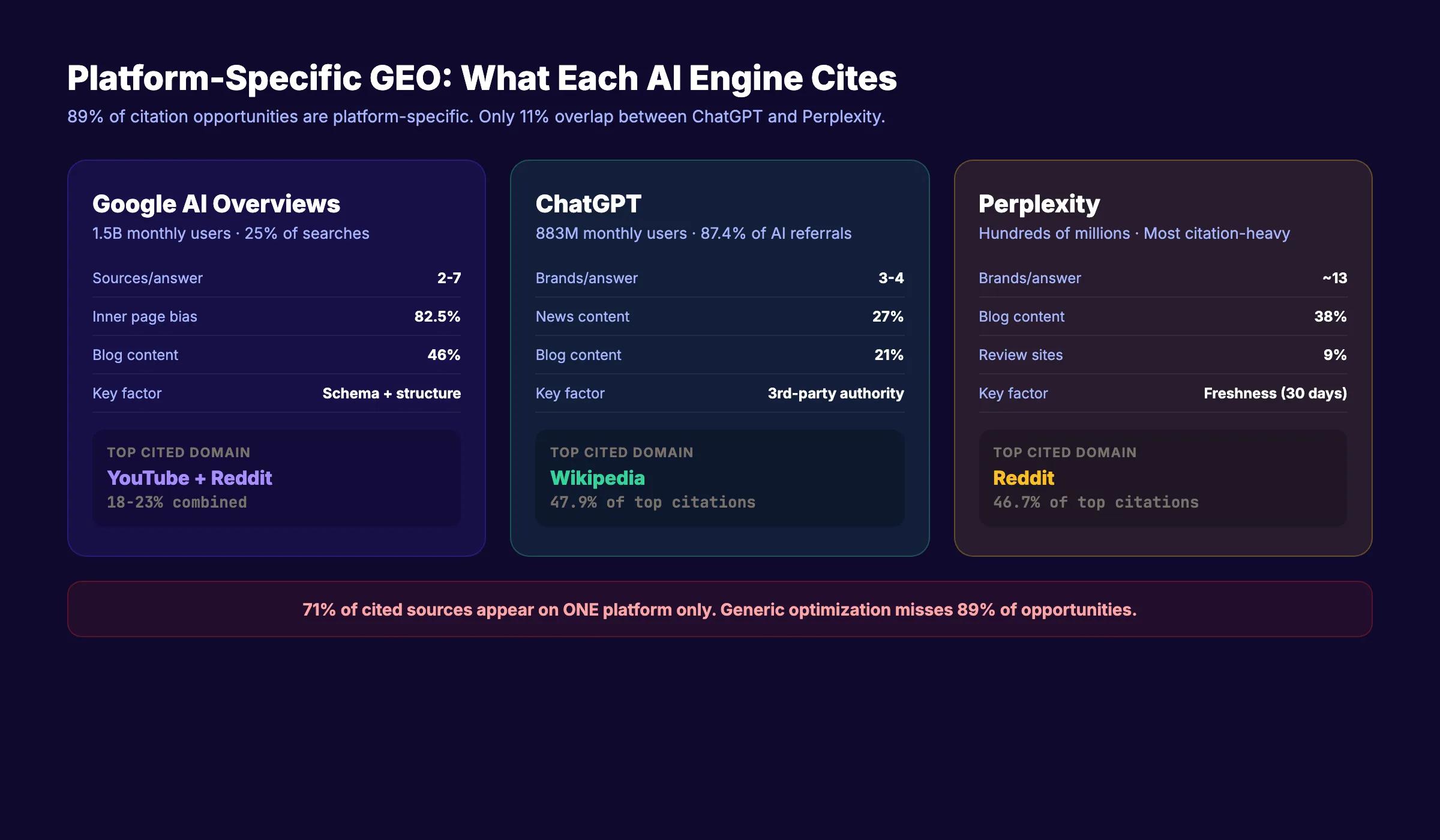
Each AI platform retrieves and cites content differently. Only 11% of citations overlap between ChatGPT and Perplexity. 71% of cited sources appear on a single platform only. A generic approach fails because 89% of citation opportunities are platform-specific.
Google AI Overviews
Google AI Overviews appear in 25% of searches and reach 1.5 billion users monthly.
What gets cited:
- 82.5% of citations link to nested inner pages, not homepages
- 80% of cited URLs are absent from Google's top 100 organic results
- YouTube is the most-cited single domain (18.8 to 23.3%)
- Blogs account for 46% of cited content
- Reddit is the most-cited single site overall
How to optimize:
- Create self-contained paragraphs that need no surrounding context
- Avoid phrases like "as mentioned above" (AI extracts blocks in isolation)
- Add schema markup (44% more citations with structured data)
- Optimize for Google AI Overviews specifically
ChatGPT
ChatGPT has 883 million monthly users and drives 87.4% of all AI referral traffic.
What gets cited:
- Wikipedia dominates at 47.9% of top citations
- News outlets account for 27%. Blogs account for 21%.
- User-generated content appears in under 0.5% of citations
- Each answer cites 3 to 4 brands on average
How to optimize:
- Build third-party mentions on authoritative domains (.edu, .gov, Wikipedia-adjacent)
- Direct on-site optimization alone is insufficient for ChatGPT
- Ensure pages are indexed in Bing (ChatGPT uses Bing for browsing)
- Focus on entity authority and brand recognition
Perplexity
Perplexity is the most citation-heavy AI engine, citing 8 to 15 sources per answer and averaging 13 brands per response.
What gets cited:
- Reddit dominates at 46.7% of top citations
- Blogs account for 38%. Specialized review sites account for 9%.
- Content freshness within 30 days gets 3.2 times more citations
- "Last Updated" timestamps are critical ranking signals
How to optimize:
- Publish frequently and update existing content within 30-day windows
- Build presence on Reddit with genuine, helpful contributions
- Include inline citations and verifiable claims
- Optimize for Perplexity with our dedicated guide
Platform Comparison
| Factor | AI Overviews | ChatGPT | Perplexity |
|---|---|---|---|
| Monthly reach | 1.5B users | 883M users | Hundreds of millions |
| Sources per answer | 2-7 | 3-4 brands | 8-15, ~13 brands |
| Top citation source | YouTube, Reddit | Wikipedia (47.9%) | Reddit (46.7%) |
| Key optimization | Schema + inner pages | Third-party mentions | Freshness + Reddit |
| Citation overlap | Low | Low | Low |
Chapter 5: GEO Content Audit
Before optimizing every page, audit what you have. Prioritize high-value pages first.
The 10-Point GEO Readiness Checklist
Score each page on these 10 factors. Give 1 point for each.
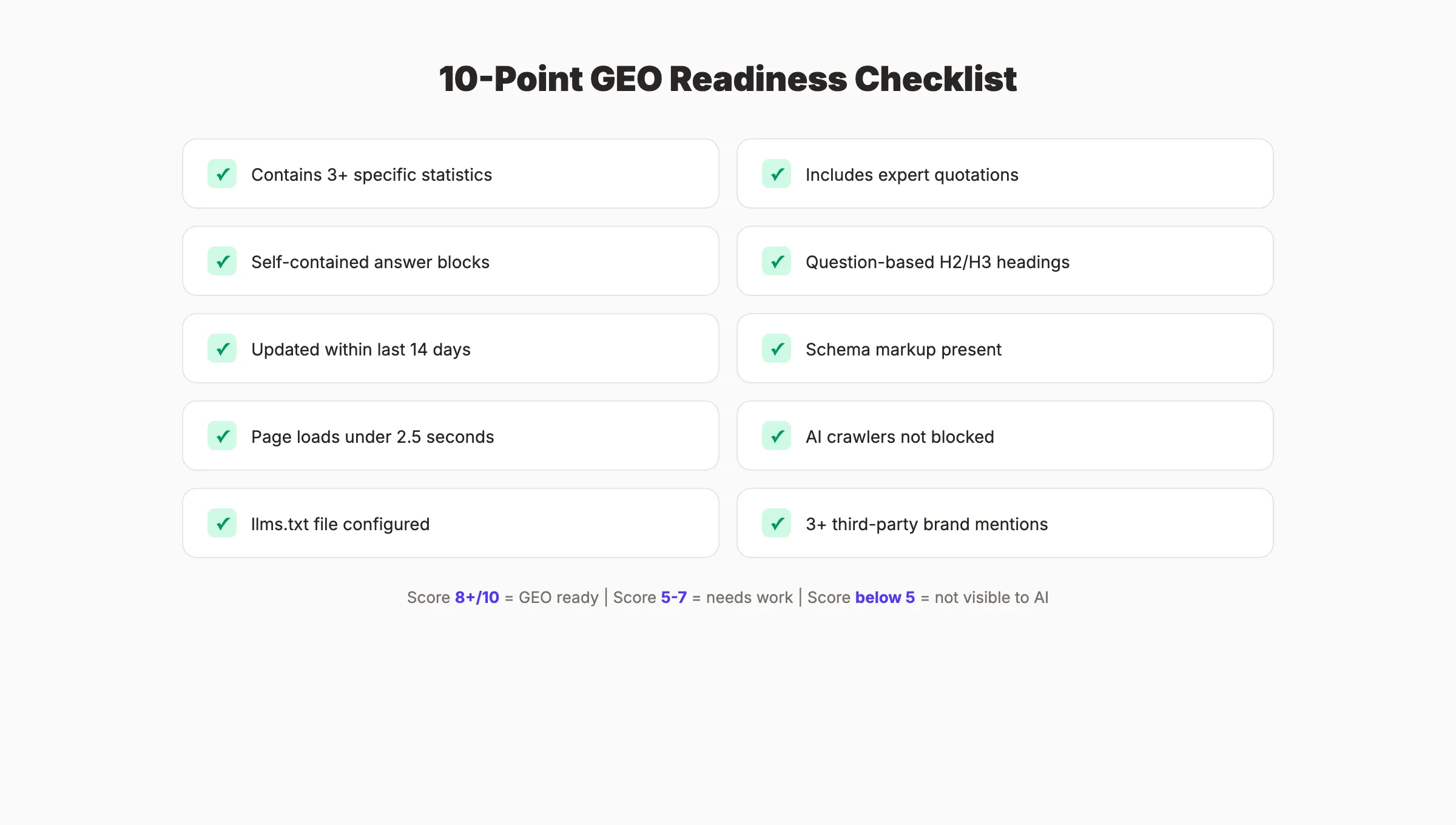
- ✓ Contains 3+ specific statistics with sources
- ✓ Includes at least 1 expert quotation or cited source
- ✓ Sections function as self-contained answer blocks (100-150 words each)
- ✓ H2 and H3 headings use question or topic format
- ✓ Content updated within the last 14 days
- ✓ Schema markup present (Article, FAQ, or HowTo)
- ✓ Page loads under 2.5 seconds
- ✓ AI crawlers not blocked in
robots.txt - ✓
llms.txtfile configured and accessible - ✓ Brand mentioned on 3+ third-party sites for this topic
Score 8-10: GEO ready. Focus on freshness and entity building. Score 5-7: Needs optimization. Prioritize statistics, structure, and technical fixes. Score below 5: Not visible to AI engines. Requires a full content overhaul.
Use this alongside our blog GEO checklist for a page-level action plan. A content audit reveals which pages have the best starting position.
Prioritize High-Value Pages First
Start with pages that have 2 of these 3 signals:
- Existing Google rankings (positions 1 to 30)
- High business value (pages that drive leads or revenue)
- Topic alignment (pages covering questions users ask AI engines)
Pages with existing rankings convert easiest for GEO. They already have authority signals AI engines recognize.
Not sure which pages to optimize first? We audit and optimize content for AI search visibility across your entire blog.
Chapter 6: How to Measure GEO Performance
GEO measurement differs from SEO. Rankings and clicks are not the primary metrics. Here is what to track.
Track AI Citations
The core GEO metric is citation frequency. How often does your content appear as a cited source in AI answers?
Methods:
- Run target queries in ChatGPT, Perplexity, and Google AI chat weekly
- Use monitoring tools: Otterly.ai, Profound, SE Visible, or Rankscale
- Track citation frequency for your top 20 target queries
- Compare your citation rate against competitors
The average brand appears in 17.2% of relevant AI responses. Category leaders hit 56.7%. Set that as your target. Read our full guide on tracking AI search visibility.
Monitor AI Referral Traffic
Check Google Analytics for referral traffic from ai.google.com, chatgpt.com, and perplexity.ai. This traffic is small (1.08% of total) but growing 1% month-over-month.
The conversion data tells the real story. AI visitors convert at 4.4 times the rate of standard organic visitors. ChatGPT drives only 0.5% of visits for most sites but 12.1% of signups. That is a 24 times conversion multiplier.
Measure Citation Sentiment
Being cited is not enough. Monitor how AI engines describe your brand. Ask AI engines directly about your brand. Check for:
- Factual accuracy of descriptions
- Positive vs neutral vs negative framing
- Whether your key differentiators appear
- Competitor mentions in the same answer
If AI engines misrepresent your brand, you need more third-party sources providing accurate information. The AI models synthesize from what is available online.
Chapter 7: Common GEO Mistakes
Most brands fail at GEO because they make one of these fundamental errors.
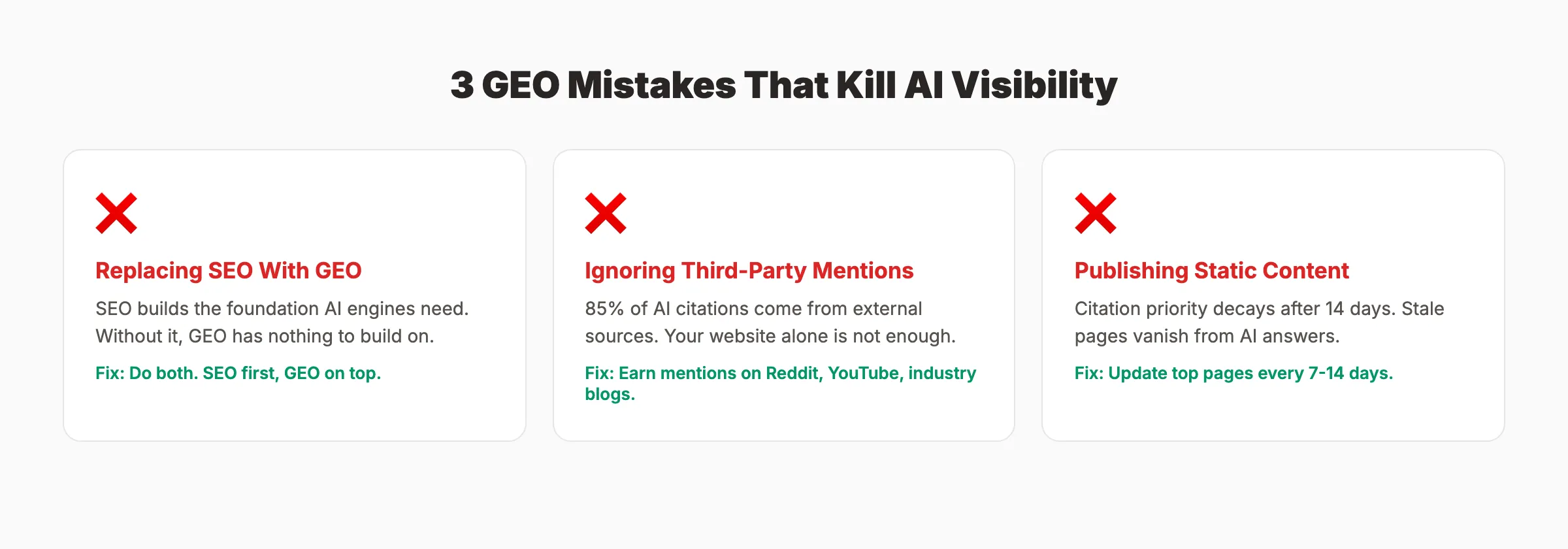
Treating GEO as a Replacement for SEO
GEO does not replace SEO. It extends it. Pages not indexed by Google are unlikely to appear in AI Overviews. Pages without backlinks lack authority signals ChatGPT uses. Your on-page SEO still matters.
Optimize for SEO first. Layer GEO tactics on top. Do both.
Ignoring Third-Party Mentions
Many brands optimize their own pages and wonder why AI engines still do not cite them. The reason: brand mentions outperform backlinks 3:1 for AI visibility. Third-party signals are 6.5 times more powerful than on-site optimization alone.
Reddit, YouTube, industry blogs, review sites, and forums shape how AI models perceive your brand. Invest in earning mentions outside your own domain. Get cited in AI search by building authority across the web.
Publishing Static Content
Content last updated 6 months ago loses GEO visibility. Content within a 30-day update window gets 3.2 times more Perplexity citations. A page that performed well in January may be invisible by March without a refresh.
Schedule content updates every 7 to 14 days for your highest-value pages. Update old blog posts with new data, examples, and timestamps.
Optimizing for One Platform Only
89% of citation opportunities are platform-specific. Only 11% of citations overlap between ChatGPT and Perplexity. A strategy that works on one platform misses the majority of opportunities on others.
Build platform-specific tactics. Optimize for Reddit presence (Perplexity). Build Wikipedia-adjacent authority (ChatGPT). Create inner-page content with schema (AI Overviews). Cover all three.
Using AI to Mass-Produce "GEO Content"
Publishing dozens of AI-generated articles and calling them GEO-ready is the fastest path to failure. AI engines deprioritize content that reads like AI content. Humanize AI content before publishing.
Chapter 8: The GEO + SEO Compound Effect
The biggest opportunity in 2026 is combining SEO and GEO into a single compounding strategy.
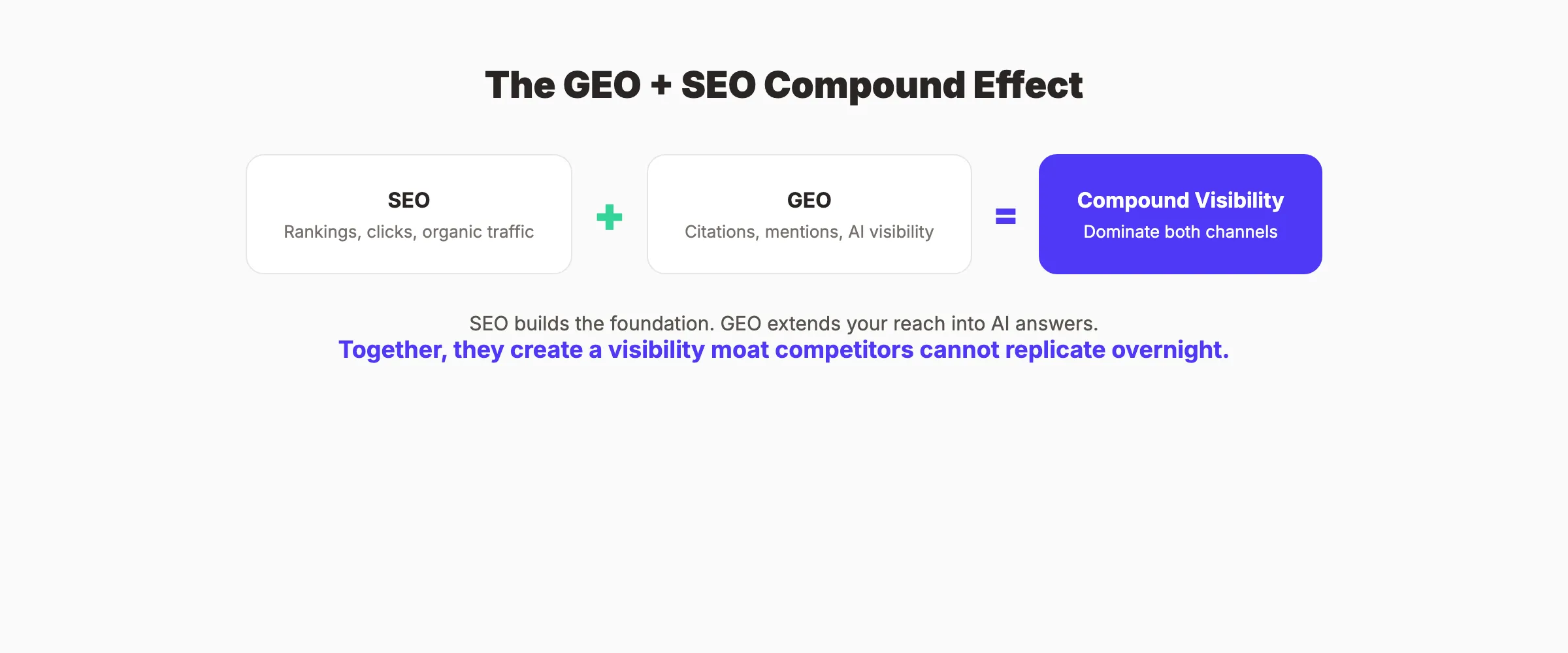
SEO drives organic traffic through rankings. GEO drives brand visibility through AI citations. When both work together, each amplifies the other.
Here is how the compound effect works:
- SEO builds indexable, authoritative content that ranks on Google
- High-ranking content gets crawled more frequently by AI engines
- GEO-optimized content on those pages earns AI citations
- AI citations drive high-intent referral traffic (4.4 times higher conversion)
- Increased traffic and engagement signal quality to Google
- Google rankings improve, leading to more AI crawling
This is the Content Compound Effect. Every article stacks on the last. Consistent publishing builds authority across both traditional search and AI search simultaneously.
Your content marketing strategy should include GEO objectives alongside SEO targets. The content optimization process should include GEO scoring for every published page.
Build your SEO and GEO moat simultaneously. We publish 30 optimized articles per month, structured for both Google rankings and AI citations.
What practitioners are saying on X
AI search advice ages quickly. Here is high-signal public discussion from SEO and growth operators — context for your roadmap, not a substitute for primary data.
- @jakezward (Feb 2026): 2026 SEO predictions emphasize AI Overview share-of-SERP, schema for LLM token efficiency, brand mentions in AI answers as a KPI, proprietary data as a moat, and content refresh beating net-new AI slop. See the post on X.
- @alexgroberman (Jul 2026): Case narrative: organic value plus multi-engine citations (ChatGPT, Perplexity, Grok) from knowledge-hub pages, category authority links, commercial intent content, and tight internal linking — not thin product copy. See the post on X.
- @varunram (Jul 2026): Critique of GEO slopfarm products that combine SEO clickbait with unresearched content marketing — quality and research still separate winners from farms. See the post on X.
Grok, AI Overviews, and multi-engine visibility
Generative engine optimization is the operating system for multi-model visibility: structure for extraction, prove claims with sources, and maintain freshness. Grok is one engine in that system, notable because it can fold live X signal into answers.
- All engines: Self-contained section answers + statistics + expert quotations remain the baseline.
- Measurement: Track citations and branded AI mentions, not only classic rank positions.
- Grok: Treat X as both a distribution channel and a retrieval surface for Grok.
Publish content built for Google and AI citations. theStacc’s Content SEO module ships SEO-scored articles structured for rankings and generative engines — including clearer entity pages models like Grok can quote.
How to measure multi-engine visibility in 2026
Split KPIs across classic search, AI Overview citations, chat referrals, and Grok-ready brand accuracy.
- GSC: non-brand clicks and query annotations.
- Citations: named in AI answers?
- Referrals: ChatGPT / Perplexity in GA4.
- Grok: on-site claims match public X discussion.
FAQ
Generative engine optimization (GEO) is the practice of optimizing content to appear as a cited source in AI-generated search answers. It targets platforms like ChatGPT, Google AI Overviews, Perplexity, and Claude. GEO focuses on citations and mentions rather than traditional search rankings. The term was coined by Princeton and Georgia Tech researchers in a 2023 paper that tested 9 optimization methods across 10,000 queries.
No. GEO extends SEO. Traditional SEO builds the crawlability, authority, and rankings that AI engines rely on. GEO adds optimization for AI citations. Only 10% of AI-cited sources rank in Google's top 10, which means you need both disciplines working together.
GEO results appear faster than SEO in some cases. AI engines re-crawl and update sources more frequently than Google updates rankings. Content optimizations can show citation improvements within 1 to 2 weeks. Building entity authority takes 2 to 4 months of consistent effort across third-party platforms.
Start with Google AI Overviews if your content already ranks on Google. Use Perplexity as your measurement platform because it shows all cited sources. Then build ChatGPT visibility through third-party mentions on authoritative domains. Each platform has different citation patterns, and 89% of opportunities are platform-specific.
Backlinks matter less than brand mentions for GEO. Brand mentions outperform backlinks 3:1 for AI visibility. However, backlinks still support SEO, which creates the authority foundation AI engines rely on. The best approach is earning both backlinks and unlinked brand mentions across authoritative sites.
Yes. Small businesses in niche industries often find GEO easier than SEO because there is less competition for AI citations in specialized topics. A local dentist publishing detailed content about dental procedures can earn AI citations that national brands do not target. Publish consistently and build mentions on review sites and local directories.
Generative engine optimization is the next layer of search visibility. The foundations match SEO: quality content, technical excellence, and consistent authority building. The execution layer is new: extractable blocks, statistics, citations, freshness signals, and cross-platform entity authority. Start with a GEO audit of your top 10 pages. Score them against the checklist. Fix the gaps. The compounding starts from day one.
Get 30 GEO-optimized articles published every month. No writers. No editing. No publishing. We handle it all.
Sources & references
- [1] Princeton / Georgia Tech et al. — GEO research (arXiv:2311.09735)
- [2] @jakezward on X — 2026 SEO predictions emphasize AI Overview share-of-SERP, schema for LLM token efficiency, brand mentions in AI answers
- [3] @varunram on X — Critique of GEO slopfarm products that combine SEO clickbait with unresearched content marketing — quality and research
- [4] Referenced source — www.superlines.io

Plan topics, review article drafts, and publish to a connected CMS.
Weekly local SEO teardowns
One practical email a week. Map Pack, GBP, AI Overviews — no fluff. Unsubscribe anytime.
Explore this topic: Generative Engine Optimization (GEO).