GEO (Generative Engine Optimization) gets your content cited by AI search engines. Learn what GEO is, how it works, and 7 proven strategies. Updated 2026.
GEO, or generative engine optimization, is the practice of structuring content so AI platforms like ChatGPT, Perplexity, and Google AI Overviews retrieve and cite it. AI search engines do not rank pages; they quote them, cite them, or skip them. The term comes from a 2023 research paper.
AI search engines do not rank your website. They quote it, cite it, or skip it entirely.
GEO (Generative Engine Optimization) is the discipline of optimizing your content so AI platforms like ChatGPT, Perplexity, and Google AI Overviews retrieve and cite it. The term comes from a 2023 research paper by Princeton University, Georgia Tech, and IIT Delhi that tested 9 optimization methods across 10,000 queries.
That research found that specific GEO techniques boost citation visibility by up to 40%. Meanwhile, keyword stuffing. The backbone of old-school SEO. Produced almost zero improvement in AI responses.
The shift is real. ChatGPT reached 800 million weekly active users by late 2025. AI-referred traffic sessions jumped 527% year-over-year. And 65% of Google searches now end without a click.
We publish 3,500+ articles across 70+ industries with a 92% average SEO score. We optimize every piece for both traditional search and AI engines. This guide covers what GEO is, how it works, and exactly how to optimize for it.
Here is what you will learn:
- What GEO means and where the term originated
- How generative engines decide which sources to cite
- The 7 key differences between GEO and traditional SEO
- Which optimization methods the Princeton research proved work best
- Platform-specific strategies for ChatGPT, Perplexity, and AI Overviews
- A complete checklist to make your content GEO-ready
- How to measure GEO success when clicks are not the metric
Chapter 1: What GEO Means
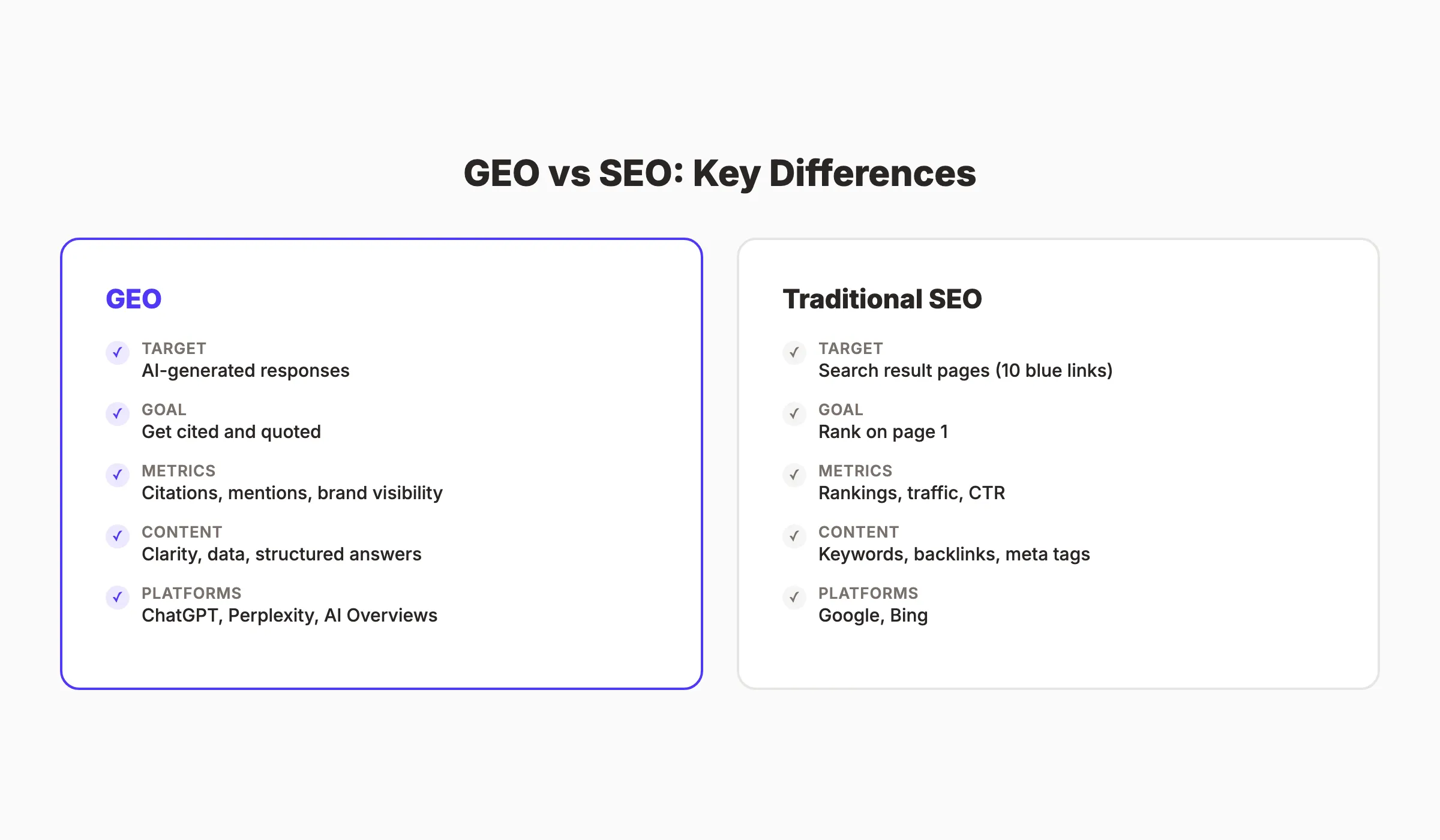
GEO stands for Generative Engine Optimization. It is the practice of creating and structuring content so AI search platforms retrieve, cite, and recommend it when answering user queries.
Traditional SEO targets a position among 10 blue links on a search results page. GEO targets inclusion among the 2 to 7 sources an AI engine cites in a single response.
Where the Term Comes From
The term "Generative Engine Optimization" was coined in a peer-reviewed research paper published by researchers at Princeton University, Georgia Tech, IIT Delhi, and the Allen Institute for AI. The paper was presented at ACM SIGKDD 2024, one of the top data science conferences in the world.
The researchers built GEO-bench, a benchmark of diverse queries across multiple domains, and tested 9 distinct optimization methods. Their core finding: content optimized with citations, statistics, and quotations saw visibility increases of up to 40% in generative engine responses.
GEO vs AEO: Is There a Difference?
You may also see the term AEO (Answer Engine Optimization). GEO and AEO address similar goals with minor distinctions. AEO originated around featured snippets and voice search. GEO specifically targets AI-generated responses from large language models. In practice, the strategies overlap significantly. Most practitioners use GEO as the standard term in 2026.
Why GEO Is Not Just "New SEO"
The most common misconception is that GEO is a rebrand of SEO. It is not. Fewer than 10% of sources cited by AI engines rank in Google's top 10 for the same query. A page can rank number 1 on Google and never get cited by ChatGPT. A page with zero organic rankings can appear in every AI response for its topic.
GEO requires a different optimization mindset. The ranking signals are different. The success metrics are different. The content format AI engines prefer is different.
Chapter 2: How Generative Engines Work
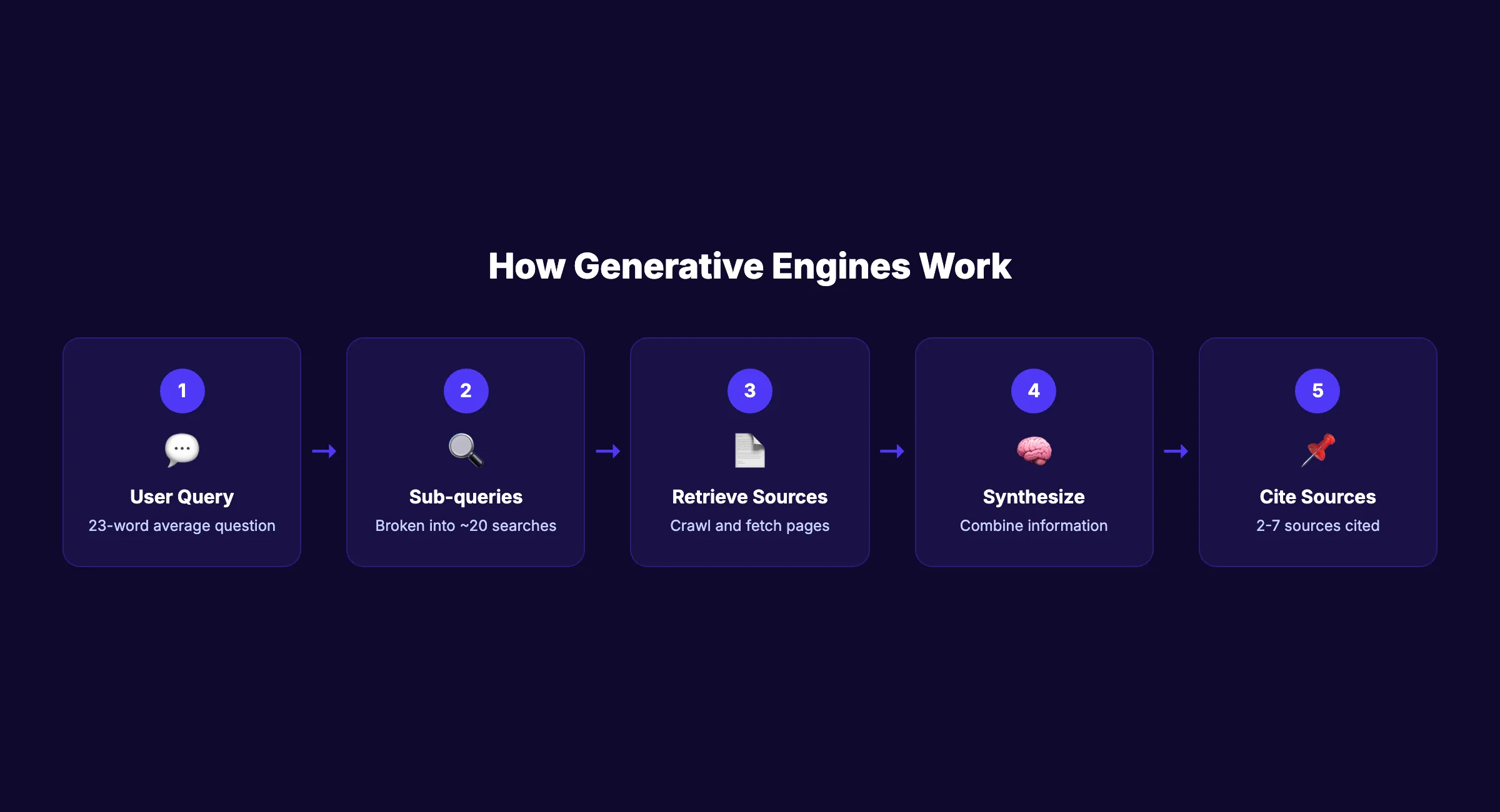
Understanding GEO starts with understanding how AI search platforms generate their answers. The process is called Retrieval-Augmented Generation (RAG).
The RAG Pipeline in 5 Steps
When a user asks an AI engine a question, the engine does not pull from memory alone. It follows a retrieval pipeline:
- Parse the query. The engine breaks the user question into sub-queries. The average AI search query is 23 words long. Far longer than the 3 to 4 word average in traditional search.
- Generate sub-queries. A single user question becomes roughly 20 internal search queries that target different aspects of the topic.
- Retrieve sources. The engine crawls and fetches web pages that match each sub-query. It evaluates freshness, authority, and relevance.
- Synthesize the answer. The language model combines information from multiple sources into one coherent response.
- Cite sources. The engine attributes specific claims to specific sources. Most responses cite between 2 and 7 sources.
What Determines Which Sources Get Cited
AI engines evaluate sources on several factors:
- Directness. Does the content answer the query in its first 200 words?
- Specificity. Does it contain exact numbers, dates, and data points?
- Authority signals. Does the page have author credentials, source citations, and E-E-A-T markers?
- Freshness. Was the content recently published or updated?
- Structure. Is the content organized with clear headings, tables, and lists that AI can parse?
- Crawlability. Does the site allow AI crawlers access?
Your content is either part of that answer or invisible. There is no position 7. There is no page 2.
Your SEO team. $99/month. theStacc publishes 30 optimized articles per month. Built for both Google and AI search engines.
Chapter 3: GEO vs SEO: 7 Key Differences
GEO and SEO are complementary. You need both. But they differ in fundamental ways.
| Factor | Traditional SEO | GEO |
|---|---|---|
| Target | Search engine result pages (10 blue links) | AI-generated responses (2-7 cited sources) |
| Goal | Rank on page 1 | Get cited and quoted |
| Query length | 3-4 word average | 23 word average |
| Success metric | Rankings, traffic, CTR | Citations, mentions, brand visibility |
| Content priority | Keywords, backlinks, meta tags | Clarity, data, structured answers |
| Authority signal | Backlink profile | Brand mentions, entity clarity, E-E-A-T |
| Platforms | Google, Bing | ChatGPT, Perplexity, Gemini, AI Overviews |
What Stays the Same
SEO fundamentals still matter for GEO. Technical health, site structure, mobile optimization, and page speed all affect whether AI crawlers can access and process your content. Content quality, freshness, and depth remain critical for both disciplines.
What Changes
The weight shifts from backlinks to brand mentions. Topical authority matters more than domain authority. Direct answers outperform keyword-optimized paragraphs. And structured data moves from "nice to have" to essential.
The biggest shift: in SEO, you optimize for clicks. In GEO, you optimize for quotes. Your content needs to contain specific, citable statements that an AI model can extract and attribute to you.
Chapter 4: Why GEO Matters in 2026
The numbers tell the story.
AI Search Adoption Is Accelerating
- ChatGPT reached 800 million weekly active users by October 2025, doubling from 400 million in just 8 months.
- AI-referred sessions grew 527% year-over-year in the first 5 months of 2025.
- 38% of Americans have used AI search tools. Up from 8% in 2023.
- Google AI Overviews appear in 16%+ of searches and reach 1.5 billion users.
- Perplexity processes over 780 million queries monthly.
Traditional Search Is Losing Clicks
Zero-click searches now account for 60% of all Google queries. The click rate for position 1 when an AI Overview appears drops to just 2.6%. Users get their answer directly from the AI response and never visit a website.
This is not a future trend. It is the current reality.
The Business Case for GEO
The GEO market hit $848 million in 2025 and is projected to reach $33.7 billion by 2034 at a 50.5% CAGR. Companies that optimize for GEO now gain a first-mover advantage in a market with far less competition than traditional SEO.
According to research from Foundation Inc., 63% of companies that have optimized for GEO report increased visibility. And 86% of enterprise SEO teams have already integrated some form of AI optimization into their workflow.
Chapter 5: What the Princeton Research Proves Works
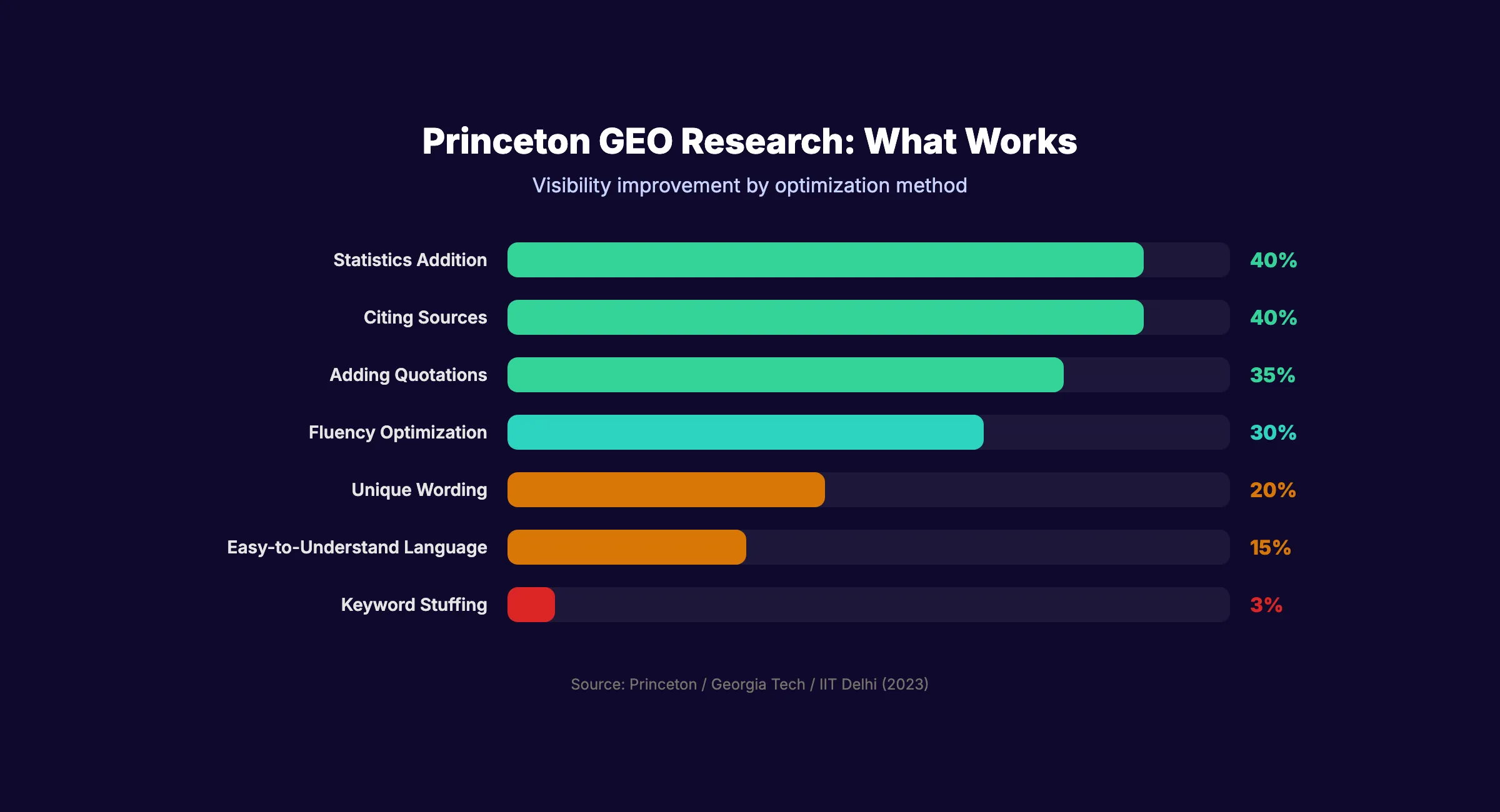
The Princeton GEO study tested 9 optimization methods across 10,000 queries. Not all methods are equal. Here is what the data shows.
The Top 3 GEO Strategies (40% Visibility Boost)
1. Add Statistics With Sources
Content with specific data points and cited sources saw the highest visibility gains. "AI-driven marketing campaigns deliver 20 to 30% higher ROI" is far more citable than "AI marketing improves results."
2. Cite Authoritative Sources
Including references to peer-reviewed studies, official documentation, and recognized industry sources signals credibility to AI engines. The Princeton study found that citations alone boosted visibility by up to 40%.
3. Include Direct Quotations
Quoting experts, researchers, or official sources adds a layer of authority that AI engines prioritize. Quotations provide ready-made extractable content that AI models can directly attribute.
Mid-Tier Strategies (15-30% Boost)
4. Fluency Optimization
Improving readability and sentence clarity produced a 15 to 30% visibility boost. AI engines favor well-written content that is easy to parse and summarize.
5. Unique Wording
Content that uses original phrasing rather than recycling competitor language saw a 20% improvement. AI engines compare sources and prefer unique perspectives.
What Does Not Work
Keyword Stuffing: The study found a mere 3% improvement from keyword optimization. Essentially zero compared to the 40% gains from citation-based strategies. The tactics that dominate traditional SEO rankings have minimal impact on AI citation rates.
3,500+ blogs published. Every article is SEO-scored before publish. See what theStacc can do for your site.
Chapter 6: How to Optimize Your Content for GEO
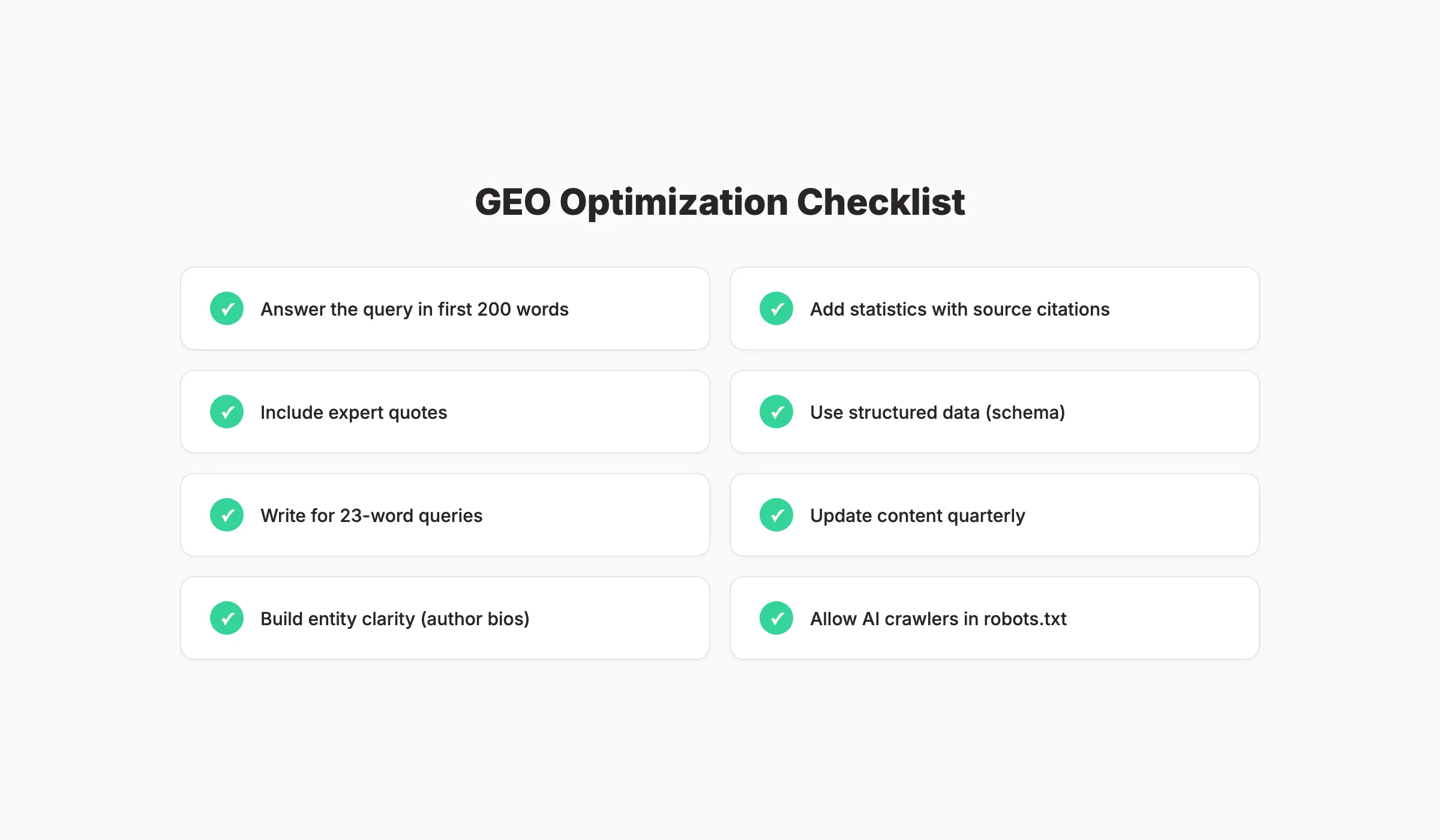
Based on the Princeton research and real-world data from 2025-2026, here are the practical steps to make your content GEO-ready.
Step 1: Answer the Query in the First 200 Words
AI engines that use real-time retrieval evaluate relevance primarily on opening content. Do not build up to your answer. State it directly. If someone searches "what is GEO," your first paragraph should define GEO.
Step 2: Add Citable Data Points
Every major claim should include a specific number, date, or percentage. Include the source. AI models extract and attribute these data points far more often than unsupported statements.
Step 3: Use Structured Formatting
Break content into clear H2 and H3 sections. Use tables for comparisons. Use numbered lists for processes. Use bullet points for features. Structured content helps AI engines parse and extract information efficiently.
Step 4: Build Entity Clarity
AI engines need to understand who you are. Include detailed author bios with relevant credentials. Maintain consistent brand information across your website, social profiles, and third-party platforms. Use schema markup to define your organization and authors.
Step 5: Allow AI Crawler Access
Check your robots.txt file. Many sites accidentally block AI crawlers like GPTBot, ClaudeBot, or PerplexityBot. If AI engines cannot crawl your content, they cannot cite it. Our AI crawlers guide covers the complete setup.
Step 6: Publish Original Research and Data
Wikipedia accounts for 47.9% of ChatGPT's top cited sources. The reason: it contains original, well-sourced, factual content. You do not need to be Wikipedia. But publishing original data, case studies, and industry research dramatically increases your citation potential.
Step 7: Update Content Regularly
AI engines favor freshness more heavily than traditional search engines. Pages updated within the last 90 days are significantly more likely to appear in AI responses. Set a quarterly content refresh cycle for your most important pages.
Chapter 7: Platform-Specific GEO Tactics
Each AI platform has different preferences. Optimizing for all three major platforms requires understanding their individual behaviors.
ChatGPT Optimization
ChatGPT processes over 1 billion prompts daily. It favors encyclopedic, well-structured content with clear definitions and thorough coverage. Wikipedia-style content with citations performs best.
What works for ChatGPT:
- Full topic coverage (depth over brevity)
- Clear definitions in the first paragraph
- Cited statistics and expert quotes
- Structured headings that match common query patterns
Perplexity Optimization
Perplexity processes 780 million queries monthly and has a strong recency bias. It prioritizes recently published or updated content and heavily cites Reddit (46.7% of citations). Learn more in our Perplexity optimization guide.
What works for Perplexity:
- Recent publication or update dates
- Community-validated content (Reddit, forums)
- Direct question-and-answer format
- Specific, factual claims with inline citations
Google AI Overviews Optimization
Google AI Overviews appear in 16%+ of searches and reach 1.5 billion users globally. They pull from Google's existing index but favor schema markup and structured data more heavily than organic results. See our full AI Overviews guide for detailed tactics.
What works for AI Overviews:
- FAQ and HowTo schema markup
- Content already ranking in the top 20 (38% of citations come from top-10 pages)
- Clear, concise answer paragraphs
- Tables and comparison formats
Rank everywhere. Do nothing. Blog SEO, Local SEO, and Social on autopilot.
Chapter 8: How to Measure GEO Success
Traditional SEO metrics do not capture GEO performance. You need new measurements.
Citation Tracking
Monitor whether AI platforms cite your content. Tools like Semrush's AI Visibility Index track citation presence across ChatGPT, Gemini, and Perplexity. Note that 40 to 60% of cited sources change monthly, so consistent monitoring matters.
Brand Mention Monitoring
Track how often your brand appears in AI-generated responses. Brand mentions in AI search carry 3 times the weight of backlinks for AI visibility, according to Foundation Inc.. Our guide on tracking AI search visibility covers the full setup.
AI Referral Traffic
Monitor AI-referred sessions in your analytics. AI traffic is a growing segment. Filter for referrals from ChatGPT, Perplexity, and other AI platforms to understand how much traffic AI search drives to your site.
Content Citability Score
Evaluate each page on how likely it is to be cited. Key factors: does the page answer queries directly in the first 200 words? Does it contain specific data? Does it use structured formatting? Does it include source citations? Score each factor and prioritize pages with the highest improvement potential.
Chapter 9: Common GEO Mistakes
Avoid these errors that 54% of marketers struggle with when starting GEO.
Treating GEO as a Replacement for SEO
GEO does not replace SEO. It complements it. Technical SEO, content quality, and site authority still determine whether AI crawlers can access and trust your content. Drop your SEO fundamentals and your GEO efforts fail too.
Optimizing for One Platform Only
ChatGPT, Perplexity, and Google AI Overviews each have different citation preferences. A strategy built only for ChatGPT may miss Perplexity entirely. Optimize for the principles all platforms share: clarity, data, structure, and authority.
Ignoring Content Freshness
AI engines favor recent content more heavily than traditional search. Content published 2 years ago without updates will lose citations to newer competitors. Refresh your key pages every 90 days minimum.
Blocking AI Crawlers
Many sites still block GPTBot, ClaudeBot, and PerplexityBot in their robots.txt. If you block the crawler, you cannot get cited. Review your robots.txt configuration and allow access to crawlers you want citations from.
Writing Vague, Unsourced Content
"AI is changing marketing" will never get cited. "AI-driven marketing campaigns deliver 22% higher ROI according to a 2025 McKinsey study" will. Every claim needs a number and a source.
Neglecting Structured Data
Without schema markup, AI engines cannot efficiently parse your content. FAQ schema, HowTo schema, and Organization schema all help AI engines understand what your page covers and who published it. Sites with proper structured data get cited more consistently than those without it.
Measuring GEO With SEO Metrics
Rankings and organic traffic do not capture GEO performance. If you only track keyword positions, you will miss the citations and brand mentions happening in AI responses. Build a separate GEO dashboard that tracks AI referral traffic, citation frequency, and brand mention volume across AI platforms.
What practitioners are saying on X
AI search advice ages quickly. Here is high-signal public discussion from SEO and growth operators — context for your roadmap, not a substitute for primary data.
- @jakezward (Feb 2026): 2026 SEO predictions emphasize AI Overview share-of-SERP, schema for LLM token efficiency, brand mentions in AI answers as a KPI, proprietary data as a moat, and content refresh beating net-new AI slop. See the post on X.
- @alexgroberman (Jul 2026): Case narrative: organic value plus multi-engine citations (ChatGPT, Perplexity, Grok) from knowledge-hub pages, category authority links, commercial intent content, and tight internal linking — not thin product copy. See the post on X.
- @varunram (Jul 2026): Critique of GEO slopfarm products that combine SEO clickbait with unresearched content marketing — quality and research still separate winners from farms. See the post on X.
Grok, AI Overviews, and multi-engine visibility
GEO is about earning citations inside generative answers, not only blue-link rankings. Engines differ: AI Overviews lean on top-ranking pages; ChatGPT rewards entity clarity; Grok additionally listens to live X conversation about your category and brand.
- Definition block: Keep a 40–60 word GEO definition near the top for AI extraction.
- Quality bar: Operator consensus is clear: research-backed pages beat GEO content farms.
- Grok: Entity mentions on X can accelerate how Grok describes you — keep claims consistent with the site.
Publish content built for Google and AI citations. theStacc’s Content SEO module ships SEO-scored articles structured for rankings and generative engines — including clearer entity pages models like Grok can quote.
How to measure multi-engine visibility in 2026
Split KPIs: classic GSC, AI Overview citations, chat referrals, and brand accuracy in Grok-style answers.
- GSC: non-brand clicks with annotation for AIO-heavy queries.
- Citations: are you named inside the AI summary?
- Referrals: ChatGPT/Perplexity sessions in GA4.
- Grok: on-site facts match public X discussion.
FAQ
GEO stands for Generative Engine Optimization. It is the practice of optimizing content to be cited and recommended by AI search platforms like ChatGPT, Perplexity, Google AI Overviews, and Gemini.
No. SEO targets rankings on search engine results pages. GEO targets citations within AI-generated responses. The strategies overlap in areas like content quality and technical health, but GEO places more weight on structured data, brand mentions, and citable content. Fewer than 10% of AI-cited sources also rank in Google's top 10.
Yes. With 60% of Google searches now ending without a click and AI search adoption growing 527% year-over-year, GEO is becoming essential. SEO drives organic traffic. GEO drives brand visibility and citations in AI responses. You need both for full search coverage in 2026.
GEO results can appear faster than traditional SEO. AI engines re-crawl and update their source pools frequently. Some sites see citation improvements within weeks of optimization. However, sustained visibility requires consistent content quality and freshness over 3 to 6 months.
AEO (Answer Engine Optimization) originated around featured snippets and voice search. GEO specifically targets AI-generated responses from large language models. In 2026, most practitioners use GEO as the standard term since it covers the broader scope of AI search optimization.
Yes. Every article theStacc publishes is optimized for both traditional search engines and AI platforms. We structure content with cited data, clear headings, schema markup, and direct answers. All factors that boost GEO visibility. Start with a free trial to see the difference.
GEO is not a future trend. It is the present. The companies that optimize for AI citations now will own visibility in a search environment where clicks are declining and AI answers are rising. Start by auditing your top 10 pages against the GEO checklist and work through the optimization steps in this guide. For the complete technical deep-dive, see our Generative Engine Optimization: The Complete Guide.
Sources & references
- [1] Princeton / Georgia Tech et al. — GEO research (arXiv:2311.09735)
- [2] @jakezward on X — 2026 SEO predictions emphasize AI Overview share-of-SERP, schema for LLM token efficiency, brand mentions in AI answers
- [3] @varunram on X — Critique of GEO slopfarm products that combine SEO clickbait with unresearched content marketing — quality and research
- [4] Referenced source — www.superlines.io

Plan topics, review article drafts, and publish to a connected CMS.
Weekly local SEO teardowns
One practical email a week. Map Pack, GBP, AI Overviews — no fluff. Unsubscribe anytime.