How to get your brand cited by ChatGPT, Perplexity, and AI Overviews: structure, sourcing, entity clarity, and the tactics that move citations.
Your content ranks on page one of Google. Yet ChatGPT never mentions your brand. Perplexity cites your competitors instead. Google AI Overviews overlook your best articles entirely.
This is the new reality of search. Organic rankings still matter, but they are no longer the finish line. AI systems now answer questions directly, and the brands they cite receive traffic that converts at 4.4 times the rate of traditional organic visitors. The marketers who understand this shift are building the next generation of visibility. Everyone else is optimizing for a search engine that is slowly becoming a reference layer, not a destination.
This guide explains exactly how AI citation optimization works, what the research proves, and how to implement it. You will learn the seven tactics that Princeton researchers found increase AI citations by up to 41%, how each major AI platform selects sources differently, and the measurement framework that separates guesswork from progress.
What Is AI Citation Optimization?
AI citation optimization is the practice of structuring content so AI answer engines use it as a source when generating responses to user queries. It combines content formatting, authority signals, technical markup, and third-party presence to increase the probability that ChatGPT, Perplexity, Google AI Overviews, Claude, and other generative systems reference your brand.
Traditional SEO optimizes for ranking positions in a list of blue links. AI citation optimization optimizes for inclusion inside the answer itself. When a user asks ChatGPT "what is the best CRM for small business," the model does not return a ranked list of URLs. It synthesizes an answer and cites the sources that informed its response. Being one of those sources means your brand appears inside the answer, often with a clickable link.
The distinction matters because user behavior has shifted. Research from 2026 shows that 62% of users now start their search journey with AI tools rather than traditional search engines. Google AI Overviews appear in approximately 25% of US searches, and when they do, only 8% of users click a traditional organic result. The traffic that remains in the AI answer is substantial, and the brands cited capture it.
AI citation optimization is sometimes called generative engine optimization (GEO) or answer engine optimization (AEO). The core principle is the same: make your content easy for AI systems to find, verify, extract, and cite.
Why AI Citations Matter More Than Rankings in 2026
The search market is splitting into two layers. Traditional search remains the infrastructure that indexes the web. AI answer engines sit on top of that infrastructure and decide which sources to surface to users. This changes what visibility means.
Organic click-through rates have dropped 61% for queries where a Google AI Overview appears. Position one on Google used to mean 15% of clicks. Now, when an AI Overview is present, position one captures closer to 8%. The rest of the attention stays inside the AI-generated summary.
The brands cited in those summaries are not losing traffic. They are gaining a new type of traffic. AI-referred sessions jumped 527% between January and May 2025, reaching 1.13 billion referral visits in June 2025 alone. More importantly, this traffic converts. AI search traffic converts at 14.2% compared to Google organic's 2.8% baseline. LLM visitors convert 4.4 times better than organic search visitors.
The reason is intent alignment. When a user asks an AI a specific question and your brand is cited as the authority on that topic, the user arrives pre-qualified. They have already received an answer that positions you as the expert. The visit is not exploratory. It is confirmatory.
For B2B businesses, this shift is even more pronounced. McKinsey research from 2025 found that 67% of B2B buyers now start their research with AI tools. If your brand is not cited in those initial AI responses, you are invisible during the most influential phase of the buying process.
How AI Search Engines Decide What to Cite
Understanding how AI systems select sources is the foundation of effective optimization. Each platform uses a different architecture, and those differences create distinct citation patterns.
The Retrieval Process
Most AI answer engines use a process called retrieval-augmented generation, or RAG. When a user submits a query, the system searches an index of web content, retrieves relevant passages, and uses those passages to generate a response. The citations you see are the sources that survived this retrieval and selection process.
The retrieval stage is a filter. Most content never makes it past this stage. The selection stage is a competition. Multiple sources may be retrieved, but only a handful are cited in the final answer. Research shows that LLMs cite only 2 to 7 domains per response on average.
Platform-Specific Citation Behavior
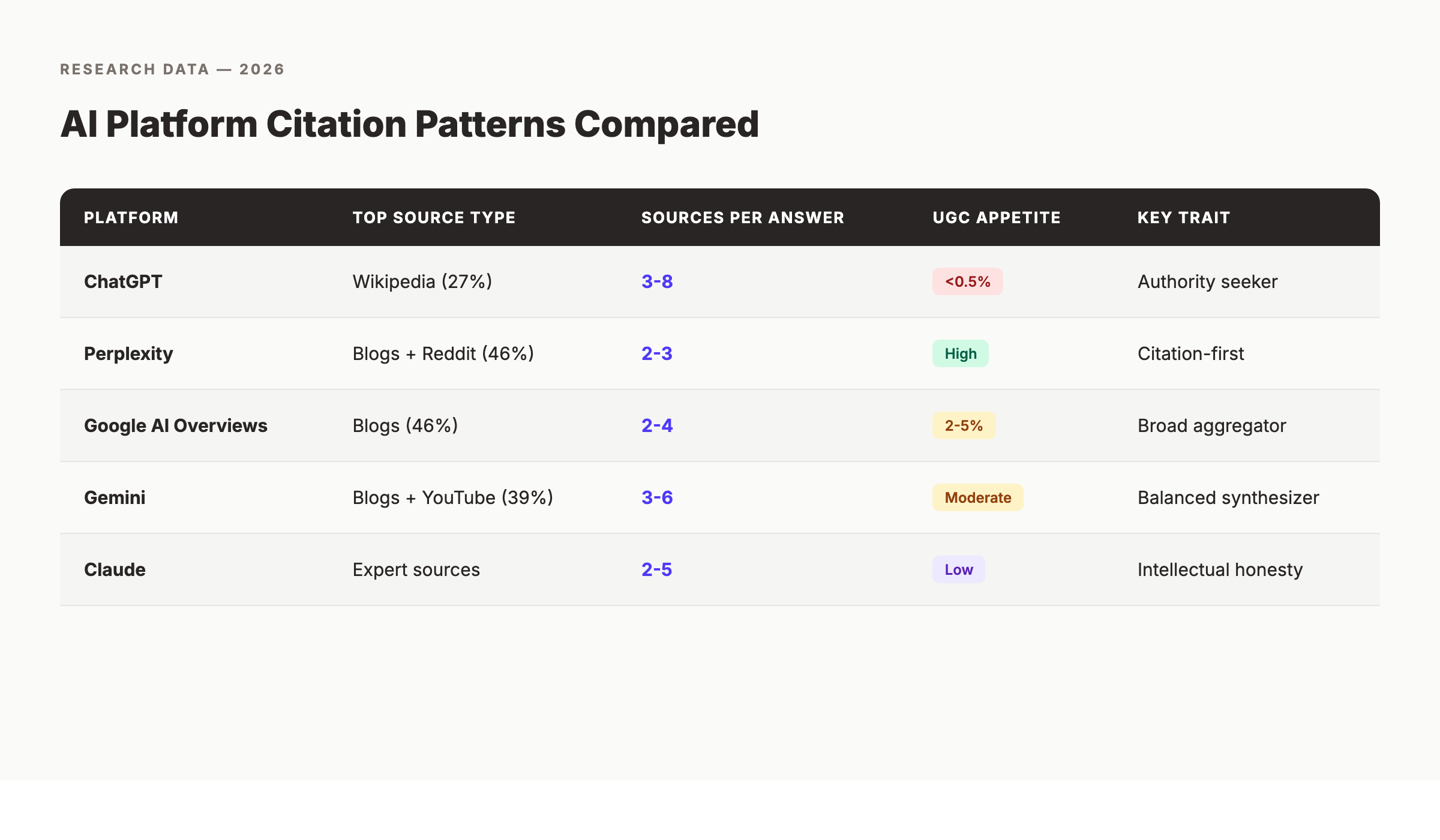
ChatGPT relies heavily on Wikipedia and major news outlets. Analysis of 8,000 citations across 57 queries found that 27% of ChatGPT citations point to Wikipedia. The platform avoids user-generated content almost entirely, with less than 0.5% of citations going to forums or social platforms. ChatGPT is conservative. It prefers established authority over niche expertise.
Perplexity behaves differently. It is built around citations and shows them prominently. Perplexity cites Reddit and Stack Exchange at much higher rates than ChatGPT. It also surfaces niche expert sites like NerdWallet, Consumer Reports, and Investopedia. Perplexity users click citations at a rate of 89% per session, making it the highest-converting AI platform for cited brands.
Google AI Overviews cast the widest net. They cite blogs at approximately 46% of the time, news at 20%, and community content at 4%. A striking finding from Search Engine Land research shows that 82.5% of AI Overview citations link to deeply nested pages, not homepages. This means specific, detailed content outperforms broad overview pages.
Gemini balances professional reviews with peer feedback. YouTube is uniquely dominant in Gemini citations, representing the top single domain for certain query types. Gemini also shows the highest error rate among major platforms, at 90% in Columbia Journalism Review testing.
Claude uses Brave Search for web retrieval, not Bing or Google. It emphasizes intellectual honesty and tends to cite sources that acknowledge limitations or trade-offs. Content that explicitly states boundaries receives a 1.7 times citation boost on Claude.
The Cross-Platform Overlap Problem
Research by Lee in 2026 tested 19,556 queries across four platforms and found that cross-platform URL overlap is only 1.4%. If ChatGPT cites five URLs and Perplexity cites five URLs for the same query, the expected shared URLs is less than one. This means optimizing for one platform does not guarantee visibility on another. Platform-specific strategies are essential.
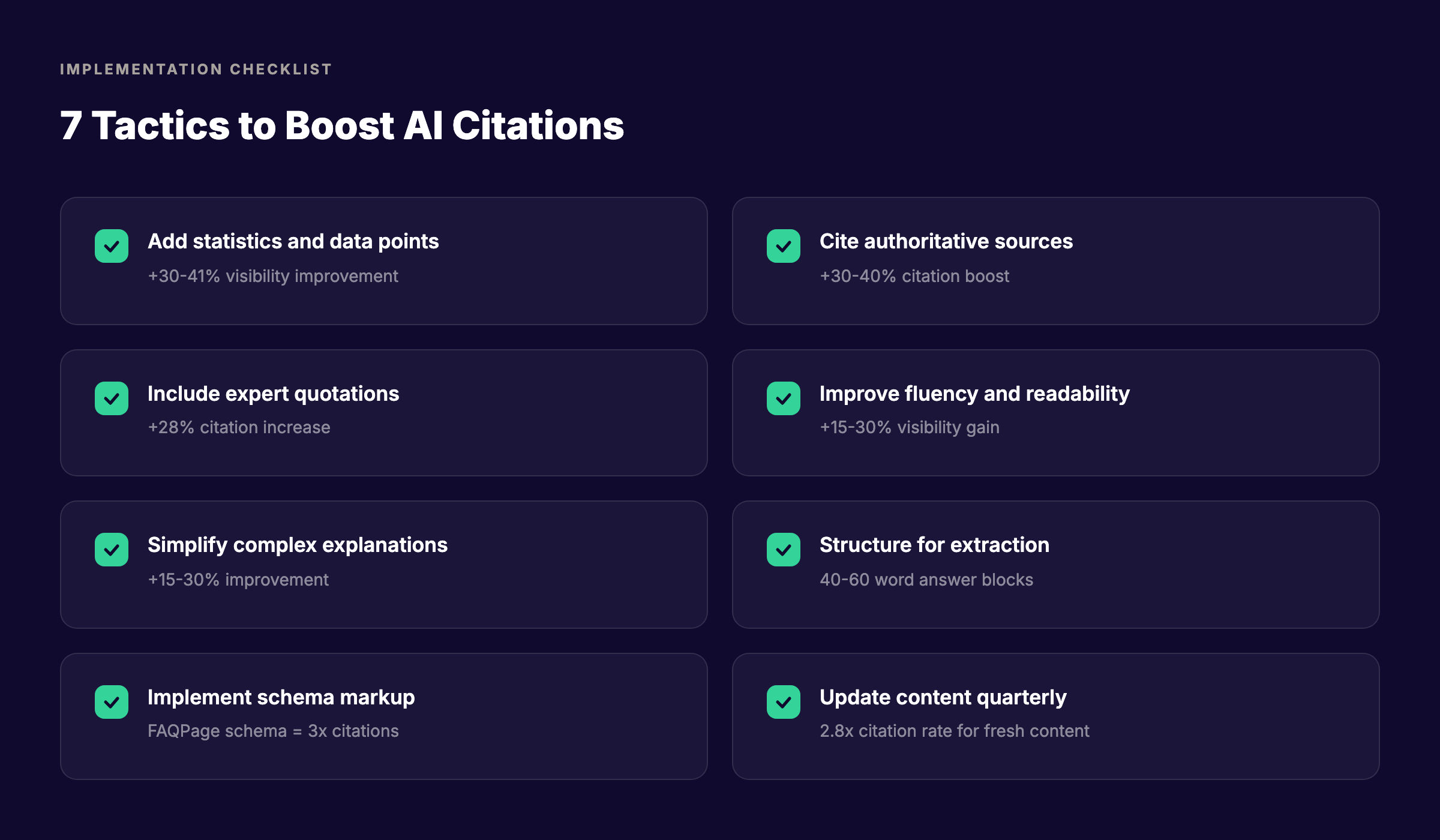
The 7 Proven Tactics That Boost AI Citations
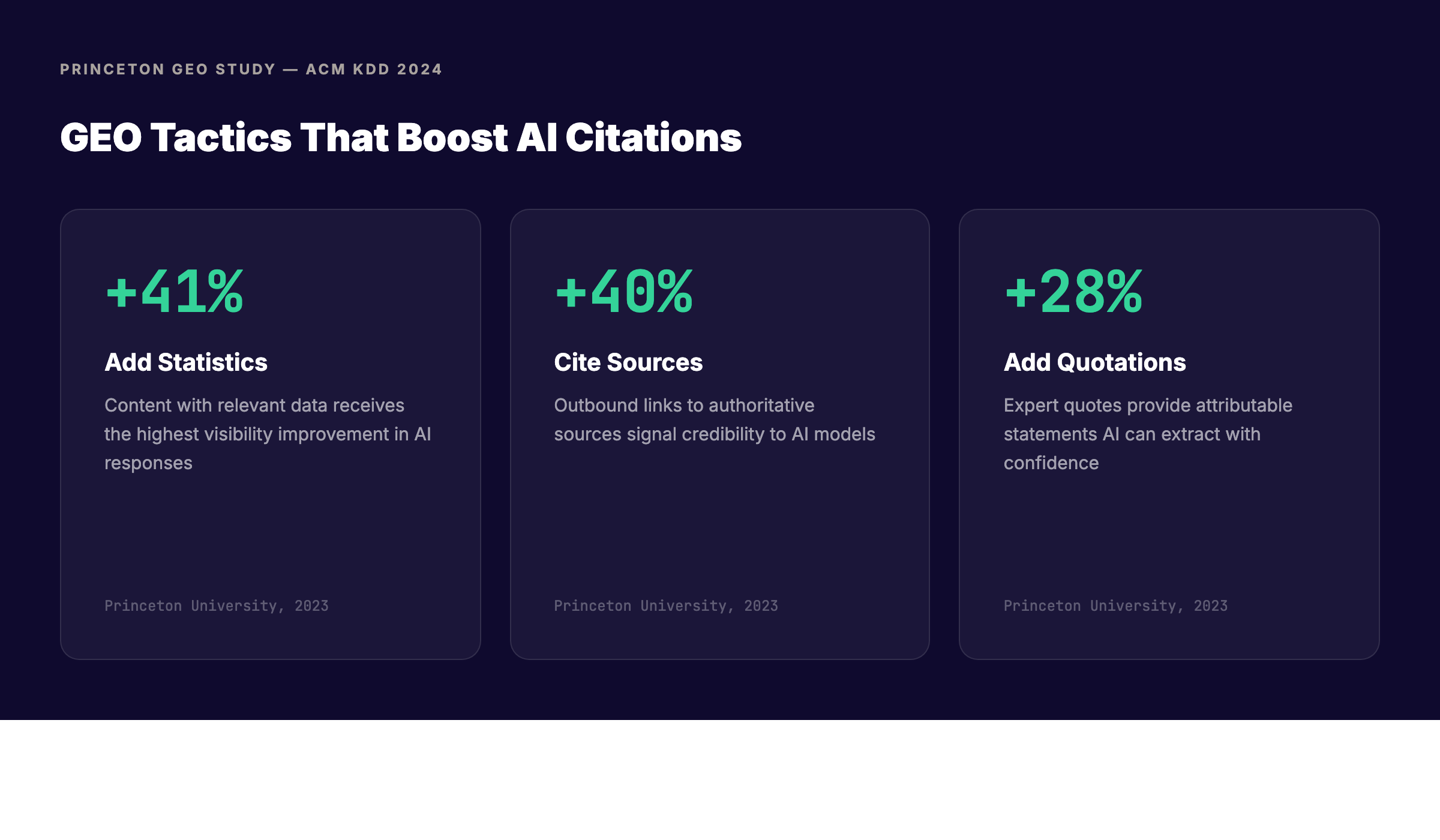
The Princeton GEO study, published in 2023 and presented at ACM KDD 2024, tested nine optimization methods across 10,000 queries. The results establish a clear hierarchy of what works.
1. Add Statistics and Data
The single most effective tactic is adding statistics to your content. The Princeton researchers found that content with relevant statistics receives a 30 to 41% visibility improvement in AI responses. This outperforms every other tested method.
AI models are trained to value quantified claims. A statement like "businesses that blog regularly get more traffic" is weak. A statement like "businesses that publish 16 or more blog posts per month get 3.5 times more traffic than those publishing 0 to 4 posts" is strong. The specific number gives the model confidence to cite the claim.
Implementation: Audit your existing content for unsupported assertions. Replace vague claims with specific, sourced statistics. Add a data point every 200 to 300 words. Cite the source by name and year.
2. Cite Authoritative Sources
Citing external sources within your content increases AI citation rates by 30 to 40%. The effect is strongest for lower-ranked websites. Pages at position five in traditional search saw a 115% visibility improvement when they included proper source citations.
This is counterintuitive. Many marketers fear that linking out reduces their authority. The research proves the opposite. AI models interpret outbound links to authoritative sources as a credibility signal. It shows that your content is part of a verified information network, not an isolated claim.
Implementation: Link to .gov, .edu, major research institutions, and established industry publications. Cite at least one external source per major claim. Use descriptive anchor text that names the institution.
3. Include Direct Quotations
Adding quotations from recognized experts increases AI citations by 28%. The Princeton study found that authoritative quotes perform best, meaning quotes from named individuals with relevant credentials outperform anonymous or generic statements.
Quotations serve two purposes. First, they provide a specific, attributable statement that AI models can extract with confidence. Second, they signal that your content incorporates diverse expert perspectives, which reduces the risk of hallucination or bias in the AI's response.
Implementation: Interview industry experts and include 2 to 3 direct quotes per article. Attribute each quote with the person's full name, title, and organization. Place quotes in pullquote formatting for extraction visibility.
4. Improve Fluency and Readability
Fluency optimization, which includes improving grammar, sentence structure, and flow, produces a 15 to 30% visibility improvement. AI models process content more reliably when the language is clear and unambiguous.
This does not mean dumbing down your content. It means removing ambiguity. Passive voice, convoluted sentence structures, and unclear pronoun references make extraction harder. Active voice, direct statements, and consistent terminology make extraction easier.
Implementation: Run your content through a readability checker. Target a Flesch-Kincaid grade of 8 or lower. Break sentences over 25 words into two sentences. Replace jargon with plain language, or define technical terms on first use.
5. Simplify Complex Explanations
The "easy-to-understand" optimization method, which involves simplifying technical or complex content, also produced a 15 to 30% improvement. AI models prefer content that explains concepts clearly because it reduces the risk of misinterpretation during synthesis.
This tactic is particularly effective for B2B and technical topics. A page that explains a complex process in plain language is more likely to be cited than a page that assumes specialized knowledge.
Implementation: Add a "What This Means" summary after technical sections. Use analogies to explain complex concepts. Include a glossary or definition section for specialized terminology.
6. Structure Content for Extraction
AI models extract content in passages, not pages. Research from seoClarity found that approximately 60% of cited passages are under 120 words. This means the structure of your content matters as much as the substance.
The most extractable content format is a standalone answer block: 40 to 60 words that answer a specific question completely, followed by elaboration. Each H2 section in this guide follows this pattern. The first paragraph after each heading is a self-contained answer. The paragraphs that follow provide depth.
Other structural elements that improve extraction include:
- Tables for comparisons and data
- Numbered lists for processes
- Bullet points for features or benefits
- FAQ sections with question-answer pairs
- Definition blocks for key terms
Implementation: Open every H2 section with a 40 to 60 word standalone answer. Use tables for any data that can be formatted as rows and columns. Add an FAQ section with 5 to 10 questions.
7. Implement Schema Markup
Schema markup provides explicit signals about what your content contains. Research shows that pages with FAQPage schema are cited approximately 3 times more often than pages without it. HowTo schema provides a 2.9 times citation lift. Product schema provides a 2.4 times lift.
Schema markup helps AI systems understand the structure and purpose of your content without having to parse natural language. A FAQPage schema explicitly labels questions and answers. A HowTo schema explicitly labels steps and instructions. This reduces ambiguity and increases citation confidence.
Implementation: Add FAQPage schema to any page with 3 or more question-answer pairs. Add HowTo schema to tutorial content. Add Article schema to all blog posts with author, date, and publisher information.
Platform-Specific Optimization Strategies
Because cross-platform URL overlap is only 1.4%, each platform requires a tailored approach.
Optimizing for ChatGPT
ChatGPT is the most conservative platform. It favors Wikipedia, major news outlets, and established institutional sources. To get cited by ChatGPT:
- Build a Wikipedia presence for your brand or founder
- Earn coverage in major publications like Reuters, Financial Times, or industry-leading blogs
- Publish original research with methodology and data
- Avoid relying on user-generated content or forum discussions
- Ensure your content is in the training data by being published before the model's knowledge cutoff
Optimizing for Perplexity
Perplexity is the most citation-friendly platform. It shows sources prominently and users click them at high rates. To get cited by Perplexity:
- Maintain an active presence on Reddit in relevant subreddits
- Publish detailed, well-sourced content that answers specific questions
- Update content frequently, as Perplexity prioritizes recency
- Target niche expertise areas where you can become the definitive source
- Build topical authority hubs that cover a subject completely
Optimizing for Google AI Overviews
Google AI Overviews have the widest source mix and the highest search volume. To get cited by AI Overviews:
- Focus on deeply nested pages, not homepages
- Maintain strong traditional SEO, as 52% of AI Overview citations come from the top 10 organic results
- Publish complete content that covers a topic from multiple angles
- Use structured data markup, especially FAQPage and HowTo schema
- Monitor which queries trigger AI Overviews in your niche and optimize specifically for those
Optimizing for Claude
Claude uses Brave Search and values intellectual honesty. To get cited by Claude:
- Acknowledge limitations and trade-offs in your content
- Cite sources transparently and completely
- Avoid exaggerated claims or promotional language
- Build authority through depth of expertise rather than breadth of coverage
The Role of E-E-A-T in AI Citations
Experience, expertise, authoritativeness, and trustworthiness are not just Google ranking factors. They are AI citation prerequisites. Research from fiftyfiveandfive.com found that 96% of AI Overview citations come from sources with strong E-E-A-T signals.
Author Bylines and Bios
Pages with visible author bylines and detailed author bios are cited more than twice as often as pages without them. AI models use author information to assess expertise. An article by "Sarah Chen, Content Strategist at theStacc" carries more citation weight than an article by "Editorial Team."
Implementation: Include author bylines on every article. Link to detailed author bios that list credentials, experience, and relevant expertise. Use author schema markup.
Firsthand Experience Signals
Content that demonstrates firsthand experience receives higher citation rates. This includes original research, case studies with specific numbers, product reviews based on actual testing, and how-to guides that include screenshots or detailed process descriptions.
Implementation: Add original data to your content. Include specific numbers, dates, and outcomes from your own work. Use first-person language where appropriate to signal direct experience.
Third-Party Validation
Brands with multi-source validation, meaning they are mentioned across multiple independent sources, see citation rates improve by 67%. This includes mentions in news articles, references in academic papers, citations in industry reports, and listings in directories.
Implementation: Pursue press coverage in industry publications. Contribute guest articles to established sites. Get listed in relevant directories and roundups. Encourage customers to mention your brand in reviews and case studies.
How to Audit Your Current AI Visibility
Before optimizing, you need a baseline. Most marketers skip this step, which is why 78% are not tracking AI visibility despite claiming it as a priority.
Manual Audit Method
Query the major AI platforms with questions your content should answer. For each query, document:
- Whether your brand is mentioned
- Whether your content is cited
- Which competitor content appears instead
- The format of the AI response
Test 10 to 15 queries per platform. Include branded queries ("what is [your brand]"), product category queries ("best [product] for [use case]"), and informational queries ("how to [process]").
Citation Tracking Tools
Several tools now track AI citations at scale:
- Citedify analyzes Google AI Overview visibility using industry data from 680 million citation patterns
- BotMetrics provides AI readiness scores and semantic content mapping
- Genrank identifies specific fixes ranked by citation impact
- Siftly tracks citation rates across platforms and monitors brand mention sentiment
Log File Analysis
You can also track AI crawler activity through server logs. The major AI crawlers are:
- GPTBot (OpenAI)
- PerplexityBot (Perplexity)
- ClaudeBot (Anthropic)
- oai-searchbot (OpenAI search)
Analyzing which pages these crawlers visit and how frequently reveals what AI systems are already indexing. Pages with high crawl frequency but low citation rates have structural or authority issues that need addressing.
Building a Content Architecture for AI Citations
Individual articles can earn citations, but sustainable AI visibility requires a content architecture designed for it.
Topical Authority Hubs
AI models prefer sources that demonstrate complete coverage of a topic. A single article about email marketing is less likely to be cited than a hub of 10 articles covering email marketing strategy, copywriting, automation, deliverability, and analytics.
Build content hubs around your core topics. Each hub should have:
- A pillar page that provides a complete overview
- 5 to 10 cluster pages that cover specific subtopics in depth
- Internal links connecting all pages in the hub
- Consistent terminology and framing across all pages
The Citation Funnel
Structure your content to serve different stages of the AI citation process:
- Awareness content answers broad questions and introduces your brand
- Consideration content compares options and establishes your expertise
- Decision content provides specific recommendations and includes strong calls to action
AI systems cite awareness content most frequently because it answers the broadest range of queries. But decision content drives the highest conversion rates when cited.
Freshness and Maintenance
Content freshness is a critical citation factor. Research shows that pages updated within 30 days are cited 2.8 times more often than baseline. Pages not updated in 3 or more months are 3 times more likely to lose citations.
Implement a quarterly content refresh cycle. Update statistics, add new sections, refresh examples, and revise conclusions. Each update signals to AI systems that your content is current and reliable.
Measuring AI Citation Success
Traditional SEO metrics do not capture AI citation performance. You need a new measurement framework.
Primary KPIs
Citation rate: The percentage of relevant queries where your brand or content is cited. Track this per platform.
Brand mention rate: The percentage of relevant queries where your brand is mentioned, even if not directly cited.
AI referral traffic: Visits from AI platforms measured in your analytics. Look for referral sources like chatgpt.com, perplexity.ai, and gemini.google.com.
Citation position: When cited, what position does your content occupy? First citations receive more clicks than later ones.
Secondary KPIs
AI crawler frequency: How often AI crawlers visit your pages, measured through log files.
Content extraction rate: The percentage of your content that AI systems can successfully extract and use, measured through testing tools.
Competitive citation gap: The difference between your citation rate and your top competitors' rates.
Reporting Framework
Run your AI citation audit monthly. Document:
- Total queries tested per platform
- Citation rate per platform
- Brand mention rate per platform
- New citations earned
- Citations lost
- Top-performing content
- Underperforming content
Get cited before your competitors do. The first-mover advantage in AI citation optimization is 3 to 5 times stronger than for later optimizers. Brands that build AI visibility now will dominate as search continues to shift. theStacc helps businesses structure content that AI systems cite, from schema implementation to topical authority hubs. Explore theStacc's content optimization tools
Common Mistakes That Block AI Citations
Even well-intentioned optimization efforts can fail if they fall into these common traps.
Keyword Stuffing
The Princeton study found that keyword stuffing reduces AI visibility by 10%. AI models interpret keyword stuffing as low-quality content. Unlike traditional SEO, where keyword density still has marginal value, GEO penalizes it.
Fix: Use keywords naturally. Focus on semantic coverage rather than exact-match repetition. Use related terms and synonyms.
Ignoring Platform Differences
Optimizing only for Google AI Overviews and assuming the same content will perform on ChatGPT and Perplexity is a mistake. The 1.4% cross-platform overlap means each platform requires distinct content and distribution strategies.
Fix: Create platform-specific content variants. Optimize your main content for Google AI Overviews. Create Reddit-friendly content for Perplexity. Build Wikipedia presence for ChatGPT.
Neglecting Technical Foundations
Content that is not crawlable cannot be cited. Block AI crawlers in robots.txt, and your content becomes invisible to AI systems. Slow-loading pages, poor mobile experience, and broken schema markup all reduce citation probability.
Fix: Allow all major AI crawlers in robots.txt. Ensure pages load in under 3 seconds. Validate schema markup with Google's Rich Results Test.
Publishing Without Authority Signals
A well-structured article from an unknown domain will not be cited. AI models use domain authority as a primary filter. Research shows that approximately 80% of cited domains have a Domain Authority of 50 or higher.
Fix: Build domain authority through traditional SEO, backlinks, and brand mentions before expecting AI citations. Focus on niche authority within your specific topic area.
Failing to Update Content
Stale content loses citations. The freshness penalty is severe. Pages not updated in 3 or more months are 3 times more likely to lose citations.
Fix: Implement a content calendar with quarterly refresh dates. Update statistics, refresh examples, and revise outdated recommendations.
The Future of AI Citation Optimization
AI citation optimization is not a trend. It is the permanent evolution of search visibility. Several developments will shape its future.
AI Agents and Autonomous Search
AI agents that conduct research, compare options, and make recommendations autonomously are emerging. These agents will cite sources based on confidence scores, not just relevance. Brands with strong E-E-A-T, clear structure, and verified data will receive preferential treatment.
Multimodal Citations
AI systems are increasingly citing images, videos, and audio content alongside text. YouTube is already a dominant citation source for Gemini. Brands that create multimodal content will have more citation opportunities.
Real-Time Retrieval
Platforms like Perplexity already prioritize real-time information. As more AI systems adopt real-time retrieval, content freshness will become even more critical. The window between publication and citation will shrink.
Regulatory Pressure
The EU AI Act and similar regulations may require AI systems to disclose their sources more transparently. This could increase citation visibility and make optimization more valuable.
Build AI visibility that lasts. The brands investing in AI citation optimization today are building the foundation for the next decade of search. theStacc's platform automates the technical and structural work, so your team can focus on creating content worth citing. Start optimizing for AI citations
What practitioners are saying on X
AI search advice ages quickly. Here is high-signal public discussion from SEO and growth operators — context for your roadmap, not a substitute for primary data.
- @jakezward (Feb 2026): 2026 SEO predictions emphasize AI Overview share-of-SERP, schema for LLM token efficiency, brand mentions in AI answers as a KPI, proprietary data as a moat, and content refresh beating net-new AI slop. See the post on X.
- @alexgroberman (Jul 2026): Case narrative: organic value plus multi-engine citations (ChatGPT, Perplexity, Grok) from knowledge-hub pages, category authority links, commercial intent content, and tight internal linking — not thin product copy. See the post on X.
- @varunram (Jul 2026): Critique of GEO slopfarm products that combine SEO clickbait with unresearched content marketing — quality and research still separate winners from farms. See the post on X.
Grok, AI Overviews, and multi-engine visibility
For topics covered in “ai citation optimization”, multi-engine visibility still starts with clear definitions, sourced statistics, and extractable section answers. Grok additionally factors live X discussion — keep public claims consistent with this page.
- Google AI Overviews: Use passage-ready answers and structured data.
- ChatGPT / Perplexity: Cite named sources next to key claims.
- Grok: Maintain accurate entity facts on-site and in high-signal X posts.
Publish content built for Google and AI citations. theStacc’s Content SEO module ships SEO-scored articles structured for rankings and generative engines — including clearer entity pages models like Grok can quote.
Frequently Asked Questions
SEO optimizes content to rank higher in search engine results pages. AI citation optimization optimizes content to be cited as a source inside AI-generated answers. SEO focuses on position in a list of links. AI citation optimization focuses on inclusion inside the answer itself. The two are complementary, not competing. Strong traditional SEO builds the domain authority that AI citation optimization requires.
Initial results typically appear within 2 to 4 weeks for content on established domains. Building stable authority takes 3 to 6 months. The timeline depends on your current domain authority, content quality, and how aggressively you implement the optimization tactics. Lower-ranked websites actually see faster relative improvement because the Princeton study found GEO benefits them more.
No. Traditional SEO and AI citation optimization work together. Approximately 52% of Google AI Overview citations come from the top 10 organic results. Strong rankings improve your chances of AI citations. Domain authority, backlinks, and technical SEO all remain important. AI citation optimization adds a new layer of optimization on top of your existing SEO foundation.
Start with the platform your audience uses most. For B2B audiences, ChatGPT and Perplexity are the primary platforms. For consumer audiences, Google AI Overviews has the widest reach. Perplexity offers the highest citation-to-click conversion rate. Google AI Overviews offers the largest total audience. Optimize for your primary platform first, then expand to others.
Yes. The Princeton study found that lower-ranked websites see the largest relative improvement from GEO tactics. A page at position five saw a 115% visibility improvement from adding source citations, while a page at position one saw minimal change. AI citation optimization is structurally more powerful for smaller brands because it rewards content quality and structure over domain age and backlink volume.
Run manual audits by querying AI platforms with questions your content answers. Use citation tracking tools like Citedify or Siftly for ongoing monitoring. Check your analytics for referral traffic from chatgpt.com, perplexity.ai, and gemini.google.com. Review server logs for visits from GPTBot, PerplexityBot, and ClaudeBot.
Standalone answer blocks of 40 to 60 words get cited most frequently. Tables, numbered lists, and FAQ sections also perform well. Approximately 60% of cited passages are under 120 words. Content that answers a specific question directly and completely, without requiring context from surrounding paragraphs, is the most extractable format.
No. Research from Rival Digital found that the correlation between content length and AI citations is only 0.04, which is effectively zero. In fact, over 53% of AI Overview citations go to pages under 1,000 words. Quality, structure, and specificity matter far more than word count. A 600-word article with clear answer blocks and specific data will outperform a 3,000-word article with rambling prose.
See where your brand stands in AI search. Most businesses have no idea whether ChatGPT, Perplexity, or Google AI Overviews are citing them. theStacc reviews AI citation readiness as part of onboarding that shows exactly where you appear and where you do not. Run your free AI citation audit
Key Takeaways
- AI citation optimization is the practice of structuring content so AI answer engines cite it as a source
- AI-referred traffic converts at 4.4 times the rate of traditional organic traffic
- The Princeton GEO study found that adding statistics increases AI visibility by 30 to 41%
- Cross-platform URL overlap is only 1.4%, so each platform requires a distinct strategy
- Pages with FAQPage schema are cited approximately 3 times more often than pages without it
- Content freshness is critical: pages updated within 30 days are cited 2.8 times more often
- Lower-ranked websites see the largest relative improvement from GEO tactics
- 78% of marketers are not tracking AI visibility, creating a significant competitive opportunity
AI citation optimization is not replacing SEO. It is extending it. The brands that master both will own the next era of search visibility.
Related Tools & Resources
Free SEO Tools:
Best Lists:
Sources & references
- [1] Princeton / Georgia Tech et al. — GEO research (arXiv:2311.09735)
- [2] @jakezward on X — 2026 SEO predictions emphasize AI Overview share-of-SERP, schema for LLM token efficiency, brand mentions in AI answers
- [3] @alexgroberman on X — Case narrative: organic value plus multi-engine citations (ChatGPT, Perplexity, Grok) from knowledge-hub pages, category

Plan topics, review article drafts, and publish to a connected CMS.
Weekly local SEO teardowns
One practical email a week. Map Pack, GBP, AI Overviews. No fluff. Unsubscribe anytime.