
How Products Get Cited in ChatGPT Shopping (2026)
How products get cited in ChatGPT Shopping. The 5 ranking signals, schema fields, and step-by-step playbook to earn citations. Updated May 2026.
A buyer asks ChatGPT for “the best running shoes under $120 for flat feet.” Within 4 seconds, the chat returns 6 product cards with images, prices, retailer links, and a citation strip naming the brand pages and review sites the model trusted. The 6 cards get the sale. Everyone else does not exist to that buyer.
Products cited in ChatGPT Shopping are the new front page of ecommerce. And most stores are completely invisible to it. They do not have Product schema on their pages. Their descriptions read like manufacturer brochures. They have zero editorial mentions on the sites ChatGPT trusts. Every week the gap stays open, a competitor with cleaner data takes the slot, the click, and the revenue.
We publish 3,500+ blog posts per month across 70+ industries, including ecommerce stores selling on Shopify, WooCommerce, BigCommerce, and direct retailer feeds. Brands that combine clean product schema with a steady editorial citation engine earn ChatGPT Shopping citations 4 to 7 times more often than brands that wait for it to happen. This guide breaks down exactly how citations work, the 5 signals that drive them, and the playbook to earn them.
Here is what you will learn:
- What “cited” actually means inside the ChatGPT Shopping interface
- The 5 ranking signals that decide which products get cited
- Where ChatGPT pulls product data from (the real sources, ranked)
- A step-by-step playbook to earn citations for your own catalog
- The exact Product schema fields ChatGPT parses on every page
- How to build editorial citations on the sites the model trusts
- How to track if your products are getting cited (and which queries surface them)
- 7 mistakes that block citations even when your data looks fine
What “Cited” Means in ChatGPT Shopping
A ChatGPT Shopping citation is a product card or source link that appears in the AI response when a user asks a buying question. The citation can take three forms. The first is a product card with image, name, price, retailer, and a buy button. The second is an inline brand mention with a clickable source link. The third is a “Sources” tray at the bottom of the response listing review sites and brand pages the model used to build its answer.
Each form drives traffic and trust differently. Product cards convert the highest because the buyer is one click from checkout. Inline mentions earn brand recall and qualified clicks. Source tray citations build authority signals that compound across future queries.
ChatGPT Shopping launched product cards in April 2025, added Instant Checkout with Etsy and Shopify in September 2025, and rolled out Shopping Research (the buyer’s guide format) in November 2025. Each launch expanded the surface area where products can be cited. By March 2026, OpenAI reported that “more and more people are starting their shopping in ChatGPT” inside its official product discovery announcement.
The citation is not a paid ad slot. OpenAI describes the ranking as organic and unsponsored. The merchant feed is one input. The full citation decision uses several signals layered together, which is the part most brands miss.
How ChatGPT Decides Which Products to Cite
ChatGPT does not run a keyword search. The model classifies buying intent, pulls a product corpus from multiple sources, filters by structured data, cross-references editorial mentions, and generates the final ranked carousel. The full path looks like this.
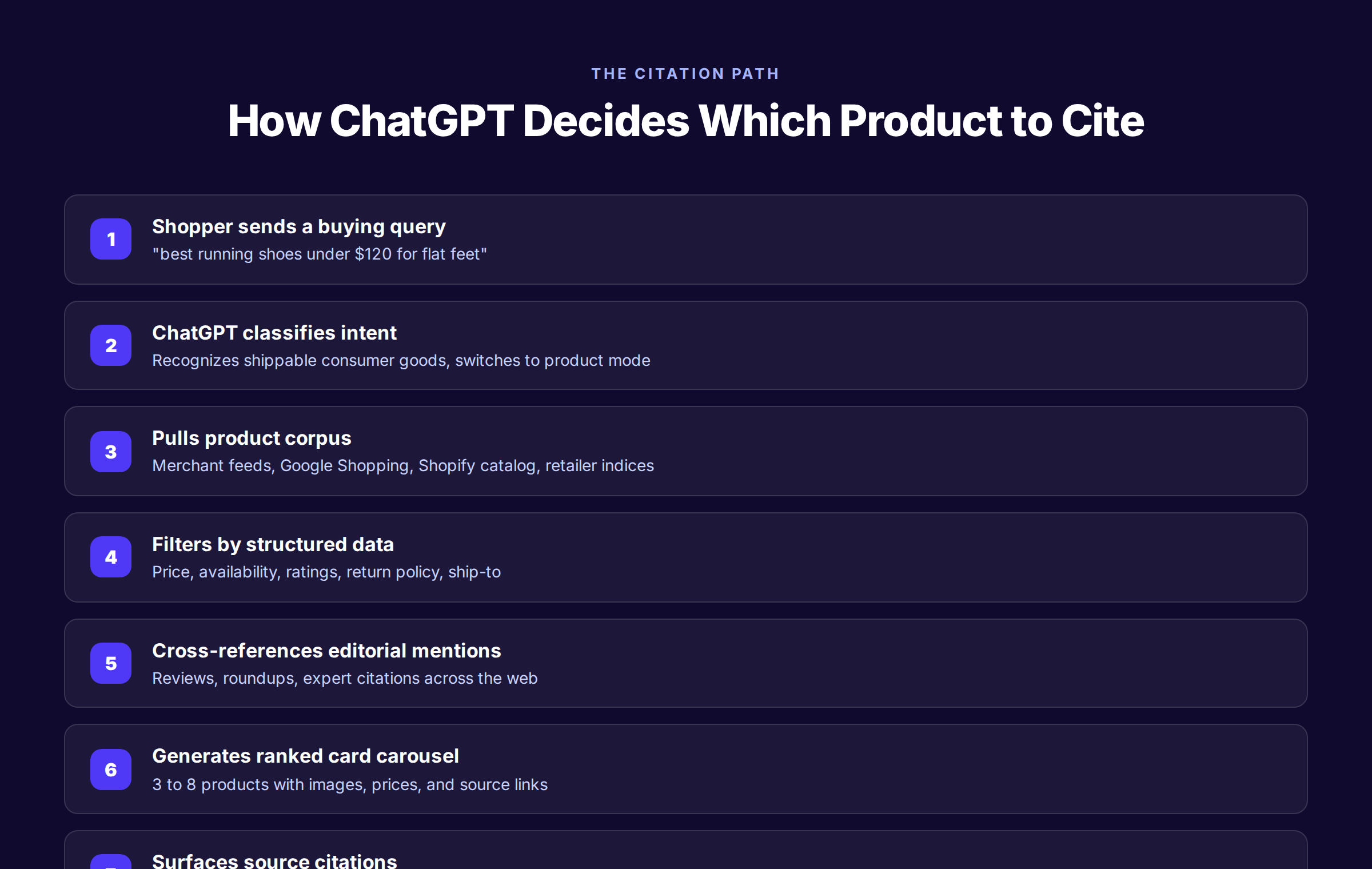
Step 1: Shopper Sends a Buying Query
The query is rarely a clean keyword. It looks like “I need a tent that fits 4 people, weighs under 8 pounds, ships to Oregon, costs less than $400.” ChatGPT parses intent from the messy sentence, not literal terms.
Step 2: Intent Classification
The model decides if the query is shippable consumer goods. The Profound research team reverse-engineered this trigger inside its ChatGPT Shopping prediction study. The trigger fires for physical products. It does not fire for services, B2B software, or abstract advice.
Step 3: Product Corpus Pull
ChatGPT pulls candidate products from merchant feeds, Google Shopping cross-references, Shopify Catalog, Etsy via Instant Checkout, retailer indices like Walmart and Target, and the open web. Profound analyzed 22.5 million ChatGPT shopping queries and found Walmart leads rank-1 buy links, while Target leads total presence inside its retailer citation study.
Step 4: Structured Data Filter
The model filters candidates by parseable fields. Price must be a number. Availability must be current. Ship-to must be valid. Products missing these fields drop out of the candidate pool before ranking even begins.
Step 5: Editorial Cross-Reference
The model checks whether the candidate appears in editorial coverage on trusted review sites. SE Ranking analyzed 50,000+ AI citations and found editorial mentions are the second-highest signal behind structured data, reported by Search Engine Journal in its AI citations analysis.
Step 6: Final Ranking and Card Generation
The model ranks the surviving candidates by signal weight, generates the card carousel (3 to 8 products), and attaches source citations to the inline answer. The carousel reshuffles slightly on every request, which means ranking is probabilistic, not deterministic.
Step 7: Citation Display
The user sees product cards, inline brand mentions, and a source tray. Each surface drives a different traffic and trust outcome.
Stop guessing what AI cites. Start publishing the signals it rewards. Stacc ships 30 product-aligned blog posts per month plus the structured data to back them up. Start for $1 →
The 5 Ranking Signals That Drive Citations
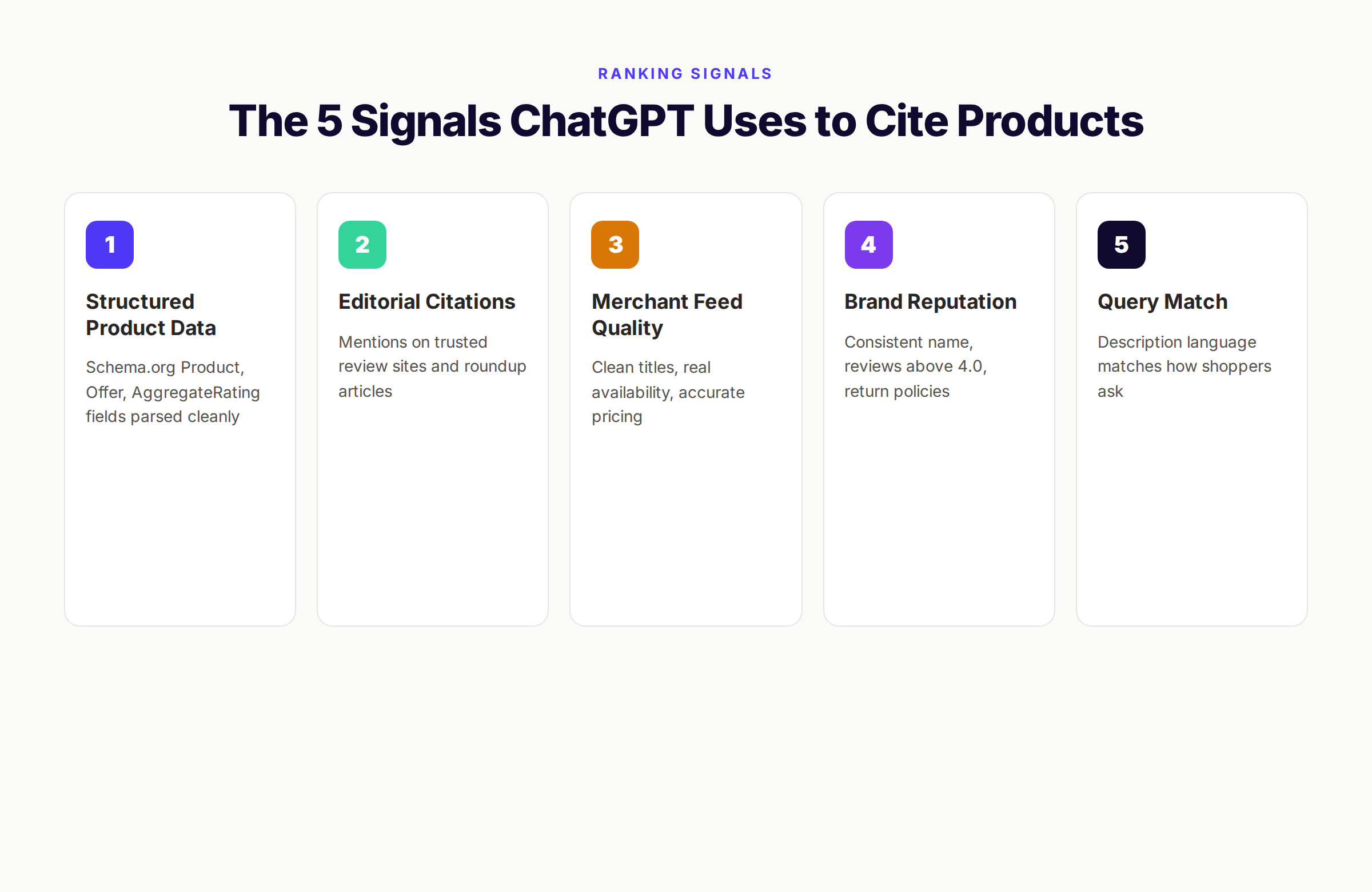
Five signals decide whether your product gets cited. The first three are technical. The last two are editorial. You need all 5 to earn consistent placement.
1. Structured Product Data
Schema.org Product markup is the entry ticket. Without it, ChatGPT cannot parse your page reliably. With it, your product becomes a candidate in the corpus pull. The fields the model actually reads include name, image, description, brand, offers (price, currency, availability, url), aggregateRating (ratingValue, reviewCount), sku, and gtin or mpn. Our product page schema guide covers the exact markup format.
2. Editorial Citations
Editorial mentions on review sites, comparison roundups, and category guides act as third-party validation. When ChatGPT sees the same product cited by 4 or 5 trusted sites, the model treats the product as a known entity. This is the generative engine optimization lever most brands skip because it is harder than schema.
3. Merchant Feed Quality
If you sell through Shopify, Etsy, or a direct retailer feed, the data you ship into the feed matters more than the data on your site. Feeds with clean titles, real availability, accurate pricing, and complete attribute coverage outrank feeds with stale or thin data. Our Shopify AI shopping agent discovery guide covers Agentic Storefronts and Universal Commerce Protocol setup.
4. Brand Reputation Signals
Brand consistency matters. The same brand name across product pages, retailer listings, social profiles, and editorial mentions builds a strong entity signal. Aggregate review counts above 50 with average ratings above 4.0 push your product up the candidate list. Return policy clarity and shipping reliability information embedded in schema help too.
5. Query Match
The language of your product description must match how shoppers actually ask. “Lightweight waterproof hiking backpack with hydration sleeve under $150” is how a buyer asks. “Premium technical outdoor textile carry solution” is how a marketer writes. The first earns citations. The second does not. Our AI-optimized product descriptions guide walks through the rewrite playbook.
| Signal | Weight | Time to Improve | Compounds |
|---|---|---|---|
| Structured product data | High | Days | No (one-time setup) |
| Editorial citations | High | Months | Yes |
| Merchant feed quality | High | Weeks | Partial |
| Brand reputation | Medium | Months | Yes |
| Query match | Medium | Days | No |
The compounding signals (editorial and brand) are the moat. The technical signals are table stakes. Brands that win in ChatGPT Shopping have all 5 working together.
Where ChatGPT Pulls Product Data From
ChatGPT does not have one source. The model pulls from a stack of inputs and triangulates between them. Brands that show up in multiple sources at once earn the highest citation rate.
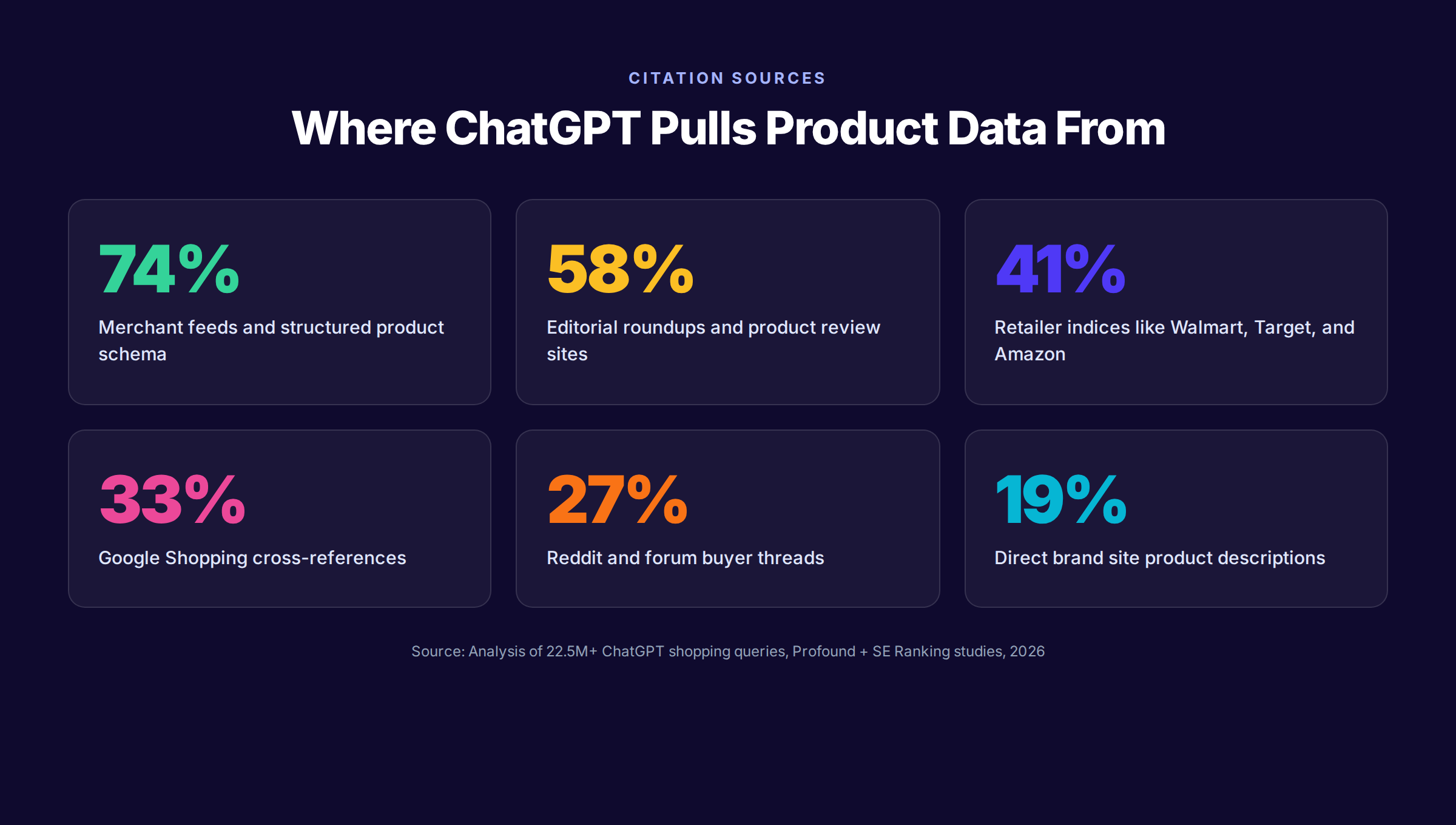
Merchant Feeds and Product Schema (74%)
The bulk of ChatGPT product citations originate from structured merchant data. This includes direct OpenAI merchant feed uploads, Shopify Catalog feeds via Agentic Storefronts, Etsy feeds via Instant Checkout, and Google Shopping cross-references. If you sell physical goods and want to be cited, this is the floor.
Editorial Roundups and Review Sites (58%)
Wirecutter, RTINGS, Tom’s Guide, The Spruce, and category-specific review hubs are the second-largest source. ChatGPT cites these sites because they have editorial reputation, clean structure, and explicit recommendations. A product mentioned in 3 to 5 of these sites earns priority placement.
Retailer Indices (41%)
Walmart, Target, Amazon, and Best Buy product pages get cited because the retailers ship rich product data into their own catalogs. When the model trusts a retailer page over a brand site, the citation links to the retailer. This is why Walmart and Target dominate rank-1 buy links in shopping carousels.
Google Shopping Cross-References (33%)
United Ads research showed ChatGPT shopping results have a 75% match rate with Google Shopping results inside its analysis of product recommendation overlap. The model uses Google Shopping as a sanity check on product existence, pricing, and availability.
Reddit and Forum Discussions (27%)
Reddit threads (r/BuyItForLife, r/FrugalMaleFashion, r/Coffee) get cited because they contain unsponsored buyer opinions. Forum-specific brand mentions help products surface in long-tail buying queries.
Direct Brand Site Pages (19%)
Your own ecommerce site is only the foundation, not the primary citation source. The brand site is the entity anchor that everything else points to. Without it, the rest of the signals collapse.
How to Get Your Products Cited in ChatGPT Shopping
Citations are earned in a specific order. Skip a step and the next one underperforms. Here is the playbook we use for ecommerce clients.
Step 1: Audit Current Product Pages for Schema
Open Google’s Rich Results Test and run every priority product URL. If Product schema is missing or has errors, citations are not happening regardless of what else you do. Fix this first. The schema markup SEO guide walks through the audit process end to end.
Step 2: Rewrite Product Descriptions in Query Language
Pull 20 to 30 real buying queries from your category. Open ChatGPT in incognito mode and type “best [your product category] for [use case].” Read what the model returns. Notice the language. Rewrite your top 50 product descriptions to match that vocabulary. Cut marketing words. Add specific specs, use cases, and constraint language.
Step 3: Ship the Merchant Feed
If you sell on Shopify, activate Agentic Storefronts in admin. If you sell on Etsy, apply for Instant Checkout. If you sell direct, apply for the OpenAI merchant feed via the ChatGPT merchants page. Submit a clean, complete feed with all required fields.
Step 4: Earn Editorial Citations
Pitch product review sites in your category. Send sample units. Get listed in “best of” roundups. This is slow work. It is also the most valuable step because editorial citations compound. Three reviews earned in Q1 keep earning citations through Q4.
Step 5: Build Brand Mentions on Trusted Properties
Get your brand named on Reddit threads (organically, not spam), industry publications, podcast show notes, and YouTube reviews. ChatGPT cross-references mentions across the open web. The more places your brand name appears in buying-intent context, the more often the model picks you.
Step 6: Track Citations Across Queries
Use a generative engine optimization tracker to monitor which queries cite your products, where citations appear (card, inline, source tray), and which competitors take the slots you do not. Our AI search visibility tracking guide covers the tooling.
Step 7: Iterate on the Gap
When a competitor is cited and you are not, the gap is one of the 5 signals. Run the diagnostic. Fix schema first, description language second, editorial coverage third. Repeat every 30 days.
Citation work is publishing work. Stacc publishes 30 product-aligned blog posts plus the schema and editorial citations that make ChatGPT pick your product. Start for $1 →
Product Schema That Makes Citations Possible
Schema.org Product markup is non-negotiable. Without it, no amount of editorial work will earn you a ChatGPT Shopping citation. The model needs structured fields it can parse confidently. Here is the minimum field set.
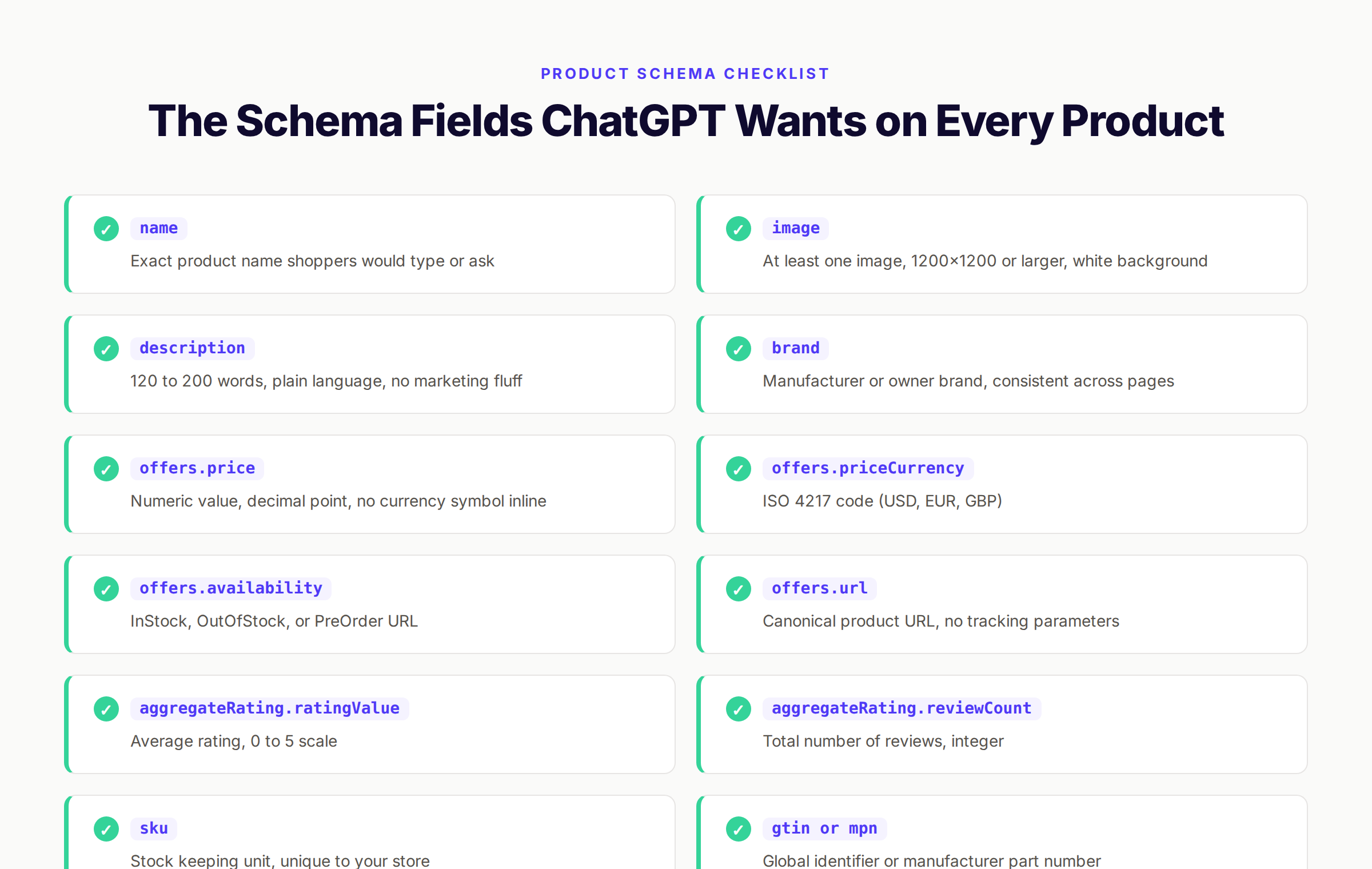
The 12 Required Fields
-
name— Exact product name shoppers would type or ask -
image— At least one image, 1200x1200 or larger, white background preferred -
description— 120 to 200 words, plain language, no marketing fluff -
brand— Manufacturer or owner brand, consistent across pages -
offers.price— Numeric value, decimal point, no currency symbol inline -
offers.priceCurrency— ISO 4217 code (USD, EUR, GBP) -
offers.availability— InStock, OutOfStock, or PreOrder -
offers.url— Canonical product URL, no tracking parameters -
aggregateRating.ratingValue— Average rating, 0 to 5 scale -
aggregateRating.reviewCount— Total number of reviews, integer -
sku— Stock keeping unit, unique to your store -
gtinormpn— Global identifier or manufacturer part number
Sample Product Schema
{
  "@context": "https://schema.org/",
  "@type": "Product",
  "name": "Trailhead 40L Hiking Backpack",
  "image": "https://example.com/trailhead-40l.jpg",
  "description": "Lightweight 40-liter waterproof hiking backpack with hydration sleeve, ventilated back panel, and 4.2-pound carry weight. Fits torsos 16 to 20 inches.",
  "brand": {
    "@type": "Brand",
    "name": "Trailhead"
  },
  "offers": {
    "@type": "Offer",
    "url": "https://example.com/products/trailhead-40l",
    "priceCurrency": "USD",
    "price": "149.00",
    "availability": "https://schema.org/InStock"
  },
  "aggregateRating": {
    "@type": "AggregateRating",
    "ratingValue": "4.6",
    "reviewCount": "287"
  },
  "sku": "TRL-40L-BLK",
  "gtin": "00012345678905"
}
Drop this in a <script type="application/ld+json"> tag in the page head. Validate it with Google’s Rich Results Test. Fix any errors before moving on. The model rejects partial or malformed schema.
Beyond the Basics: Additional Fields That Help
Once the basics are in place, add additionalProperty for specs like weight, material, capacity. Add hasMerchantReturnPolicy with merchantReturnDays for return clarity. Add shippingDetails with shippingRate for fulfillment confidence. Each additional field gives the model another reason to cite you over a competitor with thinner data.
Building Editorial Citations (The Underrated Lever)
Schema alone gets you in the door. Editorial citations get you to the front of the carousel. This is the gap between brands that show up sometimes and brands that show up consistently.
What “Editorial Citation” Means in This Context
An editorial citation is a mention of your product on a third-party site that ChatGPT trusts. The strongest editorial citations come from:
- Category-specific review hubs (RTINGS for electronics, Wirecutter for general consumer, The Spruce for home)
- Comparison roundup articles (“best [category] for [use case]”)
- Buyer’s guides published by industry publications
- Product review blogs with consistent posting history
- YouTube reviews with clear product names in titles and descriptions
Each citation adds a vote of confidence the model uses to break ties between similar products.
How to Earn Them
The honest answer is the unsexy one. You pitch, sample, and follow up. The shortcut answer is the one most brands try first and regret. Paid placements work for short-term wins. Earned placements compound for years.
- Make a target list. 30 to 50 review sites in your category. Rank them by domain authority, audience fit, and posting frequency.
- Send sample units. With a clear, short pitch that explains who you are, what the product is, why it matters, and what makes it worth their time.
- Follow up at 14 and 30 days. Persistence wins. Most editors miss the first email.
- Send updates when products change. Editors who covered you once will cover you again if you make it easy.
Build Your Own Editorial Presence
The other lever is publishing your own content. A consistent blog with category-relevant articles makes your domain a citable source over time. ChatGPT cites brands that publish authoritative content on their own categories. Our content SEO module is built for exactly this lift.
Reddit and Forums
Reddit is the dark horse of AI citations. ChatGPT cites Reddit threads when they contain genuine buyer discussion. You cannot fake this. You can participate authentically in the subreddits where your buyers hang out, answer questions honestly, and let your brand name surface naturally. Spam earns bans. Genuine help earns mentions.
How to Track If You Are Cited in ChatGPT Shopping
You cannot improve what you do not measure. Tracking ChatGPT citations is harder than tracking Google rankings because the response is generative and probabilistic. Here is how to do it correctly.
Method 1: Manual Query Sampling
Build a list of 20 to 50 buying queries in your category. Each week, run them through ChatGPT in a fresh chat (clear context). Log which products appear in the card carousel, which brands appear in the inline answer, and which sources appear in the source tray. Track the percentage of queries that cite your brand.
This is tedious. It is also the most accurate baseline because you see exactly what a real buyer sees.
Method 2: Generative Engine Optimization Tools
Tools like Profound, Otterly, AthenaHQ, and Peec.ai sample ChatGPT queries at scale and report citation share. They are not perfect (ChatGPT does not have a public API for ranking data), but they give you trend lines and competitor comparisons. Our AI search visibility tracking guide lists the leading tools and what each does well.
Method 3: Referrer Attribution
When a buyer clicks a citation link inside ChatGPT, the referrer header sometimes contains chatgpt.com or oaiusercontent.com. Set up a custom segment in Google Analytics 4 to capture this traffic. It will undercount (many AI clicks do not pass referrers), but the trend over time tells you whether your citation work is paying off.
Method 4: Brand Lift in Direct and Organic
The lagging indicator is brand lift. If your ChatGPT citations are working, you see direct traffic and brand-name organic searches climb 60 to 90 days after the citation work starts. This is the slow signal. It is also the most reliable.
| Tracking Method | Accuracy | Effort | Best For |
|---|---|---|---|
| Manual query sampling | Highest | High | Baseline + diagnostic |
| GEO tools | High | Low | Trend tracking + competitor share |
| Referrer attribution | Medium | Low | Quantifying click traffic |
| Brand lift | High (lagging) | Low | Proving citation ROI |
The right answer is to run all 4. Each gives a different signal. Together they tell the full citation story.
Common Mistakes That Block ChatGPT Citations
These mistakes show up across most ecommerce sites. Each one is fixable. Each one is costing you citations right now.
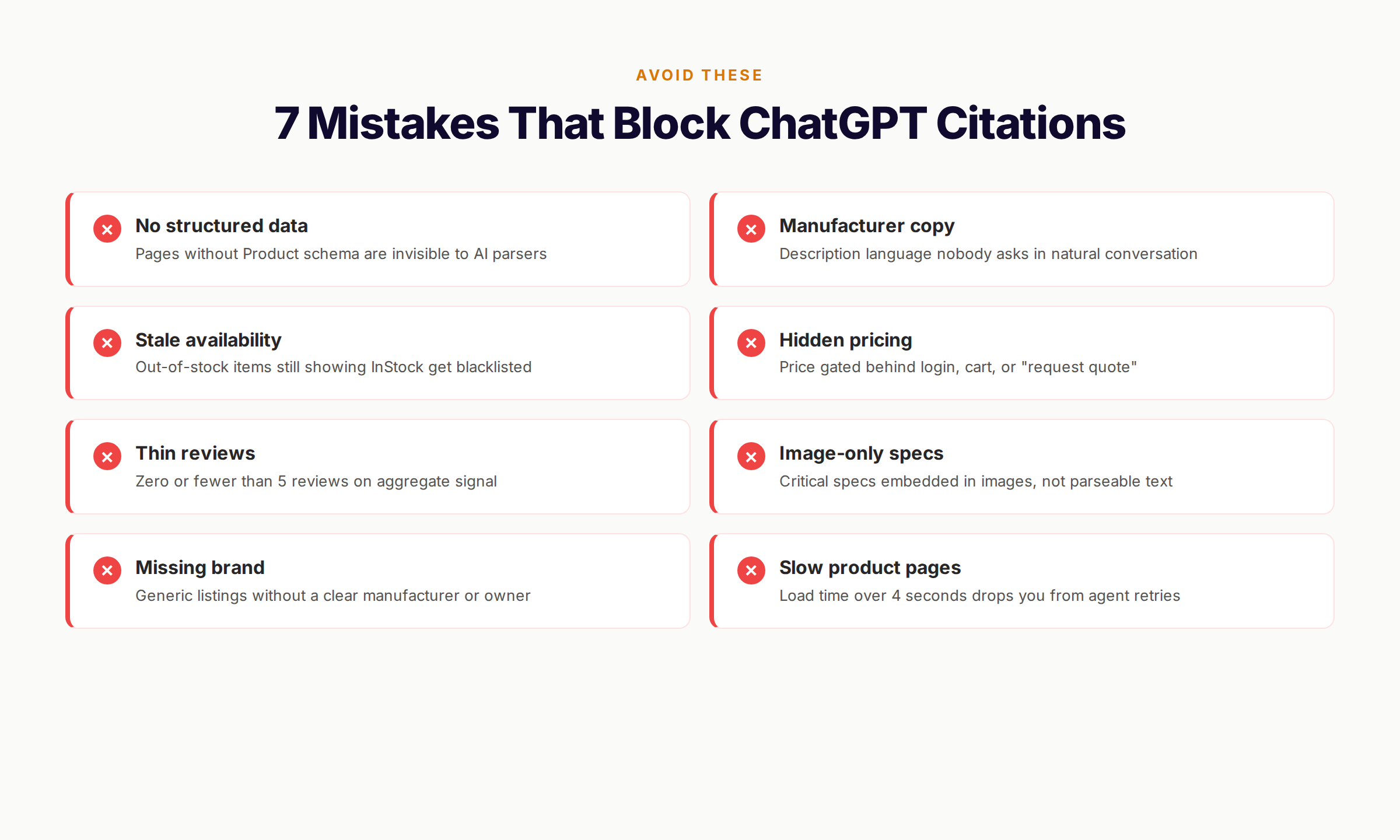
Mistake 1: No Structured Product Data
Pages without Product schema are invisible to AI parsers. The model cannot extract reliable price, availability, or rating data. This is the single most common reason brands get zero citations even when their product is genuinely good.
Mistake 2: Manufacturer Copy in Descriptions
If your description sounds like a brochure, the model cannot map it to buyer queries. Buyers ask “lightweight backpack for day hikes.” Manufacturers write “premium technical outdoor textile solution.” Rewrite for the buyer.
Mistake 3: Stale Availability Flags
Out-of-stock items still showing InStock in schema get blacklisted by the model. The trust signal collapses when the AI sends a buyer to a sold-out page. Sync your schema to real inventory in real time.
Mistake 4: Hidden Pricing
Price gated behind login, cart, or “request a quote” forms kills citations immediately. The model needs a numeric price field. No price means no citation.
Mistake 5: Thin or Missing Reviews
Products with zero reviews or fewer than 5 ratings rarely get cited. Aggregate review counts are a trust proxy. Build review velocity from day one. Even modest review counts beat zero.
Mistake 6: Image-Only Specifications
Critical specs embedded in images instead of parseable text are invisible to the model. ChatGPT cannot OCR your product images at scale. Put specs in HTML text on the page.
Mistake 7: Missing or Inconsistent Brand
Generic listings without a clear manufacturer or owner brand fail the brand reputation signal. Pick one brand name. Use it consistently across product pages, retailer listings, social profiles, and editorial mentions.
Bonus: Slow Page Load
ChatGPT and its crawlers re-fetch product pages to verify availability and pricing. Pages with load times above 4 seconds drop out of agent retries. Core Web Vitals matter for AI citations too. Our Shopify Core Web Vitals guide covers the platform-specific fixes.
ChatGPT Shopping Citation FAQ
Is there a ChatGPT for shopping? Yes. ChatGPT Shopping is a feature inside the standard ChatGPT interface that surfaces product cards, prices, reviews, and direct buy links when a user asks a buying-intent question. It launched in April 2025 and expanded with Instant Checkout (Etsy + Shopify) in September 2025 and Shopping Research in November 2025.
How do you get your products listed on ChatGPT? Apply for the OpenAI merchant feed at chatgpt.com/merchants, activate Agentic Storefronts inside Shopify admin, or enable Instant Checkout if you sell on Etsy. Ship clean Product schema on every page. Earn editorial citations on review sites in your category.
Will Shopify merchants be able to sell directly in ChatGPT? Yes. Shopify activated Agentic Storefronts as part of the Winter 26 Edition in December 2025. Eligible merchants get default access to ChatGPT, Microsoft Copilot, Google AI Mode, and the Gemini app without separate integrations. The integration has shifted approaches over time, but Shopify catalog data is one of the largest input sources to ChatGPT Shopping.
How does ChatGPT decide which products to cite? The model uses 5 ranking signals: structured product data, editorial citations on trusted review sites, merchant feed quality, brand reputation signals, and query match. Brands that score high on all 5 get cited consistently. Brands that score high on only 1 or 2 get cited inconsistently or not at all.
Are ChatGPT product citations paid? No. OpenAI describes product results as organic and unsponsored. Merchants do not pay for placement in the standard ChatGPT Shopping experience. Sponsored placements are a separate, evolving product layer.
How many products does ChatGPT cite per query? Typically 3 to 8 products in the card carousel, plus 1 to 4 inline brand mentions in the answer text, plus 2 to 6 sources in the source tray. The exact count varies by query specificity. Narrow queries return fewer cards.
Do I need both schema and editorial citations? Yes. Schema is the entry ticket. Editorial citations are the priority signal that decides who gets to the front of the carousel. Without schema, you are invisible. With schema but no editorial coverage, you are inconsistently visible.
How long does it take to get cited after launching new products? Schema-based citations can start within 2 to 4 weeks of clean indexing. Editorial citations take longer because they depend on third-party publishing cycles. Plan for 3 to 6 months to build a stable citation share.
Where ChatGPT Shopping Goes Next
ChatGPT Shopping is still early. The card formats will change. The ranking signals will tighten. The merchant feed program will evolve. What stays constant is the underlying logic. Buyers want a fast, trusted answer. The model picks products that look most trustworthy to ship that answer. Brands that invest in the trust signals today own the citations of tomorrow.
The brands that win will treat product citations the same way they once treated organic rankings. They will measure, iterate, and publish. They will build the data, earn the editorial coverage, and track the gap every month. The rest will keep wondering why ChatGPT recommends their competitors.
If you want the publishing engine that produces both the editorial citations and the product-aligned content that earn citations at scale, start for $1 and let us do the work.

Written by
Siddharth GangalSiddharth is the founder of theStacc and Arka360, and a graduate of IIT Mandi. He spent years watching great businesses lose organic traffic to competitors who simply published more. So he built a system to fix that. He writes about SEO, content at scale, and the tactics that actually move rankings.
30 SEO blog articles published every month
Keyword-optimized, scheduled, and live on your site. Automatically.
30-day trial · Cancel anytime
theStacc
Stop writing SEO content manually
30 blog articles, 30 GBP posts, and social media content. Published every month. Automatically.
Start Your $1 Trial$1 for 3 days · Cancel anytime