
Online Review Statistics 2026: 50+ Facts
50+ online review statistics for 2026, all sourced and verified. 95% read reviews before buying. Updated March 2026.
Siddharth Gangal • 2026-03-30 • Local SEO
In This Article
95% of consumers read online reviews before making a purchase. Google holds 73% of all review volume. And 30% of reviews are estimated to be fake.
Online review statistics shape how businesses invest in reputation, local SEO, and customer experience. Yet most data floating around is outdated or unsourced.
We compiled 50+ online review statistics from BrightLocal, DemandSage, Google, and other primary sources. Every stat below includes a citation and year.
We publish 3,500+ blogs across 70+ industries. The patterns in this data match what we see driving local SEO results for real businesses every month.
Here is what you will learn:
- How many consumers read reviews and where they read them
- Which platforms dominate online review volume
- How star ratings and review counts affect conversions
- What consumers expect from review responses
- How fake reviews impact trust and what regulators are doing
- How to turn these statistics into a review management strategy
Last updated: March 2026
General Online Review Statistics
These numbers show how deeply reviews influence the modern buyer journey.
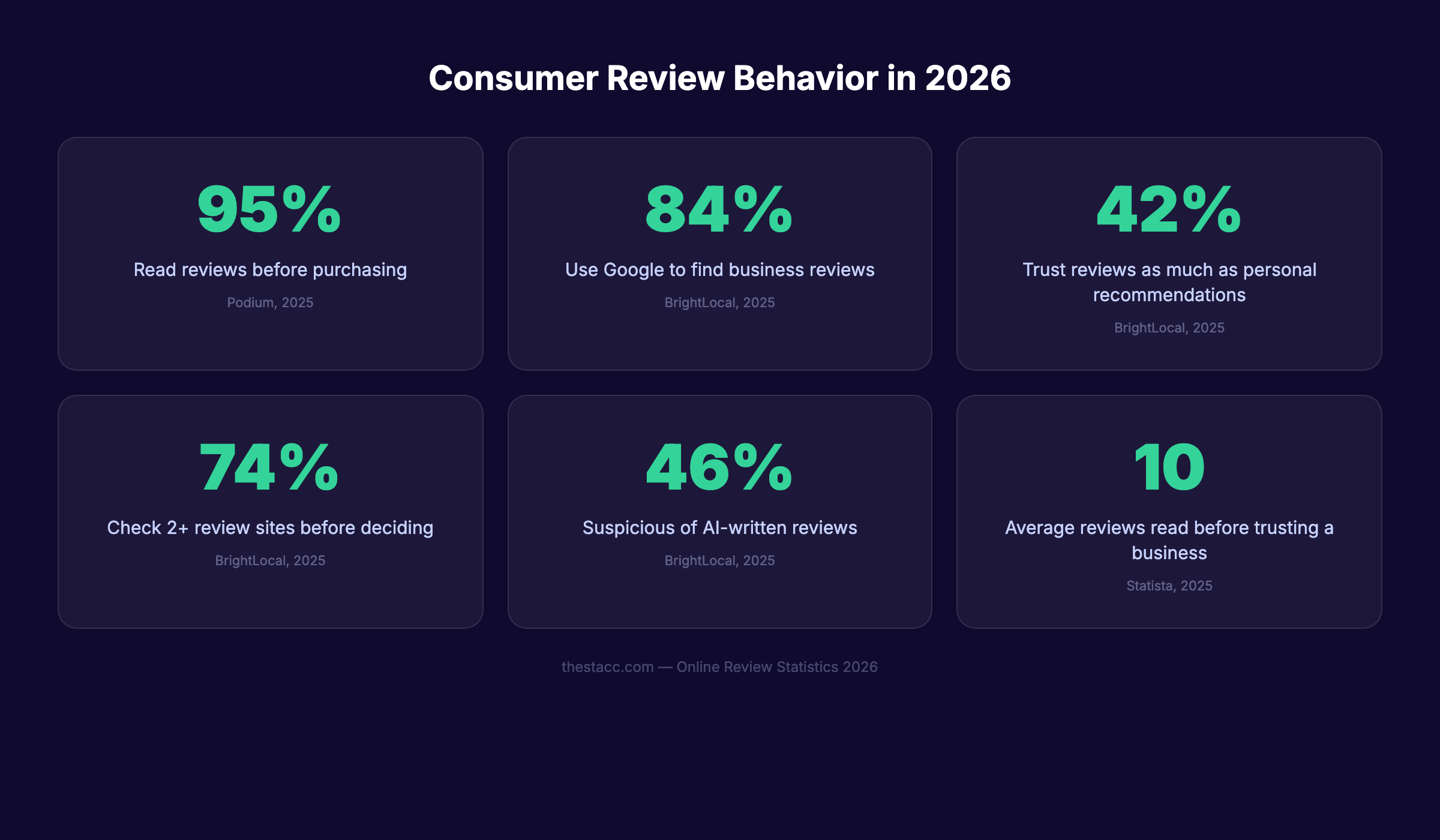
1. 95% of consumers read online reviews before making a purchase. (Source: Podium, 2025) Nearly every buyer checks reviews. The 5% who do not are statistical outliers.
2. 84% of consumers use Google to find business reviews. (Source: BrightLocal, 2025) Google is the default starting point. No other platform comes close for local search.
3. 74% of consumers check 2 or more review websites before deciding. (Source: BrightLocal, 2025) A single platform presence is not enough. Buyers cross-reference.
4. The average consumer reads 10 reviews before trusting a business. (Source: Statista, 2025) Businesses with fewer than 10 reviews face an immediate credibility gap.
5. 42% of consumers trust online reviews as much as personal recommendations. (Source: BrightLocal, 2025) This number dropped from 79% in 2020. Consumers are more skeptical now, but reviews still rank second only to word-of-mouth.
6. 46% of consumers are suspicious of reviews that appear AI-written. (Source: BrightLocal, 2025) AI-generated reviews erode trust. Authentic language matters more than ever.
7. 48% of consumers read AI-generated review summaries but still check individual reviews. (Source: BrightLocal, 2025) AI summaries are a starting point, not a replacement. Buyers still want the raw data.
8. Only 4% of consumers never read online business reviews. (Source: BrightLocal, 2025) Reviews are no longer optional. They are part of the purchase decision for 96% of adults.
Review Platform Market Share Statistics
Not all review platforms carry equal weight. Google dominates, but niche platforms still matter for specific industries.
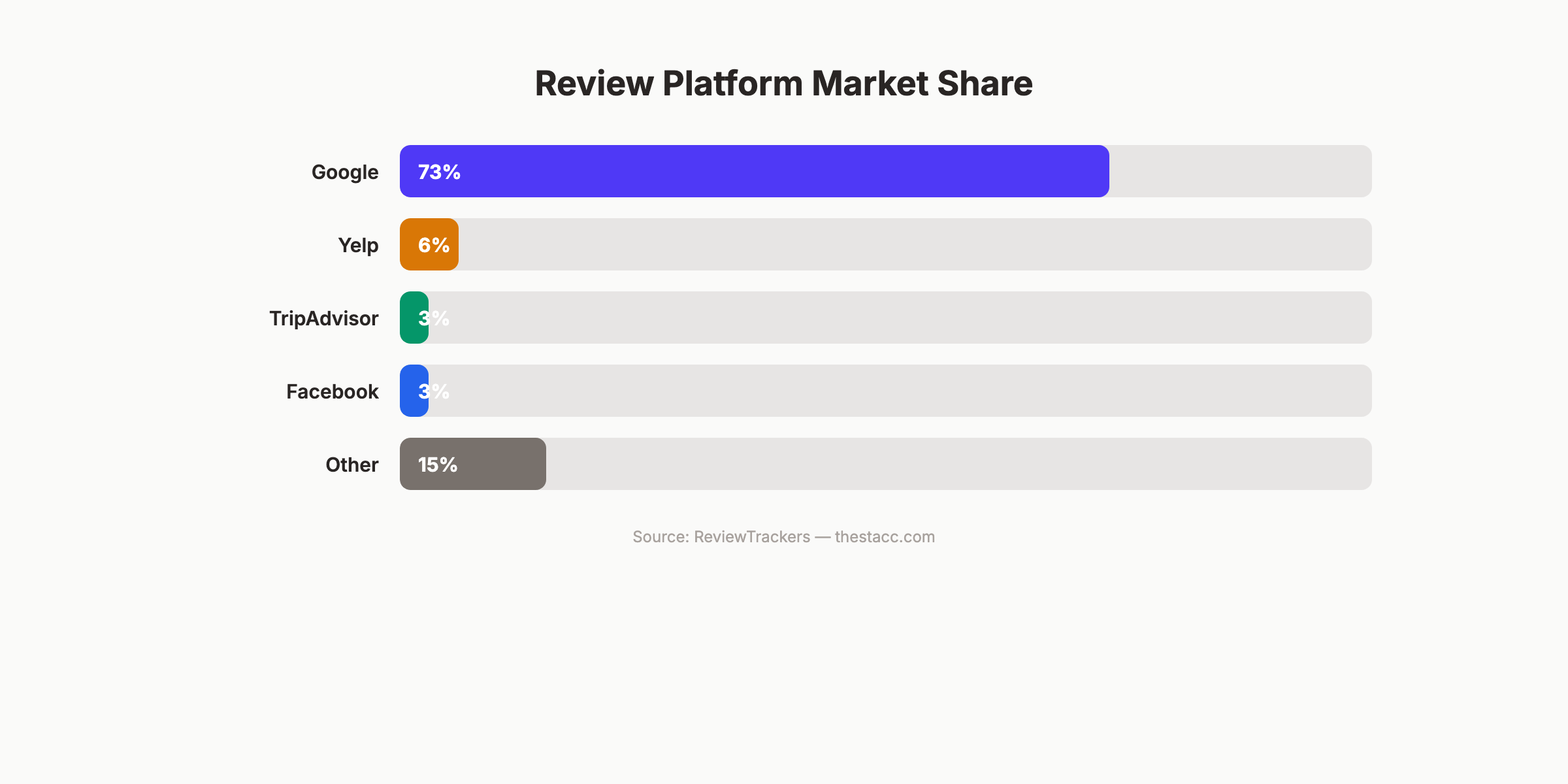
9. Google holds 73% of all online reviews. (Source: ReviewTrackers, 2025) Nearly 3 out of 4 reviews live on Google. Optimizing your Google Business Profile is the highest-priority action.
10. Yelp holds 6% of online review volume. (Source: ReviewTrackers, 2025) Yelp remains important for restaurants, home services, and healthcare. But its overall share continues to shrink.
11. TripAdvisor and Facebook each hold 3% of review volume. (Source: ReviewTrackers, 2025) TripAdvisor matters for hospitality. Facebook reviews are declining in perceived reliability.
12. 93% of Facebook users distrust reviews on that platform. (Source: BrightLocal, 2025) Facebook reviews carry the lowest trust score of any major platform.
13. Yelp receives 26,830 new reviews per minute. (Source: DemandSage, 2025) Despite its shrinking market share, Yelp still generates massive volume. For a deeper look at the dominant platform, see our Google reviews statistics breakdown.
14. 48% of U.S. adults turn to local news outlets for business reviews. (Source: BrightLocal, 2025) Local news and community sites are an underused review channel for local businesses.
Your reviews drive your rankings. Stacc publishes SEO content that brings customers to your door. They leave the reviews. Start for $1 →
Review Impact on Purchasing Decisions
Reviews do not just build trust. They directly move revenue.
15. 93% of consumers say online reviews influence their purchase decisions. (Source: Podium, 2025) Reviews are the second most influential factor after price for most buyers.
16. Products with 5+ reviews have a 270% higher purchase likelihood. (Source: Spiegel Research Center, Northwestern University) The threshold is low. Five reviews change buying behavior dramatically.
17. Displaying reviews boosts sales by 19.8% on average. (Source: Spiegel Research Center, Northwestern University) This applies across categories. The lift is higher for expensive products (380%) than low-cost ones (190%).
18. 44% of shoppers will not purchase from a business with zero reviews. (Source: DemandSage, 2025) No reviews is worse than a few mediocre reviews. Silence signals risk.
19. 86% of shoppers hesitate to buy from businesses with negative reviews. (Source: WiserReview, 2026) Hesitation does not mean refusal. But unchecked negative reviews create measurable friction. Learn how to respond to negative reviews effectively.
20. 58% of consumers will pay more or travel farther for businesses with positive reviews. (Source: Podium, 2025) Reviews override convenience and price for a majority of buyers.
21. 72% of travelers say online reviews influence their booking decisions. (Source: WiserReview, 2026) For hospitality and tourism businesses, reviews are the primary conversion driver.
Star Rating and Review Volume Statistics
The specific number of stars and the total count of reviews both affect how consumers evaluate a business.
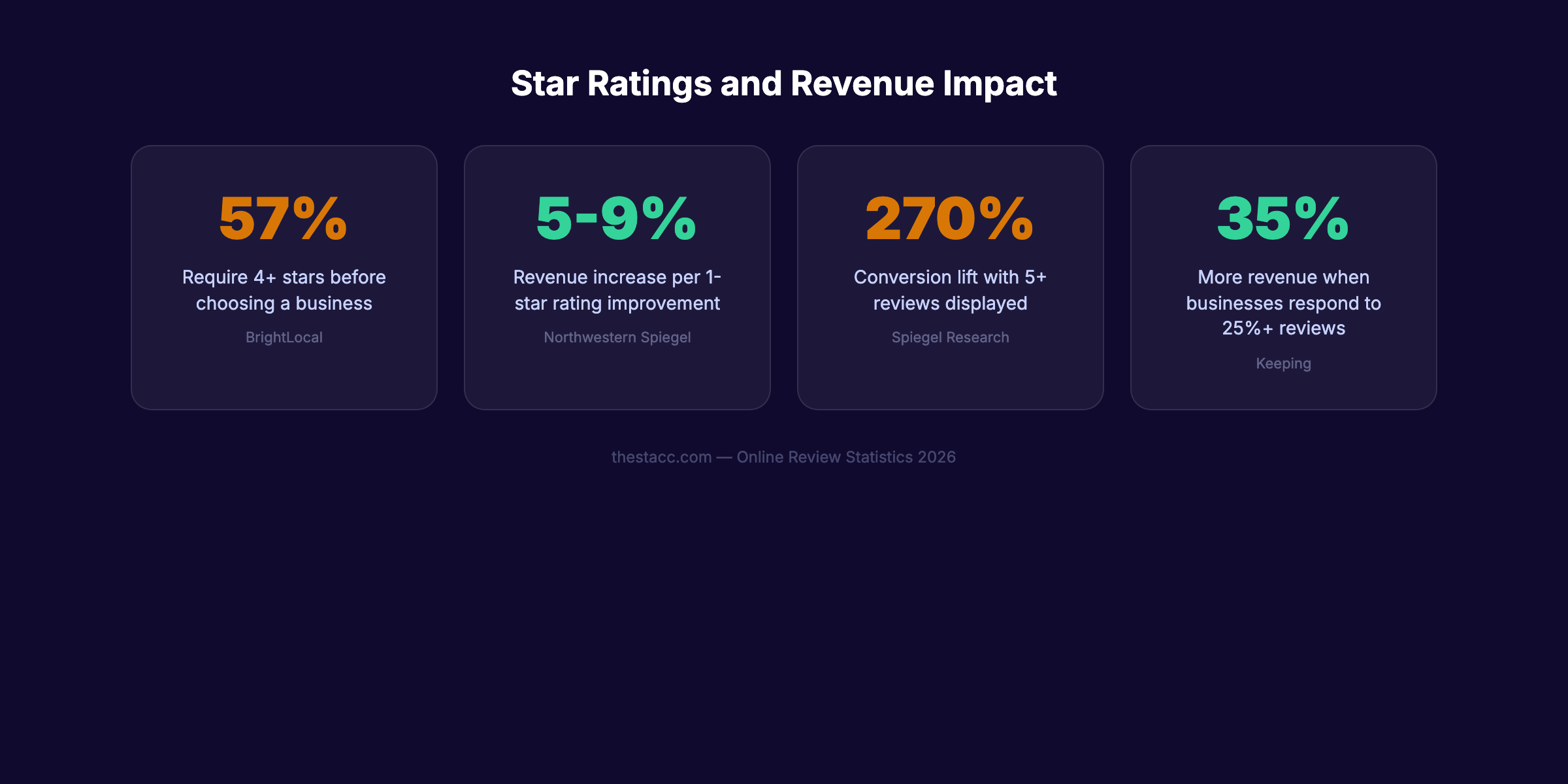
22. 57% of consumers require a business to have 4+ stars before they will use it. (Source: BrightLocal, 2025) Anything below 4 stars filters out more than half of potential customers.
23. 31% of consumers now require 4.5+ stars. (Source: WiserReview, 2026) This threshold nearly doubled from 17% in the prior year. Expectations are rising fast.
24. A 1-star improvement in rating increases revenue by 5-9%. (Source: Spiegel Research Center, Northwestern University) Moving from 3.5 to 4.5 stars can mean a 10-18% revenue gain.
25. 67% of consumers will not trust high ratings without substantial review volume. (Source: DemandSage, 2025) A 5.0 rating with 3 reviews is less convincing than a 4.6 with 200 reviews.
26. 43% of consumers prefer businesses with more than 100 reviews. (Source: DemandSage, 2025) Volume signals legitimacy. Businesses should consistently ask customers for reviews to build this number.
27. Products with 11-30 reviews convert 68% higher than those with zero. (Source: Spiegel Research Center, Northwestern University) The sweet spot is 26-50 reviews for most products and services.
| Star Rating | Consumer Willingness | Revenue Impact |
|---|---|---|
| Below 3.3 stars | Most consumers reject | Negative revenue effect |
| 3.3 - 3.9 stars | Acceptable to some | Neutral to slight positive |
| 4.0 - 4.4 stars | Acceptable to 57% | 5-9% revenue lift per star |
| 4.5 - 5.0 stars | Preferred by 31% | Peak conversion rates |
Review Response Statistics
How businesses handle reviews matters as much as the reviews themselves.
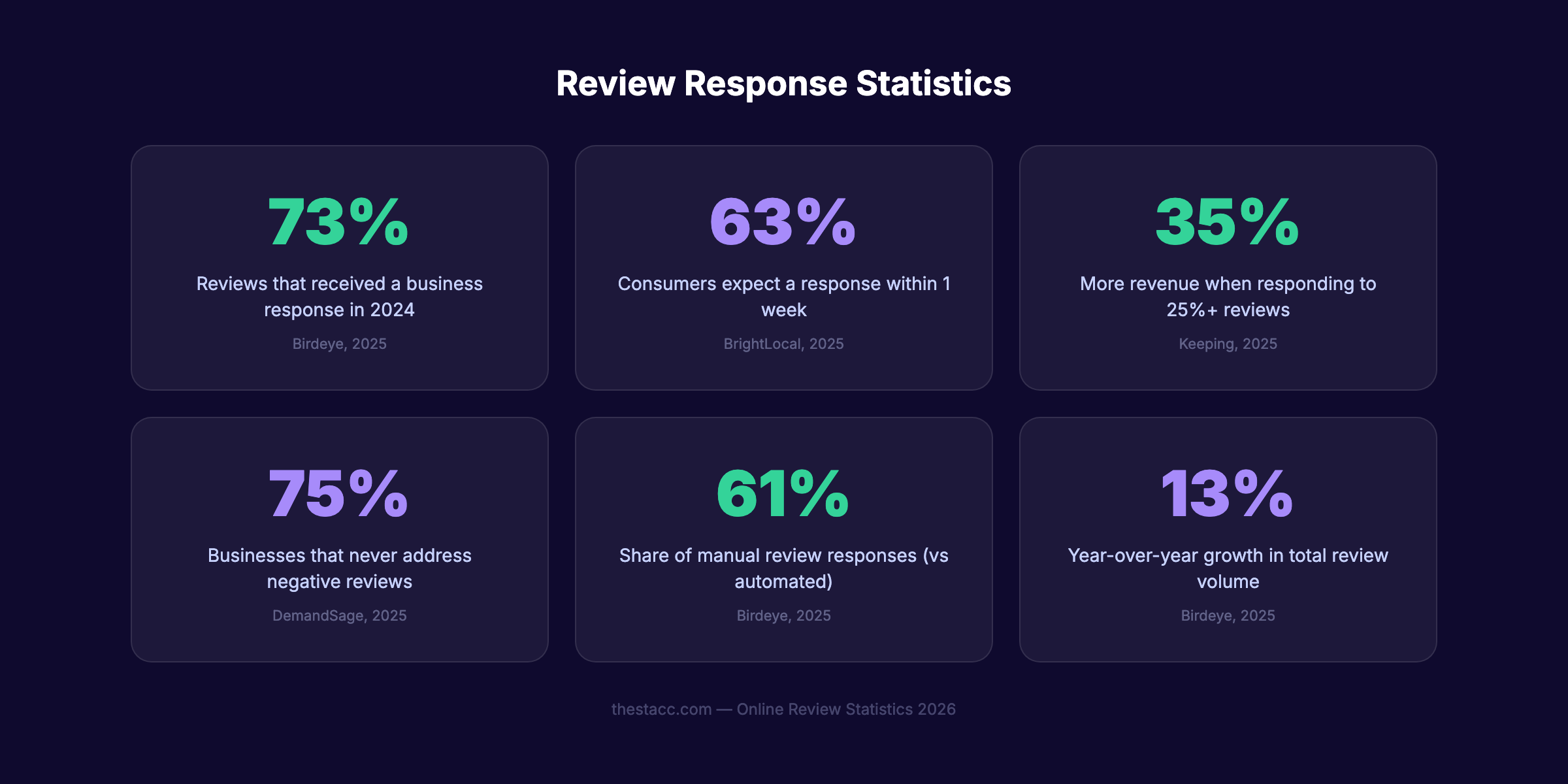
28. 73% of customer reviews received a business response in 2024. (Source: Birdeye, 2025) This is up from 63% the prior year. More businesses recognize responses matter.
29. 75% of businesses never address negative reviews. (Source: DemandSage, 2025) Three out of 4 businesses ignore their most damaging reviews. Use these review response templates to fix that gap.
30. Businesses that respond to 25%+ of reviews earn 35% more revenue. (Source: Keeping, 2025) Responding is not just good manners. It is a revenue driver.
31. 63% of consumers expect a response within 2-3 days to 1 week. (Source: BrightLocal, 2025) Speed matters. A response after 2 weeks reads as indifference.
32. Manual review responses grew from 58% to 61% of all responses. (Source: Birdeye, 2025) Businesses are shifting away from automated replies. Consumers notice the difference.
33. Total review volume increased 13% year over year in 2024. (Source: Birdeye, 2025) More reviews mean more data for consumers and more local SEO ranking signals for search engines.
Reviews drive rankings. Content drives traffic. Stacc handles the content so you can focus on earning reviews. Start for $1 →
Fake Review Statistics
Fake reviews are a growing problem. Regulators and platforms are responding.
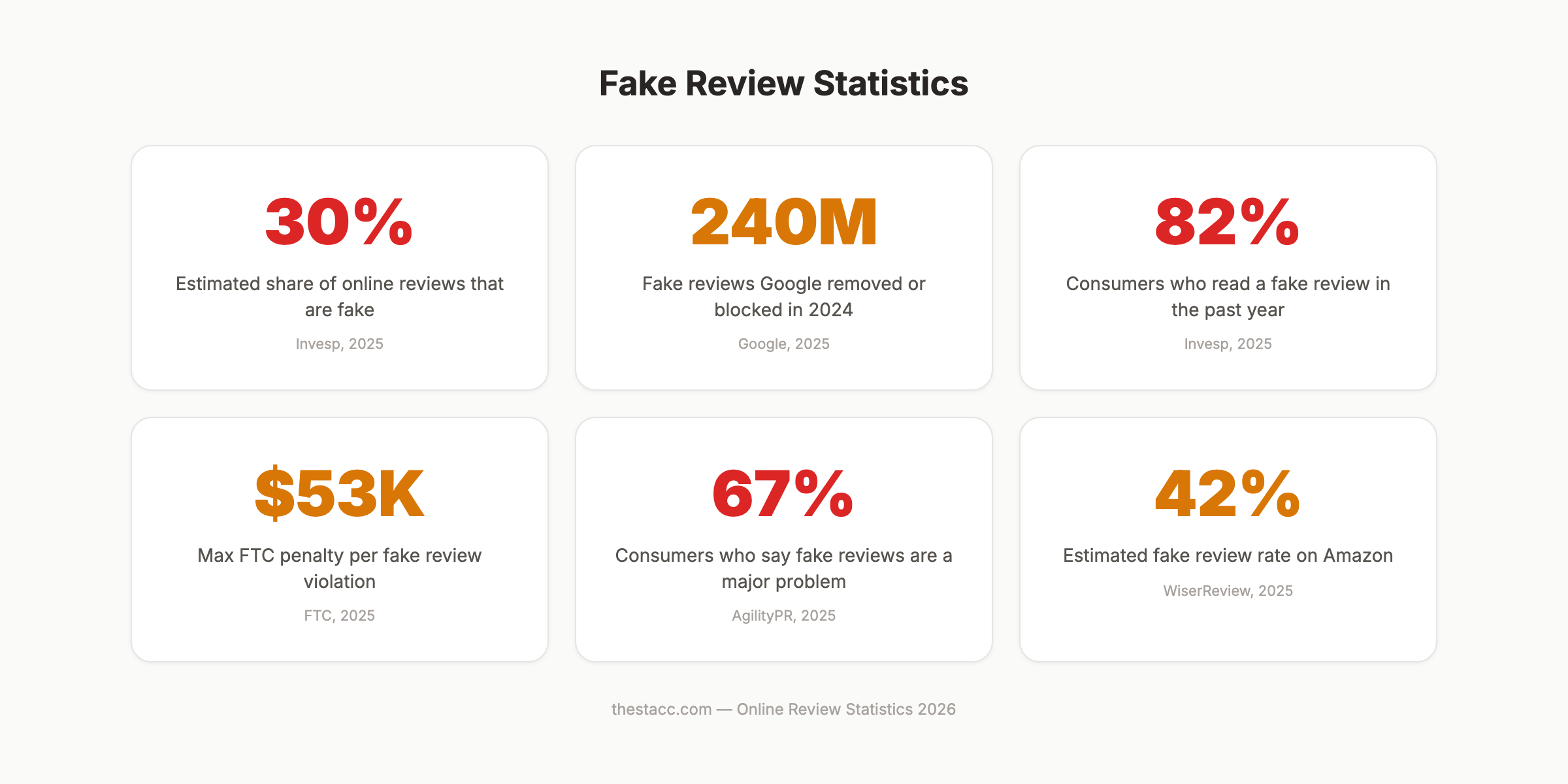
34. An estimated 30% of all online reviews are fake. (Source: Invesp, 2025) Nearly 1 in 3 reviews is fabricated. This erodes consumer trust across every platform.
35. Google removed or blocked 240 million policy-violating reviews in 2024. (Source: Google, 2025) Google is actively fighting fake reviews at scale. But 240 million removals shows the scope of the problem.
36. 82% of consumers have read a fake review in the past year. (Source: Invesp, 2025) Most consumers encounter fake reviews regularly. Learn how to handle fake Google reviews when they target your business.
37. 67% of consumers consider fake reviews a major problem. (Source: AgilityPR, 2025) Consumer awareness is high. Brands caught using fake reviews face permanent trust damage.
38. An estimated 42% of Amazon reviews may be fake. (Source: WiserReview, 2026) Amazon has the highest estimated fake review rate of any major platform.
39. The FTC can fine businesses up to $53,088 per fake review violation. (Source: FTC, 2025) The FTC issued its first enforcement warnings under the Consumer Review Rule in December 2025. Penalties will rise with inflation adjustments.
| Platform | Estimated Fake Review Rate |
|---|---|
| Amazon | 42% |
| 10.7% | |
| Yelp | 7.1% |
| TripAdvisor | 5.2% |
(Source: AgilityPR, 2025)
Review Generation and Solicitation Statistics
How and when businesses ask for reviews impacts the volume and quality they receive.
40. 40% of consumers are most likely to respond to email review requests. (Source: BrightLocal, 2025) Email outperforms SMS, in-person requests, and social media for review solicitation. This number grew from 32% in 2024.
41. 27% of consumers respond when asked for a review in person. (Source: BrightLocal, 2025) In-person requests remain effective, especially for service businesses like dentists, salons, and home service providers.
42. 29% of consumers wrote a business review in the past year. (Source: BrightLocal, 2025) Up from 27% the year before. The gap between review readers (95%) and review writers (29%) is enormous.
43. 75% of consumers leave reviews to help businesses improve. (Source: BrightLocal, 2025) Most reviewers have good intentions. Only 7% leave reviews primarily after negative experiences.
44. 96% of consumers are open to writing a review when asked. (Source: BrightLocal, 2025) The barrier is not willingness. It is the ask. Businesses that ask customers for reviews consistently outperform those that wait.
45. 23% of consumers say their experience was not noteworthy enough to review. (Source: BrightLocal, 2025) Framing the ask around specific outcomes (“How was your cleaning today?”) overcomes this objection.
Industry-Specific Review Statistics
Review patterns vary significantly across industries.
46. 86% of job seekers research company reviews before applying. (Source: Glassdoor, 2025) Reviews do not just affect customers. They affect hiring. Employer brand depends on review quality.
47. 52% of travelers avoid hotels without any reviews. (Source: DemandSage, 2025) Hospitality businesses face the steepest penalty for zero reviews.
48. The average review length dropped from 600 words in 2010 to 200 words today. (Source: BrightLocal, 2025) Reviews are getting shorter. Mobile usage drives this shift.
49. 84% of Amazon sellers consider reviews extremely critical to their business. (Source: eComEngine, 2025) For ecommerce, reviews are the primary trust signal above product descriptions and brand reputation.
50. TripAdvisor reviews are 3x longer than reviews on other platforms. (Source: TripAdvisor, 2025) Travel reviews tend to be detailed. The average hotel review on TripAdvisor runs 688 characters.
| Industry | Review Impact Level | Key Metric |
|---|---|---|
| Restaurants | Critical | 33% will not eat at a sub-4-star restaurant |
| Healthcare | High | 72% read reviews before choosing a doctor |
| Home Services | High | Reviews are the top trust factor |
| Hospitality | Critical | 52% avoid hotels with zero reviews |
| Ecommerce | Critical | 270% conversion lift with 5+ reviews |
| Professional Services | Moderate-High | 57% require 4+ stars |
Key Takeaways
- 95% of consumers read reviews before buying. Reviews are not optional. They are part of the purchase process.
- Google holds 73% of all reviews. Prioritize your Google Business Profile above all other platforms.
- 5 reviews can increase conversions by 270%. Even a small number of reviews creates a massive lift.
- 30% of reviews are estimated to be fake. Authenticity and FTC compliance are now business risks.
- Responding to reviews drives 35% more revenue. Use review response templates to respond consistently.
- 96% of consumers will write a review if asked. The biggest barrier is not asking.
- 57% of consumers require 4+ stars. Anything below 4 filters out more than half your potential customers.
Methodology
Sources: BrightLocal Local Consumer Review Survey 2025, DemandSage, Spiegel Research Center (Northwestern University), ReviewTrackers, Birdeye State of Online Reviews 2025, Podium, Statista, Google, FTC, AgilityPR, Glassdoor, eComEngine, WiserReview.
Last updated: March 2026
Note: We update this page quarterly to keep all statistics current. When a stat changes from its original publication, we note the updated date.
Frequently Asked Questions
What is the most important online review statistic in 2026?
95% of consumers read reviews before purchasing. This single number proves that reviews are not a “nice to have.” They are a requirement for every business that sells to consumers. Combine this with the fact that Google holds 73% of review volume, and the priority becomes clear.
How many reviews does a business need to be credible?
The minimum threshold is 5 reviews, which increases conversions by 270% according to the Spiegel Research Center. For maximum credibility, aim for 100+ reviews. 43% of consumers prefer businesses with more than 100 reviews. Consistent review generation matters more than occasional spikes.
Do review responses actually impact revenue?
Yes. Businesses that respond to at least 25% of their reviews earn 35% more revenue than those that do not respond. 63% of consumers expect a response within 1 week. Ignoring reviews signals that a business does not care about customer feedback.
What percentage of online reviews are fake?
An estimated 30% of all online reviews are fake. Google removed 240 million policy-violating reviews in 2024 alone. The FTC now enforces penalties of up to $53,088 per violation for businesses caught buying or fabricating reviews.
How do online reviews affect local SEO rankings?
Review signals (volume, velocity, diversity, and response rate) account for roughly 16% of local SEO ranking factors according to Whitespark. Google weighs review quantity, recency, and sentiment when ranking businesses in the local pack and Google Maps.
Reviews are the trust layer between your business and every future customer. Start building your review count, respond to every review, and pair it with consistent SEO content that drives the traffic your reviews convert.
Your SEO team. $99/month. Stacc publishes the content. Your customers leave the reviews. Rankings compound. Start for $1 →
Written and published by Stacc. We publish 3,500+ articles per month across 70+ industries. All data verified against public sources as of March 2026.
