
47 Google Reviews Statistics That Actually Matter in 2026
40+ Google reviews statistics for 2026 from BrightLocal, DemandSage, and Google. 97% read reviews before buying. Updated March 2026.
97% of consumers read reviews before choosing a local business. Google hosts 73% of all online reviews. 68% of consumers now require a 4-star minimum before they will buy.
Most business owners know reviews matter. Few realize how much the numbers have shifted in just 12 months.
Star rating expectations jumped 14 percentage points year over year. Review response speed expectations doubled. And 45% of consumers now use AI tools to evaluate reviews before making a decision.
We compiled 40+ Google reviews statistics from BrightLocal, DemandSage, Google, and other primary sources. Every stat includes a source and year.
We publish 3,500+ blogs across 70+ industries. The data below reflects what drives local SEO performance for hundreds of businesses.
Here is what you will learn:
- How many consumers read Google reviews before buying
- What star ratings consumers demand in 2026
- How reviews impact revenue and conversions
- Why review responses drive 18% more revenue
- What fake review rates look like across platforms
- How Google reviews affect local search rankings
General Google Reviews Statistics
Google dominates the online review space. No other platform comes close in volume, reach, or influence on purchase decisions.
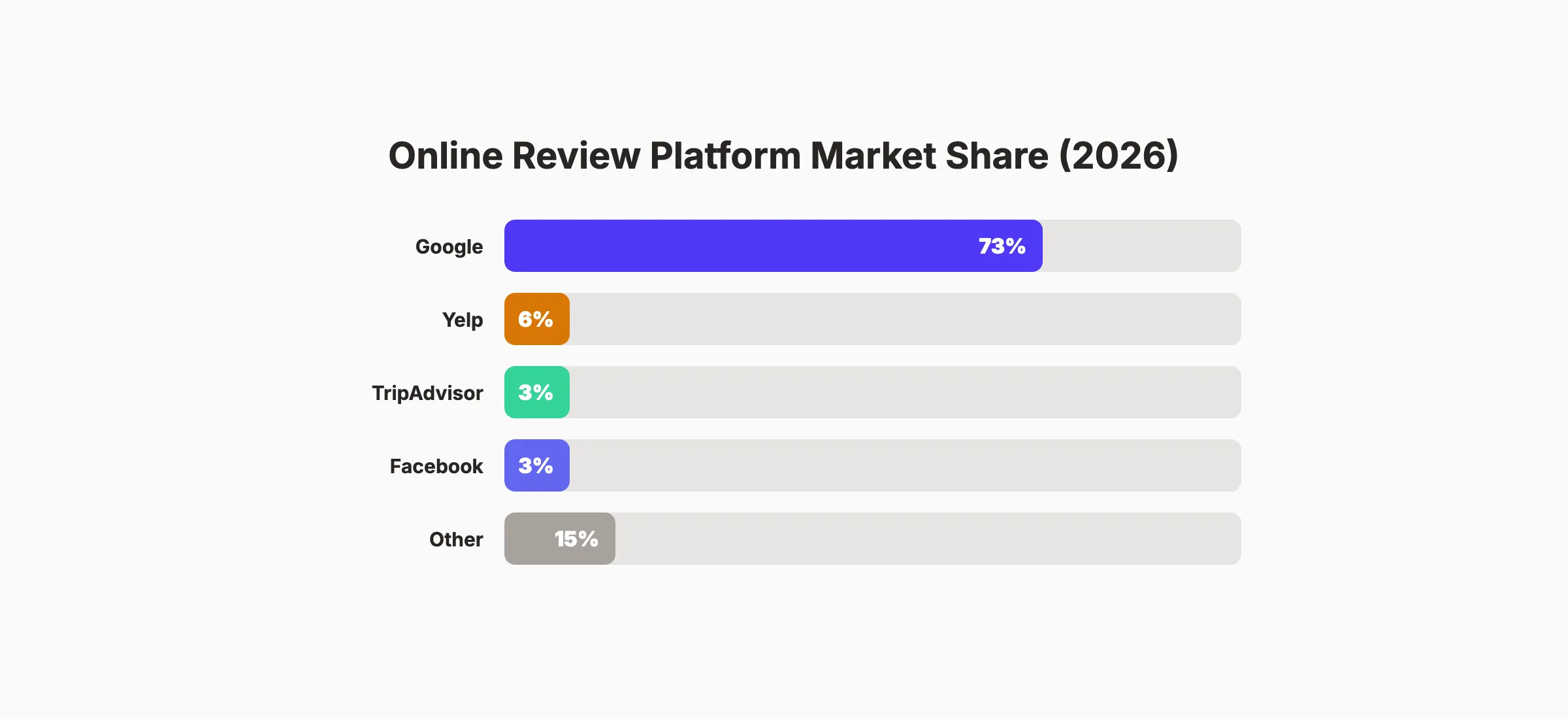
1. Google hosts 73% of all online reviews. Source: DemandSage, 2026 That makes Google the single largest review platform by a wide margin. Yelp holds 6%, TripAdvisor 3%, and Facebook 3%.
2. 81% of consumers check Google reviews before visiting a business. Source: DemandSage, 2026 Google is the first stop for most buyers. If your Google Business Profile has no reviews, you lose 4 out of 5 potential customers before they even visit your website.
3. 129,087 verified companies actively use Google Reviews as of 2026. Source: Landbase, 2026 That number keeps growing as businesses recognize the revenue impact.
4. Consumers use an average of 6 different review platforms before making a decision. Source: BrightLocal, 2026 Google is the starting point. But buyers cross-reference on Facebook, Apple Maps, and industry-specific sites.
5. Apple Maps review usage nearly doubled from 14% to 27% in one year. Source: BrightLocal, 2026 Apple Maps is growing fast as a review platform. Businesses that only focus on Google miss an expanding audience.
| Platform | Review Market Share | Year-over-Year Trend |
|---|---|---|
| 73% | Stable | |
| Yelp | 6% | Declining |
| TripAdvisor | 3% | Declining |
| 3% | Stable | |
| Apple Maps | 27% usage | +93% growth |
Consumer Trust and Review Reading Statistics
Consumers read reviews more often and trust them more deeply than ever. The 2026 data shows a clear acceleration.
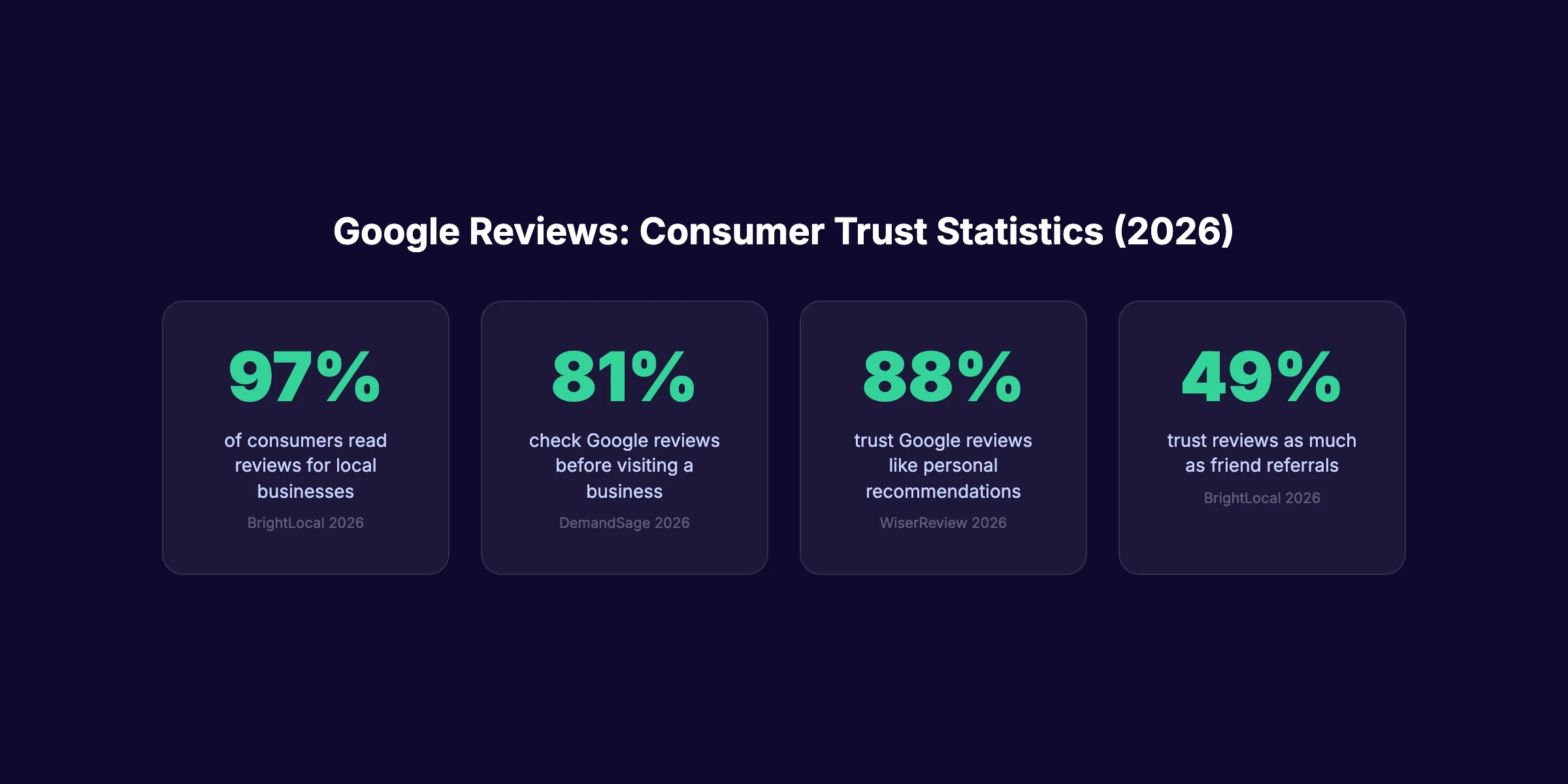
6. 97% of consumers read reviews for local businesses. Source: BrightLocal, 2026 This is near-universal behavior. Only 3% of buyers skip reviews entirely.
7. 41% of consumers “always” read reviews when browsing for businesses. Source: BrightLocal, 2026 This jumped from 29% in 2025. The “always” cohort grew by 41% in a single year.
8. 88% of customers trust Google reviews as much as personal recommendations. Source: WiserReview, 2026 A stranger on Google carries the same weight as a friend. That is a staggering level of trust.
9. 93% of consumers say reviews influence their purchasing decisions. Source: DemandSage, 2026 Reviews are not optional reading. They directly change buying behavior.
10. Consumers read an average of 10 reviews before trusting a business. Source: DemandSage, 2026 Businesses with fewer than 10 Google reviews face a trust gap that costs them sales.
11. 74% of consumers only pay attention to reviews from the last 3 months. Source: BrightLocal, 2026 Old reviews lose credibility fast. A steady stream of new reviews matters more than a large but stale count.
12. 32% of consumers want reviews from the last 2 weeks. Source: BrightLocal, 2026 This is up from 20% in 2025. Recency expectations keep accelerating.
13. Consumers spend an average of 13 minutes and 45 seconds reading reviews. Source: DemandSage, 2026 Reviews are not a quick glance. Buyers invest real time evaluating businesses through review content.
97% of consumers read reviews before choosing a local business. Stacc helps local businesses build and manage their online presence automatically. Start for $1 →
Star Rating Statistics
Star ratings are the first filter. Consumers eliminate businesses below their threshold before reading a single word.
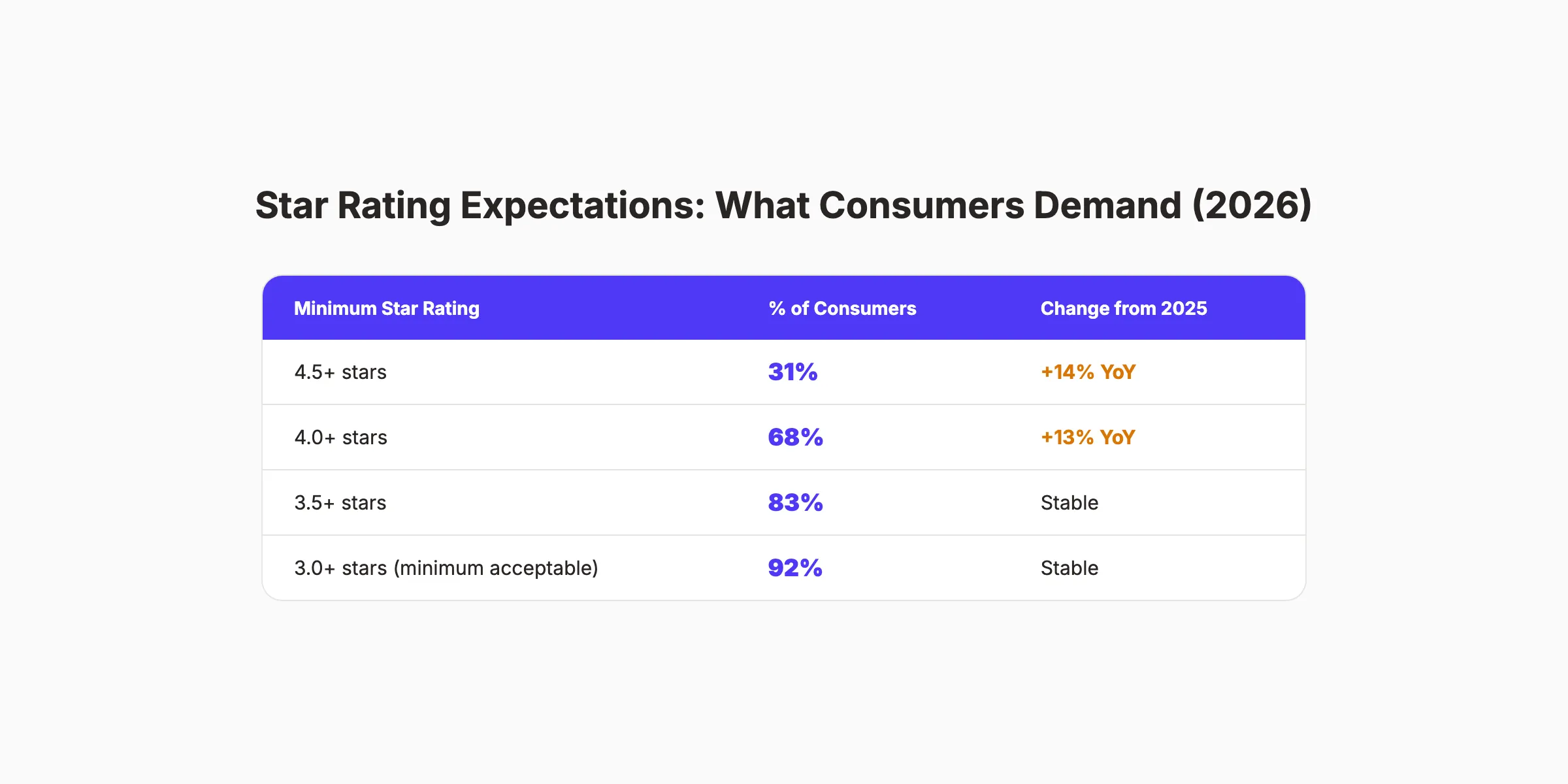
14. 31% of consumers require a 4.5-star minimum rating. Source: BrightLocal, 2026 This is up from 17% in 2025. Nearly 1 in 3 buyers will not consider anything below 4.5 stars.
15. 68% of consumers require a 4-star minimum rating. Source: BrightLocal, 2026 Up from 55% in 2025. Two-thirds of buyers now filter out anything below 4 stars.
16. 92% of consumers factor star ratings into their decision. Source: BrightLocal, 2026 Only 8% say star ratings do not matter. For everyone else, stars are the first screening tool.
17. 87% of customers engage with businesses rated 3 to 4 stars. Source: WiserReview, 2026 Businesses below 3 stars lose the vast majority of potential customers.
18. A 1-star increase in rating can boost revenue by 5 to 9%. Source: Harvard Business Review Each star has direct financial value. The difference between 3.5 and 4.5 stars translates to real revenue.
19. 76% of consumers trust mixed reviews more than all 5-star reviews. Source: BrightLocal, 2026 Perfect scores trigger suspicion. A mix of 4 and 5-star reviews with a few 3-star reviews appears more authentic.
| Star Rating | Consumer Willingness to Buy | 2025 vs 2026 |
|---|---|---|
| 4.5+ stars | 31% require this minimum | +14 points YoY |
| 4.0+ stars | 68% require this minimum | +13 points YoY |
| 3.5+ stars | 83% require this minimum | Stable |
| Below 3.0 | 8% will still consider | Stable |
Revenue and Conversion Impact Statistics
Reviews directly affect the bottom line. The connection between Google reviews and revenue is measurable.
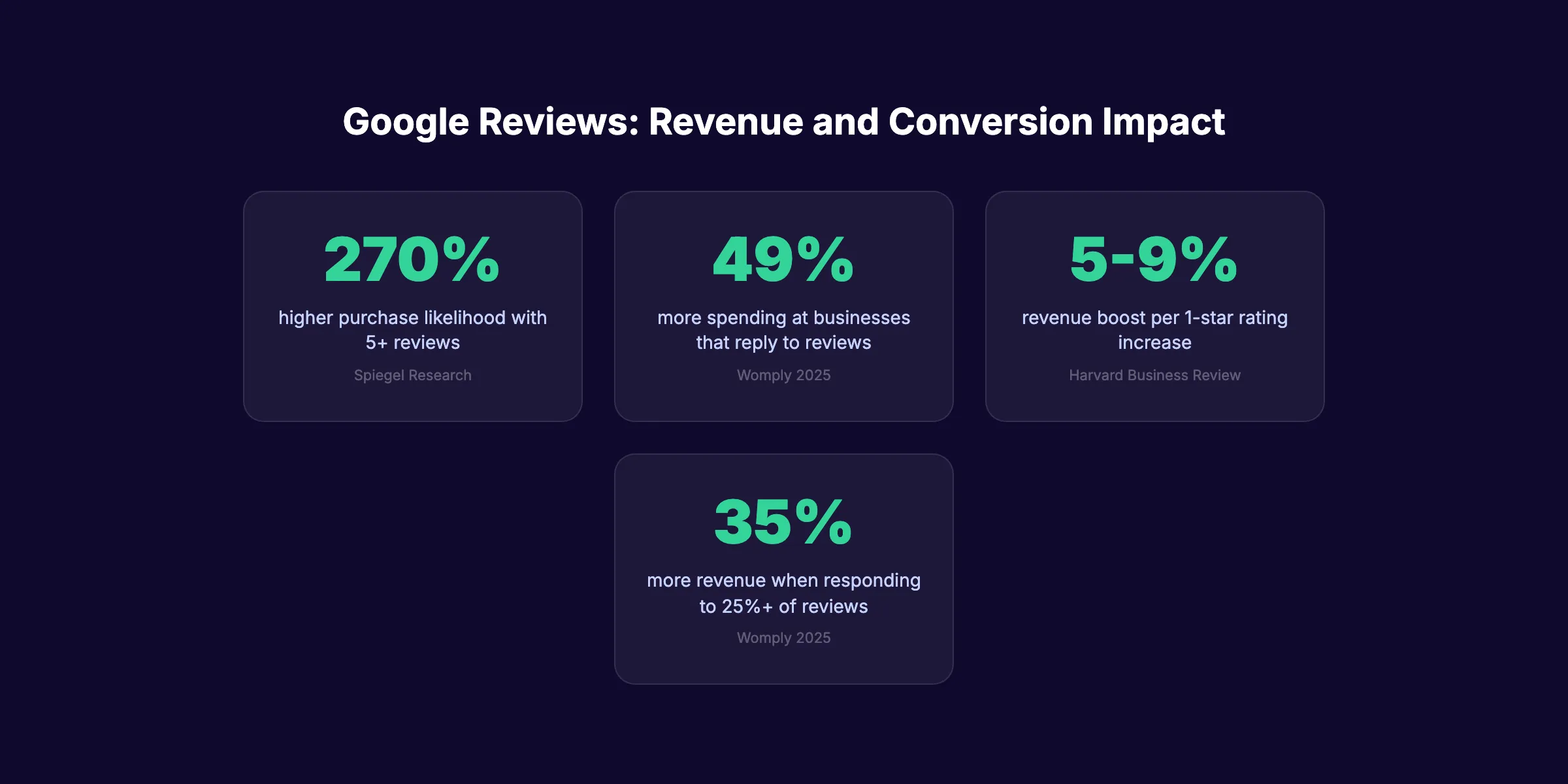
20. Products with 5 or more reviews have a 270% greater purchase likelihood. Source: Spiegel Research Center Five reviews is the minimum threshold for meaningful conversion lift. Below that, buyers hesitate.
21. Customers spend 49% more at businesses that reply to reviews. Source: Womply, 2025 Responding to reviews is not just courtesy. It is a revenue strategy.
22. Businesses that respond to 25% or more of reviews earn 35% more revenue. Source: Womply, 2025 Even partial response rates generate measurable revenue gains.
23. 58% of consumers pay more or travel further for businesses with strong reviews. Source: DemandSage, 2026 Good reviews reduce price sensitivity. Consumers pay a premium for trust.
24. 27% of consumers have spent over $1,000 based on review influence. Source: BrightLocal, 2026 Reviews are not just for small purchases. They drive high-value buying decisions.
25. Displaying reviews boosts conversion rates by 380% for higher-priced products. Source: Spiegel Research Center The higher the price, the more buyers rely on social proof from reviews.
26. 58% of customers say Google Business Profiles increase physical store visits. Source: WiserReview, 2026 Reviews on your Google Business Profile drive foot traffic. They are not just digital signals.
Review Response Statistics
How you respond to reviews matters as much as the reviews themselves. The data shows most businesses leave money on the table.
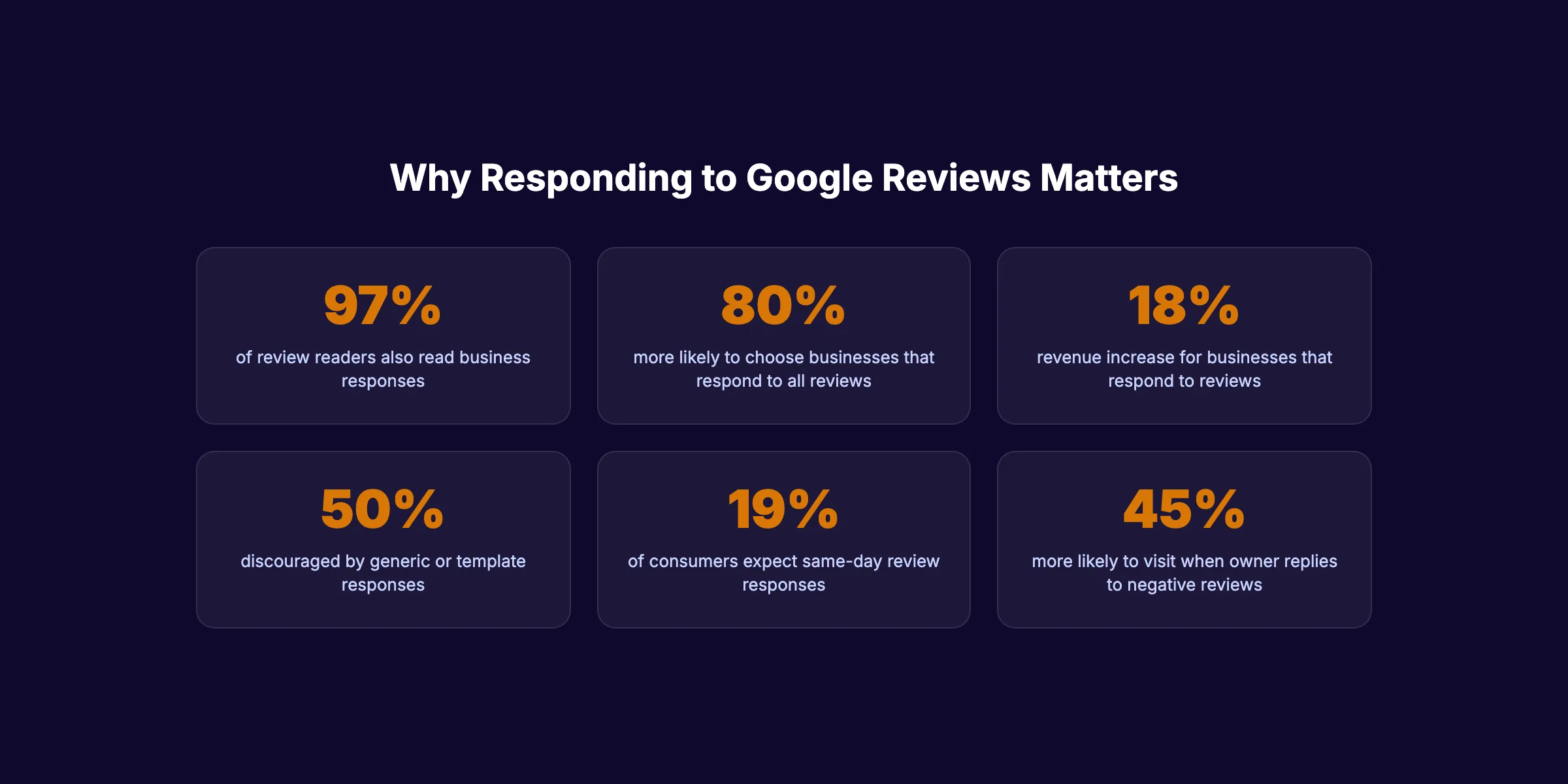
27. 97% of review readers also read business responses. Source: BrightLocal, 2026 Almost every person who reads a review also reads the owner reply. Your response strategy is visible to nearly all potential customers.
28. 80% of consumers prefer businesses that respond to all reviews. Source: BrightLocal, 2026 Responding to every review signals that a business cares about its customers.
29. 19% of consumers expect same-day review responses. Source: BrightLocal, 2026 This tripled from 6% in 2025. Speed expectations are rising fast.
30. 50% of consumers are discouraged by generic or template responses. Source: BrightLocal, 2026 Copy-paste replies hurt more than they help. Personalized responses win.
31. 45% of consumers are more likely to visit when an owner responds to negative reviews. Source: WiserReview, 2026 Responding to criticism shows accountability. It turns a negative into a trust signal.
32. Businesses that respond to reviews see up to 18% higher revenue. Source: Womply, 2025 The revenue case for review responses is clear and measurable.
33. 75% of businesses never respond to negative reviews. Source: DemandSage, 2026 Three out of 4 businesses ignore their critics. That is a competitive advantage for those who do respond.
Businesses that respond to reviews earn up to 18% more revenue. Stacc automates local SEO so you can focus on running your business. Start for $1 →
Review Generation and Volume Statistics
How many reviews does a business need? The data shows clear benchmarks by ranking position and industry.
34. The average local business has 39 to 66 Google reviews. Source: WiserReview, 2026 The range depends on industry. Service businesses tend to have fewer reviews than restaurants or hotels.
35. Businesses in the top 3 local search positions average 47 reviews. Source: WiserReview, 2026 The local pack rewards businesses with a strong review profile.
36. 47% of consumers will not use a business with fewer than 20 reviews. Source: BrightLocal, 2026 Twenty reviews is the bare minimum for credibility. Below that, nearly half of buyers walk away.
37. 68% of customers leave Google reviews when asked. Source: WiserReview, 2026 The biggest barrier to getting reviews is not asking. Most customers will write a review when prompted. Our guide on how to ask customers for reviews breaks this down step by step.
38. 83% of consumers wrote a review after being asked in the past year. Source: BrightLocal, 2026 Asking works. Businesses that build review generation systems consistently outperform those that wait.
39. 60% of reviews describe positive experiences. 29% describe negative ones. Source: BrightLocal, 2026 Positive reviews outnumber negative reviews 2 to 1. Most customers want to share good experiences.
| Review Volume | Consumer Perception |
|---|---|
| Fewer than 10 | Trust gap. Most buyers hesitate. |
| 10 to 19 | Meeting minimum threshold. |
| 20 to 49 | Credible. 53% consider this adequate. |
| 50 to 99 | Strong social proof. |
| 100+ | 43% of consumers prefer this level. |
Fake Review Statistics
Fake reviews remain a growing concern. Consumers are getting better at spotting them, and they punish businesses caught using them.
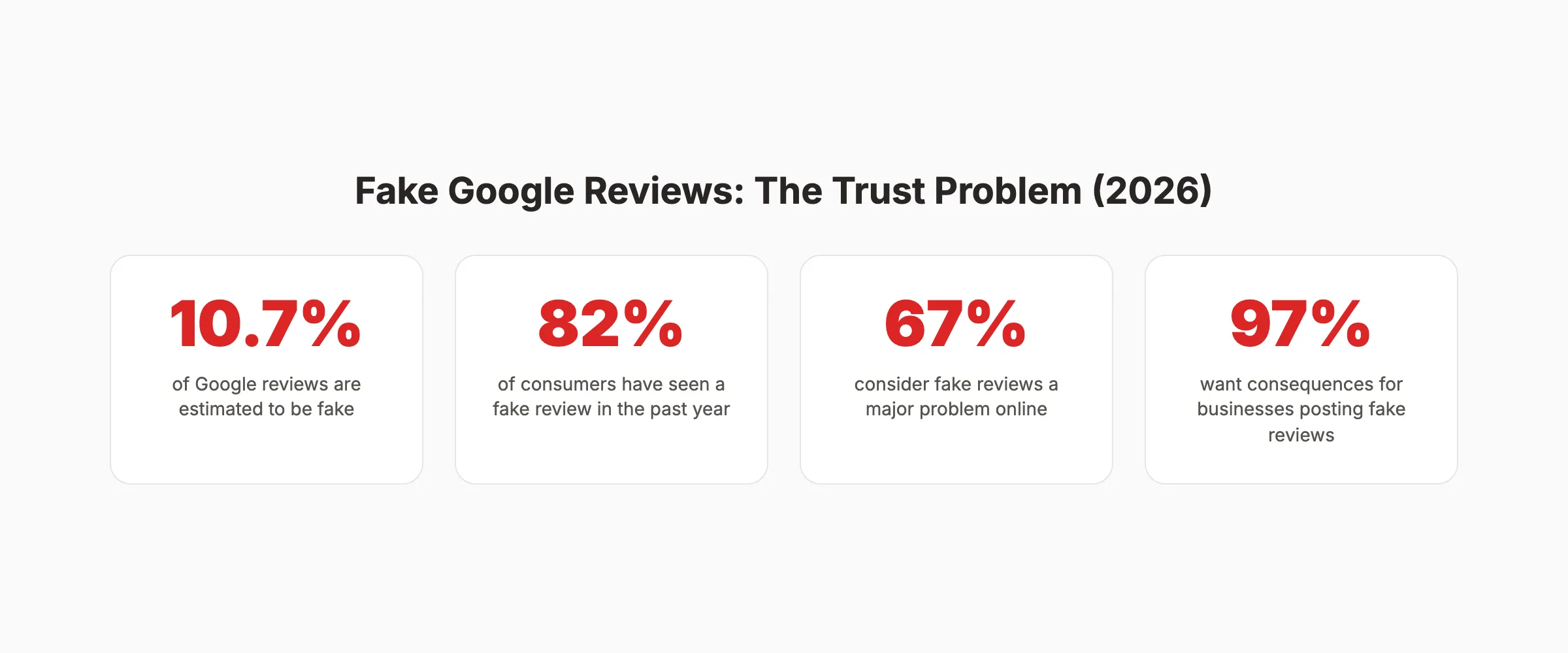
40. 10.7% of Google reviews are estimated to be fake. Source: DemandSage, 2026 Roughly 1 in 10 Google reviews is fraudulent. Yelp sits at 7.1% and TripAdvisor at 5.2%.
41. 82% of consumers have encountered a fake review in the past year. Source: DemandSage, 2026 Fake reviews are widespread enough that most buyers have seen them. Learn how to handle fake Google reviews to protect your business.
42. 67% of consumers consider fake reviews a major problem. Source: DemandSage, 2026 Trust is fragile. Businesses caught with fake reviews face severe reputation damage.
43. 97% of consumers want consequences for businesses that post fake reviews. Source: BrightLocal, 2026 Consumers demand accountability. Platform bans and penalties are expected.
44. 62% of consumers avoid brands that practice review censorship. Source: DemandSage, 2026 Deleting or hiding negative reviews backfires. Transparency wins trust.
Local SEO and Google Reviews Statistics
Google reviews are a confirmed local ranking factor. The data shows exactly how much weight they carry.
45. Review signals account for approximately 15% of local pack ranking factors. Source: Whitespark Local Search Ranking Factors Reviews are the second most important factor for local pack rankings after Google Business Profile signals.
46. Businesses ranked 1 to 3 in the local pack earn 126% more traffic than positions 4 to 10. Source: BrightLocal, 2025 The top 3 positions capture the vast majority of clicks. Reviews help you get there.
47. 20% of local business visibility comes from Google reviews. Source: WiserReview, 2026 One-fifth of your local search visibility depends on your review profile.
48. 46% of all Google searches have local intent. Source: BrightLocal, 2025 Nearly half of all searches are looking for local businesses. Reviews determine which businesses show up. Check our full local SEO statistics page for more data.
AI and the Future of Google Reviews
AI is changing how consumers discover and evaluate reviews. The 2026 data shows a dramatic shift.
49. 45% of consumers now use AI tools like ChatGPT for business recommendations. Source: BrightLocal, 2026 This jumped from just 6% in 2025. AI-based discovery is growing at an extraordinary pace.
50. 23% of consumers rely solely on AI-generated review summaries. Source: BrightLocal, 2026 Nearly 1 in 4 buyers skip reading individual reviews entirely. They trust AI summaries instead.
51. 88% of review readers believe AI-generated reviews should not be allowed. Source: DemandSage, 2026 Consumers draw a clear line. AI can summarize reviews, but it should not write them.
52. Google uses machine learning to detect and remove fraudulent reviews. Source: Google Support Google’s automated systems scan for patterns that indicate fake reviews, paid reviews, and review manipulation.
Key Takeaways
- 97% of consumers read reviews before choosing a local business. Reviews are universal. (BrightLocal, 2026)
- 73% market share makes Google the dominant review platform by far. (DemandSage, 2026)
- 68% require 4+ stars as a minimum. Star expectations jumped 13 points in one year. (BrightLocal, 2026)
- 270% higher purchase likelihood with just 5 reviews. The threshold is low but critical. (Spiegel Research)
- 49% more spending at businesses that respond to reviews. Responses equal revenue. (Womply, 2025)
- 10.7% of Google reviews are estimated fake. Trust remains fragile. (DemandSage, 2026)
- 45% now use AI for business recommendations, up from 6% in 2025. The discovery model is shifting. (BrightLocal, 2026)
Methodology
Sources: BrightLocal Local Consumer Review Survey 2026, DemandSage Online Review Statistics 2026, WiserReview Google Review Statistics 2026, Spiegel Research Center, Harvard Business Review, Womply Revenue Impact Study, Whitespark Local Search Ranking Factors, Google Support.
Last updated: March 2026
Note: We update this page quarterly to ensure all statistics remain current. When a stat changes from its original publication, we note the update date.
Build a review profile that ranks. Stacc handles local SEO, Google Business Profile optimization, and blog content on autopilot. 3,500+ blogs published across 70+ industries. Start for $1 →
Frequently Asked Questions
What is the most important Google reviews statistic in 2026?
The most impactful stat is that 68% of consumers now require a 4-star minimum before considering a business. This jumped 13 percentage points from 2025. Businesses below 4 stars lose two-thirds of potential customers before the conversation even starts.
How many Google reviews does a business need to rank?
Businesses in the top 3 local search positions average 47 reviews. The minimum credibility threshold is 20 reviews, since 47% of consumers will not use a business with fewer than 20. Aim for 50+ reviews with a steady monthly velocity.
Do Google reviews actually affect revenue?
Yes. Harvard Business Review found that a 1-star increase boosts revenue by 5 to 9%. Products with 5 or more reviews see 270% higher purchase likelihood. Businesses that respond to reviews earn up to 18% more revenue. The financial impact is well documented.
How often should businesses respond to Google reviews?
Respond to every review. 80% of consumers prefer businesses that respond to all reviews, and 97% of people who read reviews also read the business responses. Even negative reviews deserve a thoughtful reply. 45% of consumers are more likely to visit after seeing an owner respond to criticism.
What percentage of Google reviews are fake?
An estimated 10.7% of Google reviews are fake, according to DemandSage. That is higher than Yelp at 7.1% and TripAdvisor at 5.2%. Google uses machine learning to detect and remove fraudulent reviews, but the problem persists.
Are consumers using AI to evaluate Google reviews?
Yes, and the shift is dramatic. 45% of consumers now use AI tools like ChatGPT for business recommendations, up from just 6% in 2025. And 23% rely solely on AI-generated review summaries instead of reading individual reviews.

Written by
Siddharth GangalSiddharth is the founder of theStacc and Arka360, and a graduate of IIT Mandi. He spent years watching great businesses lose organic traffic to competitors who simply published more. So he built a system to fix that. He writes about SEO, content at scale, and the tactics that actually move rankings.
Automate your Google Business Profile content
30 GBP posts, local SEO articles, and review responses. Published every month automatically.
30-day trial · Cancel anytime
theStacc
Stop writing SEO content manually
30 blog articles, 30 GBP posts, and social media content. Published every month. Automatically.
Start Your $1 Trial$1 for 3 days · Cancel anytime