
SEO Forecasting: How to Predict ROI (2026)
Learn SEO forecasting with 3 proven models for predicting organic traffic, revenue, and ROI. Covers formulas, tools, and business cases. Updated 2026.
Stacc Editorial • 2026-04-04 • SEO Tips
In This Article
Your boss wants to know what SEO will deliver next quarter. Not vague promises about “long-term value.” A number. A dollar figure tied to organic search.
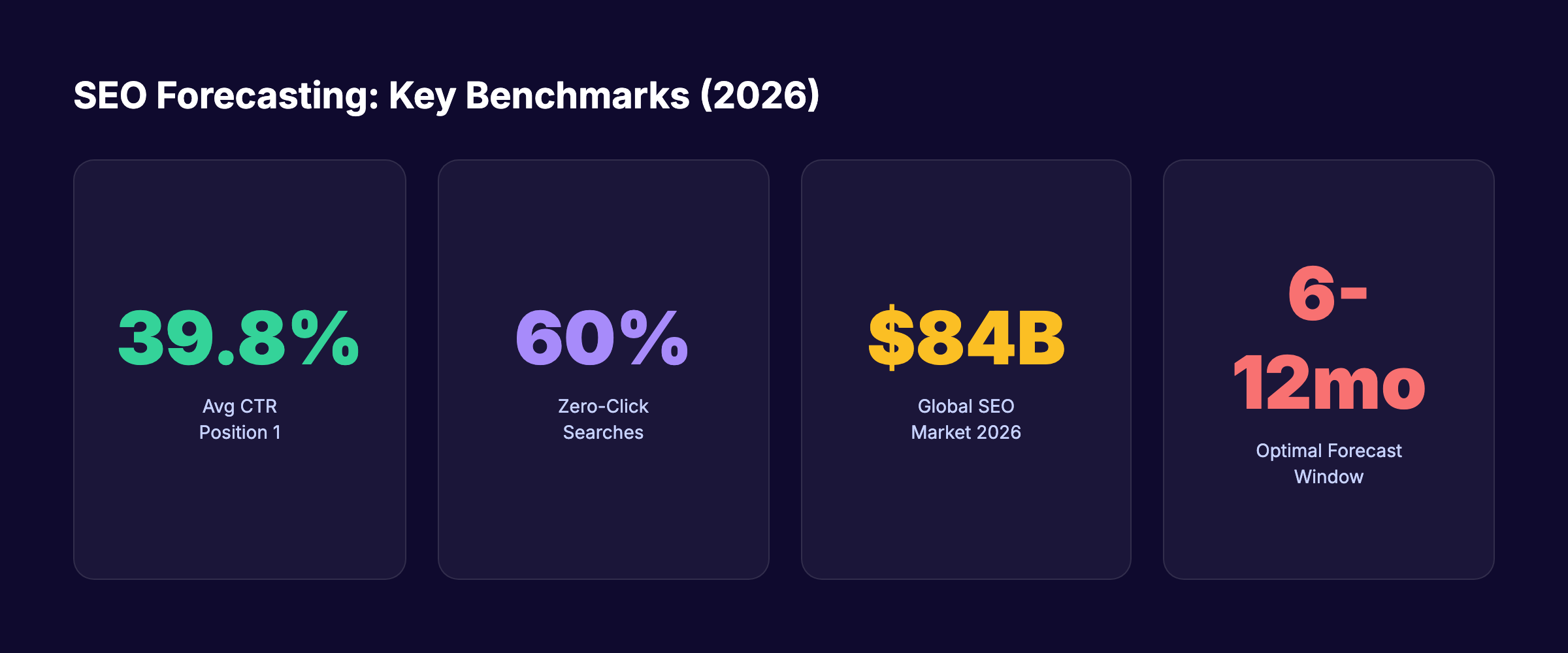
SEO forecasting is the process that turns ranking ambitions into revenue projections. Without it, every SEO budget request is a trust exercise. With it, you speak the language leadership already uses: projected revenue versus proposed investment. The global SEO market hit $84 billion in 2026, according to Statista. Companies that forecast accurately capture a larger share because they invest with confidence rather than guesswork.
We publish 3,500+ blog posts across 70+ industries and track the traffic and revenue impact of every one. This guide covers everything we know about SEO forecasting.
Here is what you will learn:
- The 3 core models for forecasting SEO traffic and revenue
- A step-by-step formula for projecting organic clicks and leads
- Which tools produce the most accurate forecast data
- How to build an SEO business case that gets budget approved
- The 7 mistakes that make most SEO forecasts unreliable
- How to connect keyword rankings to actual revenue
Table of Contents
- Chapter 1: What SEO Forecasting Is and Why It Matters
- Chapter 2: The 3 Core SEO Forecasting Models
- Chapter 3: How to Forecast SEO Traffic Step by Step
- Chapter 4: How to Forecast SEO Revenue and ROI
- Chapter 5: Best Tools for SEO Forecasting
- Chapter 6: How to Build an SEO Business Case
- Chapter 7: Common SEO Forecasting Mistakes
- FAQ
Chapter 1: What SEO Forecasting Is and Why It Matters {#chapter-1}
SEO forecasting predicts the organic traffic, leads, and revenue your site will generate over a defined period. It uses search volume data, click-through rates, conversion rates, and historical trends to build a financial model around organic search.
The difference between forecasting and guessing is data. A forecast maps specific keywords to specific traffic numbers to specific revenue outcomes. A guess says “SEO will help us grow.”
Why Forecasting Changes the Conversation
Most SEO teams struggle to get budget because they cannot answer one question: “What will we get for this money?”
A forecast answers that question directly. It shows the CFO a projected return on a proposed investment. That shifts the conversation from “trust us” to “here is the math.”
According to SEO ROI statistics, the average return on SEO investment is 748% over 3 years. But that number means nothing without a forecast to show how your specific site, in your specific market, will capture that return.
What a Good Forecast Includes
Every credible SEO forecast covers 4 elements:
| Element | What It Answers |
|---|---|
| Traffic projection | How many organic visits will we gain? |
| Lead forecast | How many leads or conversions will those visits produce? |
| Revenue estimate | What revenue will those leads generate? |
| Timeline | When will results materialize? |
A forecast without all 4 elements is incomplete. Traffic alone does not justify spend. Revenue without a timeline does not set expectations.
When to Forecast (And When Not To)
Forecasting works best for sites with at least 6 months of Google Search Console data. New domains with zero history require keyword-based models, which carry wider margins of error.
The exception: do not forecast during a major algorithm update or site migration. The data foundation shifts too fast. Wait until traffic stabilizes for 4-6 weeks, then build your model.
Chapter 2: The 3 Core SEO Forecasting Models {#chapter-2}
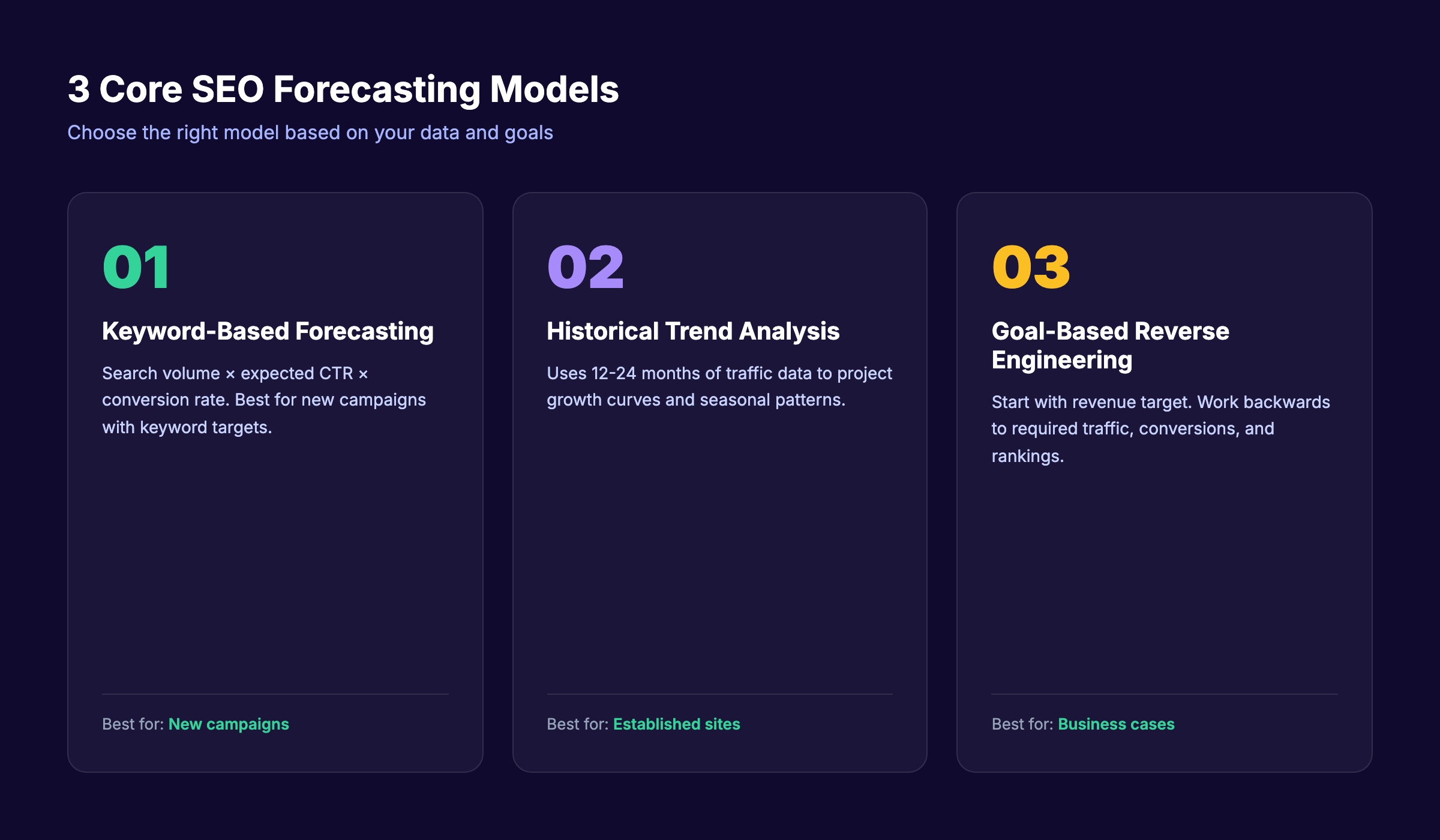
There is no single “right” method for SEO forecasting. The best approach depends on your data, your goals, and how established your site is. Most reliable forecasts combine elements from all 3 models.
Model 1: Keyword-Based Forecasting
Start with your target keyword list. For each keyword, multiply the monthly search volume by the expected organic CTR at your target position.
The formula:
Estimated monthly traffic = Search volume x Expected CTR at target position
Position 1 captures roughly 39.8% of clicks on average. Position 3 drops to about 10.2%. Position 10 gets around 1.6%. These rates shift dramatically when AI Overviews appear. Factor that into your model.
Keyword-based forecasting is the best option for new campaigns. You know which keywords you are targeting. You know the search volumes. The variable is where you will rank and when.
The weakness: it assumes you will hit your target positions. Build 3 scenarios (conservative, moderate, aggressive) to account for that uncertainty.
Model 2: Historical Trend Analysis
Pull 12-24 months of organic traffic data from Google Analytics 4 and Search Console. Plot the trend line. Project it forward with adjustments for planned content, seasonal patterns, and market changes.
Historical models work best for established sites with stable traffic patterns. They capture seasonality and growth momentum that keyword models miss.
The weakness: past performance assumes a stable competitive environment. A new competitor publishing 50 articles per month can break your trend line. Review competitor activity before trusting historical projections.
Model 3: Goal-Based Reverse Engineering
Start with the revenue target. Work backwards.
If you need $500,000 in annual revenue from organic search and your average deal is $2,000, you need 250 customers. If your close rate is 5%, you need 5,000 leads. If 2.5% of organic visitors convert to leads, you need 200,000 organic visits.
Now you know the traffic target. Map it to the keywords and rankings required to hit that number.
Goal-based models are the strongest for building SEO business cases because they start with the number executives care about: revenue.
Stop guessing what SEO will deliver. We publish 30+ SEO articles per month, on autopilot, and track every result. Start for $1 →
Chapter 3: How to Forecast SEO Traffic Step by Step {#chapter-3}
This is the practical walkthrough. Follow these 6 steps to build a keyword-based traffic forecast for the next 6 months.
Step 1: Build Your Keyword List
Start with your core keyword targets. Pull search volumes from Ahrefs, Semrush, or Google Keyword Planner. Focus on keywords aligned with business goals, not just high-volume terms.
A keyword with 500 monthly searches and a 4% conversion rate produces more revenue than a keyword with 10,000 searches and 0.1% conversion. Keyword research for blog posts covers the full process for building a revenue-focused keyword list.
Step 2: Assign Target Positions
For each keyword, estimate where you expect to rank in 6 months. Be realistic. Consider:
- Current ranking position (if any)
- Domain authority versus top-ranking competitors
- Content quality gap between your page and position 1
- Number of pages you will publish in the topic cluster
- Backlink gap between you and the top 3 results
If you currently rank position 15 for a keyword, projecting position 1 in 6 months is aggressive. Position 7-10 is more realistic for a moderately competitive term.
Step 3: Apply CTR Rates
Use position-specific CTR data. Do not use a flat rate. The difference between position 1 (39.8% CTR) and position 5 (3.4% CTR) is enormous.
| Position | Average CTR | Adjusted CTR (AI Overviews) |
|---|---|---|
| 1 | 39.8% | 10-15% |
| 2 | 18.7% | 8-12% |
| 3 | 10.2% | 5-8% |
| 4 | 7.2% | 4-6% |
| 5 | 3.4% | 2-4% |
| 6-10 | 1.6-2.5% | 1-2% |
For queries where Google shows AI Overviews, use the adjusted column. About 15% of search queries now trigger AI Overviews, but that number is growing. Check if your target keywords have AI Overviews by searching them manually.
Step 4: Calculate Monthly Traffic Per Keyword
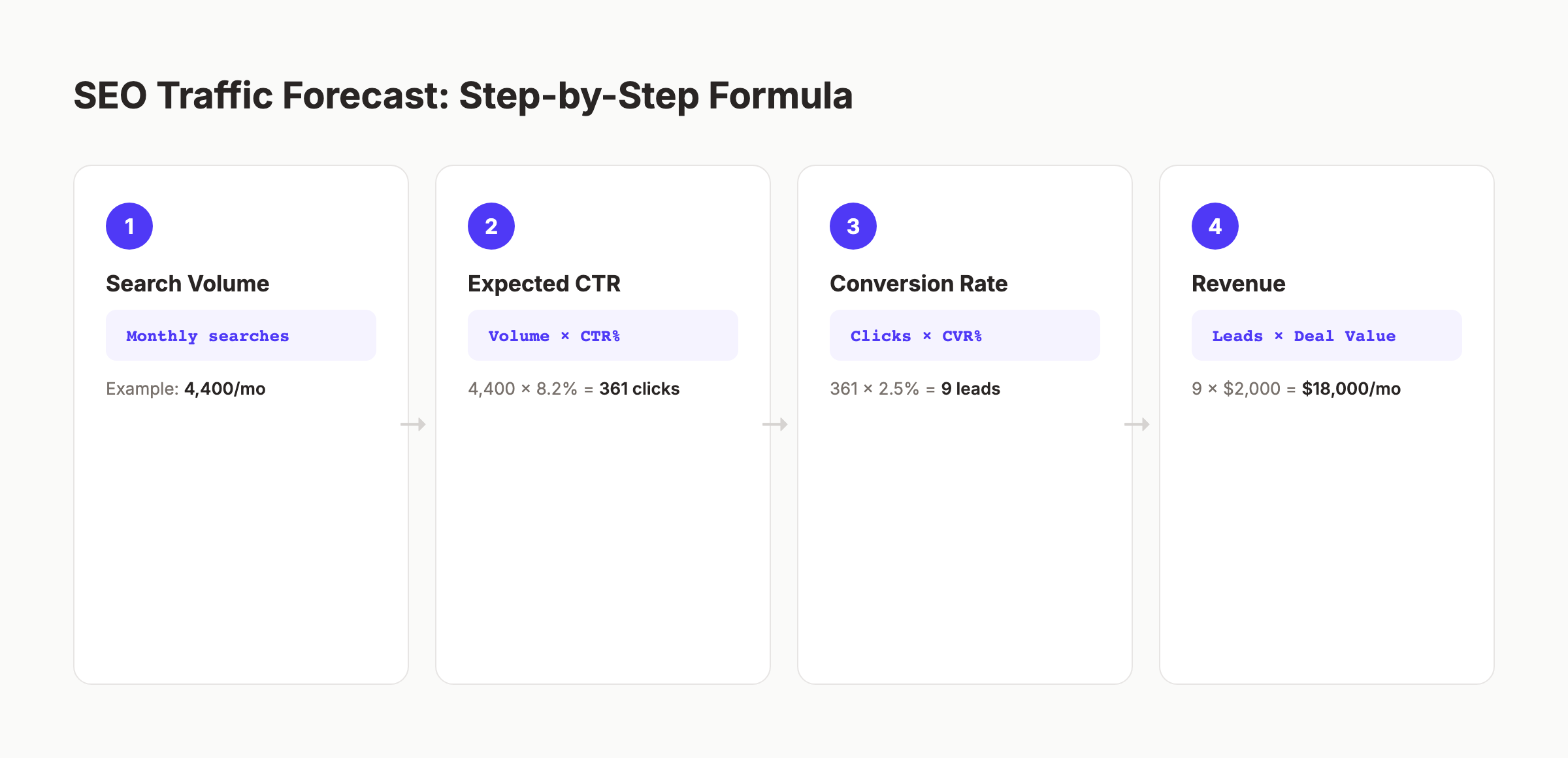
Multiply search volume by your expected CTR for each keyword. Sum the results.
Example for a single keyword:
“Local SEO guide” with 4,400 monthly searches. Target: position 3. Expected CTR: 10.2%. Projected monthly traffic: 449 visits.
Step 5: Apply Seasonality Adjustments
Some industries see 40% traffic swings between peak and off-peak months. Pull your seasonal patterns from Search Console or Google Trends.
Multiply your monthly forecast by seasonal index values. If January typically brings 120% of average traffic and July brings 80%, adjust each month accordingly.
Step 6: Build 3 Scenarios
Never present a single forecast number. Build a range:
- Conservative: Target positions 2 spots lower than expected. Use lower CTR band.
- Moderate: Target positions as planned. Use average CTR data.
- Aggressive: Hit target positions 1 spot higher. Use upper CTR band.
Present all 3 scenarios to stakeholders. The moderate scenario is your primary forecast. The range builds credibility by showing you have accounted for uncertainty.
Chapter 4: How to Forecast SEO Revenue and ROI {#chapter-4}
Traffic forecasts are a foundation. Revenue forecasts are what get budgets approved. This chapter connects organic visits to dollars.
The SEO Revenue Formula
Projected SEO revenue = Organic traffic x Conversion rate x Close rate x Average customer value
Every variable in that formula must come from real data. Use your own conversion rates from Google Analytics, not industry averages. Your conversion rate might be 1.2%, not the “average” of 2.5%.
Connecting Traffic to Leads
Your website conversion rate depends on your pages, your offer, and your audience. Pull this from GA4. Filter by organic traffic only.
If you do not have enough organic conversion data, use a blended rate. But flag that assumption in your forecast. A 0.5% difference in conversion rate can swing your revenue projection by 30%.
Calculating SEO ROI
The ROI formula is straightforward:
SEO ROI = (Revenue from organic - Total SEO investment) / Total SEO investment x 100
Total SEO investment includes content creation, tools, team time, and agency fees. Do not leave out internal labor costs. They are real.
Example:
| Input | Value |
|---|---|
| Projected organic traffic (6 months) | 24,000 visits |
| Conversion rate | 2.5% |
| Leads generated | 600 |
| Close rate | 10% |
| New customers | 60 |
| Average customer value | $3,000 |
| Projected revenue | $180,000 |
| Total SEO investment (6 months) | $18,000 |
| ROI | 900% |
That example shows a 10x return. Your numbers will differ. The formula stays the same.
Use our free SEO ROI calculator to run your own projections with custom inputs.
Setting Realistic Timelines
SEO does not produce instant results. The typical timeline:
- Month 1-2: Content published, pages indexed. Minimal traffic.
- Month 3-4: Initial rankings appear. Traffic starts building.
- Month 5-6: Rankings consolidate. Traffic compounds.
- Month 7-12: Compounding effect kicks in. Revenue materializes.
If someone tells you SEO will deliver ROI in 30 days, they are either misleading you or targeting zero-competition keywords with tiny search volumes. An honest forecast sets a 6-12 month window for meaningful returns. That matches the data on how many blog posts you need to rank.
Want 30 SEO articles published every month without lifting a finger? We handle the research, writing, and publishing on autopilot. Start for $1 →
Chapter 5: Best Tools for SEO Forecasting {#chapter-5}
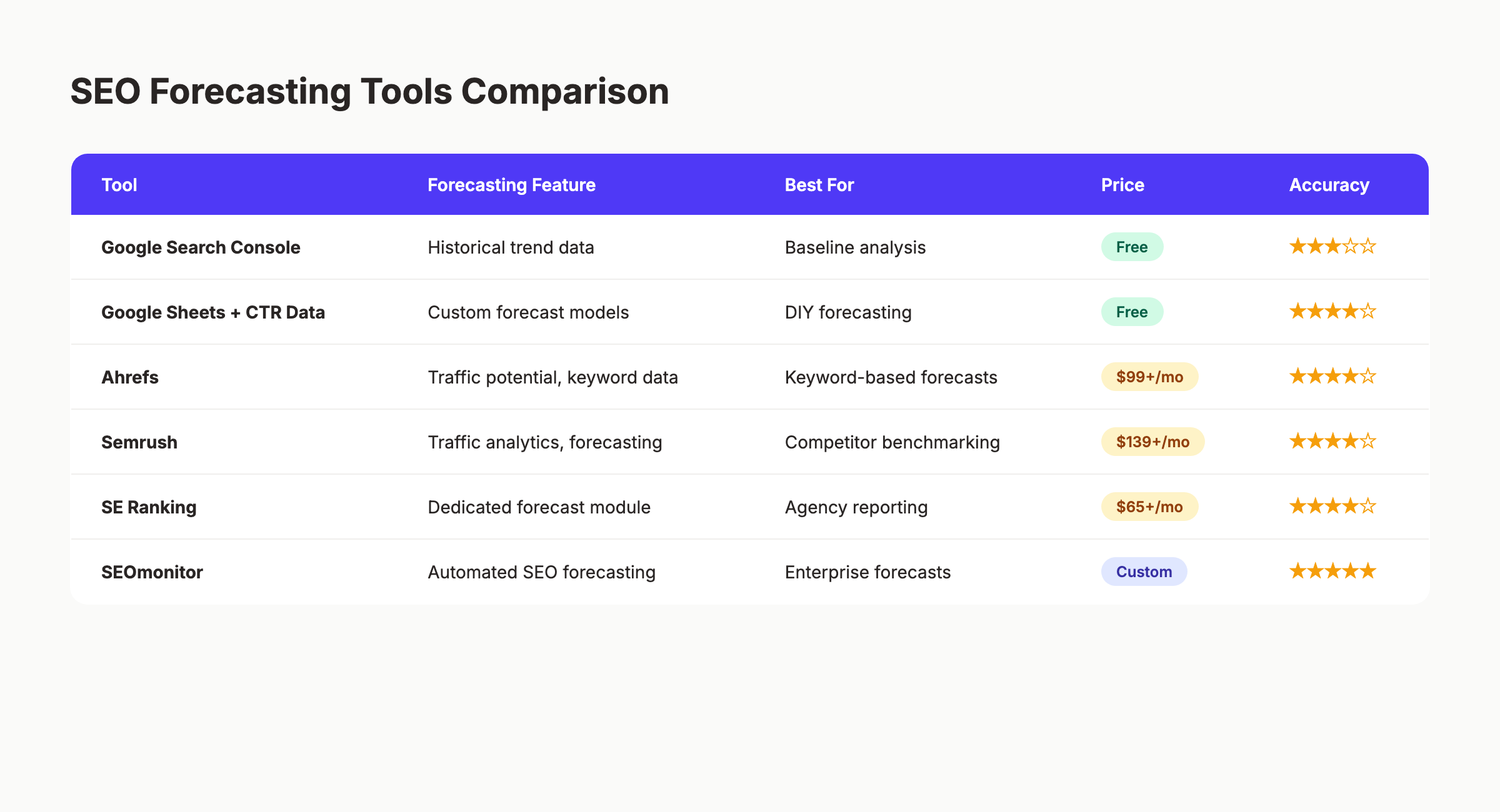
You do not need expensive software to build a solid forecast. A spreadsheet and Search Console data will get you 80% of the way. Paid tools add precision and save time.
Google Search Console (Free)
The best starting point. Search Console shows your actual impressions, clicks, CTR, and average position for every keyword. Export 12-16 months of data for trend analysis.
Limitation: Search Console only shows data for keywords where your site already appears. It does not help forecast new keyword targets. Pair it with a keyword research tool for complete coverage. Our Google Search Console guide covers the full setup.
Ahrefs
The Traffic Potential metric shows estimated monthly traffic to the top-ranking page for any keyword. That is more useful than raw search volume because it accounts for related keyword clusters.
Use the Content Gap tool to find keywords your competitors rank for that you do not. Feed those into your forecast model.
Semrush
The Traffic Analytics feature shows competitor traffic estimates. The Position Tracking tool monitors your ranking changes over time. Use Semrush to benchmark your forecast against competitor performance.
Google Sheets + CTR Data
Build your own forecast model. It takes 2 hours to set up and gives you complete control. The inputs: keyword list, search volumes, target positions, CTR curve, conversion rate, and deal value.
Most agencies use custom spreadsheets because no single tool covers the full forecast pipeline from keywords to revenue.
SEOmonitor
The most specialized forecasting tool. SEOmonitor automates the keyword-to-revenue calculation and generates visual forecast reports. Used primarily by enterprise SEO teams and agencies managing large keyword portfolios.
The downside: custom pricing makes it inaccessible for small teams. If your SEO budget is under $2,000 per month, a spreadsheet model gives you equivalent accuracy.
Chapter 6: How to Build an SEO Business Case {#chapter-6}
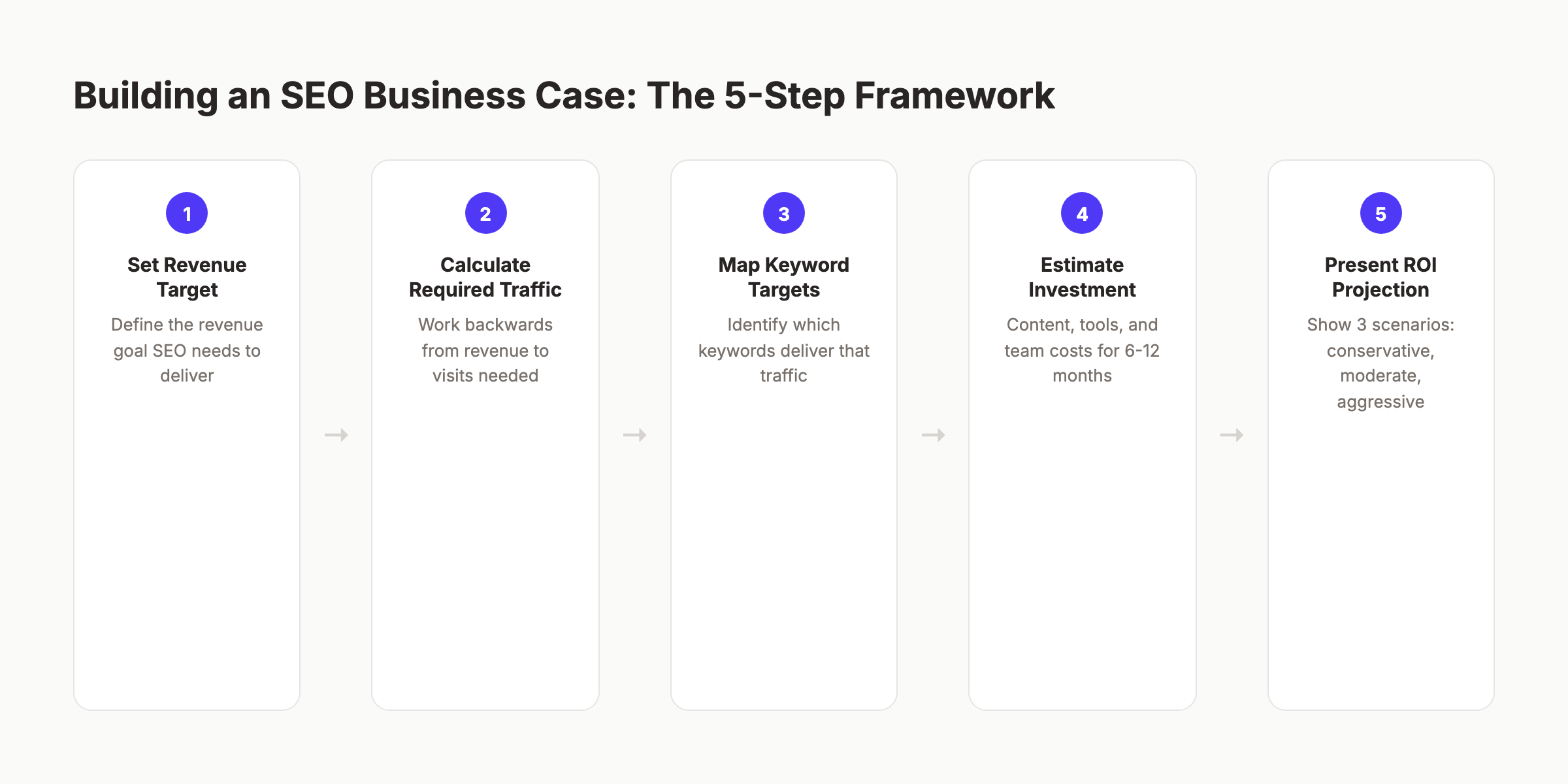
A forecast without a business case is just a spreadsheet. This chapter shows how to package your SEO forecast into a pitch that gets budget approved.
Step 1: Start With the Business Problem
Do not open with “we need more blog posts.” Open with the revenue gap. Show the cost of inaction.
“We currently generate $40,000 per month from organic search. Our target is $120,000. That $80,000 gap requires either a $320,000 annual PPC budget or a $36,000 annual SEO investment. Here is the forecast for the SEO path.”
That framing puts SEO against the PPC alternative, which makes the investment look small.
Step 2: Present 3 Scenarios
Decision-makers distrust single-number forecasts. They have been burned before. Present your conservative, moderate, and aggressive scenarios side by side.
| Scenario | 6-Month Traffic | Projected Revenue | ROI |
|---|---|---|---|
| Conservative | 15,000 visits | $90,000 | 400% |
| Moderate | 24,000 visits | $180,000 | 900% |
| Aggressive | 36,000 visits | $270,000 | 1,400% |
Even the conservative scenario should show positive ROI. If it does not, either the investment is too high or the keyword targets need adjustment.
Step 3: Show the Compounding Effect
SEO is not a campaign that stops when the budget runs out. It compounds.
A blog post published today continues generating traffic for 2-3 years. Month 1 traffic is the floor, not the ceiling. This is the Content Compound Effect in action. Show a 12-month projection where traffic grows each month as content ages and accumulates authority.
Step 4: Include the Investment Breakdown
Be specific about costs. Vague budgets get rejected. Show exactly where the money goes.
- Content production: $X per month (number of articles x cost per article)
- SEO tools: $X per month
- Technical SEO fixes: $X one-time
- Link building: $X per month
- Team time or agency fees: $X per month
Step 5: Set Review Checkpoints
Propose quarterly reviews where you compare forecast versus actuals. If month 3 traffic is tracking 20% below forecast, adjust the model. If it is tracking above, propose expanding the investment.
SEO reporting that ties directly to your original forecast builds long-term credibility with leadership.
SEO that runs itself. Stacc publishes blog content, optimizes it for search, and tracks performance. You review the results. Start for $1 →
Chapter 7: Common SEO Forecasting Mistakes {#chapter-7}
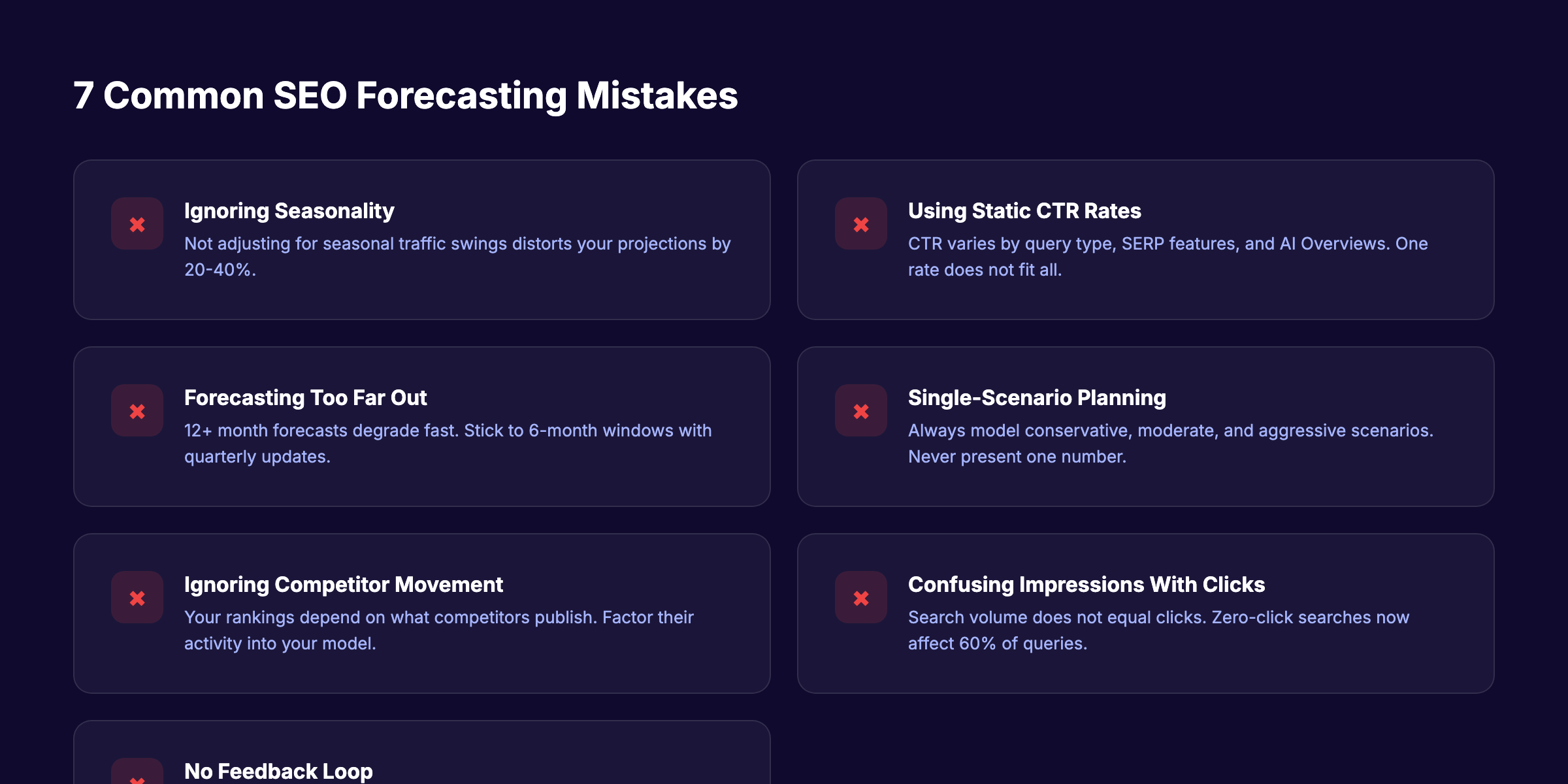
Most SEO forecasts fail not because the math is wrong but because the assumptions are flawed. Avoid these 7 mistakes.
Mistake 1: Ignoring Seasonality
A forecast that assumes flat traffic across all 12 months will miss the mark every single month. Pull seasonal data from Search Console or Google Trends. Apply monthly index values to your projections.
Mistake 2: Using a Single CTR Rate
Position 1 and position 5 have completely different click-through rates. Using an “average” CTR of 5% across all keywords produces a fiction. Apply position-specific rates. Adjust for SERP features and AI Overviews.
The organic CTR by position data shows the exact rates for 2026.
Mistake 3: Forecasting Beyond 12 Months
A 6-month forecast is useful. A 12-month forecast is reasonable. Anything beyond 12 months is speculation. Algorithm updates, competitor moves, and market shifts make long-range forecasts unreliable.
Update your forecast quarterly. Each update replaces assumptions with real data.
Mistake 4: Presenting a Single Scenario
One number invites one question: “What if you are wrong?” Three scenarios (conservative, moderate, aggressive) show you have thought about uncertainty. They also give stakeholders a range to anchor expectations.
Mistake 5: Ignoring Competitor Activity
Your rankings exist in a competitive context. If 3 competitors start publishing 30 articles per month in your niche, your growth projections need adjustment. Analyze competitor keywords quarterly and factor their activity into your model.
Mistake 6: Confusing Search Volume With Clicks
Search volume measures how many times people search a query. It does not measure how many people click a result. Nearly 60% of Google searches now end without an external click, according to SparkToro. Your forecast must account for zero-click behavior.
Mistake 7: No Feedback Loop
A forecast is a living document. Compare projected versus actual traffic every month. If your conservative scenario matches reality, your model is calibrated. If not, find the broken assumption and fix it.
The teams that forecast best are not the ones with the fanciest models. They are the ones that compare forecasts to actuals every 30 days and adjust.
Run a full SEO audit at each quarterly review to identify technical issues that might be suppressing your forecast numbers.
FAQ {#faq}
What is the most accurate SEO forecasting method?
Keyword-based forecasting combined with historical trend data produces the most reliable projections. Use keyword models for new opportunities and historical data for existing ranking pages. Always present 3 scenarios to account for uncertainty.
How far ahead should an SEO forecast project?
6 months is the sweet spot. You have enough runway to show meaningful growth but not so much that the assumptions break down. Extend to 12 months for annual planning, but update quarterly with actual performance data.
Can you forecast SEO for a new website?
Yes, but accuracy is lower. New sites have no historical data, so you rely entirely on keyword-based models with industry-average CTR and conversion rates. Flag those assumptions clearly. After 6 months of real data, rebuild the model with actual numbers.
How do AI Overviews affect SEO forecasts?
AI Overviews reduce click-through rates for informational queries by 50-70%. A keyword that would deliver 39.8% CTR at position 1 might only deliver 10-15% when an AI Overview appears. Check which of your target keywords trigger AI Overviews and adjust your CTR assumptions accordingly.
What conversion rate should I use in my SEO forecast?
Use your own site data from Google Analytics, filtered to organic traffic only. If you do not have enough organic conversion data, start with 2-3% for B2B lead generation and 1-2% for ecommerce. Replace these with real numbers as soon as you have 3 months of data.
How do I present an SEO forecast to executives?
Lead with the revenue projection, not the traffic numbers. Show the business problem (revenue gap), the proposed investment, the projected return across 3 scenarios, and the timeline. Compare the SEO path to the PPC alternative to contextualize the spend.
Every SEO investment starts with a forecast. The teams that forecast well get budget. The teams that guess well get lucky once. Build your model with real data, present it with 3 scenarios, and update it every quarter. That is how you turn organic search from an expense line into a revenue driver.
Written and published by Stacc. We publish 3,500+ articles per month across 70+ industries. All data verified against public sources as of March 2026.
