A 12-month SEO roadmap template split into four phases, with owners, deliverables, monthly reporting, and the five mistakes that stall most roadmaps.
An SEO roadmap template turns a strategy document into a dated plan with owners, phases, and deliverables. The version below covers 12 months split into four phases, from technical audit through content production, link building, and reporting, plus the copy-paste 90-day plan and the five mistakes that stall most roadmaps.
Most SEO plans die in a Google Doc. They read like strategy essays. They list 47 tasks with no owner and no deadline. Three months in, nothing ranks, and nobody knows why.
That gap between "SEO strategy" and "SEO done" is the reason you need an SEO roadmap template. A real one. Not a one-page checklist. Not a 50-tab spreadsheet nobody opens. A practical, 90-day, owner-and-date plan that any operator can follow.
This guide gives you that template. It covers every phase from audit to link building to reporting, plus the actual copy-paste 90-day plan you can drop into Notion, Asana, or a spreadsheet today.
In this guide, you will learn:
- What separates a real SEO roadmap template from a strategy document
- How to run the audit that starts every roadmap
- The priority matrix we use to sequence 200+ tasks into 90 days
- The exact 90-day plan template with weeks, owners, and KPIs
- How to track and update the roadmap without rebuilding it every quarter
- The common reasons roadmaps fail, and how to avoid them
We publish more than 3,500 SEO blogs every month across 70+ industries. This guide captures every hard-won lesson we use to build roadmaps for customers who rank.
Table of Contents
- Chapter 1: What an SEO Roadmap Template Really Is
- Chapter 2: The SEO Audit. Your Roadmap Starting Point
- Chapter 3: Keyword Research and Priority Mapping
- Chapter 4: Technical SEO Fixes to Queue First
- Chapter 5: On-Page and Content Optimization
- Chapter 6: Content Publishing Cadence and Link Building
- Chapter 7: Tracking, Reporting, and Roadmap Updates
- Chapter 8: The 90-Day SEO Roadmap Template
- Chapter 9: Common Roadmap Mistakes and How to Avoid Them
- Frequently Asked Questions
Chapter 1: What an SEO Roadmap Template Really Is
An SEO roadmap template is a time-boxed plan that assigns every SEO task an owner, a deadline, a priority score, and a target KPI. It turns strategy into execution. Without it, SEO becomes a to-do list that never shrinks.
A good template does three things. It sequences work so you fix crawl issues before writing content. It forces priority, so you publish 30 articles on high-intent topics before chasing vanity keywords. It exposes dependencies, so a site migration does not stall content production for six weeks.
How a Roadmap Differs From an SEO Strategy
A strategy states what you want to achieve. A roadmap states what happens next week. The strategy says "rank for plumber keywords in Denver." The roadmap says "publish emergency-plumber-denver on April 22, assigned to Maria, targeting 480 monthly searches."
Strategy lives in slides. Roadmaps live in sprints. If your plan does not have dates and owners next to every task, you have a strategy, not a roadmap.
Who the Template Is For
Three groups get the most value from a structured SEO roadmap template. In-house marketers at small teams who juggle SEO with five other jobs. Agency account managers who need to show clients weekly progress. Founders who want to run SEO without hiring a full team.
The format works for a 5-page local business site and a 500-page B2B SaaS site. Only the task count changes. The priority logic stays identical.
Why Most Roadmaps Fail
Most roadmaps fail because they over-plan and under-execute. Teams spend 4 weeks building a 12-month plan, then abandon it in week 6 when Google releases an update. A roadmap should plan 90 days in detail and 9 months in broad strokes.
The second reason is no ownership. A task with no owner does not get done. A task owned by "the team" does not get done either. Every row needs one name.
The third reason is no measurement. Roadmaps that track only "tasks completed" reward motion over results. Track rankings, clicks, and conversions next to every task. If a task does not move those numbers, stop doing it.
Skip the 40-hour roadmap build. Start ranking in 90 days. We handle every phase below for $99/month, with no strategy doc required.
Chapter 2: The SEO Audit. Your Roadmap Starting Point
Every roadmap starts with an audit. Not a 90-point audit that produces a 47-page PDF. A focused audit that answers four questions. What is ranking. What is broken. What is missing. What the competition has that you do not.
Give yourself 5 to 7 days to complete the audit. Any longer and you are procrastinating. Any shorter and you will miss the dependencies that sink the rest of the plan.
The Four-Part Audit
Start with a crawl. Run Screaming Frog, Ahrefs Site Audit, or Semrush Site Audit against the full site. Export every error, warning, and notice. Tag each one with severity. Only fix "errors" in the first 30 days. "Warnings" can wait.
Next, pull current rankings. Export every ranking keyword from Google Search Console for the last 90 days. Sort by clicks, then by impressions. The keywords with high impressions and low clicks are your first on-page optimization targets.
Run a backlink audit third. A backlink audit shows which referring domains you keep, which you disavow, and which topics already attract links. Use this to inform content planning in Chapter 6.
Finally, run a competitor gap. Export the top 5 competitors' top 100 pages. Find every topic they rank for that you do not. Those are your content gaps.
What to Document
Your audit output is not a report. It is four lists, each with one task per row.
- ✓ Technical errors to fix (with priority)
- ✓ Existing pages to optimize (with current rank and target)
- ✓ New content to publish (with target keyword and volume)
- ✓ Link opportunities to pursue (with referring domain authority)
Each list becomes a sprint in the roadmap. Do not skip this structure. Unorganized audits produce unorganized execution.
Quick Wins to Pull Forward
Some audit findings deserve immediate action. Pages ranking on page 2 for high-volume keywords. Pages with broken internal links. Pages missing meta descriptions on high-traffic URLs. Title tags that do not include the target keyword.
Pull these into week 1 of the roadmap. Quick wins produce movement inside 30 days, which buys trust with stakeholders and keeps momentum up. See our SEO checklist for 2026 for the full list of audit quick wins worth pulling forward.
Chapter 3: Keyword Research and Priority Mapping
Keyword research is the second phase of the roadmap because it sets content priority for the next 6 months. Do it after the audit, before the technical fixes, and map it to business outcomes, not search volume alone.
The mistake most teams make is chasing volume. A keyword with 22,000 monthly searches does nothing if it attracts visitors who will never buy. A keyword with 480 searches per month that lands a $12,000 customer pays for the entire roadmap.
The Three-Tier Keyword Model
Split every target keyword into one of three tiers. Tier 1 is commercial intent. The keywords buyers use when they are ready. "Best accounting software," "emergency plumber Austin," "law firm near me." These get priority in content publishing.
Tier 2 is informational intent with commercial adjacency. "How to file business taxes," "what to do when your pipe bursts." These capture top-of-funnel traffic and feed internal links to Tier 1.
Tier 3 is pure informational or brand awareness. "SEO statistics," "small business tax deadlines." These build topical authority but convert slowly. Publish them at 20% of your volume, not 60%.
The Priority Matrix
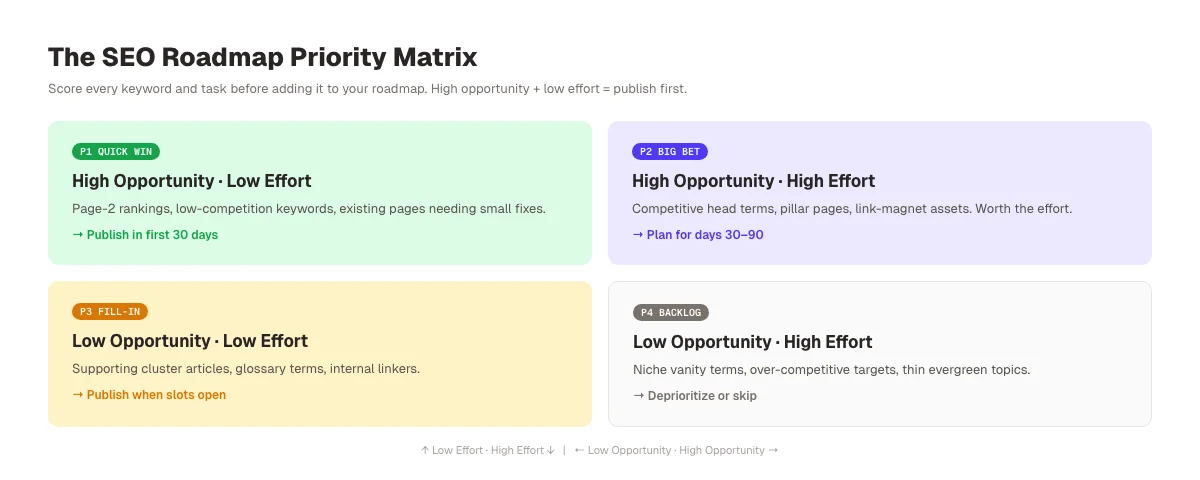
Every keyword gets scored on two axes. Opportunity (search volume × click-through × conversion rate) and Effort (content difficulty × ranking difficulty × time to produce). Plot every keyword on the matrix below.
| Priority | Opportunity | Effort | Action |
|---|---|---|---|
| P1 Quick Win | High | Low | Publish in first 30 days |
| P2 Big Bet | High | High | Plan for days 30-90 |
| P3 Fill-In | Low | Low | Publish when slots open |
| P4 Backlog | Low | High | Deprioritize or skip |
A roadmap template without a priority matrix produces flat execution. Every task feels equal. Teams do the easy ones first and the valuable ones never.
How Much Research Is Enough
For a 90-day roadmap, you need 30 primary keywords and 90 supporting keywords. That is enough to publish 30 articles with internal linking depth. More than that and you are padding the plan. Less than that and you will run dry in week 8.
Local businesses need fewer, sharper keywords. A roofing company in Phoenix needs 10 city-service combinations, not 300. See our guide to local keyword research for the geo-intent model we use. Local businesses skip keyword research at their peril. Even 10 wrong keywords can waste an entire quarter of publishing.
Want 30 articles published next month without the research? theStacc handles keyword research, writing, and publishing for $99/month.
Chapter 4: Technical SEO Fixes to Queue First
Technical SEO is the plumbing of your roadmap. If it leaks, every piece of content you publish loses value. Fix the leaks before you turn on the water. That means the first 2 to 3 weeks of the roadmap go to technical work, even if leadership wants "visible wins" sooner.
The biggest roadmap mistake is treating technical SEO as a one-time event. Crawl issues return. Core Web Vitals degrade as new scripts load. Redirect chains accumulate. Build a quarterly technical review into the roadmap from day one.
The Technical Fix Hierarchy
Not every technical issue matters equally. Rank fixes in this order:
- Indexability problems (noindex on ranking pages, blocked in robots.txt)
- Broken internal links and 404s on linked URLs
- Duplicate content and canonicalization errors
- Core Web Vitals failures on high-traffic pages
- Redirect chains longer than 2 hops
- Missing or malformed XML sitemaps
- Schema markup gaps
Fix 1-3 in weeks 1-2. Fix 4-5 in weeks 3-4. Fix 6-7 as fill-in tasks across the quarter. Do not spend 40 hours on schema before you have a working sitemap.
Site Speed and Core Web Vitals
Core Web Vitals failures cost rankings. Pages that fail LCP or INP lose an estimated 10 to 15% of organic traffic over 90 days, based on internal testing across customer sites. Fix the top 20 ranking pages first. Ignore pages with zero organic traffic.
Start with images. Convert every PNG and JPG to WebP. Serve responsive sizes. Lazy-load below-the-fold images. This single change moves 60% of pages into the green zone for LCP.
Next, tackle JavaScript. Remove unused third-party scripts. Defer what stays. See our INP optimization guide for the exact steps we use.
Internal Linking Structure
Internal linking is a technical task disguised as content. A site with no internal link plan leaks authority. Pages in deep folders rank slowly because the homepage cannot pass equity through 5 link hops.
Fix this with a hub-and-spoke structure. Every Tier 1 commercial keyword gets a hub page. Every Tier 2 article links to its hub with descriptive anchor text. No orphan pages. No links more than 3 clicks from the homepage. Our internal linking strategy article breaks down the exact map.
The Technical Fix Checklist
- ✓ Noindex tags audited on every ranking page
- ✓ robots.txt reviewed for accidental blocks
- ✓ 404 errors identified and fixed or redirected
- ✓ Canonical tags match intended URL structure
- ✓ LCP under 2.5 seconds on top 20 pages
- ✓ INP under 200ms on top 20 pages
- ✓ XML sitemap submitted and current
- ✓ Schema markup on priority page types
- ✓ HTTPS with valid SSL across all pages
- ✓ Mobile rendering tested on top 20 pages
Copy this into your roadmap template as a recurring quarterly task. The exception is site migrations. Those need their own dedicated sprint with a separate checklist.
Chapter 5: On-Page and Content Optimization
On-page optimization is where audits meet execution. You identified 40 underperforming pages in Chapter 2. This chapter tells you what to do with them. Roughly half will improve with a 2-hour optimization pass. The other half need full rewrites.
The rule we follow: optimize before you publish new. A page ranking at position 11 that moves to position 6 is worth more than a brand-new page that takes 6 months to rank. Always.
The 3-Pass Optimization Framework
Run every existing page through three passes.
Pass 1: Technical on-page. Title tag includes primary keyword and is under 60 characters. Meta description is 145 to 155 characters with keyword and benefit. H1 matches search intent. URL is clean. Internal links point in and out.
Pass 2: Content fit. Does the page answer the search query faster than competitors? Add the answer in the first 100 words. Add FAQ sections matching People Also Ask. Add tables, lists, and checklists. Search engines reward structured content.
Pass 3: Credibility. Add author information, publish dates, and updated dates. Link to 2 to 3 external authoritative sources. Add schema markup for Article or FAQ. This is the layer most teams skip and most successful pages include.
Content Gaps and New Pages
Your audit identified pages the competition has that you do not. Sort them by monthly search volume multiplied by commercial intent. The top 30 become your publishing queue for days 30 to 90.
Each new page needs a content brief. Not a keyword and a rough outline. A real brief with target keyword, secondary keywords, recommended word count, internal link plan, and 3 competitor URLs to beat. See our content brief template for the exact format.
On-Page Scoring
Score every optimized page against a checklist before it ships. Pages scoring below 85% do not go live. This is the single biggest lever for ranking quality.
| Element | Weight | Pass Criteria |
|---|---|---|
| Title tag | 10 | Keyword, under 60 chars |
| Meta description | 5 | 145-155 chars, keyword, CTA |
| H1 | 10 | Matches search intent, includes keyword |
| First 100 words | 15 | Answers query, keyword included |
| Content depth | 20 | Beats top 3 results on word count and structure |
| Internal links | 10 | 3-5 relevant links per 1,000 words |
| External links | 5 | 2-3 authoritative sources |
| Images | 10 | Alt text, WebP, responsive |
| Schema | 10 | Article, FAQ, or HowTo as appropriate |
| Mobile render | 5 | Passes mobile-friendly test |
See our full guide on how to optimize content for SEO for each element broken down further.
Chapter 6: Content Publishing Cadence and Link Building
Cadence wins SEO. The average site that ranks top 10 in a competitive niche publishes 20 to 30 articles per month. The average site that does not publishes 2. Consistent publishing is the biggest quick win there is.
Link building pairs with cadence. One without the other produces slow progress. Content earns rankings on head terms. Links earn rankings on competitive head terms. You need both.
Publishing Cadence by Site Size
Match your cadence to site maturity. A new site should publish more, not less.
| Site Stage | Monthly Cadence | Mix |
|---|---|---|
| 0-3 months old | 30 articles | 70% informational, 30% commercial |
| 3-12 months old | 25 articles | 50% informational, 50% commercial |
| 12+ months | 20 articles | 40% informational, 60% commercial |
| Mature (100+ posts) | 15 articles | 30% new, 70% refresh |
This cadence assumes content quality passes the scoring in Chapter 5. Publishing 30 thin articles produces no ranking. Publishing 30 strong articles on mapped keywords compounds.
The Content Calendar
A cadence without a calendar is a wish. Build a content calendar for SEO that assigns every publish date a keyword, a writer, a reviewer, and an internal link target. See our SEO content calendar template for the exact structure.
Batch production beats one-off writing. Write 5 articles in a week, edit the next week, publish across the following 2 weeks. This compresses thinking time and raises quality.
Link Building Tactics That Fit the Roadmap
Link building has 40 possible tactics. Your roadmap only needs 3.
Guest posting on adjacent-niche sites with DR 40+. One post per month. Pitch 10 sites to land 1.
Digital PR through HARO or Qwoted. Two pitches per week. See our HARO link building guide for the pitch framework.
Linkable asset promotion. Build one flagship asset per quarter. A statistics roundup, a template, a calculator. Promote it via email outreach and social. This is the highest-use link-building tactic we run. See link building strategies for the 10-tactic menu.
Hate publishing? We do it for you. Articles fully researched, written, and pushed to your CMS from $99/month.
Chapter 7: Tracking, Reporting, and Roadmap Updates
A roadmap without reporting is a guess. You cannot know which tasks moved the needle. You cannot defend budget. You cannot decide whether to double down or pivot. Reporting is the mechanism that keeps the roadmap honest.
Report weekly at the task level. Report monthly at the business level. Update the roadmap quarterly. Those three rhythms cover every stakeholder from operator to CEO.
The Weekly SEO Report
Keep it short. Five metrics, every week, same format.
- ✓ Tasks shipped this week (with links to the work)
- ✓ Rankings change for top 10 target keywords
- ✓ Organic clicks (week over week)
- ✓ New backlinks earned (with referring domains)
- ✓ Blockers requiring decisions
If the weekly report is longer than one page, it is too long. See our SEO reporting guide for the exact template.
The Monthly Business Review
Monthly reports tie SEO work to business results. The framework:
- Organic traffic month over month and year over year
- Organic leads or revenue (if tracked)
- Keyword rankings for top commercial targets
- Content published and average position achieved
- Next month's plan with 3 focus items
The monthly report is the only document leadership needs. Everything else is internal. theStacc's internal benchmark: top 10 target keywords should gain an average of 4 positions by month 3, based on 3,500+ campaigns.
When to Update the Roadmap
Update the roadmap at three triggers. Quarterly, no matter what. After major Google updates (use our Google algorithm updates tracker for timing). When a key metric misses target by more than 25% for 2 consecutive months.
Do not update the roadmap weekly. Small deviations are normal. Constant resequencing destroys momentum and confuses owners. Trust the plan for 90 days at a time.
The KPI Tracker Table
Build this once, update weekly.
| KPI | Baseline | Target (Day 90) | Current | Status |
|---|---|---|---|---|
| Organic sessions | 2,400 | 4,800 | , | , |
| Top-10 keywords | 18 | 45 | , | , |
| Avg. position (top 20 kw) | 34 | 14 | , | , |
| New backlinks | 0 | 30 | , | , |
| Articles published | 0 | 30 | , | , |
| Pages optimized | 0 | 40 | , | , |
| Conversions from organic | 12/mo | 24/mo | , | , |
Tweak the metrics for your business. Keep the structure. A KPI without a baseline and a target is theater.
Chapter 8: The 90-Day SEO Roadmap Template
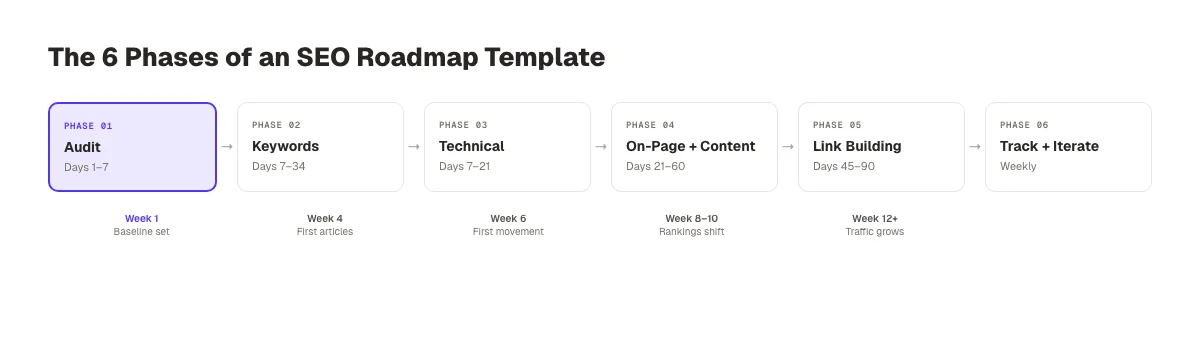
Here is the actual template. Copy it into Notion, Asana, ClickUp, or a spreadsheet. Assign owners. Set dates. Run it for 90 days and you will see ranking movement by week 8, clicks growth by week 10, and conversion impact by week 12.
This template assumes a small-to-mid-size business site with 20 to 200 pages. Scale timelines if your site is larger.
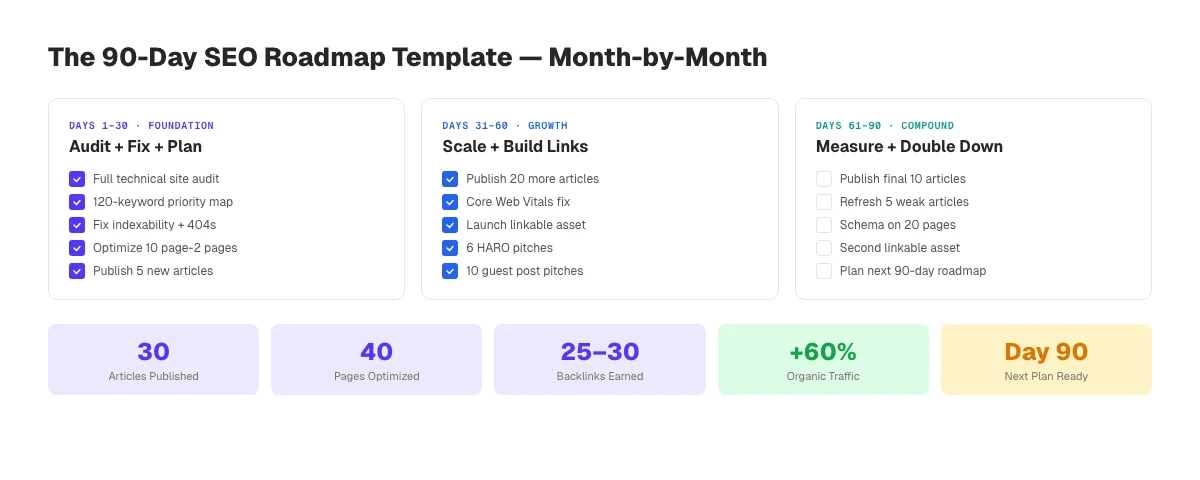
Days 1-30: Foundation Phase
Week 1. Audit and Baseline
| Task | Owner | Deadline | Priority | KPI |
|---|---|---|---|---|
| Run full technical site audit | Tech Lead | Day 3 | P1 | Error list |
| Export Search Console data (90 days) | SEO Lead | Day 2 | P1 | Ranking baseline |
| Run backlink audit | SEO Lead | Day 4 | P1 | Referring domains list |
| Competitor gap analysis (top 5) | SEO Lead | Day 5 | P1 | Content gap list |
| Document baseline KPIs | SEO Lead | Day 7 | P1 | KPI tracker populated |
Week 2. Technical Sprint 1
| Task | Owner | Deadline | Priority | KPI |
|---|---|---|---|---|
| Fix indexability issues | Dev | Day 10 | P1 | Zero accidental noindex |
| Fix broken internal links | SEO Lead | Day 12 | P1 | Zero 404s on linked URLs |
| Fix canonical errors | Dev | Day 14 | P1 | Duplicate content resolved |
| Submit updated sitemap | SEO Lead | Day 14 | P2 | Sitemap live |
Week 3. Keyword Research and Priority Mapping
| Task | Owner | Deadline | Priority | KPI |
|---|---|---|---|---|
| Build 120-keyword target list | SEO Lead | Day 18 | P1 | Keyword sheet |
| Score keywords on priority matrix | SEO Lead | Day 20 | P1 | Priority scores |
| Map 30 primary keywords to articles | SEO Lead | Day 21 | P1 | Content queue |
Week 4. On-Page Sprint 1
| Task | Owner | Deadline | Priority | KPI |
|---|---|---|---|---|
| Optimize top 10 page-2 ranking pages | Writer | Day 28 | P1 | 10 pages updated |
| Rewrite meta descriptions (top 30) | Writer | Day 28 | P2 | 30 meta tags |
| Publish 5 new articles from queue | Writer | Day 30 | P1 | 5 articles live |
Days 31-60: Growth Phase
Week 5-6. Content Scale + Technical Sprint 2
| Task | Owner | Deadline | Priority | KPI |
|---|---|---|---|---|
| Publish 10 new articles | Writer | Day 42 | P1 | 10 articles live |
| Core Web Vitals fix (top 20 pages) | Dev | Day 42 | P1 | Green LCP/INP |
| Optimize 15 more existing pages | Writer | Day 42 | P2 | 15 pages updated |
| Launch first linkable asset | Writer | Day 45 | P2 | Asset published |
Week 7-8. Link Building Activation
| Task | Owner | Deadline | Priority | KPI |
|---|---|---|---|---|
| Publish 10 new articles | Writer | Day 56 | P1 | 10 articles live |
| Pitch 10 guest post sites | Outreach | Day 56 | P2 | 1-2 accepted |
| Submit 6 HARO pitches | Outreach | Day 56 | P2 | 1-2 links landed |
| Internal link audit (all new content) | SEO Lead | Day 60 | P1 | Link graph updated |
Days 61-90: Compound Phase
Week 9-10. Publish, Optimize, Measure
| Task | Owner | Deadline | Priority | KPI |
|---|---|---|---|---|
| Publish 10 new articles | Writer | Day 70 | P1 | 30 total articles |
| Refresh 5 underperforming articles | Writer | Day 70 | P2 | 5 refreshed |
| Schema markup on 20 priority pages | Dev | Day 70 | P2 | Schema validated |
| Mid-quarter ranking review | SEO Lead | Day 70 | P1 | Ranking report |
Week 11-12. Scale What Works
| Task | Owner | Deadline | Priority | KPI |
|---|---|---|---|---|
| Double down on top-performing topic clusters | Writer | Day 84 | P1 | 5 cluster articles |
| Second linkable asset launch | Writer | Day 84 | P2 | Asset published |
| 10 more HARO pitches | Outreach | Day 84 | P2 | 2-3 links |
| Quarterly audit and roadmap update | SEO Lead | Day 90 | P1 | Next 90-day plan |
What Good Looks Like at Day 90
Run this plan and measure against these benchmarks. Based on aggregated results across our customer base, expect:
- 30 new articles published and indexed
- 40 existing pages optimized
- 15 to 30 new backlinks earned
- Top 20 target keywords improved average position by 6 to 12 spots
- Organic traffic up 25% to 60% versus baseline
- First commercial-intent keyword ranking in top 5
Numbers vary by industry, starting authority, and competition. See our SEO ROI statistics post for category benchmarks.
Too much work? That is the point. We built theStacc for this. Your 90-day plan, executed for you, starting at $99/month.
Chapter 9: Common Roadmap Mistakes and How to Avoid Them
The template above works. We have run it across 70+ industries. But even with the template, teams trip on the same 5 mistakes. Here is how to avoid each.
Mistake 1: Planning Too Long
Teams spend 6 weeks perfecting a 12-month plan. By week 7, Google has released an update that invalidates 30% of assumptions. Plan 90 days tight. Plan 9 months loose. Update the loose plan quarterly. Never more often.
Mistake 2: Ignoring Existing Assets
Every site has pages ranking on page 2 that could move to page 1 with 2 hours of work each. Teams skip this in favor of new content because new feels exciting. Existing-page optimization has a 3 to 5x higher ROI than new publishing for the first 60 days.
Mistake 3: Content Without Distribution
Publishing an article does not equal ranking the article. Every new post needs an internal link plan and a social or email push. If the post gets zero internal links and zero external traffic in the first 30 days, Google may never notice it.
Mistake 4: Link Building Before Content
Chasing links on thin content wastes outreach budget. Build the 30-article foundation first. Then pursue links in month 2 and beyond. The exception is major linkable assets. Statistics posts, templates, calculators. Which can earn links from day 1.
Mistake 5: No Owner on Tasks
This is the most common failure mode. "Marketing team will handle technical fixes." "The agency will publish content." Real accountability needs one name per task. If 2 people own it, neither does. See our guide on building an SEO team for the role split we recommend.
Mistake 6: Measuring Only Traffic
Traffic without conversion is vanity. Track organic sessions, but weight them by landing page intent. A 20% traffic increase on blog posts with no CTAs is worth less than a 5% traffic increase on commercial pages. Report both. Decide based on the second.
What practitioners are saying on X
Systems and fundamentals still compound; AI search adds new KPIs.
- @jakezward (Feb 2026): 2026 SEO predictions emphasize AI Overview share-of-SERP, schema for LLM token efficiency, brand mentions in AI answers as a KPI, proprietary data as a moat, and content refresh beating net-new AI slop. See the post on X.
- @hridoyreh (Mar 2026): Widely shared SEO skill tree: foundations, research, technical, on-page, content, links, AI SEO/GEO, analytics, UX, brand, programmatic — useful map for stats and how-to posts. See the post on X.
- @HlynurStefDev (Jul 2026): Public case: niche site traffic jumped from ~18 to 4,162 Google visits/month after focused technical/on-page SEO work (GSC screenshots claimed) — reminds that fundamentals still move numbers. See the post on X.
Grok, AI Overviews, and multi-engine visibility
For “seo roadmap template”, multi-engine visibility still starts with clear definitions, sourced numbers, and extractable section answers. Grok additionally factors live X discussion — keep public claims consistent with this page.
- Google AI Overviews: Use passage-ready answers, tables, and FAQ schema where relevant.
- ChatGPT / Perplexity: Cite named sources next to key claims.
- Grok: Maintain accurate entity facts on-site and in high-signal X posts.
Publish content built for Google and AI citations. theStacc’s Content SEO module ships SEO-scored articles structured for rankings and generative engines — including clearer entity pages models like Grok can quote.
Frequently Asked Questions
First movement shows up in weeks 4 to 6. Real ranking changes show up in weeks 8 to 12. Material business impact shows up in months 4 to 6. If a team promises page-1 rankings in 30 days on a new site, they are either paying for ads or misleading you. See how long SEO takes for the full timeline by industry.
Yes. A strategy doc names the destination. A roadmap template tells you what to do on Monday. Teams that skip the roadmap execute on 20 to 30% of the strategy. Teams that use one execute on 80%+. The format matters more than the content.
Update weekly at the task level. Mark done, add new, shift priorities. Update quarterly at the plan level. New 90-day sprint, new KPI targets. Do not rebuild the whole roadmap monthly. That destroys focus and momentum.
Partly. You need Google Search Console (free) and a crawler like Screaming Frog (free up to 500 URLs). For keyword research without paid tools, use Google's Keyword Planner and Search Console's query reports. You will miss competitor insights, but the 90-day plan still runs. See our DIY SEO guide for the no-budget version.
An audit is a snapshot of current state. A roadmap is a sequence of actions to change that state. Audits feed roadmaps. You run a fresh audit every quarter as input to the next 90-day plan. Running audits without roadmaps produces reports nobody acts on.
Local businesses need more Google Business Profile and local-pack work, less blog volume. Swap Chapter 6 cadence to 15 articles per month and add GBP posts (3 per week), citation cleanup, and review generation. Everything else stays. SaaS sites keep the template as written but add product-led content (comparison pages, alternatives pages) to Chapter 6. See our local SEO ranking factors and SaaS content strategy guides.
An SEO roadmap template only works if you run it. The template above is the one we use across 3,500+ campaigns. Copy it. Assign owners. Run it for 90 days.
The teams that rank in 2026 are not the teams with the best strategy. They are the teams that ship on the plan every single week. Start with week 1. The rest follows.
Rank Everywhere. Do Nothing. We write and publish SEO articles, starting at $99 a month. First 3 articles free, no credit card.
Related Tools & Resources
Free SEO Tools:
Best Lists:
Sources & references
- [1] Princeton / Georgia Tech et al. — GEO research (arXiv:2311.09735)
- [2] @hridoyreh on X — Widely shared SEO skill tree: foundations, research, technical, on-page, content, links, AI SEO/GEO, analytics, UX, bran
- [3] @jakezward on X — 2026 SEO predictions emphasize AI Overview share-of-SERP, schema for LLM token efficiency, brand mentions in AI answers

Plan topics, review article drafts, and publish to a connected CMS.
Weekly local SEO teardowns
One practical email a week. Map Pack, GBP, AI Overviews. No fluff. Unsubscribe anytime.