21 proven link building strategies with real data and outreach benchmarks. Strategy #3 alone earned 1,777 referring domains. Updated March 2026.
Link building strategies are repeatable ways to earn links from other sites, ranging from original data and digital PR to resource pages and expert commentary. 95% of web pages have zero backlinks, and pages that earn links rank substantially higher. Each strategy below includes the method and its benchmark.
This is a list of 21 link building strategies that work right now.
95% of all web pages have zero backlinks. The pages that do earn links rank 3.8x higher on average, according to data from Semrush and Ahrefs.
Every strategy below includes what to do, why it works, and real benchmarks where available. No filler. No theory.
We have published 3,500+ blogs across 70+ industries. Link-worthy content is at the center of every ranking result we deliver.
Here is what you will learn:
- How to earn editorial backlinks without cold pitching
- Outreach methods with 5-11% conversion rates
- Free strategies that require zero budget
- How to find and replicate your competitors' best links
- Which content formats earn 3.5x more backlinks than average
Strategy #1: Create Original Research and Data Studies
Original data is the strongest link magnet on the internet. Journalists, bloggers, and content creators need stats to cite. If you produce the data, they link to you.
Ahrefs published a single SEO statistics page and earned 1,777 referring domains from it. That one page drives more backlinks than most entire websites.
How to execute this strategy:
- Survey your customers or audience on a relevant topic (100+ responses is the minimum for credible data)
- Analyze public datasets from Google Trends, Census Bureau, industry reports, or government databases
- Pull proprietary data from your own platform, tools, or customer base
- Package findings with clear charts, tables, and quotable single-stat takeaways
The key is specificity. "73% of marketers say X" earns more links than "most marketers prefer X." Numbers get cited. Opinions do not.
Format matters too. Lead every finding with the stat, not the methodology. Create a summary section at the top with the 5-10 most surprising numbers. Journalists scan for stats. Make them easy to find and cite.
One data study can earn links for years. Update it annually with fresh numbers and you have a permanent link-earning asset.
Strategy #2: Build Free Tools That Solve One Problem
Free tools generate backlinks on autopilot. Once they exist, people link to them every time they reference the problem the tool solves.
Examples: calculators, ROI estimators, audit tools, generators, graders, and checkers. If your tool saves someone 5 minutes, they will mention it in their blog posts, resource lists, and social threads.
The tool does not need to be complex. A simple SEO audit tool or meta tag analyzer can earn hundreds of referring domains over time. Build it, index it, and let the links accumulate.
The best free tools are:
- Specific to one problem (not a full platform)
- Instant to use (no signup required)
- Easy to share (a clean URL someone can paste in a blog post)
- Branded (your domain in the URL earns the link equity)
HubSpot's Website Grader, Moz's Domain Authority checker, and Neil Patel's Ubersuggest all started as free tools that earned millions of backlinks. You do not need that scale. Even a niche calculator for your industry can earn steady links for years.
Strategy #3: Use the Skyscraper Technique
Find content that already earns backlinks. Create something better. Then reach out to the sites linking to the original and offer your improved version.
Brian Dean at Backlinko tested this with 160 cold emails. He earned 17 backlinks and increased organic traffic by 110% in 14 days. That is an 11% success rate per email.
The step-by-step process:
- Find a high-ranking article with 50+ referring domains (use Ahrefs Content Explorer)
- Identify exactly why it earns links (data, format, depth, visuals)
- Create a version that is more current, more visual, better structured, or more actionable
- Export the list of domains linking to the original
- Email each site owner with a personalized pitch explaining what you improved
The "better" does not mean longer. An article updated with 2026 data beats a 2023 article with twice the word count. Add original screenshots, build interactive elements, or include a downloadable resource. Give linkers a reason to update their reference.
Expect a 5-11% conversion rate on cold outreach. That means 100 emails should produce 5-11 new backlinks.
Strategy #4: Turn Unlinked Brand Mentions Into Backlinks
People mention your brand without linking to you. These are the easiest links to earn because the author already knows and trusts your brand.
80.9% of SEO experts believe unlinked mentions affect rankings. Converting them into actual links compounds that effect.
Set up Google Alerts or use a tool like Ahrefs Content Explorer to find unlinked mentions. Send a short email thanking the author and asking if they can add a link. Most will say yes because they already chose to reference you.
Strategy #5: Publish the Definitive Guide on Your Topic
Long-form guides (3,000+ words) generate 3.5x more backlinks than shorter articles. They become the default reference that everyone links to.
Write one definitive guide per core topic in your niche. Cover every angle. Include examples, data, visuals, and a clear structure with jump links.
This is the strategy behind the page you are reading right now. Topical authority compounds when each guide anchors an entire keyword cluster.
Stop writing. Start ranking. theStacc plans, writes and publishes optimized articles from $99 a month.
Strategy #6: Do Broken Link Building
Find broken external links on sites in your niche. Create a replacement resource. Email the site owner and offer your page as a fix.
This works because you are solving a problem for the webmaster. Nobody wants broken links on their site. Your email is a favor, not a pitch.
How to find broken link opportunities:
- Install the Check My Links Chrome extension
- Visit resource pages and guides in your industry
- The extension highlights broken links in red
- Check if you have existing content that fits the topic
- If not, create a replacement page that covers the same subject
- Email the site owner with the broken URL and your suggested replacement
You can also use Ahrefs to find broken pages across an entire domain. Filter by referring domains (highest first) to find the broken pages with the most existing links. Prioritize high-authority sites with active content teams that are likely to update their blog posts and resource pages.
The response rate for broken link outreach tends to be higher than standard link requests. You are offering a fix, not asking for a favor.
Strategy #7: Respond to Journalist Requests (HARO, Connectively, Qwoted)
Journalists need expert quotes for their articles. Platforms like Connectively (formerly HARO), Qwoted, Help a B2B Writer, and Featured connect sources with reporters.
When a journalist uses your quote, they link to your site. These are high-authority editorial links from news sites and major publications. A single placement in Forbes or Business Insider can carry more ranking power than 50 directory links.
The key is speed. Respond within 2 hours of the request going live. Keep your answer under 200 words. Include a specific data point, personal example, or quantified result. Generic responses get ignored.
A strong response follows this format:
- Open with your credential (job title + relevant experience)
- Answer the exact question in 2-3 sentences
- Include one specific number or example
- Close with one actionable takeaway
Set up email filters to catch journalist requests the moment they arrive. Treat every response like a job application. Quality and speed determine who gets published.
Strategy #8: Run a Digital PR Campaign
Digital PR is the most popular link building method in 2026. 67.3% of SEO professionals use it, and 48.6% rate it the most effective tactic.
Create a newsworthy angle from your data, product, or industry insight. Pitch it to journalists and bloggers who cover your space.
Angles that consistently earn press coverage:
- Industry surveys: "We surveyed 500 marketers and found X"
- Trend reports: "This sector grew 340% in 12 months"
- Contrarian data: "The common advice about X is wrong. Here is why."
- Local economic impact: "This city's small businesses spend $X on Y"
- Visual data stories. Interactive maps, calculators, or data visualizations
The difference between digital PR and traditional outreach is the news hook. Journalists do not care about your product. They care about a story their readers want to read. Package your data as that story.
Digital PR earns genuine editorial coverage. These links carry more ranking power than any outreach template because they come from real journalistic decisions. One successful campaign can earn 20-50 links from major publications in a single week.
Strategy #9: Guest Post on Relevant Sites
64.9% of SEO professionals still use guest posting. It works when done correctly. It fails when treated as a link scheme.
The right way: write genuinely useful content for sites your audience already reads. Include one contextual link back to a relevant page on your site. Make the article good enough that the host site's readers benefit from it.
The wrong way: mass-produce thin articles for sites that accept anything. Google explicitly warns against excessive link exchanges and low-quality guest posts.
How to find guest post opportunities:
- Search
"write for us" + [your industry] - Search
"guest post" + [your topic] - Check where your competitors guest post (Ahrefs referring domains filter by "guest" in anchor text)
- Pitch sites you genuinely read and respect
Target sites where your audience exists. The traffic referral matters as much as the link. A guest post on a niche industry blog with 5,000 monthly readers often drives more qualified traffic than a post on a generic marketing blog with 100,000 readers.
The average guest post costs $609 if you outsource the writing. Writing it yourself costs only your time and earns a link from a domain you choose.
Strategy #10: Analyze and Replicate Competitor Backlinks
Your competitors have already done the prospecting work for you. Use backlink gap analysis to find sites that link to competitors but not to you.
Open Ahrefs or Semrush and compare your backlink profile against 3-5 competitors. Export the list of domains that link to them but not you. 82% of SEOs use backlink analysis tools as their primary prospecting method.
The process:
- Enter your domain and 3-5 competitor domains into a backlink gap tool
- Filter for domains linking to at least 2 competitors but not to you
- Sort by domain authority (highest first)
- Check each linking page to understand the context (resource list, guest post, editorial mention)
- Create content that matches or exceeds what earned the competitor's link
- Reach out with a personalized email referencing the specific page
These sites already link out in your niche. They are predisposed to link to similar content. Your conversion rate will be higher than cold outreach because the site has a proven history of linking to content like yours.
Your SEO team. $99 per month. Optimized articles researched, written and published automatically.
Strategy #11: Create Linkable Visual Assets
Infographics, charts, diagrams, and interactive visuals earn backlinks because they are easy to embed and hard to replicate in text.
Create one custom visual per major blog post. Include an embed code that automatically adds a link back to your site when someone copies the graphic to their own page.
The types of visuals that earn the most links:
- Process diagrams showing step-by-step workflows
- Comparison charts putting 3-5 options side by side
- Data visualizations turning raw numbers into scannable graphics
- Decision trees helping readers choose between options
- Maps showing geographic data relevant to your industry
Visuals work especially well for data-heavy topics. A well-designed chart from your original research gets shared and cited far more than the same data in paragraph form.
Tools like Canva, Figma, and Piktochart make this accessible even without a designer. Invest 30 minutes per visual. The ROI in backlinks compounds for months.
Strategy #12: Build Resource Page Links
Resource pages exist specifically to link to useful content. Find them with searches like:
"useful resources" + [your topic]"helpful links" + [your industry]intitle: "resources" + [your keyword]
Email the page owner. Explain why your content belongs on their list. Keep the email under 100 words. The shorter the pitch, the higher the response rate.
Resource page links are easy wins because the page's entire purpose is to link outward.
Strategy #13: Get Listed in Industry Directories
Not all directories are spam. Industry-specific directories, local business listings, and professional associations pass real authority.
Focus on directories that:
- Manually review submissions
- Are specific to your industry or location
- Show up in search results themselves
- Charge a membership fee (paid directories tend to curate better)
For local businesses, citations from directories like your local chamber of commerce, BBB, and industry associations carry genuine link value.
Strategy #14: Reclaim Lost Backlinks
Links decay. Sites go down. Pages get deleted. Content gets reorganized. Every month, you lose backlinks through no fault of your own.
Monitor your backlink profile monthly. When a linking page returns a 404 or removes your link, reach out to the site owner. Ask if it was intentional. Offer an updated URL if the content moved.
This is pure maintenance, but it protects the domain authority you have already built. A link you already earned is easier to keep than a new one is to acquire.
Strategy #15: Publish Expert Roundup Posts
Ask 10-15 experts a specific question. Compile their answers into a single post. Every expert who participates has a natural incentive to link to and share the article.
The question must be specific. "What is your best SEO tip?" is too broad. "What is the one link building strategy that worked best for you in Q1 2026?" gets actionable answers.
Tag every participant when the post goes live. Most will share it with their audience and link to it from their own sites.
3,500+ blogs published. Every article is SEO-scored before publish. See what theStacc can do for your site.
Strategy #16: Become a Podcast Guest
Podcast episodes almost always include show notes with links to the guest's website. One 30-minute conversation can earn you a backlink plus a new audience.
Find podcasts in your niche using Apple Podcasts, Spotify search, or ListenNotes. Pitch the host with a specific topic you can speak on and 2-3 bullet points of what their audience will learn.
Podcast links are editorial. The host chooses to feature you. Google treats these differently from self-placed links.
Strategy #17: Write Testimonials for Products You Use
Software companies display customer testimonials on their websites. Most include a link to the customer's site.
Think about every tool you pay for. CRM, email marketing, project management, analytics. Write a genuine testimonial. Send it to their marketing team. Many will publish it with a link.
This is a 10-minute effort per link. The links come from high-authority SaaS domains. Few strategies offer this ratio of effort to authority.
Strategy #18: Create Comparison and "Best Of" Content
"Best [category] tools" and "[Tool A] vs [Tool B]" posts attract links from people evaluating options in your space. These pages become reference points that others cite when recommending tools.
The key is fairness and depth. Include real screenshots, current pricing tables, honest pros and cons, and a clear recommendation for different use cases.
Thin comparison posts get ignored. Detailed ones with original testing data earn editorial links from reviewers and industry bloggers. When someone writes "for a full breakdown, see [this comparison]," they are linking to whoever published the most thorough version.
Update these posts quarterly. Pricing and features change. The site with the most current comparison earns the most referral links.
Strategy #19: Fix Competitor 404s and Steal Their Links
When a competitor's page goes offline, every site that linked to it now has a broken link. You can create a replacement and reach out to those linking sites.
Use Ahrefs to find competitor pages with high referring domains that return 404 errors. Build a better version on your own domain. Email the linking sites with a quick heads-up about the broken link and your replacement.
This combines broken link building with competitive analysis. The links already exist. The referring sites already care about the topic. You just offer a working alternative.
The best opportunities are competitor pages that were once popular but got removed during a site redesign or content cleanup. These leave behind dozens or hundreds of orphaned links pointing to 404 pages. Each one is a potential backlink waiting for a new home.
Check your top 5 competitors monthly. New 404s appear constantly as sites reorganize their content.
Strategy #20: Use Internal Linking to Maximize Backlink Value
External backlinks send authority to one page. Internal linking distributes that authority across your entire site.
Every backlink you earn should flow to supporting pages through strategic internal links. Build content clusters where your most-linked pages connect to related posts, glossary terms, and product pages.
Most link building strategies ignore this step. They earn links but fail to distribute the value. Internal linking turns one backlink into a ranking boost for 10 pages.
Strategy #21: Publish Content Consistently at Scale
The math is simple. More content means more pages that can earn links. Sites that publish 30+ articles per month create 30 new opportunities for organic backlinks every month.
94% of online content fails to earn a single external link. But 6% does. If you publish 30 articles, roughly 2 will attract links naturally. Over 12 months, that compounds to 24+ link-earning pages without a single outreach email.
Consistent publishing also builds topical authority, which makes every future piece of content more likely to rank and earn links.
This is the Content Compound Effect. Each article stacks on the last. The 30th article ranks faster than the 1st because the domain has proven expertise.
5 Link Building Mistakes That Get Sites Penalized
Not all link building is safe. Google's spam policies are explicit about what crosses the line. Avoid these mistakes.
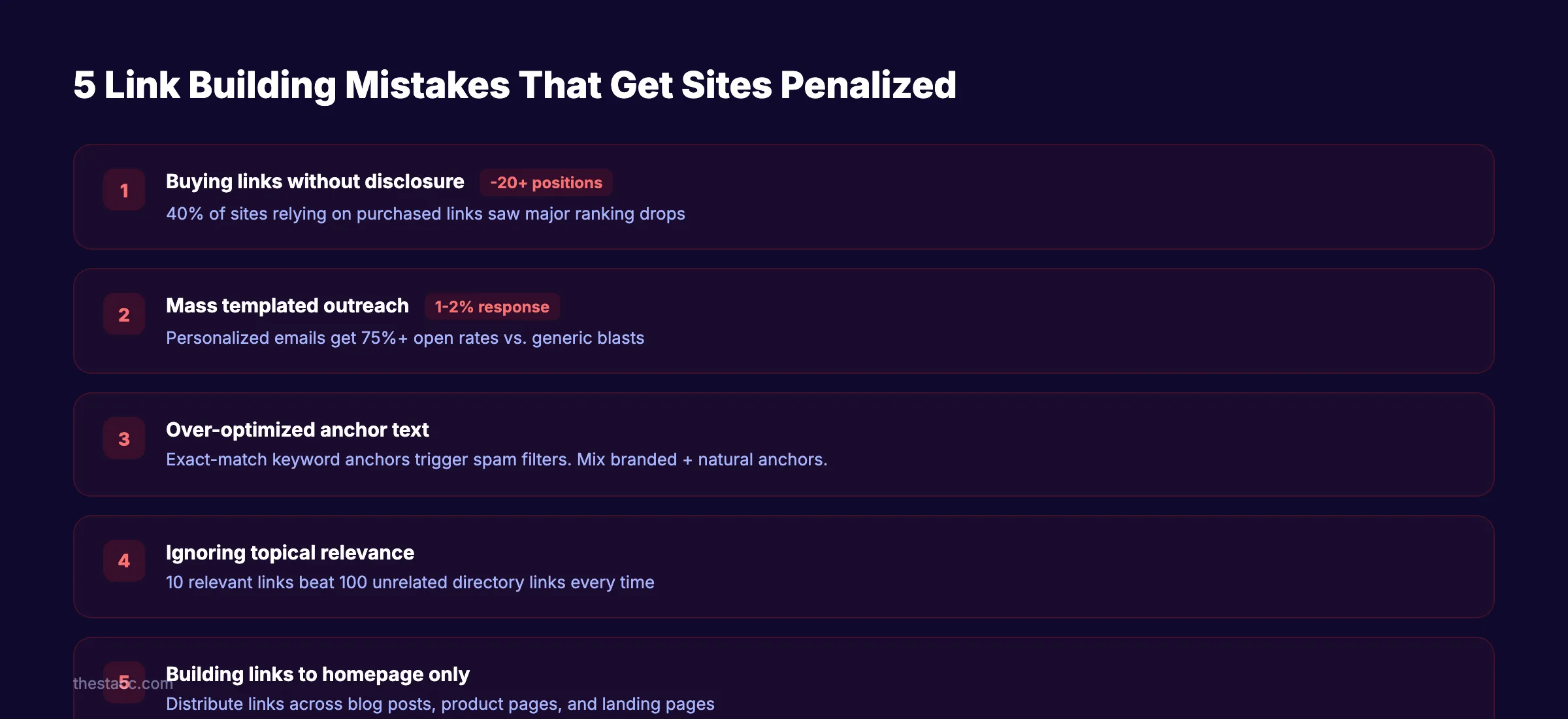
Mistake #1: Buying links without disclosure. Paid links must use rel="sponsored". Sites that rely on purchased links saw ranking drops of 20+ positions in 40% of cases. 91.9% of SEOs believe their competitors buy links. That does not make it safe.
Mistake #2: Mass templated outreach. Generic emails get a 1-2% response rate. Personalized emails with the recipient's first name achieve 75%+ open rates. Quality outreach to 50 prospects outperforms mass emails to 1,000.
Mistake #3: Over-optimized anchor text. If every backlink uses your exact target keyword as anchor text, Google flags it as manipulative. Mix branded anchors, generic phrases, and natural variations. The distribution should look organic.
Mistake #4: Ignoring relevance. A link from a cooking blog to your SaaS product carries almost zero value. Topical relevance matters more than raw domain authority. 10 links from sites in your industry beat 100 from unrelated domains.
Mistake #5: Building links to one page only. Distribute backlinks across your blog posts, product pages, and key landing pages. A natural backlink profile points to many pages, not just the homepage.
Link Building Benchmarks You Should Know
Before you choose a strategy, understand what realistic results look like. Most advice about link building sets unrealistic expectations. Here are the actual numbers from surveyed SEO professionals.
| Metric | Benchmark |
|---|---|
| Average cost per quality backlink | $508.95 |
| Average monthly budget (most common) | $1,000-$5,000 |
| Links earned per month (beginners) | 7 |
| Links earned per month (5+ years experience) | 25 |
| Cold outreach conversion rate | 5-11% |
| Personalized email open rate | 75%+ |
| Templated mass email response rate | 1-2% |
| Time to see ranking results | 1-3 months (57.1% of experts) |
| Percentage reporting positive ROI | 78.1% |
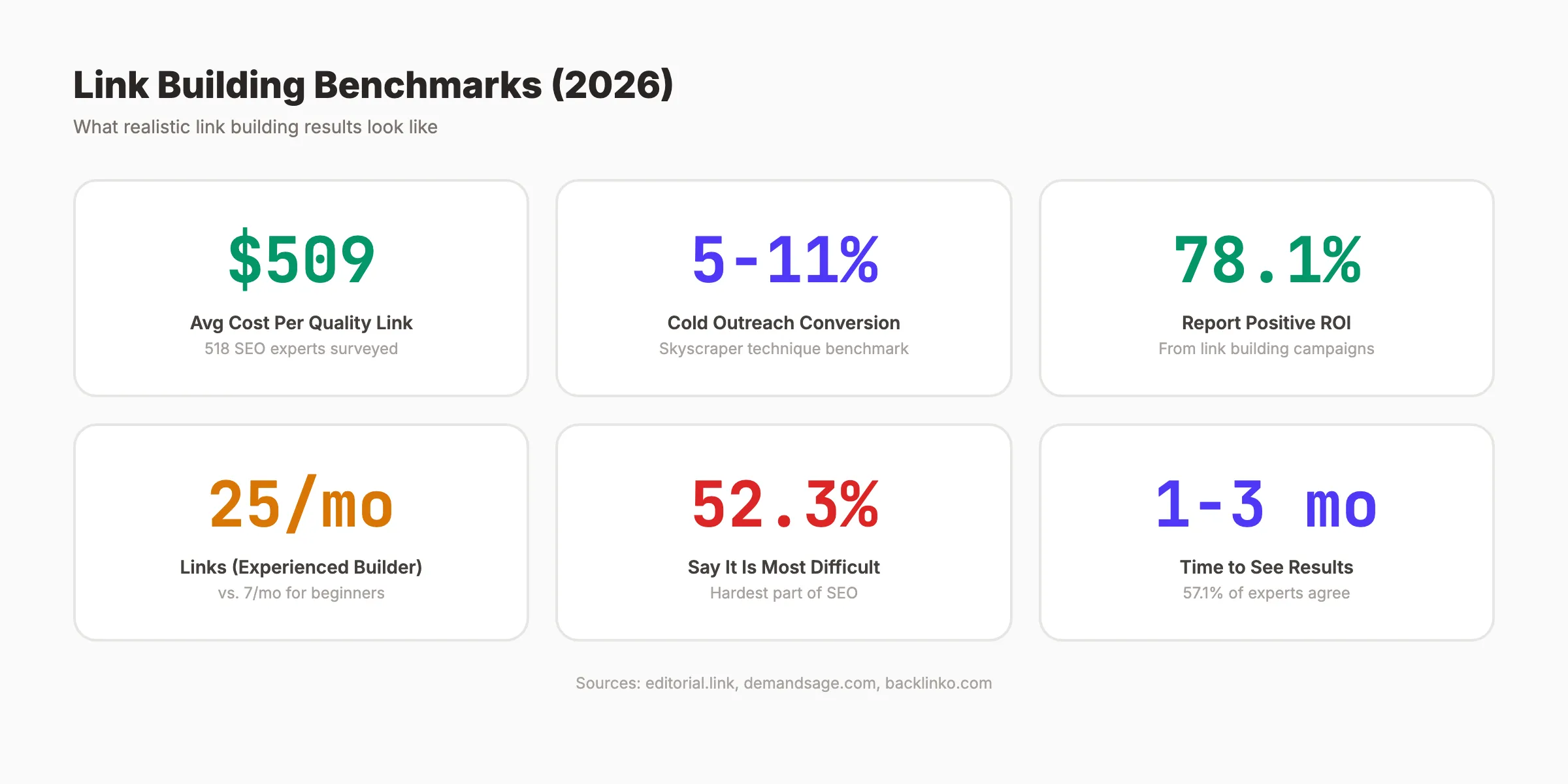
52.3% of SEO professionals consider link building the most challenging part of SEO. That difficulty is why it remains effective. If it were easy, everyone would do it and the competitive advantage would disappear.
The businesses that succeed do not treat link building as a one-time project. They build systems that run every month. The links compound over time, and so does the ranking power they deliver.
How to Prioritize Your Link Building Strategies
Not every strategy fits every business. Use this matrix to choose where to start based on your budget and team size.
| Budget | Team Size | Best Starting Strategies |
|---|---|---|
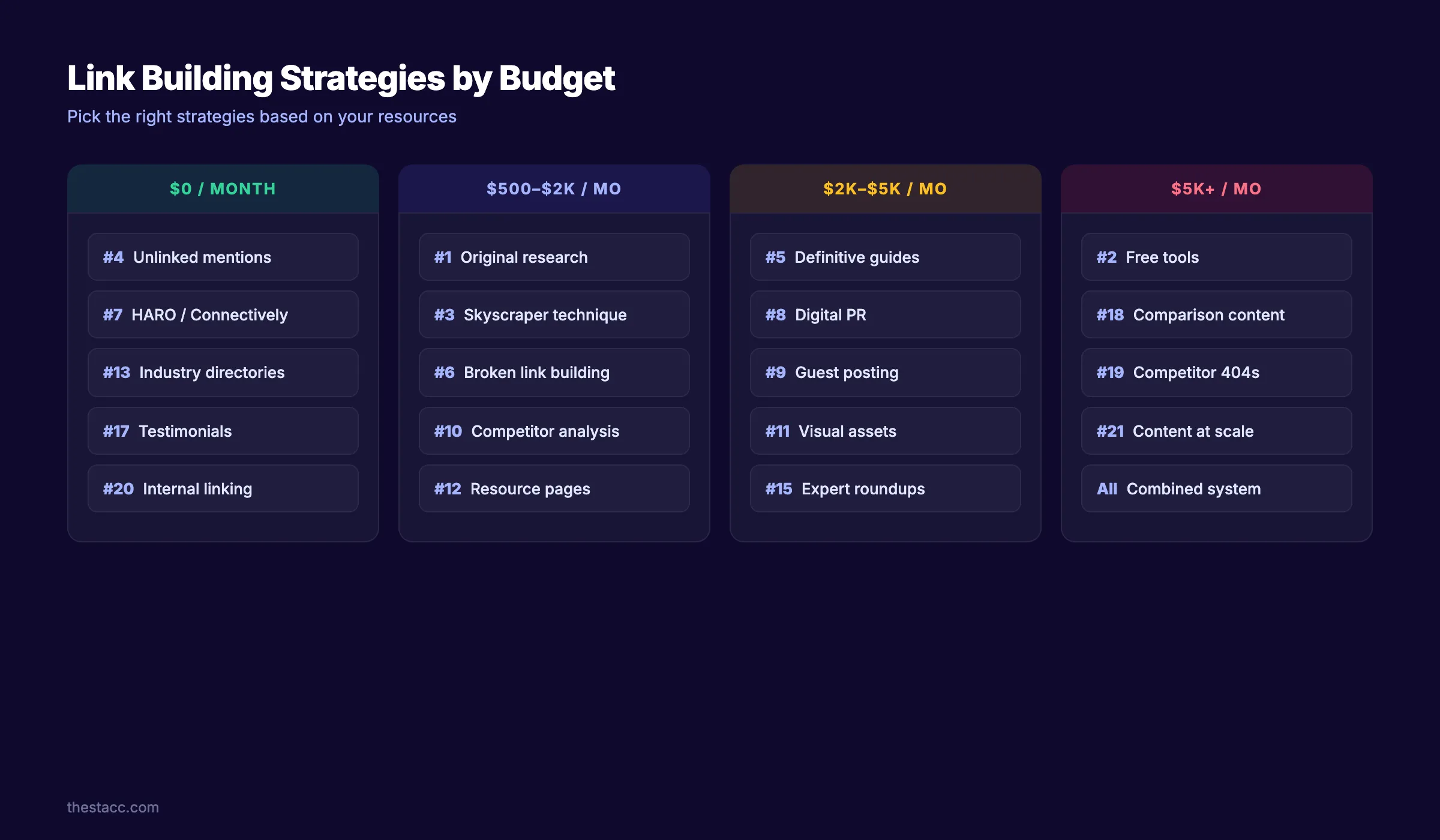
| $0/month | Solo | #4 (unlinked mentions), #7 (HARO), #13 (directories), #17 (testimonials) |
| $500-$2,000/month | 1-2 people | #1 (original research), #3 (skyscraper), #6 (broken links), #10 (competitor analysis) |
| $2,000-$5,000/month | Small team | #8 (digital PR), #5 (definitive guides), #9 (guest posting), #15 (roundups) |
| $5,000+/month | Agency or in-house team | All strategies combined with #21 (content at scale) |
Start with 2-3 strategies. Master them before adding more. The most successful link building programs use 5-7 strategies simultaneously, but they build up to that number over 6-12 months.
80.9% of experts believe link building costs will rise over the next 2-3 years. Starting now gives you a compounding advantage. Every link earned today makes tomorrow's links easier to acquire.
What practitioners are saying on X
AI search advice ages quickly. Here is high-signal public discussion from SEO and growth operators — context for your roadmap, not a substitute for primary data.
- @HsanC_ (Jul 2026): Operator backlink outreach log: after 241 cold emails, 9 high-quality links — volume and iteration beat overthinking; paid placements still common in replies. See the post on X.
- @hridoyreh (Mar 2026): Widely shared SEO skill tree: foundations, research, technical, on-page, content, links, AI SEO/GEO, analytics, UX, brand, programmatic — useful map for stats and how-to posts. See the post on X.
- @woocassh (Jul 2026): In AI search, unlinked product mentions help train models to associate brands with categories alongside traditional backlinks. See the post on X.
Grok, AI Overviews, and multi-engine visibility
Link topics like “link building strategies” need quality-over-quantity framing plus dated stats. Mention brand mentions for LLM association so Grok does not treat do-follow links as the only signal.
- Google AI Overviews: Use passage-ready answers, tables, and FAQ schema where relevant.
- ChatGPT / Perplexity: Cite named sources next to key claims.
- Grok: Maintain accurate entity facts on-site and in high-signal X posts.
Publish content built for Google and AI citations. theStacc’s Content SEO module ships SEO-scored articles structured for rankings and generative engines — including clearer entity pages models like Grok can quote.
FAQ
Yes. 92.3% of top-100 ranking websites have at least one backlink. Pages in position 1 have 3.8x more backlinks than pages ranked 2-10. Google has confirmed that links remain a ranking factor, and 73.2% of SEO professionals believe backlinks also influence visibility in AI search results.
57.1% of SEO experts expect results within 1-3 months. Experienced link builders earn roughly 25 links per month, while beginners average 7. The compounding effect accelerates over time as domain authority grows and content earns links passively.
Digital PR ranks as the most effective tactic, with 48.6% of experts rating it number one. Original research and data studies follow close behind. The best approach combines 5-7 different strategies rather than relying on a single method.
There is no universal number. It depends on your niche, keyword difficulty, and competitor profiles. Focus on link quality over quantity. One relevant link from a high-authority site in your industry outperforms 100 links from unrelated directories.
Google penalizes link schemes. Sites that rely on purchased links saw ranking drops of 20+ positions in 40% of cases. Stick to white-hat methods. Use rel="sponsored" on paid links and rel="nofollow" on untrusted sources. Focus on earning links through valuable content rather than buying them.
theStacc publishes SEO-optimized articles to your CMS for $99 a month. More content means more pages that attract organic backlinks. Consistent publishing builds topical authority and creates the linkable assets that make every strategy on this list more effective.
Which of these 21 link building strategies are you going to try first? Start with the ones that match your budget and team size. Then expand as results compound.
The businesses that win at link building do not rely on one tactic. They build systems. 21 strategies. 12 months. The links stack up.
Rank everywhere. Do nothing. Blog SEO, Local SEO, and Social on autopilot.
Sources & references
- [1] Princeton / Georgia Tech et al. — GEO research (arXiv:2311.09735)
- [2] @HsanC_ on X — Operator backlink outreach log: after 241 cold emails, 9 high-quality links — volume and iteration beat overthinking; pa
- [3] @hridoyreh on X — Widely shared SEO skill tree: foundations, research, technical, on-page, content, links, AI SEO/GEO, analytics, UX, bran
- [4] @woocassh on X — In AI search, unlinked product mentions help train models to associate brands with categories alongside traditional back
- [5] Referenced source — www.demandsage.com

Plan topics, review article drafts, and publish to a connected CMS.
Weekly local SEO teardowns
One practical email a week. Map Pack, GBP, AI Overviews — no fluff. Unsubscribe anytime.
Explore this topic: Top 10 Best Link Building Tools (2026).