Industry publication link building playbook with 8 repeatable steps, pitch templates, and 2026 benchmarks. Earn editorial backlinks from trade press.
Most operators spend a quarter chasing backlinks and end up with a folder of guest posts on sites their customers will never read. Industry publication link building solves that problem, but it is also where most teams give up first.
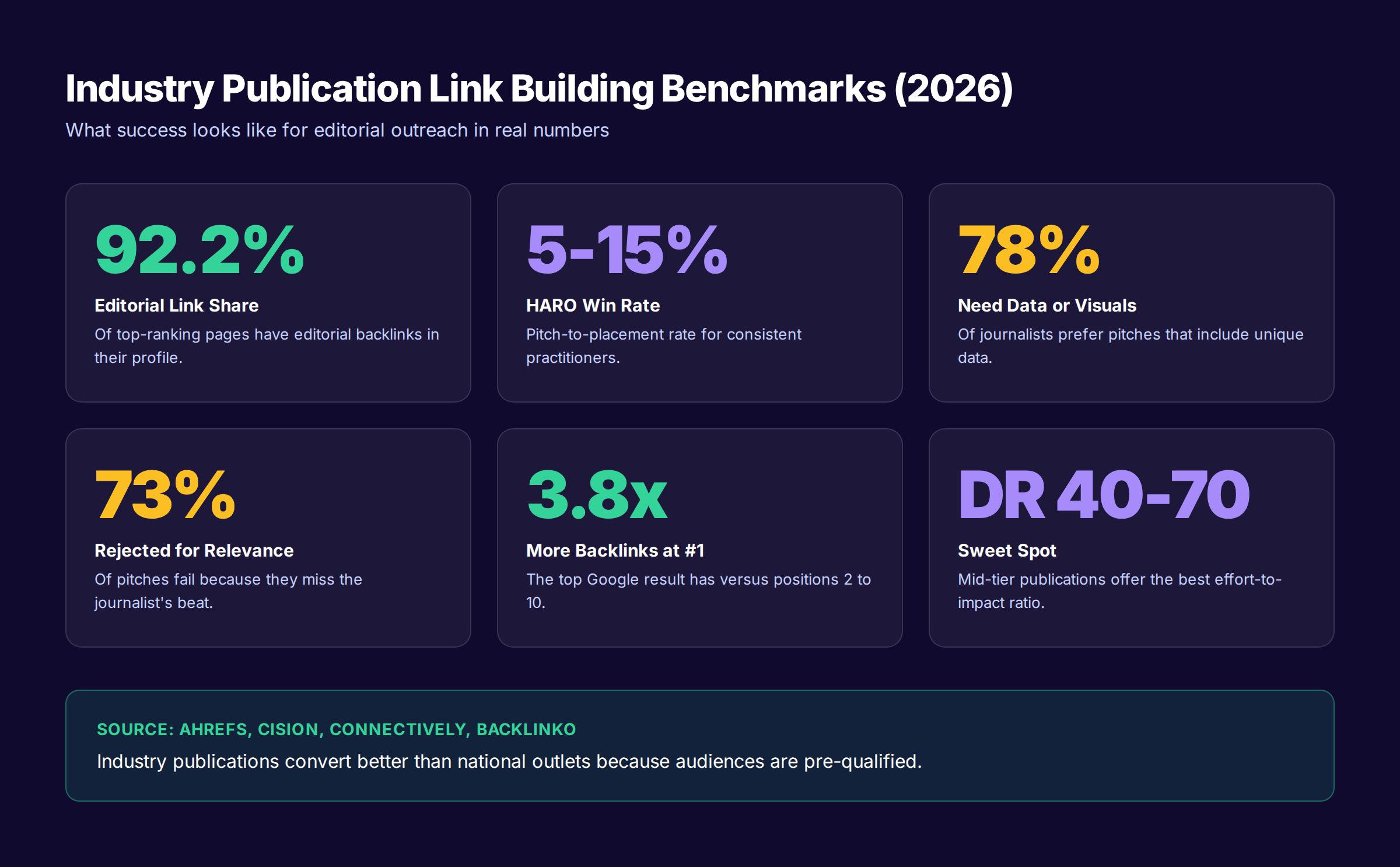
The pages your prospects already trust sit behind editorial gatekeepers. Trade journals, vertical newsrooms, and category-defining outlets are slow to respond, picky about what they publish, and allergic to spammy outreach. The win, when you earn it, is worth the effort. Editorial links make up 92.2% of top-ranking backlink profiles, and the number 1 result on Google has 3.8x more backlinks than positions 2 through 10.
We have published 3,500+ articles across 70+ industries. Every brand we work with that hits page 1 in a competitive category has at least one thing in common: a portfolio of placements in the publications their buyers actually read. Not Forbes contributor posts. Not directory listings. Real editorial coverage in industry-specific outlets.
This guide walks through the exact 8-step process we use. Every step is repeatable, measurable, and proven across hundreds of campaigns.
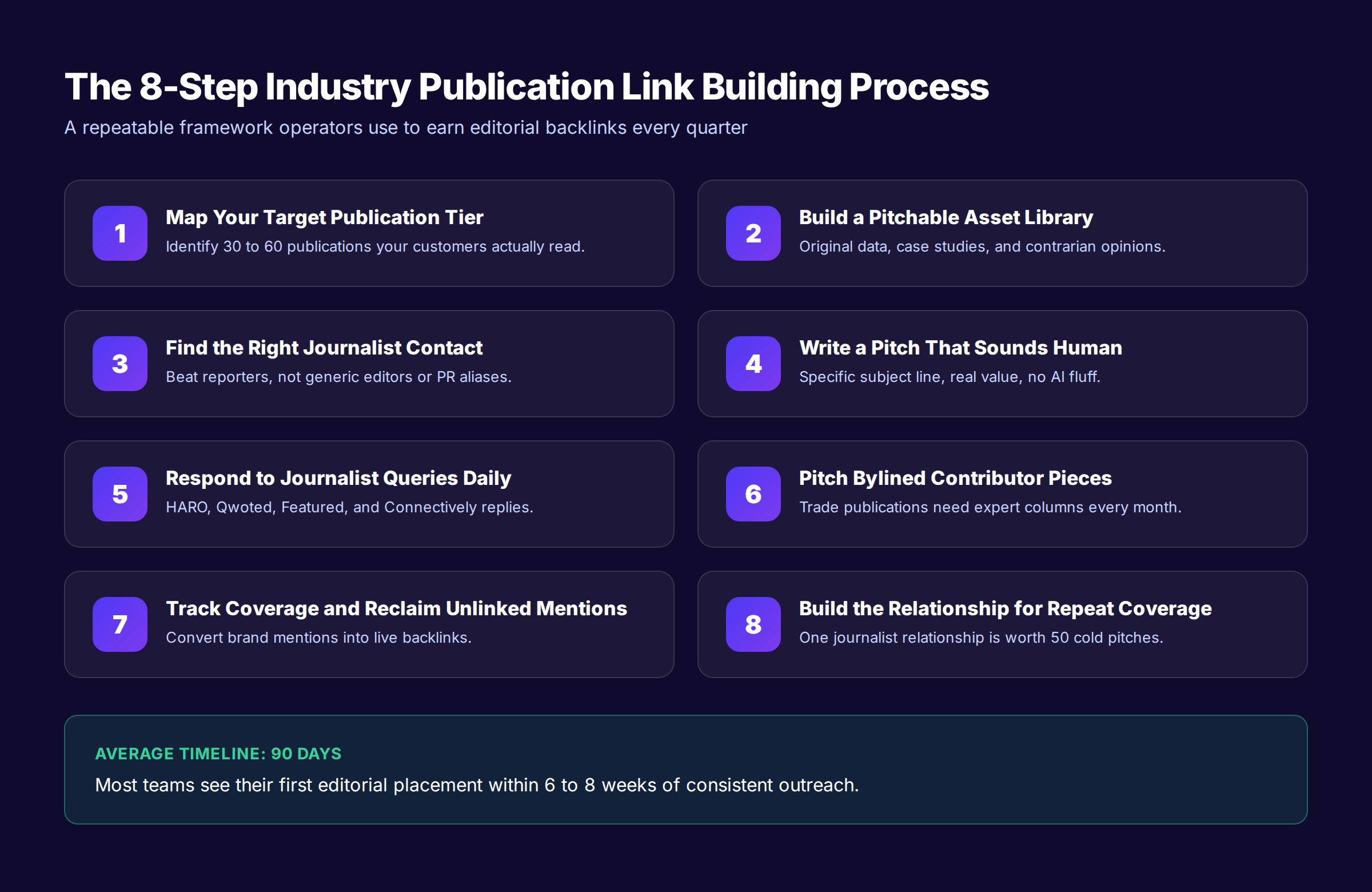
Here is what you will learn:
- How to identify the right industry publications for your business
- The asset library you need before you send a single pitch
- How to find the journalist who actually covers your beat
- A pitch template that earns 12 to 15% reply rates from editors
- How to use HARO, Qwoted, and Featured to land coverage in 30 days
- The bylined contributor strategy that compounds over 12 months
- How to convert unlinked brand mentions into live backlinks
- The journalist relationship system that produces repeat coverage
What You Will Need
Time required: 6 to 10 hours per week for the first 90 days. 3 to 4 hours per week after that.
Difficulty: Intermediate to advanced
What you will need:
- A spreadsheet for tracking publications, journalists, and pitches
- A working press email (use a real domain, not a Gmail address)
- Original research, customer data, or a strong case study
- Optional: Ahrefs, Semrush, or BuzzStream for prospecting and tracking
- Optional: HARO, Qwoted, Featured.com, or Connectively subscriptions
Step 1: Map Your Target Publication Tier
Most teams waste 6 months pitching the wrong publications. They aim for Forbes and TechCrunch on day one, get ignored, and conclude that link building does not work. The fix is to build a tiered target list before you write a single email.
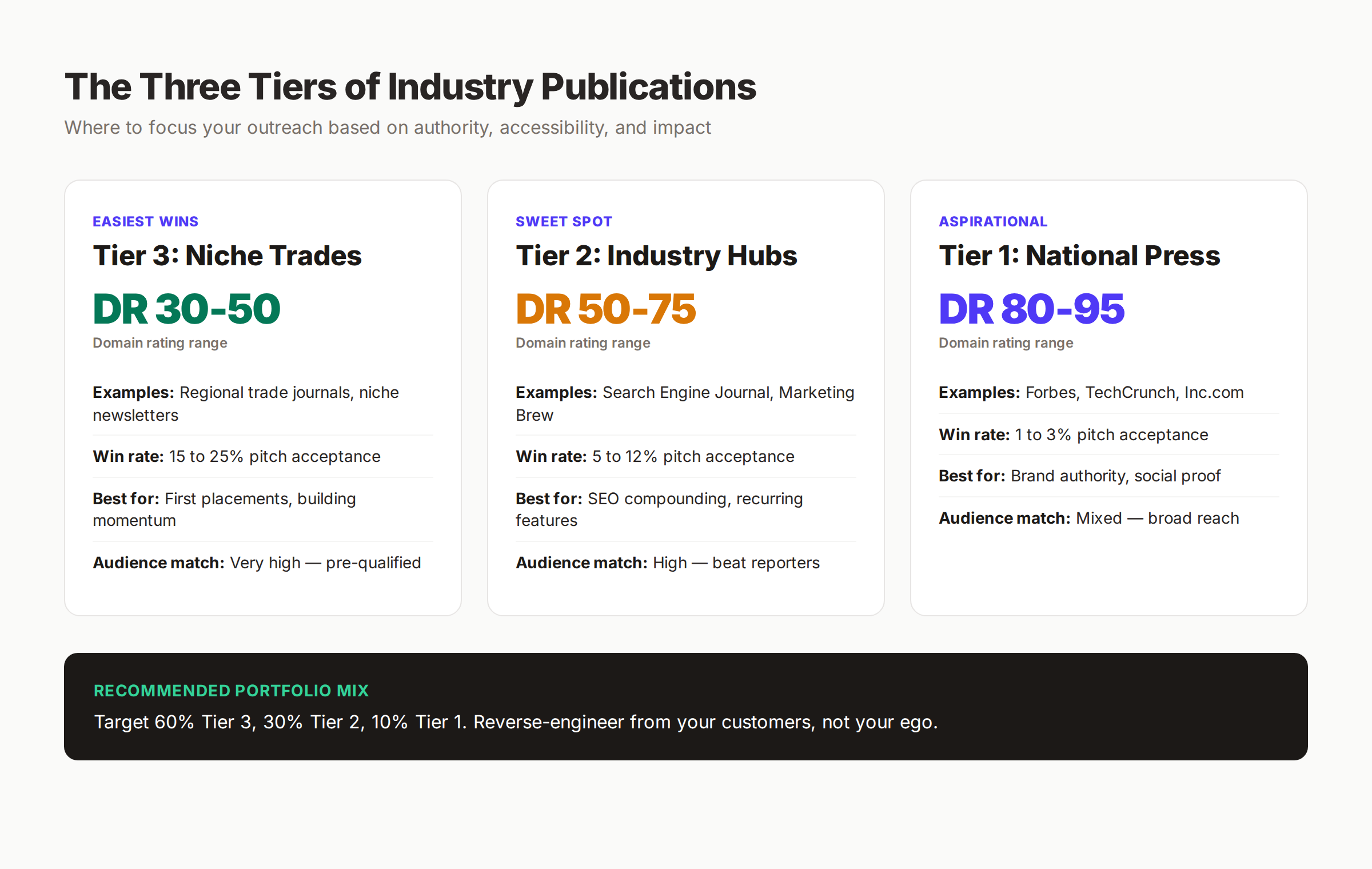
The three-tier publication framework:
| Tier | Domain Rating | Examples | Pitch Win Rate | Best For |
|---|---|---|---|---|
| Tier 3 — Niche Trades | DR 30-50 | Regional trade journals, niche newsletters, association magazines | 15-25% | First placements, building momentum |
| Tier 2 — Industry Hubs | DR 50-75 | Search Engine Journal, Marketing Brew, BuiltIn, Modern Retail | 5-12% | SEO compounding, repeat contributor columns |
| Tier 1 — National Press | DR 80-95 | Forbes, TechCrunch, Inc.com, The Wall Street Journal | 1-3% | Brand authority, social proof |
Specifically:
- Identify 60 target publications across all three tiers
- Aim for a 60/30/10 split favoring Tier 3 publications
- List the domain rating, monthly traffic, and primary audience for each
- Confirm the publication accepts external contributors or expert sources
- Note the editorial calendar, submission policies, and known editors
Why this step matters: A Tier 3 placement in a niche trade journal often drives more qualified traffic than a Forbes contributor post. The audience is pre-qualified. Your buyers are already reading that publication. A Forbes mention sounds impressive at a dinner party. A trade journal feature converts.
Pro tip: Reverse-engineer your target list from your best customers. Ask your top 20 buyers what they read every week. Their answers will produce a better target list than any agency proposal you have ever seen.
Step 2: Build a Pitchable Asset Library
The fastest way to get rejected by an editor is to pitch yourself. The fastest way to get accepted is to pitch a story they would have wanted to write anyway. The difference is your asset library.
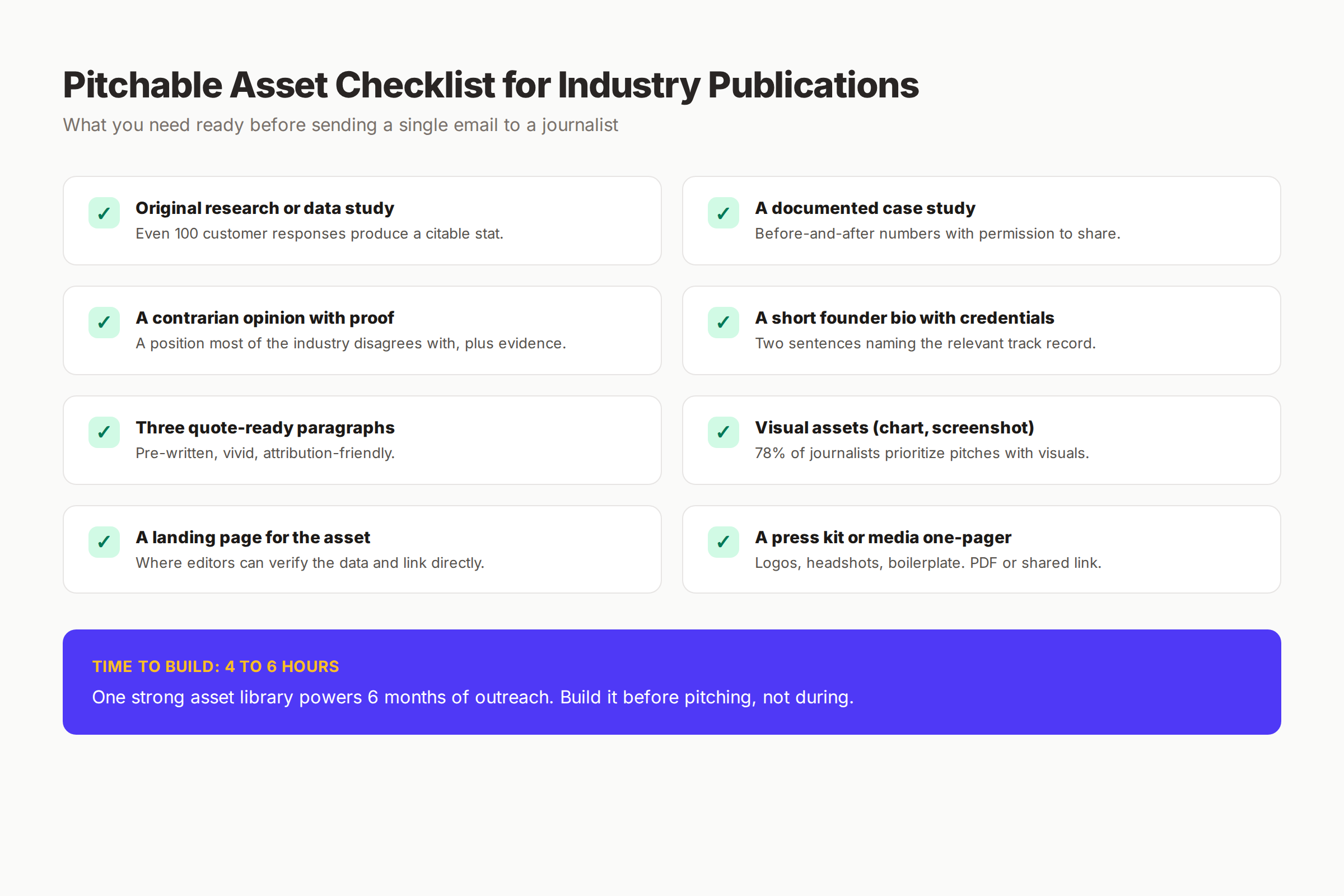
The 8 assets you need before you pitch:
- ✓ Original research or data study (even 100 customer responses produce citable stats)
- ✓ A documented case study with before-and-after numbers
- ✓ A contrarian opinion backed by evidence
- ✓ A founder bio with relevant credentials in 2 sentences
- ✓ Three quote-ready paragraphs pre-written for attribution
- ✓ Visual assets: at least one chart and one screenshot
- ✓ A landing page where editors can verify the data
- ✓ A media one-pager with logos, headshots, and boilerplate
Why journalists need this stuff:
78% of journalists are more likely to cover a story if it includes unique data or visuals. They are not looking for promotional copy. They are looking for content they can repurpose with attribution.
Specifically:
- Pick one survey question that matters in your industry
- Email 200 customers and ask it
- Compile the responses into 3 to 5 charts
- Publish the full study on a dedicated landing page
- Write a 200-word summary you can drop into a pitch email
- Pre-write 3 quote-ready paragraphs in your founder's voice
Why this step matters: Outreach without assets is begging. Outreach with assets is offering value. Editors get hundreds of pitches a week. The ones that include original data, a strong angle, and ready-to-publish materials get prioritized. The ones that say "I would love to write a guest post for you" go to the trash.
Pro tip: Repurpose one strong dataset into 5 to 8 different pitch angles. A survey of 500 founders becomes a stat for a SaaS pitch, a chart for a marketing pitch, a quote for a finance pitch, and a contrarian take for an HR pitch. Build the asset once. Pitch it 12 different ways.
Step 3: Find the Right Journalist Contact
Pitching the wrong person is the most common reason cold outreach fails. You sent a great pitch to a generic info@ alias. It got deleted. Or you sent it to a senior editor who has not actually written about your topic in 3 years. Also deleted.
73% of journalist pitches get rejected for irrelevance, not for writing quality. Relevance is the primary filter. The fix is to find the journalist who covers your specific beat, today, at the publication you are targeting.
How to find the right journalist:
| Source | What to Look For | How to Use It |
|---|---|---|
| Publication's recent articles | Articles published in the last 90 days on your topic | List the author names — these are your targets |
| Twitter/X bios | Journalists who name their beat in their bio | Follow them; check who they engage with |
| Title contains "staff writer", "contributing editor", "reporter" | Confirm they still work at the publication | |
| Muck Rack or Cision | Beat-specific journalist directories | Filter by topic, publication, and recency |
| Internal directory pages | Most publications publish a staff page | Cross-reference with bylines on recent stories |
Email patterns that work for most publications:
firstname.lastname@publication.comfirstname@publication.comfirstinitial.lastname@publication.com
Verify the email with Hunter.io or NeverBounce before sending. Bouncing pitches destroys your sender reputation.
Specifically:
- For each target publication, identify the 1 to 3 journalists who cover your beat
- Read their last 5 articles before pitching
- Note their personal angle — some prefer data, some prefer stories, some prefer controversy
- Find them on Twitter/X and LinkedIn; follow first, pitch later
- Build a simple spreadsheet with name, title, publication, beat, email, and recent articles
Why this step matters: A targeted pitch to the right journalist beats a generic pitch to 50 wrong ones. We have seen 30% reply rates on hyper-targeted outreach. We have seen 0% reply rates on lists scraped from publication staff pages. The investment in research compounds.
Pro tip: Engage with the journalist publicly before pitching. Reply thoughtfully to one of their tweets. Comment on their LinkedIn post with a useful angle. This is not bribery. It is the same warm-up you would do before pitching an investor or a prospect. By the time your email lands, your name is no longer cold.
Step 4: Write a Pitch That Sounds Human
The average journalist gets 100 to 300 pitches a week. The ones they read are short, specific, and obviously written by a human who knows their work. The ones they delete are long, generic, and obviously AI-generated.
The new Connectively HARO platform now uses AI text detection, and journalists have built sharp pattern recognition after two years of AI-generated outreach. Your pitch needs to read like a smart colleague wrote it.
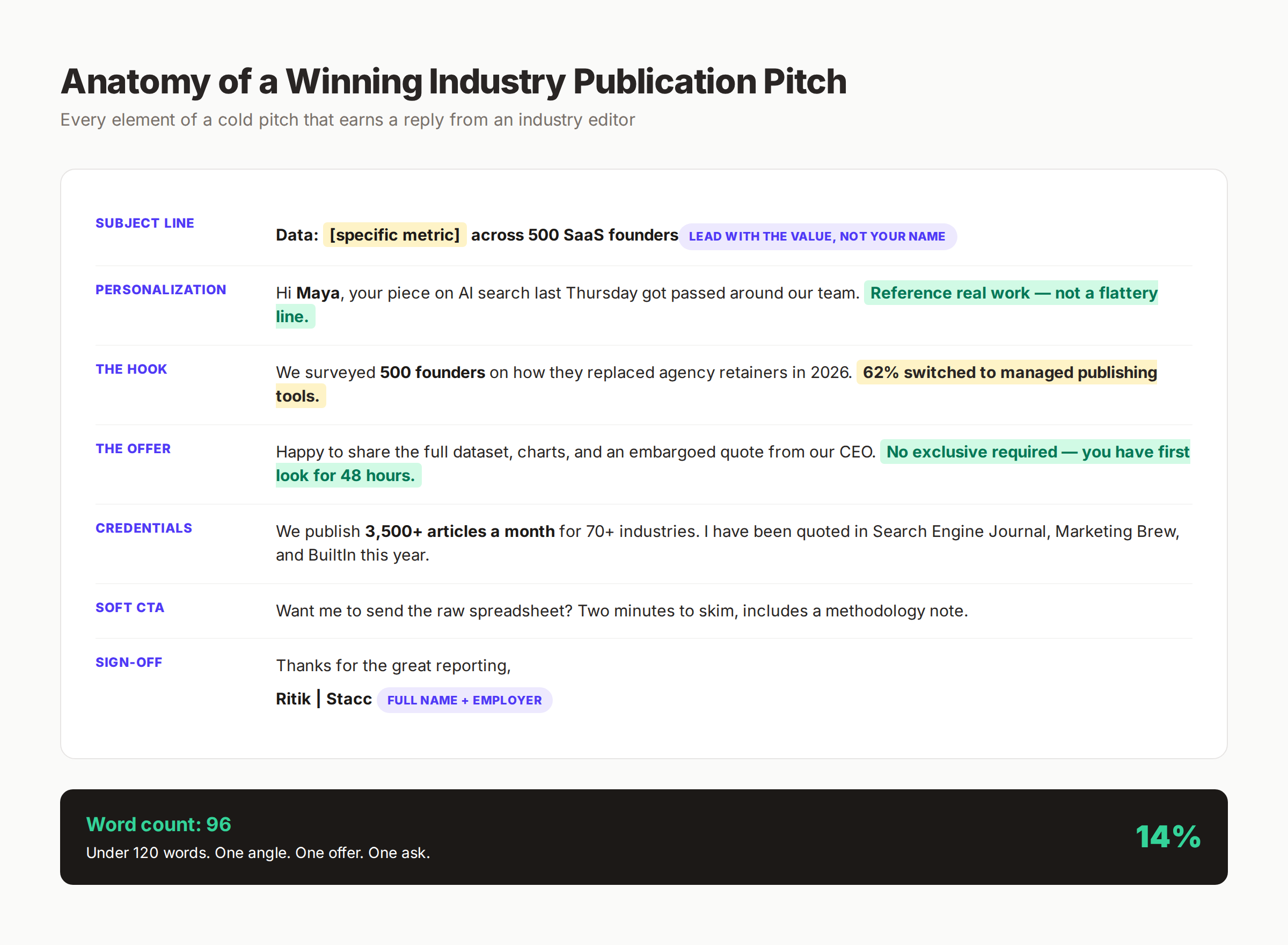
The 7 elements of a winning pitch:
| Element | What to Write | Word Count |
|---|---|---|
| Subject line | Specific value, not your name | Under 50 chars |
| Personalization | Reference real work, not flattery | 1 sentence |
| The hook | Data point or story angle | 2 sentences |
| The offer | What you will provide | 2 sentences |
| Credentials | Why you, in 1 sentence | 1 sentence |
| Soft CTA | Easy yes/no question | 1 sentence |
| Sign-off | Full name plus employer | 1 line |
Template that works (under 120 words):
Subject: Data: 62% of founders fired their agency in 2026

Hi Maya,

Your piece on AI search last Thursday got passed around our team.

We surveyed 500 SaaS founders on how they replaced agency retainers in 2026. The headline: 62% switched to managed publishing tools, and 31% cut their content spend by half.

Happy to share the full dataset, charts, and an embargoed quote from our CEO. You have first look for 48 hours — no exclusive required.

We publish 3,500+ articles a month for 70+ industries. I have been quoted in Search Engine Journal and Marketing Brew this year.

Want me to send the spreadsheet?

Thanks,
Ritik | theStacc
Pitch rules that earn replies:
- Subject under 50 characters, leading with the value not the name
- First name only, never "Hi there" or "Dear editor"
- Reference a specific recent article in the first 2 sentences
- One angle, one offer, one ask — never multiple options
- Word count under 120 words total
- No attachments — link to a hosted asset instead
- One follow-up after 4 to 5 business days, then move on
Why this step matters: Pitch quality is the single biggest determinant of reply rate. We have seen identical assets earn 0% reply rates with a bad pitch and 14% reply rates with a good one. The asset matters. The pitch matters more.
Pro tip: Write your pitch out loud first. Speak it into a voice memo, then transcribe. Then trim 30%. Pitches written this way sound like a real person. Pitches written from a template sound like every other pitch in the inbox.
Stop chasing backlinks. Start earning them. theStacc publishes 30 SEO articles per month for $99 — including the original research that earns editorial features. Built for topical authority, not just traffic.
Step 5: Respond to Journalist Queries Daily
Reactive outreach is the fastest path to your first editorial placement. Instead of pitching cold, you respond to journalists who have publicly asked for sources. The query platforms make this scalable.
The 4 platforms worth using in 2026:
| Platform | Cost | Best For | Avg Response Rate |
|---|---|---|---|
| Connectively (formerly HARO) | Free + paid tiers | Broad coverage, US and UK media | 5-10% |
| Qwoted | $99/mo | Higher-quality queries, fewer spam pitches | 8-15% |
| Featured.com | $99/mo | Quality-controlled queries, AI-friendly | 10-18% |
| SourceBottle | Free | Australian and small-business outlets | 5-12% |
The target pitch-to-placement rate is 5 to 15% for consistent practitioners. A consistent effort of 20 to 40 pitches per month produces 1 to 3 placements per month. The math compounds: in 12 months, that is 12 to 36 editorial placements on autopilot.
The 90-second query response framework:
- Read the query 3 times. Most rejections come from missing the actual question.
- Lead with the answer. Sentence 1 answers the question directly.
- Add 1 specific data point or example. This is your differentiator.
- Include credentials in 1 line. Title, company, relevant track record.
- Add the link you want. Specify the exact URL you want credited.
- Send within 4 hours. Journalists pick the first useful answer.
Why this step matters: Reactive outreach has the lowest cost per placement of any link building tactic. The journalists are already writing the story. They need a quote. If you can provide one within 2 to 4 hours, you have a real shot. We have seen brands earn 4 placements per month on Featured.com alone with 30 minutes of daily effort.
Pro tip: Set up a daily 30-minute block specifically for query responses. Set a Slack notification or RSS feed for new queries. Speed wins. A great answer sent 8 hours late loses to a decent answer sent in 90 minutes. Build a habit, not a marathon.
Step 6: Pitch Bylined Contributor Pieces
Trade publications need columns. Every week. The smaller and more niche the outlet, the more they depend on outside contributors. This is the highest-impact placement type for industry publication link building.
A bylined contributor piece is different from a guest post. You are not writing for a blog network. You are writing as a named expert for a publication your audience trusts. The byline includes your title, employer, and a backlink to your site or specific landing page.
Where to find contributor opportunities:
- The publication's "Write for us" or "Contribute" page
- The byline footer of recent articles ("Author is X at Y company")
- LinkedIn posts from editors saying "looking for contributors"
- Direct pitches to editors who run a regular column format
The contributor pitch template:
Subject: Column pitch: [specific topic + angle]

Hi [Editor],

Three column ideas for [publication name]'s readers, each tied to a real
data point or case study we have access to:

1. [Headline] — Why we believe [contrarian angle]. Includes data from
   our recent survey of 500 founders.

2. [Headline] — A teardown of [specific case study], including 6 months
   of before-and-after metrics with the customer's permission.

3. [Headline] — The 5 mistakes most [audience] make when [topic], from
   reviewing 1,200 customer accounts.

I can deliver any of these as a 1,200-word draft within 7 days, formatted
to your house style. Happy to also include 2 to 3 charts.

We publish 3,500+ articles a month at theStacc. Recent work: [link to your
own publication].

Which angle would be most useful for your readers?

Thanks,
Ritik | theStacc
Specifically:
- Pitch 3 specific column ideas, not 1 vague offer
- Each idea names a real story, data point, or case study
- Commit to a deadline (most editors test contributors with a 7 to 10 day deliverable)
- Match the publication's existing format and word count
- Offer charts, screenshots, or quotes from real customers
- Confirm the byline format and backlink rules before writing
Why this step matters: A single bylined column in a trade publication produces a backlink, a brand mention, and a quote-able credential for life. "As featured in X" appears in every future pitch you send. The credibility compounds. Plus, most editors who accept one column will accept future columns. A successful first piece becomes a recurring monthly placement.
Pro tip: Always negotiate the backlink before writing. Ask: "Will the byline include a dofollow link to a specific URL of my choosing?" Some publications only offer nofollow links. Some only offer homepage links. Both are still valuable, but you need to know before you invest 4 hours writing.
Step 7: Track Coverage and Reclaim Unlinked Mentions
Half the brand mentions you earn never include a backlink. The journalist mentioned your company in the article, but the editor stripped the hyperlink during copy edit. Or the writer included your data but forgot to link to the source. These are the easiest backlinks you will ever earn — if you find them.
The unlinked mention recovery process:
- Set up brand alerts. Use Google Alerts, Ahrefs Alerts, or Mention to track every published reference to your brand.
- Filter for industry publications only. Ignore press release syndication and social mentions.
- Identify mentions without backlinks. Visit each article and check whether your brand name links to your site.
- Send a friendly reclaim email. Polite, short, no attitude.
The reclaim email template:
Subject: Thanks for the mention — quick favor

Hi [Journalist],

Thanks for including theStacc in your piece on [topic] yesterday. The
article got passed around our team — your point about [specific point]
matched what we have been seeing too.

One small ask: would you mind linking the "theStacc" mention to
https://thestacc.com? Makes it easier for your readers to find us
if they want to dig in.

Either way, thanks for the great work.

Ritik | theStacc
Specifically:
- Set up alerts within 24 hours of launching outreach
- Check for unlinked mentions every Monday
- Send reclaim emails within 7 days of the article publishing (while it is fresh)
- Always specify the exact URL you want linked
- Never push back if the editor declines — preserve the relationship
Why this step matters: Unlinked mentions convert at 30 to 50% when you ask politely and promptly. That is a 5x higher conversion rate than cold pitches for new placements. You have already earned the coverage. The link is the easy part. BuzzStream research shows reclaim emails are one of the highest-ROI link building activities.
Pro tip: Track the journalist who wrote each mention, not just the publication. If the same writer covers your space twice, they are now a known relationship. Add them to your priority outreach list. The next time you have data to share, they get first look.
Step 8: Build the Relationship for Repeat Coverage
One journalist relationship is worth 50 cold pitches. The teams that win at industry publication link building are not the best pitch writers. They are the best relationship builders. The first placement opens the door. Every placement after that depends on what you do next.
The post-placement relationship system:
| When | Action | Why |
|---|---|---|
| Day 0 (publication day) | Share the article on LinkedIn, X, and your newsletter. Tag the journalist and publication. | Drives traffic to their article. Editors notice. |
| Day 1 | Send a personal thank-you email referencing one specific line you liked. | Builds the human connection. Most sources skip this. |
| Day 7 | Send 1 piece of useful info (not a pitch). Industry trend, dataset, contact intro. | Demonstrates ongoing value. Stays top of mind. |
| Day 30 | Check in with a relevant story idea or new data. | The first re-pitch. Reference the prior placement. |
| Day 90 | Audit the relationship. Are they responding? Are they your top-tier contact? Adjust outreach. | Focus your time on the journalists who respond. |
The compounding math of relationships:
A new cold pitch has a 5 to 12% reply rate. A pitch to a journalist who has worked with you before has a 40 to 70% reply rate. The math is brutal. One earned relationship is worth more than 6 months of new outreach.
Specifically:
- Maintain a contact list of every journalist who has ever covered you
- Send 1 non-pitch touchpoint per quarter to each contact
- Send pitches only when you have a story that genuinely fits their beat
- Never use the same pitch on multiple journalists at the same publication
- Always thank the editor publicly for the placement
Why this step matters: Most outreach campaigns die because the team treats every placement as a transaction. Send pitch, get coverage, move on. The teams that compound use every placement as the start of a relationship. By year 2, you have 10 to 20 journalist relationships that produce coverage on demand. By year 3, journalists pitch you when they need a source.
Pro tip: Keep a personal note for each journalist. What they care about, what beat they cover, what they ignored. The detail does not need to be deep. "Maya prefers data over case studies. Cares about midmarket SaaS. Replies fastest on Tuesday mornings." Three lines per contact. The notes are your competitive advantage in 18 months.
Your SEO team. $99 per month. 30 optimized articles published automatically — including the original research that earns features in your industry's biggest publications.
Results: What to Expect
A consistent industry publication link building campaign produces predictable outcomes. Here is the realistic 90-day forecast for a brand starting from zero.
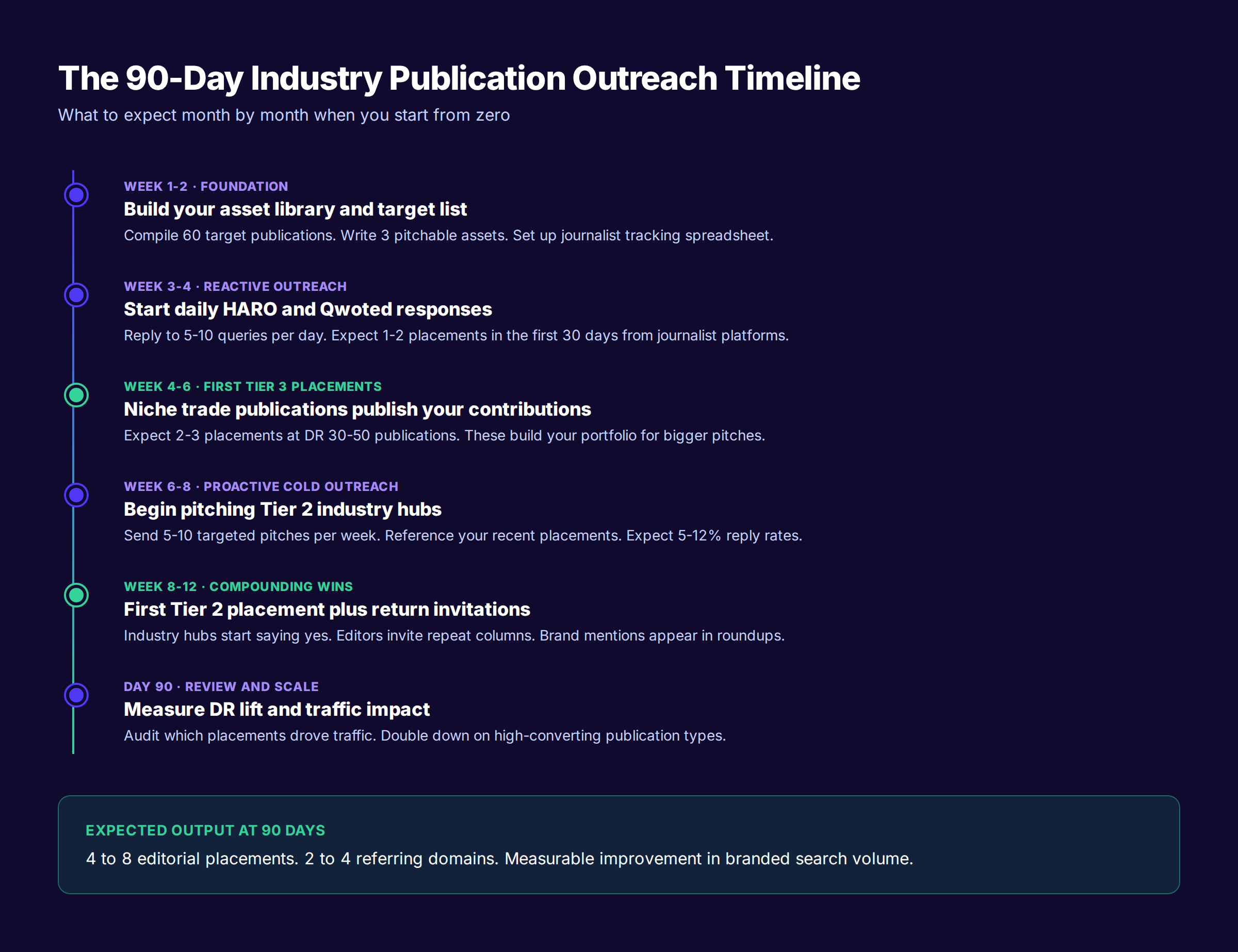
Realistic 90-day outcomes:
| Month | Expected Output | What Drives It |
|---|---|---|
| Month 1 | 1-2 placements (Tier 3, niche trades) | HARO and Qwoted query responses |
| Month 2 | 3-5 cumulative placements | First proactive pitches land. Tier 3 wins build credibility. |
| Month 3 | 6-10 cumulative placements | First Tier 2 placement. Contributor columns scheduled. |
12-month benchmarks for a focused operator:
- 20 to 40 editorial placements total
- 4 to 8 recurring contributor relationships
- 2 to 4 Tier 1 (national press) placements
- 15 to 25 net new referring domains
- Measurable lift in branded search volume and direct traffic
Backlinks remain a top 3 ranking factor for Google in 2026, and editorial links from industry publications carry more authority than any other type. The brands that publish consistent original research and pitch consistently end the year with a permanent moat.
Troubleshooting
Problem: You have sent 30 pitches and earned zero replies. Solution: Your pitches are probably either too generic or sent to the wrong people. Audit 5 recent pitches against the 7-element framework in Step 4. Most failures come from one of three issues: subject lines that sound like spam, generic personalization ("I love your work"), or vague offers ("I would love to contribute"). Fix one element at a time.
Problem: You are getting replies but no placements. Solution: Your assets are not strong enough. Editors are willing to engage but the underlying story is not publication-worthy. Strengthen one asset before pitching again. Original research with at least 200 respondents, a documented case study with permission to share, or a contrarian opinion backed by data will all work.
Problem: Placements happen but they do not drive traffic. Solution: You are targeting the wrong publications. Re-do Step 1 with your top 20 customers. Ask them what they read. The publications they name are your real target list. Generic SEO blogs send link equity but not buyers. Trade publications send both.
Problem: You earned a great placement but the editor stripped the backlink. Solution: Send a polite reclaim email within 7 days using the template in Step 7. If the publication has a strict no-backlink policy, focus on brand mentions and quote credibility instead. Even unlinked mentions feed Google's E-E-A-T signals and improve domain authority indirectly.
Problem: You cannot afford Connectively, Qwoted, or Featured subscriptions. Solution: Start with the free tiers of Connectively and SourceBottle. Both produce 1 to 2 placements per month for active responders. Spend the saved budget on building one strong original research asset instead. A great asset opens more doors than a paid query subscription.
What practitioners are saying on X
AI search advice ages quickly. Here is high-signal public discussion from SEO and growth operators — context for your roadmap, not a substitute for primary data.
- @HsanC_ (Jul 2026): Operator backlink outreach log: after 241 cold emails, 9 high-quality links — volume and iteration beat overthinking; paid placements still common in replies. See the post on X.
- @hridoyreh (Mar 2026): Widely shared SEO skill tree: foundations, research, technical, on-page, content, links, AI SEO/GEO, analytics, UX, brand, programmatic — useful map for stats and how-to posts. See the post on X.
- @woocassh (Jul 2026): In AI search, unlinked product mentions help train models to associate brands with categories alongside traditional backlinks. See the post on X.
Grok, AI Overviews, and multi-engine visibility
Link topics like “industry publication link building” need quality-over-quantity framing plus dated stats. Mention brand mentions for LLM association so Grok does not treat do-follow links as the only signal.
- Google AI Overviews: Use passage-ready answers, tables, and FAQ schema where relevant.
- ChatGPT / Perplexity: Cite named sources next to key claims.
- Grok: Maintain accurate entity facts on-site and in high-signal X posts.
Publish content built for Google and AI citations. theStacc’s Content SEO module ships SEO-scored articles structured for rankings and generative engines — including clearer entity pages models like Grok can quote.
FAQ
Industry publication link building is the process of earning editorial backlinks from publications that serve your specific industry or vertical. These are trade journals, niche newsletters, and vertical media outlets where your target customers already spend time. Unlike general guest posting or directory submissions, industry publication links carry both SEO authority and direct audience relevance, which is why they compound faster than other backlink types.
Most teams see their first placement within 30 to 60 days of consistent outreach. Reactive outreach through Connectively, Qwoted, and Featured produces placements fastest. Proactive cold outreach to specific journalists takes 6 to 8 weeks to ramp up. Bylined contributor columns take 8 to 12 weeks from first pitch to publication. Total: expect 4 to 8 placements in your first 90 days if you commit 6 to 10 hours per week.
Build a target list of 60 publications across 3 tiers. Aim for a 60/30/10 split: 60% Tier 3 (niche trades, DR 30-50), 30% Tier 2 (industry hubs, DR 50-75), and 10% Tier 1 (national press, DR 80-95). This ratio produces consistent wins while still aiming high. Listing fewer than 30 publications leaves too much pitch volume on the table. Listing more than 100 makes follow-up impossible.
Yes. Editorial links from industry publications are still the most valuable backlinks in SEO, even after Google's helpful content updates and the rise of AI search. The number 1 result on Google has 3.8x more backlinks than positions 2 through 10, and editorial backlinks make up 92.2% of top-ranking link profiles. AI search engines like ChatGPT and Perplexity also cite industry publications more often than general SEO blogs, so industry coverage now compounds in both traditional and AI search visibility.
A guest post is a piece you write and submit to a content network or general blog, usually with limited editorial oversight. An industry publication feature involves a real editor, a real publication brand, and an audience that pre-trusts the outlet. Guest posts produce backlinks. Industry publication features produce backlinks plus brand authority plus qualified traffic. The effort is higher. The compounding value is much higher.
Track 4 metrics: referring domains gained, branded search volume, direct traffic from referrals, and qualified lead attribution. Use Google Search Console for branded search trends, GA4 for referral traffic, and Ahrefs or Semrush for backlink tracking. The lagging metric is rankings. Most teams see ranking lift 90 to 180 days after their first wave of placements. Plan for a 6-month measurement window, not a 6-week one.
In-house wins for industry publication link building 90% of the time. Agencies charge $5,000 to $25,000 per month and rarely match the relevance of insider knowledge. Your team knows your category better than any agency. The work that matters most — asset creation, journalist research, relationship building — happens faster and better in-house. Use agencies only for Tier 1 national press campaigns where their existing journalist relationships save you 12 months of cold outreach.
3,500+ blogs published. Every article is SEO-scored before publish. See what theStacc can do for your content strategy and editorial outreach.
Now you have the full 8-step framework for industry publication link building. The strategy is repeatable. The math compounds. The only variable is whether you commit to consistent execution.
Start with Step 1 today. Build your target list of 60 publications by Friday. Pitch your first journalist by next Monday. Six months from now, you will have a portfolio of editorial placements that no competitor can shortcut. Build it once. Compound it forever.
Sources & references
- [1] Princeton / Georgia Tech et al. — GEO research (arXiv:2311.09735)
- [2] @HsanC_ on X — Operator backlink outreach log: after 241 cold emails, 9 high-quality links — volume and iteration beat overthinking; pa
- [3] @hridoyreh on X — Widely shared SEO skill tree: foundations, research, technical, on-page, content, links, AI SEO/GEO, analytics, UX, bran
- [4] @woocassh on X — In AI search, unlinked product mentions help train models to associate brands with categories alongside traditional back
- [5] Referenced source — ahrefs.com

Researched, written, and published articles that compound organic traffic.
Weekly local SEO teardowns
One practical email a week. Map Pack, GBP, AI Overviews — no fluff. Unsubscribe anytime.