
SEO vs SEM: The Complete Guide (2026)
SEO vs SEM explained with real data. Covers cost, ROI, timeline, conversion rates, and when to use each. Includes a budget allocation framework for 2026.
Siddharth Gangal • 2026-03-30 • SEO Tips
In This Article
SEO vs SEM is one of the most searched marketing questions online. It is also one of the most poorly answered. Most guides define both terms, list a few differences, and end with “it depends.” That does not help anyone make a budget decision.
Here is what the data actually shows. Organic search drives 53.3% of all website traffic. Paid search drives 15%. SEO delivers a median ROI of 748%. PPC averages 200%. Yet 70-80% of users skip paid ads entirely and click organic results, according to multiple studies.
The answer is not “it depends.” The answer is: most businesses should invest in SEO first, add SEM strategically, and understand exactly when each channel earns its budget.
We have published 3,500+ SEO articles across 70+ industries. This guide covers the SEO vs SEM comparison with real numbers, industry benchmarks, and a framework for allocating your budget.
Here is what you will learn:
- The actual definitions of SEO and SEM (the industry still confuses these)
- Head-to-head comparison on cost, ROI, timeline, and conversion rates
- Which industries benefit more from SEO vs SEM
- A budget allocation framework by spend level
- How AI Overviews are changing the equation in 2026
Chapter 1: What Is SEO?
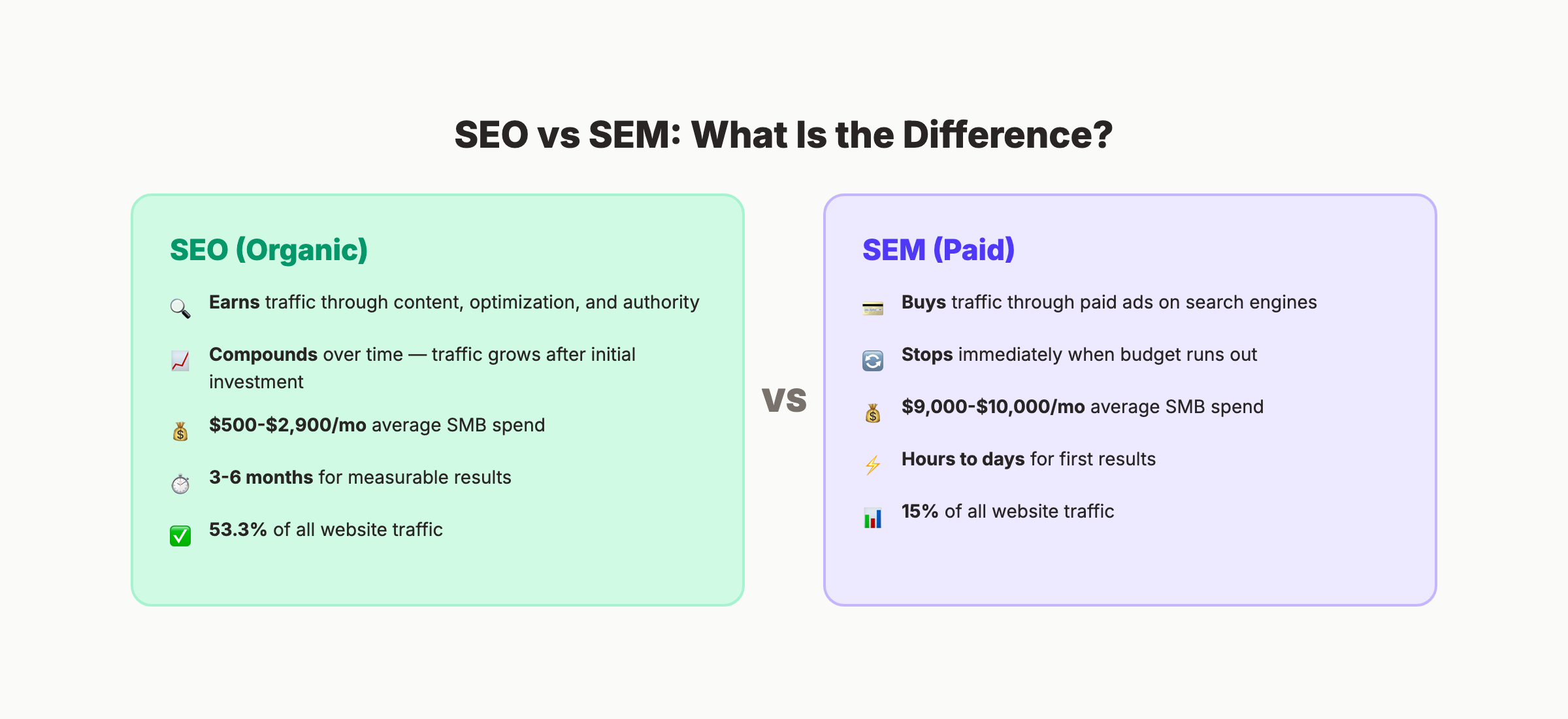
SEO (Search Engine Optimization) is the practice of earning organic traffic from search engines. You optimize your website, create content, and build authority so Google ranks your pages without paying per click.
The Four Pillars of SEO
On-page SEO covers everything on your website: title tags, meta descriptions, header structure, internal links, and content quality. A strong on-page SEO guide walks through each element.
Technical SEO ensures search engines can crawl and index your site. Page speed, mobile responsiveness, structured data, and site architecture all fall here.
Content SEO is the production engine. Publishing relevant, high-quality content that matches search intent. The content velocity at which you publish directly affects how quickly you build topical authority.
Off-page SEO builds domain authority through backlinks, brand mentions, and digital PR. Quality links from relevant sites remain one of the strongest ranking signals.
What SEO Costs
Small businesses typically spend $100-$5,000 per month on SEO. The average sits around $500 per month for basic SEO and $2,900 per month for more competitive strategies, according to Semrush.
The critical difference: SEO spend builds equity. The content and rankings you earn today continue generating traffic for years. Stop paying for SEO and the traffic does not disappear overnight.
Chapter 2: What Is SEM?
SEM (Search Engine Marketing) is the practice of gaining visibility through paid advertising on search engines. In 2026, SEM primarily means Google Ads and Microsoft Ads (Bing).
A Definition That Needs Clearing Up
The industry has debated whether SEM includes SEO or only paid search. The original definition included both. In practice, SEM now refers almost exclusively to paid search advertising (PPC). SEO is treated as a separate discipline.
This guide treats SEM as paid search marketing. When we say SEM, we mean Google Ads and similar pay-per-click platforms.
How SEM Works
You bid on keywords. When someone searches that keyword, your ad appears above organic results. You pay each time someone clicks. The cost per click (CPC) varies by keyword competition, industry, and quality score.
What SEM Costs
The average Google Ads CPC in 2025 is $4.22-$8.34 depending on the study, according to WordStream benchmarks. High-competition industries pay far more. Legal services average $137.55 per click for personal injury keywords. Insurance averages $67.73.
Small to medium businesses spend $9,000-$10,000 per month on PPC on average. That is roughly 7x more than the average SEO spend.
The critical difference: SEM spend rents visibility. Stop paying and traffic drops to zero the same day.
Stop writing. Start ranking. Stacc publishes 30 SEO articles per month for $99. Organic traffic that compounds, not ad spend that disappears. Start for $1 →
Chapter 3: SEO vs SEM Head-to-Head Comparison
This is where the data matters more than opinions.
| Factor | SEO | SEM (PPC) |
|---|---|---|
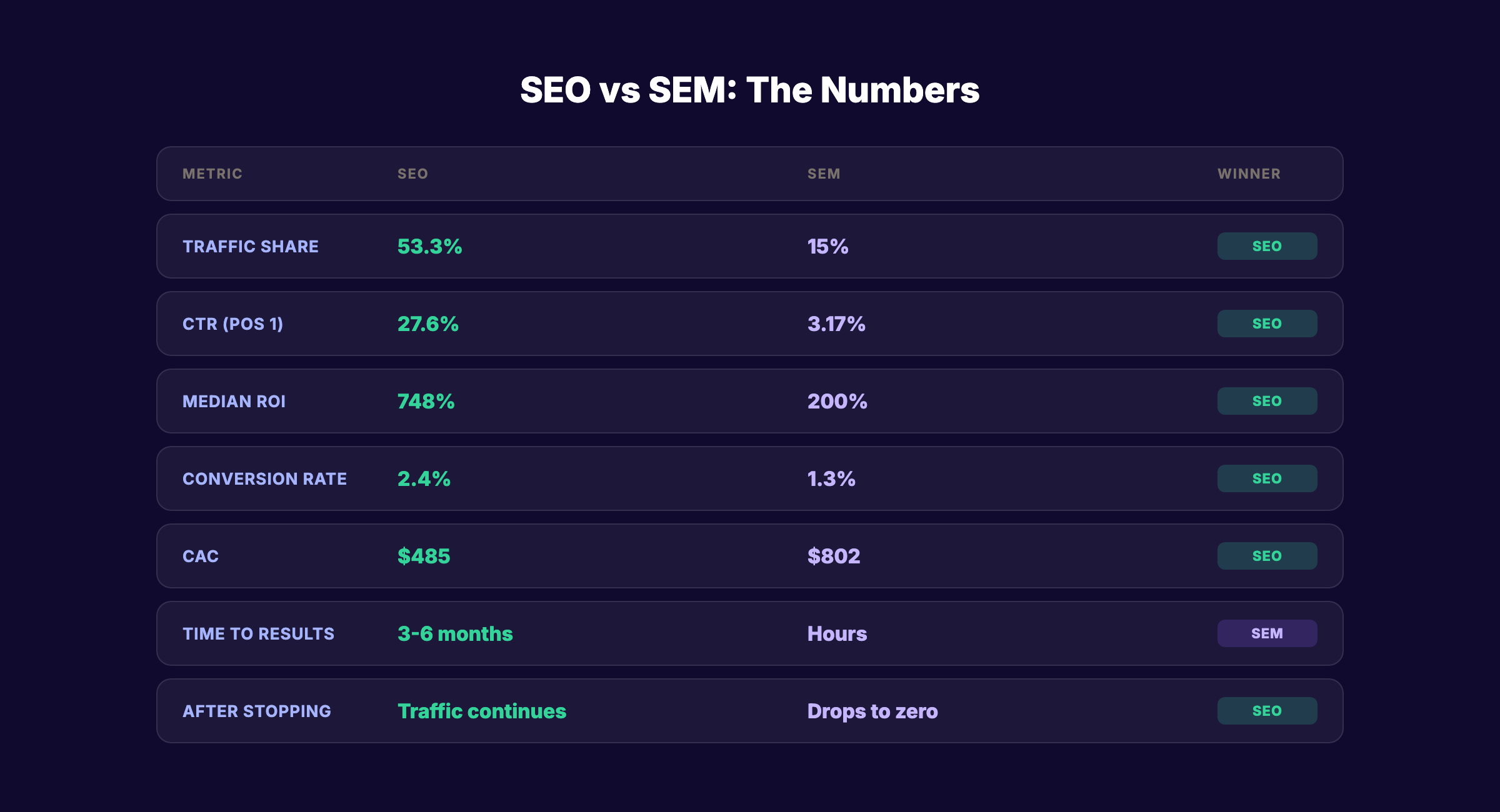
| Traffic share | 53.3% of all website traffic | 15% of all website traffic |
| Average CTR | 27.6% (position 1) | 3.17% average |
| Median ROI | 748% | 200% |
| Average conversion rate | 2.4% | 1.3% |
| Customer acquisition cost | ~$485 | ~$802 |
| Time to results | 3-6 months | Hours to days |
| Traffic after you stop | Continues for months/years | Drops to zero immediately |
| Average monthly cost (SMB) | $500-$2,900 | $9,000-$10,000 |
Sources: First Page Sage, BrightEdge, WordStream, Ahrefs, Semrush
Click-Through Rates: Organic Wins by 8x
The top organic result earns a 27.6% click-through rate. The average search ad earns 3.17%. First Page Sage data shows that organic position 1 captures more clicks than all paid ads combined on most queries.
70-80% of users scroll past paid ads entirely. They trust organic results more. This behavioral pattern has held steady for over a decade despite Google making ads look increasingly similar to organic listings.
ROI: SEO Delivers 3.7x More Return
SEO returns a median of $7.48 for every $1 invested (748% ROI). PPC returns approximately $2 for every $1 (200% ROI). The data comes from First Page Sage’s analysis across 19 industries.
The ROI gap exists because SEO compounds. An article published today continues generating traffic for years. A PPC campaign only generates traffic while the budget is active.
Conversion Rates: SEO Converts Nearly 2x Better
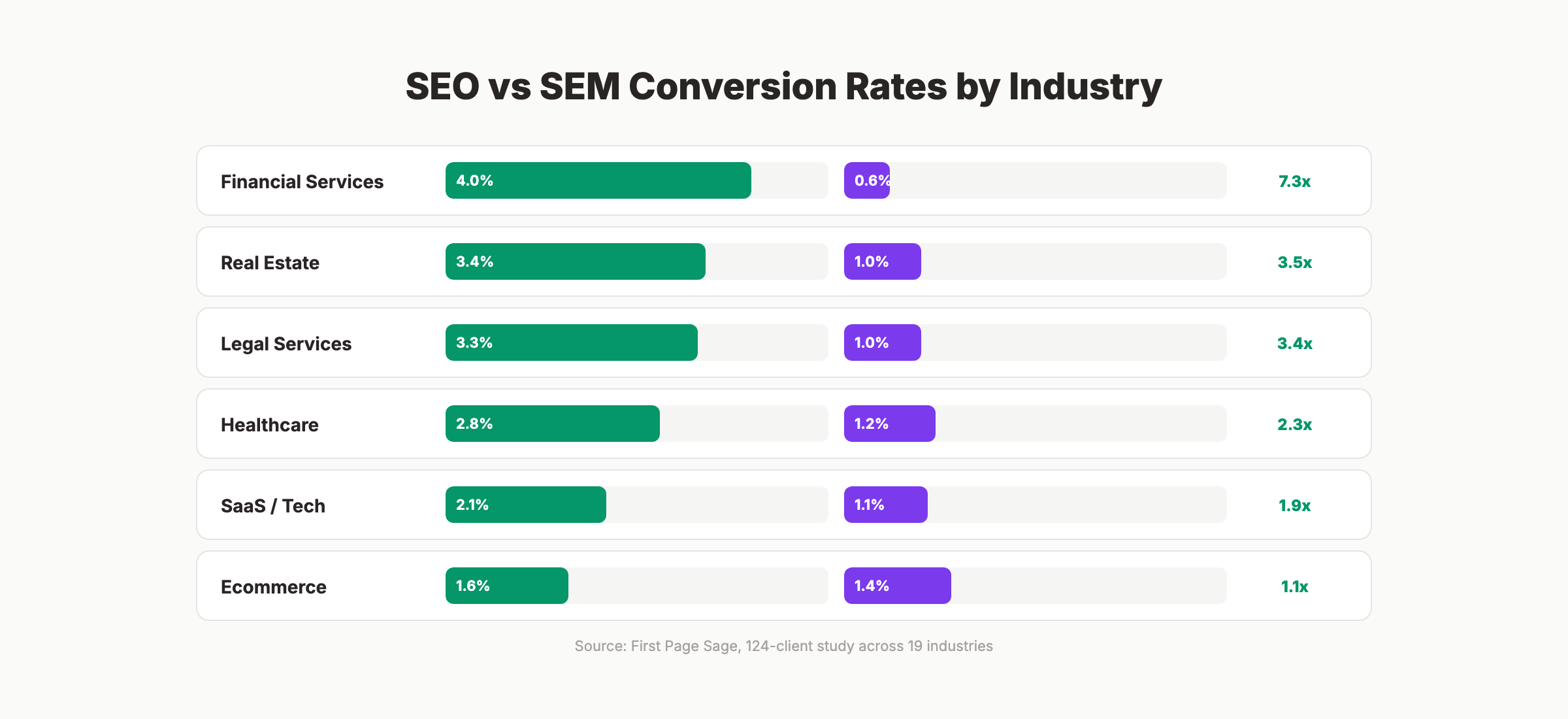
SEO converts at an average of 2.4% across industries. PPC converts at 1.3%. In some industries, the gap is even wider. SEO converts 7.3x more than PPC in financial services and 3.5x more in real estate, according to First Page Sage’s 124-client study.
Organic leads close at 8x the rate of outbound leads. People who find you through organic search have higher intent and higher trust than people who click ads.
Customer Acquisition Cost: SEO Is 40% Cheaper
The average organic customer acquisition cost is $485. The average paid search CAC is $802. That is a 65% premium for paid traffic.
For businesses running both channels, this means shifting budget from SEM to SEO reduces overall CAC while maintaining or increasing lead volume.
Timeline: SEM Wins on Speed
This is the one area where SEM clearly beats SEO. PPC delivers traffic within hours of campaign launch. SEO takes 3-6 months for measurable results. Only 5.7% of new pages reach Google’s page 1 within their first year, according to Ahrefs.
The average page ranking in position 1 is approximately 3 years old. Building SEO authority takes time. There are no shortcuts.
Chapter 4: When to Choose SEO
SEO is the right primary investment for most businesses. The data supports this clearly.
Choose SEO When:
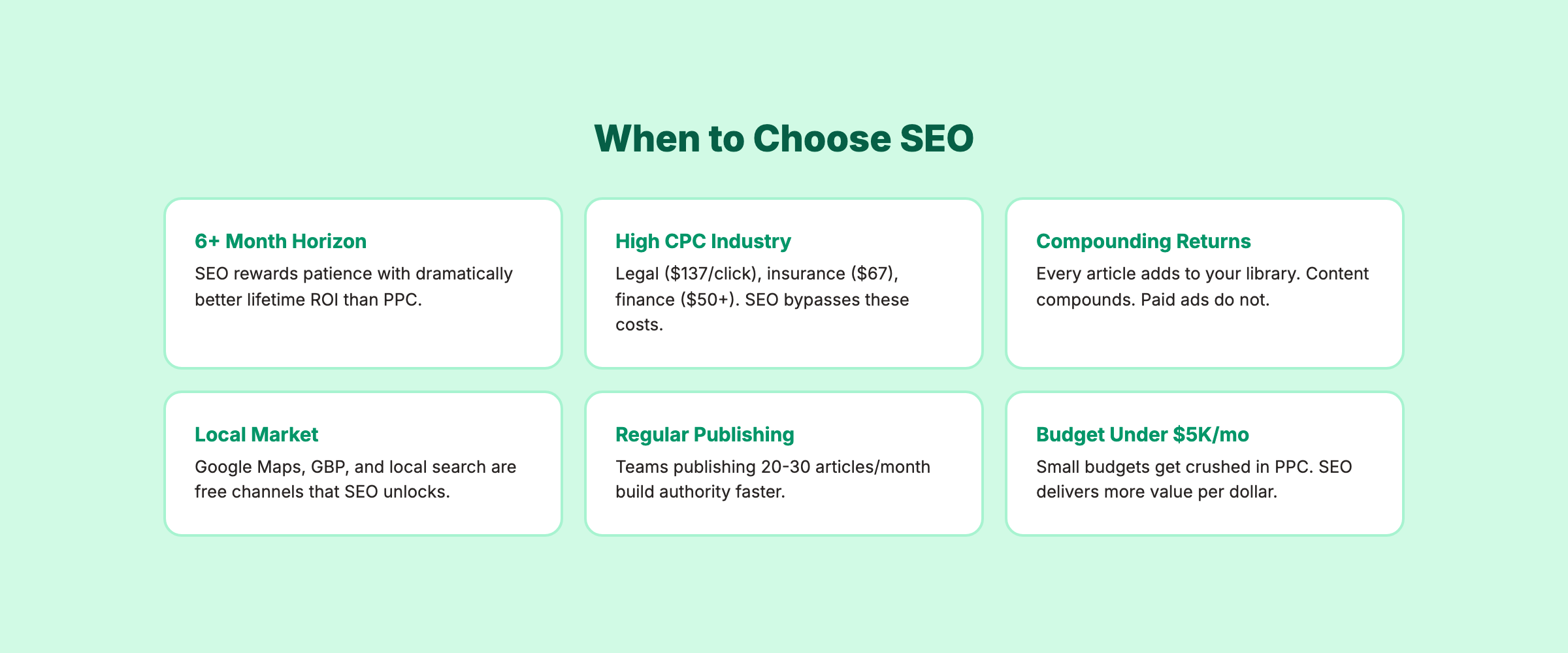
You have a 6+ month time horizon. SEO rewards patience. If you can invest for 6-12 months before expecting full returns, SEO delivers dramatically better lifetime ROI than PPC.
Your industry has high CPCs. Legal services ($137 per click), insurance ($67 per click), and finance ($50+ per click) make PPC unsustainable for small budgets. SEO provides access to the same keywords at a fraction of the cost.
You want compounding returns. Every article you publish adds to your content library. Each new page can rank for dozens of keywords. Content compounds. Paid ads do not.
You serve a local market. Local SEO drives Google Maps visibility, Google Business Profile traffic, and location-based search results. These channels are free. Local PPC often targets the same keywords at $5-15 per click.
You publish content regularly. Blog frequency matters for SEO. Teams publishing 20-30 articles per month build authority faster. If you can sustain consistent content production, SEO returns accelerate.
SEO Limitations
SEO does not deliver immediate results. New businesses competing for high-difficulty keywords may wait 12+ months for page 1 rankings. SEO also requires ongoing investment in content, technical maintenance, and link building. It is not a set-and-forget channel.
Your SEO team. $99 per month. 30 optimized articles, published automatically. Rankings that compound every month. Start for $1 →
Chapter 5: When to Choose SEM
SEM earns its budget in specific scenarios. It is not a default strategy. It is a tactical channel.
Choose SEM When:
You need traffic today. Product launches, seasonal promotions, event registrations, and time-sensitive campaigns all benefit from instant visibility. SEO cannot deliver traffic on day one.
You are testing new markets or keywords. PPC is the fastest way to validate keyword demand. Run a $500-$1,000 test campaign to measure click-through rates, conversion rates, and cost per acquisition before committing to a long-term SEO strategy.
Your brand has zero search presence. New websites with no domain authority and no indexed content need visibility while SEO ramps up. SEM fills the gap during the 3-6 month SEO build phase.
You target high-intent transactional queries. Searches like “emergency plumber near me” or “buy [product] online” have high commercial intent. These users are ready to purchase. The CPC may be justified by immediate conversion.
You operate in ecommerce with Shopping ads. Google Shopping ads display product images, prices, and ratings directly in search results. Ecommerce businesses often see stronger SEM ROI than service businesses because Shopping ads reduce friction.
SEM Limitations
SEM stops the moment you stop paying. There is zero residual value. CPCs increase year over year as competition grows. Rising costs squeeze margins over time, especially for small businesses with fixed marketing budgets.
Chapter 6: The Budget Allocation Framework
Most high-performing marketing teams do not choose one or the other. They allocate strategically.
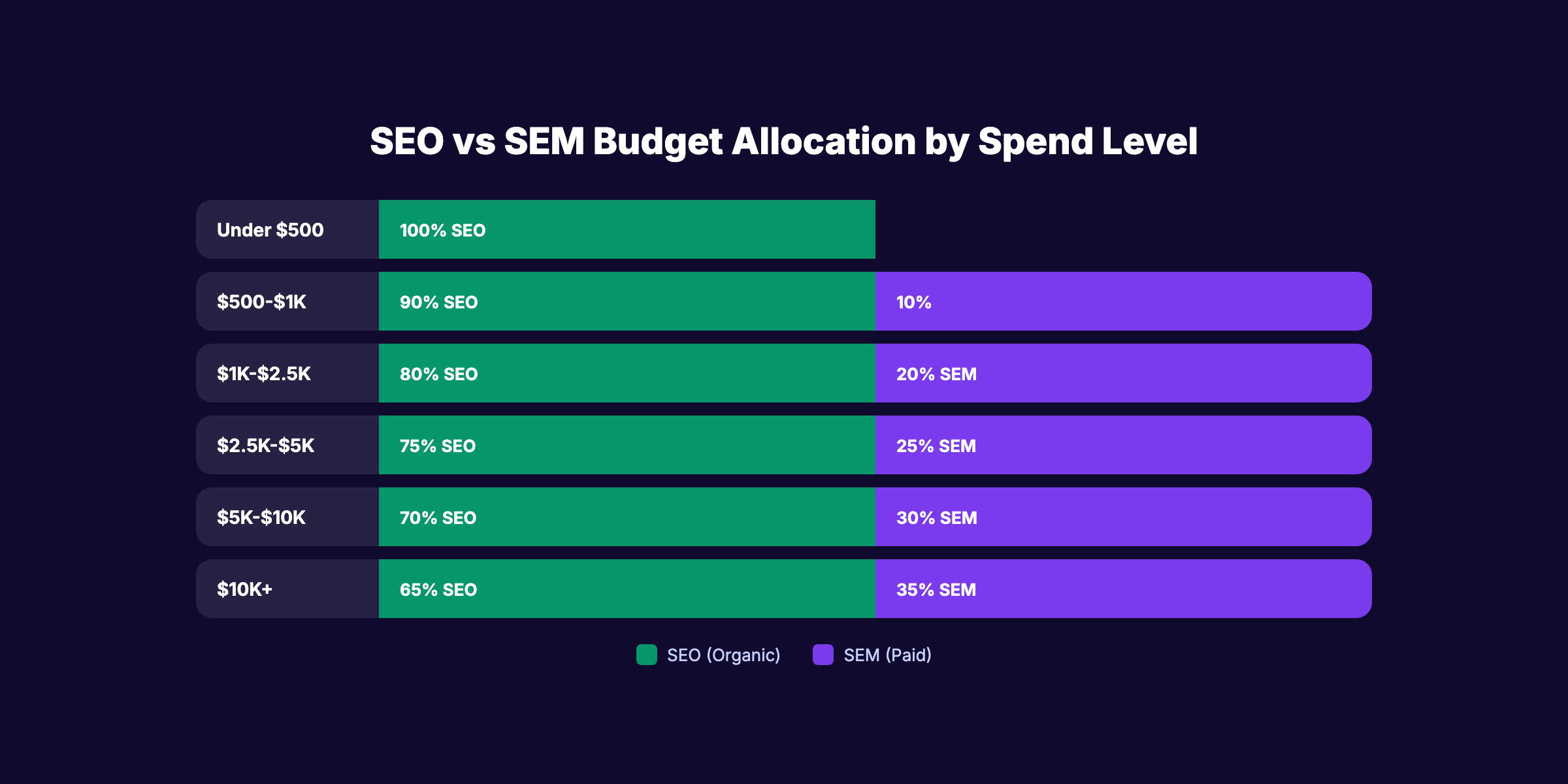
First Page Sage research found that their highest-performing clients allocate approximately 75% of budget to SEO and 25% to SEM.
Budget Tiers
| Monthly Budget | Recommended Allocation | Strategy |
|---|---|---|
| Under $500 | 100% SEO | Focus entirely on organic. PPC at this budget burns money. |
| $500-$1,000 | 90% SEO, 10% SEM | SEO builds foundation. Tiny PPC budget tests 1-2 high-intent keywords. |
| $1,000-$2,500 | 80% SEO, 20% SEM | Scale content production. Use PPC for bottom-funnel keywords only. |
| $2,500-$5,000 | 75% SEO, 25% SEM | Full SEO strategy plus branded and high-intent PPC campaigns. |
| $5,000-$10,000 | 70% SEO, 30% SEM | Broad SEO coverage. Expand PPC to competitor keywords and remarketing. |
| $10,000+ | 65% SEO, 35% SEM | Enterprise strategy with both channels fully activated. |
The Phase Approach
Months 1-3: SEM-heavy launch. If you are starting from zero, use SEM to generate immediate traffic while SEO foundations are being built. Allocate 60% SEM, 40% SEO during this phase.
Months 4-6: Transition. As organic rankings begin appearing, shift budget toward SEO. Move to 50/50, then 40% SEM / 60% SEO.
Months 7-12: SEO-dominant. Organic traffic should be building momentum. Shift to the 75/25 allocation. Use SEM only for high-intent keywords and remarketing.
Year 2+: Optimization. Reduce SEM spend on keywords where you now rank organically. Reinvest savings into more SEO content. The content compound effect means each article makes the next one more effective.
For teams that want SEO content production handled automatically, automated blog publishing covers the workflow.
Chapter 7: How AI Overviews Change the SEO vs SEM Equation
Google AI Overviews are reshaping search behavior in 2026. Both SEO and SEM are affected.
The Impact on Organic Search
60% of traditional search queries now end without a click due to AI summaries and zero-click results. AI Overviews reduce organic CTR by 61% on queries where they appear, according to PPC.land research.
But the impact is not uniform. Brands cited in AI Overviews see 35% higher organic CTR and 91% higher paid CTR compared to non-cited competitors, per Seer Interactive.
The new SEO goal: get cited in AI Overviews. This requires authoritative, well-structured content that AI models can extract and reference. Our guide on how AI search is changing SEO covers the full strategy.
The Impact on Paid Search
AI Overviews reduce paid traffic by 68% on affected queries. The paid ads that do appear earn fewer clicks because users get their answer from the AI summary.
Paid search click share doubled between January 2025 and January 2026 across major verticals, but this masks a key nuance: Google is showing ads in more places (including within AI Overviews), while individual ad click rates decline.
What This Means for Your Strategy
The businesses winning in 2026 are the ones producing the most authoritative content. AI Overviews cite content that demonstrates expertise, provides original data, and answers questions directly. That is an SEO play, not an SEM play.
SEM remains useful for transactional queries where AI Overviews do not appear. Product searches, local service queries, and branded terms still convert through paid ads.
3,500+ blogs published. 92% average SEO score. See what Stacc can do for your organic search presence. Start for $1 →
Chapter 8: SEO vs SEM by Industry
The right allocation varies by industry. Here are the conversion rate benchmarks.
| Industry | SEO Conversion Rate | PPC Conversion Rate | SEO Advantage |
|---|---|---|---|
| Financial services | 4.0% | 0.6% | 7.3x |
| Real estate | 3.4% | 1.0% | 3.5x |
| Legal services | 3.3% | 1.0% | 3.4x |
| Healthcare | 2.8% | 1.2% | 2.3x |
| SaaS / Technology | 2.1% | 1.1% | 1.9x |
| Ecommerce | 1.6% | 1.4% | 1.1x |
| Travel / Hospitality | 1.5% | 1.3% | 1.2x |
Source: First Page Sage, 124-client study across 19 industries
The pattern: industries with complex purchase decisions and long sales cycles favor SEO heavily. Ecommerce and travel, where purchases are simpler and more impulsive, see the smallest gap.
For Google Ads vs SEO in specific verticals, the industry data should drive your allocation, not generic advice.
FAQ
What is the difference between SEO and SEM?
SEO earns organic traffic through content, technical optimization, and link building. SEM buys traffic through paid search ads (Google Ads, Bing Ads). SEO compounds over time. SEM delivers instant traffic that stops when you stop paying.
Which is better for small business, SEO or SEM?
SEO is better for most small businesses. It costs less ($500-$2,900/month vs $9,000-$10,000/month for SEM), converts at nearly 2x the rate, and builds lasting traffic. The exception: new businesses that need immediate visibility should use SEM while building their SEO foundation.
How long does SEO take compared to SEM?
SEM delivers traffic within hours. SEO takes 3-6 months for measurable results. Only 5.7% of new pages reach Google page 1 within their first year. The tradeoff: SEO traffic continues for years after publication. SEM traffic stops the day the budget runs out.
Can you do SEO and SEM at the same time?
Yes, and most businesses should. The recommended allocation is 75% SEO and 25% SEM for established businesses. Use SEM for high-intent transactional keywords and remarketing. Use SEO for everything else. As organic rankings grow, shift more budget to SEO.
Is SEO cheaper than SEM?
Yes. The average organic customer acquisition cost is $485 vs $802 for paid search. SEO costs 40% less per customer. The gap widens over time because SEO content continues generating traffic long after the initial investment.
Does SEM include social media advertising?
No. SEM refers specifically to paid search advertising on Google and Bing. Social media advertising (Facebook Ads, Instagram Ads, LinkedIn Ads) is a separate channel. Some marketers use “SEM” loosely to mean all paid digital, but the standard definition covers search engines only.
The SEO vs SEM debate has a clear answer for most businesses. SEO delivers higher ROI, lower acquisition costs, better conversion rates, and compounding returns. SEM earns its budget for immediate traffic, market testing, and high-intent transactional queries. The winning strategy uses both channels with the right allocation. Start with SEO. Add SEM where the data justifies it.
Written and published by Stacc. We publish 3,500+ articles per month across 70+ industries. All data verified against public sources as of March 2026.
