
How to 5x Content Output Without Hiring (7 Steps)
Scale content production 5x without adding headcount. 7 steps covering workflow audits, AI drafts, repurposing, and automation. Updated April 2026.
Most small businesses publish 4 blog posts per month. The ones ranking on page 1 publish 16 or more. That gap is not a talent problem. It is a systems problem.
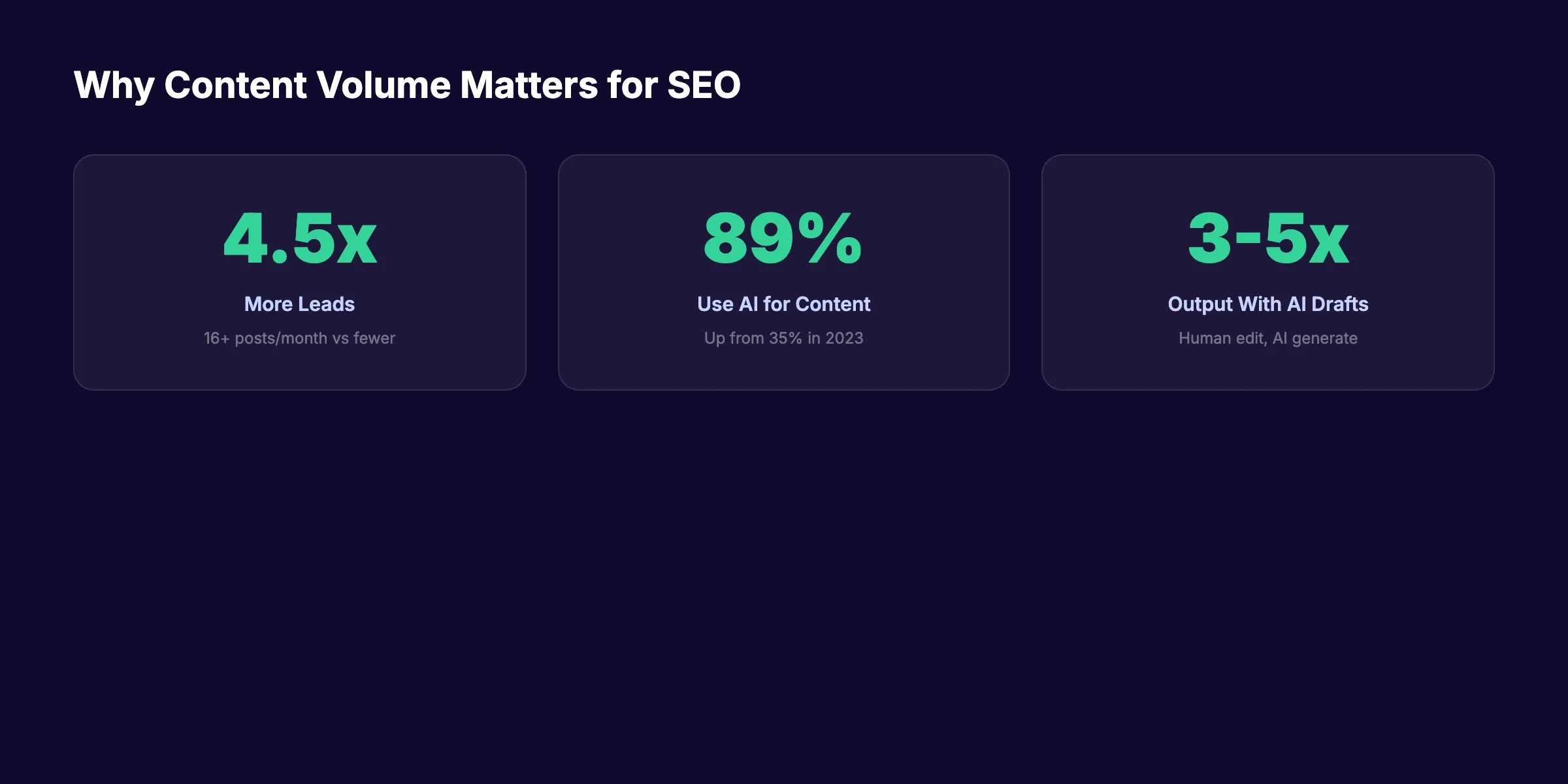
The cost of that gap is real. Companies publishing 16+ posts per month generate 4.5x more leads than those publishing fewer. Every month you stay at 4 posts, your competitors stack more indexed pages, more backlinks, and more keyword rankings above you.
This guide shows you how to 5x content output without hiring a single new writer. No freelancer contracts. No job postings. No onboarding headaches.
We publish 3,500+ blog posts across 70+ industries using these exact systems. The process works for teams of 1 and teams of 20.
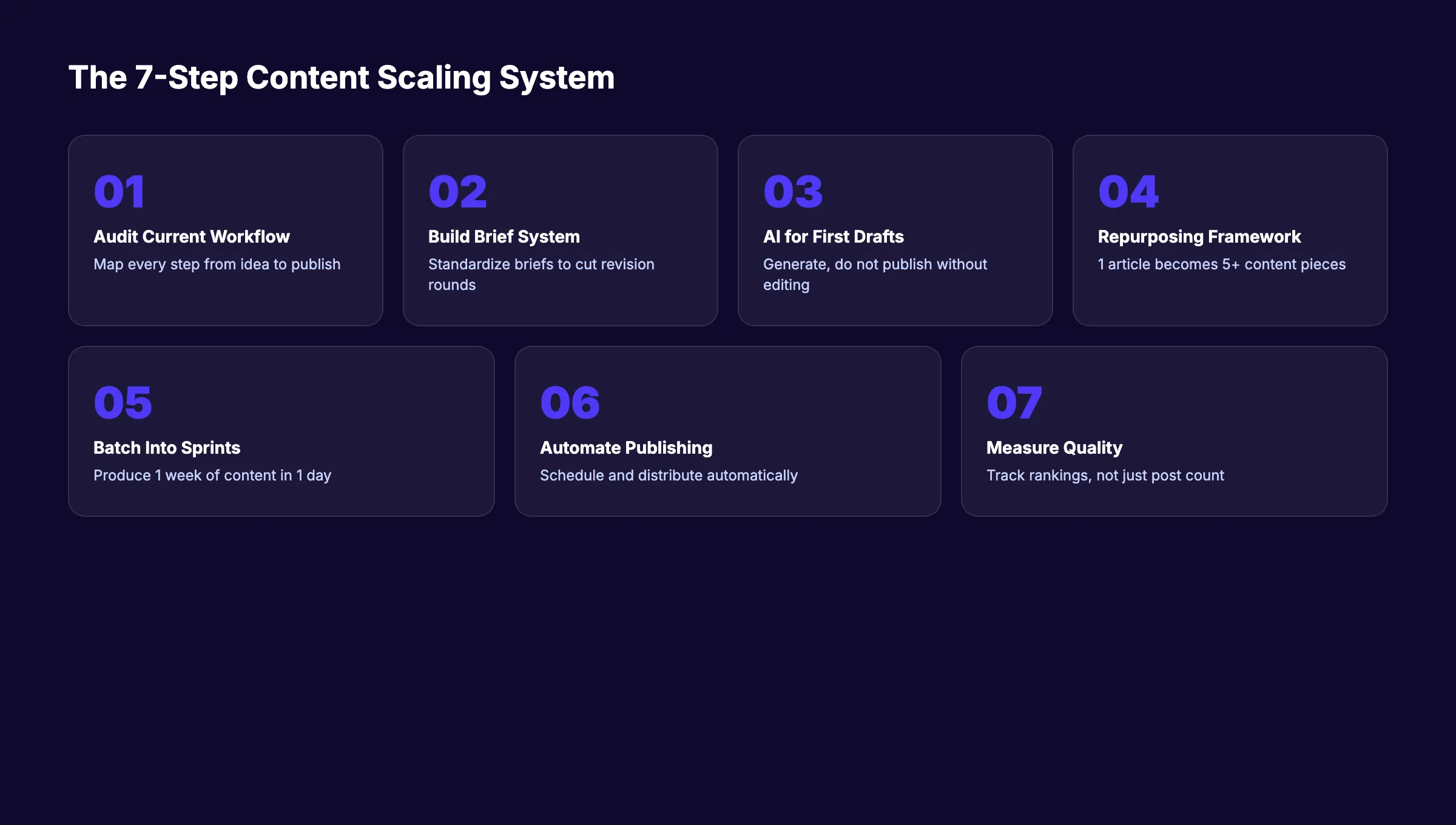
Here is what you will learn:
- How to audit your current workflow and find the bottlenecks killing your output
- How to build a content brief system that eliminates revision loops
- How to use AI for first drafts without sacrificing quality
- How to turn 1 blog post into 5+ content pieces
- How to batch a full week of content into a single sprint day
- How to automate publishing and distribution
- How to measure quality so volume does not tank your rankings
Why Most Teams Get Stuck at 4 Posts Per Month
The bottleneck is rarely writing speed. It is everything around the writing.
A 2026 Canto study found that only 32% of organizations can update content across channels on the same day. Most teams spend more time on approvals, revisions, and formatting than on actual content creation.
Here is where time disappears in a typical content workflow:
| Task | Time Spent | Percentage of Total |
|---|---|---|
| Topic ideation and keyword research | 3-5 hours | 20% |
| Briefing and outlining | 2-4 hours | 15% |
| Writing the first draft | 4-8 hours | 30% |
| Editing and revision rounds | 3-6 hours | 20% |
| Formatting, images, and publishing | 2-4 hours | 15% |
That is 14-27 hours per post. At that rate, 4 posts per month consumes 56-108 hours. No wonder teams hit a ceiling.
The fix is not working harder. The fix is removing the friction at each stage. The 7 steps below target every row in that table.
What You Need Before You Scale
Time required: 2-3 hours for initial setup, then 8-10 hours per week for ongoing production
Difficulty: Beginner to intermediate
What you will need:
- A content calendar (even a simple spreadsheet works)
- Access to an AI writing tool or a done-for-you service like Stacc
- A content brief template (we provide one below)
- A publishing platform (WordPress, Webflow, Ghost, or similar)
- Google Search Console for tracking results
Step 1: Audit Your Current Content Workflow
Before you add speed, you need to find the drag. Every content operation has hidden bottlenecks. Most teams do not realize where their time actually goes.
Specifically:
- Map every step from topic idea to published post
- Time each step for your last 5 articles
- Identify which steps require waiting on someone else
- Flag any step that takes more than 2 hours per article
The audit usually reveals 1 of 3 problems. First, too many approval layers. Every article passes through 3-4 people before publishing. Second, no standardized briefs. Writers start from scratch every time, which creates inconsistent quality and long revision cycles. Third, manual formatting. Someone spends 45-60 minutes per article adding images, meta tags, and internal links by hand.
One pattern we see across the 3,500+ blogs we publish: teams that cut their approval chain from 4 people to 2 double their output within 30 days. No other change required.
Why this step matters: You cannot fix what you have not measured. Skipping the audit means you will automate the wrong steps and wonder why output stays flat.
Pro tip: Run this audit on a Monday. Track the actual time for 5 existing posts. The data will surprise you. Most teams overestimate writing time and underestimate editing and formatting time.
Step 2: Build a Content Brief System That Eliminates Revision Loops
A standardized brief is the single highest-impact change you can make. Teams using detailed briefs report fewer than 15% of articles needing major revisions. Teams without briefs see 50-70% revision rates.
The brief is the operating system for scaled content. It tells the writer (human or AI) exactly what to produce. No guessing. No back-and-forth.
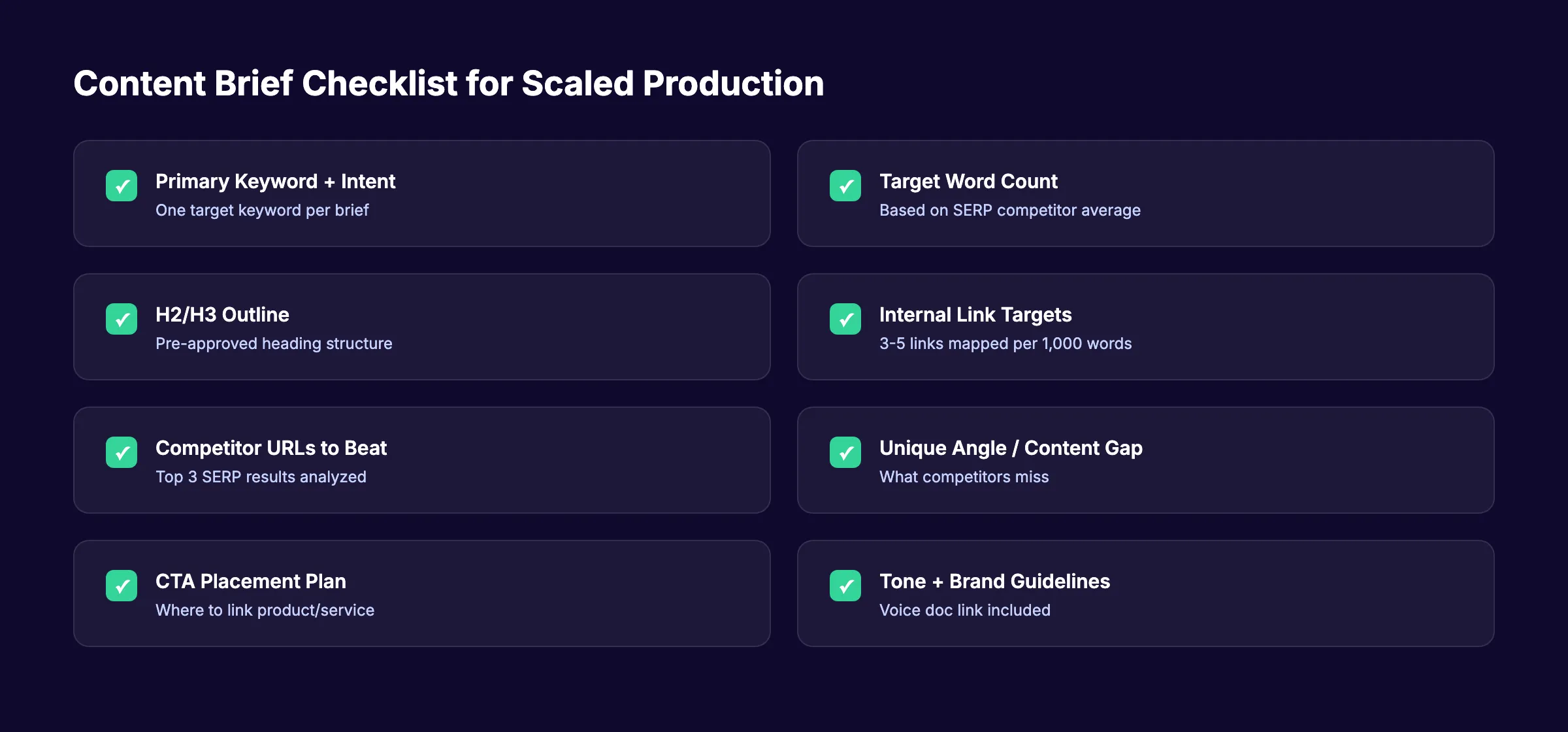
Your content brief should include:
- Primary keyword and search intent (informational, commercial, transactional)
- Target word count based on SERP competitor analysis
- H2/H3 heading structure approved before writing starts
- 3-5 internal link targets with exact anchor text
- Top 3 competitor URLs to analyze and beat
- Unique angle or content gap the article fills
- CTA placement plan
- Brand voice guidelines link
You can create content briefs with AI in under 10 minutes per article. That is 50 minutes for 5 briefs. Compare that to 2-4 hours of unstructured brainstorming.
For a ready-to-use format, grab our content brief template.
Why this step matters: Without a brief, every article is a custom project. With a brief, every article follows a proven blueprint. The brief is what makes batch production possible in Step 5.
Pro tip: Build 10 briefs at once during a single research session. Group related keywords together. This sets up your entire topical authority strategy.
Step 3: Use AI for First Drafts (Not Final Copy)
This is where most teams get the multiplier wrong. They either reject AI entirely or publish raw AI output. Both approaches fail.
The right model: AI generates the draft. A human edits for expertise, accuracy, and voice. This split produces 3-5x more content per person per week. 89% of marketers now use AI for content creation. The 11% who do not are already falling behind on volume.
Here is the workflow that works:
- Feed the content brief into your AI tool or service
- Generate a first draft with all H2/H3 sections filled
- Human editor reviews for factual accuracy
- Editor adds original insights, data, and examples
- Editor adjusts tone to match brand voice
- Run the final draft through an on-page SEO checker
The key distinction: AI handles the 30% of work that is structural (outlines, section drafts, meta descriptions). Humans handle the 70% that is strategic (unique angles, real-world examples, expert opinions).
For a deeper walkthrough, read our guide on how to use AI to write blog posts.
| Task | Without AI | With AI + Human Edit |
|---|---|---|
| First draft | 4-8 hours | 30-60 minutes |
| Editing | 1-2 hours | 2-3 hours |
| Total per article | 5-10 hours | 2.5-4 hours |
| Articles per week (1 person) | 1-2 | 5-7 |
Never publish without human review. Google rewards helpful, experience-driven content. Raw AI output ranks poorly and damages trust. Learn how to humanize AI content the right way.
Why this step matters: AI alone produces generic content. Humans alone produce limited volume. The combination produces volume and quality. Skip the human edit and your content joins the flood of low-quality pages that Google filters out.
Scale your blog to 30 articles per month. Stacc handles the research, writing, optimization, and publishing. You review and approve. Start for $1 →
Step 4: Create a Repurposing Framework
One blog post should never stay as one piece of content. Every article you publish contains 5-10 derivative pieces waiting to be extracted.
The math is simple. If you publish 5 blog posts per week and repurpose each into 5 social pieces, you produce 25 social posts per week. That is 100+ social posts per month from the same 5 articles.
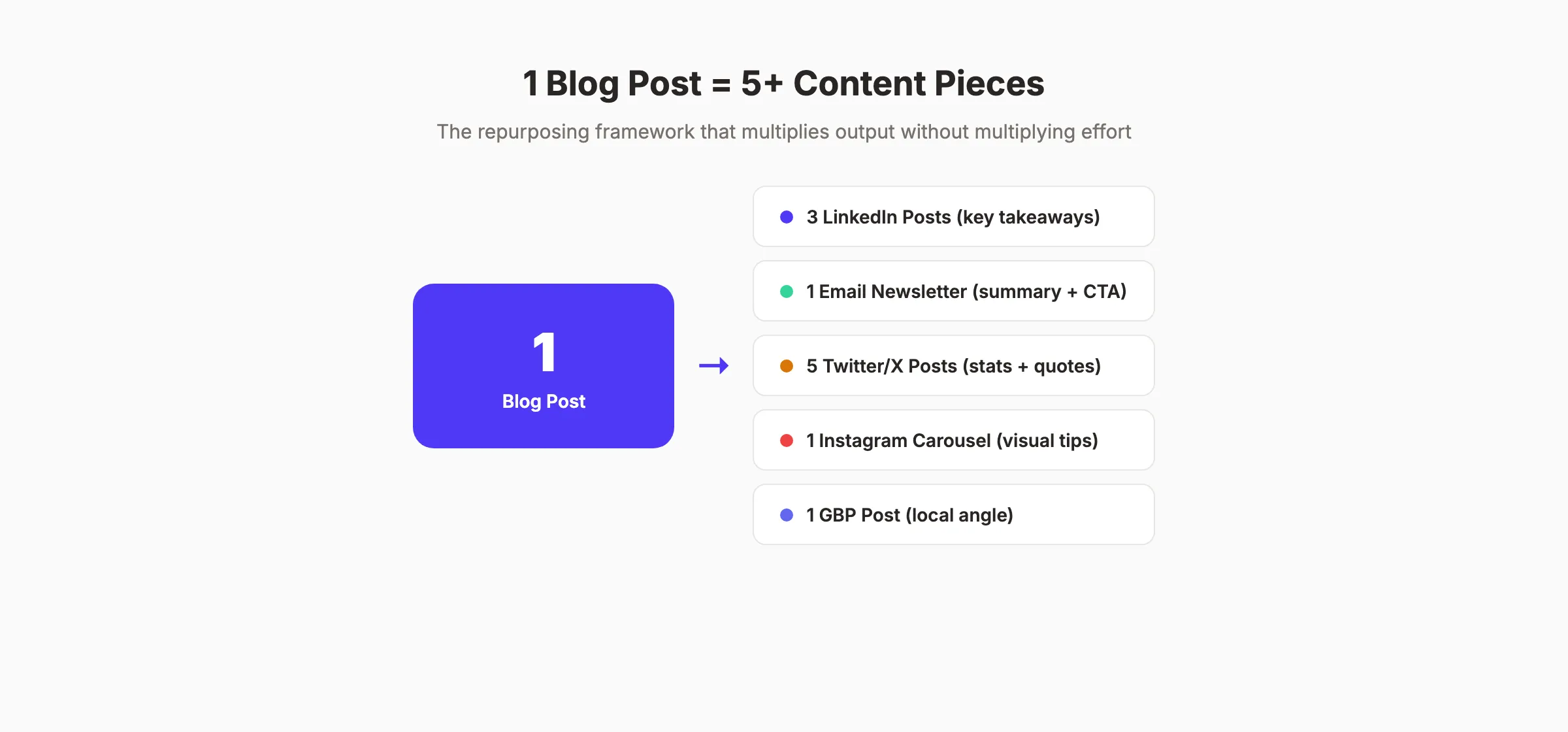
The repurposing framework:
| Source Content | Derivative Format | Time to Create |
|---|---|---|
| Blog post key takeaway | LinkedIn post | 5 minutes |
| Blog post statistic | Twitter/X post | 2 minutes |
| Blog post how-to section | Instagram carousel | 15 minutes |
| Blog post summary | Email newsletter | 10 minutes |
| Blog post local angle | Google Business Profile post | 5 minutes |
For the full process, see our guide on how to repurpose blog content for social media.
Specifically:
- Extract 3 standalone insights from every article
- Pull every statistic for Twitter/X threads
- Summarize each article in 150 words for email
- Adapt 1 tip per article for a GBP post
The rule: no content gets created without a plan to repurpose it. Build repurposing into the brief from Step 2. Add a “derivative content” section to every brief.
Why this step matters: Repurposing is how you multiply output without multiplying production time. Creating from scratch every time is the most expensive way to produce content.
Pro tip: Use a simple spreadsheet to track which blog posts have been repurposed and which formats you have covered. Gaps become obvious fast.
Step 5: Batch Production Into Weekly Sprints
Context switching kills output. Writing 1 article on Monday, editing another on Tuesday, and researching on Wednesday means you never build momentum.
Batching groups similar tasks together. You write all 5 drafts on the same day. You edit all 5 on another day. You format and schedule all 5 on a third day.
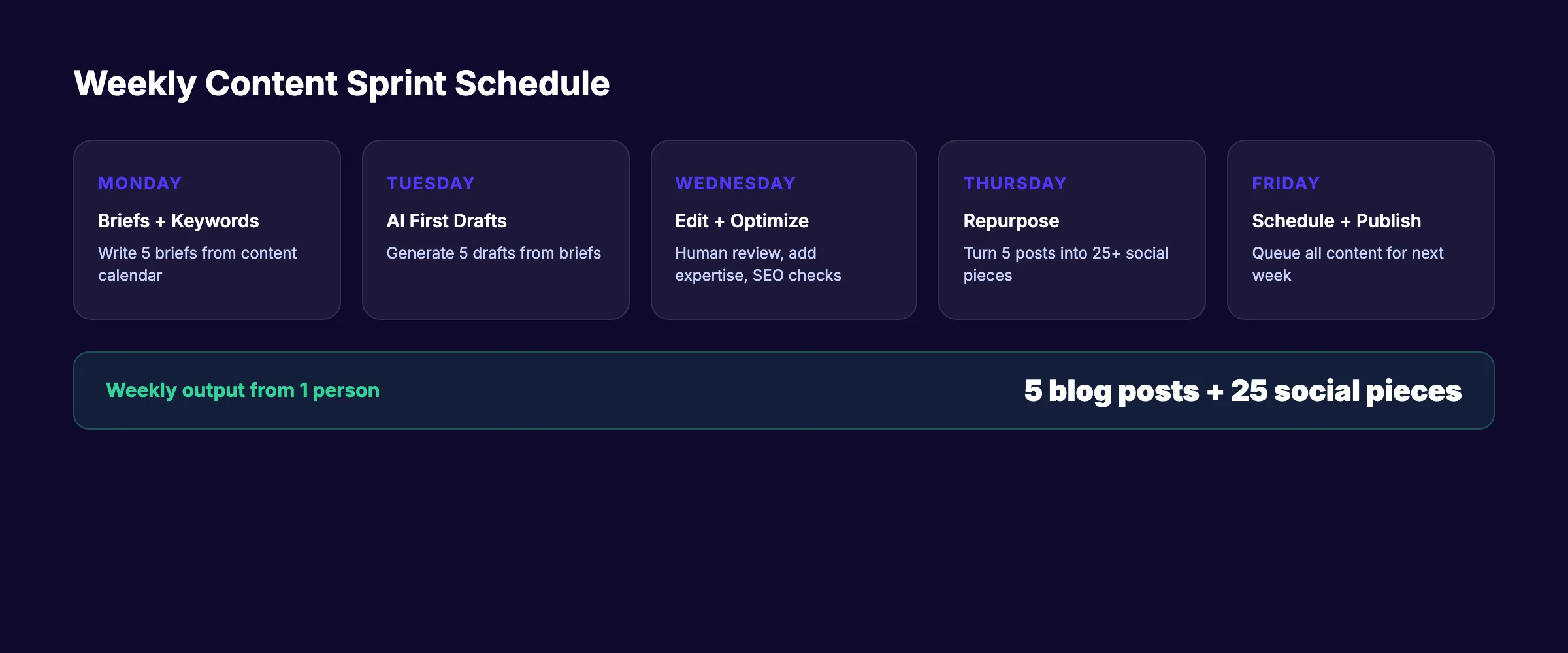
The weekly content sprint:
- Monday: Write 5 content briefs from your content calendar. Research keywords. Outline all 5 articles. Total time: 2-3 hours.
- Tuesday: Generate 5 AI first drafts from briefs. Review initial output. Total time: 1-2 hours.
- Wednesday: Human edit all 5 drafts. Add expertise, examples, internal links. Run SEO checks. Total time: 3-4 hours.
- Thursday: Repurpose all 5 articles into social media content. Create 25+ derivative pieces. Total time: 2-3 hours.
- Friday: Format, add images, schedule everything for the next week. Total time: 1-2 hours.
Total weekly time: 9-14 hours for 1 person. Output: 5 blog posts plus 25+ social pieces.
Compare that to the old model. The same person spent 14-27 hours on a single article. Batching with AI and systems produces 5x the output in half the hours.
Why this step matters: Batching reduces the cognitive overhead of switching between tasks. Your brain stays in “writing mode” or “editing mode” for hours instead of minutes. That alone increases speed by 30-40%.
Pro tip: Protect your sprint days. No meetings on batch days. Treat content production like a deadline-driven project, not something you fit around other tasks.
Step 6: Automate Publishing and Distribution
Manual publishing adds 30-60 minutes per article. At 20 posts per month, that is 10-20 hours spent on clicking “publish,” adding meta tags, and copying content to social platforms.
Automation handles this entire layer.
What to automate:
- Blog post scheduling (queue posts for specific dates and times)
- Meta tag generation (title, description, Open Graph)
- Internal link insertion (based on keyword mapping)
- Social media distribution (auto-post to LinkedIn, X, Facebook)
- GBP post scheduling (weekly local content updates)
- Email newsletter triggers (new post notifications)
For a full breakdown, see our guide on how to automate your SEO workflow.
Tools that handle this:
| Automation Layer | Options |
|---|---|
| Blog publishing | WordPress scheduled posts, Webflow CMS, Ghost |
| Social distribution | Buffer, Hootsuite, or Stacc social module |
| Email notifications | Mailchimp, ConvertKit, or native CMS features |
| SEO optimization | On-page SEO checker, Stacc auto-optimization |
| Full autopilot | Stacc (blog + social + GBP in one service) |
The goal: once you approve a piece of content, it should reach every channel without additional manual steps.
For teams that want zero production overhead, content automation platforms handle the entire pipeline from brief to published post.
Why this step matters: Publishing is not creative work. It is operational work. Every hour spent on publishing is an hour not spent on strategy or editing. Automating this layer is what separates teams producing 5 posts per month from teams producing 20.
Publish 30 blog posts, 30 social posts, and 30 GBP posts per month. Stacc runs your entire content engine on autopilot. Zero manual publishing. Start for $1 →
Step 7: Measure Output Quality, Not Just Volume
Publishing 20 articles per month means nothing if none of them rank. The danger of scaling content is that quality drops alongside the increase in volume.
This is where most scaling strategies fail. Teams celebrate hitting 20 posts per month. Then 6 months later, organic traffic is flat because the content did not meet Google’s quality bar.
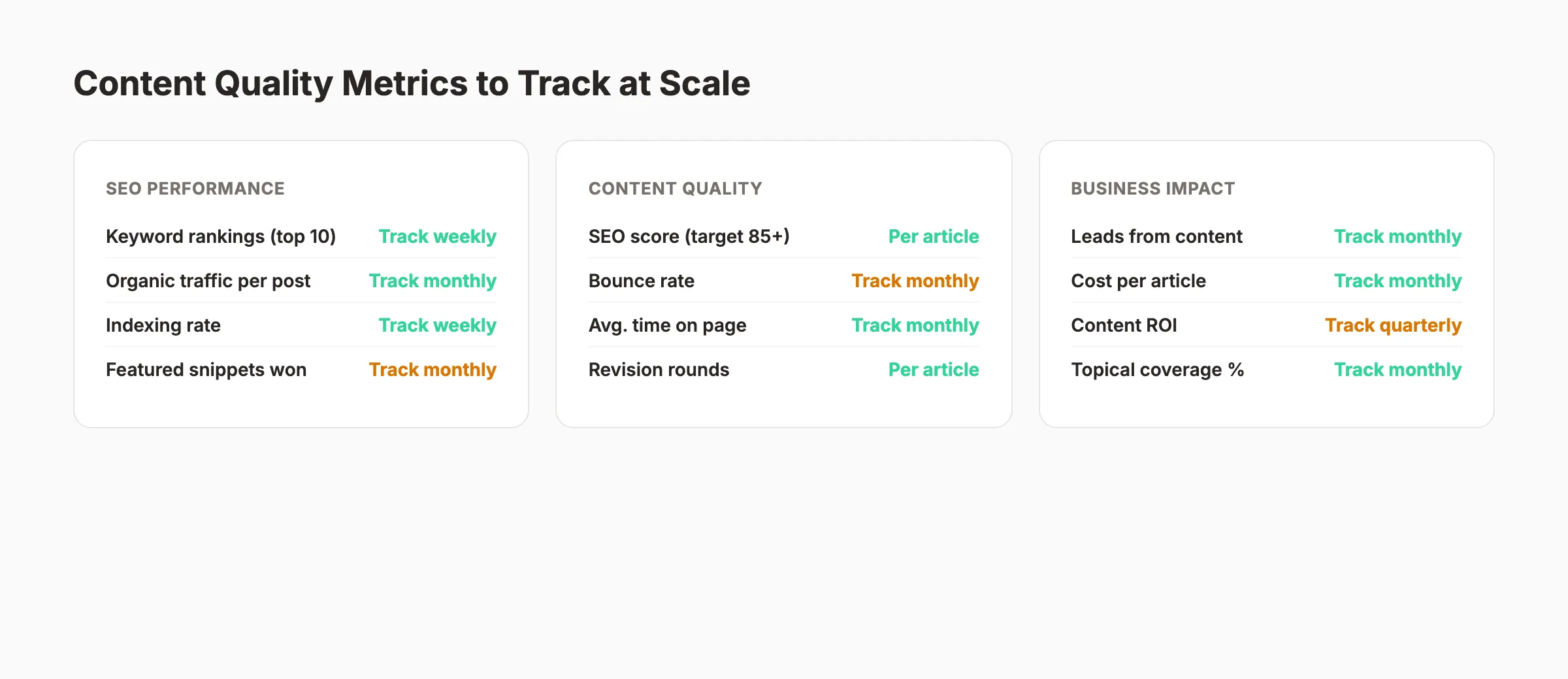
Track these metrics weekly:
- Keyword rankings for target terms (are new posts entering the top 20 within 30 days?)
- Indexing rate (is Google indexing your new content within 48 hours?)
- Average SEO score per article (target 85+ using an on-page SEO checker)
- Organic traffic per published post (baseline: 50+ sessions within 60 days)
Track these metrics monthly:
- Total organic traffic growth (month over month)
- Content marketing ROI (revenue attributed to content vs. production cost)
- Bounce rate per article (above 80% signals quality issues)
- Average time on page (below 1 minute signals thin content)
For the full measurement framework, read our guide on how to optimize content for SEO.
| Metric | Red Flag | Target |
|---|---|---|
| Indexing rate | Below 80% | 95%+ |
| SEO score | Below 70 | 85+ |
| 30-day rankings | No movement | Top 50 within 30 days |
| Bounce rate | Above 85% | Below 65% |
| Time on page | Below 45 seconds | 2+ minutes |
Why this step matters: Volume without quality is just noise. Google processes over 8.5 billion searches per day. It does not need more content. It needs better content published consistently.
Pro tip: Set a quality gate. No article publishes unless it scores 80+ on your SEO checker. This single rule prevents the quality cliff that kills most scaling efforts.
Results: What to Expect
After implementing these 7 steps, here is a realistic timeline:
- Week 1-2: Audit complete. Brief system built. First batch of 5 articles produced.
- Month 1: 15-20 articles published. Repurposing generates 75-100 social pieces. Production rhythm established.
- Month 2-3: Google starts indexing and ranking new content. First organic traffic increases visible. Internal linking between articles starts compounding.
- Month 3-6: Topical authority builds. Articles start ranking for secondary keywords. Organic traffic grows 30-60% month over month.
- Month 6+: The Content Compound Effect takes over. Your library of 100+ articles generates traffic, leads, and backlinks on autopilot.
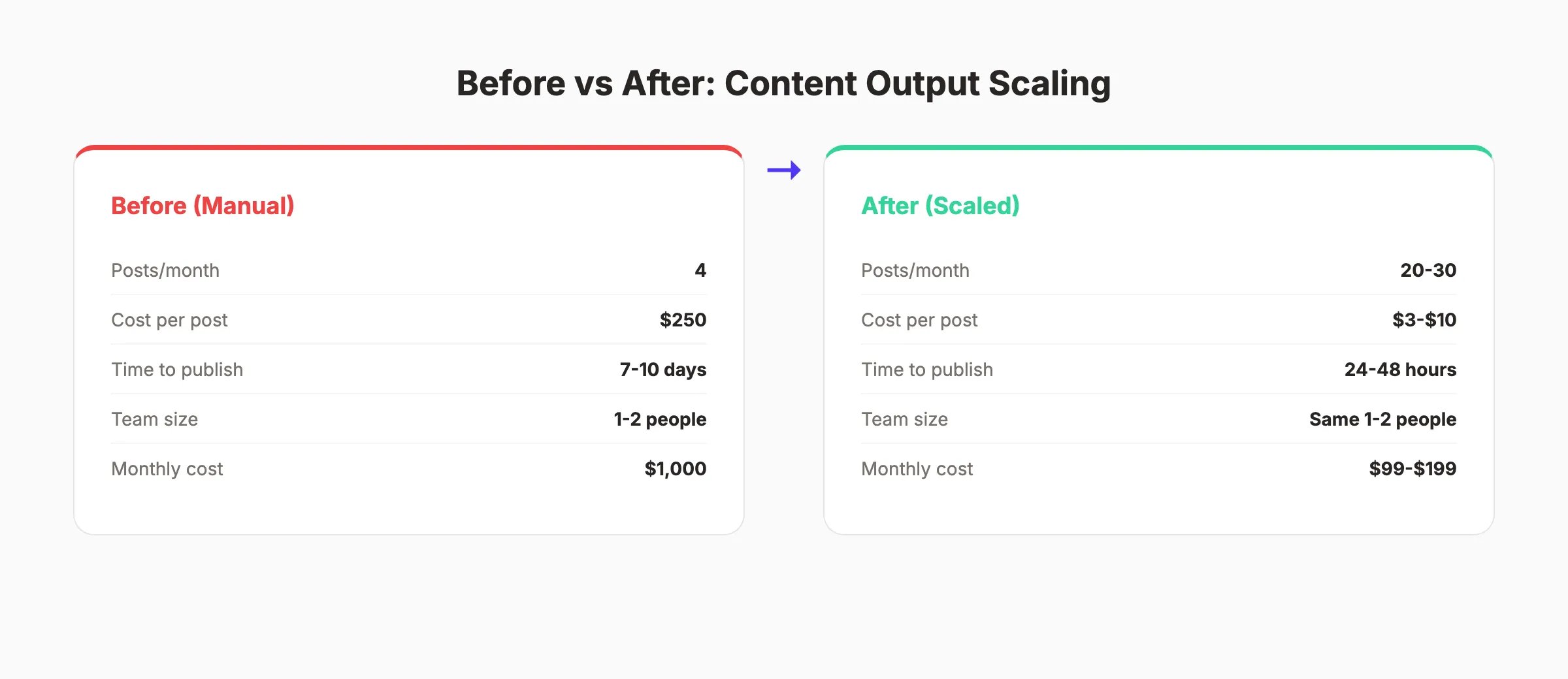
The teams that execute this system consistently for 6 months typically see a 3-5x increase in organic traffic. The ones that maintain it for 12 months see 10x or more. Content compounds. Every article stacks on the last.
For more strategies to grow traffic, see our full guide on how to increase organic traffic.
Troubleshooting Common Scaling Problems
Problem: Content quality drops after scaling. Fix: Tighten your brief template. Add a mandatory quality score threshold (85+). Review the top 3 lowest-performing articles each month and identify common issues.
Problem: AI drafts sound generic and repetitive. Fix: Add specific examples, data points, and original opinions during the human edit phase. Feed your brand voice guide into the AI prompt. Use our ChatGPT for SEO content guide for better prompting techniques.
Problem: Internal linking becomes chaotic at scale. Fix: Maintain a central link map. Assign 3-5 internal link targets per brief. Use our internal linking guide to build a systematic approach.
Problem: You are publishing more but traffic stays flat. Fix: Check your keyword targeting. You might be publishing content for keywords with zero search volume. Run a content gap analysis to find topics with actual demand.
FAQ
How many blog posts per month do I need to see SEO results?
HubSpot data shows that companies publishing 16+ blog posts per month generate 4.5x more leads than companies publishing 0-4. The minimum effective dose for SEO traction is 8-12 posts per month. Below that threshold, you are building authority too slowly to compete.
Can AI-generated content actually rank on Google?
Yes, when edited properly. Google does not penalize AI content. It penalizes unhelpful content. The 89% of marketers using AI for content are seeing results because they combine AI drafts with human expertise. Raw, unedited AI output will not rank. Edited, enriched AI content ranks consistently.
Is it better to hire writers or use an automated service?
That depends on your budget and timeline. Hiring a full-time writer costs $50,000-$80,000 per year and produces 8-16 articles per month. A service like Stacc produces 30 articles per month for $99. Read our full comparison in the in-house vs outsource content team guide.
How long before I see traffic from scaled content?
Most teams see initial ranking movement within 60-90 days. Meaningful traffic growth (30%+ increase) typically appears in months 3-6. Content SEO is a compounding investment. The first 3 months build the foundation. Months 4-12 is where the returns accelerate.
What if I do not have time to edit 20 articles per month?
You have 3 options. First, edit fewer articles but maintain quality (10 excellent posts beat 20 mediocre ones). Second, use a done-for-you service that handles editing internally. Third, hire 1 part-time editor (10 hours per week) to handle the review layer. Most teams choose option 2 because it costs less than option 3.
What tools do I need to start?
At minimum, you need a content calendar, a brief template, and an AI writing tool. For the full stack, see our roundup of content marketing tools for small teams and AI blog writers. If you want zero setup, Stacc handles everything for $99 per month.
Now you have the complete 7-step system to 5x content output without hiring. The gap between 4 posts per month and 20 is not about talent or budget. It is about systems, briefs, AI-assisted drafts, repurposing, batching, automation, and quality tracking.
Start with Step 1 this week. Audit your current workflow. Time every step. The bottlenecks will reveal themselves.
Your SEO team. $99 per month. 30 blog posts, fully optimized, published automatically. See what Stacc handles for you. Start for $1 →
Related Tools & Resources
Free SEO Tools:
Best Lists:

Written by
Siddharth GangalSiddharth is the founder of theStacc and Arka360, and a graduate of IIT Mandi. He spent years watching great businesses lose organic traffic to competitors who simply published more. So he built a system to fix that. He writes about SEO, content at scale, and the tactics that actually move rankings.
30 SEO blog articles published every month
Keyword-optimized, scheduled, and live on your site. Automatically.
30-day trial · Cancel anytime
theStacc
Stop writing SEO content manually
30 blog articles, 30 GBP posts, and social media content. Published every month. Automatically.
Try for free$1 for 3 days · Cancel anytime