
How to Get More Website Traffic: The Complete Guide
25 proven ways to get more website traffic in 2026. Covers SEO, content, social, email, paid ads, and AI search. Data from 3.25B visits.
Siddharth Gangal • 2026-03-29 • Content Strategy
In This Article
59% of websites lost traffic in 2025. Cost per visit rose 30% over 3 years. Zero-click searches now account for 60% of all Google queries. The old playbook of “publish and pray” no longer works.
Getting more website traffic in 2026 requires a different approach. You need multiple channels working together. You need content that earns clicks even when Google answers the question itself. And you need to stop relying on a single source.
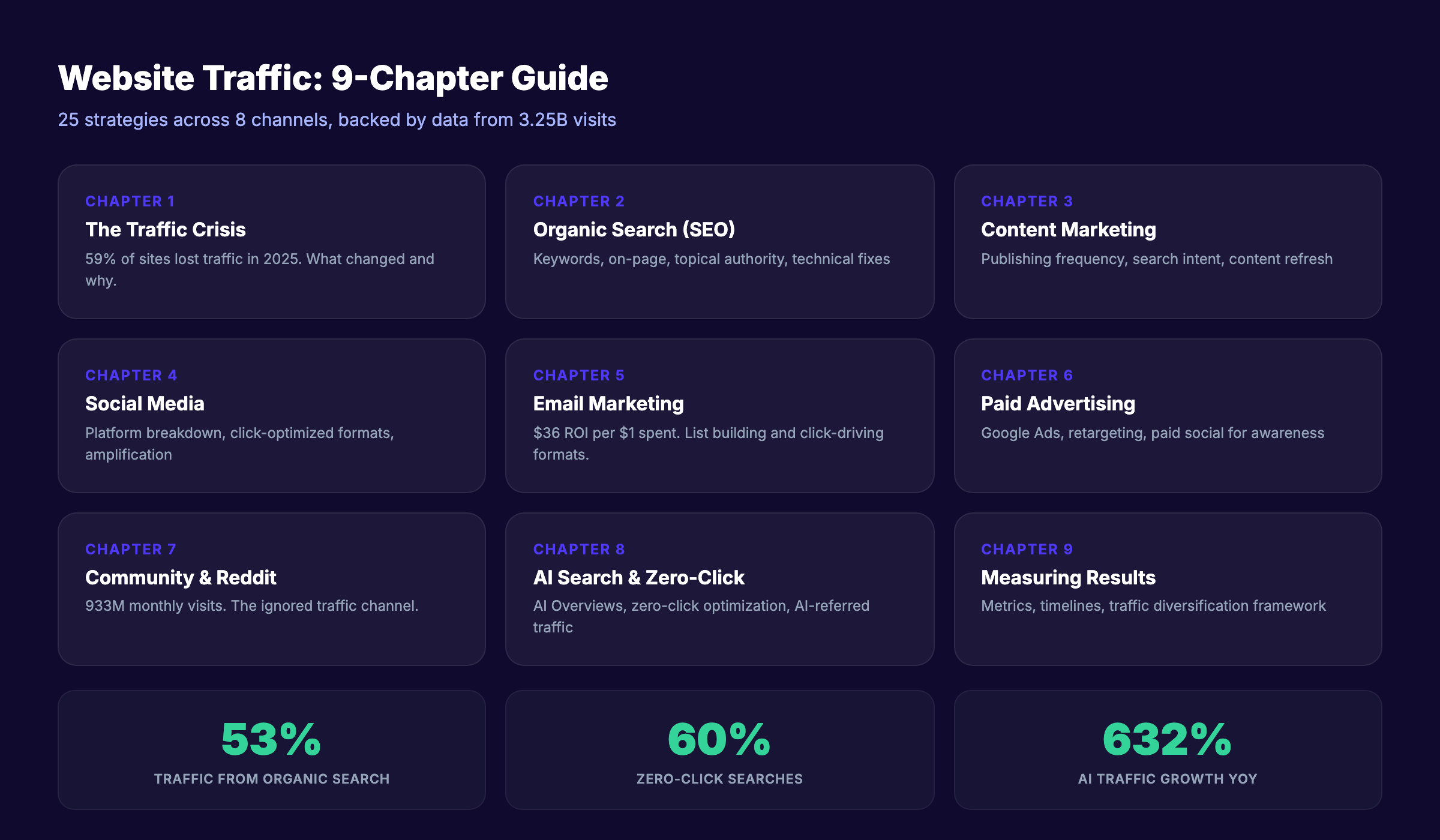
This guide covers 25 traffic strategies across 8 channels. Each one includes the data behind why it works, the steps to execute it, and the timeline to expect results. No theory without application.
We have published 3,500+ SEO articles across 70+ industries. This guide distills what actually moves traffic numbers based on real publishing data.
Here is what you will learn:
- Why most websites are losing traffic and how to reverse the trend
- The 8 traffic channels that work in 2026 (ranked by effectiveness)
- How to get more website traffic from organic search, content, social, and email
- How to optimize for AI search and zero-click queries
- The exact metrics to track and timelines to expect
Chapter 1: Why Most Websites Are Losing Traffic
Before adding new traffic sources, understand why the old ones stopped working.
The 2025-2026 Traffic Crisis
Contentsquare’s analysis of billions of web sessions found that overall website traffic dropped 3.8% in 2025. New visitor traffic fell 5.8%. The cost to acquire each visit rose 9% year-over-year.
This is not a blip. It is a structural shift.
Three forces are driving this:
| Force | Impact | Data |
|---|---|---|
| Zero-click searches | Google answers queries without a click | 60% of searches end with no click |
| AI Overviews | Google summarizes content in the SERP | CTR drops 47% when AI summaries appear |
| Platform consolidation | Social platforms keep users on-platform | Organic reach on Facebook is near zero |
The Traffic Source Reality
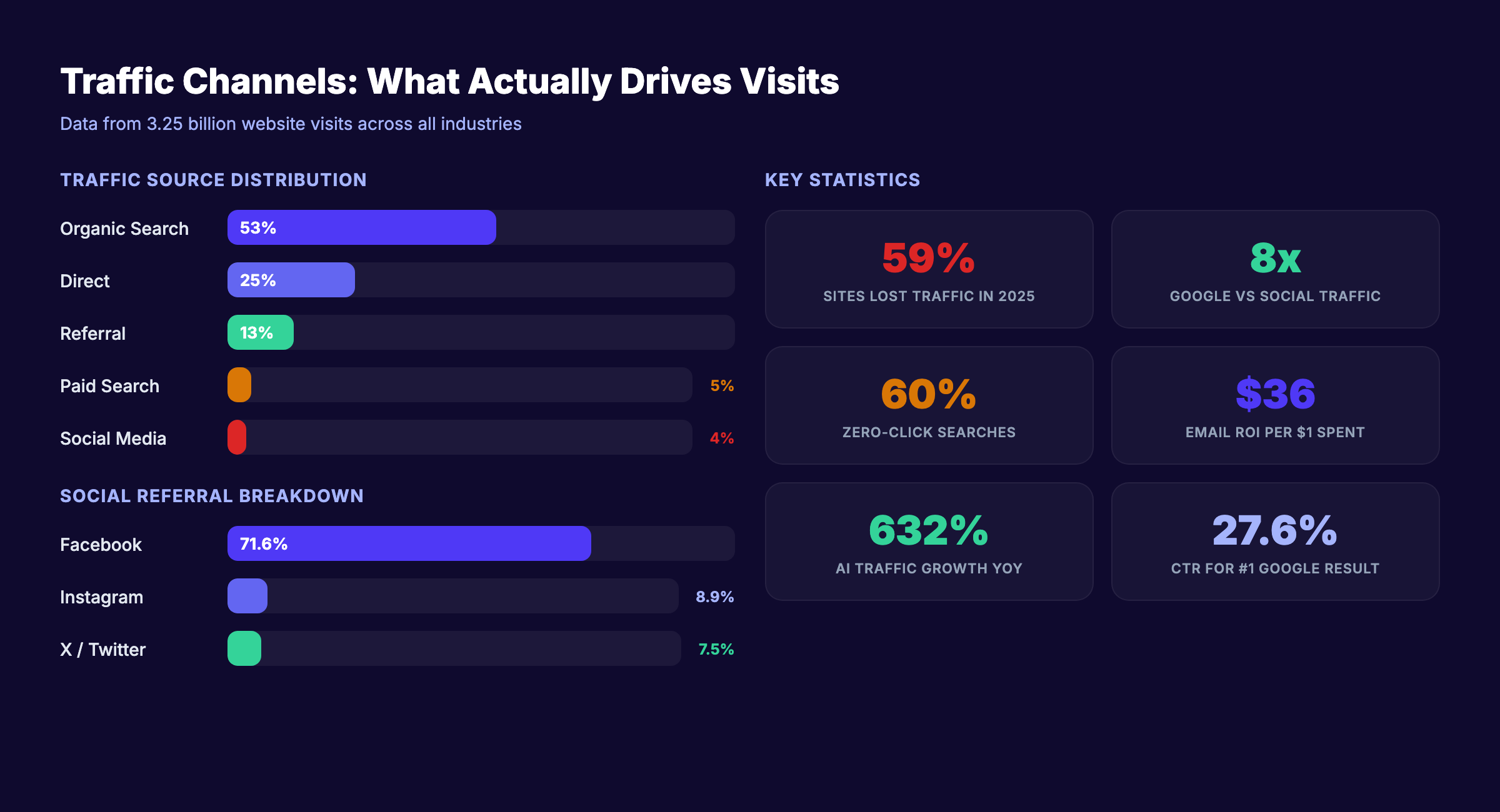
A study of 3.25 billion website visits by GrowthBadger found that organic search generates 53% of all website traffic. Direct traffic accounts for 25%. Referral is 13%. Social media contributes just 4%.
Google drives 8x more traffic than all social media platforms combined. That ratio holds across every industry.
The takeaway is clear. Organic search remains the dominant traffic channel. But relying on it alone is a risk because Google itself is reducing how many clicks it sends.
What Winners Do Differently
Sites that grew traffic in 2025 share three patterns:
- They publish consistently. Businesses that blog get 55% more visitors than those that do not.
- They diversify channels. At least 3 to 4 active traffic sources.
- They optimize for the new SERP. Featured snippets, AI Overviews, and entity-based search.
The rest of this guide breaks down each channel with specific tactics.
Chapter 2: Organic Search (SEO)
Organic search is still the highest-volume, lowest-cost traffic source. The #1 Google result captures 27.6% of all clicks. The top 3 results collectively get 54.4%.
The problem is that most websites never get there. 96.55% of all pages get zero traffic from Google.
Target Long-Tail Keywords First
Short keywords like “website traffic” have massive competition. Long-tail keywords like “how to get more website traffic for a small business” have less competition and higher conversion rates.
Use Google Search Console to find queries where your site already appears on page 2 or 3. These are your fastest wins. A better title tag, an updated introduction, or 500 more words of depth can push these to page 1.
For a full breakdown of keyword strategy, see our SEO for beginners guide.
Optimize On-Page Elements
Every page on your site needs these elements checked:
- Title tag under 60 characters with the primary keyword at the front
- Meta description between 145 and 155 characters with a clear benefit
- H1 tag matching the search intent (not your internal page name)
- Internal links to related pages on your site (3 to 5 per 1,000 words)
- Image alt text describing what the image shows with relevant keywords
Our technical SEO checklist covers every on-page and technical element in detail.
Build Topical Authority
Google rewards sites that demonstrate deep expertise on a topic. Publishing one article about “email marketing” will not rank. Publishing 15 articles covering email subject lines, automation, segmentation, deliverability, and templates signals authority.
Map your topic clusters. Write a pillar guide for each cluster. Then create 8 to 12 supporting articles that link back to the pillar. This is how topical authority works.
Fix Technical Issues
A site that loads in 5 seconds instead of 2 loses 40% of visitors before they see any content. Check your Core Web Vitals in Google Search Console. Fix the largest content paint (LCP), interaction to next paint (INP), and cumulative layout shift (CLS) scores first.
Other technical blockers: broken internal links, missing robots.txt directives, duplicate content without canonical tags, and pages blocked from indexing by mistake.
Stop writing. Start ranking. Stacc publishes 30 SEO-optimized articles per month for $99. Start for $1 →
Chapter 3: Content Marketing and Blogging
Content marketing is the engine behind organic search. Without content, there is nothing to rank. But quantity alone does not work. The approach matters.
Publish at the Right Frequency
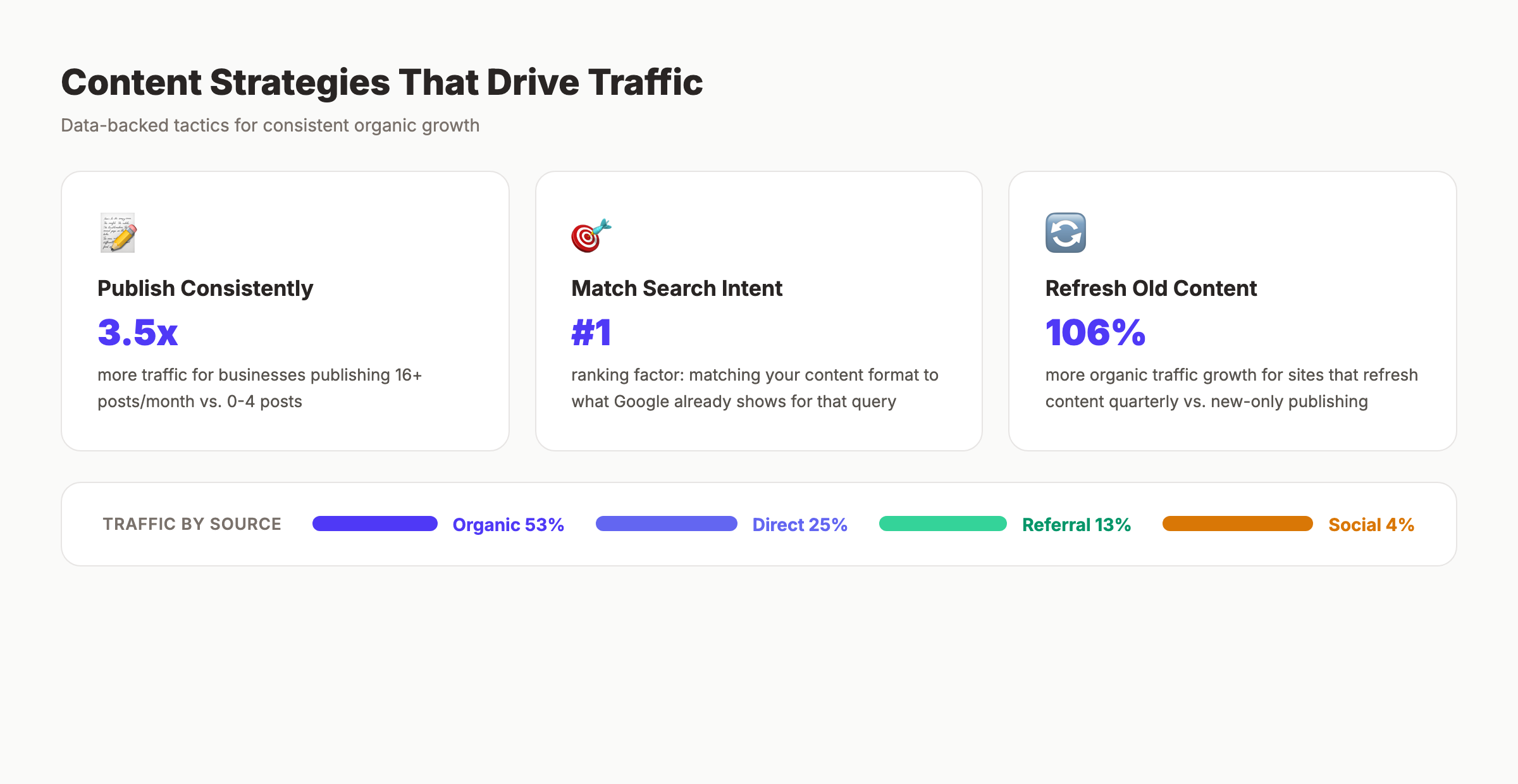
Companies that publish 16+ blog posts per month get 3.5x more traffic than those publishing 0 to 4. That is not a magic number. The principle is that consistent publishing builds a library of indexed pages. Each page is a new entry point from search.
Our blog frequency study breaks down the exact publishing cadence by business size.
Write for Search Intent
Every piece of content should target a specific search query. Before writing, search the keyword on Google. Look at what ranks.
- If the top results are how-to guides, write a how-to guide.
- If the top results are listicles, write a listicle.
- If the top results are product comparisons, write a comparison.
Matching format to intent is the single biggest factor in whether your content ranks. A 5,000-word guide will not rank for a query where Google shows quick answer boxes.
Update Existing Content
Old content decays. A blog post that ranked #3 two years ago might sit on page 4 today. Content refresh is one of the fastest ways to recover lost traffic.
Audit your top 20 pages by traffic. Check if the information is current. Add new data points. Update screenshots. Expand thin sections. Then update the published date.
Sites that refresh content quarterly see 106% more organic traffic growth than those that only publish new articles.
Create Content That Earns Links
Not all content attracts backlinks. Data studies, original research, free tools, and visual assets earn links naturally. A single data study can generate more backlinks than 50 standard blog posts.
Think about what other websites in your industry would want to reference. Industry benchmarks, survey results, and calculators are reliable link magnets.
Chapter 4: Social Media Traffic
Social media drives only 4% of total website traffic. That number surprises most marketers who spend 40% of their time on social. But within that 4%, some platforms outperform others dramatically.
Platform Traffic Breakdown
| Platform | Share of Social Referral Traffic | Best For |
|---|---|---|
| 71.58% | B2C, local businesses, community groups | |
| 8.88% | Visual brands, e-commerce, lifestyle | |
| X / Twitter | 7.52% | B2B, tech, news, thought leadership |
| 6.34% | DIY, recipes, home decor, fashion | |
| Higher than YouTube for blogs | B2B, tech, niche communities | |
| Varies by industry | B2B services, professional content |
Facebook dominates referral traffic by a wide margin. But the platform where your audience already spends time matters more than aggregate data.
Optimize for Clicks, Not Likes
Most social content gets engagement but zero clicks. The fix: stop posting content that resolves entirely within the platform. Share a stat, a finding, or a question that requires clicking through to get the full answer.
Formats that drive clicks:
- Data snippets with “full breakdown in the link”
- Carousel posts where the last slide links to the article
- Thread starters on X that end with a link to the full guide
- Short video clips with a CTA to read the detailed version
Use Social Proof to Amplify
Posts that already have engagement get shown to more people. Before sharing a new article publicly, share it with your team, email list, or close network first. Ask for genuine reactions. That initial engagement signals the algorithm to push the post further.
For a deeper strategy on social media and search working together, our guide on does social media help SEO covers the relationship between the two.
For contractors and service businesses specifically, our social media for contractors guide covers industry-specific tactics.
Chapter 5: Email Marketing
Email marketing generates $36 for every $1 spent. It is the only traffic channel you fully own. Algorithms cannot reduce your reach. Platform changes cannot kill your distribution.
Build the List Before You Need It
Every page on your site should have an email capture mechanism. The most effective formats:
- Exit-intent popups with a specific lead magnet (not “subscribe to our newsletter”)
- Inline content upgrades (a downloadable version of the article the reader is already on)
- Free tools or calculators that require an email to save results
- Gated templates (checklists, spreadsheets, swipe files)
A list of 1,000 engaged subscribers who open your emails drives more traffic than 50,000 social media followers who never see your posts.
Send Traffic-Driving Emails
Every email you send is a traffic opportunity. Do not just announce new blog posts. Give the reader a reason to click.
High-click email formats:
- “We analyzed [X]. Here is what we found.” (data tease)
- “The [topic] mistake that costs you [specific amount].” (problem hook)
- “[Number] things that changed about [topic] this month.” (news roundup)
- “Here is the exact [template/process] we use for [outcome].” (resource share)
Send 1 to 2 emails per week. More frequent sends reduce open rates. Less frequent sends make subscribers forget who you are.
Your SEO team. $99 per month. 30 optimized articles, published automatically. Blog SEO, Local SEO, and Social on autopilot. Start for $1 →
Chapter 6: Paid Advertising
Paid channels now account for nearly 42% of all website traffic. That number grew 18% year-over-year in 2025. Paid traffic is not a shortcut. It is a legitimate channel that compounds when paired with organic efforts.
Google Ads for High-Intent Traffic
Google Ads captures people actively searching for what you offer. The conversion rates are higher than any other paid channel because intent is built into the query.
Start with branded and competitor keywords. These have the highest conversion rates and lowest cost per click. Then expand to high-intent commercial keywords in your niche.
For a detailed comparison of when to use paid vs. organic, see our Google Ads vs SEO breakdown.
Retargeting for Return Visits
97% of first-time visitors leave without converting. Retargeting ads bring them back. Set up retargeting pixels on your site and serve ads to people who visited specific pages but did not take action.
Retargeting typically costs 50 to 70% less per click than cold traffic campaigns. The audience already knows your brand.
Paid Social for Awareness
Paid social works differently than paid search. The audience is not searching. They are browsing. Use paid social to amplify your best organic content to a wider audience.
Boost your top-performing blog posts to lookalike audiences. If a post already gets organic engagement, paying to expand its reach is a high-probability bet.
Our SEO vs PPC guide covers how to allocate budget between the two channels.
Chapter 7: Community, Forum, and Reddit Traffic
Most traffic guides ignore this channel entirely. That is a mistake.
Reddit as a Traffic Source
Reddit receives 933 million organic search visits per month. Google is surfacing Reddit threads in search results more than ever. A well-received Reddit post can drive traffic directly and rank in Google for years.
The rules for Reddit traffic:
- Contribute value for 30 days before posting any links.
- Follow the 90/10 rule: 90% helpful comments, 10% self-promotion.
- Answer questions in detail within the thread. Then add “I wrote a full breakdown here: [link]” at the end.
- Target subreddits with 10,000 to 500,000 members. Too small and there is no audience. Too large and your post gets buried.
Reddit users are aggressive about detecting self-promotion. If your post reads like marketing, it will get downvoted and removed. Write like a person sharing something useful. Not like a brand pushing content.
Niche Forums and Communities
Industry-specific forums, Slack groups, Discord servers, and Facebook groups drive highly targeted traffic. The volume is lower than search or social. But the conversion rates are higher because the audience is already engaged with your topic.
Find 5 to 10 active communities in your niche. Become a regular contributor. Share insights, answer questions, and reference your content only when it genuinely answers someone’s question.
Quora and Q&A Platforms
Quora answers rank in Google. A detailed answer to a popular question can drive traffic for years. Focus on questions with high view counts and weak existing answers. Write 300 to 500 word answers. Include a link to your full article at the end.
Chapter 8: AI Search and Zero-Click Optimization
This is the newest traffic channel and the one most websites completely ignore.
Optimize for AI Overviews
AI Overviews now trigger on 13.14% of Google queries, doubled from 6.49% in January 2025. When they appear, the click-through rate to organic results drops 47%.
You have two options: fight this trend or work with it.
Working with it means getting cited in AI Overviews. Here is how:
- Structure content with clear question-and-answer format. Use H2 headings that match common questions. Follow each heading with a direct, concise answer in the first 2 sentences.
- Include specific data points. AI systems prefer citing content with numbers, percentages, and named sources.
- Add structured data markup. FAQ schema, HowTo schema, and Article schema help AI systems parse your content.
- Keep paragraphs short. 1 to 3 sentences. AI systems quote short, self-contained statements.
Our SEO trends for 2026 guide covers the full impact of AI on search strategy.
Capture Zero-Click Value
60% of searches ending without a click does not mean 60% of searches are worthless. Many zero-click searches build brand awareness. Someone searches “best SEO tools for small business,” reads the AI Overview that mentions your brand, and searches for you directly later.
Strategies for zero-click value:
- Ensure your brand name appears in featured snippets and AI summaries.
- Optimize your Google Business Profile so local searches display your information directly.
- Create content that answers the query AND gives a reason to click through for more depth.
For local businesses, our Google Maps SEO guide covers how to capture traffic from map-based searches.
AI-Referred Traffic
AI-referred traffic grew 632% year-over-year according to Contentsquare. It is growing 165x faster than traditional organic search. The total volume is still small (0.2% of all traffic). But the trajectory matters.
To capture AI-referred traffic, your content needs to be the source that AI models cite. That means clear, authoritative, well-structured content with original data points. AI models prefer citing primary sources over aggregators.
3,500+ blogs published. 92% average SEO score. See what Stacc can do for your site. Start for $1 →
Chapter 9: Measuring What Works
Traffic without measurement is guesswork. You need to know which channels drive visits, which visitors convert, and where to invest more.
The Metrics That Matter
| Metric | What It Tells You | Where to Find It |
|---|---|---|
| Sessions by source | Which channels drive traffic | GA4 > Acquisition > Traffic Acquisition |
| Organic keywords | Which searches find you | Google Search Console > Performance |
| Bounce rate by source | Traffic quality per channel | GA4 > Engagement > Pages |
| Conversion rate by source | Which traffic converts | GA4 > Conversions > Attribution |
| Pages per session | Content engagement depth | GA4 > Engagement > Overview |
Set Up Google Search Console
If you have not connected Google Search Console to your site, do it now. It is free. It shows every query that triggers your pages in search results, your average position, click-through rate, and impressions.
Check it weekly. Sort by impressions to find keywords where you appear but do not get clicks. These are title tag and meta description optimization opportunities.
For a full walkthrough of tracking and reporting, our SEO reporting guide covers the setup.
Track the Right Timeframes
SEO and content marketing take 60 to 90 days to show measurable results. Paid ads show results within days. Email marketing shows results within hours.
Do not judge organic strategies on a 2-week timeline. Do not judge paid strategies on a 6-month timeline. Match your measurement window to the channel.
| Channel | Expected Timeline | When to Evaluate |
|---|---|---|
| SEO / Organic search | 60-90 days | Monthly, after 3 months |
| Content marketing | 30-90 days | Monthly, after 6 months for compound effect |
| Email marketing | Immediate to 7 days | Per campaign |
| Paid search (Google Ads) | 1-7 days | Weekly, optimize biweekly |
| Social media | 1-30 days | Weekly |
| Community / Reddit | 1-7 days per post | Monthly aggregate |
The Traffic Diversification Framework
Do not depend on a single channel. The sites that lost the most traffic in 2025 were those that relied 80%+ on organic search.
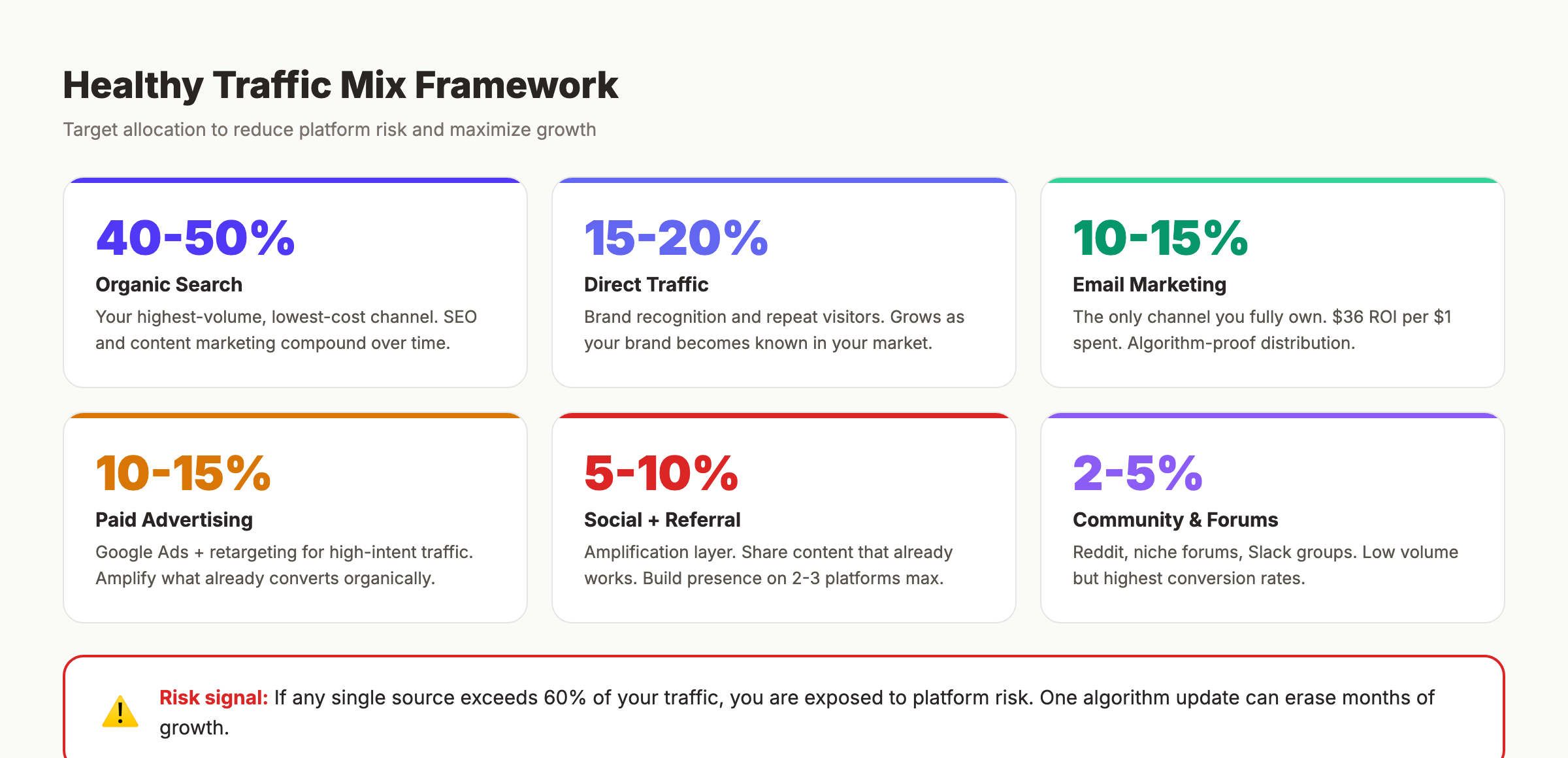
A healthy traffic mix looks like:
- 40-50% organic search
- 15-20% direct (brand recognition)
- 10-15% email
- 10-15% paid
- 5-10% social + referral
- 2-5% community and forums
If any single source exceeds 60%, you are exposed to platform risk. One algorithm update can erase months of growth.
Our SEO competitor analysis guide shows how to study your competitors’ traffic sources and find gaps in your own strategy.
Common Mistakes That Kill Website Traffic
Publishing without keyword research. Writing about topics nobody searches for produces content that nobody finds. Every page needs a target keyword with verified search volume.
Ignoring mobile optimization. Mobile devices account for 63 to 70% of all web traffic. A site that loads slowly or looks broken on mobile loses the majority of potential visitors.
Chasing vanity metrics. Pageviews without conversions mean nothing. 10,000 visitors who bounce immediately are worth less than 500 visitors who engage and convert.
Giving up too early. SEO takes 60 to 90 days for initial results. Content compounds over 6 to 12 months. Most businesses quit at week 4. The ones that persist for 6 months see the traffic curve inflect upward.
Relying on one channel. 59% of websites lost traffic in 2025. Many of those sites depended entirely on Google organic search. Diversify across at least 3 to 4 channels.
Publishing thin content. A 300-word blog post will not rank for anything competitive. The average first-page result on Google contains 1,447 words. Depth matters.
For a broader breakdown of SEO fundamentals and common pitfalls, our SEO small business guide covers everything from setup to scaling.
FAQ
How can I get more website traffic for free?
The highest-impact free methods are SEO, blogging, and community participation. Publish keyword-targeted blog posts consistently. Optimize every page for on-page SEO. Contribute to Reddit and niche forums where your audience already gathers. These methods cost time but zero dollars.
How long does it take to increase website traffic?
It depends on the channel. Paid ads drive traffic within days. Email marketing works within hours of sending. SEO and content marketing take 60 to 90 days for initial ranking movement and 6 to 12 months for compounding results. The businesses that succeed are the ones that stick with organic strategies past the 90-day mark.
What is the fastest way to get website traffic?
Paid advertising is the fastest method. Google Ads and paid social can drive targeted visitors within 24 hours of launching a campaign. For free methods, sharing content in active Reddit threads or email lists generates traffic within days.
Does social media increase website traffic?
Social media accounts for only 4% of total website traffic across all industries. Facebook drives 71.58% of all social referral traffic. Social works best as an amplification channel for content that already performs well organically. It should not be your primary traffic strategy.
Why is my website traffic dropping?
The most common causes: Google algorithm updates, increased zero-click searches (60% of queries end without a click), AI Overviews reducing organic CTR by 47%, content decay on older pages, and technical issues like slow page speed or broken links. Run a site audit, check Search Console for ranking drops, and refresh your top pages.
How many blog posts do I need to get traffic?
Businesses publishing 16+ posts per month get 3.5x more traffic than those publishing 0 to 4. But quality matters as much as quantity. 30 well-researched, keyword-targeted articles outperform 100 thin posts. Aim for at least 8 to 12 posts per month if you are serious about organic growth.
Rank everywhere. Do nothing. Blog SEO, Local SEO, and Social on autopilot. Stacc starts at $99/mo with a $1 SEO trial. Start for $1 →
The websites growing traffic in 2026 are not doing one thing well. They are doing 3 to 4 things consistently. Start with SEO and content. Add email. Layer in community participation. Then amplify with paid when you find what converts. Every article, every email, every comment compounds over time. That is how traffic grows.
Written and published by Stacc. We publish 3,500+ articles per month across 70+ industries. All data verified against public sources as of March 2026.
