
SEO vs PPC: Which Is Better for Your Business? (2026)
SEO vs PPC compared on cost, ROI, speed, and conversion rates. Includes data from 2026 studies and a budget allocation framework. Updated 2026.
SEO vs PPC is the most common marketing budget question businesses face. Both drive traffic from Google. Both generate leads. But they work on fundamentally different economic models.
SEO builds an asset. Every article, every optimized page, every backlink compounds over time. The cost per lead drops as traffic grows. PPC rents attention. Every click costs money. The traffic stops the moment you stop paying.
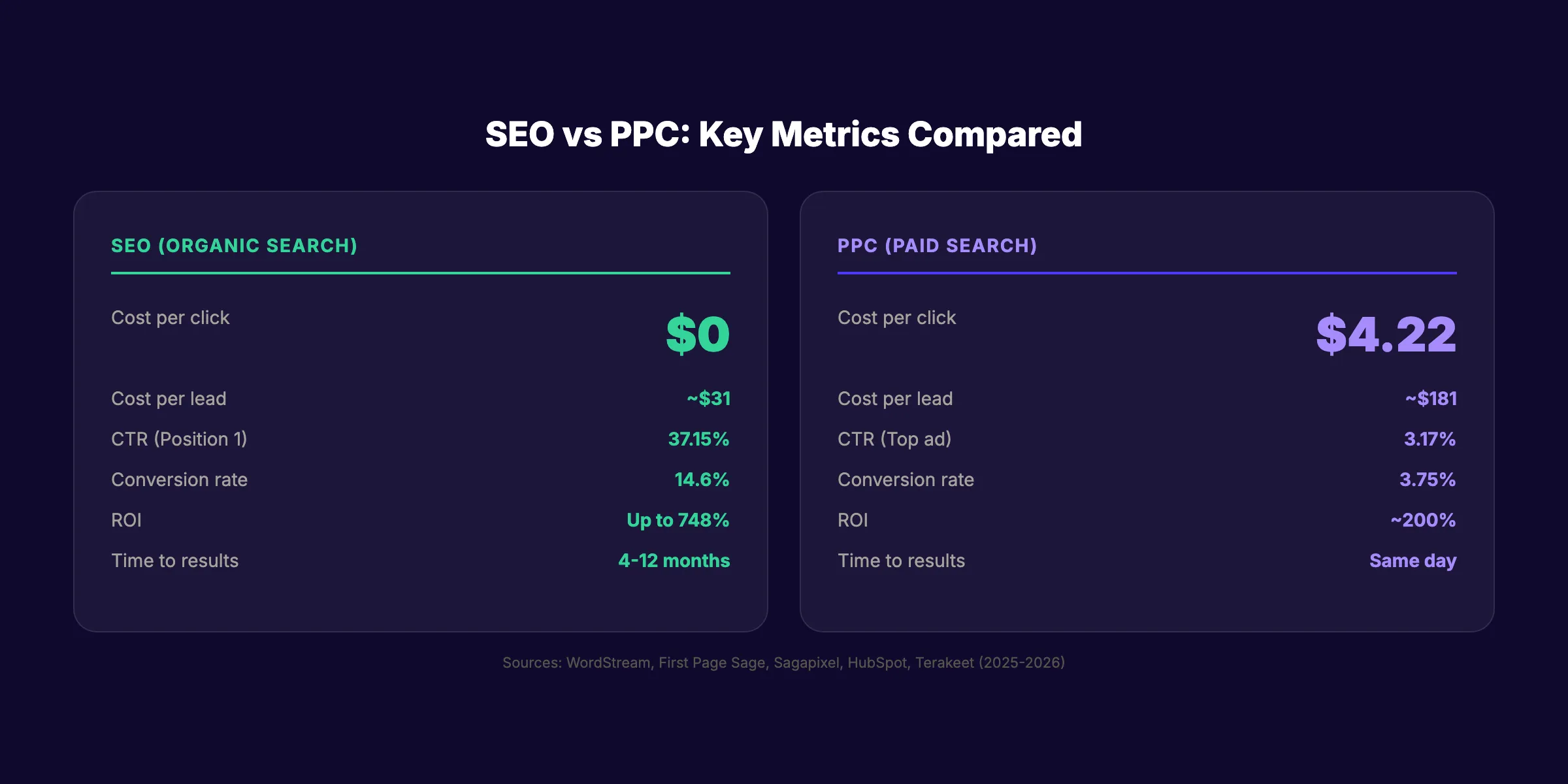
The data makes the difference clear. Organic search drives 53% of all website traffic. Paid search drives 27%. SEO generates leads at roughly $31 each. PPC generates leads at $181 each, according to Sagapixel research. The ROI gap is even wider: SEO returns up to $12.20 per dollar invested. PPC returns approximately $2 per dollar.
But PPC has one advantage SEO cannot match: speed. PPC delivers traffic the same day you launch a campaign. SEO takes 4 to 12 months.
This guide breaks down exactly when to use SEO, when to use PPC, and how to combine both. We publish 3,500+ articles across 70+ industries and track organic performance data daily. Every recommendation here is backed by real numbers.
Here is what you will learn:
- The core differences between SEO and PPC (with data)
- Which channel delivers better ROI, conversion rates, and cost per lead
- When SEO is the right choice and when PPC wins
- How to allocate budget between SEO and PPC by business stage
- The hybrid strategy that outperforms either channel alone
- How AI search changes the SEO vs PPC equation in 2026
SEO vs PPC: The Core Differences
Both SEO and PPC put your business in front of people searching on Google. The mechanics are different.
What Is SEO?
SEO (Search Engine Optimization) earns organic rankings through content, technical optimization, and authority signals. You do not pay Google for organic clicks. You invest in creating pages that deserve to rank.
SEO covers 4 areas:
- On-page SEO: Title tags, headers, content quality, keyword placement
- Technical SEO: Site speed, Core Web Vitals, mobile optimization, crawlability
- Content: Blog posts, service pages, pillar pages, FAQs
- Off-page: Backlinks, citations, brand mentions
What Is PPC?
PPC (Pay-Per-Click) buys ad placement in search results. You bid on keywords. Google shows your ad above the organic results. You pay every time someone clicks.
PPC platforms include:
- Google Ads (search, display, shopping)
- Microsoft Ads (Bing)
- Local Service Ads (pay-per-lead for service businesses)
Head-to-Head Comparison
| Factor | SEO | PPC |
|---|---|---|
| Cost model | Investment (compounds) | Expense (recurring) |
| Time to results | 4-12 months | Same day |
| Cost per click | $0 | $4.22 average (varies by industry) |
| Cost per lead | ~$31 | ~$181 |
| Average CTR (position 1) | 37.15% | 3.17% |
| Conversion rate | 14.6% (close rate) | 3.75% (on-page) |
| ROI | Up to 748% median | ~200% average |
| Traffic when you stop | Continues for months/years | Stops immediately |
| Trust perception | Higher (earned placement) | Lower (labeled as “Ad”) |
The data tells a clear story. SEO delivers better ROI, lower cost per lead, and higher trust. PPC delivers speed and control.
Where SEO Outperforms PPC
SEO wins in 5 specific areas. These advantages grow stronger over time.
Lower Cost Per Acquisition
SEO costs approximately $300 to acquire a customer. PPC costs approximately $600, according to SEOmator research. The gap widens as you scale because organic traffic costs $0 per click while PPC costs rise with competition.
In the legal industry, Google Ads CPC averages $8.67. A law firm running PPC at scale can spend $10,000 per month and generate 50 to 100 leads. The same $10,000 invested in SEO generates content and backlinks that produce leads for years after the initial investment.
Higher Click-Through Rates
The first organic result on Google receives 37.15% of all clicks. The first paid ad receives 3.17%. Users trust organic results more because they earned their position rather than buying it.
This trust gap is not small. It is a 10x difference in click volume between position 1 organic and the top paid ad.
Compounding Returns
PPC delivers linear returns. Spend $5,000 this month, get X clicks. Spend $5,000 next month, get approximately the same X clicks. Stop spending, get zero clicks.
SEO delivers compounding returns. A blog post published today can rank for years. Twenty articles published per month creates a library of 240 indexed pages in 12 months. Each page generates traffic indefinitely.
The Content Compound Effect means every new article strengthens the existing ones through internal linking and topical authority. Month 12 traffic is dramatically higher than month 1 traffic, even at the same monthly investment.
Better Conversion Quality
Organic leads close at 14.6% compared to 1.7% for outbound leads, according to HubSpot. The quality gap exists because organic visitors are self-selected. They searched, found your content, read it, and decided to contact you. PPC visitors clicked an ad and may not have engaged deeply with your brand.
In financial services, SEO converts at 7.3x the rate of PPC. In real estate, 3.5x. In legal services, 3.4x, per First Page Sage data.
Long-Term Asset Value
Every SEO asset you build belongs to you. Blog posts, optimized pages, and domain authority persist even if you pause your SEO efforts for months. PPC campaigns disappear the instant you pause spending.
A business that invests $100,000 in SEO over 2 years owns hundreds of indexed pages generating free traffic. A business that invests $100,000 in PPC over 2 years owns nothing when the budget runs out.
Higher Trust and Credibility
Users skip ads. Eye-tracking studies show that searchers scroll past paid results to reach organic listings. The “Ad” label triggers banner blindness in experienced users.
70% of B2B marketers rank SEO as the most effective long-term driver, according to industry surveys. 49% of all marketers cite organic search as their most profitable channel. The trust gap between organic and paid results is measurable in click-through rates: organic position 1 earns 37% of clicks. The top paid ad earns 3%.
For professional services, legal firms, healthcare providers, and financial advisors, organic rankings signal earned credibility. A paid ad for “best lawyer in Denver” does not carry the same weight as an organic position 1 ranking for that same term.
Stop renting traffic. Start owning it. Stacc publishes 30 SEO articles per month for $99. Build a traffic asset that compounds every month. Start for $1 →
Where PPC Outperforms SEO
PPC wins in 4 specific scenarios. These advantages matter most for speed-dependent businesses.
Immediate Traffic
PPC delivers clicks the same day you launch. SEO takes 4 to 12 months to produce meaningful results. If you need leads this week, PPC is the only option.
New businesses, product launches, seasonal promotions, and time-sensitive campaigns all require immediate visibility that SEO cannot provide.
Precise Audience Targeting
PPC allows you to target by:
- Exact keywords and match types
- Geographic location (down to ZIP code)
- Device type (mobile, desktop)
- Time of day and day of week
- Demographics (age, household income)
- Remarketing audiences (people who visited your site before)
SEO targets keywords. PPC targets people. That targeting precision makes PPC valuable for testing and for reaching specific audience segments.
Keyword Testing and Validation
PPC provides immediate data on which keywords convert. Before investing 6 months of SEO effort into a keyword, run a PPC campaign for 2 weeks. If the keyword converts profitably via PPC, it will likely convert even better via organic search.
This test-first approach prevents wasting SEO resources on keywords that attract traffic but do not generate revenue. Use PPC data to inform your keyword research and content strategy.
Scalable Budget Control
PPC gives you complete control over spending. Set a daily budget of $50 or $5,000. Pause campaigns instantly. Increase spend during peak seasons and reduce during slow periods.
SEO budgets are less flexible. You cannot scale organic traffic up or down on a weekly basis. The investment is front-loaded and the returns are delayed. PPC matches the cash flow patterns of seasonal and variable-revenue businesses.
SERP Domination
Running PPC and SEO simultaneously lets you own multiple positions on the same results page. A business ranking organically in position 1 and showing a paid ad above it captures significantly more total clicks than either channel alone.
Semrush data shows that combined organic + paid presence increases total click-through by 25% compared to organic alone.
Remarketing Power
PPC enables remarketing to people who visited your site but did not convert. An organic visitor reads your blog post and leaves. A PPC remarketing ad follows them across the web, bringing them back when they are ready to act.
This capability turns organic traffic into a PPC asset. SEO attracts the initial visit. PPC remarketing closes the loop. No other channel combination works this efficiently for recapturing abandoned visitors.
The Budget Allocation Framework
The standard advice is “do both.” That is unhelpful when your budget is $2,000 per month.
Here is a staged approach based on business maturity and budget.
Stage 1: New Business (Months 0-3)
Budget split: 80% PPC / 20% SEO
You need revenue now. PPC delivers immediate leads. The 20% SEO investment goes toward foundational work: Google Search Console setup, on-page optimization, Google Business Profile, and publishing your first 5 to 10 blog posts.
Stage 2: Establishing Presence (Months 4-12)
Budget split: 50% PPC / 50% SEO
PPC continues generating leads while SEO gains traction. Organic traffic begins appearing for long-tail keywords. Use PPC data to identify high-converting keywords, then build SEO content around those terms.
Stage 3: SEO Momentum (Year 2+)
Budget split: 25% PPC / 75% SEO
Organic traffic now generates a steady flow of leads at near-zero marginal cost. PPC shifts to retargeting, brand defense, and high-competition commercial keywords. Most clients allocate approximately 75% to SEO and 25% to PPC at this stage, according to Search Engine Journal.
Stage 4: Market Dominance
Budget split: 15% PPC / 85% SEO
SEO drives the majority of leads. PPC serves a supporting role: conquesting competitor brand terms, running seasonal campaigns, and retargeting organic visitors who did not convert.
Your SEO team. $99 per month. 30 optimized articles, published automatically. Start building the organic asset while PPC covers the gap. Start for $1 →
How AI Search Changes the SEO vs PPC Equation
AI Overviews now appear on a growing percentage of Google searches. When an AI summary appears at the top of the results page, traditional organic CTR drops from 15% to 8%, according to OutreachZ.
This creates a new dynamic for both channels.
Impact on SEO
AI Overviews cite sources. Sites that get cited in AI summaries see CTR jump from 0.6% to 1.08%. The goal shifts from ranking in position 1 to getting cited by AI search engines.
Optimizing for Generative Engine Optimization (GEO) requires structured content with clear answers, authoritative citations, and schema markup. These are the same signals that drive traditional SEO. GEO is an extension of SEO, not a replacement.
Impact on PPC
AI Overviews push paid ads further down the page on some queries. But Google protects its ad revenue. Shopping ads, Local Service Ads, and branded search ads continue to appear prominently.
PPC costs are rising. 87% of industries saw increased average CPCs in 2025, according to WordStream via Hallam. As AI search reduces organic CTR on some queries, advertisers compete more aggressively for the remaining paid clicks.
The Combined Strategy
The businesses winning in 2026 run both channels with a clear division of labor:
- SEO handles informational queries, content clusters, long-tail keywords, and AI citation optimization
- PPC handles high-intent commercial queries, brand defense, retargeting, and quick-launch campaigns
Neither channel alone captures the full search opportunity. Together, they cover the entire buyer journey from research to purchase.
Using PPC Data to Improve SEO
Run PPC campaigns on 20 to 30 target keywords for 2 to 4 weeks. Measure which keywords generate actual conversions, not just clicks. The keywords with the highest PPC conversion rates are the keywords worth building SEO content around.
This test-first approach saves months of wasted SEO effort. A keyword with 10,000 monthly searches and zero PPC conversions will likely deliver the same result organically: traffic without revenue. Validate demand with PPC before committing SEO resources.
PPC ad copy data also informs SEO. The headlines and descriptions with the highest CTR in ads become the basis for organic title tags and meta descriptions that earn more clicks from the SERP.
SEO vs PPC by Business Type
The right channel depends on your business model.
| Business Type | Primary Channel | Why |
|---|---|---|
| Local service business | SEO + Local SEO | Local pack drives most calls. PPC costs are high for service keywords. |
| Ecommerce | PPC (short term) + SEO (long term) | Product searches have high purchase intent. Shopping ads convert well. |
| B2B / SaaS | SEO | Long sales cycles. Buyers research extensively before contacting sales. |
| New product launch | PPC | Need immediate visibility. No existing organic presence. |
| Seasonal business | PPC during peak + SEO year-round | PPC captures seasonal spikes. SEO captures research queries. |
| Professional services | SEO | High trust required. Organic rankings signal credibility. |
For local businesses, the combination of blog SEO + GBP optimization + local content produces the highest ROI. 46% of all Google searches have local intent. 76% of local mobile searchers visit a nearby business within 24 hours.
The Cost Trajectory Over Time
The single most important difference between SEO and PPC is how costs behave over time.
PPC cost trajectory: Linear. Month 1 spend = Month 12 spend = Month 24 spend (assuming constant traffic volume). As competition increases, CPCs rise. The same traffic costs more each year. 87% of industries saw CPC increases in 2025.
SEO cost trajectory: Front-loaded, then declining. Months 1 to 6 require the highest investment relative to traffic. By month 12, cost per visit drops dramatically. By month 24, organic traffic generates leads at near-zero marginal cost.
A business spending $2,000 per month on PPC for 24 months spends $48,000 total and owns nothing at the end. A business investing $2,000 per month in SEO for 24 months spends $48,000 total and owns a content library generating thousands of monthly visits for free.
The break-even point varies by industry. Most businesses reach SEO break-even (where cumulative organic value exceeds cumulative spend) between months 8 and 14. After break-even, every additional month of organic traffic is pure profit.
This math explains why 49% of marketers rank organic search as their most profitable channel. It also explains why experienced businesses shift their budget toward SEO over time while maintaining a smaller PPC allocation for speed and testing.
Rank everywhere. Do nothing. Blog SEO, Local SEO, and Social on autopilot. Stacc starts at $99/mo with a $1 trial. Start for $1 →
FAQ
Is SEO cheaper than PPC?
In the long run, yes. SEO costs roughly $31 per lead compared to $181 for PPC. The upfront investment is higher because SEO takes 4 to 12 months to produce results. But once pages rank, they generate traffic at zero marginal cost per click. PPC requires continuous spending.
How long does SEO take compared to PPC?
PPC delivers traffic immediately. SEO takes 4 to 12 months for meaningful organic visibility. The exact timeline depends on keyword competition, content quality, and your existing domain authority. Most businesses see initial ranking movement within 60 to 90 days.
Should a new business start with SEO or PPC?
Start with PPC for immediate revenue. Invest 20% of your budget in SEO foundations (site optimization, first blog posts, GBP setup) from day 1. Shift the balance toward SEO over 12 months as organic traffic builds. By year 2, most businesses run 75% SEO and 25% PPC.
Does PPC help SEO rankings?
PPC does not directly improve organic rankings. Google has confirmed that paid ads do not influence organic placement. However, PPC data helps SEO indirectly: you learn which keywords convert, which ad copy resonates, and which landing pages perform best. Apply those insights to your organic content strategy.
Can I do SEO without spending money?
Yes, but it requires significant time. Free SEO includes Google Search Console setup, on-page optimization, blogging, and manual link building. The tradeoff is speed. A business investing $0 in SEO tools or services will see slower results than one investing even $99 per month in content production.
What is the average ROI of SEO vs PPC?
SEO delivers a median ROI of approximately 748% over 2 to 3 years, with some sectors exceeding 1,000%. PPC delivers approximately 200% ROI (roughly $2 per $1 spent). The difference grows over time because SEO costs plateau while traffic compounds. PPC costs grow linearly with traffic.
The SEO vs PPC decision is not either-or. It is a sequencing question. Use PPC for speed when you need it. Invest in SEO for the long-term asset. The businesses outperforming their competitors in 2026 figured out the right ratio at the right time. Start with the data, allocate based on your stage, and shift toward organic as it compounds.
Related Tools & Resources
Free SEO Tools:
Best Lists:

Written by
Siddharth GangalSiddharth is the founder of theStacc and Arka360, and a graduate of IIT Mandi. He spent years watching great businesses lose organic traffic to competitors who simply published more. So he built a system to fix that. He writes about SEO, content at scale, and the tactics that actually move rankings.
30 SEO blog articles published every month
Keyword-optimized, scheduled, and live on your site. Automatically.
30-day trial · Cancel anytime
theStacc
Stop writing SEO content manually
30 blog articles, 30 GBP posts, and social media content. Published every month. Automatically.
Start Your $1 Trial$1 for 3 days · Cancel anytime