Google Algorithm Updates: The Complete Guide
Every major Google algorithm update explained. Covers Panda, Penguin, BERT, core updates, and how to recover from ranking drops. Updated March 2026.
Siddharth Gangal • 2026-03-30 • SEO Tips
In This Article
Google runs thousands of algorithm changes every year. Most go unnoticed. A few reshape entire industries overnight. One core update can erase months of SEO work. The next one can double your traffic.
Understanding Google algorithm updates is not optional for anyone who depends on organic search. Each update signals what Google rewards and what it penalizes. Missing those signals costs rankings, traffic, and revenue.
We have published 3,500+ blog posts across 70+ industries. We have watched our content survive every major update since 2023. This guide explains every significant Google algorithm update, what each one targets, and exactly how to protect your rankings.
Here is what you will learn:
- The major Google algorithm updates and what each one changed
- A complete timeline of core updates from 2024 through 2026
- How core updates, spam updates, and system updates differ
- What to do when your rankings drop after an update
- How to build a site that thrives through algorithm changes
- The connection between content quality and update resilience
How Google Algorithm Updates Work
Google uses hundreds of ranking factors processed through multiple systems. An “algorithm update” is a change to one or more of those systems. Some changes are small. Others rewrite how Google evaluates entire categories of content.
Types of Google Updates
| Update Type | What It Does | Frequency | Example |
|---|---|---|---|
| Core updates | Reassess content quality across all search | 3-4 per year | March 2026 core update |
| Spam updates | Target manipulative practices and policy violations | 2-3 per year | December 2024 spam update |
| System updates | Improve specific ranking systems (links, reviews, etc.) | Varies | Reviews system update |
| Daily changes | Small ranking adjustments | Constant | Not announced |
Core updates receive the most attention because they affect the most sites. Google confirms core updates publicly on its Search Status Dashboard.
What “Core Update” Actually Means
A core update does not target specific sites or techniques. It changes how Google evaluates quality overall. A page that ranked #3 before a core update might drop to #15. Not because it got penalized. Because Google decided other pages better satisfy the search intent.
Google’s official position: “There is nothing wrong with pages that perform less well in a core update. They have not violated our spam policies. A core update is an update to our overall ranking process.”
The practical implication: if you lose rankings after a core update, the fix is not removing something bad. It is making your content genuinely better than the competition.
Core updates typically take 1-3 weeks to roll out completely. During rollout, rankings fluctuate as Google tests new quality assessments. Final results become clear only after the rollout completes.
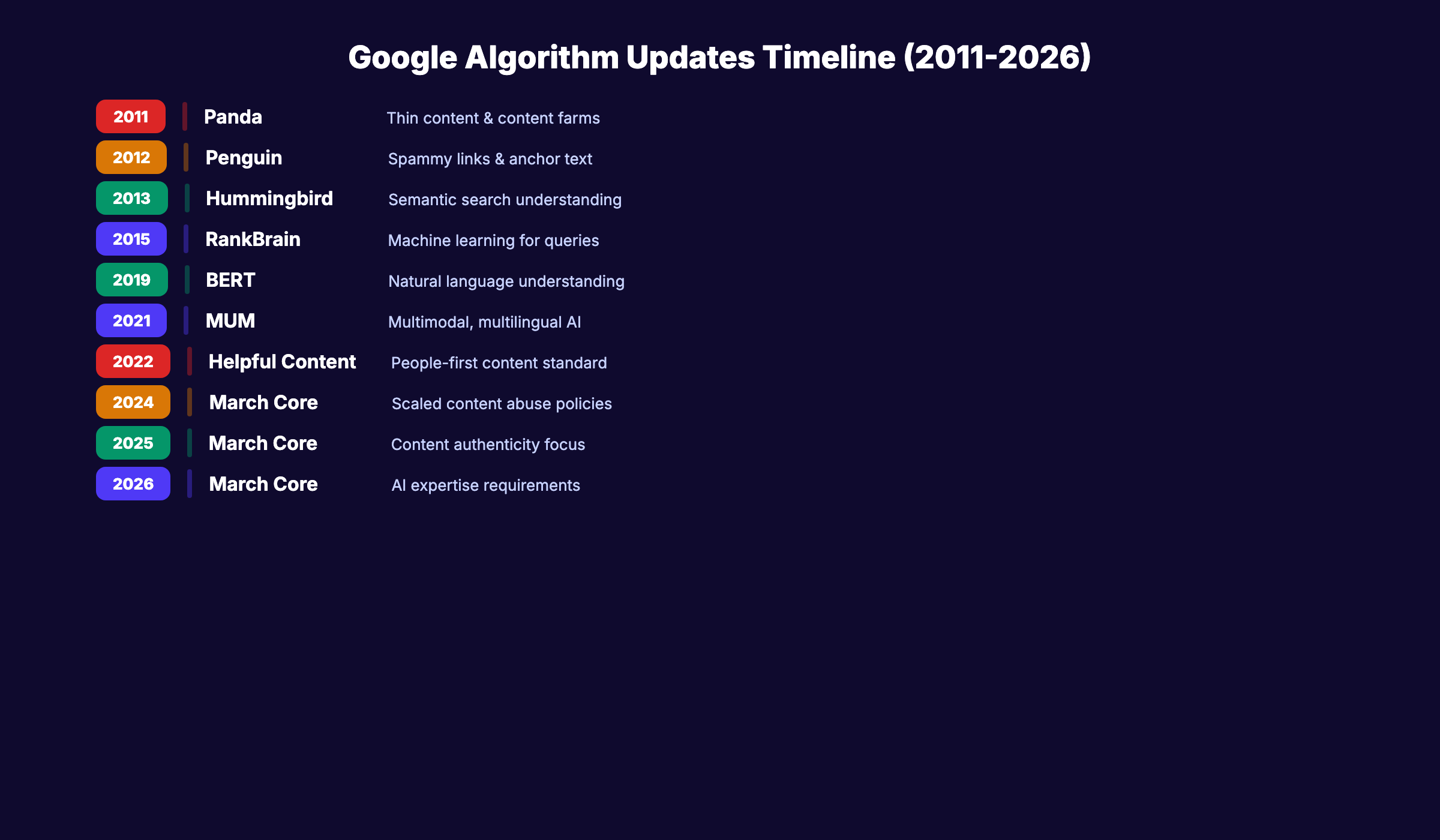
The Major Google Algorithm Updates (History)
Every SEO professional should know these updates. They established the rules that still govern search rankings today.
Panda (2011)
Target: Thin content, content farms, duplicate content.
Panda penalized sites with low-quality pages designed to rank through volume, not value. Content farms like Demand Media and eHow lost 50-80% of their traffic overnight.
What survived: Sites with original, in-depth content that answered real questions. The “would you trust this content?” test became Google’s baseline for quality.
Legacy: Panda became part of the core algorithm in 2016. Its principles still drive how Google evaluates content quality today.
Penguin (2012)
Target: Spammy link building, keyword-stuffed anchor text.
Penguin penalized sites using manipulative backlink schemes. Paid link networks, blog comment spam, and exact-match anchor text manipulation all triggered penalties.
What survived: Sites with natural link profiles built through genuine content and relationships. Penguin made organic link building the only safe strategy.
Legacy: Penguin became a real-time core algorithm component in 2016. Google now devalues bad links rather than penalizing the entire site.
Hummingbird (2013)
Target: Keyword-matching search. Hummingbird moved Google toward understanding meaning.
Before Hummingbird, Google matched keywords in queries to keywords on pages. After Hummingbird, Google understood that “best place to eat pizza near downtown” and “pizza restaurants downtown” mean the same thing.
Legacy: The foundation for semantic search. Every subsequent update (BERT, MUM) built on Hummingbird’s approach.
RankBrain (2015)
Target: Queries Google had never seen before. RankBrain used machine learning to interpret unfamiliar searches.
Google confirmed RankBrain as the third most important ranking factor. It processes searches by relating them to similar known queries. About 15% of daily searches had never been seen before. RankBrain handled those queries by finding patterns in similar past searches.
Legacy: The first machine learning system in Google Search. Proved that AI could improve search quality at scale. Set the stage for BERT and MUM.
BERT (2019)
Target: Misunderstood search queries, especially long and conversational ones.
BERT (Bidirectional Encoder Representations from Transformers) helped Google understand context. The word “to” in “flights from New York to London” versus “things to do in London” means different things. BERT catches those differences.
Legacy: BERT improved 10% of all English searches. It made writing naturally (for humans) more important than writing for keyword matching.
Helpful Content Update (2022)
Target: Content written for search engines rather than for people.
The Helpful Content Update penalized sites producing content primarily to rank, not to help readers. “People-first content” became Google’s explicit standard.
What it punished: Generic, AI-generated content without expertise. “Best [product] review” pages written by someone who never used the product.
What survived: Sites with genuine expertise, original research, and first-person experience. Content written by people who actually used the products, visited the places, or practiced the skills they wrote about.
Legacy: Merged into Google’s core ranking systems. The E-E-A-T framework (Experience, Expertise, Authoritativeness, Trustworthiness) became the primary content evaluation model. Every content creator must now demonstrate real knowledge, not just keyword coverage. For more on writing content that passes this test, read our on-page SEO guide.
MUM (2021)
Target: Complex searches requiring information from multiple sources and languages.
MUM (Multitask Unified Model) is 1,000x more powerful than BERT. It understands text, images, and 75 languages simultaneously. Google uses MUM to answer complex queries that previously required multiple searches.
Legacy: MUM powers features like “Things to know” boxes and multi-format search results. It represents Google’s shift toward understanding topics holistically rather than matching individual keywords.
Stop writing. Start ranking. Stacc publishes 30 SEO articles per month for $99. Start for $1 →
Google Core Updates: 2024-2026 Timeline
Here is every confirmed core update from 2024 through March 2026.
2024 Core Updates
| Update | Start Date | End Date | Duration | Key Impact |
|---|---|---|---|---|
| March 2024 Core | March 5 | April 19 | 45 days | Targeted low-quality content, new spam policies |
| August 2024 Core | August 15 | September 3 | 19 days | Demoted low-value SEO content |
| November 2024 Core | November 11 | December 5 | 24 days | Quality reassessment |
| December 2024 Core | December 12 | December 18 | 6 days | Quick follow-up refinement |
The March 2024 core update was the most impactful of the year. It introduced new spam policies targeting scaled content abuse, site reputation abuse, and expired domain abuse.
2025 Core Updates
| Update | Start Date | Duration | Key Impact |
|---|---|---|---|
| March 2025 Core | March 13 | 14 days | Content authenticity focus. Deprioritized AI content without expertise |
| June 2025 Core | June 30 | 17 days | Quality refinement |
| December 2025 Core | December 11 | 18 days | E-E-A-T signal strengthening, Core Web Vitals integration |
The March 2025 update specifically targeted content written without real expertise or first-hand experience. Sites that mass-produced AI content without human editorial oversight saw significant drops.
2026 Updates (So Far)
| Update | Start Date | Type | Status |
|---|---|---|---|
| February 2026 | February 5 | Discover-focused core update | Completed (English US only) |
| March 2026 Core | March 10 | Core update | Rolling out |
| March 2026 Spam | March 24 | Spam update | Rolling out |
The March 2026 core update impacted 55% of tracked sites. Sites relying on template-based AI content for long-tail keywords saw 20-35% traffic drops. Pages with clear author expertise, original research, and first-hand experience gained positions.
How to Know If an Update Hit Your Site
Not every traffic fluctuation is an algorithm update. Here is how to diagnose the cause.
Step 1: Check the Timeline
Compare your traffic drop against Google’s Search Status Dashboard. If your drop aligns with a confirmed update date (within 2-3 days), the update likely caused it.
Step 2: Analyze the Scope
Open Google Search Console. Look at which pages lost impressions and clicks.
- Sitewide drop = Core update likely reassessed your overall quality
- Specific pages dropped = Those pages may not meet current quality standards
- Specific queries dropped = Google may have changed how it interprets those searches
Step 3: Compare Against Competitors
If your competitors gained what you lost, study their content. What do their pages have that yours do not? More depth? Better expertise signals? Fresher data?
Step 4: Wait Before Reacting
Core updates take 1-3 weeks to fully roll out. Rankings fluctuate during rollout. Wait until Google confirms the update is complete before analyzing results. Reacting too early leads to changes that make things worse.
For a systematic approach, read our SEO audit guide.
Your SEO team. $99 per month. 30 optimized articles, published automatically. Start for $1 →
How to Recover from a Google Algorithm Update
Recovery is not about reversing a penalty. It is about improving content quality until Google recognizes your site as the best result.
The Recovery Framework
1. Audit your content against E-E-A-T.
For every page that lost rankings, ask:
- Does this content demonstrate first-hand experience with the topic?
- Does the author have verifiable expertise?
- Does the page provide information you cannot find on 10 other sites?
- Would a subject-matter expert find this content accurate and complete?
If the answer to any of these is no, that page needs improvement.
2. Remove or consolidate thin content.
Pages with under 300 words, duplicate information, or no unique value should be consolidated with related pages or removed entirely. Fewer, stronger pages outperform many weak ones.
3. Strengthen expertise signals.
Add author bios with real credentials. Link to author profiles on LinkedIn or industry publications. Include original data, screenshots, or case studies that prove direct experience.
4. Update outdated content.
Content with old data, broken links, or outdated advice signals low quality to Google. Update statistics, refresh examples, and fix all broken links.
5. Improve technical performance.
Core Web Vitals, mobile usability, and page speed affect rankings. Run a technical SEO audit and fix any issues.
6. Check your backlink profile.
Low-quality or spammy backlinks weigh your site down. Use Ahrefs or Google Search Console to identify toxic links. Disavow the worst offenders. Focus on earning links from authoritative sites through quality content.
7. Analyze your competitors who gained.
The pages that replaced yours hold the answers. Study their content depth, author credentials, formatting, and unique information. Your recovery plan should close every gap between their content and yours.
Recovery Timeline
Most sites that make meaningful improvements recover within 4-6 months. The fastest recoveries happen when the next core update rolls out and Google reassesses the improved content.
Google does not offer manual recovery for core updates. The fix is always content improvement.
What NOT to Do After an Update
- Do not panic-publish new content. Quality matters more than volume during recovery.
- Do not remove pages randomly. Analyze first. Remove only confirmed thin or duplicate pages.
- Do not disavow your entire link profile. Targeted disavowal of clearly toxic links only.
- Do not change your domain or URL structure. Technical disruption compounds the problem.
- Do not buy links to recover. Google detects purchased links. This makes the problem worse.
The recovery process requires patience and systematic improvement. Quick fixes do not exist.
How to Build an Update-Proof Site
The best recovery strategy is prevention. Sites that follow these principles rarely lose significant traffic from core updates.
Publish Expert-Level Content
Every page should demonstrate genuine knowledge. Use specific data, first-hand examples, and original insights. Generic content that anyone could write is the first thing Google deprioritizes.
Prioritize E-E-A-T
Experience, Expertise, Authoritativeness, Trustworthiness. Google evaluates content through this framework. The strongest pages combine personal experience (“we tested this”) with expertise (“here is what the data shows”).
Focus on Search Intent
Match what Google shows on page 1. If the top results for your keyword are step-by-step guides, do not publish a listicle. If the top results show product comparisons, do not publish an opinion piece. Content that matches intent survives updates.
Study the top 5 results for every target keyword. Note the format, depth, and angle. Your content should match that format while adding something the existing results miss. Matching intent while providing unique value is the formula that performs through every update.
Build a Natural Link Profile
Earn links through quality content, not link schemes. Google’s Penguin system devalues manipulative links. One authoritative backlink from an industry publication is worth more than 100 directory links.
Maintain Technical Health
Sites with slow load times, broken pages, and mobile usability issues lose rankings during updates. Keep your technical SEO checklist current.
Publish Consistently
Content velocity matters. Sites that publish regularly build topical authority faster than those that publish sporadically. Consistency also signals to Google that the site is actively maintained.
The data supports this. Companies publishing 16+ blog posts per month get 3.5x more traffic than those publishing 4 or fewer. The compounding effect of consistent publishing creates a moat that algorithm updates rarely breach. Sites with 200+ indexed pages of quality content rarely lose more than 5-10% in any single core update.
Monitor and Adapt
Track your SEO performance metrics weekly. Watch for ranking shifts before they become traffic problems. Set up automated alerts for position drops exceeding 5 places. The faster you identify a problem, the faster you can respond.
Review your content against current SEO trends quarterly. What Google rewards evolves. Your content strategy should evolve with it.
3,500+ blogs published. 92% average SEO score. See what Stacc can do for your site. Start for $1 →
What the March 2026 Core Update Changed
The most recent core update deserves special attention. It hit 55% of tracked sites and redefined what Google considers quality AI content.
Key Changes
- AI content without expertise dropped. Pages generated by AI without human editorial review or subject-matter expertise lost 20-35% of traffic.
- Template-based programmatic content penalized. Sites using AI to mass-produce pages for long-tail keywords without genuine depth saw steep declines.
- Author expertise rewarded. Pages with named authors, verifiable credentials, and unique perspectives gained positions.
- Original research elevated. Content with proprietary data, surveys, or case studies outperformed content that summarized other sources.
What This Means for Your Strategy
The March 2026 update confirmed a direction Google has been moving toward since 2022. AI-generated content is not penalized by default. AI-generated content without human expertise, editorial judgment, and unique value is.
The winning approach: use AI as a drafting tool. Add human expertise, original insights, and verifiable experience. Publish content that a real person with real knowledge actually reviewed and improved.
For guidance on using AI responsibly for content, read our guide on humanizing AI content.
FAQ
How often does Google update its algorithm?
Google makes thousands of small changes per year. Major confirmed updates (core updates and spam updates) happen 5-8 times per year. Core updates typically roll out 3-4 times annually. Each core update takes 1-3 weeks to complete.
What is a Google core update?
A core update is a broad change to how Google evaluates content quality. It does not target specific sites or techniques. Instead, it reassesses which pages best satisfy search queries. Sites can gain or lose rankings based on relative quality compared to competitors.
How do I know if a Google update affected my site?
Check your Google Search Console data for sudden drops in impressions and clicks. Compare the timing against Google’s Search Status Dashboard. If the drop aligns with a confirmed update date, the update likely caused it.
How long does it take to recover from a core update?
Most meaningful recoveries take 4-6 months. The fastest recoveries happen when the next core update reassesses improved content. There is no instant fix. Recovery requires genuine content improvements aligned with E-E-A-T principles.
Does Google penalize AI content?
No. Google does not penalize AI-generated content by default. It penalizes low-quality content regardless of how it was produced. AI content that lacks human expertise, editorial review, and unique value will lose rankings. AI content that includes genuine expertise and adds real value can rank well.
What is the best way to protect against future updates?
Publish expert-level content with verifiable authorship, original data, and genuine insights. Maintain strong technical performance. Build natural backlinks. Update content regularly. Sites that follow SEO best practices consistently perform well through algorithm changes.
Google algorithm updates reward sites that genuinely help searchers. The pattern has been consistent since 2011. Every major update pushed the same direction: better content wins. Build your SEO strategy around quality, expertise, and consistency. The updates will take care of the rest.
Written and published by Stacc. We publish 3,500+ articles per month across 70+ industries. All data verified against public sources as of March 2026.