Learn how to choose an SEO agency in 9 steps. Covers goals, budget, vetting, red flags, contracts, and the questions that separate good agencies from bad.
Most businesses pick the wrong SEO agency. They sign 12-month contracts based on a slick pitch deck, then watch 6 months go by with no rankings, no traffic, and no straight answers. By the time they cancel, they have burned $30,000 and lost a year of organic growth to competitors.
The cost is brutal. A bad SEO agency does not just waste money. It can tank your rankings with low-quality backlinks, destroy your site with botched migrations, or leave you trapped in a content prison where you do not even own the articles they wrote. Recovery takes longer than the original campaign.
This guide walks through the exact 9-step process for vetting and selecting an SEO partner that actually delivers. We publish 3,500+ blogs across 70+ industries and maintain a 92% average SEO score, so we know what good SEO work looks like from the inside.
Here is what you will learn:
- How to define goals and KPIs before you talk to any agency
- How to set a realistic budget that matches your growth stage
- How to vet case studies, methodology, and team experience
- How to spot the 10 red flags that signal a bad agency
- How to ask the questions that separate operators from sales reps
- How to evaluate contracts, reporting, and data ownership
What an SEO Agency Actually Does
An SEO agency is a team you hire to grow your organic search traffic. Good agencies handle 4 pillars: technical SEO, on-page optimization, content production, and link building. Some specialize in one pillar. Others offer full-service campaigns.
The work is not magic. It is a mix of audits, keyword research, content briefs, on-page edits, internal link planning, technical fixes, and outreach. The results show up in rankings, organic traffic, and pipeline. The timeline runs 3 to 12 months for most sites.
Agency models vary widely. Some charge a monthly retainer for ongoing work. Others bill per project, like a one-time audit or a content sprint. A few use hybrid structures with a strategy fee plus production costs.
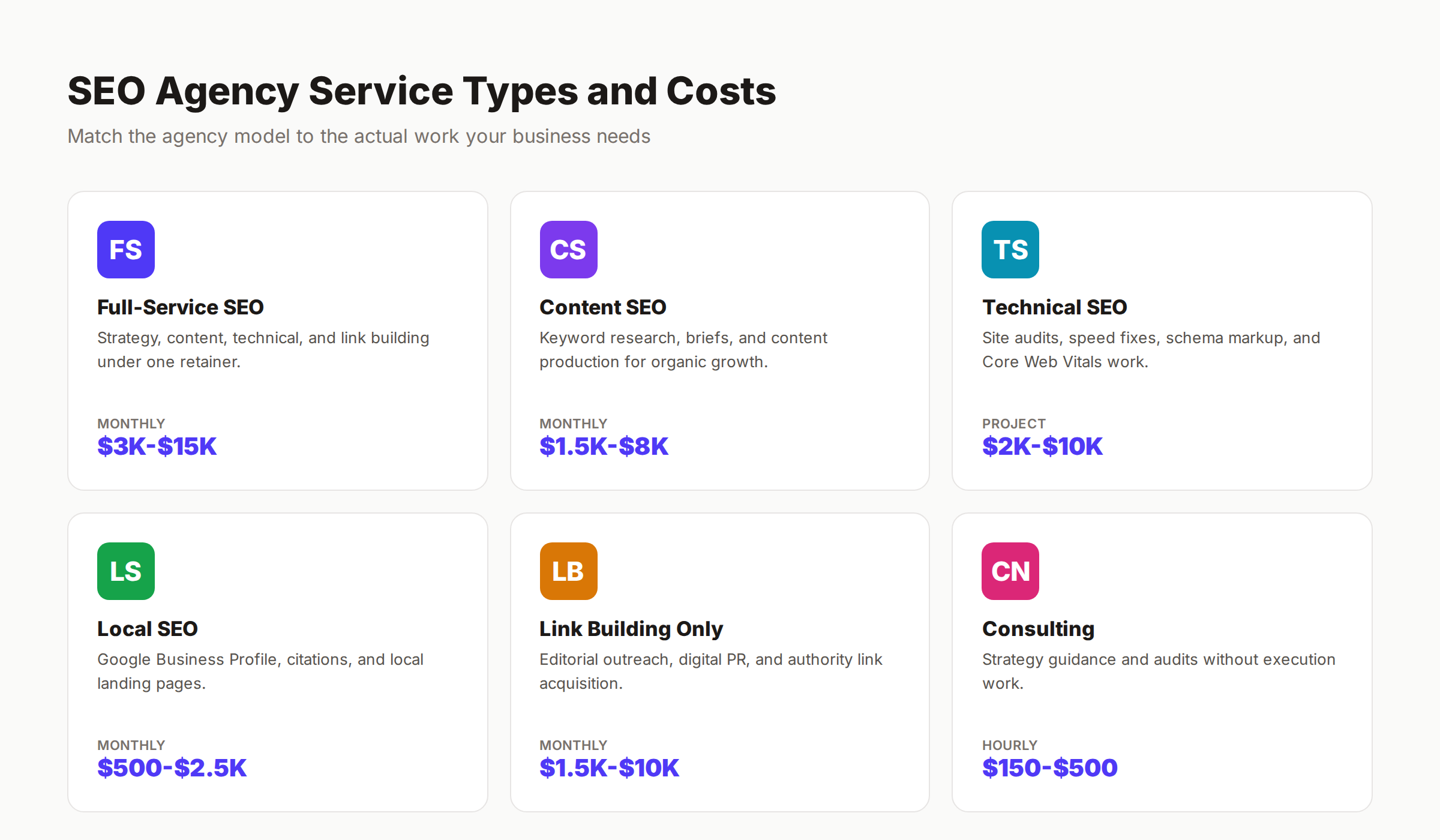
| Service Type | What It Covers | Typical Cost |
|---|---|---|
| Full-service SEO | Strategy, content, technical, links | $3,000-$15,000/mo |
| Content SEO | Keyword research, briefs, articles | $1,500-$8,000/mo |
| Technical SEO | Audits, fixes, site speed, schema | $2,000-$10,000 project |
| Local SEO | GBP, citations, local content | $500-$2,500/mo |
| Link building only | Outreach, guest posts, digital PR | $1,500-$10,000/mo |
| Consulting | Strategy guidance, no execution | $150-$500/hour |
Before you sign anything, you need to know which model fits your business. A SaaS startup needs content and links. A local plumber needs Google Business Profile work and local citations. An ecommerce site needs technical SEO and category page optimization. Match the agency to the actual work.
Step 1: Define Your Goals and KPIs
If you cannot describe what success looks like, no agency can deliver it. This is the most skipped step in the entire process. Companies hire SEO agencies because they "want more traffic," then complain 6 months later that the traffic did not convert.
Start with business outcomes, not SEO metrics. Rankings and traffic are inputs. Revenue, leads, signups, and pipeline are outcomes. A good agency connects the two. A bad one reports on impressions and calls it a win.
Write down 3 specific outcomes before you contact any agency:
- ✓ What revenue, leads, or signups do you need from organic in 12 months?
- ✓ Which pages or product lines need to rank?
- ✓ Which competitors do you want to outrank, and for which keywords?
- ✓ What is your current organic baseline (traffic, leads, conversions)?
- ✓ Which markets matter most (national, regional, local, international)?
Then translate those outcomes into SEO KPIs. If you need 500 qualified leads a month from organic, and your current conversion rate is 2%, you need 25,000 organic visits per month. That is your traffic target. Now you can evaluate whether an agency's strategy can plausibly hit it.
The other half of goal-setting is timeline. SEO is not a 30-day sprint. Most campaigns need 3 to 6 months to show traction and 9 to 12 months to hit serious volume. If you need leads next week, you need paid search, not SEO. Read our guide on how long SEO takes for realistic timelines by industry.
Agencies that promise rankings in 30 days are either lying or planning to use tactics that will get you penalized. Google's own guidelines on hiring SEO providers explicitly warn against anyone guaranteeing rankings. Walk away.
Pro tip: Bring your goals to the first call. Watch how the agency reacts. A good agency will push back on unrealistic targets and explain what is actually possible. A bad agency will agree to everything and start selling.
Step 2: Set a Realistic SEO Budget
SEO is not cheap, and cheap SEO is the most expensive mistake a business can make. The agencies charging $300 a month are almost always selling spam links, AI slop content, or fake reports. The damage they cause costs 10x to clean up.
Industry data from Semrush's 2026 SEO pricing research shows SEO retainers range from $1,500 to $15,000 per month for most agencies, with the national average around $3,500 to $4,500 per month. Local campaigns start lower. Competitive national and enterprise campaigns run much higher. AI tools have compressed pricing for routine work by 20 to 30%, but strategy and link building remain labor-intensive.
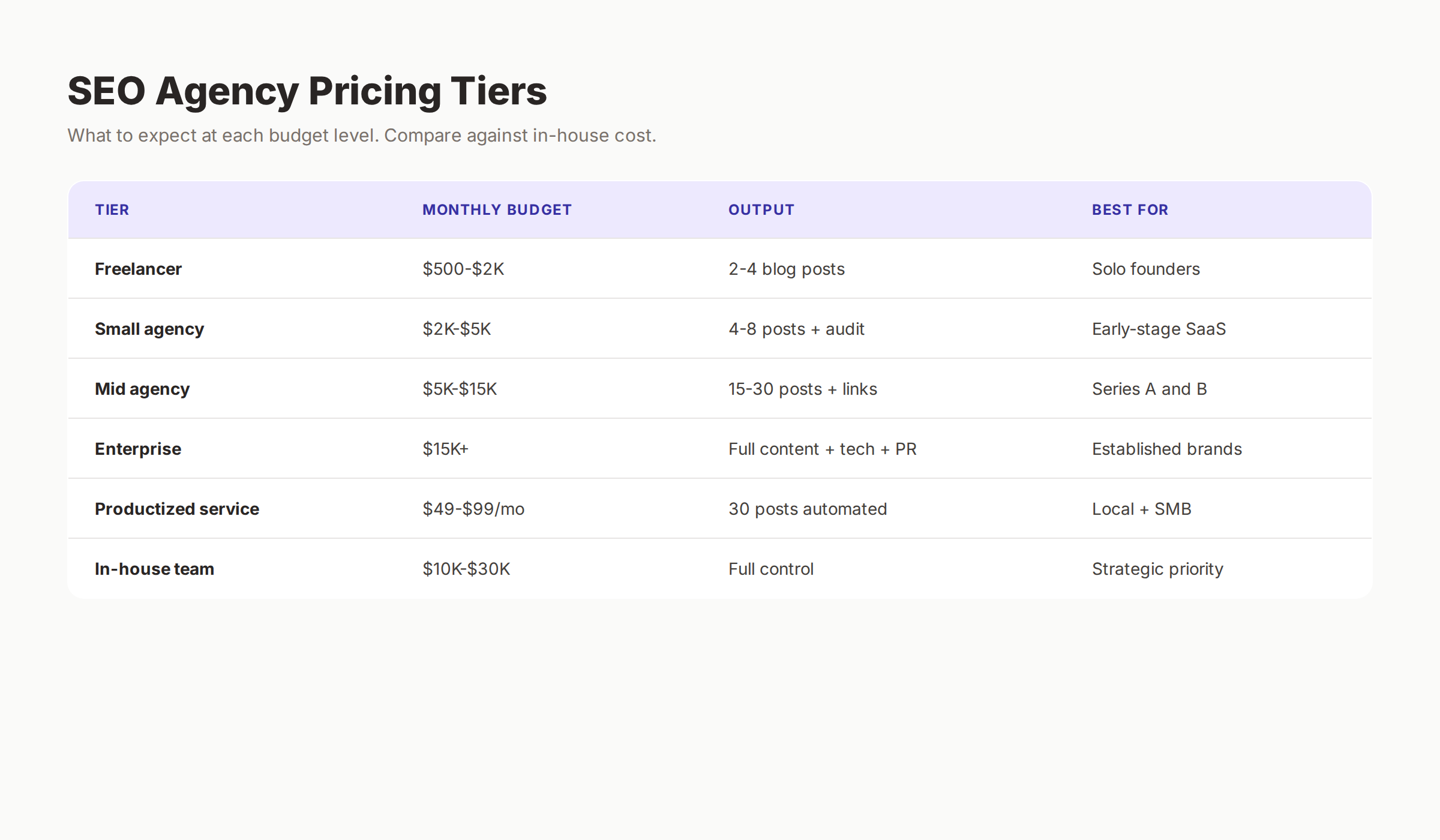
| Business Stage | Monthly Budget | What You Get |
|---|---|---|
| Local single-location | $500-$2,000 | GBP optimization, local citations, 2-4 local pages/mo |
| Small business | $2,000-$5,000 | Full local SEO + 4-8 blog posts/mo + on-page work |
| Mid-market B2B | $5,000-$12,000 | Strategy, 8-15 articles/mo, link building, technical |
| Enterprise | $15,000-$50,000+ | Dedicated team, advanced strategy, large content volume |
| DIY with software | $99-$499/mo | Automated content publishing with tools like theStacc |
Budget by deliverable, not just by retainer. A $5,000 retainer that produces 4 articles a month is $1,250 per article. The same retainer that produces 20 articles a month is $250 per article. Same money. Wildly different value.
Ask every agency to break down what the retainer covers. How many articles? How many links? How many hours of strategy? How many technical fixes? If they cannot answer, the retainer is a black box.
Compare agency pricing to building in-house. A senior SEO hire runs $90,000 to $150,000 per year plus tools. A content writer adds another $60,000 to $90,000. Add a link builder and a developer for technical work, and you are at $250,000+ before benefits. For most companies under $20M revenue, an agency is cheaper. Read our breakdown of marketing agency cost vs in-house for the full math.
Skip the $5,000 retainer. Get a full SEO team for $99/month. We publish 30 SEO-optimized articles every month, handle internal linking, and maintain a 92% average SEO score across 3,500+ blogs.
Step 3: Research and Shortlist 5-7 Agencies
Now you have goals and a budget. Time to build a shortlist. Do not skip this step and pick the first agency that runs a Facebook ad at you. The agency you choose will spend a year inside your business. Vet accordingly.
Use 4 channels to source candidates:
- Direct referrals. Ask 5 founders in your industry who they use and what they think. This is the highest signal source. Real opinions, not pitch decks.
- Industry review sites. Clutch, G2, and DesignRush rank agencies by client reviews. Filter by industry and budget. Read the 3-star reviews, not just the 5-star ones.
- SEO research. Search your target keywords. The agencies ranking page 1 for terms like "SEO agency [your city]" or "SaaS SEO agency" can rank their own site. That matters.
- Content audit. Read agency blogs. Are they publishing original research, case studies, and useful frameworks? Or generic AI fluff? The quality of their content predicts the quality of yours.
Build a spreadsheet with these columns: Name, Specialty, Industries, Team Size, Starting Price, Contract Length, Notable Clients, Location, Years in Business. This is your shortlist tracker.
Limit the shortlist to 5 to 7 agencies. More than that and you will burn weeks on intro calls. Less than that and you will not have negotiating power. Each agency should fit at least 2 of your criteria: industry experience, budget range, service mix, or geographic focus.
What to filter out immediately:
- ✓ Agencies with no published case studies
- ✓ Agencies that do not rank for their own target keywords
- ✓ Agencies under 2 years old (unless founded by a known operator)
- ✓ Agencies that hide pricing entirely (some opacity is normal, total opacity is not)
- ✓ Agencies with mostly fake-looking reviews
If you want a faster path, our roundup of SEO agency alternatives compares fully managed services and DIY platforms by cost, scope, and lock-in.
Step 4: Audit Their Case Studies and Proof
Every agency has a pitch deck full of growth charts. Most of those charts are useless. Your job is to figure out which case studies are real and which are cherry-picked. Real case studies show context, methodology, and verifiable outcomes.
A legitimate case study includes the client name (or industry and size), the starting position, the specific work done, the timeline, and the measured result. Research from Ahrefs found that 96.55% of pages get zero traffic from Google, so claims of dramatic growth need real context. Vague claims like "300% traffic increase" mean nothing without a baseline. Going from 100 visits a month to 400 visits a month is technically 300% growth and also irrelevant.
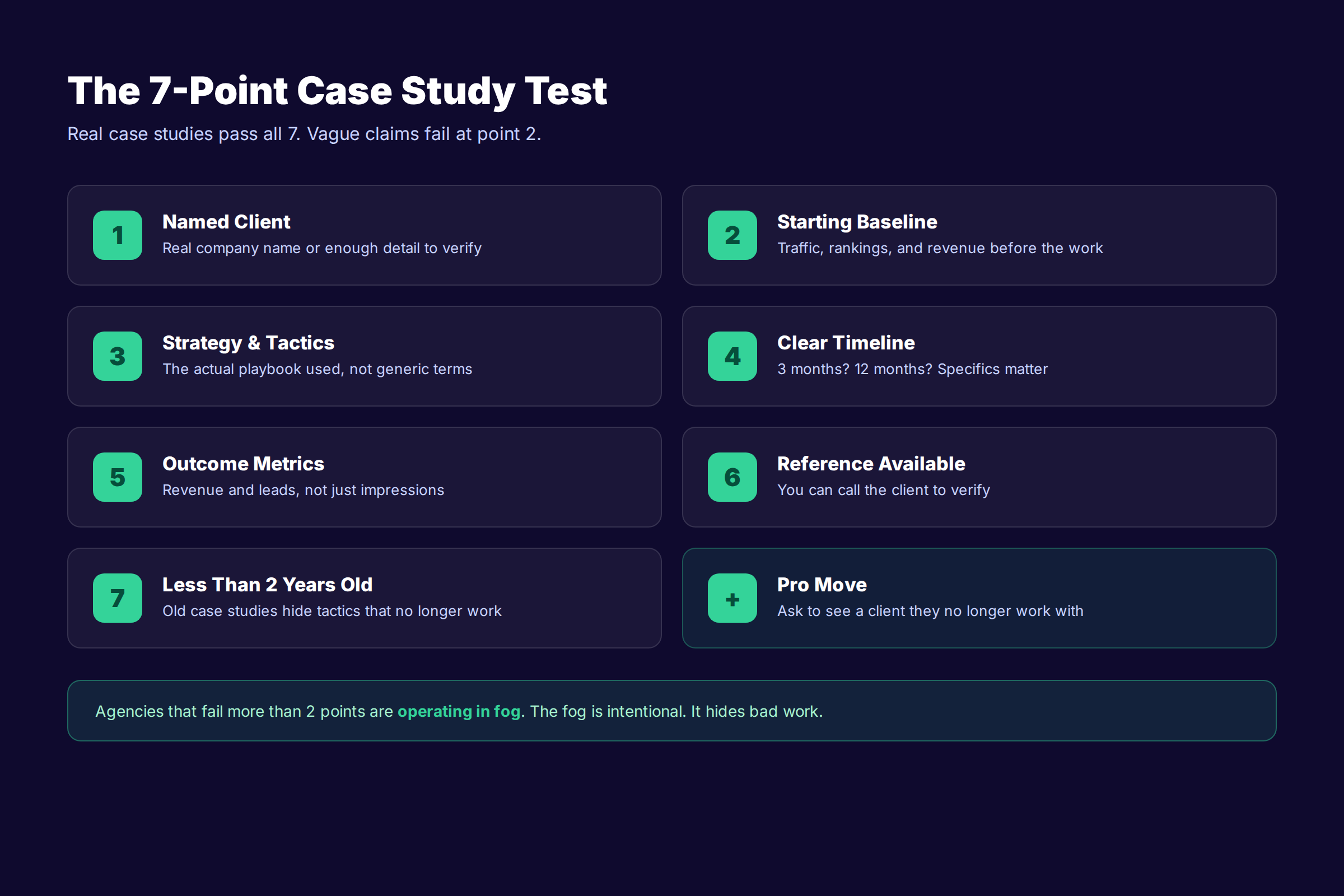
The 7-point case study test:
- Does the case study name the client or describe them in enough detail to verify?
- Does it list the starting baseline (traffic, rankings, revenue)?
- Does it explain the strategy and tactics used?
- Does it show the timeline (3 months? 12 months?)
- Does it measure outcomes (revenue, leads, pipeline) not just vanity metrics?
- Can you contact the client to verify?
- Is the case study less than 2 years old?
Agencies that ace this test are operating in daylight. Agencies that fail it are operating in fog. The fog is intentional. It hides bad work.
Ask for 3 client references you can call. Not a curated testimonial video. Actual phone numbers. Then ask each reference 4 questions:
- ✓ What is your current relationship status with the agency?
- ✓ What did the agency promise vs what did they deliver?
- ✓ How responsive are they when things go wrong?
- ✓ Would you sign with them again today, and why or why not?
The "would you sign again" question is the most predictive. References are usually polite. Forcing a yes or no answer cuts through politeness.
Pro tip: Ask the agency to show you a client they no longer work with. How they describe a lost client tells you more than how they describe a happy one. Look for accountability, not blame.
Step 5: Evaluate Their Methodology
Anyone can talk about SEO. The question is whether they can do it. Methodology is where the rubber meets the road. A good agency will explain their process in plain English without proprietary jargon or vague references to "secret sauce."
Ask them to walk you through their process for a typical client engagement. Listen for 5 specific things:
- Discovery and audit. How do they assess a new site? What tools do they use? What deliverables do you get in the first 30 days? A good answer involves a structured SEO audit, competitor analysis, and a written strategy doc.
- Keyword and content strategy. How do they pick keywords? Do they prioritize by traffic potential, conversion value, and competitive difficulty, or do they just chase volume? Do they build topic clusters or just stand-alone articles?
- Content production. Who writes the content? In-house writers, freelancers, or AI? What is the review and editing process? Can you see writer samples before signing?
- Link building. How do they earn links? Editorial outreach, digital PR, guest posts, or directory submissions? Can they show real examples? If they cannot explain link building in 5 minutes without sounding sketchy, walk away.
- Technical work. How do they prioritize technical fixes? Who implements them: the agency or your dev team? Do they understand schema, Core Web Vitals, and JavaScript rendering?
The methodology red flag list:
| Red Flag | What It Means |
|---|---|
| "We use proprietary AI algorithms" | They do not want to explain because they cannot |
| "We optimize everything equally" | They do not know how to prioritize |
| "We guarantee page 1 rankings" | Either lying or planning black-hat tactics |
| "We have a secret link network" | Private link networks get sites penalized |
| "Trust us, it just works" | No process. No accountability. Run. |
| "We start with the homepage" | Cookie-cutter approach, no real strategy |
A solid agency will tell you which technical issues they would fix first if they found 10 problems. The answer reveals whether they understand business impact or just follow a checklist. If they cannot prioritize, they will burn your retainer on low-impact work.
Ask about their AI search strategy too. By 2026, Google AI Overviews dominate informational queries. Any agency that cannot articulate an AI search plan is selling 2019 SEO at 2026 prices.
Step 6: Ask the Right Questions on the Sales Call
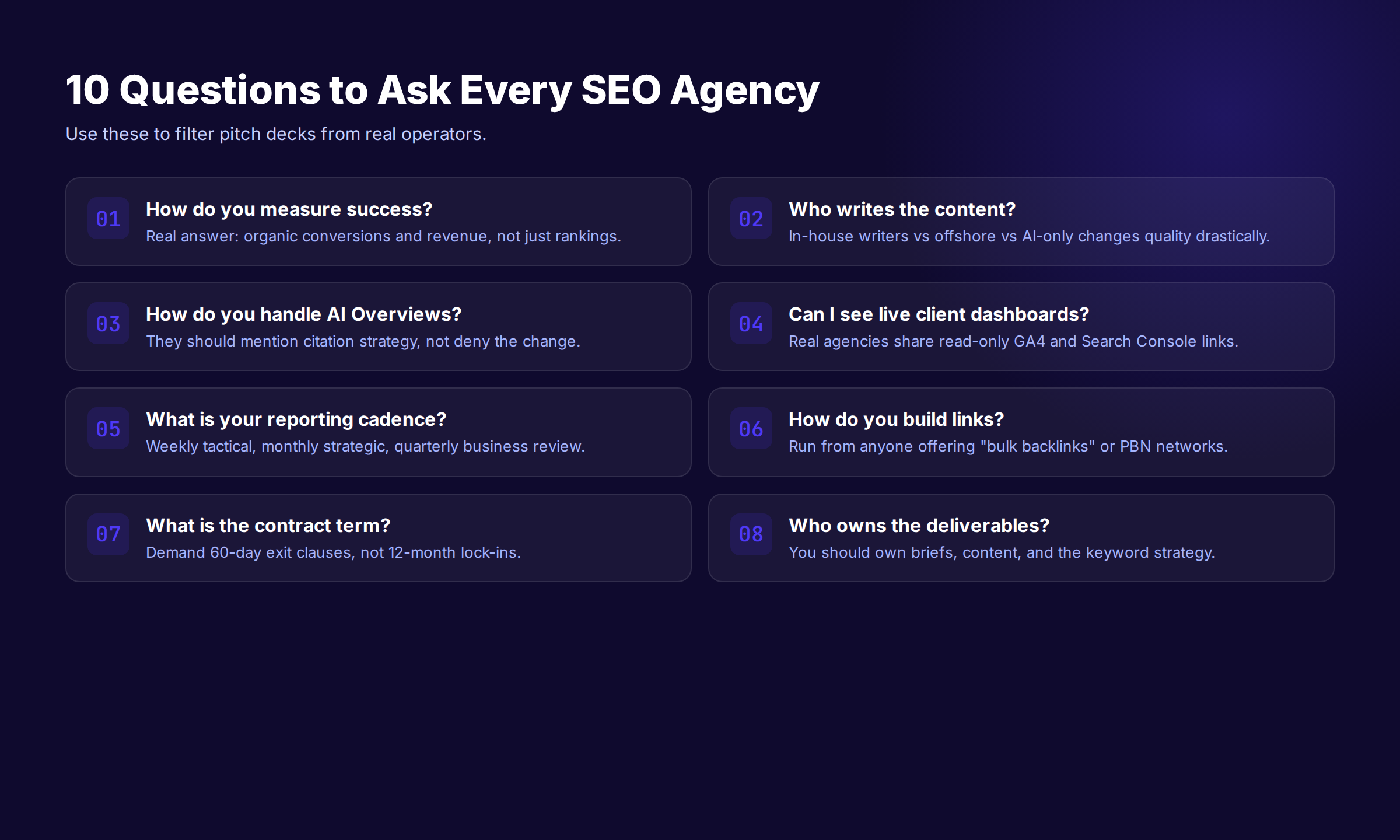
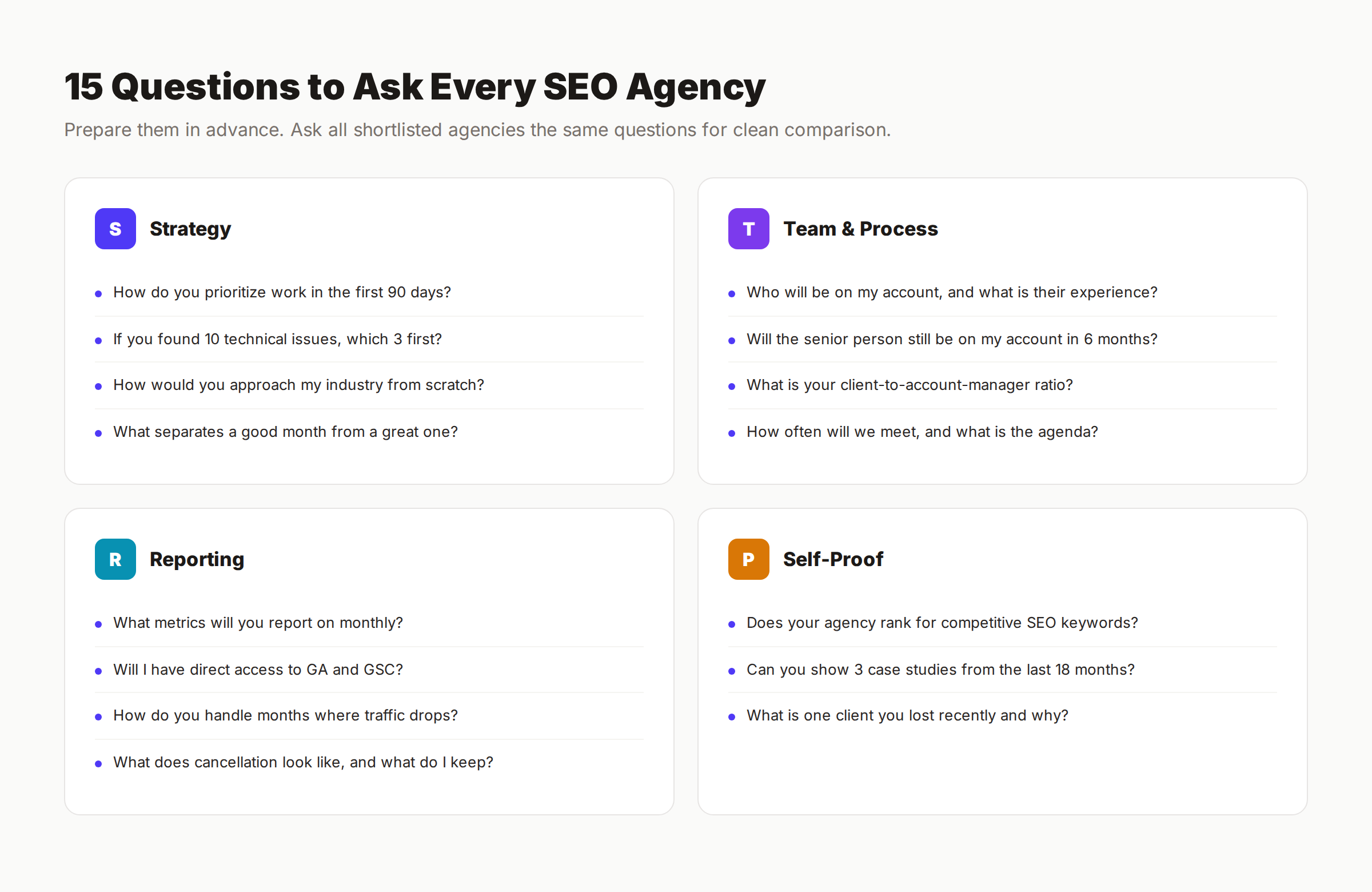
The sales call is your interview, not theirs. Prepare 15 questions in advance and ask every shortlisted agency the same ones. This makes comparison easy and reveals who actually knows their craft.
Strategy questions:
- How do you prioritize work in the first 90 days for a new client?
- If you found 10 technical issues, how would you decide which 3 to fix first?
- Walk me through how you would approach a client in [my industry] from scratch.
- What separates a good month from a great month in your SEO work?
Team and process questions:
- Who will be on my account, and what is their SEO experience?
- Will the senior person I am meeting now still be on my account in 6 months?
- What is your client-to-account-manager ratio?
- How often will we meet, and what is the agenda for those meetings?
Reporting and accountability questions:
- What metrics will you report on monthly?
- Will I have direct access to Google Analytics, Search Console, and any other tracking tools?
- How do you handle months where rankings drop or traffic dips?
- What does cancellation look like, and what do I keep?
Self-proof questions:
- Does your agency rank for competitive SEO keywords in your own market?
- Can you show me 3 case studies from the last 18 months in industries similar to mine?
- What is one client you lost recently and why?
The team question is the most important and most often skipped. A common bait-and-switch pattern is meeting a sharp senior strategist during the pitch, then getting handed off to a junior account manager 3 weeks after signing. Get names. Get LinkedIn profiles. Confirm they will work on your account.
Data ownership is non-negotiable. You should have your own logins to Google Analytics, Search Console, and any tracking tools. Not screenshots. Not proprietary dashboards that lock you out when you leave. Agencies that retain ownership of your data are structuring the relationship to make leaving painful.
The "client you lost" question is brutal because it forces accountability. How they describe a lost client reveals their true character. Look for ownership, not blame.
Step 7: Spot the 10 Red Flags
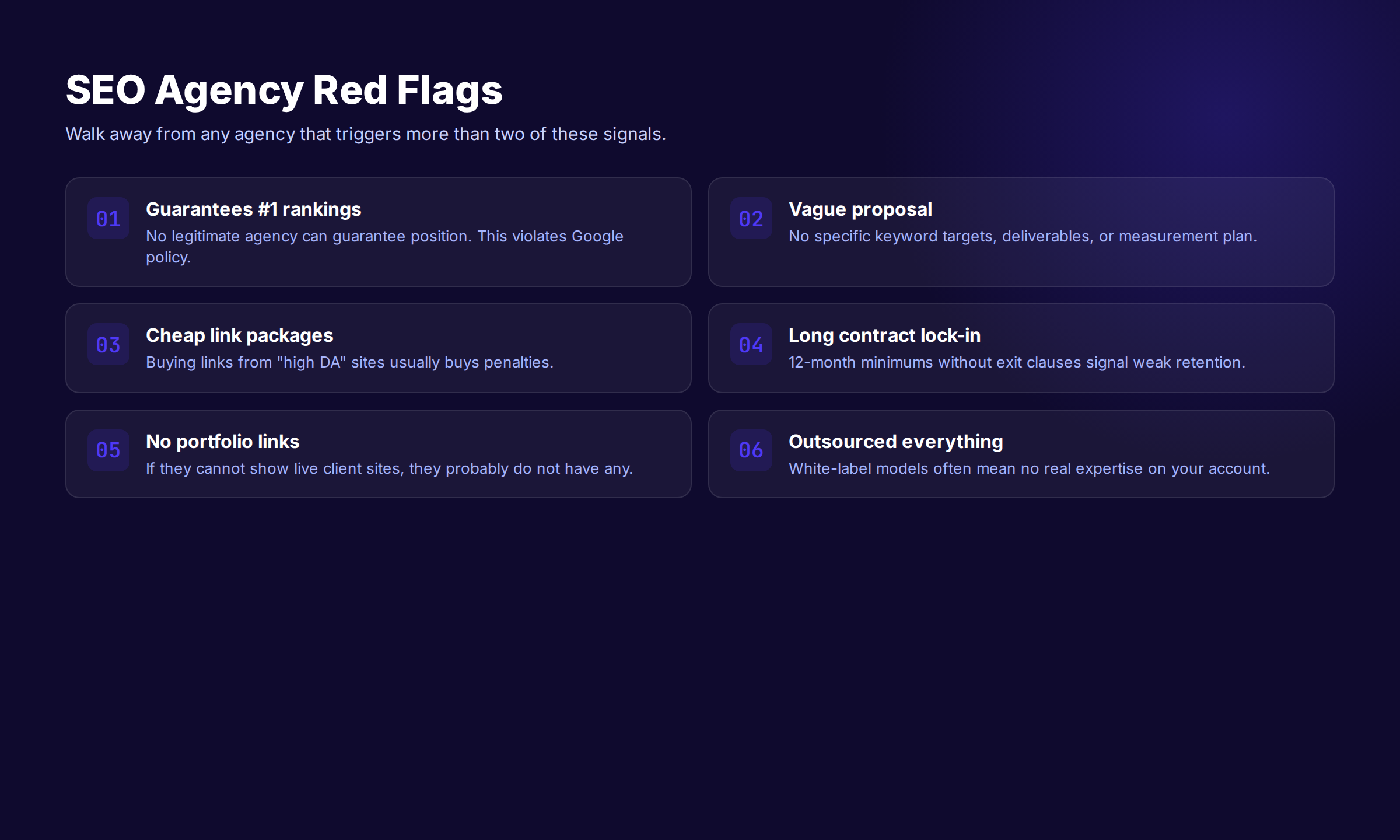
Some red flags are obvious. Others hide in plain sight. After 3,500+ blogs across 70+ industries, we have seen every flavor of bad SEO agency. Here are the 10 patterns that consistently signal trouble.
| Red Flag | Why It Matters | What to Do |
|---|---|---|
| Guaranteed page 1 rankings | Google's algorithm rules this out | Walk away |
| Suspiciously low prices ($200/mo) | Spam links or AI slop content | Walk away |
| Long contracts (12+ months) with no exit clause | They cannot retain clients on results | Negotiate or walk |
| No published case studies | Either new or hiding bad work | Demand proof |
| Vague methodology ("our secret sauce") | They cannot explain because they do not know | Probe deeper or walk |
| The agency does not rank for its own keywords | They cannot do what they sell | Walk away |
| Bait-and-switch team after signing | Common, predatory pattern | Lock team in contract |
| Data ownership stays with agency | Designed to trap you | Demand full access |
| Black-box reporting (proprietary dashboards) | Hides bad work | Demand raw data access |
| Pressure to sign immediately | Sales tactic, not partnership | Walk away |
A few of these deserve more detail.
Long contracts without exit clauses. Good agencies retain clients with results, not handcuffs. A 12-month contract is reasonable. A 12-month contract with no termination clause is a trap. Always negotiate a 60 to 90-day exit window if performance KPIs are missed.
Bait-and-switch team. This is the single most common predatory pattern in agency sales. The pitch is run by an experienced strategist who asks sharp questions about your industry. Three weeks after signing, that person disappears and a junior account manager takes over. Lock in your team by name in the contract.
Black-box reporting. Some agencies build "proprietary dashboards" that show pretty charts but hide the underlying data. They report on impressions, "estimated traffic value," and other vanity metrics while avoiding revenue, leads, and conversions. Demand raw access to Search Console, Analytics, and any keyword tracking tools.
Pressure to sign immediately. Real agencies have wait lists. They are not desperate. If a sales rep is pushing hard to close in a single call, the agency has client retention problems, sales quota problems, or both.
Pro tip: Run the agency's own website through a free SEO audit. If their site has thin content, missing meta tags, slow page speed, and broken links, they cannot do basic SEO for themselves. Why would they do it for you?
Step 8: Review the Contract and SLA
The contract is where promises become obligations. Most businesses skim the agreement, sign, and pay. Then they discover the agency owns the content, the agency owns the analytics setup, and cancellation requires 90 days written notice with a kill fee.
Read every line. Or better, have a lawyer read it. The legal fees are cheap compared to a bad 12-month contract.
Contract checklist:
- ✓ Scope of work is itemized with deliverables and quantities
- ✓ Pricing is broken down by service, not bundled into a black box
- ✓ Term length is clear and reasonable (3-12 months)
- ✓ Cancellation terms allow exit with 30-60 days notice
- ✓ You own all content, analytics data, and accounts created on your behalf
- ✓ Reporting cadence and format are specified
- ✓ Team members are named (especially the lead strategist)
- ✓ Performance KPIs and review milestones are defined
- ✓ Liability and indemnification clauses are reasonable
- ✓ Non-compete clauses (if any) are narrow and time-limited
Service-level agreements to demand:
| SLA Item | Reasonable Standard |
|---|---|
| Response time to client emails | Within 24 business hours |
| Monthly reports delivered by | 5th of the following month |
| Strategy review cadence | Quarterly minimum |
| Content delivery timing | Within 2 weeks of approved brief |
| Technical fix turnaround | Within 5 business days for critical issues |
| KPI review checkpoint | At 90 days and 180 days |
Data ownership is the clause that bites hardest. Write into the contract that all content, analytics accounts, tracking pixels, schema markup, and tools created during the engagement are owned by your company. If you cancel, you walk away with everything. The agency walks away with nothing of yours.
Watch for "auto-renewal" clauses. Some contracts renew for another 12 months unless you cancel in writing 60 days before the end of the term. This is a trap designed to extend bad relationships through inertia. Either remove the clause or set a calendar reminder to cancel before the window closes.
For deeper context on what good agency reporting looks like, read our SEO reporting guide. A good monthly report covers rankings, organic traffic, conversions, and revenue attribution, with clear analysis and next-month priorities.
Tired of agency contracts that trap you? theStacc is month-to-month. No setup fees. No exit clauses. Cancel anytime. Plus you own every article we publish.
Step 9: Make the Final Decision
You have goals, a budget, a shortlist, case studies, references, and contracts. Now you decide. Most companies overthink this final step. The decision rarely comes down to one clear winner. It comes down to risk and fit.
Score each agency on 6 dimensions: strategy quality, team experience, case study strength, communication style, contract terms, and price. Use a 1-10 scale per dimension. The agency with the highest total is your lead candidate.
Final decision framework:
| Dimension | Weight | Score (1-10) |
|---|---|---|
| Strategy quality and methodology | 25% | __ |
| Team experience in your industry | 20% | __ |
| Case study and reference strength | 15% | __ |
| Communication and responsiveness | 15% | __ |
| Contract terms and flexibility | 15% | __ |
| Price and ROI fit | 10% | __ |
Notice price is the lowest weight. SEO outcomes vary 10x between good and bad agencies. The cheapest option is rarely the best value. Pay for quality strategy and execution. Saving $1,000 a month on a bad agency costs $50,000 in lost growth.
Trust your gut on communication. You are going to be on calls with this team weekly for a year. If they feel slow, defensive, or evasive during the sales process, they will be worse after you sign. Walk away from anyone who makes you uneasy.
Pro tip: Negotiate a 90-day pilot. Most agencies will agree to a shorter trial period if you commit to a larger retainer afterward. This protects you from being locked into a bad fit while signaling serious intent. Use the 90 days to verify the actual team, the actual methodology, and the actual results.
SEO Agency Alternatives
Hiring an agency is not the only path. Depending on your size, budget, and tolerance for management, alternatives may fit better. Each has trade-offs.
Hire in-house. Build a team of 1 strategist, 1 writer, and 1 link builder. Total cost is $250,000 to $400,000 per year. You get full control and full accountability. The challenge is hiring, managing, and retaining SEO talent. For companies above $20M revenue, in-house often wins. Below that, agencies and software are more efficient. Read our analysis of in-house vs outsource content teams for the full breakdown.
Use SEO software with done-for-you delivery. Platforms like theStacc publish 30 SEO-optimized articles a month from $99. The work is automated, the quality is human-grade, and you own every article. No 12-month contracts. No bait-and-switch teams. No data lock-in. For most small and mid-market businesses, this delivers the same content output as a $5,000 agency at a fraction of the price.
Hire a freelance SEO consultant. Individual consultants charge $100 to $300 per hour for strategy and audits. Use them for one-off projects: migration planning, audit reviews, or competitive analysis. Not a fit for ongoing execution at scale.
Hire a fractional SEO lead. A senior SEO operator works part-time as your strategic lead, then hires freelancers or software for execution. Cost runs $3,000 to $8,000 per month. Good model for companies that want senior expertise without full-time payroll.
| Option | Best For | Monthly Cost |
|---|---|---|
| Full agency | Companies with $10M+ revenue, no in-house team | $3,000-$15,000 |
| In-house team | Companies with $20M+ revenue, long horizon | $20,000+ (loaded) |
| Done-for-you SEO software | SMBs, startups, founders | $99-$499 |
| Fractional SEO lead | Mid-market with some in-house capacity | $3,000-$8,000 |
| Freelance consultant | Specific projects, audits | $100-$300/hour |
Our done-for-you SEO services for small business roundup compares the top platforms side by side, including pricing, output, and lock-in terms.
What practitioners are saying on X
Agency and white-label models evolve fast. Here is operator signal from X on tooling and service delivery.
- @syedbalkhi (Sep 2024): White-label pro services can add multi-six-figure revenue without building an in-house services org — partner delivery behind the brand. See the post on X.
- @ConnorGillivan (Jul 2026): 2026 SEO stack favorite list: Semrush/Ahrefs, GSC, Surfer, KeywordInsights, ChatGPT, SEOwind, Screaming Frog, ClearScope, GA4, Notion/Airtable — tools amplify systems, they don’t replace them. See the post on X.
- @jakezward (Feb 2026): 2026 SEO predictions emphasize AI Overview share-of-SERP, schema for LLM token efficiency, brand mentions in AI answers as a KPI, proprietary data as a moat, and content refresh beating net-new AI slop. See the post on X.
Grok, AI Overviews, and multi-engine visibility
For “how to choose seo agency”, multi-engine visibility still starts with clear definitions, sourced numbers, and extractable section answers. Grok additionally factors live X discussion — keep public claims consistent with this page.
- Google AI Overviews: Use passage-ready answers, tables, and FAQ schema where relevant.
- ChatGPT / Perplexity: Cite named sources next to key claims.
- Grok: Maintain accurate entity facts on-site and in high-signal X posts.
Publish content built for Google and AI citations. theStacc’s Content SEO module ships SEO-scored articles structured for rankings and generative engines — including clearer entity pages models like Grok can quote.
Frequently Asked Questions
A good SEO agency for small to mid-market businesses costs $2,000 to $8,000 per month. Enterprise campaigns run $10,000 to $50,000+. Anything under $1,000 per month is usually spam links or AI slop content. Done-for-you SEO software like theStacc delivers comparable output for $99 to $199 per month.
Most campaigns show early signals in 3 to 4 months and material traffic gains in 6 to 9 months. New domains take longer than established ones. Local SEO can move faster, often within 60 to 90 days. If an agency promises page 1 rankings in 30 days, they are lying or planning black-hat tactics.
Geography matters less in 2026 than it did 5 years ago. Most SEO work happens over Slack, email, and video calls. Hire the best-fit agency regardless of location. The exception is highly local campaigns (single-city plumbers, restaurants), where regional market knowledge can be useful.
An SEO agency focuses exclusively on organic search: content, links, technical SEO, and local SEO. A digital marketing agency offers a broader mix including paid ads, social media, email, and design. Specialists usually outperform generalists for SEO outcomes. If SEO is your priority, hire an SEO specialist.
Look at 4 signals over 6 months: organic traffic to commercial pages, keyword rankings for target terms, leads or revenue from organic, and content output quality. Any agency that cannot show progress on at least 3 of these by month 6 is failing. Track everything yourself with Google Search Console and Analytics. Do not rely on agency dashboards.
Yes. Switching is painful but often necessary. Most pain comes from contract clauses (early termination fees, auto-renewal traps) and data lock-in (proprietary dashboards, agency-owned content). Negotiate these clauses in the original contract to make switching easy if the relationship fails.
Most businesses under $1M in revenue cannot afford a quality SEO agency at $3,000+ per month. They are better served by done-for-you SEO software or a freelance consultant for project work. Above $1M revenue with a clear path to $5M+, an agency starts making sense.
Three questions cut through pitch decks: "Does your agency rank for competitive SEO keywords in your own market?" "If you found 10 technical issues, how would you decide which 3 to fix first?" and "Can I see 3 case studies from the last 18 months in my industry?" Agencies that fumble these are not operators.
The Bottom Line
Choosing an SEO agency is a 9-step process. Define your goals, set a budget, build a shortlist, vet case studies, evaluate methodology, ask hard questions, spot red flags, review the contract, and decide based on fit and risk. Skip any step and you increase the chance of signing a bad deal.
The cost of getting this wrong is brutal: lost time, wasted budget, and damaged rankings that take 6 to 12 months to recover from. The cost of getting it right is a partner that drives organic growth for years.
If you want the agency experience without the agency price, lock-in, or risk, try a managed SEO platform instead. theStacc publishes 30 SEO-optimized articles a month for $99, handles internal linking automatically, and gives you full ownership of everything we create. No contracts. No bait-and-switch. The first 3 articles are free, no credit card.
Related Tools & Resources
Free SEO Tools:
Best Lists:
Sources & references
- [1] Princeton / Georgia Tech et al. — GEO research (arXiv:2311.09735)
- [2] @hridoyreh on X — Widely shared SEO skill tree: foundations, research, technical, on-page, content, links, AI SEO/GEO, analytics, UX, bran
- [3] @jakezward on X — 2026 SEO predictions emphasize AI Overview share-of-SERP, schema for LLM token efficiency, brand mentions in AI answers
- [4] Referenced source — developers.google.com

Plan topics, review article drafts, and publish to a connected CMS.
Weekly local SEO teardowns
One practical email a week. Map Pack, GBP, AI Overviews. No fluff. Unsubscribe anytime.