Learn how to rank in AI Overviews with 8 proven steps. Get cited by Google's AI using answer-first content, E-E-A-T, schema, and topical authority.
To be cited in AI Overviews, put a direct 40 to 60 word answer under each heading, mark the page up with schema, show real authorship and expertise, and cover the topic deeply enough that your site is the obvious source. Ranking first in organic results does not guarantee a citation.
Most pages that rank #1 still do not get cited in AI Overviews. That gap is where traffic is being lost right now.
Seer Interactive measured a 61% organic CTR drop on queries where AI Overviews appear. Ahrefs clocked a 34.5% decline for position-1 results. But brands that Google's AI actually cites earn 35% more organic clicks than uncited competitors.
That is the new split. Cited or invisible. Ranking #1 is no longer enough.
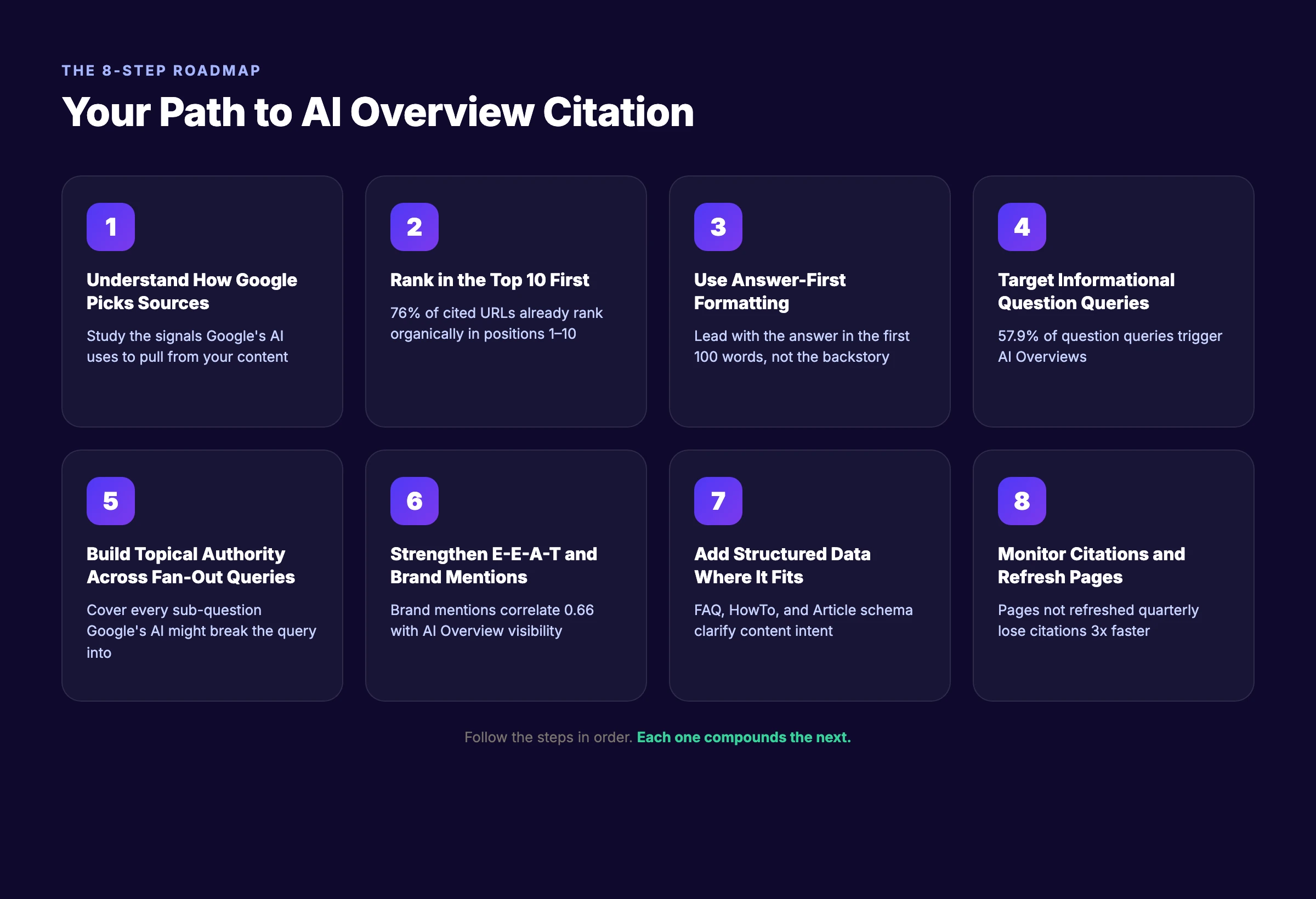
This guide explains exactly how to rank in AI Overviews across 8 concrete steps. Each step comes from citation-pattern studies and our own data from publishing at scale. No theory. No guessing.
We publish 3,500+ blog posts a month across 70+ industries. We see which content structures Google's AI pulls from and which it skips. The patterns repeat.
Here is what you will learn:
- How Google's AI selects which pages to cite in AI Overviews
- The content structures that get pulled into generated answers
- Which query types trigger AI Overviews most often
- How topical authority and fan-out coverage drive citations
- The E-E-A-T and brand signals that separate cited from ignored
- Which schema markup actually helps (and which does not)
- How to monitor AI Overview citations and refresh cited pages
- The content patterns that disqualify your site from citation
What AI Overviews Are and Why They Behave Differently
AI Overviews are generated summaries that sit above the traditional search results. Google's Gemini model synthesizes the answer from multiple pages and cites 3 to 8 source links in the box.
They are not featured snippets. A featured snippet pulls one passage from one page. An AI Overview blends several pages into a new paragraph. That changes everything about how you optimize.
The current rollout numbers matter. AI Overviews appear in roughly 25.8% of all US searches as of early 2026. Informational queries trigger them 39.4% of the time. Question-format queries hit 57.9%. Medical YMYL queries trigger 44.1%. Commercial queries sit at 4.3%, and transactional queries at 2.1%.
What gets cited is not random. A Semrush study of thousands of AI Overviews found 76% of cited URLs already rank in the top 10 organically. Ahrefs pegged the median position of cited URLs at #2. Brand mentions across YouTube, Wikipedia, and Reddit correlate strongly with visibility.
The model is doing something specific. It is running a "query fan-out" where one search becomes many sub-queries. It then looks for pages that rank across that cluster, extracts the clearest passages, and grounds the synthesis in those sources. Your job is to be present and extractable.
For a full breakdown of the feature, see our guide to what a Google AI Overview is and our AI Citation Readiness Checklist.
Step 1: Understand How Google Selects AI Overview Sources
Start here. If you do not understand the selection signals, the rest of the steps are shots in the dark.
Google's AI Overview system weighs four things when it picks sources:
- Organic rank on the triggering query. If you are not in the top 10, your odds drop sharply. Search Engine Land reported 53% of citations come from position 1 and 36.9% from position 10, with a steep decline past there.
- Coverage of related fan-out sub-queries. The model does not look at one keyword. It breaks the query into sibling questions and grades you on how well your domain covers the cluster.
- Authority and brand signals. Branded mentions correlate around 0.66 with AI visibility in Ahrefs's study. YouTube mentions correlate at 0.74, the highest single factor they measured.
- Content freshness. Around 85% of citations come from pages published or updated in the last 3 years, per Search Engine Land's analysis.
This is not speculation. These are measured correlations across real AI Overview results.
The practical takeaway is simple. Your page is not competing against one other page. It is competing to be one of 3 to 8 sources that explain a concept across a cluster of related questions. You win by being the clearest, most extractable voice on the topic.
| Selection Signal | Why It Matters | How to Act On It |
|---|---|---|
| Organic top 10 ranking | 76% of citations come from positions 1–10 | Earn the ranking before worrying about AI |
| Fan-out coverage | Cited pages rank for many related queries | Build topic clusters, not one-off posts |
| Brand mentions | Strongest non-link correlation with visibility | Get on YouTube, Reddit, Wikipedia, LinkedIn |
| Content freshness | 85% of citations are from last 3 years | Refresh pages quarterly, republish annually |
Why this step matters: If you treat AI Overview optimization as a formatting problem, you will miss. The real work is ranking, clustering, and brand-building. The formatting is the last 10%.
Pro tip: Check which queries in your niche currently show an AI Overview. Paste the query into Google logged out, note the sources cited, then study their topical coverage and brand presence. That is your competitive benchmark.
Step 2: Rank in the Top 10 Before Anything Else
Nothing else works if you are on page 2.
76% of cited URLs rank in the top 10. Roughly half are in positions 1 to 3. Pages past position 10 account for under a quarter of citations, and even those tend to be high-authority domains with unusual topic coverage.
This is the discipline of traditional SEO. Before you optimize for AI Overviews, optimize for organic rank. That means:
- Keyword targeting with real search intent match
- Internal linking that passes authority to your target pages
- Backlinks from credible sources in your topic area
- Page experience including Core Web Vitals and mobile performance
- Content depth appropriate to the query type
A clean internal link structure often moves the needle fastest. Link from your highest-authority pages into the targets you want cited. Use descriptive anchor text that reinforces the topic.
If you already rank in the top 10 on a query but are not cited, the problem is usually one of the other steps in this guide. If you do not rank in the top 10, work there first.
Our published research shows a simple pattern. Sites that publish 20+ articles a month in a tight topical cluster see average rankings climb 14 positions within 4 to 6 months. That volume builds both organic rank and fan-out coverage at once.
For the mechanics of getting to the top 10, read our guides on building topical authority and writing blog posts that rank.
Why this step matters: Ranking in the top 10 is the gatekeeper. Skip it and nothing else compounds. Every other step here amplifies an existing organic presence.
Pro tip: Do not chase high-volume head terms first. Start with question-form long-tail queries where AI Overviews trigger most often. They rank faster and cite more readily. One ranking long-tail query can seed citations for its parent concept.
Step 3: Structure Content with Answer-First Formatting
Google's AI grounds its summaries in specific passages. The model pulls the clearest, most direct sentence or paragraph from a cited page. Your job is to make that passage obvious.
Lead with the answer in the first 100 words. Not after a story. Not after three paragraphs of setup. The answer comes first, in plain language.
Here is the pattern that gets extracted most:
- Question as H2 heading (phrased close to how users search)
- Direct one-sentence definition immediately below the heading
- Expanded explanation of 2 to 4 sentences
- Supporting details with numbers, examples, or a short list
This is not a style choice. It is reverse-engineered from what the model pulls. Studies of AI Overview citations find grounding passages plateau around 540 words per cited section. Pages over 2,000 words see diminishing marginal returns. Density of clear answers beats raw length.
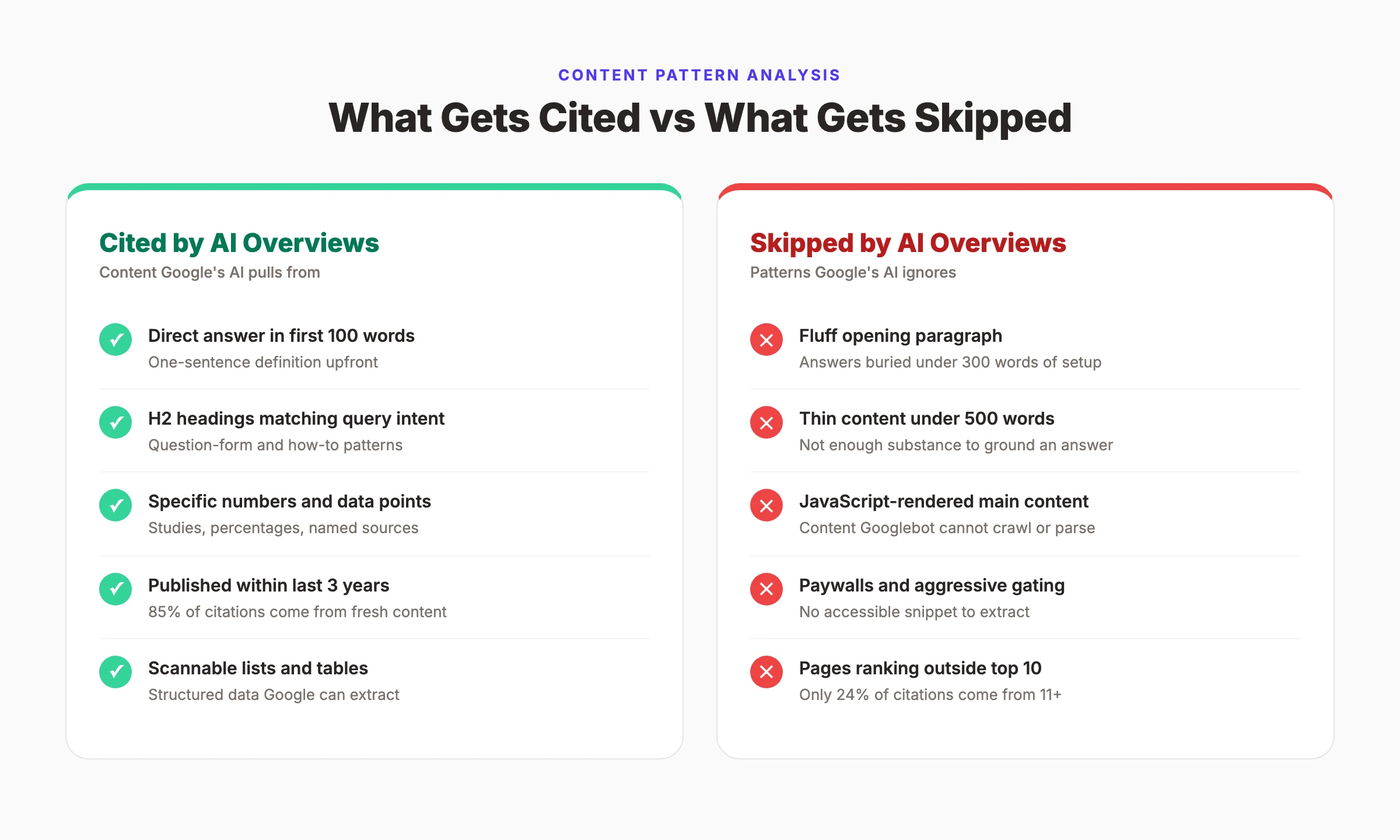
Use lists when the answer is enumerable. Use short tables when the answer compares attributes. Use short paragraphs when the answer is a definition or explanation. Avoid walls of prose that bury the key sentence.
A few concrete rules we follow:
- Every H2 on a target page answers one specific sub-question
- The first sentence after each H2 contains the direct answer
- Every claim that could be a snippet includes a number, percentage, or proper noun
- Lists stay under 10 items unless the topic demands more
- Tables have clear headers and 3 to 6 rows for easy extraction
For more on this, see how to get featured snippets and our blog post structure guide.
Why this step matters: The model cannot cite what it cannot isolate. Bury the answer and you lose the citation to a competitor who wrote the same idea in one clean sentence.
Pro tip: Write the sentence you want Google to quote first. Then write the rest of the section around it. That one sentence is the asset. Everything else is support.
Step 4: Target Informational, Question-Based Queries
Not every keyword triggers an AI Overview. Picking the right ones is half the battle.
The data is consistent across studies. Question queries trigger AI Overviews 57.9% of the time. Non-question queries trigger them only 15.5% of the time. Queries with 7 or more words trigger at 46.4%. Single-word queries trigger at 9.5%.
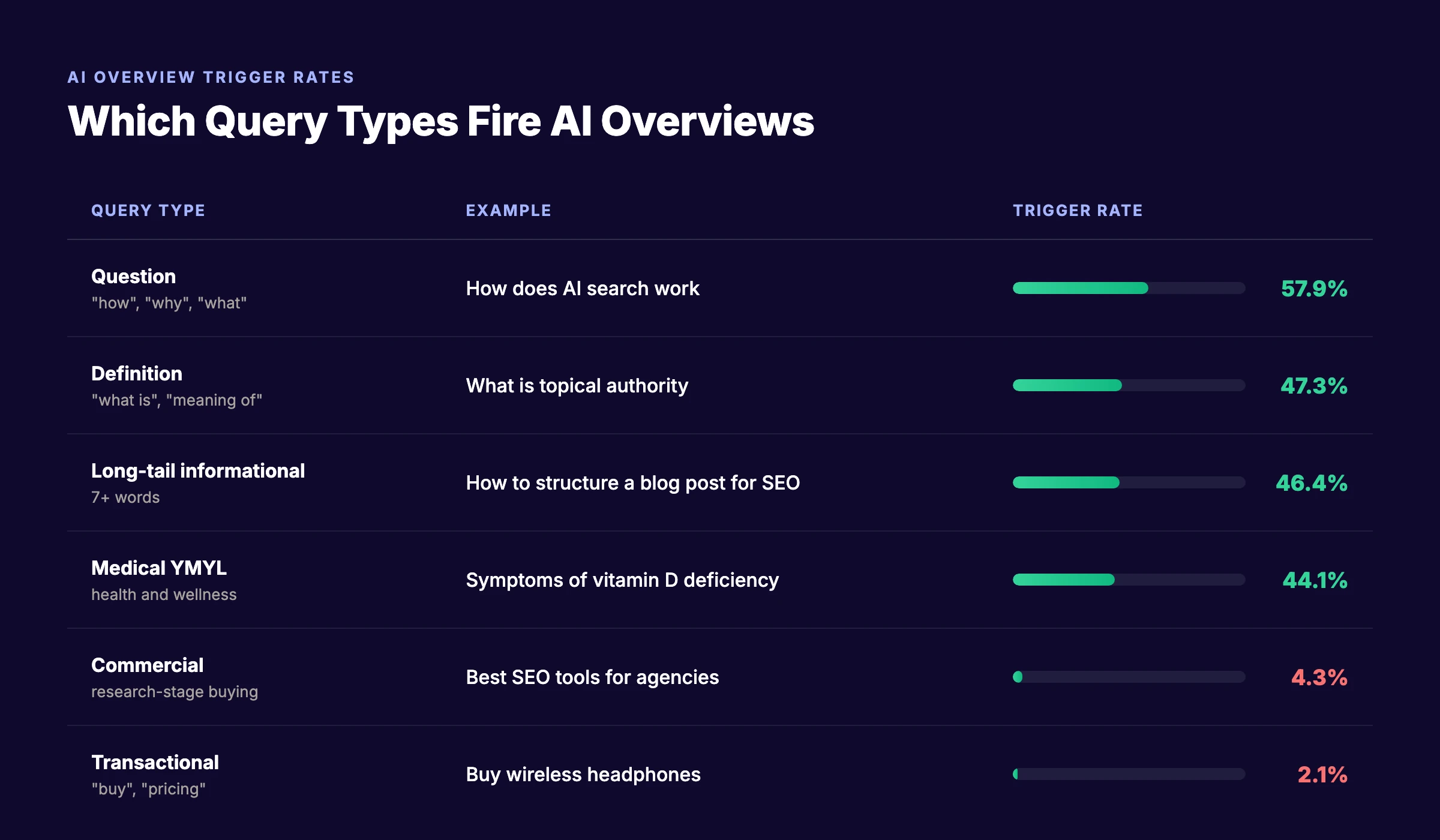
Commercial and transactional queries barely trigger at all. Commercial sits at 4.3% and transactional at 2.1%. Branded searches trigger at 13.1% versus 24.9% for non-branded. That means product landing pages and pricing pages are the wrong battlefield.
Target these query shapes:
- How to [achieve outcome]. How to rank in AI Overviews, how to start a blog
- What is [concept]. What is topical authority, what is E-E-A-T
- Why [phenomenon]. Why is my CTR dropping, why do AI Overviews cite Wikipedia
- Can I [do action]. Can I block AI Overviews from scraping my site
- Best way to [solve problem]. Best way to structure a blog post for AI
These map to real intent and fire AI Overviews at high rates. They also align with the "informational" intent class, which accounts for 99.9% of AI Overview appearances in Semrush's data.
Build your keyword list with this filter in mind. A keyword that triggers an AI Overview at 50%+ deserves priority. A keyword that triggers 4% of the time is not an AI Overview play, even if the volume looks good.
For keyword-level strategy, see our content strategy guide and generative engine optimization guide.
Why this step matters: You can execute steps 3 through 8 perfectly and still not get cited if your target keyword does not trigger AI Overviews. Picking the right keywords decides whether the work compounds.
Pro tip: Filter your keyword tracker for queries where an AI Overview already appears on the SERP. Those are the keywords where citation is possible. Ignore the rest for AIO strategy, even if they rank well.
3,500+ blogs published. Every article is SEO-scored before publish. See what theStacc can do for your site. 30 optimized articles, published automatically, structured for AI Overview citation.
Step 5: Build Topical Authority Across Fan-Out Queries
Ranking on one keyword is not enough. The AI model cross-references how well your domain covers the entire cluster of related questions.
This is called query fan-out. When a user searches "how to rank in AI Overviews," Google's AI internally breaks that into dozens of sibling queries. Things like "what are AI Overviews," "which content gets cited," "what schema helps AI citation," "how do brand mentions affect AI visibility," and more. It then grades every domain on coverage.
Ahrefs measured this effect directly. Pages ranking on 0 fan-out queries had a 9% citation rate. Pages ranking on 9+ fan-out queries had a 57% citation rate. The Spearman correlation between fan-out rankings and citations was 0.77. That is one of the strongest signals in their entire study.
The implication is structural. A single great post does not win. A topic cluster wins.
Here is the cluster pattern we follow:
| Cluster Layer | Purpose | Example for This Topic |
|---|---|---|
| Pillar page | Defines the core concept | What is a Google AI Overview |
| How-to posts | Walk through execution | How to rank in AI Overviews |
| Sub-topic deep dives | Explore adjacent questions | E-E-A-T for AI citation, schema markup guide |
| Stats and studies | Provide data to cite | AI search statistics, AI Overview appearance rates |
| Tool and alternatives | Cover commercial intent | Best AI SEO tools, AI Overview tracking tools |
Every post in the cluster links to every other post. Every post targets one specific sub-question. Over 3 to 6 months, the domain starts ranking on dozens of fan-out queries, and citation rates climb.
Our own content here is built this way. We have pillar guides for AEO and GEO, then deep dives into AI citability, brand entity optimization, and how AI search is changing SEO. The cluster ranks across the fan-out set, not just the head term.
Why this step matters: Fan-out coverage is the single strongest correlation with AI citation in every public study. You cannot shortcut it. You build it by publishing clustered content consistently.
Pro tip: Before writing a new post, list every question a reader might ask before, during, and after the main query. Turn 6 to 10 of those into separate posts. Publish them linked to the pillar. The cluster does more than any single article can.
Step 6: Strengthen E-E-A-T and Brand Mention Signals
Google's AI weighs trust signals heavily. That is not marketing speak. It is measurable in citation data.
E-E-A-T stands for Experience, Expertise, Authoritativeness, and Trustworthiness. Google's March 2026 core update reinforced its weight. Sites producing expert, human-led content gained visibility. Thin AI-spun content lost it.
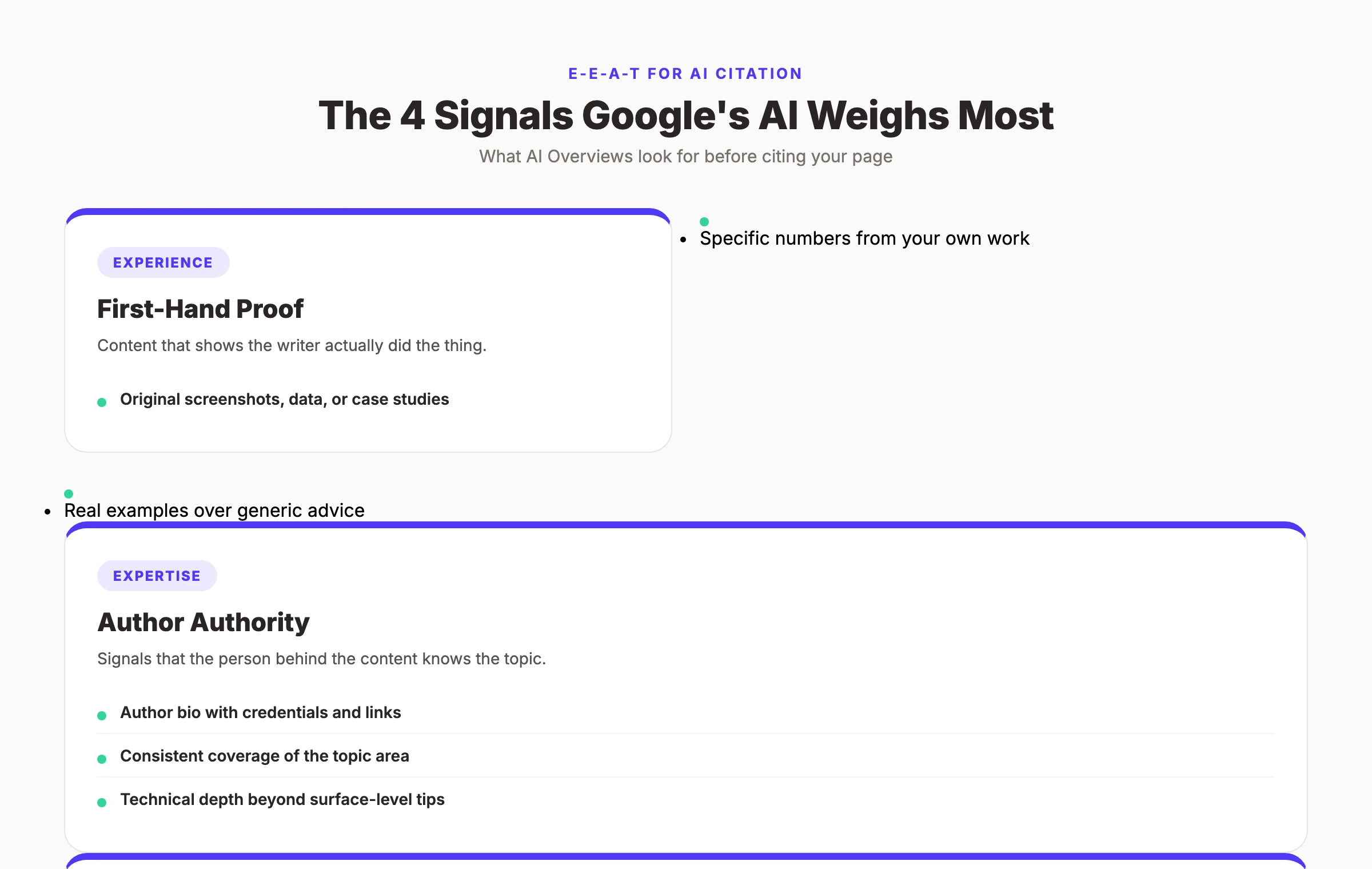
Each pillar shows up in citation patterns differently:
- Experience shows up as original data, first-hand case studies, and screenshots the writer clearly took themselves
- Expertise shows up as author pages with credentials, consistent topic coverage, and technical depth
- Authoritativeness shows up as backlinks from high-authority domains and brand mentions across the web
- Trust shows up as HTTPS, clear ownership, accurate dates, working citations, and factual claims
Brand mentions matter more than most SEOs realize. Ahrefs found branded web mentions correlate 0.664 with AI visibility. YouTube mentions correlate 0.740. Wikipedia accounts for 18.41% of AI Overview citations. Reddit accounts for 9.37%. These are not link metrics. These are entity signals.
Our take is direct. If your brand does not exist on YouTube, Reddit, LinkedIn, and Wikipedia in some form, you will lose AI Overview citations to brands that do, even when you rank better organically. That is the uncomfortable truth.
Here is how to build those signals:
- YouTube. Publish short explainer videos for your top content. Link back from video descriptions. Invite customer mentions.
- Reddit. Participate authentically in topic subreddits. Answer questions with substance. Do not spam.
- LinkedIn. Post your best insights as LinkedIn articles and document posts. Engage with your industry.
- Wikipedia. Earn mentions through earned media, not self-edits. Notable coverage in mainstream press is the path.
- Industry publications. Contribute guest posts or be quoted in roundups. Every mention is an entity signal.
Read our deep dive on brand entity optimization for AI search and our E-E-A-T guide for the full picture.
Why this step matters: You can produce excellent content and still not rank in AI Overviews if your brand is absent from the broader web. The model trusts entities. Entities are built through presence, not just pages.
Pro tip: Add an author bio with real credentials and external links to the top of every post. Link your author page to a schema.org/Person block. This single change moves the E-E-A-T needle on every post at once.
Step 7: Add Structured Data Without Overthinking It
Schema markup helps. It does not make up for poor content. Both things are true.
Google's own documentation on AI features is clear. You do not need special schema to be eligible for AI Overview citation. The same technical requirements that apply to Google Search apply here. That said, the right schema makes your content easier to parse, which improves extraction quality.
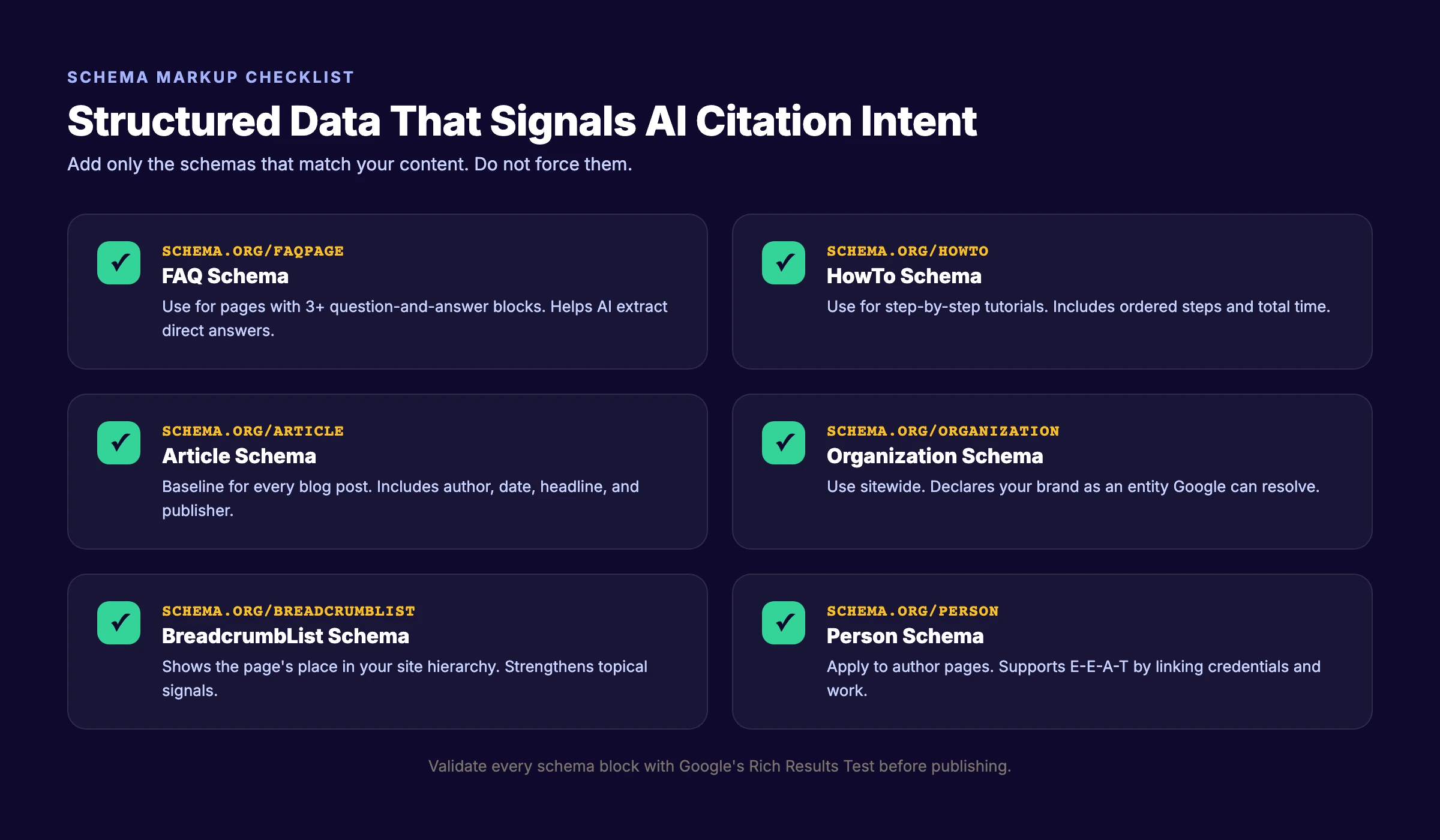
Use these schemas where they match your content:
| Schema Type | Use Case | Extraction Benefit |
|---|---|---|
| Article | Every blog post | Confirms author, date, publisher |
| FAQPage | Posts with 3+ Q&A blocks | Isolates clean answers |
| HowTo | Step-by-step guides | Marks each step as an extractable unit |
| Organization | Site-wide | Declares your brand as a resolvable entity |
| BreadcrumbList | Every page | Shows topical placement in your site |
| Person | Author pages | Links expertise signals to the author |
Do not add schemas that do not fit. A stuffed schema block signals manipulation. Google penalizes it. Keep the markup honest.
Validate every block with Google's Rich Results Test before publishing. A broken schema block is worse than no schema at all. It can flag your page for quality review and slow future citations.
A few nuances worth noting:
- FAQPage is powerful but only if your FAQ is real. Do not pad with fake questions. The model can tell.
- HowTo works best when the steps are concrete and numbered in the content. Abstract steps confuse extraction.
- Article schema should always include
datePublishedanddateModified. Freshness is a citation factor. - Organization schema should link to your official social profiles and verified presence. That wires your brand to the knowledge graph.
For the complete implementation details, see our schema markup guide and schema markup for blog posts.
Why this step matters: Schema is not magic. It is clarity. It tells Google's systems what each section of your page represents. When the model decides whether to cite, clarity moves the odds in your favor.
Pro tip: If you can only add one schema type, add Article with proper author and date fields. That single addition gives Google's AI a stable anchor for every post and fixes 80% of common citation extraction issues.
Rank everywhere. Do nothing. Blog SEO, Local SEO, and Social on autopilot. Built for the AI search era, structured for citation from day one.
Step 8: Monitor Citations and Refresh Cited Pages
Citation is not a one-time win. It is a renewable asset. And it decays.
Pages not updated quarterly are roughly 3x more likely to lose AI Overview citations than recently refreshed pages, per multiple industry studies. The model prefers fresh, accurate sources. If your data is from 2023, you lose to a competitor who republished in 2026.
You need to know two things every month:
- Which of your pages are being cited in AI Overviews right now
- Which cited pages are starting to slip or lose their citation
Tracking tools that surface AI Overview appearances include Semrush, Ahrefs, and AlsoAsked. Native Search Console does not yet report AI Overview citations directly, but you can cross-reference impression and CTR drops against queries that show an AIO.
Here is the refresh cadence we run:
- Monthly. Check which cited pages lost their AI Overview slot. Investigate why.
- Quarterly. Refresh every pillar page with new data, new examples, and updated publication dates.
- Annually. Republish top-performing posts with new images, new structure, and a full fact-check.
A refresh is not a rewrite. Change the date, swap in current statistics, add a new example or two, and update any claim that has gone stale. That is often enough to restore a lost citation.
Watch for patterns across your cited pages. If you notice all your cited pages trend toward the same format. Say, question-led H2s with answer-first paragraphs. Double down on that format across new content. Let the data guide the template.
For deeper tracking methodology, see our guides on AI search traffic analytics and AI search referral traffic stats.
Why this step matters: AI Overview citations decay. Without active monitoring and refresh, your cited pages slip one by one until the traffic disappears. Maintenance is the compounding half of this work.
Pro tip: Keep a simple spreadsheet of every cited page, the query that cites it, and the last refresh date. Review it every Monday. Spending 30 minutes a week on this protects more traffic than most content programs add.
What Kills Your Chances of Getting Cited
Some content patterns disqualify a page from AI Overview citation, even when the page ranks. Knowing the list is worth its weight in traffic.
Avoid these patterns entirely:
- Thin content under 500 words. Not enough substance for the model to ground an answer. You lose the slot to a competitor with more depth.
- JavaScript-rendered main content. If Googlebot cannot parse the text without executing JS, extraction fails. Server-side rendering or hydration is safer.
- Aggressive paywalls and gating. Any content hidden behind a login or paywall is invisible to the model. Keep at least the answer section public.
- Fluff openings that bury the answer. The model cannot extract what it cannot find quickly. A 400-word intro kills your citation odds.
- AI-spun content with no original data. The March 2026 core update specifically targeted this pattern. Thin generated content lost rank and citation.
- Dated claims without refresh. Statistics from 2022 used in 2026 signal neglect. The model picks fresher sources.
- Unverified author attribution. Posts with no byline, no bio, no credentials lose E-E-A-T weight and with it, citation probability.
- Excessive ads above the fold. Pages where main content competes with ads for space rank and cite worse.
- Broken or redirected pages. 404s, redirect chains, and crawl errors remove pages from the citation pool entirely.
Two of these deserve special attention because they catch sites off guard.
The first is JavaScript rendering. A page that looks fine in a browser can be effectively blank to Googlebot if it relies on client-side JS to load the main content. Run your top pages through Google's URL Inspection Tool. If the rendered HTML is missing your content, you have a crawl problem masquerading as an AI problem.
The second is the fluff opening. Many writers still open with a 200-word scene-setter before naming the topic. That era is over. The model wants the answer in the first 100 words. If yours is on line 12, the page below you with the answer on line 2 gets the citation.
For more on content structure that works in this era, read zero-click search and SEO and AEO vs SEO.
Results: What to Expect
Be realistic about the timeline. Ranking is not instant and neither is citation.
Here is the honest curve we see:
- Weeks 1 to 4. Content published and indexed. Organic positions start to move for long-tail question queries. AI Overview citations are unlikely yet.
- Months 2 to 3. The first long-tail queries hit the top 10. The first AI Overview citations begin to appear on question-format queries.
- Months 4 to 6. Topic cluster coverage compounds. Citations appear across sibling queries. Brand mentions build. CTR on cited pages stabilizes.
- Months 6 to 12. Pillar pages earn durable citations on head terms. The cluster produces a flywheel of traffic. Refresh cadence protects the gains.
Do not expect overnight results. Do expect compounding. Every published article adds to fan-out coverage. Every brand mention adds to entity weight. Every schema block adds to extractability. The curve bends upward with volume and consistency.
We see the sharpest movement in accounts publishing 20 to 30 optimized articles a month inside a tight topic cluster. That volume builds both rankings and fan-out coverage at a rate single-post strategies cannot match.
What practitioners are saying on X
AI search advice ages quickly. Here is high-signal public discussion from SEO and growth operators — context for your roadmap, not a substitute for primary data.
- @jakezward (Feb 2026): 2026 SEO predictions emphasize AI Overview share-of-SERP, schema for LLM token efficiency, brand mentions in AI answers as a KPI, proprietary data as a moat, and content refresh beating net-new AI slop. See the post on X.
- @alexgroberman (Jul 2026): Case narrative: organic value plus multi-engine citations (ChatGPT, Perplexity, Grok) from knowledge-hub pages, category authority links, commercial intent content, and tight internal linking — not thin product copy. See the post on X.
- @varunram (Jul 2026): Critique of GEO slopfarm products that combine SEO clickbait with unresearched content marketing — quality and research still separate winners from farms. See the post on X.
Grok, AI Overviews, and multi-engine visibility
Ranking in AI Overviews usually means already ranking well enough to be a retrieval candidate, then winning extractability with clear answers, structure, and trust. Grok is a separate surface: optimize Overviews with classic + GEO tactics, and Grok with web clarity plus credible X presence.
- Eligibility: Strong organic rankings and comprehensive topical coverage still help AIO.
- Extractability: Lists, tables, and FAQ schema improve lift odds.
- Grok: Do not confuse AIO tactics with Grok tactics — validate on both surfaces.
Publish content built for Google and AI citations. theStacc’s Content SEO module ships SEO-scored articles structured for rankings and generative engines — including clearer entity pages models like Grok can quote.
How to measure multi-engine visibility in 2026
Split KPIs: classic GSC, AI Overview citations, chat referrals, and brand accuracy in Grok-style answers.
- GSC: non-brand clicks with annotation for AIO-heavy queries.
- Citations: are you named inside the AI summary?
- Referrals: ChatGPT/Perplexity sessions in GA4.
- Grok: on-site facts match public X discussion.
Frequently Asked Questions
Most sites see their first AI Overview citations within 2 to 3 months of publishing clustered, answer-first content. Durable citations on higher-volume queries typically take 4 to 6 months. Sites without existing domain authority may take longer because top-10 ranking is a prerequisite.
No. Google's official documentation states you do not need special schema to be eligible. That said, Article, FAQPage, and HowTo schemas improve extractability and clarify content intent. Add them where they match your content. Do not force schemas that do not fit.
Medical and health queries trigger AI Overviews at 44.1%, science at 43.6%, pets and animals at 36.8%, and financial topics at 22.9%. Informational queries in any niche trigger at 39.4%. Commercial and transactional queries trigger much less often, at 4.3% and 2.1% respectively.
Being cited protects you. Uncited pages see CTR drops as steep as 61% on queries with AI Overviews. Cited brands earn 35% more organic clicks than uncited competitors on the same queries. The gap widens every quarter as AI Overview coverage expands.
Yes, but you give up visibility. You can use nosnippet, max-snippet:0, or Google-Extended robots directives to opt out. Most sites should not. Opting out removes you from the citation pool and still does not guarantee you keep the traditional clicks you would have lost anyway.
Answer-first paragraphs under question-style H2 headings with specific numbers and short supporting lists. Studies show grounding plateaus around 540 words per cited section. Density of direct answers beats raw length. Pages that lead with the answer in the first 100 words dominate citations.
Yes. Around 85% of AI Overview citations come from content published or updated in the last 3 years. Pages not refreshed quarterly are roughly 3x more likely to lose citations than recently updated pages. Quarterly refresh is the floor, not the ceiling.
Putting It All Together
Ranking in AI Overviews is the sum of 8 disciplines, not a single tactic. You rank in the top 10. You structure for extraction. You target the right query types. You build topic clusters. You earn brand mentions. You add honest schema. You monitor and refresh. And you avoid the patterns that disqualify pages.
The sites winning the AI Overview game right now are doing one thing more than any other. They are publishing consistent, clustered content at volume. Not one perfect post. Dozens of answer-first posts linked into a coherent topic map.
That is the part most in-house teams cannot staff. Writing 30 optimized articles a month, each structured for citation, across a connected cluster, is a full-time content operation.
Your SEO team. $99/month. 30 optimized articles, published automatically, built for AI Overview citation. Rank everywhere. Do nothing.
Related Tools & Resources
Free SEO Tools:
Best Lists:
Sources & references
- [1] Princeton / Georgia Tech et al. — GEO research (arXiv:2311.09735)
- [2] @neilpatel on X — Early AI Overviews guidance: informational queries hit hardest; monitor citations and accuracy; GEO process + technical
- [3] @jakezward on X — 2026 SEO predictions emphasize AI Overview share-of-SERP, schema for LLM token efficiency, brand mentions in AI answers
- [4] Referenced source — seerinteractive.com

Researched, written, and published articles that compound organic traffic.
Weekly local SEO teardowns
One practical email a week. Map Pack, GBP, AI Overviews — no fluff. Unsubscribe anytime.