A Google AI Overview is the AI-generated summary Google places above the traditional results. It now appears on close to half of tracked queries, and click-through rates drop sharply when it does. This explainer covers how Overviews differ from featured snippets, which queries trigger them, and how sources get chosen.
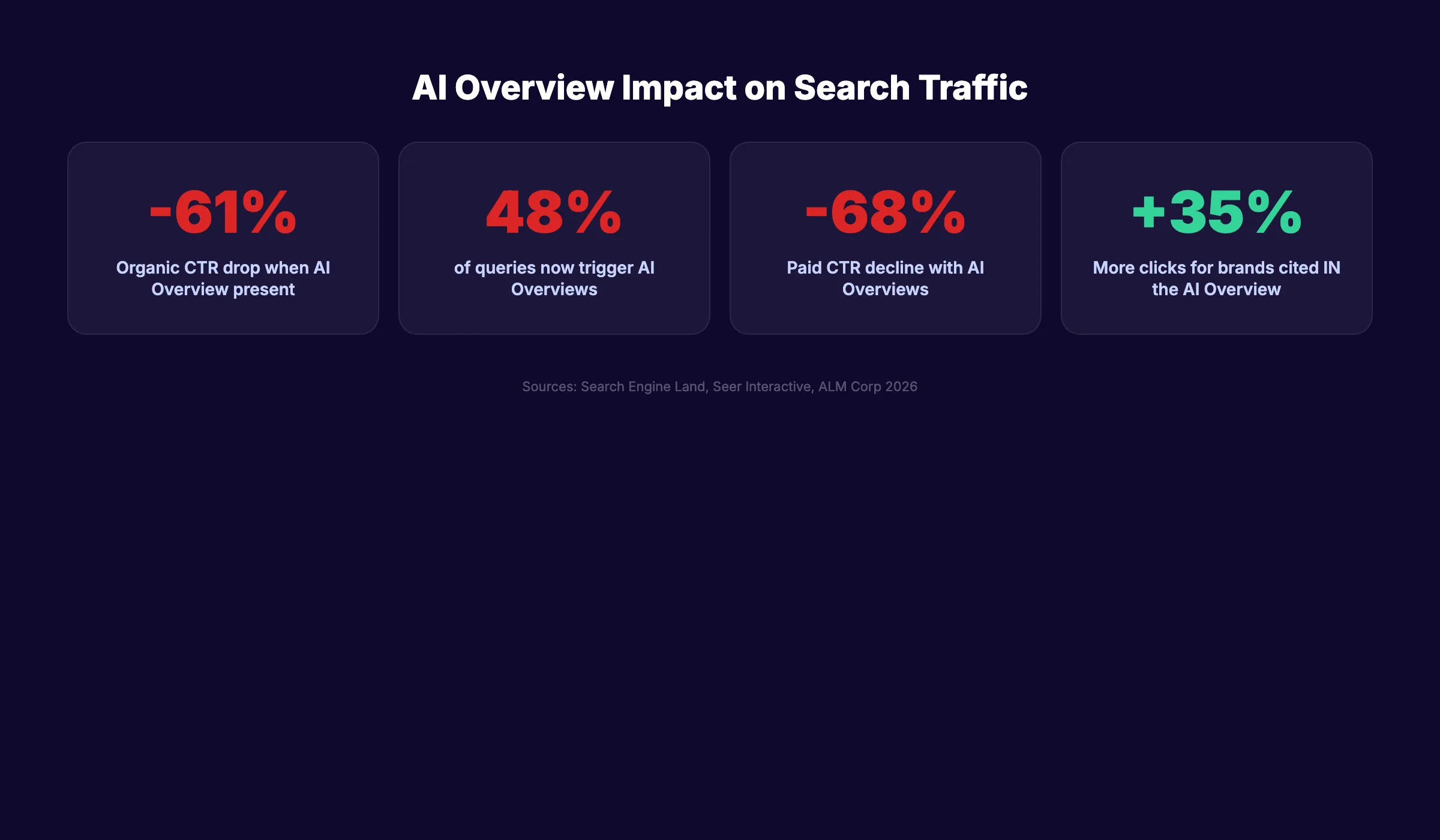
Google AI Overviews now appear on nearly half of all tracked search queries. When they show up, organic click-through rates drop by 61%. That single stat reshapes everything you thought you knew about SEO.
The AI-generated summary box pushes traditional search results below the fold. On desktop, the average AI Overview exceeds 1,200 pixels in height. Most monitors display about 900 pixels. Your position 1 ranking now sits where nobody can see it without scrolling.
Most SEO advice still focuses on ranking higher. But ranking position 1 for a query with an AI Overview is not the same as ranking position 1 used to be. The rules changed. Understanding what Google AI Overviews are, how they work, and how they affect your traffic is the first step to adapting.
We have published 3,500+ blog posts across 70+ industries and studied how AI Overviews select sources, impact traffic, and change content strategy.
Here is what you will learn:
- What Google AI Overviews are and how they generate answers
- How AI Overviews differ from featured snippets and traditional results
- The data on how AI Overviews impact organic traffic and CTR
- Which types of searches trigger AI Overviews
- How Google selects sources for AI Overviews
- What you can do to get cited instead of buried
- How AI Overviews affect your SEO strategy going forward
What Is a Google AI Overview
A Google AI Overview is an AI-generated summary that appears at the top of search results for certain queries. Google's Gemini model reads content from multiple web pages, synthesizes the information, and produces a concise answer directly in the search results page.
The feature launched as Search Generative Experience (SGE) in May 2023 as a Google Labs experiment. Google rebranded it to "AI Overviews" in May 2024 and rolled it out to all US users. As of 2026, AI Overviews are available in over 200 countries and more than 40 languages. Google CEO Sundar Pichai confirmed 2 billion monthly users on the Q2 2025 earnings call.
How AI Overviews Generate Answers
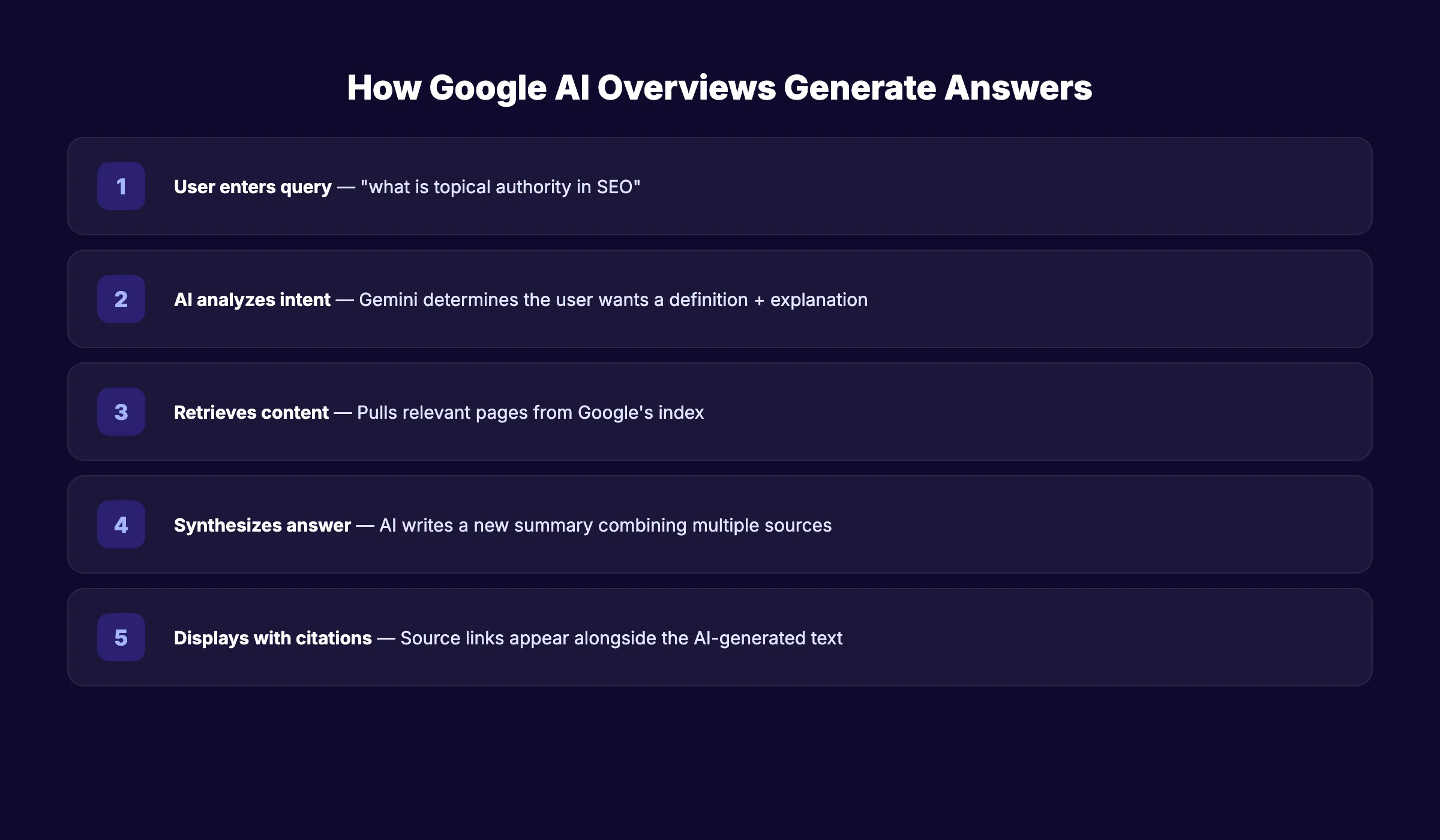
The process works in 5 steps:
- A user enters a search query
- Google's AI model analyzes the search intent behind the question
- The system retrieves relevant content from Google's index
- The AI generates a summarized answer by synthesizing information from multiple sources
- Links to source websites appear alongside the summary
Unlike featured snippets, which pull a single excerpt from one page, AI Overviews create original text by combining information from several sources. The AI does not copy content. It writes a new response based on what it found.
What AI Overviews Look Like
An AI Overview appears as a large box at the very top of search results, above ads and organic listings. The box contains:
- A multi-paragraph AI-generated answer
- Source links embedded within the text or listed on the right side
- An option to expand the answer for more detail
- Follow-up question suggestions the user can click
- A "Show more" button for additional sources
The average AI Overview runs about 169 words. That is 3 to 4 times longer than a typical featured snippet.
Your SEO team. $99 per month. 30 optimized articles published monthly, structured to earn AI Overview citations.
AI Overviews vs Featured Snippets vs Organic Results
These three elements serve different purposes and have different impacts on your traffic.
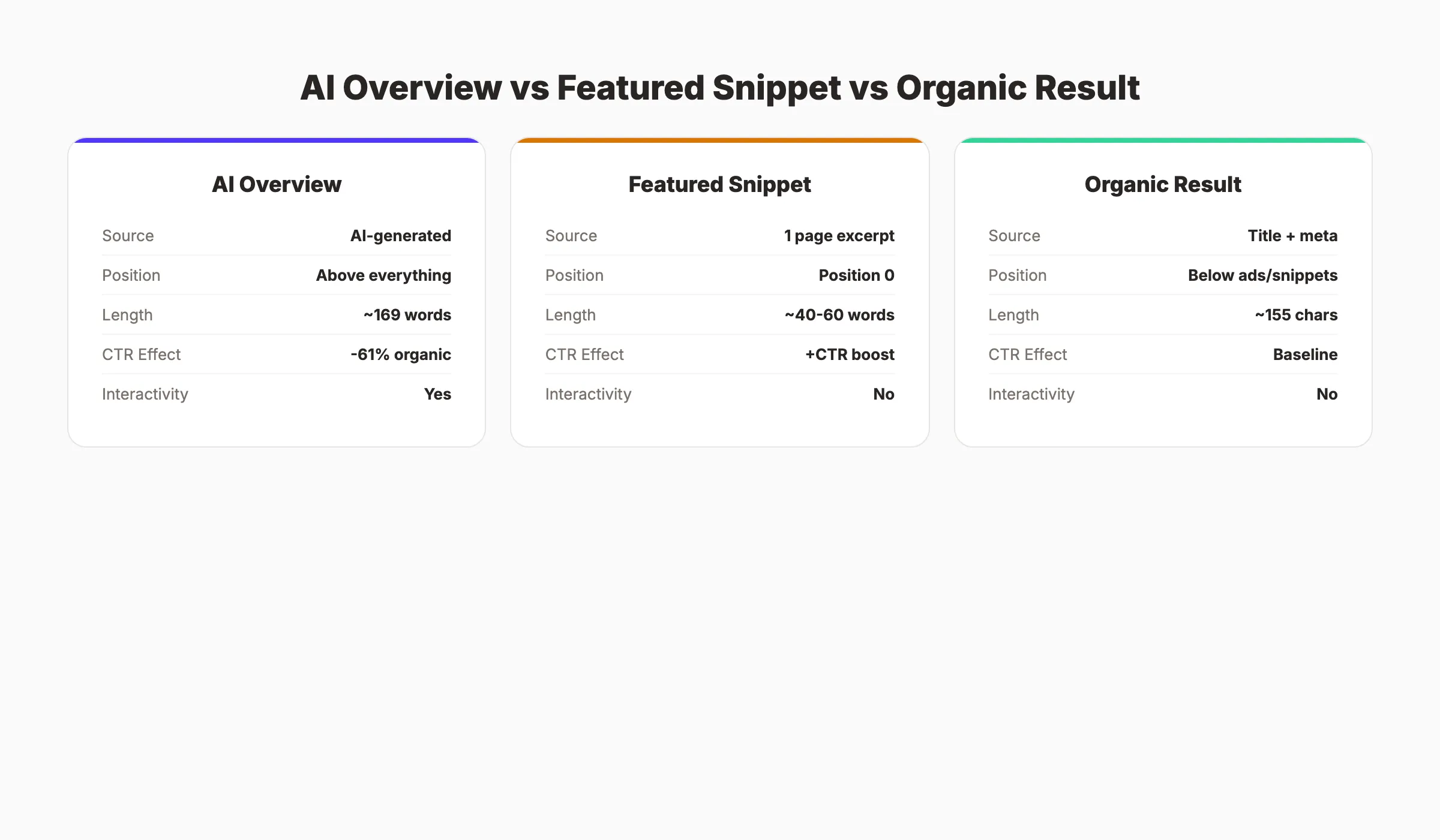
| Feature | AI Overview | Featured Snippet | Organic Result |
|---|---|---|---|
| Content source | AI-generated from multiple pages | Extracted from 1 page | Page title + meta description |
| Position | Above everything (new position 0) | Below ads, above organic | Below ads and snippets |
| Average length | ~169 words | ~40-60 words | ~155 characters |
| Interactivity | Follow-up questions, expandable | Static | Static |
| Attribution | Multiple sources cited | Single source credited | Direct link |
| CTR impact | 61% drop in organic CTR | Moderate CTR boost | Baseline |
| User action | Often zero-click | Sometimes click-through | Click to visit |
The key distinction: featured snippets drive traffic to the cited source. AI Overviews often satisfy the query without a click. Users get their answer and move on.
That does not mean AI Overviews are always bad for traffic. Brands cited in AI Overviews earn 35% more organic clicks than brands that rank organically but are not cited. The citation itself acts as a trust signal that drives clicks.
The Impact of AI Overviews on Organic Traffic
The data is clear. AI Overviews change how traffic flows through Google search results.
The CTR Numbers
| Metric | Without AI Overview | With AI Overview | Change |
|---|---|---|---|
| Organic CTR (position 1) | 15% | 8% | -47% |
| Overall organic CTR | 1.76% | 0.61% | -61% |
| Paid CTR | 19.7% | 6.34% | -68% |
| Zero-click rate | ~40% | ~60-70% | +50-75% |
Sources: Search Engine Land, Seer Interactive, Pew Research Center
How Fast AI Overviews Are Expanding
The growth rate tells the bigger story:
- February 2025: AI Overviews appeared on approximately 31% of tracked queries
- June 2025: Crossed the 40% threshold
- February 2026: Reached 48% of tracked queries
- Overall growth: 58% increase year over year across 9 major industries
AI Overviews are not a small experiment anymore. They are the default experience for nearly half of all Google searches.
Which Industries Are Most Affected
AI Overviews do not appear equally across all search categories. Some industries see far higher trigger rates than others.
| Industry | AI Overview Trigger Rate | Impact Level |
|---|---|---|
| Healthcare / Medical | High (60%+) | Severe |
| Finance / Banking | High (55%+) | Severe |
| Technology / SaaS | High (50%+) | High |
| Education | High (50%+) | High |
| E-commerce (product queries) | Moderate (30-40%) | Moderate |
| Local services | Low (15-25%) | Lower |
| Branded searches | Very low (<10%) | Minimal |
Informational queries trigger AI Overviews most frequently. Transactional and local queries trigger them less often. Branded searches almost never get an AI Overview.
3,500+ blogs published. Every article is SEO-scored before publish. See what theStacc can do for your site.
Which Queries Trigger AI Overviews
Not every Google search produces an AI Overview. Understanding which queries trigger them helps you predict where your traffic is at risk.
Queries That Trigger AI Overviews
Informational "what is" and "how to" queries. Questions like "what is photosynthesis" or "how to tie a bowline knot" almost always trigger an AI Overview. Google can answer these directly from web content.
Comparison queries. "React vs Vue" or "Roth IRA vs traditional IRA" often trigger AI Overviews because the AI can synthesize pros and cons from multiple sources.
Health and medical questions. "Symptoms of strep throat" or "ibuprofen vs acetaminophen" trigger AI Overviews at high rates. Google applies extra caution here with disclaimers and source citations.
Multi-step process queries. "How to set up Google Analytics" or "how to file taxes online" trigger AI Overviews because the AI can create step-by-step summaries.
Queries That Rarely Trigger AI Overviews
Branded searches. "Nike shoes" or "Apple iPhone 16" rarely get AI Overviews. Google sends users directly to the brand.
Local intent queries. "Pizza near me" or "dentist in Austin" show map packs instead of AI Overviews. Local SEO signals dominate here.
Transactional queries. "Buy running shoes online" or "book flight to Paris" show shopping results and ads, not AI summaries.
Current events. Breaking news queries often skip AI Overviews because the AI cannot generate accurate real-time information.
Navigational queries. "Gmail login" or "YouTube" do not get AI Overviews. Google knows the user wants a specific website, not an AI summary.
How to Check If Your Keywords Trigger AI Overviews
Search your target keywords in an incognito browser window and note which ones show AI Overviews. Track this systematically across your top 20 to 50 keywords. You can also use tools like Semrush or Ahrefs that now flag SERP features including AI Overviews in their keyword databases.
Divide your keywords into two groups: queries with AI Overviews (optimize for citation) and queries without AI Overviews (optimize for traditional clicks). This split informs your entire content strategy going forward.
How Google Selects Sources for AI Overviews
Google has published official documentation on AI features explaining how sources are selected. The process favors the same signals that drive traditional organic rankings, with some key differences.
The Selection Criteria
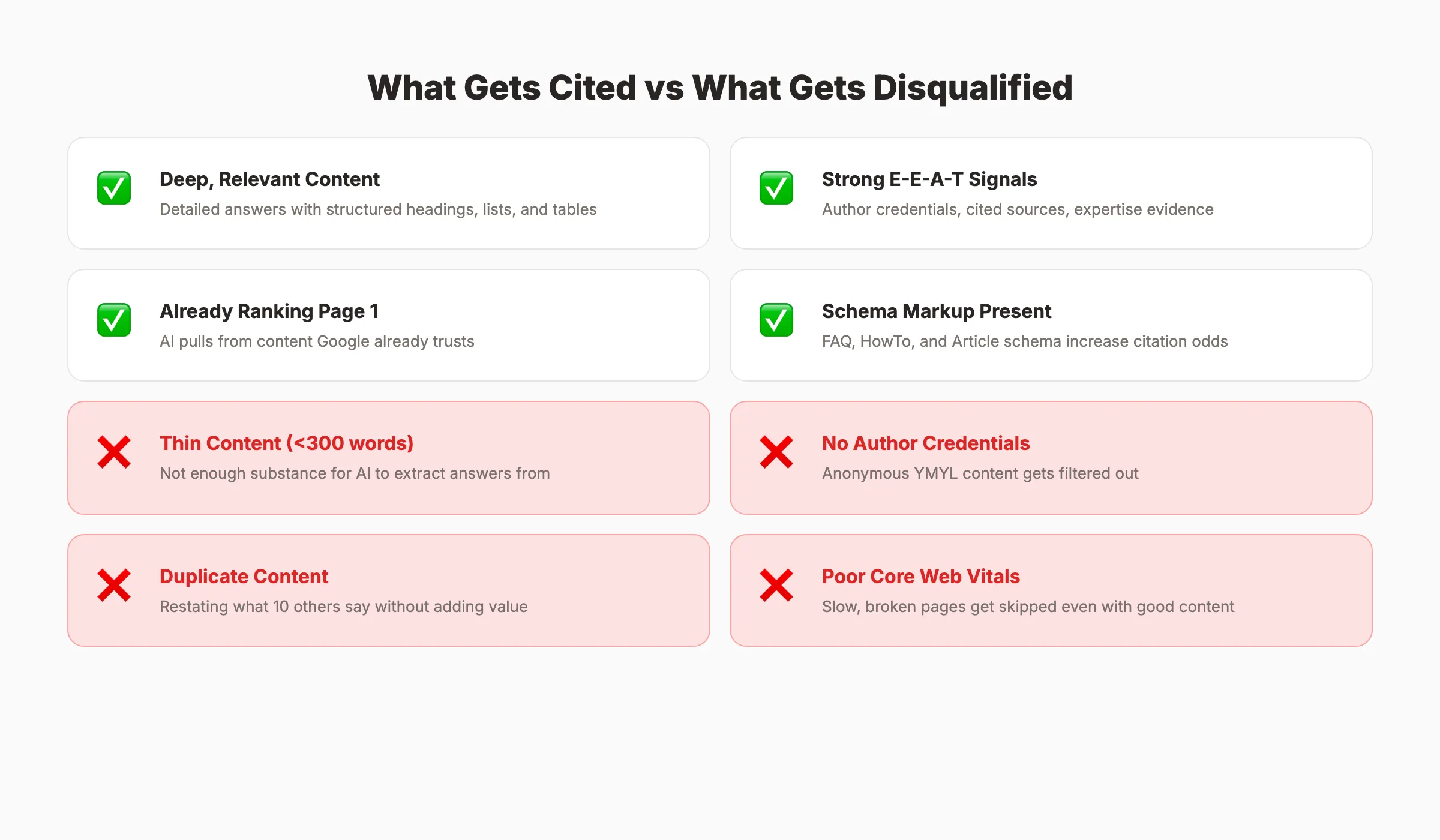
Content relevance and depth. Google's AI pulls from pages that directly answer the query with specific, detailed information. Thin content that barely touches the topic does not get cited. Pages with structured, clear explanations do.
E-E-A-T signals. Experience, Expertise, Authoritativeness, and Trustworthiness matter even more for AI Overview citations than for traditional rankings. Google's quality raters evaluate whether the AI's sources are credible.
Content structure. Well-organized content with clear headings, lists, tables, and concise paragraphs is easier for the AI to parse and cite. Structured blog posts with proper H2/H3 hierarchy get cited more frequently.
Existing ranking position. Pages that already rank on page 1 are more likely to be cited in AI Overviews. The AI primarily pulls from content Google already trusts. Getting cited starts with ranking higher on Google through traditional SEO.
Schema markup. Schema markup helps Google understand the context and type of your content. FAQ schema, HowTo schema, and Article schema all increase the chances of citation.
How Many Sources Get Cited
88% of AI Overviews cite 3 or more sources. Only 1% cite a single source. The typical AI Overview cites 3 to 8 sources. The most-cited source is not always the page ranking position 1. Google's AI selects the sources that best answer specific parts of the query. A page ranking position 4 can get cited if it covers a subtopic the top-ranking pages miss.
What Disqualifies Content From Citation
Not all content is eligible for AI Overview citation. Google applies filters to exclude certain types of content:
YMYL content without credentials. Health, finance, and legal content needs visible author credentials and cited sources. Anonymous health advice does not get cited. Read our guide on healthcare SEO for specific YMYL requirements.
Thin content. Pages with fewer than 300 words rarely get cited. The AI needs enough text to extract meaningful information. Aim for 1,500+ words with structured sections.
Duplicate or near-duplicate content. If your page restates what 10 other pages say without adding new information, the AI has no reason to cite yours over the others. Original data, unique frameworks, or expert analysis differentiate your content.
Pages with poor Core Web Vitals. Google factors page experience into source selection. Slow, broken, or poorly formatted pages are less likely to be cited even if the content is strong.
How AI Overviews Change SEO Strategy
AI Overviews do not make SEO irrelevant. They change which SEO tactics matter most.
What Still Works
Content quality and depth. The AI needs high-quality sources to generate its answers. Pages with original data, expert analysis, and thorough coverage still win. SEO content writing fundamentals remain critical.
Topical authority. Sites that demonstrate deep expertise on a subject are more likely to be cited across multiple AI Overviews within that topic area. Building content clusters still compounds.
Technical SEO. Fast load times, mobile optimization, proper indexing, and schema markup all influence whether your content gets selected as an AI Overview source.
What Changes
Keyword strategy shifts. Target queries where AI Overviews do not appear (transactional, local, branded) for direct traffic. Target queries where AI Overviews do appear for citation-based visibility. Use two separate strategies for each type.
Content formatting matters more. Structure your content so the AI can easily extract specific answers. Use concise definitions, numbered lists, comparison tables, and clear subheadings. Read our guide on optimizing for Google AI Overviews for specific formatting tactics.
Citation tracking becomes essential. Monitor whether your content appears in AI Overviews using AI search visibility tracking. Traditional rank tracking alone no longer tells the full story.
Generative Engine Optimization (GEO) emerges. A new discipline focused specifically on getting cited by AI systems. GEO tactics overlap with traditional SEO but add specific requirements around content structure, source citation, and answer formatting.
Multiple AI platforms matter. Google AI Overviews are not the only AI search system. Perplexity AI, ChatGPT web search, and other AI search engines also pull from web content. Optimizing for AI citation works across all of these platforms. The principles are the same: clear structure, authoritative content, original data.
The Opportunity in AI Overviews
Most content about AI Overviews focuses on the threat. The opportunity is underreported.
Brands cited in AI Overviews earn 35% more organic clicks than brands that rank organically but are not cited. That means getting cited can actually increase your traffic beyond what traditional position 1 delivered. The key is shifting from a ranking-only mindset to a citation-plus-ranking strategy.
AI Overviews also expose your brand to users who would never have scrolled to your organic listing. If your site ranks position 5 but gets cited in the AI Overview, you gain visibility that position 5 never provided before.
Stop writing. Start ranking. theStacc publishes 30 SEO articles per month, structured for both traditional rankings and AI Overview citations.
How to Get Cited in AI Overviews
Getting buried below an AI Overview costs you traffic. Getting cited in one earns you more visibility than a traditional position 1 ranking. Here is how to position your content for citation.
6 Tactics for AI Overview Citation
1. Answer questions directly in the first paragraph. When a user searches "what is topical authority," the page that defines it clearly in the first 2 to 3 sentences has a higher chance of being cited. Front-load your answers.
2. Use structured formatting. Lists, tables, and step-by-step formats are easier for the AI to parse. A comparison table is more citable than 3 paragraphs of prose covering the same information.
3. Cover the full topic with depth. AI Overviews pull from pages that cover a subject thoroughly. Pillar pages with 3,000+ words covering multiple subtopics earn more citations than thin 500-word posts.
4. Add original data and statistics. Pages with unique data points, survey results, or analysis get cited more often because the AI needs specific numbers and facts to include in its summaries.
5. Build topical authority. Sites with deep content clusters on a subject earn citations across multiple related queries. A single page can get cited, but a site with 20+ pages on the topic gets cited repeatedly.
6. Keep content current. AI Overviews favor recent content. Update old blog posts with fresh data, current dates, and new information. Stale content loses citation eligibility over time.
For the complete optimization process, read our step-by-step guide to optimizing for Google AI Overviews.
What practitioners are saying on X
AI search advice ages quickly. Here is high-signal public discussion from SEO and growth operators — context for your roadmap, not a substitute for primary data.
- @jakezward (Feb 2026): 2026 SEO predictions emphasize AI Overview share-of-SERP, schema for LLM token efficiency, brand mentions in AI answers as a KPI, proprietary data as a moat, and content refresh beating net-new AI slop. See the post on X.
- @alexgroberman (Jul 2026): Case narrative: organic value plus multi-engine citations (ChatGPT, Perplexity, Grok) from knowledge-hub pages, category authority links, commercial intent content, and tight internal linking — not thin product copy. See the post on X.
- @varunram (Jul 2026): Critique of GEO slopfarm products that combine SEO clickbait with unresearched content marketing — quality and research still separate winners from farms. See the post on X.
Grok, AI Overviews, and multi-engine visibility
A Google AI Overview is an AI-generated summary at the top of many Search results, with citations. It is not the same as ChatGPT or Grok chat, but the content patterns that win — clarity, trust, structure — transfer across engines.
- Definition: Keep a simple ‘what it is / what it is not’ block above the fold.
- Impact: Explain CTR and zero-click effects without panic framing.
- Grok: Mention Grok only as a separate AI answer surface users may also use.
Publish content built for Google and AI citations. theStacc’s Content SEO module ships SEO-scored articles structured for rankings and generative engines — including clearer entity pages models like Grok can quote.
How to measure multi-engine visibility in 2026
Split KPIs: classic GSC, AI Overview citations, chat referrals, and brand accuracy in Grok-style answers.
- GSC: non-brand clicks with annotation for AIO-heavy queries.
- Citations: are you named inside the AI summary?
- Referrals: ChatGPT/Perplexity sessions in GA4.
- Grok: on-site facts match public X discussion.
FAQ
A Google AI Overview is an AI-generated summary that appears at the top of Google search results. Google's Gemini AI reads multiple web pages, combines the information, and writes a concise answer directly in the search results. Source links appear alongside the summary so users can visit the original pages.
Yes, for queries where they appear. Organic click-through rates drop by 61% when an AI Overview is present. However, brands cited within the AI Overview earn 35% more clicks than brands that only appear in traditional organic results. The strategy shifts from ranking to getting cited.
AI Overviews evolved from SGE (Search Generative Experience). Google launched SGE as a Labs experiment in May 2023, rebranded it to "AI Overviews" in May 2024, and rolled it out to all US users. The feature is now available in 200+ countries.
Structure your content with clear definitions, lists, and tables. Answer questions directly in opening paragraphs. Build topical authority with deep content clusters. Add original data and statistics. Keep content updated. Read our full guide on optimizing for AI Overviews for the complete process.
No. AI Overviews appear on roughly 48% of tracked queries as of early 2026. They trigger most often for informational queries (what is, how to, comparison). They rarely appear for branded searches, local queries, transactional queries, or breaking news.
No. AI Overviews pull from pages that rank well using traditional SEO signals. Content quality, topical authority, E-E-A-T, and technical SEO still determine which pages get cited. The fundamentals matter more than ever. What changes is the format: structure content for citation, not just for clicks.
AI Overviews are not going away. Google has committed to expanding them globally and increasing the types of queries they cover. The shift from click-based traffic to citation-based visibility is permanent.
The sites that adapt will earn more visibility than they had before AI Overviews existed. The ones that ignore the shift will watch their organic traffic erode one query at a time. Start by auditing your top keywords for AI Overview exposure. Build content that earns citations. The transition from ranking-first to citation-first SEO is the defining shift of this era.
Related Tools & Resources
Free SEO Tools:
Best Lists:
Sources & references
- [1] Princeton / Georgia Tech et al. — GEO research (arXiv:2311.09735)
- [2] @neilpatel on X — Early AI Overviews guidance: informational queries hit hardest; monitor citations and accuracy; GEO process + technical
- [3] @jakezward on X — 2026 SEO predictions emphasize AI Overview share-of-SERP, schema for LLM token efficiency, brand mentions in AI answers
- [4] Referenced source — searchengineland.com

Plan topics, review article drafts, and publish to a connected CMS.
Weekly local SEO teardowns
One practical email a week. Map Pack, GBP, AI Overviews — no fluff. Unsubscribe anytime.